1906: The would-be assassins of General Rafael Reyes

BOGOTA, Colombia, Tuesday, March 6. — The three men who on Feb. 10 attempted to assassinate Gen. Reyes, the President of the Republic of Colombia, were shot to-day at the spot where the attack took place.

-New York Times, March 8

Reyes had parlayed a successful military career into politics (Spanish link), and was the elected-ish but also dictatorial president of Colombia.

He had the misfortune to ascend to this illustrious post on the heels of a bitter civil war that had seen its Panama department break clean away. To Reyes’ administration would fall a variety of civil society infrastructure projects (more Spanish): constitutional reform, military modernization, a central bank, reconciliation with the Liberal party.

Marco Salgar (left) and Roberto Gonzalez, two of the failed assassins.

He couldn’t make these omelets without breaking a few eggs and his authoritarian power was challenged with at least two coup attempts and multiple assassination plots, as well as a bid by other Colombian territories to break away and join up with Panama.

But the most notorious angry-with-Reyes event was the 10th of February 1906 — also the title (Spanish again) of a book of photographs documenting the incident — when three gunmen ambushed Reyes on the outskirts of Bogota and somehow all managed to miss both the president and his daughter.

Reyes’ vengeance was extrajudicially old-school: the executions he arranged were not permitted under Colombian law at all, and by having them publicly shot at the scene of the crime, he added a downright medieval twist of lese-majeste.

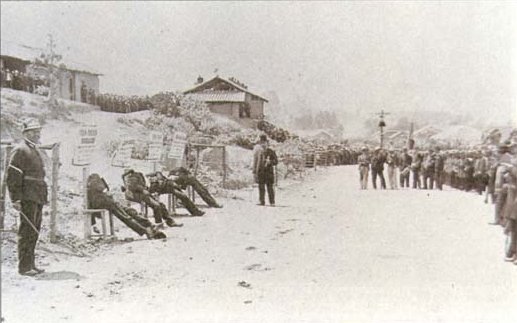
Images from here. These are the three shooters mentioned by the Times, as well as a fourth accomplice.

However rough his methods, Reyes did accomplish some important reforms for his country, and he did have the grace to resign his position in 1909 under fire for financial and diplomatic mismangement. (The man’s five-year administration has its own periodization in Colombian historiography: the quinquenio.) There have been worse entries in the annals of dictatorship.

On this day..

1476: The Garrison of Grandson, by Charles the Bold

On this day in 1476, the 412-strong garrison of Grandson, Switzerland surrendered to Charles the Bold during the Burgundian Wars … and was executed en masse by hanging and drowning.

Detail view (click for the full image) of a mounted Charles the Bold under a forest of hanged men.

Charles — less generously known as “Charles the Rash” or “Charles the Terrible” — was the Duke of Burgundy, an ancient territory whose warlike inhabitants were celebrated back to The Nibelungenlied

Upon his single person the sword-strokes fell thick and fast. The wife of many a hero must later mourn for this. Higher he raised his shield, the thong he lowered; the rings of many an armor he made to drip with blood … Then men saw the warrior walk forth in full lordly wise. As the strife-weary man sprang from the house, how many added swords rang on his helmet! Those that had not seen what wonders his hand had wrought sprang towards the hero of the Burgundian land. (XXXII)

In the 15th century, the swords ringing on Burgundian helmets were those of the French and the Habsburgs, who squeezed the mighty duchy on either side.

Charles the Bold fought the expansionist Burgundian Wars as a project to strengthen his duchy’s independence. But it would have the exact opposite effect.

The Swiss had been pulled into the anti-Burgundian league, and taken the city of Grandson, inducing an irritated Charles to put it to a fearful bombardment that threatened to overrun the place in short order.

Sources vary by partisan affiliation as to whether the besieged garrison surrendered at its antagonist’s discretion (Burgundian version) or on a pledge of mercy (Swiss version). But in the actual event, no mercy at all was given. To a man, the prisoners were strung up on trees and drowned in the adjacent Lake of Neuchatel — a warning to the Swiss not to mess with Burgundy.

It was bluster that Charles’s men could not back up when their opponents fought back … and after this, who was going to surrender?

A couple days later, the Swiss relief force arrived too late to bail out the garrison. Instead, it trounced the Burgundians in battle, sending them fleeing “without looking back, helter-skelter” as Charles, “exasperated beyond measure by the stupid cowardice of his troops, rode amongst them with drawn sword, striking them furiously, in the vain effort to bring them to a standstill.”

The victorious Swiss made off with a fantastic booty from the abandoned Burgundian camp, but also recovered a more dolorous prize.

There were found sadly the honorable men still freshly hanging on the trees in front of the castle whom the tyrant had hanged. It was a wretched, pitiable sight. There were hung ten or twenty men on one bough. The trees were bent down and were completely full. There hanged a father and a son next to each other, there two brothers or other friends. And there came the honorable men who knew them; who were their friends, cousins and brothers, who found them miserably hanging. There was first anger and distress in crying and bewailing.

Charles was plenty distressed himself at his embarrassing reversal, and boldly (or rashly) regrouped, marched on the Swiss again — and had Burgundian power decisively shattered at the Battle of Murten that June. The following January, a dispirited Charles died in another losing battle, leading most of the once-imperious realm of Burgundy to settle into French hands, where it remains today.

On this day..

1897: Henri-Osime Basset

On this date in 1897, all Versailles turned out to witness the beheading of recidivist pedophile Henri-Osime Basset, a 23-year-old who had kidnapped and strangled to death (French link) 13-year-old Louise Millier the previous summer.

Executioner Anatole Deibler and crew arrived at 3:30 a.m. to erect the portable guillotine at the pont Colbert* for the occasion, under the eyes of a curious pre-dawn crowd restrained by dragoons; by 4:45 la sinistre machine was fully installed.

About an hour after that, the prisoner Basset was awoken from his fitful sleep — he’d been plagued by restless guillotine-themed dreams lately, for some reason — and advised that his application for presidential clemency had been denied.

Le Petit Parisien nevertheless found the prisoner in steady enough spirits for his expiatory moment. He took the bad news with equanimity, received communion, and stuck close by the comforting priest to whom he had already given his last confession. (And who helpfully steeled the doomed man’s nerves with a steady supply of rum, cigars, and Bourdeaux wine.)

In any event, the practiced French executioners did not give Basset long to stew on his fate. After the toilette to prepare him for the blade, he was out the door shortly after 6 a.m. — broad daylight by now, and the crowd swollen in anticipation of the show. The blade fell at 6:33, and the remains of the late Henri-Osime Basset were immediately deposited at the Cimetirie des Gonards.

* This is pont Colbert in Versailles, not the cool then-new steel bridge in Dieppe, which is now the last hydraulic turn bridge still in use in Europe.

On this day..

1684: Three Covenanters

Just three indistinguishable Covenanters among very many in the Killing Time.

From the journal of John Erskine of Cardross:

22 February 1684. — After dinner I went to the Laigh Council house, where the three condemned men were brought before Baillie Chancellour, who inquired if they had any more to say for themselves, and if they would bid God save the King? They said, they were not now come to answer, neither would they answer questions, and the refused not to obey all the King’s lawful commands. They refused to hear one of the town curates pray; but he beginning, not desired, George Martin offered to interrupt him the time of his prayer, by saying, ‘Let us be gone, what have we to do here?’ but he ended his prayer without stopping. They were hanged in the Grassmarket, but I went not to the place of execution.

On this day..

1677: Five witches at the Gallowgreen of Paisley

On this date in 1677, Janet Mathie, Bessie Weir, Margaret Jackson, John Stewart, and Marjory Craig were hanged for having bewitched a Sir George Maxwell of Pollok.

These unfortunates were “sacrificed on the altar of popular superstition”, in the words of a later broadside — one element of that superstition being the belief in the superordinary insight of the deaf-dumb.

God hath taken away the tongue and ear of the dumb, and hath given them a rich gift of knowledge in the room of it; and by this would teach all of us his goodness to his creatures, and that we should study humility and sobriety of mind.

This is a culture working with some embarrassingly primitive forensics to begin with.

So, when the Pollok lord started ailing, the indications by “a young deaf and dumb girl, of unknown origin,” to the effect that a local family was doing him mischief by stabbing a wax effigy, well, that was enough to open a case. When they found a wax effigy right where the girl pointed, “The prosecution wanted no stronger proof.”

So they got the 14-year-old daughter (she was spared execution this date) to confess, and tortured her brother into agreeing that the devil appeared as a cloven-hooved Negro, and our unnamed detective-girl miraculously found not one, not two, but three different effigies all attributed to the diabolical voodoo parties to cinch the condemnation.

It’s rather embarrassing what tripe did then and can still now pass for persuasive indicia of guilt among parties already committed to convicting someone. Like show trial victims, even the condemned were swept into the act of auto-denunciation — one final tenuous strand to link an outcast to her community, even from the stake. At least, some of them were.

John and Annabel exhorted their mother to confess, reminding her of all the meetings which she had had with the devil in her own house, and that “a summer’s day would not be sufficient to relate what passages had been between the devil and her.” But Jennet Mathie was a stern, brave, high-hearted Scotch woman, and would not seal her sorrow with a lie. “Nothing could prevail with her obdured and hardened heart,” so she and all, save young Annabel, were burnt; and when she was bound to the stake, the spectators saw after a while a black, pitchy ball foam out of her mouth, which, after the fire was kindled, grew to the size of a walnut, and flew out into sparks like squibs. This was the devil leaving her. As for Bessie Weir … the devil left her when she was executed, in the form of a raven; for so he owned and dishonoured his chosen ones.

“The dumbe girl, Jennet Douglas, now speaks well, and knows Latine, which she never learned, and discovers things past!” says Sinclair. But she still followed her old trade. She had mesmeric visions, and was evidently a “sensitive;” and some of the people believed in her, as inspired and divine, and some came, perhaps mockingly, to test her. (From E.L. Linton)

Sometimes, at least, these malevolent professional accusers get their comeuppance.

The dumb girl herself was afterwards carried before the great council at Edinburgh, imprisoned, scourged through the town, and then banished to “some forraigne Plantation,” whence she reappears no more to vex her generation. God forgive her! She has passed long years ago to her account, and may her guilty soul be saved, and all its burning blood-stains cleansed and assoilzed!

On this day..

1836: Giuseppe Fieschi, Pierre Morey, and Theodore Pepin, infernal machinists

On this date in 1836, three men were guillotined for a spectacular but unsuccessful regicide attempt.

Giuseppe Fieschi

This was in the days of the July Monarchy, a much-despised government of the country’s wealthiest elites that generated opposition both right and left and a ceaseless string of assassination attempts (French link) against King Louis-Philippe.* As Marx put it,

when the liberal banker Laffitte led his compère, the Duke of Orléans, in triumph to the Hôtel de Ville, he let fall the words: “From now on the bankers will rule”. Laffitte had betrayed the secret of the revolution.

It was not the French bourgeoisie that ruled under Louis Philippe, but one faction of it … the so-called financial aristocracy. It sat on the throne, it dictated laws in the Chambers, it distributed public offices, from cabinet portfolios to tobacco bureau posts.

Hard to imagine such a state of affairs.

Fieschi (English Wikipedia page | French) et al conceived a bold attempt to destroy the entire ruling family in a single fusillade, and to that end constructed a machine infernale of 25 gun barrels mounted together to fire on a single fuse.

Unleashed upon a royal procession along the Boulevard du Temple on the fifth anniversary of the monarchy’s founding July days, this monster proved quite impressively destructive.


The assassination attempt of Fieschi, 28 July 1835 by Eugene Lami.

The infernale barrage took out an esteemed marshal and a bunch of bystanders, but somehow managed to miss everyone in the royal family. (Louis-Philippe himself was grazed … and his horse was hit.)

Exploiting the familiar power of a terrorist incident to enact horrible new policies not available in normal times, “Parliament was hastily recalled and in a near-panic atmosphere passed severe measures against the newspaper press,” notes William Fortescue. “Approximately thirty more republican newspapers were closed down by the September 1835 Press Laws.”

Police soon traced the conspiracy to Fieschi, a truly Gallic character of mixed-up national pride, personal honor, class envy, and opportunistic lechery, who had fought for Bonaparte and helped Joachim Murat on the latter’s fatal attempt to re-take “his” kingdom of Naples back in his youth. But lately, a more worn-out and middle-aged Fieschi had been booted out by his mistress and lost all his money.

Fieschi, according to Barricades: The War of the Streets in Revolutionary Paris, 1830-1848, basically became a dependent of Morey and Pepin, true-blue republicans who helped channel Fieschi’s unmoored passions into engineering his hydra-headed musket. He’d be back on the French-nationalism side by the end.

“I’m going to appear before God,” Fieschi said on the scaffold, after Morey and Pepin had preceded him. “I have spoken the truth. I die content. I have rendered a service to my country in signaling my accomplices … I regret my victims more than my life.”

More repressive laws and radical-hunting followed. They did not slake the thirst abroad in France for regicide.

* Louis-Philippe’s royal dad backed the French Revolution, but was still executed by Robespierre.

On this day..

1555: John Hooper

On this date in 1555, English Calvinist John Hooper fell victim to Mary Tudor’s abortive bid for Catholic restoration.

A onetime monk on the receiving end of the Dissolution of the Monasteries, Hooper got the evangelical bug by reading Zwingli and became more un-Catholic than the anti-pope.

That meant that in quasi-Catholic Anglican England, he had to hot-foot it over to the continent a couple of times to keep out of trouble.

Even when more aggressive reformers took the lead after Henry VIII died, Hooper proved a gadfly; he’s noted for setting off the decades-long “vestments controversy” with his denunciation of the “Aaronic” ceremonial garb donned by priests.

(Hooper himself had to work out a compromise just to be ordained in garb sufficiently modest to satisfy his conscience.)

He survived the fall of his patron Edward Seymour, but the death of Edward VI and the ensuing succession of the Catholic Queen Mary Tudor was Hooper’s demise. Historians may debate whether “Bloody Mary” really deserves her unkind nickname, but had she left a proto-Puritan loose cannon like Hooper unmolested, she would have indeed been a little lamb.

Hooper — naturally — took solace from the Word, “as St. Paul that loved the policy, laws, order, and wisdom of the Romans, yet disliked very much the vice and naughtiness of Nero, unto whom he submitted, and willingly brought into servitude both his body and goods, and rebelled not, though Nero was a naughty emperor, for his office sake, which was the ordinance of God.”

A large collection of Hooper’s writings (including the foregoing) is available at this Google books freebie.

On this day..

1942: Icchok Malmed

(Thanks to Meaghan Good of the Charley Project for the guest post. -ed.)

On this day in 1942, Icchok Malmed* was hanged on Kupiecka Street in the Bialystok Ghetto for throwing acid in a Nazi’s face and blinding him.

Zchor tells the story:

When the Nazis attacked the house at 29 Kupiecka Street, rounding up all of its residents into the street, a bold young man, Izchok Malmed, whipped out a jar of acid from his pocket, hurling it in the face of a Nazi soldier, who was blinded at once. Seeking revenge, the sightless Nazi fired his revolver several times, hitting another Nazi soldier and instantly killing him. In the melee, Malmed vanished.

Commandant Friedl, after learning what had happened, ordered that one hundred men, women and children living in the area where the incident occurred be rounded up and force-marched to a nearby garden, where they were lined up against the wall of an adjacent bet hamidrash and shot with machine guns.

Afterward Nazi soldiers captured another group of Jews, forcing them to dig a large pit for the bodies of the one hundred martyrs. A thin layer of earth covered them. Some were still alive, their hands groping upward through the earth.

The Nazi soldier accidentally shot by his colleague whom Malmed had blinded was carried to the Judenrat building, and his body was placed on [Judenrat Chairman Efraim] Barasz’s desk. Friedl then proclaimed to Barasz, “See what your Jewish criminals have done. Now we shall take revenge. You shall see what we can do.” Friedl issued an ultimatum for the perpetrator of the crime to surrender within twenty-four hours. Failing that, the entire ghetto would be destroyed with everyone in it.

Barasz knew the Nazis meant what they said. He sent word to Malmed to give himself up and thereby save thousands of Jewish lives. As soon as Malmed heard, he surrendered himself to the Nazis.

Tamarof’s diary described in detail Malmed’s courage. Asked why he killed the Nazi soldier, he replied: “I hate you. I regret I only killed one. Before my eyes my parents were murdered. Ten thousand Jews in Slonim were liquidated before me. I have no regrets.” Tamarof tried to slip poison to Malmed but failed. Even the police could not get near the prisoner.

The next morning, Izchok Malmed, a hero of the ghetto, was hanged in the square where he had performed his act of courage. Despite the horrible torture to which he had been subjected, Malmed cursed the Nazi murderers. After several minutes of hanging on the gallows, the rope broke and the body fell to the earth. Instantaneously, the Nazis riddled Malmed’s corpse with bullets and re-hanged the body for another forty-eight hours.

Kupiecka Street was renamed Malmed Street after the war. Near the site of Malmed’s execution is a plaque reading, in Polish and in Hebrew, “Icchok Malmed, the hero and fighter of the Bialystok Ghetto, was killed here by the Nazi murderers on 8 February 1943. In his honor.”

* The Zchor account spells his name “Izchok” but on the memorial plaque it says “Icchok”. It’s a form of the name Isaac.

On this day..

1579: Thomas Sherwood, Catholic martyr

On this date in 1579, young Catholic layman Thomas Sherwood was hanged at Tyburn, cut down while still alive, disemboweled, and quartered.

This casualty of the Elizabethan era’s dangerous struggle for the soul of Britain had popped across to the continent to begin his studies under the church’s auspices.

He had not yet completed them when, on a return trip, a Protestant recognized him and got him locked up in the Tower, where Sherwood was tortured for information about the whereabouts of the underground Catholic Mass — but “he was brave beyond his years, no racking, no cross-examination could make him name any one.”

Sherwood had the distinction during his confinement of being one of the last earthly creatures to receive the (attempted) aid of octogenarian fellow-Catholic William Roper, Sir Thomas More‘s son-in-law and first biographer. (Roper’s attempts to send money to the imprisoned Sherwood were intercepted, however.)

Sherwood’s brother recalled of the martyr,

He was of small learning, scarcely understanding the Latin tongue, but had much read books of controversies and devotion, and had used much to converse among Catholic priests, and by reason thereof, having a good wit and judgment, and withal being very devout and religious, he was able to give good counsel, as he did to many of the more ignorant sort, being much esteemed for his virtuous life and humble and modest behaviour: besides God did give a special grace in his [conversation] , whereby together with his good example of life, he much moved and edified others. He was a man of little stature of body, yet of a healthful and good constitution, and very temperate in his diet.

After his first racking in the Tower (which was said to be rigorous), being visited by a Catholic gentlewoman, he showed himself of that joyful and comfortable spirit as she was astonished thereat. As also his keeper with compassion giving him warning that he was to be racked again, he was so little moved therewith, as merrily and with a cheerful countenance he said these words: ‘ I am very little, and you are very tall; you may hide me in your great hose and so they shall not find me; ‘ which the keeper did afterwards report to divers, much marvelling at his great fortitude and courage. He was about the age of twenty-seven years when he was martyred.

On this day..

1860: John Guthrie, antislavery horse thief

On this date in 1860 in “Bleeding Kansas” — the frontier zone of dirty war by and against the Slave Power where John Brown got his start — a man named John Guthrie was hanged under scant-to-no color of law.

The site of this execution is still known as Guthrie’s Mountain or Mound … and it’s even alleged that the spot is still ill-omened by the event, and that the dying Guthrie “assailed his executioners for lynching an innocent man,” prophesying that “each of them would meet a horrible death” which curse the imminent U.S. Civil War carried into effect.

For a fuller account, see this pdf of a 1982 Kansas History article, “Guthrie Mound and the Hanging of John Guthrie”.


I know a story I think worth preserving of a Bourbon county execution without benefit of clergy, but it was not a lynching. I have had the story from a lot of people, including two eyewitnesses — not participants, of course. Away back in the later territorial days, when Bourbon county was in the ‘region beyant the law,’ a young man named Guthrie was caught up near Mapleton riding somebody else’s horse. Everybody knows that at that time in those parts, horse stealing and nigger chasing and homicide were offenses in a class by themselves. The hardheaded and hard-fisted farmers thereabouts gathered in a hurry. But there were no courts that they respected or had reason to respect. What to do?

Just across the river south of Mapleton in the Little Osage bottom is a little round hill about three hundred feet high shaped almost exactly like an overturned soup bowl. They adjourned to the top of that hill. There they elected a judge and a sheriff and a prosecuting attorney. They selected a jury and tried their man, who admitted his guilt. After the verdict and the proper sentence, the sheriff had no place to keep the man, so he executed the sentence at once by hanging him to the limb of a jack oak tree nearby. His body was buried where it was cut dawn. It is there yet.

From what I have been told I am quite satisfied that that trial was quite as regular and formal as many cases in the regular courts of that day, though not sanctioned by the law.

By the way, that hill is the same ‘pretty little hill’ where Lieut. Zebulon M. Pike ate the fried venison steak that September morning in 1806, as he notes in his journal. It is still called Guthrie mountain, and is one of the real beauty spots of old Bourbon.

–C.E. Cory, 1932

The horse-thief story has different versions, in which Guthrie is either innocent of the charge or not. For what it may be worth, the 1860 New York Times also reported a “very imperfect” version of this take.


However, there’s at least one primary document suggesting that “thieving” may have been a pretext for killing the man over his anti-slavery stance.

Mapleton, K. T., Feb. 12, 1860. “MY DEAR PARENTS: … Last Sunday night about 1 o’clock a man named John R. Guthrie was hanged about a mile and a half from here on the top. of what is known as Tigret Mound. He was left suspended until Monday eve. His corpse was in plain sight from here as he hung. The proslavery’s hung him for an alleged crime of horse stealing. They arrested him without authority or shadow of law and never gave him even a mock trial, as has generally been the case. The country is again in commotion. I know not what will be the result, the probability is that unless Montgomery takes the field again it will soon blow over and give them a chance to hang the next ones that gets in their way.

–Free Stater (i.e., anti-slavery) Alpheus H. Taylor

On this day..