1783: John Grinslade and John Cunningham

From Felix Farley’s Bristol Journal (Bristol, England), Saturday, August 30, 1783:

Monday was executed at Hall-Down, near Exeter, John Grinslade, aged 22, for the murder of the Rev. Mr. Gilbert Yarde; and John Cunningham, aged only 17, for the murder of John Pratt. The former expressed sorrow for his offences, and declared he died in charity with all men: The latter, from whose youth and ignorance no great degree of sensibility could be expected, appeared rather stupified than grieved at his fate. Cunningham professed himself a Papist.

On this day..

Feast Day of Saint Bartholomew

August 24 is the feast day* of Saint Bartholomew the Apostle, an original companion of Christ who is silent as the grave when it comes to the Gospels** but holds a distinguished place in artistic history as Christianity’s best-known flayed martyr.

(And of course, a distinguished place in sectarian bloodshed history thanks to the St. Bartholomew’s Day Massacre during the French Wars of Religion.)


A fierce Bartholomew brandishing his flayed skin in Michelangelo’s Last Judgment.


Marco d’Agrate shows off his anatomical expertise in this sculpture at the Milan Cathedral, which he arrogantly signed “I was not made by Praxiteles but by Marco d’Agrate.” (cc) image by Latente Flickr.


This flinchingly realistic depiction of the skin being cut off the muscle comes from Caravaggio disciple Valentin de Boulogne. (cc) image by livioandronico2013.


This late 16th century fresco by (speculatively) Niccolo Circignani in Rome’s Basilica of Santi Nereo e Achilleo perhaps alludes to the Ottomans’ 1571 flaying execution of a Venetian commander.

* Per the Catholic tradition. For Orthodox Christians, the feast is observed on June 11; in the Coptic church, it occurs on the first day of Thout which currently corresponds to September 11 or 12.

** Bartholomew’s name does go on several apocryphal texts.

On this day..

1497: Lorenzo Tornabuoni, Florentine nobleman

On this date in 1497, five Florentines were beheaded for a seditious conspiracy, headlined by the scion of one of the city’s leading families.

Our scene is the Italian city-state of Florence, during the 20-year intrregnum with the Medici family out of power. Lorenzo the Magnificent had died in 1492; his much less magnificent son and successor Piero the Unfortunate was expelled in 1494. For the time being the Dominican cleric Savonarola holds sway; after his fall a few months hence, it would briefly be Machiavelli’s humanist republic.

For these years the Medici schemed from exile, and Florentines guarded warily against their prospective restoration … the circumstance that will bring five heads to the block here. Earlier that same month of August 1497, the Florentine apothecary Luca Landucci noted the arrest of a man who “when flogged … confessed to a certain plot with Piero de’ Medici, and accused many, who were sent for and detained n the Palagio and the Bargello, and put to the rack. Amongst these were Lorenzo Tornabuoni, Gianozzo Pucci, Bernardo Del Nero, Niccolo Ridolfi, and others who fled.”

Landucci’s diary records the speedy progress of this investigation.

6th August. Signore Rinuccio and other leaders were sent for, and soldiers were hired in the Piazza.

10th August. There was much talk in the city as to what would be done with them (these prisoners); some said they were not guilty, and some said they were.

13th August. It was said that the Tornabuoni had despatched an estafette to the King of France, to beg that he should request the liberation of Lorenzo.

This Tornabuoni family were powerful bankers and their name is preserved to this day on one of Florence’s major city streets. The elderly patriarch Giovanni Tornabuoni was Piero de’ Medici’s great-uncle and had long been tight with that family — and it’s due to their prominence as well as the unexpected extremity of political execution that we’re drawn to gawk in particular here at Giovanni’s son Lorenzo.

As a matter of fact, art lovers can still gawk at him thanks to his doting wealthy dad.

Look for Lorenzo mugging for the viewer as he beholds the expulsion of Joachim in a Domenico Ghirlandaio fresco at the Tornabuoni Chapel at the church of Santa Maria Novella.


Detail view; click for the full image

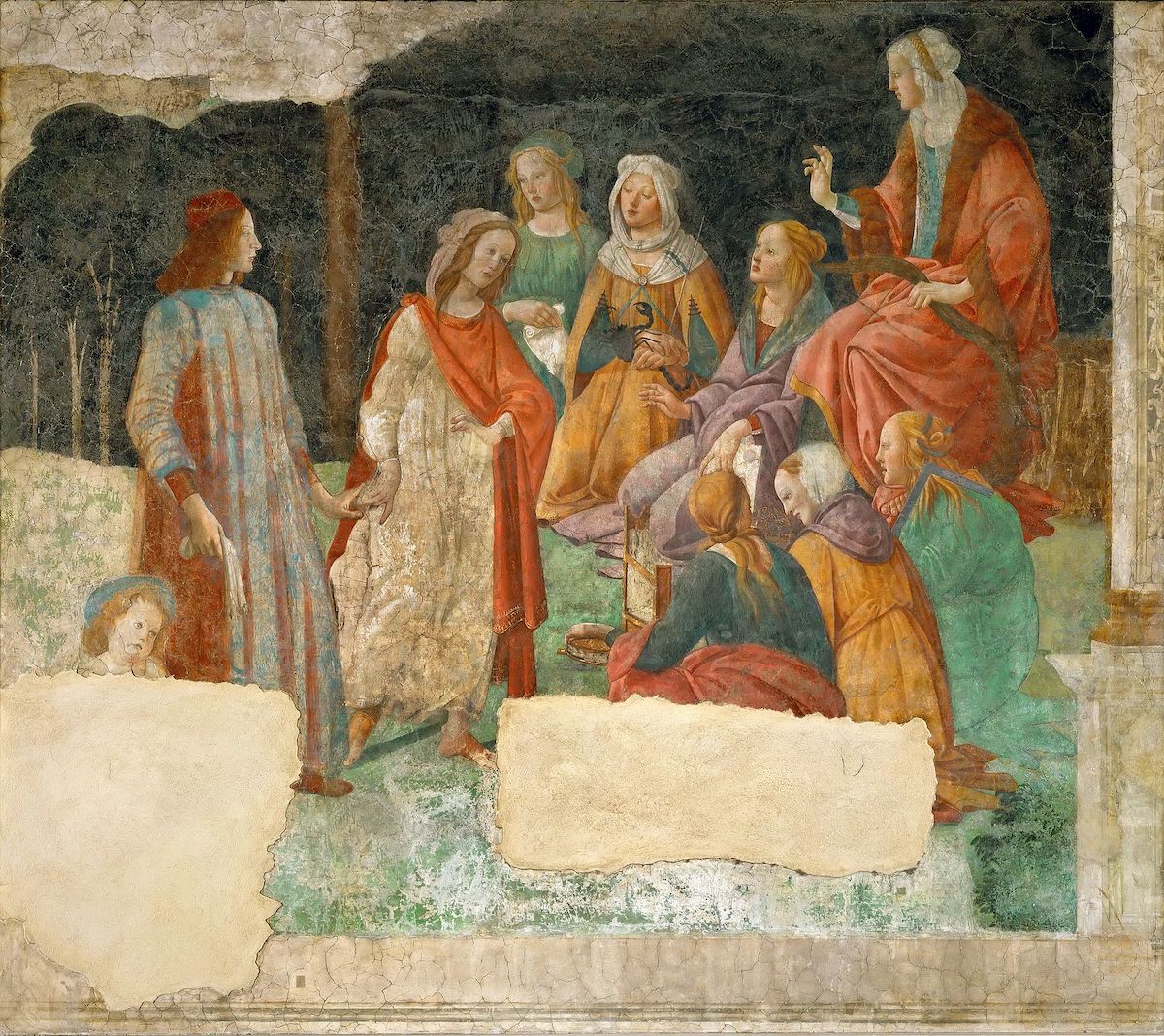
And a pair of Botticelli frescos now held at the Louvre are thought to model bride and groom on the occasion of Lorenzo’s sensational marriage to the beautiful daughter of a rival noble house, Giovanna degli Albizzi.


A Young Man Being Introduced to the Seven Liberal Arts (likely modeled on Lorenzo Tornabuoni)


Venus and the Three Graces Presenting Gifts to a Young Woman (likely modeled on Giovanna degli Albizzi)

All the brushwork in the world couldn’t save even this strapling oligarch when events tied him to a prospective Medici restoration, even though it broke soft republican hearts. Our apothecary Luca Landucci “could not refrain from weeping when I saw that young Lorenzo carried past the Canto d’ Tornaquinci on a bier” and if his diary is to be believed the dry eyes were few and far between.

17th August. The Practica [Court] met and sat in the Palagio from the morning till midnight. There were more than 180 men. And the five prisoners were condemned by word of mouth to be put to death and their property to be confiscated according to law. The five men condemned were Bernardo Del Nero, Niccolo Ridolfi, Giovanni Canbi, Gianozzo Pucci, and Lorenzo Tornabuoni, for whom all Florence was sorry.

On this day..

1830: Cornelius Burley

(Thanks to Cornelius Burley for the guest post, which was originally his “confession” on the scaffold at the first-ever hanging in London, Ontario, on August 19, 1830. “Poor, ignorant, weak-minded and almost an idiot,” he’s an unlikely author for the erudite tract — so it’s a fair bet that it was wrung out of him/ghost-written by his minister, who published the dang thing afterwards. More serious than the style is the content: many people to the present day have suspected Burley innocent of the crime to which he here “confesses” and that the real killer of the constable might have been one of the Ribble family with whom he was hiding out. -ed.)

As I am on this day to be executed as the just reward of my crimes, and the only satisfaction which can be made to meet the penalty of the civil law which I have violated, I feel it to be my duty to all those who stand here as spectators of my disgrace, and also to God, who has been justly offended with me on account of my transgressions, to make the following humble confession before I die; and I sincerely pray that it may be acceptable in the sight of the Almighty God, and have a tendency to check the progress of evil, and prevent others from doing as I have done.

I have always been wicked and thoughtless from my youth, having been brought up under the tuition of my parents who were tender and kind in many respects, but never appreciated the benefits arising from education of religion therefore I never was instructed to read or write, nor did they ever attempt to impress my mind with religious sentiments; having no attachments to any system of religious instruction themselves, I was left to wander through the world under the influence of depravity, with out the advantages of education or religious instruction to counter-balance the influences of my natural propensities of evil of various kinds, particularly that of frequenting places of profane resort. I was often found in the merry dance, and lost no opportunity of inducing thoughtless and unguarded females to leaves the paths of innocence and virtue. I lived in constant neglect of the holy Sabbath, and considered it as a day of profane amusement and I entirely neglected the worship of God; and daring profaneness employed my tongue, which ought to have been employed n the service of God, and in imploring his pardoning mercy.

I was married at the age of 21 to a respectable young woman by the name of Sally King; but soon found pretext to forsake her, as jealousy arose in my mind (perhaps without any just causes) that she was guilty of the same crime that my propensities led to. Some time after this, perhaps in June 1829, I married a second, (the first being still alive) — her name was Margaret Beemer, of Waterloo.

The unfortunate circumstances which led to my untimely end were as follows: A misunderstanding took place between Mr. Lamb and myself, in which I considered that the said Mr. Lamb defrauded me; and I could get no legal redress for the fraud, and being influenced partly with a spirit of revenge and partly with a desire to get redress, I took the law into my own hands and shot a steer belonging to the said Mr. Lamb for which transgression a warrant was issued, and I was pursued and taken; but by a stratagem I escaped from the constable, and fled to the township of Bayham in London district, whither I was pursued by Mr. Pomeroy, the unfortunate victim of my rashness.

I made use of various means to escape from him and those who were aiding him in pursuit of me, until the dark and unhappy night of the 15th September, 1829, when the heart appalling deed was committed, the thoughts of which produce the keenest remorse.

That evening I took the fatal instrument of death and after close examination that it was in order to do execution, I fled to avoid them, but in my flight I came near meeting them before I was aware of my danger; but as soon as I saw them I stepped behind a tree to avoid being seen by them, but Mr. Pomeroy at this moment altered his course and came toward the tree behind which I stood. I then supposed that he saw me, and was determined to take me; I then under the impression at the moment, concluded that my escape could not be effected without taking the life of Mr. Pomeroy; I accordingly presented my rifle, and ordered him to stand back, but gave him no time to escape till I fired on him, which shot was instrumental in bringing him to an untimely grave, and me to this disgraceful end. Yes! O yes! It was I who did this murderous deed; it was I alone who was guilty of this horrid and bloody crime, and none but I was guilty of shedding the blood of that trusty man, Mr. Pomeroy, who was faithfully performing his duty to his King and country.

As an act of justice due to Anthony Ribble, I am constrained to say that he had no hand in the crime whatever. Neither had any other person. It was altogether my own act for which I now feel to abhor myself and feel deeply humbled in the sight of God. O that I could recall that most shocking and dreadful deed! But as I cannot, I wish to warn all others nor to do as I have done. And I further say, that now considering myself as a dying man, I attach no blame to his Lordship the Chief Justice, nor his assistant on the Bench, the Sheriff, the Jurors, or Witnesses in my conviction and execution, as I believe they all acted from pure motives, and did their duty with punctuality in obedience to the laws of the country; and I only suffer the penalty that is justly due my crimes. I feel grateful for, and desire to acknowledge the favour of being visited by the ministers of the different denominations, whose instructions have been instrumental in leading me to my last refuge, which is Christ alone; and in my great extremity I have gained a confidence that through the merits of Christ alone I will be saved, although the chief of sinners.

I now big farewell to the world, and to all earthy things at the age of twenty six; and I sincerely hope that all you who behold my disgrace, will take a warning by my untimely end, and avoid the snares into which I have run. I freely forgive all that have injured me, and I sincerely ask forgiveness of all whom I have injured, but particularly God, whose righteous laws I have violated, but who has become the reconciled through Jesus Christ, and had given me as evidence of his love. O praise the Lord! I now leave this world with the fullest confidence that my sins are washed away in the Blood of the Lamb, and with sincere desire for the happiness of all I leave behind, I say again FAREWELL.


After his hanging — and his second hanging, when the rope broke on the first try — Burley’s skull was removed and sawed open by a phrenologist. It took a circuitous route through private collections and museums and was only buried in 2001.

On this day..

2015: Khaled al-Asaad, Palmyra archaeologist

Syrian archaeologist Khaled al-Asaad was beheaded by the Islamic State on this date in 2015 for refusing them the ancient artifacts of his native Palmyra.

Eighty-two years old — Palmyra was still a French colony at the time of this birth — Al-Asaad was involved in excavations around that city throughout his adult life. He became the custodian of the archaeological site in 1963 and held the post for 40 years.

When the Salafist militant army rolled up on his oasis city that spring.* he helped to evacuate the town’s museum and Daesh put him to torture to extract the whereabouts of the priceless cultural treasures he’d concealed from them. He made himself a hero to Syrians and antiquarians alike by denying his captors any satisfaction save his death — which was accomplished by a public beheading.

At least one other scholar, Qassem Abdullah Yehya, the Deputy Director of DGAM Laboratories, was also killed by ISIS/ISIL for protecting the dig site.

after Khaled al-Asaad

bonepole bonepole since you died
there’s been dying everywhere
do you see it slivered where you are
between a crown and a tongue     the question still
more god or less     I am all tangled
in the smoke you left     the swampy herbs
the paper crows     horror leans in and brings
its own light     this life so often inadequately
lit     your skin peels away     your bones soften
your rich unbecoming     a kind of apology

when you were alive your cheekbones
dropped shadows across your jaw     I saw a picture
I want to dive into that darkness     smell
the rosewater     the sand     irreplaceable
jewel how much of the map did you leave
unfinished     there were so many spiders
your mouth a moonless system
of caves filling with dust
the dust thickened to tar
your mouth opened and tar spilled out

“Palmyra”, by Kaveh Akbar

* The modern city of Palmyra (also called Tadmur) is adjacent to but not synonymous with the ancient city/archaeological site of Palmyra.

On this day..

1820: Rebecca Worlock, arsenic poisoner


From a 2017 film treatment of the case.

Thirty-seven-year-old Rebecca Worlock was hanged at Gloucester on this date in 1820 for poisoning her husband.

She’d mixed in a lethal dose of arsenic into a jug of beer from Oldland‘s the Chequers Inn that Thomas Worlock had thirstily quaffed at the end of a long journey. She did this, according to her confession (see p. 19) due to “jealousy on the part of her husband, who had repeatedly called her the most opprobrious epithets, which she declared was without foundation.”

According to Penny Deverill, a descendant of this unfortunate couple who wrote a book about the case, this was a euphemism on Rebecca’s part for her husband’s violent drunken rages.

She certainly was no master criminal. Instead of obtaining the beer herself, she sent her 13-year-old daughter Mary Ann to get it which positioned the kid to testify that, yup, mom intercepted the drink and might have tampered with it. In fact, according to Mary Ann the victim immediately realized what had been done to him.

Father was drinking the last of the beer. He said there was something at the bottom of the cup; and then said to mother you have done for me … I went to call Mrs. Butler; my mother then had the cup and was throwing away what was in it. Mrs. Butler lives next door but one. Mrs. Butler came with me immediately. After I came back mother had the cup in her hands; father was by the fire, and mother by him. Afterwards she threw the stuff out and swilled it. Mother took the cup out of the kitchen into the cellar adjoining the kitchen; could see from the kitchen into the cellar; no steps down. I saw her then empty it into water in a bucket; she swilled the cup out and brought it into the kitchen. My father said he wanted to show the stuff to some one, and was unwilling that she should throw it away.

Still worse, Rebecca to purchase this putative rat poison had been required by regulation to buy in the company of a second person — owing to its very popularity as an expedient for domestic homicide.

To accomplish this, she had fast-talked an obliging passerby outside the apothecary to act as her impromptu aide … and then on leaving the store with her deadly draught in hand, spontaneously blabbed about its real purpose to this total stranger.

On this day..

1831: Dic Penderyn, Merthyr Rising martyr

Welsh coal miner Dic Penderyn was hanged on this date in 1831 to crush a labor rising.

Richard Lewis was his real name — he got his nickname from the village of his residence, Penderyn, which is also true of Wales’s most famous whisky — dug carbon out of the ground to serve the mighty ironworks of Merthyr Tydfil.


Satanic mill? Cyfarthfa Ironworks Interior at Night, by Penry Williams (1825).

This vital node of the burgeoning industrial revolution made princes of its masters, and paupers of its subjects. “The town of Merthyr Tidfil was filled with such unguided, hard-worked, fierce, and miserable-looking sons of Adam I never saw before,” Thomas Carlyle would write in 1850. “Ah me! It is like a vision of Hell, and will never leave me, that of these poor creatures broiling, all in sweat and dirt, amid their furnaces, pits, and rolling mills.” The broiling creatures’ surplus labor lives on to delight the modern visitor in the form of Cyfarthfa Castle, the spired mansion thrown up in the 1820s by the prospering ironmaster William Crawshay II. (His successor in the role, Robert Thompson Crawshay, would be known as the “Iron King of Wales”.)

For workers, precarity sat side by side with toil and in 1831 the pressure of contracting wages and constricting debt triggered a protest that metastasized into rebellion. The Merthyr Rising saw the town completely overrun by the lower orders, flying the red flag in perhaps the earliest deployment of this now-familiar symbol as a banner of the proletariat.

They sacked the debtors’ court and fed its obnoxious bonds to a bonfire, and formed a militia that fought off a couple of attempted state interventions before 450 troops occupied Merthyr Tidfil on June 6 to finally quell the revolt. Two dozen protesters were killed in the associated fighting.

Twenty-six people were arrested and tried for various crimes associated with the Merthyr Rising, but amid the various imprisonments and transportations-to-Australia, Westminster perceived the need for the sort of message that only hemp conveys. Two men, Lewis Lewis (Lewsyn yr Heliwr) and our man Richard Lewis (Dic Penderyn) drew death sentences for stabbing a soldier with a bayonet. The former man’s sentence was downgraded to penal transportation when a policeman testified that he’d been shielded from a dangerous moment in the riot by Lewis Lewis. That left just the one guy and never mind a widespread belief in the town that Dic Penderyn was innocent of the crime.

Prime Minister Charles Grey, 2nd Earl Grey — yes, he’s the Earl Grey tea guy — refused an 11,000-strong community petition to spare him. Dic Penderyn hanged at Cardiff on August 13, 1831, at the site of the present-day Cardiff Market. A plaque marks the spot.

To latter-day descendants, both those of blood and those of insurrectionary spirit, Dic Penderyn is a seminal working-class martyr. Commemorations, and efforts to officially exonerate him, continue down to the present day.

On this day..

1469: Andrea Viarani

The August 12, 1469 beheading of a Ferrara nobleman named Andrea Viarani is the subject of a chapter in the very fine volume The Art of Executing Well: Rituals of Execution in Renaissance Italy.

This scholarly tome explores via six chapters with different authors and several translated texts the spiritual and ritual experience of execution, particularly as mediated by confraternities of lay comforters who worked to steady the condemned for their ordeal and — as they prayed — their salvation.

Notably, The Art of Executing Well favors the reader with a 100-page translation of a Bolognese Comforters’ Manual and its associated hymnal. This resource was used by the Compagnia di Santa Maria della Morte to train its brethren for their weighty task of counseling the doomed.

This manual is, in the first place, a philosophical text for the counselor — to get his mind right, fully versed in Church doctrine concerning the afterlife and approaching his somber task full of contrition, humility, and piety.

Those doing this work must put their heart in it and act only out of love for God, and also out of charity for and the salvation of the neighbor. And they must make a great effort to do this, otherwise it would be displeasing to God. And take note that it will not gain you anything for eternal life if it is done for any vain reasons: any aspect of glory or mundane pomp, or to be held in high esteem by the people of this world, or to avoid disrespect of your fellow man, or for any worldly gain, or to be on everyone’s lips, or to be praised, or to be able to learn the secrets or the deeds of those people, or out of revenge, or out of ill will, or for faction, or for reward. But you should only do it out of reverence for God and to observe his commandment.

And in the second place, it’s a practical handbook for navigating the many reactions and considerations that people in their last hours might have, as part of guiding the sufferer towards reconciliation with God. “You must not tire of speaking” to those who wish to listen and pray with you, but also bring several enumerated volumes for those who prefer to read; in many other cases, “you will find those who do not willingly accept their death and for whom it is a very big thing” and who must be guided empathetically when their thoughts are preoccupied by concern for their family, or by writing their will, or by their raw resistance to death. At times the guidance reads strikingly modern; set aside the figure of the executioner and words like these would not be amiss to aid you or I in a 21st century personal crisis:

There are those whom you will find hard-hearted in the beginning and who do not want to hear anything you say … Be very careful not to unsettle him with words or harshness. Because sometimes those who are so hardened and miserable may react quite violently against one word they don’t like, with the result that you risk never being able to say anything that they do like, and this leads to worse. And if you see that in spite of your words he doesn’t wish to repent and remains hard-hearted, let it be and say nothing to him. Rather, let him say what he wants. And then tell some appropriate story or some example to your companion [i.e., a brother emissary from the confraternity -ed.] or with whoever is around, and tell in such a way that he who is to die hears you. And when his anger subsides and he is just there not doing anything, then go and put your hand on his back and ever so gently reprove him for his folly and place him on the proper road.

We’ve previously seen in these annals an example of lay brother and condemned prisoner working together to ready a soul for the block, in the person of Niccolo Machiavelli associate Pietro Boscoli, who was involved in (or perhaps merely adjacent to) an anti-Medici plot.

That’s not dissimilar from the situation of our day’s principal. Andrea Viarani came from a cultured noble family numbering diplomats, doctors, and astrologers among its ranks — and he came to his grief by his involvement in a conspiracy against the local tyrant, Borso d’Este, Duke of Ferrara.*

Not much is really known about this man’s life, but he comes alive in Alfredo Troiano’s examination of three poems that the man wrote while awaiting execution. These poems later made their way to Bologna, where the aforementioned Compagnia di Santa Maria della Morte incorporated them into its own corpus and for Troiano, that’s no coincidence: they exhort the reader to attitudes characteristic of confraternities, revealing the unrecorded exertions these lay brethren must have made in Viarani’s cell.

If the blind, false, and treasonous world,
full of injustice, betrayal, and deception
has held you many years
far from your Maker and the Supreme Good,

Shows now both the shadowy and the fleeting nature
of hoping for vain pleasures, which
that foolish desire inclines towards
never thinking of its true salvation:

Now that heaven has given you much grace
and you are brought back to the point,
Andrea, that God has made you
repentant of the wrong committed.

Lift your mind to God, move your hard heart
and do not be so obstinate with him
but with devout tears,
repentant of having erred, ask for forgiveness.

Ah! Don’t wish to abandon your soul,
being diffident of eternal grace,
for it never is tired of gathering
he who, repentant, so asks.

This sirvente runs to 35 stanzas, and the translation is original to The Art of Executing Well where the reader may peruse it at length; Viarani also wrote two sonnets, one addressed to the Eternal Father and the other the Eternal Queen (that is, to God and to the Virgin Mary), which also appear in that book.

* The son of Niccolo d’Este, a name distinguished in execution annals by meting that fate out to his young wife and his son for their shocking affair. (The lovers weren’t kin themselves.)

On this day..

1915: A day in the death penalty (and lynch law) around the U.S.

U.S. hangmen clocked overtime on this date in 1915. The Washington D.C. Herald of August 8 covered the bloodbath thus:

Robert Watkins and John Salter were executed for the murder of Mrs. Mary Lassiter at Evergreen. A militia guard prevented a mob from burning the negroes. The other two executions in Alabama [Millard Carpenter and George James -ed.] were for the murder of white men.

At Fresno, Miss., Peter Bolen and Jim Seales, who killed another negro, were executed while 5,000 persons sang “There Is a Land of Pure Delight.” Bunyan Waters was executed at Fayetteville, Miss.

Nor were legal executions the end of it.

A dispatch from Shawnee, Okla., relating the story of the lynching of Ed Berry, stated that the affair was “one of the most orderly lynchings in the State.” Berry was hanged from a railroad bridge, and his body was riddled with bullets, after which the mob dispersed “in an orderly manner.”

In Trilby, Fla., a crowd of citizens lynched Will Leach, accused of attacking a 13-year-old girl.

Early today a report from Liberty stated that a lynching was almost certain if a mob caught a negro laborer who attacked a farmer’s wife near there.

While this piece focuses on the U.S. South, there was also a hanging on August 6, 1915, in Connecticut. Just minutes after midnight, with the words “Good-bye, Father, good-bye,” followed by a firm “not guilty!” from under the hood, Bernard Montvid died for murdering a Catholic priest named Joseph Zebris, along with Zebris’s housekeeper Eva Gilmanaitis in a home invasion/robbery that earned less than $5. Worse yet, Montvid had to split this paltry blood money with his partner, Peter Krakas — who had already been separately hanged by the time Montvid paid his own penalty.

The Espy file of U.S. executions, a wonderful resource but liable to errors, attributes an August 6, 1915 hanging to the state of Georgia. I’ve trawled several newspaper databases without substantiating this supposed execution of Henry Floyd.

On this day..

1843: Sarah Dazley

(Thanks to Richard Clark of Capital Punishment U.K. for the guest post, a reprint of an article originally published on that site with some explanatory links added by Executed Today, and footnotes which are also my own commentary. CapitalPunishmentUK.org features a trove of research and feature articles on the death penalty in England and elsewhere. -ed.)

Sarah was born in 1819 as Sarah Reynolds in the village of Potton in Bedfordshire, the daughter of the village barber, Phillip Reynolds. Phillip died when Sarah was seven years old and her mother then embarked on a series of relationships with other men. Hardly an ideal childhood.

Sarah grew up to be a tall, attractive girl with long auburn hair and large brown eyes. However she too was promiscuous and by the age of nineteen had met and married a local man called Simeon Mead. They lived in Potton for two years before moving to the village of Tadlow just over the county border in Cambridgeshire in 1840. It is thought that the move was made to end one of Sarah’s dalliances. Here she gave birth to a son in February 1840, who was christened Jonah. The little boy was the apple of his father’s eye, but died at the age of seven months, completely devastating Simeon. In October Simeon too died suddenly, to the shock of the local community. Sarah did the grieving mother and widow bit for a few weeks, before replacing Simeon with another man, twenty-three-year-old William Dazley. This caused a lot of negative gossip and considerable suspicion in the village. In February 1841, Sarah and William married and moved to the village of Wrestlingworth three miles away and six miles north east of Biggleswade in Bedfordshire. Sarah invited Ann Mead, Simeon’s teenage daughter, to live with them. It seems that all was not well in the marriage from early on and William took to drinking heavily in the village pub. This inevitably led to friction with Sarah which boiled over into a major row culminating in William hitting her. Sarah always had other men in her life through both her marriages and confided to one of her male friends, William Waldock, about the incident, telling him she would kill any man who hit her. Sarah also told neighbours a heavily embroidered tale of William’s drinking and violence towards her.

William became ill with vomiting and stomach pains a few days later and was attended by the local doctor, Dr. Sandell, who prescribed pills which initially seemed to work, with William being looked after by Ann Mead and showing signs of a steady recovery. Whilst William was still bedridden, Ann — not entirely realising what she was seeing at the time — observed Sarah making up pills in the kitchen.

Sarah told a friend of hers in the village, Mrs. Carver, that she was concerned about William’s health and that she was going to get a further prescription from Dr. Sandell. Mrs. Carver was surprised to see Sarah throw out some pills from the pillbox and replace them with others. When she remarked on it, Sarah told her that she wasn’t satisfied with the medication that Dr. Sandell had provided and instead was using a remedy from the village healer. In fact the replacement pills were those that Sarah had made herself. She gave these to William who immediately noticed that they were different and refused to take them. Ann who had been nursing him and had still not made any connection with the pills she had seen Sarah making, persuaded William to swallow a pill by taking one too. Inevitably they both quickly became ill with the familiar symptoms of vomiting and stomach pains. William vomited in the yard and one of the family pigs later lapped up the mess and died in the night. Apparently Sarah was able to persuade William to continue taking the pills, assuring him that they were what the doctor had prescribed. He began to decline rapidly and died on the 30th of October, his death being certified as natural by the doctor. He was buried in Wrestlingworth churchyard. Post mortems were not normal at this time, even when a previously healthy young man died quite suddenly.

As usual Sarah did not grieve for long before taking up a new relationship. She soon started seeing William Waldock openly and they became engaged at her insistence in February 1843. William was talked out of marriage by his friends who pointed to Sarah’s promiscuous behaviour and the mysterious deaths of her previous two husbands and her son. William wisely broke off the engagement and decided not to continue to see Sarah.

Suspicion and gossip was now running high in the village and it was decided to inform the Bedfordshire coroner, Mr. Eagles, of the deaths. He ordered the exhumation of William’s body and an inquest was held on Monday the 20th of March 1843 at the Chequers Inn in Wrestlingworth High Street. It was found that William’s viscera contained traces of arsenic and an arrest warrant was issued against Sarah. Sarah it seems had anticipated this result and had left the village and gone to London. She had taken a room in Upper Wharf Street where she was discovered by Superintendent Blunden of Biggleswade police. Sarah told Blunden that she was completely innocent and that she neither knew anything about poisons nor had she ever obtained any. Blunden arrested her and decided to take her back to Bedford. What would be a short journey now required an overnight stop in those days and they stayed in the Swan Inn, Biggleswade. Sarah was made to sleep in a room with three female members of the staff. She did not sleep well and asked the women about capital trials and execution by hanging. This was later reported to Blunden and struck him as odd.*

The bodies of Simeon Mead and Jonah had also now been exhumed and Jonah’s was found to contain arsenic, although Simeon’s was too decomposed to yield positive results.

On the 24th of March 1843, Sarah was committed to Bedford Gaol to await her trial and used her time to concoct defences to the charges. She decided to accuse William Dazley of poisoning Simeon and Jonah on the grounds that he wanted them out of her life so he could have her to himself. When she realised what he had done she decided to take revenge by poisoning William. Unsurprisingly these inventions were not believed and were rather ridiculous when it was William’s murder she was to be tried for. In another version William had poisoned himself by accident.

She came to trial at the Bedfordshire Summer Assizes on Saturday the 22nd of July before Baron Alderson, charged with William’s murder, as this was the stronger of the two cases against her. The charge of murdering Jonah was not proceeded with but held in reserve should the first case fail.

Evidence was given against her by two local chemists who identified her as having purchased arsenic from them shortly before William’s death. Mrs. Carver and Ann Mead told the court about the incidents with the pills that they had witnessed.

William Waldock testified that Sarah had said she would kill any man that ever hit her after the violent row that she and William had. Forensic evidence was presented to show that William had indeed died from arsenic poisoning, it being noted that his internal organs were well preserved. The Marsh test, a definitive test for arsenic trioxide, had been only available for a few years at the time of Sarah’s trial. Arsenic trioxide is a white odourless powder that can easily pass undetected by the victim when mixed into food and drink.

Since 1836 all defendants had been legally entitled to counsel and Sarah’s defence was put forward by a Mr. O’Malley, based upon Sarah’s inventions. He claimed that Sarah had poisoned William by accident. Against all the other evidence this looked decidedly weak and contradicted the stories Sarah had told the police. It took the jury just thirty minutes to convict her. Before passing sentence Baron Alderson commented that it was bad enough to kill her husband but it showed total heartlessness to kill her infant child as well. He recommended her to ask for the mercy of her Redeemer. He then donned the black cap and sentenced her to hang. It is interesting to note that Baron Alderson had, at least in his own mind, found her guilty of the murder of Jonah, even though she had not been tried for it.

During her time in prison, Sarah learnt to read and write and began reading the Bible. She avoided contact with other prisoners whilst on remand, preferring her own company and accepting the ministrations of the chaplain. In the condemned cell she continued to maintain her innocence and as far as one can tell never made a confession to either the matrons looking after her or to the chaplain.

There was no recommendation to mercy and the Home Secretary, Sir James Graham, saw no reason to offer a reprieve. The provision of the Murder Act of 1752, requiring execution to take place within two working days, had been abolished in 1836 and a period of not less than fourteen days substituted. Sarah’s execution was therefore set for Saturday the 5th of August 1843. A crowd variously estimated at 7,000 – 12,000 assembled in St. Loyes Street outside Bedford Gaol to watch the hanging. It was reported that among this throng was William Waldock.

The New Drop gallows was erected on the flat roof over the main gate of the prison in the early hours of the Saturday morning and the area around the gatehouse was protected by a troop of javelin men. William Calcraft had arrived from London the previous day to perform the execution.

Sarah was taken from the condemned cell to the prison chapel at around ten o’clock for the sacrament. The under sheriff of the county demanded her body from the governor and she was taken to the press room for her arms to be pinioned. She was now led up to the gatehouse roof and mounted the gallows platform, accompanied by the prison governor and the chaplain. She was asked if she wished to make any last statement which she declined, merely asking that Calcraft be quick in his work and repeating “Lord have mercy on my soul”. He pinioned her legs, before drawing down the white hood over her head and adjusting the simple halter style noose around her neck. He then descended the scaffold and withdrew the bolt supporting the trap doors. Sarah dropped some eighteen inches and her body became still after writhing for just a few seconds, as the rope applied pressure to the arteries and veins of her neck, causing a carotid reflex. Sarah was left on the rope for the customary hour before being taken down and the body taken back into the prison for burial in an unmarked grave, as was now required by law.

It was reported by the local newspapers that the crowd had behaved well and remained silent until Sarah was actually hanged. Once she was suspended they carried on eating, drinking, smoking, laughing and making ribald and lewd remarks. Copies of broadsides claiming to contain Sarah’s confession and her last dying speech were being sold among the crowd, which amazingly people bought even though she had made neither. You can see a broadside about her hanging below. Note the stylised woodcut picture that was modified to show a man or a woman as appropriate.

The 1840s were a time of great hardship nationally and yet Sarah, whilst hardly wealthy, did not seem to suffer from this and it was never alleged that she was unable to feed her child or that she was destitute. Extreme poverty in rural areas did appear to be the motive in some murders at this time, especially of infants. Sarah’s motive seems to be a much more evil one, the elimination of anyone who got in the way of her next relationship.

Sarah’s was the first execution at Bedford since 1833 and she was the only woman to be publicly hanged there. In fact Bedfordshire executions were rare events and there were to be only two more in public, Joseph Castle on the 31st of March 1860 for the murder of his wife and William Worsley on the 31st of March 1868 for the murder of William Bradbury.

Notes on the period.

Queen Victoria ascended to the throne in 1837, at the age of eighteen and her reign saw a great deal of change in the penal system. For the first thirty one years of it executions were a very public event enjoyed by the masses. People would come from far and wide to witness the spectacle, in some cases special trains were even laid on! Broadsides were sold at many executions giving the purported confessions of the prisoner and there was considerable press interest, particularly where the criminal was female.

Thirty women and two teenage girls were to be executed in England and Scotland in the thirty one year period from May 1838 to the abolition of public hanging in May 1868. Of these twenty-one had been convicted of poisoning (two thirds of the total). Sarah Chesham was actually executed for the attempted murder of her husband but was thought to be guilty of several fatal poisonings as well. Attempted murder ceased to be a capital crime in 1861 under the provisions of the Criminal Law Consolidation Act of that year. Mary Ann Milner would have made the total thirty three had she not hanged herself in Lincoln Castle the day before her scheduled execution on the 30th of July 1847. There were no female executions in Wales during this time but a further ten women were hanged in Ireland during the period, all for murder.

Sarah Chesham‘s case prompted a House of Commons committee to be set up to investigate poisoning. This found that between 1840 and 1850, ninety seven women and eighty two men had been tried for it. A total of twenty-two women were hanged in the decade 1843-1852 of whom seventeen had been convicted of murder by poisoning, representing 77% of the total. There were no female executions in the years 1840-1842 in England. This rash of poisonings led to a Bill being introduced whereby only adult males could purchase arsenic. Poisoning was considered a particularly evil crime as it is totally premeditated and thus it was extremely rare for a poisoner to be reprieved whereas it was not unusual for females to be reprieved for other types of murder, such as infanticide. One of the few poisoners to be reprieved was Charlotte Harris in 1849 who had murdered her husband but who was pregnant at the time of her trial.

* I’m baffled as to why anyone would find it odd — much less incriminating — for a person freshly in custody on a potential capital charge to lose sleep fretting about the horrors of execution. -ed.

** Alderson took part in his share of capital trials, as did any judge of consequence in his day, but was notable as a jurist on the more progressive and less bloody-minded end of the spectrum. An oft-quoted comment of his cautioning against stretching facts to fit your theory would have prevented many a wrongful punishment imposed by tunnel-visioned investigators: “The mind is apt to take pleasure in adapting circumstances to one another, and even in straining them a little if need be, to force them to form parts of one consecutive whole … and in considering such matters to overreach and mislead itself, to suppose some little link that is wanting, to take for granted some fact consistent with previous theories, and necessary to render them complete.”

On this day..