2010: Farid Baghlani, womanslayer

On this date in 2010, Farid Baghlani was hanged in Ahvaz for a 2004-2008 serial murder spree that claimed the lives of six women.

At trial, Baghlani openly attributed his crimes to his hatred for women, probably not a defense calculated to maximize his prospects of acquittal. Those who lost loved ones to Baghlani returned the sentiment, and celebrated his execution by handing out sweets.

On this day..

1752: James of the Glen

On this date in 1752, the Scotsman Seamus a’ Ghlinne mounted a gallows above the narrows at Ballaculish with the reproach of Psalm 35 for his persecutors:

False witnesses rose; to my charge things I not knew they laid.
They, to the spoiling of my soul, me ill for good repaid.

Seamus a’Ghlinne — James of the Glen, or just James Stewart — had come there that day to die for the ambush murder of Colin Roy Campbell.

The victim was stock of Clan Campbell, one of the largest Highland clans and one whose loyalties to England’s Hanoverian kings were being richly rewarded.

The Stewarts, who had backed the recent ill-fated Jacobite rebellion in favor of the exiled pretender Bonnie Prince Charlie, were in the opposite predicament.

Colin Campbell was said on that fatal May 14 to be en route to expel the Stewarts from the village of Duror so that Campbells could move in. But even Campbell’s everyday job of extracting resentful rents from estates repossessed from Jacobite sympathizers would have turned many a murderous eye his way.

Someone that day shot Colin Campbell in the back from wooded cover, then vanished, murderous eye and trigger finger and all, never to be never apprehended. So they got James Stewart to answer for it instead.

This wasn’t a tragic case of well-intentioned police developing tunnel vision on the wrong suspect so much as repaying tit for tat in a family feud. The trial was held at the Campbells’ Inverary Castle. Its presiding judge was the Campbell alpha male, the Duke of Argyll. Eleven more Campbells sat on Stewart’s jury. But then, from the Campbells’ side, or London’s for that matter, what was to say that this one murder might not be the germ of a new rebellion if not ruthlessly answered?

Still, there was “not a shred of evidence,” says present-day Glasgow barrister John Macauley, who is pushing for an official reversal of the verdict. “The whole thing from start to finish was a farce.” (Judge for yourself here.)

James Stewart was, however, the foster father of a man who actually was suspected of firing the shot, Allan Breck Stewart, a former Jacobite fighter who had returned from exile in France to collect rents for the Stewarts. Known to have threatened the Campbells previously, Allan was also tried and condemned to death — but only in absentia, since he suspiciously fled to France immediately after the so-called Appin Murder.

Many years later, Robert Louis Stevenson would use this dramatic crime, and Al(l)an Breck’s flight to safety, in Kidnapped. “I swear upon the Holy Iron I had neither art nor part, act nor thought in it,” Stevenson’s Alan says to the fictional protagonist in the novel, just after both have witnessed the murder.

And in reality, Alan too is thought by those who know the case to be clear of guilt in the matter. The Stewart family reputedly knew all along which of their number was Campbell’s real killer, but refused to give him up and kept the family secret for generations. It’s even said that that man had to be forcibly held down on execution day to prevent him giving himself up.

To judge by the most recent research, that man was likely Donald Stewart, the son of Stewart of Ballachulish and the best shot among a group of several young hotheads who resolved together to slay the Campbells’ hated Factor. The conspiracy also goes as the reason — or at least excuse — for keeping Donald silent, since in giving himself up he might see all four of them to the gallows. The late Lee Holcombe makes a comprehensive case for Donald Stewart as the gunman in the 2004 book Ancient Animosity: The Appin Murder and the End of Scottish Rebellion; Donald Stewart was also fingered publicly in 2001 by a matriarch of the Stewarts of Appin, though others of her family have not publicly confirmed that that’s the secret name.

James Stewart’s decaying corpse remained gibbeted on the spot of his execution for 18 months after, a rotting warning to the Stewarts or any late Jacobites. In 1754, a local halfwit called “Daft Macphee” finally tore down the gallows and threw it into Loch Linnhe … but its former position overlooking the modern Ballachulish Bridge is still marked by a mossy stone monument to James of the Glen, “executed on this spot Nov. 8th 1752 for a crime of which he was not guilty.”

A Few Books About the Appin Murder

On this day..

2009: Behnoud Shojaee, Mohammad Mostafaei client

At dawn this date in 2009, Iran hanged Behnoud Shojaee in Tehran’s Evan Prison for a murder committed while he was still a juvenile.

His attorney, Mohammad Mostafaei, later had to flee Iran in the face of persecution over his own activism against the death penalty, and the juvenile death penalty in particular.

Mostafaei wrote a Farsi post detailing the harrowing moments leading up to the Shojaee’s hanging, complete with the young offender kneeling in front of the parents of his victim imploring them to exercise their power to spare his life. That post, excerpted below, was translated to English by the site Persian2English.com.

The plan was to get the parents of the victim to drop the case so he would be spared from execution. We could hear the prayers of the activists from outside the prison. After a few minutes we were admitted into another salon. Behnoud was there along with a few of the prison guards. When the parents of the victim entered the room, Behnoud kneeled in front of them and begged them to not execute him. The head of convictions prepared the conviction papers. A few of the prison guards, Mr. Oliyaifard, and I went to the parents of the victim and begged them to not go through with the execution. The mother of the victim replied, “I cannot think right now. I have to put the rope around his neck.” After a few minutes we heard the Call for Prayer. Behnoud walked to another room to say his last prayers. He went to ask God for forgiveness.

After the prayer we all went to the prison grounds. My entire body was shaking and I didn’t know what would become of this boy without a mother. When Behnoud kneeled in front of the parents of the victim, he told the mother, “I don’t have a mother. Please act as a mother and tell them to not execute me.” We all went to another room. In that room there was a metal stool and a blue plastic hanging rope suspended above it. The parents of the victim entered that room. Then they brought Behnoud into that horrible room where they carried out the executions. I had never heard of sole executions in Evin prison. I thought it strange that only Behnoud was being executed that night.

Maybe this was his unfortunate fate that took him to die all alone. The people present in the room asked the parents to forgive and to stop the execution. The mother said you have to put the rope around his neck. Behnoud stood on top of the stool and they put the rope around his neck. After only a few seconds the mother and father of the victim ran toward the stool and pulled it away.

On this day..

2013: Xia Junfeng, chengguan slayer

China has announced the execution this day of “homicide criminal” Xia Junfeng, a kebab vendor from Shenyang.

This case has been in the public eye for several years, and the predominant sentiment has been sympathetic towards the condemned man.

Xia and his wife Zhang Jing were part of China’s vast population of working urban poor, Xia having found his way into job insecurity by virtue of a layoff from the state electricity company. In the entrepreneurial spirit of the age, Xia started up an unlicensed business selling sausages and the like.

These denizens of the gray economy are, as a class, afflicted by the attentions of the City Urban Administrative and Law Enforcement Bureau, better known as the chengguan. Their benign job description entails administering municipal regulations, but this much-loathed force’s relationship to everyday citizens is perhaps best illustrated by the word chengguan‘s status as a shorthand neologism for bullying and abuse. Too many people know this goon squad firsthand, and too many stories of their worst excesses have circulated. Just this past July, the chengguan made headlines by killing a watermelon vendor.

“Chengguan abuses are an open scandal in China,” said Human Rights Watch’s China director. “The chengguan’s ability to flout China’s laws and inflict harm on members of the public is a recipe for greater public resentment and more violent confrontations.”

In the violent confrontation at issue in today’s execution, the chengguan chengguanned Xia Junfeng in May 2009. Xia fought back with his meat-carving knife, and slew two of his tormenters.

Death penalty cases redolent of the social stratification and institutional corruption that ordinary Chinese people experience have proven to be lightning rods in recent years.

Xia Junfeng’s turned, legally, on his claim that he killed protecting himself from the chengguan‘s beating.*

“Extralegal violence, thus employed to compensate for inadequate regulation and an absence of authority and legal deterrence, is no longer individual behavior. Such violence exists everywhere with the permission of the authorities. It is needed because of an overriding concern for “city image” and “urban management.” Finally, when extralegal violence is not monitored by the people and the media, and not punished by the law, it is only natural for Chengguan members to feel justified. Using violence with impunity enables the Chengguans to see violence psychologically as their “privilege,” a sign of status and pride. Since the legal and political status of Chengguan is unclear, it is only natural for its members to seek personal gain, vent their anger, and prey on the citizens they were intended to protect.”

-from the closing argument of Xia’s defense attorney

This allegation didn’t fly in court, where brother chengguan denied that they’d been abusing the shishkebaber, but it’s won in a rout when it comes to the court of public opinion. “His life and death are more than just a legal matter, but a bellwether of the era, with the tsunami-like public opinion firmly on the side of Xia Junfeng,” wrote author Yi Chen today.

Particularly galling for many is the disparity in treatment between Xia Junfeng and the likes of Gu Kailai, the latter a powerful business and political figure who was able to avoid execution despite being convicted of a scandalous contract murder. And Chengguan themselves never seem to be at risk of harsh punishment for any misbehavior; had Xia Junfeng been the one to leave that confrontation in a body bag, there certainly wouldn’t have been a death penalty case.


Anonymous cartoon circulated on Weibo criticizing Xia Junfeng’s condemnation. (Via) The drawing of the boy in the background was done by Xia’s son, whose art school fees were earned by his father’s roadside business.

Chinese speakers might want to peruse the Weibo feed of Xia’s widow.

* Several years ago, self-defense helped a Beijing migrat worker avoid execution for killing a chengguan who attempted to confiscate his bicycle cart.

On this day..

2007: John Joe “Ash” Amador

On this date in 2007, John Joe “Ash” Amador died of lethal injection in Texas.

Amador, age 18, and a 16-year-old cousin, hailed a taxi in San Antonio in the dark predawn hours of January 4, 1994, directed it on a long drive to a dark street in Poteet, Texas, and abruptly shot the cabbie in the head with a .25 caliber handgun. Amador’s cousin shot the cab driver’s ride-along companion.

It’s possible to get unusually up close and personal with Amador — both the man himself, and the gears of the death penalty process at the anticlimax of 13 long years.

To begin with, journalist Dave Maass interviewed Ash Amador a month before the latter’s execution, and posted 52 minutes of audio on Archive.org.

And in a more outre vein, a team of British filmmakers crafted a surreal and digressive but frequently touching documentary of Amador’s end, most especially through the eyes of the condemned man’s wife and family. As Maass put it, they’ve “given the man one wicked afterlife.”

If that teaser intrigues, the entire documentary is freely available online here — complete with an amazing scene of a death mask being cast from the freshly-executed, just-body-bagged Ash.

On this day..

1480: The Martyrs of Otranto

On this date in 1480, Ottomans invading Otranto, Italy conducted a mass execution of prisoners.

Landing at the southern Italian city on July 28, the Ottoman force quickly overwhelmed Otranto. (Otranto rashly slew the messenger come to offer a merciful capitulation, only to find that its garrison began deserting within days.) On August 11, the Turks took the city by storm. Thousands died on that day’s bloodbath, including the Archbishop of Otranto.

Surviving women and children were sold into slavery. Men over age 15 had the choice of conversion — or death.

“Now it is time for us to fight to save our souls for the Lord!” a Christian shoemaker is said to have exhorted his 800 fellow prisoners. “And since he died on the cross for us, it is fitting that we should die for him.”

The acclaim greeting this call signaled inflammation ahead for the Turkish headsmen’s rotator cuffs. They had 800 faithful souls to dispatch to their eternal reward this date at the place still known as the Hill of Martyrs. (When in Otranto, visit it by taking the via Ottocento Martiri, just off via Antonio Primaldo — that’s the name of the militant shoemaker.)


The remains of the Otranto martyrs, arrayed as relics in the Otranto cathedral. (cc) image from Laurent Massoptier.

Historical novel set during these vents.

This, at least, is the most pious version of the story. The mass execution certainly did occur, but some latter-day historians like Francesco Tateo have argued that martyrdom is not attested by any of the contemporaneous sources, and the specifically religious understanding of events was only read in after the fact.

On whatever grounds one likes, Italy’s fractious city-states were deeply alarmed by the appearance on their shores of the all-conquering Turks. “It will always seem as if the funeral cross is borne before me while these barbarians remain in the boundaries of Italy,” wrote the Florentine humanist Poliziano.* (Source, a nonfiction book which covers Otranto in some detail.)

In the ensuing months, they rallied together vowing to expel the invaders.

Fortunately for this coalition, the Ottoman sultan Mehmed the Conqueror died in May 1481, and a brief period of internal conflict within the Ottoman empire over the succession perhaps led it to allow its Otranto outpost to wither on the vine. The Turks made peace and withdrew from their potential beachhead not long after, having held the city for just over a year. The bodies of the martyrs were said to have been found uncorrupted by decay.

The Catholic church beatified the 800 martyrs in 1771, but their final elevation to sainthood occurred only in 2013, just three months ago as I write this. They were in the very first group canonized by the new Pope Francis — although the canonization was approved by his predecessor Benedict XVI on the same day that Benedict resigned his pontificate. Considering current relations between the respective faiths, it was seen as a potentially impolitic move.

“By venerating the martyrs of Otranto, we ask God to protect the many Christians who in these times, and in many parts of the world, are still victims of violence,” Pope Francis said at the canonization Mass, diplomatically not naming any of those parts of the world.

* At the same time, Florence (in common with other Italian polities) had trade and diplomatic relations with the Ottomans.

On this day..

1997: Chiang Kuo-ching, Taiwan wrongful conviction

On this date in 1997, Taiwanese airman Chiang Kuo-ching was shot for the rape-murder of a five-year-old girl the previous September.

Chiang was nominated as a suspect by a fellow enlistee just a day after the little girl’s body was found in a privy gutter.

So, he and three other early suspects were given “lie detector” tests. Because Chiang was the only one of these who “failed” to acquit himself by this ludicrous mummery, he became the subject of implacable official tunnel vision.

The case was referred — illegally and arbitrarily — to the country’s intelligence services, who subjected Chiang to 37 hours of torture in order to extract a confession: beatings, threats, sleep deprivation, and private screenings of “his victim’s” autopsy.

Chiang broke, and admitted to the crime.

That admission was the star witness against him in his ensuing military trial. Chiang had retracted it by then — but that was much too late to help himself, especially since potentially exculpatory forensic evidence was intentionally withheld from his defense.

As it turned out, the bloody handprint and the DNA trace recovered from the scene didn’t match Chiang at all. No evidence connected him to the crime, except the evidence of truncheons.

Another airman, Hsu Rong-chou, eventually admitted to the killing. (He’d already been convicted in two other child molestation cases, in 1997 and 2003.) In 2011, Hsu received an 18-year prison sentence for the crime that took Chiang Kuo-ching’s life. Chiang was posthumously acquitted that same year.

The latter-day reversal of the sentence was so sensational that Taiwan’s legislature enacted a special law to increase the compensation Chiang’s family received. The family also got an extraordinary televised apology from President Ma Ying-jeou, who bowed three times before an image of the wrongfully executed man.

On this day..

1899: Three in the Klondike Gold Rush

On this date in 1899, the gallows of gold rush boom down Dawson City, Yukon strained for three murderers.

The 1896 gold strike in the Klondike triggered a huge rush of prospectors warming sub-Arctic climes with visions of sudden wealth. “When the world rang with the tale of Arctic gold, and the lure of the North gripped the heartstrings of men,” as put by that lure’s great muse Jack London, who himself had already come and gone from the Dawson City by this time, and struck his own variety of fortune in the process.

Miners pouring into the Yukon did not, of course, enter virgin territory. Native peoples had occupied it for thousands of years.

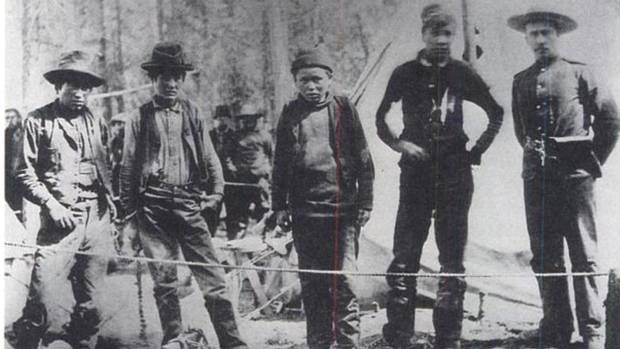
In May 1898, two prospectors, Christian Fox and William Meehan, camped near the mouth of McClintock Creek were only mildly uneasy about the arrival of the Nantucks, Tagish brothers who set up an adjacent camp. Relations were amicable for a while, but when returning one afternoon from the day’s work the prospectors were suddenly fired upon from ambush by their neighbors.

Meehan was slain in the fusillade. The injured Christian Fox managed to float away, get to land, and reach a miners’ settlement. He described the attack thus:

I was lying on the sacks against the side of the boat … and I saw Joe standing with his gun like this … and all the boys went into the brush, and I says to myself “Now they have shot us for our outfit, and are hurrying down to the next bend in the river to catch the boat … My only show is to get to the opposite side of the river and try to make for a white habitation” … I took the paddle in my hand and tried to paddle the boat but I was too weak, so I … used it as a pry … The boat ran up to a nice little level place where it was grassy and as I stepped out I stepped over the leg of my partner as he was stretched out over the boat with his head back and his mouth open and I saw that he was dead, and I said “Good by Billy old boy, I can do nothing for you here.”

By Fox’s report, the four Nantucks were soon taken into custody.

The four Nantuck brothers, shackled after arrest.

The trial unfolded in a court at the territorial capital of Dawson City. A compelling chapter in Strange Things Done: Murder in Yukon History does wonderful work with the cultural disconnections, including a two-page exchange between judge and interpreter (and, off-camera, Frank Nantuck) in which the court struggles to get the accused sworn “so help me God” since Frank’s cosmology has no idea of an afterlife. “He says, when he is dead he is dead — that is all I can get out of him,” the helpless middleman reports.

Q Has he any knowledge of God at all or any idea about a future state of rewards and punishments?

A No sir.

Q Or any clear belief in religion of any kind?

A No sir.

Q Will you say to him that we want him to tell us the truth and not to tell us anything that is not the truth; that he may be punished if he tells us anything that is not the truth; that we are going to ask him some questions and that he must tell us just the truth; ask him if he will agree to do that.

The outcome of the trial will not surprise and there was no question but that the Nantucks had done the shooting. What the Dawson court only barely noted was that brothers had been detailed to avenge two Tagish deaths. An old woman had previously been given or found some “baking powder” and proceeded to make bread with it: in fact, it was arsenic, which was used in mining. Here again is the cultural dislocation; the Nantucks living next to Fox and Meehan were trying to feel out whether those two prospectors were of the tribe that had provided this poison, and of equivalent social rank to the two men who died eating the arsenic-bread. Basically, neither side in this subarctic tragedy had any concept of what the other was on about.

There’s a play about this case, Justice. Peruse the play’s pdf companion study guide on the real historical case here.

In the end, all four Nantucks were condemned to die; Frank was probably still a minor, and he had cooperated with the investigation, so his sentence was commuted to life imprisonment … which did not turn out to be very long at all, since Frank and his condemned brother Joe both died in jail of tuberculosis during the 1898-99 winter.

Dawson Nantuck and Jim Nantuck remained to hang.

Momentarily sensational, the case was long forgotten among whites; it has, however, remained in the oral tradition of Yukon First Peoples. Both communities, however, saw the case brought to the fore when excavations accidentally turned up their remains — along with those of two other hanged men.

One of the other two was the third man to hang this date, a fellow by the name of Ed Henderson. Henderson was an American prospector whose fate might be a bit less instructive for posterity. He suffered from a horrible bladder infection that caused him to pass bloody water every 15 or 20 minutes. “The tortures of the damned,” he described it to court. Wincing yet?

The fact that Henderson suffered from it meant his two prospector-mates suffered from it as well — call it purgatory-level suffering; a member of their party had to relieve himself constantly and thrashed about in his sleeping bag all night for the agony it caused him.

Their empathy for his situation was overturned along with Ed Henderson’s inside-the-tent piss-bowl one night. The drenched and vengeful Tomberg Peterson started an immediate brawl, but Henderson’s leaky plumbing didn’t impair his ability to shoot Peterson dead. Henderson himself reported the incident when the prospectors reached their destination, possibly thinking that no jury would convict him.

The trio comprises the first men hanged by the Yukon Territory, which was only separated from the Northwest Territory in 1898. In fact, there was a bizarre procedural deficiency for the Nantucks (but not for Henderson): they were condemned by the court of the wrong, former territory since word of the territories’ separation had not reached Dawson City at the time of the trial. Nobody saw fit to remedy this blunder, however.

On this day..

1976: Christian Ranucci, never yet rehabilitated

On this date in 1976, Christian Ranucci, 22, was guillotined in Marseilles … with the last words addressed to his attorneys, “Réhabilitez-moi”.

If that has not yet occurred, it has not been for want of trying.

Many people think Ranucci was the last person executed by France; in fact, this is not correct. But the confusion is understandable: Ranucci has persisted in the headlines and the public imagination owing to a running controversy over whether he was wrongly convicted. It’s a vexing case rife with ambiguous circumstantial evidence, and observers are usually able to see in it what they want to see.

On June 3, 1974, two incidents — a minor traffic accident, and the request by a young man of a local mushroomer to help his car out of a muddy gallery where it was stuck — placed a gray Peugeot 304 at La Pomme, outside Marseilles. This also happened to be the date that 8-year-old Maria-Dolores Rambla was abducted from St. Agnes by an unknown man in a red sweater reportedly driving a gray Simca 1100, a vehicle that would be possible to mix up with the Peugeot 304.

When news of the abduction broke on the radio the morning of June 4, the people who saw the Peugeot(s) later called it in as a tip.

Police got to the bespectacled young Ranucci (English Wikipedia entry | French; most of the links from here on out are French) via the accident. His car didn’t stop for the other motorist, but limped on down the road another kilometer. The other driver’s vehicle was inoperable, but that driver sent a passerby to follow the hit-and-run Peugeot’s path to see if he could track down a license plate number. Indeed he did do that.

And when that good citizen called police, he said he had seen the driver running into the nearby woods with either a sizable package or a small child. (The story has … evolved.) You can see where this is going: when the area was searched after the tip came in, poor Maria’s dead body was steps away from the spot the car stopped. She’d been knifed to death.

The mushroom-gallery, for its part, yielded up a red pullover sweater like the one the abductor wore, and a bloody knife.

After 17 hours’ grilling by the police, Ranucci broke down and confessed. He would later retract the confession, blaming police pressure. (Here in 2013, everybody does know — right? — that false confessions happen with alarming frequency, and that they’re widely associated with exonerations.)

As open-and-shut as this sounds, Ranucci’s many defenders have found a great deal wanting in the case

Journalist Gilles Perrault has been on about this case for decades. His L’ombre de Christian Ranucci drew a 50,000 euro judgment for defaming the Marseilles police.

Among the sticking-points for skeptics:

  • There’s the inconsistency in the reported make and model of the vehicle vis-a-vis what Ranucci was driving.
  • None of the eyewitnesses to the abduction could identify Ranucci in a lineup … until the lineup was pared down to make it a gimme. Sloppy lineup work has been a significant factor in wrongful convictions; on the other hand, eyewitnesses are extremely unreliable in general.
  • The recovered red pullover was much too small for Ranucci, possibly suggesting that this apparent link to the observed abductor did not reach all the way to the accused.
  • Mr. Red Pullover Simca 1100 was allegedly seen attempting other abductions at times and places that made it certain that he was not Christian Ranucci.
  • Questionable handling of physical evidence by investigators.

That’s basically just to scratch the surface. Here (pdf) is a much lengthier exegesis of the potentially exculpatory evidence, in French. Here’s an English summary covering the same stuff on a site whose resources are mostly also in French. (“We do not assert Christian Ranucci is innocent.”) Countless additional search hits en francais await the interested researcher.

Ranucci himself insisted against advice on pursuing an actual-innocence defense, rather than mounting a mitigation case focusing on avoiding the guillotine while conceding guilt. He was convicted on just a 9-3 jury vote.

But neither in his own time nor latterly has that case gained much purchase on the conscience of his prosecutors. The President who denied Ranucci’s clemency petition, Valéry Giscard d’Estaing, has recently given his 1976 decision a vote of confidence; the father of the victim feels likewise.

On this day..

2003: He Xiuling, Ma Qingxui, Li Juhua and Dai Donggui

On this date in 2003, four women all condemned for drug offenses were among a group executed by shooting at Wuhan, in central China. This mass execution (conducted in secret but preceded by a humiliating public trial) was scheduled around the June 26 International Day against Drug Abuse and Illicit Trafficking. China has a very long history of looking askance at drug-dealing, and it usually uses the prelude to June 26 for some pointed, well-publicized executions.

In 2003, photographer Yan Yuhong spent 12 hours with this quartet of women on the eve and morning of their executions at Detention Center No. 1. Only years later did the photographs get out: a moving glimpse of ordinary people under the pall of death and the guards and prisoners around them, they made worldwide news in 2011. Apparently their distribution in 2003 was quashed on authorities’ concerns that they were a bit too moving for the big anti-drug message.

Select images follow; the entire series can be perused here or here, and in poignant timeline form here.

He Xiuling

He Xiuling is the most immediately recognizable among them, a pudgy 25-year-old who looks inordinately mirthful in many pictures, but sobs openly just before she is led away to be shot. Follow-up reporting paints the picture of a simple country girl lured by a boyfriend into being a drug mule. She was evidently led to believe, up until the last, that her sentence would be commuted: “I’ll still only be 40 when I’m free!”

Had she been spared, she would be 35 now.


She thought the white top made her look “too fat”, and a guard kindly provided a black one.


Several pictures how He Xiuling smiling and laughing. Here, she enjoys breakfast on the morning of the 25th. She has about four hours to live.


Weeping moments before her execution.

Ma Qingxui

The oldest of the women and seemingly the only one of the quartet who could be characterized as something more than a small-time mule, 49-year-old Ma Qingxui from Baokang county of Hubei province was on her fourth conviction for smuggling more than 8 lbs. of narcotics.


Dressed all in red, Ma Qingxui donates her clothes to another inmate.


Ma Qingxiu being escorted out of the detention center for the execution grounds at 7:21 a.m.

Li Juhua and Dai Donggui

The prisoners least seen in the series and those of whom the least has been reported in the west.


An ordinary (non-condemned) prisoner paints Li Juhua’s toenails on the morning of the latter’s execution.


She dictates her last will and testament to a fellow-prisoners.


On the evening of June 24th, Dai Donggui carefully folds the execution clothes a guard has purchased for her.


A last supper. Reportedly, McDonald’s food is routinely served at the facility for this occasion.

On this day..