2000: Robert Earl Carter, exonerating Anthony Graves

On this date in 2000, Robert Earl Carter was executed in Texas for slaughtering six people at the home of his Somerville ex, after the latter filed a child support suit against him.

The ex herself, Lisa Davis, wasn’t home at the time. But Carter’s stabbing-and-shooting rampage slew Davis’s mother Bobbie, Bobbie’s 16-year-old daughter Nicole, Robert and Lisa’s son Jason (the subject of the support suit), and three other small children that shared the residence. After murdering them, Carter set the house on fire: the burns he suffered to his own face and arms in the process helped connect him to the crime.

Pressed by interrogators, Carter at first admitted only that he was present with someone else who carried out the murders. Over time, he broke down and admitted to the slayings himself.

But Carter’s supposed other party also became a character fixed in the story that investigators were looking to tell — and that party’s identity became fixed on a casual acquaintance whom Carter eventually accused: Anthony Graves.

No forensic evidence implicated Graves, but Carter provided damning testimony at Graves’s 1994 trial. On that occasion, Carter claimed to have shot the teenage daughter Nicole, while Graves committed the rest of the murders, testimony that sent Anthony Graves to death row as well. (Graves’s brother Arthur Curry testified that Graves had been at home sleeping.)

But Carter changed his story again after both men were convicted.

As he prepared for his execution, Carter was keen to clear Anthony Graves before he left this mortal coil. Weeks earlier, he provided a sworn 85-page statement insisting that “Anthony Graves did not have any part in the murders and was not present before, during or after I committed the multiple murders at the Davis home.”

Even in his last statement on this date, Carter went out of his way to exonerate his supposed accomplice. “I’m sorry for all the pain I’ve caused your family,” Carter said from the gurney in his last moments, addressing the execution witnesses from his victims’ family. “It was me and me alone. Anthony Graves had nothing to do with it. I lied on him in court.”

Anthony Graves had been on death row for six years at this point. With Carter’s retraction it had become discomfitingly apparent that there was practically nothing to associate him with that horrific night in Somerville … butit would still be another decade more before he was officially exonerated and released.

After an appeals court ordered a new trial, a different prosecutor’s investigation of the case turned up just how scanty the case against him was.

“After months of investigation and talking to every witness who’s ever been involved in this case, and people who’ve never been talked to before, after looking under every rock we could find, we found not one piece of credible evidence that links Anthony Graves to the commission of this capital murder,” announced former Harris County prosecutor Kelly Siegler in a statement officially exonerating Graves. “This is not a case where the evidence went south with time or witnesses passed away or we just couldn’t make the case any more. He is an innocent man.” Siegler had been hired as a special prosecutor, and would have been the one to re-try Anthony Graves.

That happened in 2010, by which point Graves at age 45 had spent 18 years in prison, 12 of them on death row.

Today, Anthony Graves — you can find him on twitter at @AnthonyCGraves — is an activist and motivational speaker. He’s been outspoken especially on the torture inflicted by long-term solitary confinement, which he also endured during his years in prison.

Graves’s original prosecutor Charles Sebesta — against whom Graves has sought disciplinary action — maintains a site of his own with a page casting doubt on Anthony Graves’s innocence. (It’s also a minor monument to the “Blog” of “Unnecessary” Quotation Marks.)

On this day..

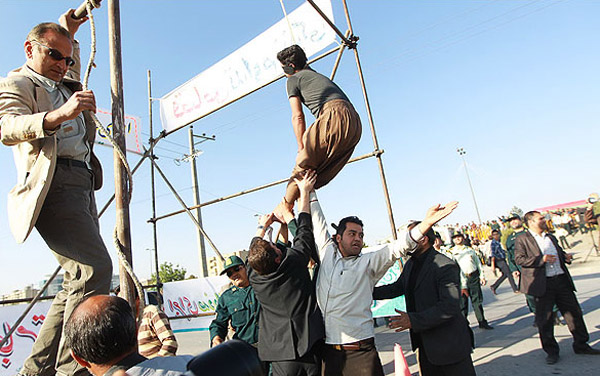
2013: Vahid Zare pardoned while hanging

Last year on this date, an astonishing scene unfolded at a public hanging in Mashhad, near the Iran-Afghanistan border.

Vahid Zare, a robber who murdered a young military conscript pursuing him, was the man due for execution.

Moments after he was dropped and began strangling, the family of his victim pardoned him — their right under Iranian law. Zare was immediately rescued mid-hanging, and his executioner helped him off the gallows for transportation to a local hospital.

The graphic pictures that follow tell an astonishing story.

On this day..

1922: Colin Campbell Ross, for the Gun Alley Murder

On this date in 1922, Colin Campbell Ross was hanged for the rape-murder of a little girl, still on the scaffold vainly protesting his innocence.

I am now face to face with my Maker, and I swear by Almighty God that I am an innocent man. I never saw the child. I never committed the crime, and I don’t know who did. I never confessed to anyone. I ask God to forgive those who have sworn my life away, and I pray God to have mercy on my poor darling mother, and my family.

Ninety-odd years later, folks finally believe him.

Ross had a couple of brushes with the law already to his rap sheet when 12-year-old Alma Tirtschke went missing in the vicinity of Ross’s Melbourne dive bar on December 30, 1921.

In a classic instance of police tunnel vision, the proximity of a violent felon to the murdered girl — for Alma’s body was found the next morning in nearby Gun Alley, which bestowed a popular moniker upon the case — soon formed the theory of the crime, the predetermined conclusion into which incoming evidence was read.

(It certainly catalyzed the investigation that the case became a media sensation. Rupert Murdoch’s father through the Melbourne Herald shamelessly hounded the Crown for each day’s delay, and jacked up the reward purse.)

Witnesses established that Ross had been tending bar all that afternoon; to account for that, it was necessary to posit that Ross had plied his prey with wine for several hours until he could finish her off after his shift.

Once arrested, despite continuing to assert his innocence to all and sundry, Ross proved to suffer from that universal tendency accused men have to senselessly unburden themselves to a random cellmate. The Crown could scarce shirk its public duty by omitting the incriminating evidence merely because it was related by a convicted perjurer. Ross, his accuser claimed, “said he was simply burning to tell someone.”

Still more damningly, a blanket from Ross’s home proved to have some strands of auburn hair glancingly similar to Alma Tirtschke’s — or possibly Ross’s girlfriend.

A Crown analyst from ventured to compare these under a microscope, and would later put it to the court that they looked like Alma’s. This would be the first time hair forensics were deployed in an Australian courtroom.

Was it not possible, asked Ross’s counsel — who genuinely believed his client’s innocence and fought the corner until the very last — that it might be almost literally anyone else’s auburn hair?

“Yes; quite possible, but not probable,” was the reply from the witness. “Because of the general similarity of hair.” Oh.

Even decades later this gotcha was being celebrated as a triumph of forensic science, for the blanket’s locks “corresponded exactly” with those of the victim.

But they didn’t correspond.

“The day is coming when my innocence will be proved,” Ross wrote in a farewell letter to his family.

That day took 85 years in coming.

In the 1990s, author Kevin Morgan stumbled somewhat miraculously upon preserved hair samples from the case and began an odyssey that would see him to officially exonerating Colin Campbell Ross.

Tests Morgan was able to arrange with the Victorian Institute of Forensic Medicine and then with police both agreed that under modern microscopic examination the hairs in question did not bear even a surface resemblance. With the support of the Victorian Attorney General and the Australian Supreme Court, Ross was granted a posthumous pardon on May 27, 2008 — the first person ever so distinguished in Victoria’s history.

Tirtschke’s own family, too, supported this result: they had long harbored their own doubts about the verdict. “She didn’t say who was the right man but she said the wrong man was hung,”* one descendant said of her grandmother’s recollections.

* Though a lesser horror compared to being railroaded in the first place, Ross’s hanging was also badly botched. An experimental four-strand rope failed to sever his spinal cord, leaving his dangling body to convulse as Ross wheezed his last breaths through a torn windpipe.

On this day..

1801: Angre Kethi, Polygar prey

On this date in 1801, a luckless British messenger was hanged to a Tamarind tree during the Polygar Wars.

The Polygars — an English corruption of the Tamil word Palaiyakkarar — were feudal administrators in South India whose authorities the ascending East India Company struggled to bring to heel.

A brief first rebellion in 1799 gave way to a second more substantial one from 1800 to 1805; these are the Polygar Wars.

As one might imagine the fight was quite nasty, and not wanting for executions. Notably, the British had hanged a Polygar chief named Kattabomman in 1799 after the first Polygar War.

But one of Kattabomman’s old allies, name of Ethalappa Naicker Zamin, was among a coalition of Polygars who rose against the British in the subsequent war.

It was to this man that the British dispatched the messenger Angre Kethi — a man whom Naicker decided to make an example of.

The spot of the hanging, known as “Thookupuliamara Thottam”, was long known locally, but it recently made wider news when an archaeologist discovered a stone inscription at the messenger’s memorial attesting the name and date of the hanging.

On this day..

2013: Alireza Mafiha and Mohammad Ali Sorouri, viral video stars

A 37-second security camera clip of a Tehran being mugged by machete-wielding assailants went viral to great outrage in Iran in December 2012, and resulted in the very speedy execution on January 20, 2013, of the culprits.

Alireza Mafiha and Mohammad Ali Sorouri were publicly hanged at a still-dark 6:30 a.m. before a crowd of about 300 people for Moharebeh (waging war against God)

There’s a photo series of the execution here.

Two other accomplices (the video captures four assailants in all) received 10 years in prison and 74 lashes.

On this day..

2013: Zhang Yongming, cannibal corpse

(Thanks to Meaghan Good of the Charley Project for the guest post. -ed.)

One year ago today, 57-year-old Zhang Yongming was executed in China, just six months after a court in the province of Yunnan convicted him of murder. Zhang, a farmer, was modern China’s answer to Fritz Haarmann: authorities believe he killed young men and boys, cannibalized parts of their bodies and sold the leftover flesh at the village market.

Convicted of eleven murders, he’s suspected of six more.

When young people started disappearing in the neighborhood, the police initially assumed they’d been kidnapped and sold for slave labor, a sad situation that’s all too common in present-day China.

From TruTV:

Witnesses reported that Yongming began selling meat at the local market, which he had never done before, after 1997. The meat, which he sold as ostrich meat, was cured and dried.

When police finally searched Yongming’s house, they found strips of human flesh that were hung up to dry around his house. He kept dozens of human eyeballs preserved in alcohol in bottles, which police said looked like “snake wine.” Investigators said Yongming likely fed human remains to his dogs. In a nearby vegetable garden, police found bones believed to be human.

This wasn’t the first time Zhang had faced the death penalty, either: in 1979, he was convicted of murder and sentenced to death, but the sentence was reduced and he was released from prison in 1997. The government even helped him get back on his feet by giving him a bit of land and a monthly allowance.

But Zhang simply couldn’t stay on the straight and narrow: by the spring of 2008, he’d started killing again, and the murders didn’t stop until his arrest four years later.

Following his conviction in July 2012, he confessed to his crimes and didn’t bother to file any appeals. He reportedly showed no remorse and didn’t offer any apologies for his victims’ families or any explanation for his conduct.


Zhang’s victims.

On this day..

2013: Rizana Nafeek, Sri Lankan maid

A year ago today, a blindfolded, white-clad Rizana Nafeek had her head chopped off in public in Dawadmy, near the Saudi capital of Riyadh.

Rizana Nafeek, a Sri Lankan, was among the numerous foreign laborers routinely imported to Saudi Arabia for domestic work. There are an estimated 1.5 million migrant domestic workers in Saudi Arabia from South Asia (especially Sri Lanka), Nepal, Indonesia, East Africa, and the Philippines. Most are employed via the kafala (“sponsorship”) system that places their host in an almost lord-like position of authority.

Such workers are excluded from Saudi Arabia’s labor protections, and as a result stand vulnerable to horrifying abuse.* Household heads often confiscate these workers’ passports, and in some cases have subjected their domestic employees to rape, beatings, wage confiscation, and work weeks of 100-plus hours. One Sri Lankan woman had nails driven into her hands when she complained about overwork.

Rizana Nafeek hardly had time to find out whether any of these perquisites were in store for her. Not long after she arrived in Saudi Arabia in 2005 hoping to make enough money as a domestic drudge to move her impoverished family into a house, she had bottle-feeding duties for her host family’s infant foisted upon her. Nafeek had no training in caring for infants.

In May 2005, that child began choking while in Rizana’s care, and her panicked shouts summoned the mother. By the time the mother arrived, the infant had fallen unconscious, and the upset family immediately handed over their maid to the police, accusing her of strangling the baby.

This was the victim for whom Nafeek was decapitated, and also perhaps an illustration of tunnel vision in law enforcement. It’s quite doubtful whether there was ever any objective basis for supposing a homicide, but the fact that this was the color the family gave to events in the horror of the moment set in motion all the ensuing events.

During the investigation leading up to her 2007 trial and condemnation, Nafeek confessed to smothering the child — but she would later claim this confession was tortured out of her, and that the baby simply started choking on its bottle. (There was never a post-mortem on the dead baby.)

Opaque as the Saudi Arabian criminal justice system is, it’s got ample reputation for obtaining confessions by violence, and for mistreating migrant workers. And the accused had scant legal representation and no translator when she was tried for her life in a Saudi court.

After her conviction, it would also emerge that, order to land her the gig, Nafeek’s Sri Lankan recruiting agency falsified her papers to bump her age up past the legal minimum of 21. Rizana Nafeek arrived in Saudi Arabia carrying a passport that said she was born in 1982, making her 23 years old when she committed the supposed murder … but her birth certificate said that she was born in 1988, and was still a minor when the “murder” took place.

As an international clemency push developed for the potentially-innocent underaged migrant worker, the Saudi government strongly rejected its critics’ charges.

Noting that the dead infant’s family refused repeated blandishments of “blood money” to exercise its right to grant clemency, Riyadh officially “deplore[d] the statements made” by Rizana’s supporters “over the execution of a Sri Lankan maid who had plotted and killed an infant by suffocating him to death, one week after she arrived in the kingdom.”

More sympathetic Saudis, undoubtedly meaning well, offered Rizana Nafeek’s family cash compensation after the young woman was beheaded. That money, too, was angrily refused.

“I will not accept any gifts from the Saudis or the Saudi government which murdered my daughter,” mother Saiyadu Farina told a Sri Lankan newspaper. That anger was widely shared in Sri Lanka; Colombo even recalled its Saudi ambassador in protest.

That’s as may be, but money is sure to carry the argument at the end of the day. Wage remittances by overseas laborers are a massive boon to the island nation, amounting to $6.3 billion in 2012 — 8.8% of the Sri Lankan economy. And Saudi Arabia remains the single largest employer (pdf) of Sri Lankans abroad.

As of the time of Rizana Nafeek’s execution, at least 45 other foreign domestics, most of them Indonesians, were also awaiting execution on Saudi Arabia’s death row.

* Ill treatment of migrant domestic workers is a phenomenon elsewhere in the Middle East, and elsewhere around the world.

On this day..

1982: Dos Erres massacre

On December 7, 1982, a unit of army commandos entered the Guatemalan hamlet of Dos Erres.* There it authored one of the signature atrocities of the bloody Guatemalan Civil War.

This was the Guatemala of Efrain Rios Montt, once a junior officer during the CIA-backed 1954 coup that set in motion decades of civil strife.

Relative brutality in that conflict waxed and waned over the years. In 1982, the now-General Efrain Rios Montt overthrew another general and went full werewolf. “A Christian has to walk around with his Bible and his machine gun,” Rios Montt infamously remarked. And more than walk them: the general’s policy was a you’re-either-with-us-or-with-the-terrorists hard line called Frijoles y Fusiles, “beans and shooting.” Campesinos who were with Rios Montt got the beans.

Shortly before this date’s atrocity, a column of Guatemalan soldiers were ambushed by leftist guerrillas, killing 21. Those guys were going to get the fusiles — them, or any convenient peasants who might hypothetically be on friendly terms with them.

Dos Erres, a remote jungle village of 60 families, was the settlement nearest where the rebels were thought to be operating. The little town had already drawn the ire of the army by resisting recruitment to civil defense patrols.

Late on the night of December 6, 1982, 20 members of Guatemala’s Kaibiles commandos set aside their special forces uniforms and disguised themselves as guerrillas, in green t-shirts and civilian trousers and red armbands. Ostensibly their mission was to recapture the rifles the rebels had seized from the ambushed convoy, which were supposed to be stashed in Dos Erres.

Hiking two hours into the jungle to reach their target, the commandos crept into the still-sleeping settlement at 2 in the morning. With the support of a 40-man regular army detachment to seal Dos Erres’s perimeter, the commandos stormed into residences and drug bewildered townspeople out, herding the men into a school and the women and children into a church.

That commenced an all-day litany of horrors for the residents of what was about to become the former village. Dos Erres was wiped off the map by the end of it.

One of the senior lieutenants on the mission raped a woman, and other commandos immediately availed themselves of the implied license to abuse women and girls. By the end of it, the last sobbing women and children were led out to the forest and machine-gunned en masse.

They were by then the last survivors, save for a little boy who managed to escape into the jungle. Throughout the course of the 7th of December, the Kaibiles brought villagers old and young to the edge of the town well. “As they were brought to the well, they were asked, ‘where are the rifles?’,” one of the participants later described. “They said nothing about rifles, and they were hit on the back of the head with a sledgehammer, and thrown in the well.” Every commando had to participate, so that all were implicated.

Commando Gilberto Jordán drew first blood. He carried a baby to the well and hurled it to its death. Jordán wept as he killed the infant. Yet he and another soldier, Manuel Pop Sun, kept throwing children down the well.

The commandos blindfolded the adults and made them kneel, one at a time. They interrogated them about the rifles, aliases, guerrilla leaders. When the villagers protested that they knew nothing, soldiers hit them on the head with a metal sledgehammer. Then they threw them into the well.

“Malditos!” the villagers screamed at their executioners. “Accursed ones.”

“Hijos de la gran puta, van a morir!” the soldiers yelled back. “Sons of the great whore, you are going to die!”

[Commando Cesar] Ibañez dumped a woman in the well. [Favio] Pinzón, the cook, dragged victims there alongside a sub-lieutenant named Jorge Vinicio Sosa Orantes. When the well was half-filled, a man who was still alive atop the pile of bodies managed to get his blindfold off. He shouted curses up at the commandos.

“Kill me!” the man said.

“Your mother,” Sosa retorted.

“Your mother, you son of the great whore!”

Pinzón watched as the infuriated Sosa shot the man with his rifle and, for good measure, threw a grenade into the pile. By the end of the afternoon, the well overflowed with corpses.

The commandos left town the next morning with six captives: the rebel who had been forced at gunpoint to guide the Kaibiles to Dos Erres in the first place (he would be executed in the field); three teenage girls (the soldiers that night would take turns raping them, then strangled them the next day); and two very small boys (these were returned to the Kaibiles base). A few days later, the army returned and razed the remains of the devastated town to the ground. Only recently has the site been excavated and its many victims’ remains cataloged for proper burial.

The tragedy of Dos Erres became public in the 1990s. Five soldiers who participated in the butchery have each been sentenced to 6,060 years in prison just for this one incident, but there were many more like it in Guatemala in those years — many more people who were put to Frijoles y Fusiles.

A 1990s truth commission after the war pegged the total number of civilians killed during the war above 200,000, mostly indigenous Mayans and (as was the case for most at Dos Erres) mestizos. “State forces and related paramilitary groups were responsible for 93% of the violations documented.”

The truth commission also found that the “government of the United States, through various agencies including the CIA, provided direct and indirect support for some state operations.” Indeed, supporting death squads against leftists in Central American dirty wars was overt U.S. policy during the 1980s; just days before Dos Erres, U.S. President Ronald Reagan returned from a Latin American tour and told reporters that Rios Montt, whom he had just met, was “totally dedicated to democracy in Guatemala.”

“They’ve been getting a bum rap” from human rights nabobs, Reagan averred.

In the fullness of time that rap would eventually encompass Rios Montt’s own remarkable conviction for crimes against humanity and (since the Mayan population was targeted en masse) genocide in a landmark case that’s still being appealed as of this writing. (The May 2013 verdict against Rios Montt was immediately overturned; the case is obviously extremely politically sensitive.) In a separate case, he’s been charged specifically with responsibility for the Dos Erres massacre.

U.S. President Bill Clinton formally apologized for Washington’s role in Guatemala after the truth commission’s findings were issued in 1999.

The PBS radio program This American Life has an hour-long documentary about Dos Erres here; a companion ProPublica series has even richer (and more horrifying) detail.

* Named for its founders, two men named Ruano and Reyes, the name literally meant “two Rs”.

On this day..

2008: Wo Weihan, spy?

On this date in 2008, Chinese biochemist and businessman Wo Weihan was shot for espionage along with his alleged co-conspirator Guo Wanjun.

Wo had been resident in Austria since 1990, and his daughters Chen Ran and Chen Di were Austrian citizens. In 2004, he returned to his native soil to launch a medical equipment firm in Beijing.

Wo was arrested in China in January 2005 and accused of passing “state secrets” to Taiwan and the U.S. He didn’t have a lawyer until 2006 — by which time he had produced a coerced confession that he tried in vain to retract — and the 2007 trial took place in secret, so the case against him was troublingly opaque at the time of his execution. The verdict publicly released in March 2008 even included such trifles as “discussing the health of senior Chinese leaders” — an actual crime in China but awfully difficult to accept as a factor in a capital case.

“The lack of transparency does nothing to reassure us that the court’s conclusion was the right one,” said a Dui Hua Foundation spokesman.

Allegedly, Wo got information about Chinese ICBMs from missile expert Guo Wanjun, and passed drawings to Taiwanese and American intelligence. Chinese state media have claimed that Wo’s wife was able to open a restaurant in Austria with the payoffs.

His daughters mounted a last-ditch clemency campaign involving European Union officials, Austrian President Heinz Fischer, and U.S. Secretary of State Condoleeza Rice, all to no avail.

On this day..

2011: Reginald Brooks, flipping the bird

(Thanks to Meaghan Good of the Charley Project for the guest post. -ed.)

On this day in 2011, multi-filicide Reginald Brooks was executed in the Southern Ohio Correctional Facility in Lucasville, Ohio.* He was the fifth man executed that year and, at 66, the oldest since 1999.


Brooks (top) and the children he murdered.

Although his guilt was never in question, he had spent close to thirty years on death row while his appeals wound their way through the system.

On March 6, 1982, just days after his wife filed for divorce, Brooks shot their three sleeping sons: Reginald Jr., 17, Vaughn, 15, and Niarchos, 11. He then bought a bus ticket to Las Vegas, taking the gun with him in his suitcase, as well as his birth certificate and high school diploma. The police caught up with him in Utah.

Brooks had some history of domestic violence, but his only prior arrest had been for grand theft. His aunt, when asking the appeals board for clemency, said he had a normal, loving relationship with his children. Before shooting them all in their sleep, that is.

His attorneys argued that his crimes were motivated by mental illness, namely paranoid schizophrenia. Brooks had a normal childhood and young adulthood, but started to fall apart in the years prior to the murders. He quit his job in the 1970s because he thought his coworkers were trying to poison him. (He never worked again and his wife had to support their family.)

Beginning around 1980, he began isolating himself from friends and family, and accused his wife of committing incest with Reginald Jr. The family tried to get psychiatric help for him, to no avail.

In spite of overwhelming evidence, Brooks never admitted to his crime and suggested various bizarre theories as to what had really happened. A psychiatrist who evaluated him in 2010 and 2011 believed Brooks genuinely could not remember shooting his sons.

There was, however, clear evidence of premeditation: Brooks had purchased the murder weapon nine days before the murders, lying on his application form where it asked if he’d ever been convicted of a felony. He also turned on the stereo in his apartment and left the music blaring loudly, presumably to drown out the sound of the gunshots. Then, after the murders, Brooks immediately left town, taking documents he would need to start a new life — clearly suggesting cognizance of guilt.

The prosecution conceded Brooks did have schizophrenia, but argued that his illness was not so severe as to make him incompetent or legally insane, and that he was lying when he said he couldn’t remember committing the murders. Attorneys for the state suggested he murdered his children to spite his wife, “through a twisted sense of jealousy, hatred, or despair.”

Brooks’s ex-wife, Beverly, witnessed his execution. He had no last words, but he did give a message: glaring at the glass behind which the witnesses were standing, he stuck out the middle fingers of both hands. And as he slowly lost consciousness and breathed his last, his middle fingers still stood erect.

* The Texas of the North when it comes to capital punishment.

On this day..