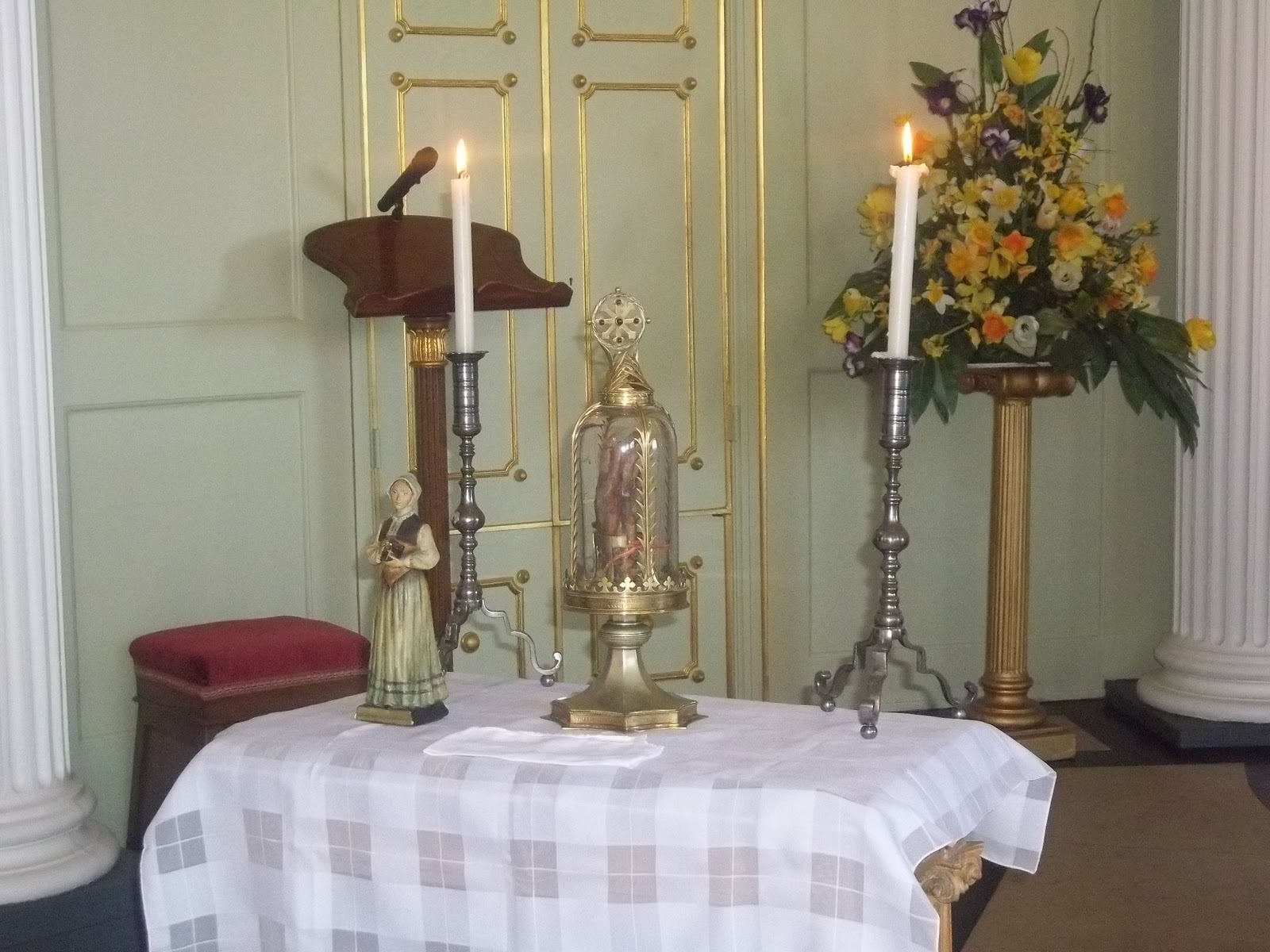
1586: Saint Margaret Clitherow, pressed Catholic

(Thanks to historian Courtney Thomas for the guest post. -ed.)

On March 25, 1586 Margaret Clitherow, the wife of a York-based butcher, was subjected to one of the more obscure forms of capital punishment in early modern England: she was pressed to death, the mandated form of punishment for those who refused to enter a plea to a legal charge.*

Margaret was a victim of increasingly stringent attitudes toward recusants in the second half of Elizabeth I’s reign (1558-1603): Margaret was pressed to death just a year before the execution of Mary Queen of Scots for her role in a Catholic plot to overthrow the Elizabethan regime and two years before the 1588 Spanish Armada.

The two officials who were tasked with carrying out the sentence allegedly employed several beggars to perform the job instead and Margaret was taken to the toll-both on the bridge that straddles the river Ouse where she was stripped and had a handkerchief tied over her eyes as a blindfold. She was then placed upon a rock roughly the size of a baseball or an adult’s fist and a large panel of wood (roughly the size of a door) was put on top of her and slowly loaded with 700-800 pounds of rocks and stones.

In theory the smaller rock beneath her would break her back when the heavy rocks were piled on.

Witnesses report that she expired within about fifteen minutes. Other victims of this punishment were not typically so lucky. For example, Giles Corey, executed in Salem in 1692, had weights slowly piled on him for a period of several days (being asked daily before more weight was added if he wished to enter a plea to the charge that he was a warlock) before he expired.

Margaret was born Margaret Middleton in 1552/3, the daughter of a wax-chandler named Thomas and his wife Jane, the daughter of Richard Turner, an innkeeper. One of four children, she was born during the reign of Mary I (who has gone down in history with the unfortunate (but not entirely undeserved) appellation “Bloody” attached to her).

A bit of background on the process of the various reformations in England is necessary to understand why Margaret’s Catholic beliefs were treated so harshly.

Having broken with the Roman Catholic Church and founded the Anglican Church in the 1530s through a legislative reformation designed to assist him in securing the dissolution of his marriage to Catherine of Aragon so that he could wed Anne Boleyn, Henry VIII saw many of his religious policies undone by his heirs.

He was succeeded on the throne in 1547 by his son (with his third wife, Jane Seymour), Edward VI, who made England into a more recognizably Protestant state than Henry appears to have intended (while Henry was interested in reforming stances, he appears to have identified most strongly with Catholic principles and geared his reformation toward abolishing the authority of the Pope in English ecclesiastical affairs, rather than changing beliefs and practices).

Edward was, however, a short-lived king, having died in 1553 after but six years on the throne. He was succeeded by his half-sister Mary (daughter of Henry’s first wife Catherine of Aragon) who was a devout Catholic and spent much of her reign steering England back into the port of Catholicism — a task which involved martyring approximately three hundred of her subjects for their Protestant sympathies.

Mary, in turn, was succeeded by Elizabeth, the daughter of Henry’s second wife, Anne Boleyn. Elizabeth was of a Protestant mindset and reinstituted the Anglican Church. Though initially reluctant to persecute people for their beliefs (she expressed herself as having no desire to “make windows into men’s souls”), political circumstances involving a plethora of plots on the part of Catholics (both real and perceived) against the Queen resulted in a hardening of attitudes.

While fines and penalties were in place for non-attendance at Church of England services, the regime also began to enforce strict penalties against those found guilty of sheltering priests and Jesuits. And it was to these laws that Margaret fell victim.


On July 1, 1571, when she was about eighteen years old, Margaret wed John Clitherow, a local York butcher and a widower with two sons. The number of children borne by Margaret to her husband is unknown; in addition to her stepsons William (1563-1636) and Thomas (d. 1604), she bore Henry (b. 1572) and Anne (1574-1622) and there is mention of other pregnancies but the details do not survive.

In 1574, when she was twenty one, Margaret experienced a spiritual awakening and converted to Catholicism.

While her husband did not join her in converting, members of his family also held Catholic sympathies and he was not unsupportive of her conversion, with the exception of one recorded incident when he railed against Catholics while drunk at a banquet.

Margaret soon became highly involved in northern England’s underground Catholic community. She regularly held masses in her home in the Shambles (where she assisted her husband with his business) and her son, Henry, traveled to Rheims (a Jesuit centre) to train for the priesthood. Inside her home, Margaret created a series of architectural features to facilitate the concealing of priests, including a priest hole and a hole which was cut between the attics of her house and the adjoining house which could be used by a priest to escape in the event that the house was searched.

Inevitably Margaret’s involvement with the local Catholic community drew official censure, and from 1576 onwards, John Clitherow incurred regular fines for her refusal to attend Church of England services with him. She was also imprisoned several times for her refusal to conform, serving three separate terms in York Castle as a recusant (August 1577 – February 1578; October 1580 – April 1581; March 1583 – winter 1584).

Once released, despite her efforts at concealment, on March 10, 1586 Margaret was arrested for harbouring priests (which, in 1585 had been made a capital offense). In a search of her house, a frightened child had revealed the location of a secret room containing Catholic paraphernalia and designed to shelter a priest.

After her arrest, Margaret was jailed and on March 14 she appeared at the assizes. Although she was repeatedly asked to plead, she refused a trial by jury and thereby incurred the penalty of peine forte et dure: being crushed or pressed to death. Margaret maintained that her refusal to plead was a measure to prevent her children and servants having to testify against her and also served to protect the souls of the jury which would find her guilty. It is very likely that she also wanted to protect other local recusants who had assisted her and desired to prevent the revealing of their identity, which a trial would have uncovered. However, many contemporaries simply thought her mad and wondered at her seeming indifference to her husband and children — and Margaret’s willingness to abandon them for martyrdom.

Yet, despite her imminent death, Margaret allegedly did not forget her family in her final days and reportedly sent her hat to her husband and her hose and shoes to her daughter, Anne. Some people, including her father-in-law, engaged in scurrilous mongering and postulated that Margaret’s willingness to die stemmed from guilt over an illicit encounter with her confessor, whose child she now carried. Such views, however, did not attain much popularity.

After her sentencing, she was visited by several local Protestant preachers and kin, who endeavoured in vain to persuade her to plead guilty and throw herself on the mercy of the assize justices. She also appears to have been pregnant at the time as many people urged her to publicly admit her condition and thereby obtain a stay of execution.

Margaret steadfastly refused to consider any of these things; she had embraced martyrdom. After her death, local family and friends (one of whom, John Mush, later authored a biography that remains the primary source for her life) found her corpse (buried anonymously as a criminal) and reinterred her in an unknown location in accordance with Catholic rites.

After his wife’s death, John Clitherow married for a third time and remained a convinced Protestant until his own death. The couple’s children, however, embraced their mother’s Catholic faith. Anne Clitherow was briefly imprisoned in 1593 for her refusal to attend Church of England services and eventually became a nun at the convent of St. Ursula’s in Louvain in 1598. Henry (the son who had traveled to Rheims) studied first to be a Capuchin (he joined that order in 1592) and then to become a Dominican. He died, possibly insane, without having firmly settled on an order. Margaret’s stepson, William, became a priest in 1608, and her other stepson, Thomas, a draper, was imprisoned for his recusancy. He died in Hull prison in 1604.

Margaret’s work for the English Catholic community and her martyrdom resulted in her canonization in the twentieth century. She was beatified in 1929 and canonized in October of 1970 — one of the Forty Martyrs of England and Wales. After her execution, somebody apparently chopped off her hand to preserve as a relic at the Bar Convent in York. Margaret’s feast day in the current Roman Catholic calendar, together with that of the other thirty-nine English martyrs, is May 4 — although in England it is celebrated on August 30.

A few books about Margaret Clitherow

* Editor’s note: the trial could not begin without a guilty/not-guilty plea, so pressing was a means of forcing a mum defendant to the bar. Brute force often succeeded in extracting the necessary plea; however, because death by pressing preceded trial or conviction, a defendant hardy enough to undergo that fate could use it as a means to skip to the “execution” without suffering the other pains of criminal conviction. In Margaret’s case, she avoided the potential implication of other furtive Catholics at trial; in Giles Corey’s case, he avoided forfeiting his property upon the inevitable witchcraft conviction, and passed his estate to his heirs instead.

On this day..

1943: Toralf Berg, Norwegian resistance member

On this date in 1943, Norwegian resistance member Toralf Berg was executed at Falstad concentration camp in Quisling Norway.

Information about this courageous outdoorsman is difficult to come by; try this Norwegian page for a bit of background.

The Gestapo captured him in August 1942, tortured him horribly, and had him shot. Later, Berg’s torture and execution would be one of numerous World War II brutalities charged in the war crimes indictment (PDF | HTML) against German Obersturmbannführer Gerhard Flesch.

Flesch was himself executed on these charges on February 28, 1948.


Memorial for Falstad forest, where many of the camp’s executions took place. (cc) image from the Municipal Archives of Trondheim.

On this day..

1548: Francesco Burlamacchi, Lucca republican

On this date in 1548, Francesco Burlamacchi lost his head … for a united Italy?

A humanist patrician with a soft spot for Plutarch, Burlamacchi had orchestrated a bid to break away an independent federation of Tuscan cities — Florence, Pisa, and his own city of Lucca.

The dream of the Republic and liberty lived long after Rome’s legions had ceased to tromp. It’s just that said dream got reliably tromped over whenever it threatened to materialize in reality.

These prospectively-liberated cities existed with formal independence under the aegis of the allied Holy Roman Emperor Charles V — and were locally bullied by the Medici Duke Cosmo. That made two Caesars who would not be keen on fragmented city-states coalescing into Burlamacchi’s Republic of Tourist Hotspots; for good measure, Burlamacchi threw in some religious reform and anti-clericalism that would be sure to go down poorly with the church. (Lucca was notorious in the Vatican’s eyes as a center of heterodoxy.)

Against this likely formidable opposition, our plotter counterpoised an astonishing rolling-putsch plan.

His scheme was to march a militia, under cover of “training,” out to the environs of Pisa where he would appeal to the Pisans to throw off their Florentine shackles, then march the resulting larger troop to Florence and appeal to the Florentines to kick out the Medici. Revolution accomplished, the neighboring cities — Siena, Arezzo, Lucca itself — would naturally adhere to this new confederation.* He meant, he later told his judges, to “free all of Tuscany.”

Pretty ambitious. Or optimistic. Or … bonkers.

Once the impossible dream plot was betrayed from the inside, Duke Cosmo, as the most direct target of the intended march, wanted Burlamacchi delivered to his own hands for interrogation and punishment; the elders of Lucca could not do this without making an impolitic show of submission to their neighbor.** Charles V resolved the impasse by taking Burlamacchi to the imperial seat of northern Italy, Milan, and cutting his head off there.

During Italy’s 19th century risorgimento, the Italian writer Carlo Minutoli rediscovered Burlamacchi and popularized him as a forerunner of the new Italian nationalists. (Burlamacchi had long been forgotten as an embarrassment in the intervening centuries.)

Accordingly, with the (proto-)unification of Italy, Tuscan sculptor Ulisse Cambi was commissioned to produce a monumental statue of Francesco Burlamacchi. This would-be Aratus still keeps watch on Lucca’s Piazza San Michele.


(cc) image from alphaorionis. Note that, according to The Renaissance in the Streets, Schools, and Studies (whose chapter “Fortune’s Fool” by Mary Hewlett was invaluable to this post), the historical Burlamacchi actually never carried a sword and hated bloodshed.

* The confederated city-states model was really big in the family. Burlamacchi’s teenage — at the time of the execution — son Michele later emigrated to Geneva, in the Swiss Confederation, and converted to Calvinism.

** Lucca was declining as a power at this time, and all the more insistent about jealously guarding a maximal appearance of sovereignty. The city-state’s major project in the 16th century was throwing up city-girding defensive walls meant to preserve her independence.

On this day..

1565: Benedetto Accolti, would-be papal assassin

On this date in 1565, three men who schemed to assassinate Pope Pius IV were put to public death at the Capitol.

Detail (click for the full painting) of Parnassus by Raphael, the Vatican’s “Raphael Rooms”. According to Jonathan Unglaub,* this figure is the then-acclaimed, today-obscure poet Bernardo Accolti, our failed assassin’s great-uncle.

Pius was a pope of the counter-reformation; it was he who brought the Council of Trent to its conclusion.

And though generally noted for his moderation (and his enthusiasm for building), he was not above striking heads from shoulders. Upon his ascension a few years prior he had dealt harshly with the nephews of his predecessor.

Accolti hailed from a prominent Florentine noble family; his father and namesake was a scheming cardinal.

Young Benedetto, clearly, could scheme a little himself, since he roped several buddies (Italian link) into a plot to murder the pontiff. In December 1564, they presented themselves at a papal audience, but apparently got cold feet. One of their number, a Cavalier Pelliccione, ratted the lot of them out before they could muster their nerve a second time: the good cavalier might have been motivated by having possession of treasonably pre-written letters to be sent to various dignitaries upon the pope’s violent deposition.

Pelliccione accordingly skated with a pardon, but two co-conspirators were sent to the galleys for life.

Benedetto Accolti, Antonio Canossa, and Taddeo Manfredi were dragged to the Capitol on January 27 and put to the gruesome public butchery — “like cows” — of the mazzolatura.

There are several resources that claim the plot was among Catholic ultras who found Pius a little on the heretical side. This Italian encyclopedia entry attributes to the astrologically-inclined Accolti a more nutty-prophetic ambition of a “papa angelico” who would unify Christendom.

Maybe he should have just exercised a little patience. Pius IV died in December 1565.

* Jonathan Unglaub, “Bernardo Accolti, Raphael’s ‘Parnassus’ and a New Portrait by Andrea del Sarto,” The Burlington Magazine, Vol. 149, No. 1246, Art in Italy (Jan., 2007).

On this day..

1863: Mangas Coloradas, Apache leader

One hundred and fifty years ago, day to day,* the Apache chief Dasoda-hae — better known as Mangas Coloradas, “red sleeves” — was extrajudicially executed by U.S. Army soldiers at Fort McLane, New Mexico.

This legendary Apache statesman’s nickname was Spanish, because he’d spent the 1830s and 1840s fighting Mexicans seeking bounties on Apache scalps. Indeed, when the U.S. in 1846 attacked Mexico, Mangas Coloradas gave U.S. soldiers safe passage through Apache territory, and subsequently signed a treaty with the victorious Americans. (There’s a handy map of the scene in this pdf.)

He did his utmost to keep relations with the gigantic industrial society on his borders safely diplomatic, but over the 1850s Apaches spiraled into conflict with aggressive Anglo settlers drawn by the call of gold. In 1861 Mangas Coloradas married his daughter to another Apache chief, Cochise. These two were able to keep whites at bay with raids for a short time (and given a big assist from the resource diversion of the Civil War). But there was only one way this was going to end.

In January 1863, Mangas Coloradas — about 70 years old and still alive to the impossibility of long-term success by force of arms — arrived under a flag of truce to negotiate a ceasefire with Brigadier General Joseph Rodman West. West had him clapped in irons instead, and let his soldiers know exactly how to handle their prisoner.

Men, that old murderer has got away from every soldier command and has left a trail of blood for 500 miles on the old stage line. I want him dead or alive tomorrow morning, do you understand? I want him dead.

That night, Mangas Coloradas was tortured with red-hot bayonets and shot “trying to escape.” The Apache Wars would expand calamitously in the years to come.

The army medical officer David Sturgeon took the Apache’s scalped head (they scalped him, too), eventually bringing it to Ohio after he left the service. Sturgeon finally presented his prize to Prof. Orson Squire Fowler; Fowler examined it and published a description in his 1873 work Human Science: Or, Phrenology: Its Principles, Proofs, Faculties, Organs, Temperaments, Combinations, Conditions, Teachings, Philosophies, Etc., Etc..**

The fate of this horrid trophy after it passed through Fowler’s hands is a mystery. It’s rumored that the Smithsonian received it, and perhaps surreptitiously got rid of it; while the institution has always denied ever having the skull of Mangas Coloradas, it is a fact that the Smithsonian collected and still possesses an alarmingly enormous trove of Native American remains.

* It appears to me that Mangas Coloradas entered into army custody on January 17, and was shot just about midnight that night: the exact moment of the incident could be either the 17th or the 18th. An eyewitness account from one of the soldiers on night watch describes giving over the watch to George Lount until midnight. When the first watchman returned at that time, he noticed that “Mangas arose upon his left elbow, angrily protesting that he was no child to be played with. Thereupon the two soldiers [who had been torturing Mangas], without removing their bayonets from their Minie muskets, each quickly fired upon the chief, following with two shots each from their navy six-shooters.”

** What did the skull-measurer make of his prize? “It bulges out at its side in the region of Secretion, Caution, and Destruction, beyond anything I ever saw. Cunning is his largest organ, and far exceeds any other development of it I have ever seen, even in any and all Indian heads. It is simply monstrous. Yet Destruction also far exceeds any other development of it I ever saw …

“Conscience and Worship are unusually large, both absolutely and relatively, which coincides with the scrupulous fidelity with which he kept his promises. He doubtless thought he was but doing his duty in avenging the injuries white men had done to his tribe, by torturing and killing them. He must also have been a devout worshipper of the Great Spirit and extremely superstitious. Benevolence is very poorly developed indeed.”

(Mangas Coloradas actually was a very tall man with a very large head: a number of accounts attest to this.)

On this day..

1897: The Bicol martyrs of Philippines independence

On this date in 1897, eleven pro-independence Filipinos were shot at Manila’s Bagumbayan execution grounds.

These eleven,* together with one who was tortured to death on a prison brig and three others who died exiled to prisons elsewhere in the Spanish empire, comprise the Fifteen Bicol (or Bikol) Martyrs.

Spanish suppression of the unfolding Philippine Revolution was in full martyr-making; just days before, the same site had seen the execution of Dr. Jose Rizal. (A few days after this, it made still another batch of martyrs.)

“They died bravely,” a Filipino newspaper reported. “They died like those who are sustained by a sacred ideal.”

They were.

This date’s victims had been rounded up on September 16 at Naga City in the Bicol Region. It was the aftermath of Spain’s discovery of the anti-colonial Katipunan secret society, and mass arrests followed by torture-aided interrogation were the order of the day.

These would not, in the end, avail.

As a result, the “Quince Martires” are still commemorated in independent Philippines every January 4, which is a public holiday in Naga City … and commemorated throughout the year at that city’s Plaza Quince Martires, and its monument.


(c) image courtesy of Wally Ocampo.

* Rev. Fr. Gabriel Prieto; Gabriel’s brother, Thomas Prieto; Rev. P. Severino Diaz; Rev. P. Inocencio Herrera; Manuel P. Abella; Manuel’s son, Domingo I. Abella; Camilo Jacob; Florencio Lerma; Macario Valentin; Cornelio Mercado; and Mariano Melgarejo.

On this day..

1635: Hester Jonas, cunning-woman

On this date in 1635, the aged cunning-woman Hester Jonas was beheaded as a witch in the city of Neuss.

Torture chair-illustrated title page of Hetty Kemmerich’s study of German witchcraft prosecutions, including but not limited to Hester Jonas’s. Sagt, Was Ich Gestehen Soll! has not been translated from German, but is available from Amazon.de.

Jonas (English Wikipedia entry | German), one of the better-known German witch-hunt victims, was an epileptic midwife who knew her way around the mandrake.

She was around 64 years of age when longstanding rumors of her witchiness triggered her arrest in the Hexenprozesse-crazed atmosphere of the Thirty Years War. The city’s mayor came right out and accused her of taking the devil into her bed, signaling that Jonas would have a difficult time escaping the scaffold.

Although the accused denied the charges at proceedings in November, ten hours naked in a spike-studded torture chair secured the customary confession — in this case, to fornicating in the turnip field with a black man named “Hans Beelzebub” who gave her magical powers. (Source, in German)

She managed to escape confinement the very night after she made these “admissions” but was re-taken, and her attempts to repudiate her previous self-incriminations flogged out of her.

After the executioner struck off her head, burned her body, and scattered her ashes to the four winds, her husband got the executioner’s bill for 65 Thalers.

20th century Dusseldorf poet Peter Maiwald wrote a “Ballade von der Hester Jonas” in honor of our date’s victim. The German band Cochise released an interpretation of this ballad on its 1979 album Smoke Signals.

On this day..

1761: Jacinto Canek, Mayan revolutionary

On this date in 1761, King Canek Chan Montezuma was torn apart in the main square of Merida.

This august regnal name was asserted by a shaman previously known as Jacinto Uc de los Santos (English Wikipedia entry | Spanish). “Canek” echoed the history of the Mayan Itza kings, but it was Jacinto in using it for a single month’s insurrection that fixed its immortality.

“Memory is not just a tool of the spirit for calling up the past. Rather it is a skill which allows us in a moment to see what is in its essence outside of time. Memory allows us to rise to a state, not available to the mind alone, where everything is present.”

Jacinto Canek’s life followed by just a few decades Spain’s final conquest of the last independent Mayan peoples, the Itza, in the 1690s, complete with the usual religious assimilation, political control, and enslavement.

Canek, a commoner (perhaps an orphan) with some education, mounted in November 1761 a surprise revolt at the village of Cisteil (or Quisteil). There he deposed the parish priest and preached from the Catholic pulpit in the Mayan tongue:

My beloved children, I know you yearn to throw off the heavy yoke you have labored under since the Spanish subjugation … Spanish rule [brings] nothing but suffering servility.

About this same time, a Spanish merchant on his routine business rolled into town, blithely unaware of the gathering rebellion. Canek found the interloper insolent, and had him killed.

Crowned the new Mayan king and asserting semi-divine powers, Canek rapidly gained the support of neighboring towns. Within a week, he fielded 1,500 Mayan soldiers to defend Cisteil against a Spanish force sent to suppress them. Hundreds died in a bitter hand-to-hand battle on November 26, 1761, and Cisteil burned … but the Spanish won, and Canek, following a short flight, was captured with his remaining followers.

The Spanish governor of Yucatan, Jose Crespo (Spanish link), ordered Canek to a tortuous execution: tortured, broken, burned, and his ashes scattered. Many of his other followers were also put to death in various ways around the same time.


Mural of Jacinto Canek’s torture by Fernando Castro Pacheco at the Palacio de Gobierno in Yucatan, Mexico. (cc) image from Yodigo.

The Spanish hadn’t heard the end of this.

In the next century, Canek’s name was on the lips of Mayan descendants and mixed-blood Mestizos when they revolted again in the long-running (1847-1901, or even later: Quintana Roo maintained itself semi-autonomous until the 1910s) Caste War against domination by the European-identifying peoples of what was now the independent state of Mexico.

For decades, large areas of the Mayan Yucatan remained deadly to enter for any white-skinned outsider.

Today, it’s safe to check out the monumental tribute to Jacinto Canek on the Merida boulevard that bears his name.

On this day..

1721: Jean-Pierre Balagny, Cartouche lieutenant

On this day in 1721, Jean-Pierre Balagny, alias Capuchin, was broken on the wheel in Paris. He was one of the lieutenants and boon companions of legendary French outlaws Cartouche.

We have noted that that renowned bandit crowned his fame at the last by enduring all tortures, only to voluntarily give up the names of his companions as he approached the scaffold and perceived that they had failed to arrange a rescue.

“Capuchin”, who was with Cartouche when he was captured and subject to much the same interrogation, proved as good as his captain. He, too, endured the boot without breaking. And he, with two companions, likewise reached the scaffold and only there coughed it up.

They gave information as to their accomplices, and made, at the foot of the scaffold, confessions which torture had failed to elicit from them.

They implicated so many persons, that another series of trials began, which lasted as long as the declarations of convicted prisoners compromised other persons, and threw new light on the immense ramifications of an association of miscreants which had for many years defied the police. More than sixty persons were under lock and key at the time of the execution of Cartouche and Balagny. This number increased every day in consequence of the confession of those who hoped to save their lives by denouncing their accomplices, and in June of the following year it rose to one hundred and fifty … all this blood, instead of washing the affair away, seemed rather to make it more serious. Every day brought to light some new discovery; and this shows how profoundly mistaken were those who denied that Cartouche, the centre and wire-puller of this horrible association, possessed the organising spirit without which he could not have extended this immense net over the Parisian society.

One is left to infer from this entry in the memoirs of the Parisian hereditary executioner-family Sanson that Balagny likewise did in his friends over some ornate notion of honor … although if the anecdote is true, one could as easily suppose any number of less “creditable” reasons.

At any rate, Balagny’s evidence added to that of Cartouche’s snowballed into a bloody cycle of tortures and executions and fresh denunciations over the year to come.

Of course, getting rid of all the criminals did not get rid of crime.

“In spite of the executions at La Greve, there are more thieves than ever in Paris,” lamented one observer (quoted here). “Cartouche has died on the wheel; but his name and memory engender robbers.”

On this day..

1646: Twelve at an Evora auto da fe

This date in 1646, the city of Evora, Portugal, celebrated an auto-da-fe — one of those festivals of Catholic orthodoxy in which penitents were paraded and the most wicked amongst them burnt to death.

They were also fine times for the Inquisitors who prosecuted them, and a burden on the public treasury only made sustainable by the contemporary looting of the New World. We turn for this account of profligacy to The Marrano Factory, a book whose thesis is that the alleged “Judaizers” these displays were meant to showcase were mostly just regular Catholics caught up by the chance factors of torture-adduced accusations or the presence of some remote Jewish ancestor on the family tree.

It’s not hard to see from what follows why the guys running them might have been convinced they were doing God’s work. It’s difficult, after all, to get a man to understand something when his sweetmeats and rabbit feast depend on his not understanding it.

With time and experience, the auto-da-fe publico and its minutely regulated ceremonial grew into a grand and pompous pageant. It was attended by the top brass, often by the king and the royal family and, much as a carnival, it galvanized the whole city into communal bustle …

All defendants appearing at autos-da-fe, public or private, had to wear a sanbenito. At the Evora public auto-da-fe of November 18, 1646, 165 covados (one covado = 0.66 meters) of red and yellow cloth were used, i.e., about 87 meters of cloth for 115 penitents and persons to be executed, costing a total of 62,700 reals at 380 per covado. On the two sides were painted the insignia corresponding to the offenses. In the case of those on death row, painters called in by the Inquisition had — seeing but unseen — to sketch their features and then paint on one side of the sanbenito their portrait, head engulfed by flames.

The day on which a forthcoming auto-da-fe publico was announced in the palace of the Holy Office was a festive one, as we can ascertain from the quantity of compotes and various pastries, procured from neighboring convents and delivered on that day to the secret chambers of the Inquisition. According to the List of Expenses for the Evora auto of November 18, 1646, 64,820 reals were spent on these dainties, hence more than on the 87 meters of cloth for the sanbenitos … and more than triple the cost of feeding a prisoner during an entire year (20,000 reals). It is worth noting that prison fare included meat, in order to test whether the prisoners were observing Jewish dietary laws. This fabulous quantity and variety of foodstuffs was destined exclusively for higher echelons of lawyers and clergy, i.e., three Inquisitors, four deputies, four notaries and a prosecutor, besides the six Jesuit fathers who confessed the six persons sentenced to death …

The feasting did not stop there. Since Friday was a “fast” day on which Catholics abstain from meat, six varieties of fish (sole, mullet, eel, pollock, snapper and sardines) as well as flour and olive oil to cook them in and seasonings for fish-cakes, to the tune of 27,546 reals, were delivered at the Palace of the Inquisition, to be eaten on that day and the left overs [sic] on the Saturday preceding the auto. This fish was distributed to everyone, including the guards who received also rations of bread, meat, wine and fruit, for a total value of 760 reals. The day of the ceremony proper saw the “auto-da-fe supper,” which we are coming to, by and by.

When they were done killing, it was time for the “auto-da-fe supper,” served at the estaus. In the Evora account of November 18, 1646 it comprised about 14 kilos of lamb, 20 young chickens and pullets, 12 roasting chickens, 4 ducks, 4 rabbits, 3 turkeys (each one cost more than what was paid to the painter for one portrait of a prisoner condemned to death); one sow “which was divided by the Gentlemen Inquisitors and the notaries” and one large fruit basket, containing Bosc pears, bergamots, chapel apples and rennets. Like the sweatmeats and compotes which had arrived at the palace of the Holy Office a fortnight before the auto, this repast was meant for the higher officials … it is a curious thing that there were as many turkeys as Inquisitors, as many duck and rabbits as deputies and notaries. This evokes both the idea of an alimentary hierarchy and a kind of remuneration in commodities. However that may be, the total expense of these men in food on the occasion of the auto came to about 110,000 reals (not to mention the porcelain and cutlery), or more than half of the total expense of the auto-da-fe.

The count of 12 executed people comes from a footnote in the text attributing a 3,600-real bill to the painter Miguel Fernandes for sanbenitos of hellfire made for the condemned. However, “executed” people “could refer to live people (‘executed in the flesh’) and to dead or otherwise unavailable people (‘executed in effigy’ or ‘executed in statue’) and in the latter case their effigies (‘statues’) were to be decked out and then ‘executed’.” So, call it a total of 12 flesh-and-bones people and effigies, in some combination; if there’s a firm accounting of who was executed (and whether they were alive, dead, or absent at the time) at this particular auto, I have not yet been able to locate it.


Unrelated: Evora’s Bone Chapel.

On this day..