1600: The corpses of John and Alexander Ruthven, for the Gowrie conspiracy

Remember, remember, the fifth of … August?

If you didn’t get August 5 off, your jurisdiction is ignoring the Scottish parliament’s 1600 decree: “in all times and ages to come the fifth of August should be solemnly kept with prayers, preachings, and thanksgiving for the benefit, discharging all work, labour, and other occupations upon the said day.”*

They didn’t mean to keep it out of excess reverence for St. Emygdius: rather, August 5 was the date of the Gowrie conspiracy, a sketchy supposed assassination attempt on King James VI of Scotland (soon also to become King James I of England). John Ruthven, Earl of Gowrie and his brother Alexander Ruthven were both slain on the spot during that event … but not until 15 weeks later did Parliament rule that “the said bodies of the said Traitors shall be carried, upon Monday next [i.e., November 17], to the publick cross of Edinburgh: and there to be hangd, quarter’d, and drawn, in presence of the hail People: and thereafter, the heads, quarters, and carcasses, to be affix’d upon the most patent parts and places of the Burroughs of Edinburgh, Perth, Dundee and Stirling.”

Did they deserve it?

Scottish writer John Prebble considered the Gowrie conspiracy one of his realm’s best mysteries. It’s a maddeningly perplexing sequence of ambiguous (or altogether dubious) events related by interested, partisan sources.

I am murtherit!

The summary official version — and we’re skipping over such writerly red herrings as a mystery man in the turret, a still-stabled horse, and a wild fable about a pot of foreign gold — is that while staying at the Ruthven estates, James’s courtiers saw him shouting out the window, “I am murtherit! Treassoun! My Lord of Mar, help! help!”

While Lord Mar and others spent half an hour (!) trying to batter down a locked entrance to the regicidal turret, a page named John Ramsay found another staircase in, where he came upon the king and Alexander Ruthven grappling. Ramsay stabbed Ruthven about the head and neck, and Ruthven fled down Ramsay’s same staircase: there he careened headlong into more arriving royal retainers who killed him flat. Ruthven died exclaiming “Allace! I had na wyte [blame] of it!”

Meanwhile, the Lord Gowrie — quite possibly knowing nothing but that there was a commotion involving the king in his home — had rallied outside the courtyard with his own household and marched in swords drawn, passing the fresh-slain body of his little brother on the way. He must have been in an evil temper when he burst into the chamber, there to discover Ramsay and friends, and only them: the king had been locked in another room for his protection. Ramsay demanded Gowrie’s submission and the two crossed swords, with Ramsay running the elder Ruthven through, too.

(Small wonder Ramsay went on to become a royal favorite.**)

“… if it be true”

“A very wonderful story, your Majesty, if it be true,” one lord is supposed to have replied to James upon hearing this amazing tale.

Suspicion was immediately rife that this “treason” stuff was a cover for the king to take out a rival noble. The Ruthvens had often been at odds with King Jamie’s own family; John and Alexander’s own father was beheaded in 1584 for trying to kidnap the then-teenaged king, and their grandfather had helped a gang of nobles destabilize James’s mother Mary by murdering her favorite courtier David Rizzio right before her eyes. And of course, the crown would be able to seize all the “traitors'” estates, nicely flipping around a significant cash debt owed to the Ruthven clan.

Edinburgh Presbyterian ministers openly disputed the Ruthvens’ guilt, refusing to thank God for James’s “deliverance”.† James found it necessary to forcibly quash this talk, and he would insist upon the Ruthvens’ guilt all his days. But those outside the reach of Scottish royal power had looser tongues.

French nobles who had met Gowrie on the latter’s recent return from his continental studies, and Queen Elizabeth, who had received Gowrie warmly at court, openly doubted the official account: it was thought wildly at odds with the young man’s character. The nature of the interaction between the king and Alexander Ruthven prior to the intervention of John Ramsay depends upon the account of the king himself — that account, and no other. The other witnesses were dead. And the object of the plot seems unclear: sure, maybe Alexander Ruthven could have killed the king mano a mano, but then what? There was no indication at all of confederates (even Alexander’s brother reacted in confusion), nor coherent design for some next step like massacring James’s courtiers or toppling the government or even escaping. These were scheming aristocrats, not deranged lone assassins. And both James and Gowrie had behaved for all the world before this incident as if the unpleasantness with the father was water under the bridge.

“The assassination of the Gowries was the most indefensible act that has ever appeared on the pages of Scottish history,” avers mildy a 1912 volume of the Ruthven family papers. It was “a cunning conspiracy that has disgraced the historical record for more than three hundred years.”

The jury’s still out

Still, the hypothetical account of a royal anti-Gowrie conspiracy seems if anything even less satisfying than the official story. Most of the happenings besides what passed between Alexander and James were witnessed by others, so … the king falsely yelled “treason” counting on the handful of his guys staying in the Ruthvens’ own place to kill the Ruthvens instead of the other way around? Events played out so chaotically that this convenient outcome seems mere [mis]chance. What was the plan if John Ramsay hadn’t found the unlocked second entrance?

And yet some 350 witnesses were examined without turning up any concrete design, and three Ruthven retainers hanged on August 23 insisting upon their innocence of any treasonable intent.

One can go a lot of ways from here, and it’s hard to spin any one story that satisfyingly accounts for all the evidence. A scheme to kidnap (and extract policy change from) the king, rather than murder him? Alexander an unwilling pawn, forced into it by his brother? Or, as one English envoy supposed, a destructive spiral of events proceeding from a silly misunderstanding wherein a chance reference to the Ruthvens’ executed father led Alexander to defend the family a little too hotly and the king to start shouting in panic when he realized he was unarmed in the company of an excited, and much larger, man?‡

We’ll never really know. Light a candle for epistemological uncertainty next August 5.

Much help drawn from a two-parter review of the contradictory evidence in The Scottish Historical Review, nos. 121 and 122 (April and October 1957) by W.F. Arbuckle.

* August 5 was indeed “solemnly kept” during the reign of James, according to F.C. Eeles in “The English Thanksgiving Service for King James’ Delivery from the Gowrie Conspiracy” from the July 1911 Scottish Historical Review. As the title of that piece suggests, there was even a service promulgated (though never incorporated into the Book of Common Prayer), beseeching God that James “may bee kept as the apple of thine eye, and thy kindnesse and mercy may follow him all the dayes of his life, with abundance of all thy blessings both heavenly and earthly upon his Majesty, our gracious Queene, the Prince …”

The Prince in question was the future King Charles I, which might cause one to doubt the prayer’s efficacy.

** Ramsay would be supplanted in the royal sun come the 1620s, by George Villiers.

† Religion affords another potential motivation here, although perhaps only retrospectively. James was working a long-term project to reintroduce episcopacy — crown-appointed bishops — to control the loose canons of Scotch Presbyterianism. “No bishop, no king,” in the aphorism attributed him.

With the Gowrie plot as backdrop, James was able to force radical ministers and their tin-foil hats out of Edinburgh and obtain the consent of the rest to James’s own hand-picked bishops — the camel’s nose under the tent, if you like. (See Maurice Lee, Jr., “James VI and the Revival of Episcopacy in Scotland: 1596-1600,” Church History, 43 (1974).) The Ruthven family papers volume also sets great stock by the idea that a Catholic party was out to get Lord Gowrie.

‡ “by occasion of a picture (as is sayde) or otherwise, speech happening of Earle Gourie his father executed, the k. angrelie sayde he was a traitour. Whereat the youth showing a greived and expostulatorie countenance and happilie Scot-like woords, the k. seeing hymself alone and wythout weapon cryed, ‘Treason, Treason’. The Mr [i.e., Alexander Ruthven], abashed much to see the k. to apprehend yt so … putt his hand with earnest deprecations to staie the k. showing his countenance to them with out in that moode, immediatlie falling on his knees to entreat the k.” Ramsay did say that when he entered the room he saw Alexander’s head under James’s arm, which might be consistent with this supplicatory pose … especially given that accounts of the men’s respective physiques suggest Alexander should have had the clear advantage in an actual scrap.

On this day..

1930: Yang Kaihui, Mao Zedong’s wife

(Thanks to Meaghan Good of the Charley Project for the guest post. -ed.)

On this date in 1930, Yang Kaihui was executed in Changsha, China.

The 29-year-old mother of three was beheaded for her refusal to renounce the Chinese Communist Party and Mao Zedong. She was technically Mao’s second wife; a previous marriage had been arranged for Mao by his parents, but he and the woman never lived together and the marriage was never consummated.

Yang and Mao grew up together in Changhsa — she was the daughter of one of his teachers — and fell in love as young adults. Yang, like Mao, was an enthusiastic Communist. She joined the CCP in 1921, becoming one of its earliest members. She never held any official position in the CCP, however, and wasn’t terribly active in the movement, since she had to raise the children.

Mao and Yang truly loved one another. Phillip Short, in his biography of Mao, writes of this period: “Perhaps for the only time in Mao’s life, he had a truly happy family to come home to … It was a surprisingly traditional Chinese household.”

But Mao became more and more absorbed in dangerous revolutionary work, and he and Yang were often separated when he traveled. The last time she saw her husband was in 1927, the year the Chinese Civil War started and Mao became a guerrilla leader, hiding in the mountains, far from his family. They maintained sporadic contact after that, but often what little she knew about his activities came from the papers.

During the final years of her life, Yang missed her husband desperately and had thoughts of suicide. “No matter how hard I try,” she wrote once, “I cannot stop loving him.”

Yang predicted she might meet with a violent death. She was right: on October 24, 1930, a warlord loyal to the nationalists captured her and one of her sons.

She did not break under threats and torture, and refused to give in and publicly repudiate her husband and Communism, even though her captors offered to spare her life if she did so. She became one of the CCP’s earliest martyrs.

Yang was executed more for being Mao’s wife than she was for anything she’d done herself. She wasn’t the only woman who would be killed for being married to a prominent member of the CCP; the wife of Zhu De had met with the same fate in 1929.

Mao, who had always called Yang his true love, was reportedly devastated by her death and wrote, “the death of Kaihui cannot be redeemed by a hundred deaths of mine!” He wrote a poem about her in 1957 that suggests he still grieved for her even then. But it must be noted that he never tried to rescue her or his sons when he knew their home had turned into a battleground and their lives were in danger.


Propaganda poster of Yang and Mao.

Tragedy followed the lives of Yang and Mao’s three sons.

The youngest boy, Anlong, died of dysentery in Shanghai at the age of four, soon after his mother’s execution. The oldest, Anying, was killed in the Korean War. Middle child Anqing lived to be 83, but perhaps as a consequence of watching his mother being put to death as a youth, he suffered bouts of mental illness throughout his life. He died quietly in China in 2007.

On this day..

1676: Anna Schmieg and Barbara Schleicher, Langenburg witches

On this date in 1676, the tiny German principality of Hohenlohe strangled and burned to death its last convicted “witches”.

This story is the subject of the recent book The Last Witch of Langenburg: Murder in a German Village by Thomas Robisheaux. (Interview with the author.)

Almost a full year had elapsed since Anna Fessler had received a few shrovetide cakes from the daughter of the neighboring millers.* Hours later, Fessler (who had delivered a child just a week before) took painfully ill and died in her bed.

The cakes led back to the miller’s wife Anna Schmieg, of course. But decades after the Thirty Years’ War, the whole witchcraft construct was on its way out. Robisheaux builds a powerful micro-history of the local magistrate’s painstaking effort to satisfy the era’s rigorous legal standards for witch-persecution.

These standards would soon break down entirely, but in the here and now (or there and then), the authorities had to establish Schmieg’s malevolent reputation, and figure out if there was sufficient evidence to license torture. There wasn’t, the legal doctors whom Hohenlohe consulted advised; Hohenlohe made up a justification to do it anyway.

Hey, times hadn’t changed that much. Maybe still haven’t.

Anyway, the torture did to a co-accused what torture usually does. That luckless itinerant local woman was named Barbara Schleicher: she’d been under a pall from the accusation of a previously-tortured “witch” in a nearby village a few years before, and with the requisite pressure she soon copped to everything. Schmieg denied and fought and repelled, but eventually she too broke down and made the fatal confession. So, on November 8, 1676, before a court constituted of local grandees,

Anna Elisabeth Schmieg and Barbara Schleicher had to confess one more time, openly and publicly.

This was the moment of danger. Were Anna now to curse the judges as she had cursed the executioner before she was tortured, “asking them to join her for God’s Judgment in the Valley of Jehosaphat,” the proceedings might break up. She could be tortured again, but the curse would have had a shocking effect and raised the question about whether an injustice was about to be committed.

Because of these dangers, instead of asking the women to speak for themselves, the county’s officer spoke for them, saying that the two poor sinners had freely confessed their crimes and were ready to be given over to justice. The scribe read of Anna’s use of witchcraft and murder, as well as her seduction by Satan. He pronounced that she had done so many evil things that she could not even remember them all. He then read out a list of Schleicher’s crimes, which included witchcraft, murdering two husbands, turning herself into a wolf, and attempting to commit suicide. Whoever these two poor sinners had been before that day, they were now publicly branded as witches, poisoners, and murderers.

Talk about speak now or forever hold your peace. For not raising a ruckus, the court threw a bone to the wicked and now-confessed hags and mitigated the sentence of tearing at their flesh with iron tongs followed by burning at the stake to tearing at their flesh with iron tongs followed by strangulation followed by burning at the stake.

Chief Justice Assum turned to the court assessors and asked them whether the sentence had been decided as the court scribe had read it. Together they replied yes. Assum then rose, broke the ceremonial staff in two, and threw the pieces to the floor. With this old legal gesture, the blood court was symbolically breaking its staff over the lives of the prisoners. Then he said, “God help their poor souls.” [Local Count] Heinrich Friedrich’s representative then asked that the executioner carry out the sentence. According to prescription, the command to the executioner was repeated three times. At the close the chief justice forbade everyone present, on penalty of bodily punishment, from seeking revenge for this act of justice. No one was to take up violence against the law or question what was being done. The court scribe repeated his admonition.

The executioner then led the women out of the court, across the drawbridge, and over into the market square, where they joined the procession that had assembled. Drummers beat out a cadence, schoolboys sang hymns, and the sober procession marched down Langenburg’s long main street and out the gate at the east end of the town.

Once past the town gate, Anna’s and Barbara’s expulsion from the community was complete. From many perspectives, as we have seen, Anna’s emotional world was not like our own. It would be wrong to assume that Anna and Barbara felt the same anxiety and fear that we would today as they climbed the “Path of Straw” to Gallows Hill. The belief that someone who received absolution before an execution, and who did not sin again by resisting, would go right to heaven may help explain why prisoners rarely resisted at this point. Most tried to meet their fate as best as they could. Considering the suffering of the last ten months, Anna may have welcomed her end. She and Schleicher may also have been fortified for the ordeal by wine. Prayer may have brought them solace. However she felt about her fate, no record mentions her resisting or cursing the executioner or members of the court.

The scene at the gallows must have been crowded. The execution was seen as an example, and it was considered essential that the Langenburg schoolchildren be let out of school to join the procession. There, with the rest of their neighbors, they would have watched Anna and Barbara torn with hot irons and then strangled with a rope. After the bodies were burned to ashes, the last ritual gesture was made. “Lord Chief Justice,” Master Endris asked, “Have I carried out the law?” To which Assum would have replied, “If you have executed what the law and the sentence require, then the law has been fulfilled.”

This verbal exchange was critical for the execution to have fulfilled its purpose. At this moment the law, formally in suspense since Anna’s arrest, had been restored. The breach in public order that had opened on Shrove Tuesday was now mended. Count Heinrich Friedrich had seen to it. The chief justice and the assessors filed back into town and into the courtroom. Once they took their seats, it was announced that justice had been done. A lavish feast awaited them.

Just stay away from the cakes.

* A delicious tradition. Here’s a recipe for vanilla-frosted custard-filled shrovetide buns, from Denmark. Deadly deadly Satanpoison is optional.

On this day..

1944: Boy Ecury, Aruban Dutch Resistance hero

On this date in 1944, Dutch Resistance hero Boy Ecury was shot by the occupying Germans.

Ecury (English Wikipedia entry | Dutch) grew up in Oranjestad, capital of the Dutch-controlled Caribbean island of Aruba, but had packed off to the Netherlands to finish school by the time World War II broke out. He spent the early Forties with a Resistance group sabotaging German assets and the like.

This insurgent clique eventually got rolled up, and Boy Ecury was arrested on November 5, 1944. He had only that one night to enjoy the legendary hospitality of the occupiers before he and several others of his group were shot the next day.

The young martyr’s body was repatriated to Aruba after the war and buried with honors; a public memorial still stands to him in Oranjestad.

Boy’s sister, the venerable poet Nydia Ecury, just passed away earlier this year.

On this day..

1865: Johnson Speed, arson bystander

The line between a snap military tribunal with a preordained outcome, a summary execution in the field, and simple murder blurs over in this affair where the word of any armed man in a British uniform had virtual color of law.

This account of one poor sod flogged within an inch of his life and then summarily shot when his captor soldiers took it into his heads that he might have had something to do with some fire comes from Illustrations of Martial Law in Jamaica: Compiled from the Report of the Royal Commissioners, and Other Blue Books Laid Before Parliament.


On [October] the 22nd four white soldiers were taken by Mr. Christopher Codrington to his house at Rose Garden, where they had dinner. When they returned in the evening to David Mayne’s shop, at Long Bay, two constables were there with two prisoners, James Sparkes and Johnson Speed.

They tied the former to a tree, and gave him 100 lashes.

They then tied up Johnson Speed, and gave him eighty-five lashes, when the cat broke.

One of the soldiers ran into the shop and brought a horsewhip, but another one interfered as it was not a thing to beat a man with. Another looker-on was here asked whether Johnson Speed had done anything during the disturbance, and he replied that when Mr. Hinchelwood’s house was burning Speed was there. Then the soldier said, “Where is my rifle?”

The man cried out, “Lord, I don’t do nothing, and I am going to dead.”

The soldier fired, but his rifle had no ball in it, or he had missed. He loaded the gun afresh, and hit the man in the middle of the back as he was tied to the tree. Another one went up, as he dropped writhing to the ground, and put a rifle to his ear and blew out his brains. These were soldiers of the 2nd Battalion of H. M. 6th Regiment of Foot. Mr. Christopher Codrington, a Justice of the Peace, was present.


The above is one of the very last accounts in a tome heavy with atrocities destined never to be punished in this world.

It seems apt both for the subject matter of this site and for laying bare the biases of the source to include the very last few paragraphs that follow.


David Burke was shot at Manchioneal. The soldiers ordered him to go before and point out rebels. “He was a big stout young man,” said a witness, ” and he walked quite lumber-like, and they said he was a rebel too, and shot him dead”.

Andrew Clarke was shot in his own house, at Manchioneal, under the following circumstances, as described by his widow :—

I was sitting with the baby, and I saw a black soldier, and he asked Andrew Clark, “Where are all the men’s goods you have ? Please bring them out.” Clarke said, “I have been sick three months, and I did not interfere.” The soldiers searched and found nothing. Then I was sitting down, and three soldiers came in, and a man named Saunders came in with them, and I explained that it was John Murray’s house, and the soldier dropped him, and he dropped on his side and bawled for mercy. The soldier told me, “Take yourself right out,” and I came out, and another soldier said, “Put another bullet into that fellow’s head,” and they blew out his brains. They burnt the house with fire from the kitchen.

These are samples of the scenes enacted in the beautiful island of Jamaica under pretence of repressing disturbances. My task has not been undertaken in vain if it tends to deepen the resolve of my countrymen to resist at all hazards, the preposterous pretensions of Colonial Governors and military officers, to deal with human life and property as they please, without responsibility to the laws which bind society together, or to the nation which places the sword in their hands for the purposes of justice and mercy.

On this day..

1817: Gertrudis Bocanegra, Mexican independence heroine

On this date in 1817, Mexican War of Independence heroine Gertrudis Bocanegra was publicly shot in her native town of Pátzcuaro for treason.

Bocanegra (English Wikipedia entry | Spanish), a literate Enlightenment woman was already 45 years old when the rebellion against the Spanish empire broke out.

Her husband and son joined Hidalgo‘s forces, in which service they would lay down their own lives.

Gertrudis Bocanegra kept a safe house, gathered supplies and money, shuttled messages … until Spanish authorities arrested her in 1817 and tortured her for information. (Need one even ask if the noble Bocanegra informed on her compatriots?)

She’s known as La Heroína de Pátzcuaro and is the namesake for, among other things, a plaza in that city and the striking Biblioteca Gertrudis Bocanegra, where one can find this:


(cc) image from eperales depicts Juan O’Gorman‘s monumental Historia de Michoacan. We’ve seen this monument before, as it depicts the Spanish burning to death the last native Tarasco ruler.

Bocanegra’s own execution is also shown in the mural — in the lower right, obscured by the bookshelves in the photograph above, but captured in detail in this Spanish blog post.

On this day..

1629: Jeronimus Cornelisz and other Batavia mutineers

It was 2 Oct 1629, Dutchman Jeronimus Cornelisz was noosed along with 15 other men by the Dutch East Indies Company for a reign of terror that included mutiny and murder off the coast of Australia.* Six others would eventually hang in the infamous affair, two marooned on the Australian mainland, and many more punished for the gruesome atrocities committed on the Southern Ocean.

Cornelisz was not such an assuming character when he boarded the vessel Batavia in 1628.

This definitive history of the Batavia mutiny is by one of the web’s best history bloggers, Mike Dash. He reprinted an interview largely about this book here.

Rather, he was a marginally failed merchant, someone who could buy his way on board as an under-merchant** and sail to the southern seas for the prospect of a new life. It has been speculated (here, for instance) that his move to Indonesia was motivated by a desire to put oceanic distances between himself — an apothecary who couldn’t make it in Haarlem — and prosecutors pursuing Anabaptists and other heretics. It didn’t help, either, that his infant child had recently died of the disgracing condition of syphilis. All that is enough to send a man to Indonesia, apparently.

Though Cornelisz was not a successful businessman, he was an energetic protagonist from his own station in life and could, eventually, win over any suggestible person with his intelligence and wit. It didn’t take long to do just that to the ship’s skipper, Ariaen Jacobsz — who already held a grudge against the Batavia‘s upper-merchant (and fleet commander), Francisco Pelsaert.

In due time their thoughts turned to the ship’s valuable cargo — silver and trade goods headed for the Mughal Empire. As night follows day, the next thoughts turned to mutiny.

Cornelisz pulled in people from each of the major groups onboard† to help with his mutiny without attracting the attention of the Pelsaert. All the plot needed was a kickstart to turn enough people against the commander.

In the part where the villain reveals his plot, Cornelisz’s goes like this: A group of hooded mutineers assaults the mostly widely lusted-after woman among the socialite passengers, Lucretia (Creesje) Jans; once the assault is reported, the commander must respond; but if the assailants are well-hidden, he must make an example arbitrarily, which pushes his men towards mutiny.

And, like a movie villain’s evil plot, Cornelisz’s didn’t come off.

The captain punished nobody for the assault, as Creesje could not identify the assailants. The shipboard mutiny withered on the vine. But lucky for Cornelisz, the captain had no inkling that the ship’s under-merchant was involved — though he was pretty sure the skipper and boatswain had something to do with it.

In the midst of those days of planned insurrection, the Batavia hit a slightly larger speed bump. On June 4, the vessel ran aground on Morning Reef.

There were few casualties from the initial crash, and the remainder escaped in groups, crammed onto small coral islands in the remote but plausibly survivable Houtman Abrolhos chain off the west coast of Australia.

The ship’s complement was eventually transferred to Beacon Island and Traitors Island — with limited water (but plenty of silver!), it was clear to Pelsaert there would be few people left if they didn’t get some help. Off went the captain with 47 crew and passengers in a longboat, leaving more than 250 behind to fend for themselves on the isles.

Two months later, Pelsaert found himself in the colonial city Batavia (today, the Indonesian capital Jakarta) appealing to the local authorities at the Dutch East Indies Company for a ship to rescue his stranded crew and passengers. He was quickly given the Sardam — another vessel in his fleet — with a skeleton crew to pick up the passengers (oh, and all that silver).

But he wasn’t going to need all those passenger quarters.

Cornelisz, as under-merchant, had technical rank in the emergency, and he had taken over the situation at the islands when the commander left. The refugee pharmacist reveled in the power, certainly amplified by the dozen chests of treasure the Batavia carried.

So here’s your motivation: a fortune in booty and the South Seas as your playground. This is the stuff of rum wishes and buccaneer dreams.

And Lord of the Flies nightmares.

Sensing the the time was ripe to lighten the group’s victual needs, Cornelisz‡ sent 15 men to search a larger island visible to the west for water. This journey, Cornelisz was convinced, would be fruitless, so any possible power rivals he could find went off. As well, Cornelisz shipped a larger group to Long Island to get more space.

And then began the killing.


Detail view (click for the full image) of a 1647 engraving of the carnage on Beacon Island. Cornelisz had a good 110 homicides on his soul’s account by the time it was all said and done.

Some 20 mutineers formed a tight inner circle with fantasies of having their way on the island until the rescue boat could be commandeered for piracy. The purpose of the killings was simply to knock the number of residents down closer to 40 or 45 so that the mutineers would be overwhelmingly dominant when the rescue boat came. That’s a tough task when starting with almost 200 people.

At first, killings proceeded under faux-juridical cover: theft and slander were enough to endanger everyone in these cramped quarters, so Cornelisz would have his men claim illegal activities were afoot and kill one or more of the people he considered either threats or non-entities among the group.

A few loyal footsoldiers did most of the killing, along with some pressed into service with the threat of violence; pretty soon the numbers on the island had dwindled noticeably.

With vague ideas of riches and a growing bloodlust, killing essentially became sport. Families were done to death wholesale, by whatever means were available — drowning, slitting throats, bludgeoning. Those liable to fight back might be jumped by a group at the beach, sometimes getting all of the above.

And before you go thinking murder was the only thing the mutineers had on their minds, they retained at least a few women (including Creesje) as private consorts.


Now is the time to mention that Cornelisz was personally acquainted with notorious (and then-imprisoned) degenerate artist Johannes van der Beeck. This is van der Beeck’s Faun and Nymphs.

But remember those doomed guys searching for water two islands over?

Turns out they found it, along with ample food, and they were now occupying the largest island in the chain.

They, along with 30 or so who escaped Cornelisz’s clutches over the course of two months, were the Resistance, and they were full of incriminating knowledge about what had been going down over on psycho isle.

One of the original group, Wiebbe Hayes, had taken charge of the island’s affairs, and he had done quite well. Those living on what is now known as West Wallabi Island were far better off than their Beacon counterparts.

Back on Beacon, Cornelisz was forced to ration water — even to his favorites — and had thoughts that the High Islanders might scupper his search party takeover plot. So late in July, he sent an amphibious landing team to attack High Island. Cornelisz’s men were met with a line of opposition at the beach, armed with pikes made of driftwood with nails. The mutineers retreated.

Weeks later, Assault II began; like most sequels, it fell on its face. Assault III, Cornelisz decided, should include cunning, cunning like an ostensible negotiation to trade the clothing Cornelisz had hoarded for water and food.

Hayes was even a little more cunning that that, and when Cornelisz and his four top lieutenants came ashore and began sweet-talking, he and his men seized four of them. (The fifth, Wouter Loos, escaped.)

Knowing that having mutineers on his island would be trouble, Hayes convened his council, which swiftly decided to dispatch any prisoner not named Jeronimus: that one was tossed in a pit and given birds to pluck for Hayes’ army.

Two weeks went by before the mutineers (now led by Loos) got up the courage to attack again, but by the time they took to the channels and began a long-range gun assault, the Sardam was in the archipelago. Hayes got to Pelsaert first and informed him of the planned mutiny. Pelsaert trained all his weapons on the mutineers’ boat until they decided to disarm.

The trials were done in the Dutch way, including some amount of torture. Pelsaert finally decided he had enough evidence against the mutineers, and his small tribunal passed 16 death sentences. (One was commuted to exile.) That included a half dozen who had one or more hands lopped off before their passage to the gallows.


Detail view (click for the full image) of the mutineers’ execution.

Three weeks later, when the Sardam returned to Batavia, five more of the rescued mutineers were executed, and a sixth — the boatswain involved in the assault on Creesje — was put to death while Pelsaert was out.

Once word got out, Cornelisz’s heinous crimes were known around the world and Southern sailors heard the tales for hundreds of years to come.

Pelsaert, meanwhile, was partly blamed for the incident and saw the Company seize his assets: he was dead within a year. As for Hayes, he was promoted, but his further adventures are unknown.

The remains of the shipwreck that commenced this hecatomb are still visible at Houtman Abrolhos, from cannons off the original Batavia to the fort built by Wiebbe Hayes and his men — everyday monuments to a hellish ordeal.

* Technically the first European settlers in Australia.

** Dutch merchant vessels were headed by an upper-merchant, who had control over decisions on the ship and represented the overriding interest of the Dutch United East India Company. In addition, an under-merchant was taken aboard as his second-in-command Company man. The skipper was considered head of the crew and placed in charge of navigational concerns, but his role was subordinate to the upper-merchant.

† Like all Dutch merchant vessels, the Batavia featured four major classes of people on board:

  • a standard crew to run the vessel;
  • a complement of soldiers who were generally kept below-decks but could be recruited to maintain order and would disembark at the destination;
  • a group which tended to shipboard needs (surgeon, cook, and so on);
  • and merchants and passengers, who had social standing over the rest.

‡ Technically, Cornelisz was part of a three-member council in charge of the shipwrecked. The initial council was selected from among the socially significant survivors, but Cornelisz used his rank to quickly dissolve that group and appoint two of his own future mutineers as his cohorts. Needless to say, the judiciary wasn’t independent after that.

On this day..

Feast Day of St. Euphemia

This is the feast date of early Christian martyr St. Euphemia.

Euphemia the “All-Praised” (that’s an Eastern construction; both east and west honor her martyrdom on September 16) died in the Asia Minor city of Chalcedon around 307. That would place her at the tail end of the Diocletianic persecutions, the part that actually came after said Diocletian retired to his cabbages and left the care and feeding of the eastern empire to Galerius.

Euphemia is said to have been the daughter of a senator, but went off and took vows of chastity and avoided sacrificing to Ares. Like many early martyrs, she is supposed to have survived various creative Roman execution attempts thanks to angelic protection, before the pagans just gave up and pitched her into the arena for the classic Christians-vs.-Lions showdown.

Euphemia would be credited with a supernatural intervention of her own a century and a half after her death.

The 451 Council of Chalcedon, meeting at a cathedral consecrated to St. Euphemia in her native city, featured orthodox Christianity attempting to bring to heel the “heresies” disputing the eminently disputable nature of Christ.

God + man? How does that work?

Monophysites, a substantial minority in the east at that time, took the position that Christ had only one single nature, rather than the view still mainstream to Christianity that Christ had both divine and human natures simultaneously. Among well-educated people sensitive to historicity, it’s the sign of a gross prejudice towards the secular and the modern to consider it absurd that humans spent decades at one another’s throats over this sort of hairsplitting, but seriously … humans spent decades at one another’s throats over this sort of hairsplitting.

But memo to Monophysites: do not get Saint Euphemia involved unless you’re ready for a faceful of hypostasis all up in your christology.

The story goes that at Chalcedon, two quarrelsome prelates representing the orthodox and Monophysite positions submitted the matter to the holy martyr’s adjudication by each leaving an apologia in her tomb. Three days of fasting and praying later, they opened the tomb and found the orthodox manifesto in Euphemia’s right hand, and the heretical manifesto at her feet. As the synod gloated to the (very orthodox) Pope Leo I,

it was God who worked, and the triumphant Euphemia who crowned the meeting as for a bridal, and who, taking our definition of the Faith as her own confession, presented it to her Bridegroom by our most religious Emperor and Christ-loving Empress, appeasing all the tumult of opponents and establishing our confession of the Truth as acceptable to Him, and with hand and tongue setting her seal to the votes of us all in proclamation thereof.

Euphemia’s relics today rest in Rovinj, Croatia, and are not available for settling metaphysical debates.

On this day..

1944: Noor Inayat Khan, SOE operative

(Thanks to Meaghan Good of the Charley Project for the guest post. -ed.)

On either September 12 or (as we’re going with here) the early hours of September 13* in 1944, 30-year-old French spy Noor Inayat Khan (also known as Nora Baker, or by her code name Madeleine) was executed at Dachau for her activities on the behalf of the Resistance in Nazi-occupied France.

Noor, the first woman radio operator to be sent into France, came from a rather unusual background: her father was a Sufi religious leader descended from Indian royalty, and her mother an American from New Mexico.
Born in Russia, raised in England and France, Noor studied psychology and wrote poetry and a book of Buddhist-inspired short stories before the war intervened and her she and her family fled to England.

Although Noor had strong pacifist leanings, she decided to join in against Nazi Germany. Because she was fluent in French and English and was a good radio operator, they decided to send her to France. She went in June 1943.

Many of those who had trained her had grave doubts about her suitability as a spy. As part of her Sufi upbringing she had been taught that lying was the worst of all sins. Leo Marks, who taught her cryptography, later wrote his initial impressions of her in his book Between Silk and Cyanide:

She was cycling towards her ‘safe-house’ to practice transmitting when a policeman stopped her and asked what she was doing.

“I’m training to be an agent,” she said, “here’s my radio — want me to show it to you?” She then removed it from its hiding place and invited him to try it. […]

She’d been so startled by an unexpected pistol-shot that she’d gone into a Sufi-like trance for several hours, and finally emerged from it to consult a Bible.

Once in France, however, she displayed lion-like courage.

Even when the Nazis were making mass arrests of the French agents she associated with and the British forces offered to let her come home, she refused to desert her post.

After three and a half months she was betrayed, and pacifism notwithstanding she fought so furiously on arrest that her Nazi guards were afraid of her. In spite of considerable pressure (and we know what that means) she refused to provide them with any information about herself or her Resistance colleagues. On top of all that, she also made two escape attempts.

They decided to send her to Germany to better keep an eye on her.

Noor spent the rest of 1943 and most of 1944 in prison in KahrsruleKarlsruhe, subject to repeated interrogations by the Gestapo. She never gave anything away. In September 1944 she was sent to Dachau and shot to death with three other female agentsYolande Beekman, Madeleine Damerment, and Eliane Plewman — their bodies cremated.

Her last word? “Liberté.”

After her death she was awarded with the French Croix De Guerre and the British George Cross, and made a Member of the Order of the British Empire. Shrabani Basu published her biography, Spy Princess, in 2007 … and there’s a memorial in the works for her for London’s Gordon Square.

* Not everyone buys these dates or the story of these SOE agents’ execution.

On this day..

1890: Otto Leuth

(Thanks to Meaghan Good of the Charley Project for the guest post. -ed.)

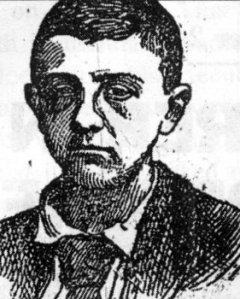
On this date in 1890 at the Columbus Penitentiary in Ohio, a sullen German-American teenager named Otto Leuth (sometimes spelled “Lueth”) paid with his life for the brutal murder of his seven-year-old neighbor, Maggie Thompson.

John Stark Bellamy II, writing of the murder in his book The Corpse in the Cellar: And Further Tales of Cleveland Woe, noted how familiar the case sounds to modern ears:

[T]he sickening murder of an innocent child; yet another child accused for the dreadful deed; a sensational trial, replete with dubiously “expert” testimony, suspicious “confessions,” allegations of police “third-degree” methods, and charges of biased press; not to mention “latchkey” children, systematic child abuse, saccharine sympathy for the guilty, and charges of ethnic favoritism.

Yet it happened over a century ago.

Otto, sixteen at the time he killed little Maggie Thompson, had had a hard life, as Bellamy explains in his book. His mother, Lena, testified at his trial that she

went into veritably demonic fits of rage, during which she was in the habit of physically abusing her children, especially Otto. From an early age, she blandly admitted, she had pulled his hair, kicked him, beaten him, walked on him, and often hit him with any object that came to hand. Once, when Otto was eight, she had beaten him with a chair leg and, when [Otto’s father] Henry tried to intervene, stabbed Henry twice with a convenient butcher knife. Just a few months before Maggie Thompson’s murder, Lena had repeatedly slammed Otto’s head into a wooden door.

It speaks volumes of the difference between that century and this one that nobody who heard Lena’s testimony seemed to think this was in any way excessive, never mind cruel; on the contrary, one person praised her methods as being “good German discipline.”

On May 9, 1889, sixteen-year-old Otto was alone at his family’s home at 47 Merchant Avenue in Tremont, a suburb of Cleveland. He was used to being alone: his mother had been committed to a mental hospital some months before, his father was wrapped up in his cabinet-making business, and his older brother had moved out of the house.


Otto (top) and his victim.

That morning, down the street at 24 Merchant Avenue, Maggie Thompson set off for school. Her mother, Clara, dropped her off at the front gate; it was the last time she would see her daughter alive.

Maggie attended the morning classes and, when school was dismissed for lunch at 11:15 a.m., started on the four-block walk home. En route, she vanished without a trace, as if “the sidewalk might have opened and swallowed the girl.”

Naturally there was a frantic search, lead by her devastated parents and the Cleveland Police Department, who tore the city apart looking for her.

But, although there were numerous false sightings and a few wild stories about Maggie’s disappearance, in spite of everyone’s efforts they couldn’t find her.

Otto participated in the search, along with most of the neighborhood. Nearly every day he would approach Clara Thompson and solicitously ask if she’d heard any news of her child.

In early June, Clarissa Shevel, the woman who lived with her husband in the back of the Lueths’ two-family house, asked Otto to do something about the terrible stench that pervaded the entire building. Otto suggested the odor was caused by a dead animal. He bought some chloride of lime and put it in the ventilation hole, then burned some sulfur, but it didn’t help.

Around that time he was witnessed carrying some badly stained bedding to the smokehouse at the back of the property.

On June 9, Otto’s mother Lena, who had by now been discharged from the mental hospital, became fed up with the smell and sent her husband Henry down to the cellar to investigate. He came back up a few minutes later, deeply shaken, and ran out to find a policeman.

In the Lueths’ cellar was the nude corpse of Maggie Thompson.

She was wrapped in one of Lena’s dresses and her own clothes lay underneath her. She had been beaten to death and her body was so badly decomposed that her parents had to identify her by scars on her hips.

The police promptly arrested everyone who lived at the house: Henry and Lena Lueth, Clarissa Shevel and her husband, and Otto, who was picked up on his way home from the ice cream parlor. All five suspects were separated and subjected to a serious “sweating,” but Otto was the prime suspect. He had a reputation as a bully, and he’d been at home alone for much of the previous month.

Bellamy records:

The climax came at 3:30 a.m., when an agonized female shriek resounded from the floor below the sweating room. “Who is that?” cried Otto to Detective Francis Douglass. “Your mother, I believe,” replied Douglass. “She had nothing to do with it!” blurted out Otto. “Who did?” queried Douglass. Otto: “I did it! I did it!” Douglass: “Did what, Otto?” “I killed her! I killed her! Please give me your revolver so I can kill myself!”

Resisting the temptation, the police instead took his verbal confession, wrote it down, had him sign it and escorted him to a cell.

Otto said he had been standing outside his parents’ home at about 11:30 a.m. on May 9 when he encountered Maggie. She asked him if he could donate any buttons to the “button-string” she was making, and he said he had four and would give them to her if she came inside.

Maggie obediently followed him in, and he led her upstairs to his bedroom, where he attempted to rape her. When she screamed, he hit her with a nearby hammer.

Otto said he thought he’d probably killed her with the first blow, but he kept striking her until her head was a pulp and the bed was covered in blood. After an unsuccessful attempt to have sex with her body, he fled the scene. He did go back to the house that night, but spent the next several days at his brother’s home.

Six days later, just before his mother was supposed to come home, Otto returned home to clean up. He carried Maggie’s corpse to the family cellar and left it lying there; he didn’t even bother to bury it or cover it up.

Given Otto’s confession, the circumstantial evidence and the revulsion his crime invoked in the city of Cleveland, his lawyer didn’t have much to work with. Not even trying for an acquittal, his defense instead claimed Otto was mentally impaired and/or insane.

Otto had a strange depression in his skull and his attorney suggested he was brain-damaged — which might very well have been true, given the abuse he had suffered at Lena’s hands. Several members of his family, including his mother and brother, had epilepsy, and his attorney suggested he might have had a seizure and committed his crime without even knowing what he was doing.

Such a scenario was possible. The problem was, though, that none of the medical experts who testified for the defense could diagnose Otto with epilepsy.

The claims of subnormal intelligence were contradicted by the testimony of Otto’s former teachers. Although his pathetic attempts to conceal Maggie’s body might indicate otherwise, his intellect seems to have been about average. Before he quit school at age 13, he had been an unexceptional student with some talent as a violinist.

Otto’s lawyer also said his client had not, in fact, attempted to sexually assault Maggie Thompson either before or after death, and Otto had invented that part of his confession because the police were pressing him to cough up an explanation for his motiveless crime. But given the fact that Maggie’s body was found naked, this claim didn’t carry much weight either.

It was no surprise that, when the trial concluded on December 27, 1889, the jury came back with a verdict of guilty without a recommendation of mercy. Perhaps the only surprising thing was that they actually bothered to deliberate for a whole four and a half hours.

Otto rapidly exhausted his appeals and was hanged eight months after his trial, alongside another killer, one John “Brocky” Smith of Cincinnati. Two other men had also been scheduled to die that night, but one got reprieved and the other’s execution was postponed.

Otto left behind a statement where he admitted he’d killed Maggie Thompson, but denied his previous claims that he’d tried to rape her. He died calmly and without a fuss, standing on the trap and saying simply “All right, let her go.”

On this day..