At the time, Nigeria was liable to put to death condemned prisoners without warning at any time, like Japan does today … except that Nigeria carried out such executions by the dozens. In one instance Angel witnessed, there were 58 executions in a single day.
On August 2, 1994, a Tuesday, that occasion finally arrived for Arthur Judah Angel — or so it seemed.
“I was chained; I was given my last meal that was August 2, 1994,” Angel said in an interview. “38 others were executed that very day. Only God knew how I was spared. He was the one that made my name disappeared in the book. I did not know how it happened. But it happened. I died, in fact, every person on the death row dies every day.”
Who exactly it was that saved Angel on that date I have not seen conclusively documented, but they say that God helps those who help themselves. In this case, Angel helped himself with his charcoal sketches on death row, which soon brought him to the attention of some well-placed people in the prison bureaucracy, a Catholic bishop — even a British arts organization which organized exhibitions of his work in 1993 and 1994.
Angel’s death sentence was commuted in 1995, and he was released outright in 2000. He well knows that, like those other 38 people who hanged this date, he’d be forgotten if not for his fortuitous escape. Life is just too damn cheap for exonerating the dead.
“I am able to clear my name because I am alive,” Angel said. “If I had been executed, nobody would believe that I was innocent. If I didn’t make it, no one would know. I knew many people who were innocent in prison. Yet they died in prison. Only people like me, who were close to them until their death, knew they were innocent. The rest of the world learnt that armed robbers were executed on so and so day; nobody knew they were innocent.”
But Angel did survive, and is remembered — not only for his exoneration, but for the 51 startling sketches he made of Nigeria’s death row. They (and other anti-death penalty art Angel has created since) have been exhibited worldwide by human rights NGOs.
Angel, who’ll turn 50 this November, continues to work as an artist from a studio outside Lagos — and uses his art to campaign against the death penalty, as one might imagine. He has written a book, I Refused to Die; unfortunately for its prospective international readership, the book requires expensive shipping from Nigeria.
(There’s also a bit of video from a news report here.)
On this date in 1798,* two Irish rebels — a Catholic and a Protestant — were hanged side by side at Blundell Hill, Edenderry for their parts in that year’s Irish Rebellion.
The two men were major movers in the Wexford Rebellion, one of the more successful and (to the British) surprising centers of insurrection in 1798. Perry, still half-broken by British torture,† returned to the field to help rout the Brits at the Battle of Tuberneering, obtaining the nickname “the Screeching General” for his barbaric vociferations in battle.
A few weeks later, the multiconfessional leaders were captured, and quickly hanged at Edenderry, with “benefit” only of a summary court-martial.
Perry was extremely communicative, and while in custody, both before and after trial, gratified the enquiries of every person who spoke to him, and made such a favourable impression, that many regretted his fate …
Kearns was exactly the reverse of his companion — he was silent and sulk, and seldom spoke, save to upbraid Perry for his candid acknowledgments … [he had] an hypocritical and malignant heart, filled with gloomy and ferocious passions — He seemed rather to be an instrument of Hell, than a minister of Heaven, for his mind was perpetually brooding over sanguinary schemes and plans of rapines, while he assumed the sacred vestments of a servant of Christ!
Their capture marked the final collapse of Wexford’s rebellious “republic”; by September of that same year, all Irish disturbances had been definitively, and bloodily, quelled.
* Some sources have July 12, an apparent transposition of the correct date; both men appear to have skirmished in Clonard on July 11 and again at Knightstown Bog on July 14, and only captured thereafter, followed by several days’ captivity before hanging.
** “The history of the Priest is somewhat extraordinary — he had actually been hanged in Paris, during the reign of Robespierre, but being a large heavy man, the lamp-iron from which he was suspended, gave way, till his toes reached the ground — in this state he was cut down by a physician, who had known him, brought him to his house, and recovered him.”
† Perry’s troops happened to capture two men involved in Perry’s torture in early June. He had his ex-tormenters executed.
Contrary to what all the slasher films would have you believe, an ax does not make a very good murder weapon. Axes are big. They are heavy. They are difficult to conceal. When used they create a big mess. And if you are caught with one, it’s hard to come up with a suitably innocuous explanation for it.
Nevertheless, this was Jake Bird’s weapon of choice on October 30, 1947, when he broke into Bertha Kludt’s home and killed her and her seventeen-year-old daughter, Beverly June.
Perhaps if he had used a different weapon, things would have turned out differently. As it was, the two women’s screams — and that’s another problem with the ax: unless you can wield it like Gimli, the victim is going to survive the first blow and start hollering — attracted two police officers, who apprehended Bird after a foot chase.
This excellent History Link article provides a thorough account of Bird’s life and crimes. 45 years old at the time of his arrest, he was a drifter and a ne’er-do-well with an extensive criminal record. He’d spent a third of his life in prison for various offenses. Bird openly confessed to the Kludt killings, saying the murders were the result of a botched burglary.
One of the police officers who testified at the trial admitted he beat the daylights out of Bird after his arrest. Naturally, the defense moved to throw out the murder confession on the grounds that it was obtained under force, but the judge ruled that the police brutality and Bird’s statements were “unrelated” and so the confession was admitted into evidence.
This was the attorney’s only attempt to defend his client; he called no witnesses and presented no evidence at the trial.
In all fairness, it must be said that Bird was spattered with gore when he was arrested, they found his fingerprints in blood at the crime scene and on the ax, and he’d left his shoes at the Kludt house. So the confession didn’t figure to be exactly decisive.
This would be a fairly unremarkable murder case, but shortly after his arrival on Death Row, Bird suddenly discovered he had an excellent singing voice. For the next several months he detailed 44 murders from all across the country which he claimed he’d committed during his wanderings. Most of his victims were women.
Bird’s claims, if true, would make him one of America’s most deadly serial killers, right up there with the much more famous Ted Bundy and the Green River Killer, Gary Leon Ridgway. One inevitably wonders if all of his statements were genuine. Henry Lee Lucas, another violent drifter much like Bird, admitted to hundreds of homicides and captivated police from all over the nation before it was discovered that many of his confessions were lies.
Police in several states did find Bird credible, though. Bird was calm and ready for his hanging, which went off without a hitch. He willed his estate, valued at $6.15, to his appeals attorney.
On this date in 1978, peripatetic Communist intellectual Hu Nim vanished into Khmer Rouge Cambodia’s charnel house along with 126 others at Tuol Seng.
The child of a poor peasant’s family, Nim was a gifted young state worker who studied in Paris in the 1950s, where he met several future Khmer Rouge leaders.
Nim charted an independent — some might say hypocritical — course over the next two decades, serving uneasily as a leftist parliamentarian in Prince Sihanouk‘s nationalist coalition government, fleeing ahead of a conservative purge into the bush to join Communist guerrillas, then returning once more to Sihanouk’s now-leftist Chinese-backed government-in-exile. It’s a period whose interests and alliances don’t map straightforwardly onto the familiar Cold War axis.
Hu Nim’s stature as Minister of Information in the government-in-exile transitioned directly to that same portfolio when the Khmer Rouge came to power.
Maybe those old ties to the ancien regime did him in — Vietnam, after invading Cambodia, would seize on the late minister’s reputation for independence to damn the Khmer Rouge for purging a moderate socialist — but there was no ideological talisman for safety during those terrible years. Hu Nim’s longstanding pro-Chinese position was also a dangerous association come 1977, and Phouk Chhay, a fellow officer of the Khmer-Chinese Friendship Association, was among the batch of prisoners shot along with Hu Nim this date.
Early in 1977, a massive internal purge shook the regime; as many people (some 1,500) went to Tuol Sleng from mid-February to mid-April of that year as had gone in all of 1976.* Almost every one of these humans would be, in the terrible bureaucrat-ese of the security apparatus, “smashed.”
Hu Nim was one of these, a denunciation wrung from a local commander leading to his April 10, 1977 arrest. Under repeated torture over the ensuing three months, the ex-Minister of Information would write and re-write his confession, fashioning himself “a counterfeit revolutionary, in fact … an agent of the enemy … the cheapest reactionary intellectual disguised as a revolutionary,” a stooge of the CIA since the high school, and a skeptic of the disastrous forced agricultural collectivization who had swallowed his doubts lest “I would have had my faced smashed in like Prom Sam Ar.” The confession ultimately tallied 200-plus pages. (Here’s some of it.)
Four days after his arrest, Hu Nim submitted the first of seven draft “confessions” to his interrogator, who appended a note to Deuch, saying: “We whipped him four or five times to break his stand, before taking him to be stuffed with water.” On April 22, the interrogator reported: “I have tortured him to write it again.” Five weeks later, Hu Nim was abject: “I am not a human being, I am an animal.” (Source
* Official count for all of 1977: 6,330 “anti-party” types tortured and executed at Tuol Sleng, as against “only” 2,404 in 1975-1976 combined.
On this date in 1945, Japanese forces occupying Indonesia cut off Dr. Achmad Mochtar’s head for a medical experiment gone horribly awry.
Officially, Dr. Mochtar had been responsible for a supposed vaccine whose administration killed hundreds of Indonesian forced laborers.
Latter-day research, however, indicates that it was the Japanese military who administered the vaccine (Indonesian link), an experimental tetanus-cholera-typhoid-dysentery combination shot, getting a trial run before it was administered to Japan’s own soldiers. When this drug proved lethal to most of its recipients, Mochtar and his staff at the Eijkman Institute were arrested in 1944 and subjected to harrowing torture.
According to Jakarta-based British researcher Kevin Baird, Mochtar agreed to take the fall for the experiment in exchange for the release of his colleagues.
“We think of this sort of heroism as the reserve of military men and not learned intellectuals,” Baird told the Guardian. “Achmad Mochtar was not only a hero of Indonesia, but a hero of science and humanity.”
Present-day Eijkman Institute director Sangkot Marzuki (right), and two descendants of the executed man, Monique Mochtar (left) and Jolanda Mochtar (center) lay flowers at a 2010 memorial event after the doctor’s location in a mass grave was discovered. Achmad Mochtar’s name also graces a Sumatran hospital.
On this date in 1680, the Spanish capital of Madrid celebrated an enormous auto de fe, culminating with 18 executions plus eight people posthumously burned and 22 fugitives “executed” in effigy. (Source of the numbers)
This signal event needed every drop of sunlight from the long summer’s day. Staged for the appearance of the royal family itself, it likewise pulled in every available case from around Spain: the regional cities shipped their apostates and heretics to Madrid to dignify the main event with a suitable quantity of prey.
It began with a morning ceremonial procession of prisoners, nearly a hundred — every source seems to have a slightly different figure — in the traditional Inquisitorial manner. This account comes from an English contemporary, as reprinted in Human Judgment: The Eye of the Beholder. (Note: paragraph breaks added, and ubiquitous capitalization of nouns removed, for better readability.)
A scaffold, fifty feet in length, was erected in the Square, which was raised to the same height with the balcony made for the King to sit in. At the end, and along the whole breadth of the scaffold, at the right of the King’s balcony, an amphitheatre was raised, to which they ascend by twenty-five or thirty steps; and this was appointed for the Council of the Inquisition, and the other Councils of Spain. Above these steps, and under a canopy, the Grand Inquisitor’s rostrum was placed so that he was raised much higher than the King’s balcony. At the left of the scaffold and balcony, a second amphitheatre was erected of the same extent with the former, for the criminals to stand in.
A month after proclamation had been made of the Act of Faith, the ceremony opened with a procession [on June 29], which proceeded from St. Mary’s church in the following order. The march was preceded by an hundred coal merchants, all arm’d with pikes and muskets; these people furnishing the wood with which the criminals are burnt. They were followed by Dominicans, before whom a white cross was carried. Then came the Duke of Medina-Celi, carrying the Standard of the Inquisition. Afterwards was brought forwards a green cross covered with black crepe; which was followed by several grandees and other persons of quality, who were familiars of the Inquisition. The march was clos’d by fifty guards belonging to the Inquisition, clothed with black and white garments and commanded by the Marquis of Povar, hereditary Protector of the Inquisition.
The procession having marched in this order before the palace, proceeded afterwards to the square, where the standard and the green cross were placed on the scaffold, where none but the Dominicans stayed, the rest being retired. These friars spent part of the night in singing of psalms, and several Masses were celebrated on the altar from daybreak to six in the morning. An hour after, the King and Queen of Spain, the Queen-Mother, and all the ladies of quality, appeared in the balconies.
At eight o’clock the procession began, in like manner as the day before, with the company of coal merchants, who placed themselves on the left of the King’s balcony, his guards standing on his right (the rest of the balconies and scaffolds being fill’d by the embassadors, the nobility and gentry).
Afterwards came thirty men, carrying images made in pasteboard, as big as life. Some of these represented those who were dead in prison, whose bones were also brought in trunks, with flames painted round them; and the rest of the figures represented those who having escaped the hands of the Inquisition, were outlaws. These figures were placed at one end of the amphitheatre.
After these there came twelve men and women, with ropes about their necks and torches in their hands, with pasteboard caps three feet high, on which their crimes were written, or represented, in different manners. These were followed by fifty others, having torches also in their hands and cloathed with a yellow sanbenito or great coat without sleeves, with a large St. Andrew’s cross, of a red colour, before and behind.
Detail view (click for the full image) of a Goya painting of Inquisition prisoners in the sambenito.
These were criminals who (this being the first time of their imprisonment) had repented of their crimes; these are usually condemned either to some years imprisonment or to wear the sanbenito, which is looked upon to be the greatest disgrace that can happen to a family. Each of the criminals were led by two familiars of the Inquisition.
Next came twenty more criminals, of both sexes, who had relapsed thrice into their former errors and were condemn’d to the flames. Those who had given some tokens of repentance were to be strangled before they were burnt; but for the rest, for having persisted obstinately in their errors, were to be burnt alive. These wore linen sanbenitos, having devils and flames painted on them, and caps after the same manner: five or six among them, who were more obstinate than the rest, were gagged to prevent their uttering any blasphemous tenets. Such as were condemned to die were surrounded, besides the two familiars, with four or five monks, who were preparing them for death as they went along.
[skipping the seating arrangements … ]
About twelve o’clock they began to read the sentence of the condemned criminals. That of the criminals who died in prison, or were outlaws, was first read. Their figures in pasteboard were carried up into a little scaffold and put into small cages made for that purpose. They then went on to read the sentences to each criminal, who thereupon were put into the said cages one by one in order for all men to know them. The whole ceremony lasted till nine at night; and when they had finished the celebration of the Mass the King withdrew and the criminals who had been condemn’d to be burnt were delivered over to the secular arm, and being mounted upon asses were carried through the gate called Foncaral, and at midnight near this place were all executed.
As best I can determine, two condemned people bought their lives with last-second conversions, leaving 18 to die for Judaizing … or, in one case, for converting to Islam. It will suffice to say that a very large, very ornate, and very long ceremony unfolded, and that at the end of it the flames consumed a number of people (and even more mannequins) associated with the Abrahamic faith.
“These punishments,” observed a French diplomat who witnessed the proceedings, “do not significantly diminish the number of Jews in Spain and above all in Madrid where, while some are punished with great severity, one sees several others employed in finance, esteemed and respected though known to be of Jewish origin.” Actual eliminationist Jew-hunting was so 1492.
Great as were these astounding spectacles, their day was passing. In fact, this was it — the long, sweltering, tiresomely gaudy day that it passed.
Spain in 1680 was in the grip of plague, famine, and deflation; though there’s value to the state in the distraction of a circus, there’s also the very substantial cost of putting the bloody thing on, especially on such a scale, especially when you’re going to let off most of the victims but not until you sock them away in prison and feed them for months or years until the next auto.
It seems that by the 17th century this end-zone spike of the Inquisition had become quite an encumbrance: procedures required the Inquisition to dispose of certain cases in autos de fe, which, because they had to be put on just so, were increasingly rare, and clogged up gaol cells in the meanwhile. There’s a reason besides spectacle that all the rest of Spain gratefully dumped its religious criminals on Madrid on this date.
The model just wasn’t sustainable.
Over the 1680s, practical pushback reconfigured the venerable ritual into something less burdensome to the public purse. This date’s event was very far from the last auto de fe in Spain, but it’s seen as the last of the classic, public-festival spectaculars evoked by the term. They would, in the future, become (mostly) smaller, (usually) shorter, and (somewhat) less garish affairs conducted not on public plazas but on church grounds, and with most cases of reconciliation simply handled quickly, quietly, and locally.
On this date in 1844, Cuban poet Gabriel de la Concepcion Valdes was executed in Matanzas for conspiring to overthrow Spanish authority on the island.
His mother (who gave him up to an orphanage) was a Spanish dancer. His father (who adopted him back) was a “quadroon” barber. Valdes, aka Placido (Spanish link, which is true of most available online resources about him) grew up as a free mixed-race youth in a slave society.
This situated him in the privileged (relative to plantation slaves) but precarious position of the petty bourgeoisie, menaced not only by the prospect of economic reversal but by the vicissitudes of Spanish policy towards his caste — whose growth many colonial officials fretted warily.
Though Placido made his bread apprenticing as a print-maker and later making turquoise combs, he made his fame by dint of literary gift that was celebrated throughout Cuba and abroad. His “La siempreviva” won a literary competition when he was just 25, and led to an invitation to visit Spain (Placido declined it); the Cuban-born, naturalized Mexican poet Jose Maria Heredia visited Cuba in 1836 and made a point to look up Placido; and according to the out-of-print Cuba’s Romantic Poet: The Story of Placido by Frederick Stimson, the young Cuban was wildly popular with North American slavery abolitionists as well.
Placido is less well-remembered beyond his home island today, but arguably rates as Cuba’s most distinguished Romantic poet.
In the 1830s especially, when civil war in Spain put the reigning monarch on the liberal side, Placido was able to exploit the opening to write openly of Cuban political aspirations.
Better to fall prey to La Parca [the Grim Reaper]
Than to a despotic Monarca
But notwithstanding the war in Iberia, the exalted Queen still put Cuba under special (read: repressive) law. Placido’s prominence, having advocated for much more freedom than Cuba was slated to enjoy, subjected him to automatic Spanish suspicion as more authoritarian governance arrived in the 1840s.
The poet was arrested in the Conspiración de La Escalera (Conspiracy of the Ladder, so named for the structure its accused were tortured upon). This purported plot to raise a slave revolt may or may not (pdf) have really existed, but the crackdown it authorized sure did. Indeed, despite the “slave revolt” bogeyman, it was overwhelmingly free blacks whom the Spanish suppressed in this affair.
Gariel de la Concepcion Valdes, known as “Placido”, was shot with ten others, “miserable instruments of the most depraved machinations of immoral men, men who deserve the curse of the living and the opprobrium of generations to come,” just a week after his conviction.
The appointed lot has come upon me, mother,
The mournful ending of my years of strife,
This changing world I leave, and to another
In blood and terror goes my spirit’s life.
But thou, grief-smitten, cease thy mortal weeping
And let thy soul her wonted peace regain;
I fall for right, and thoughts of thee are sweeping
Across my lyre to wake its dying strains.
A strain of joy and gladness, free, unfailing
All glorious and holy, pure, divine,
And innocent, unconscious as the wailing
I uttered on my birth; and I resign
Even now, my life, even now descending slowly,
Faith’s mantle folds me to my slumbers holy.
Mother, farewell! God keep thee — and forever!
There are volumes of Placido’s poetry (in the original Spanish) freely available via public-domain Google books offerings here and here, with a short thumbnail biography here. For the nonfiction biographical exploration of Placido’s life, and detailed critical analysis of his poetry, this Vanderbilt master’s thesis (pdf) is highly recommended.
On this date in 1740, the Russian politician Artemy Volynsky was beheaded in St. Petersburg.
Volynsky, as famously corrupt as he was famously able, had worked himself up from Peter the Great’s dragoons into the circles of high statecraft but lost a power struggle in the notoriously cruel court of Empress Anna. He’d made it all the way to Anna’s cabinet, but there made himself the rival of powerful Baltic grand chamberlain Ernst Johann von Biron: in political terms, Biron and the fellow Balt who ran foreign policy had a west-facing, German orientation, while Volynsky looked east to Central Asia, India, and China; in personal terms, Biron was the lover of the queen, and Volynsky … was not.
After Volynsky beat up a poet, Biron had the excuse to have him investigated and was able to construct as treasonable some private correspondence about changing the way things are done in Russia, Biron thereby ridding himself of the rival.
Just a few months after Volynsky’s execution, Anna herself died, leaving an ill-starred one-year-old heir and an uncertain political situation.
In the event, Biron and his fellow Germanophiles were driven out of court by the Russian grandees, who then constructed the late Volynsky — by all indications as cutthroat and grasping as anyone else at court — as a patriotic martyr vis-a-vis the detested late ascendancy of the Baltic types.*
Further to that same end, the scaffold-bound 19th century Decembrist poet Ryleyev (Ryleev) paid his own tribute to Volynsky in verse. So far, I’ve only found Ryleyev’s “Volynsky” in Russian, but here’s a little taste [courtesy of blog friend Sonechka] of the gist:
He who resists the overweening
Expects no reward and asks for none
And forgetting even himself
Sacrifices all to the motherland.
Against the cruel tyrants
He will be free even in chains
At execution justly proud
And ever after exalted.
In that same vein, Ryleyev’s contemporary Ivan Lazhechnikov featured Volynsky as the protagonist of his historical novel The Ice Palace or The Ice House,† again whitewashing the man’s ample stock of disreputable qualities.
The book’s title alludes to a famous structure put up in the winter of 1739-1740 for the royal court’s amusement, a vast frozen edifice 20 meters tall and 50 meters wide, designed by the architect Pyotr Yeropkin … a Volynsky ally who ultimately shared Volynsky’s fate on June 27, 1740.
This sounds great, but the decadent amusement park soon became the scene for one of imperial Russia’s more infamous and bizarre horrors: Anna forced an ex-prince who had been demoted to court jester for marrying a Catholic to wed a homely Kalmyk serving-girl, with whom he would have to pass a “wedding night” naked in that icebox. (Somehow, they managed to survive.)
The yellow-clad Anna dances merrily while her terrified servants/prey brace to survive a winter night on the ice bed. Detail view; click for the full painting.
Volynsky’s machiavellian contribution to the ghastly scene had been to associate this spectacle with a celebration of Anna’s name day.
This bit of sucking up didn’t buy him quite enough time when it was all said and done, but it reminds of Volynsky’s highly mitigated claim on eternal exaltation.
* Remembered as the Bironovshchina. Compare to the Yezhovshchina, at the height of Stalin’s purges: why don’t these things ever get named for the actual chief executive?
On this date in 1842,* British diplomats Charles Stoddart and Arthur Conolly were summarily beheaded by a Central Asian potentate as London’s ill-chosen intervention in Afganistan came to a disastrous conclusion.
The backdrop is “the Great Game”,** the long-running chess match for supremacy in Central Asia between an expanding Russian Empire and Great Britain, with its imperial position in India.
Seeking to pre-empt a Russian move into Afghanistan, Britain invaded in 1839. This was the First Anglo-Afghan War: it would have, for the Brits, an inglorious end.
Our day’s featured principals were among the postscript casualties of that catastrophe, never-avenged losses for an empire that had overreached itself.
Stoddart, an intelligence officer, had been dispatched northward to the ancient silk road city of Bokhara intending enlist the allegiance, or at least the benign neutrality, of its emir, Nasrullah Khan. Today Uzbekistan’s fifth-largest city, Bokhara was then an independent state .
[I]n the nineteenth century, the executions carried out there with genuine cruelty, as well as the tales told by travelers gave the city a reputation of being a forbidden, closed, and hostile place. It was “despotic” Bukhara, and the Europeans projected onto it their own oriental fantasies: with citadel, dungeons, palaces, and city walls bolted shut at night, all helping to set the scene.
Scenic! Bukhara’s historic citadel, the Ark, where Stoddart (and later Conolly) were imprisoned (and later executed). (cc) image from elif ayse.
Into this scene, our Brit entered clumsily, immediately irritating the ruler he intended to supplicate. Reportedly (though the fact has been disputed), he was on the brink of execution when he acceded to save his life to Nasrullah’s formulaic offer of clemency in exchange for conversion to Islam.
In any event, Stoddart languished for years, alternately imprisoned and in the custody of the (better-received) Russian mission. Though the latter had also been charged by its sovereign to retrieve the ill-favored English emissary as a gesture of Great Powers goodwill (and to deprive England of any rationale for intervention that his captivity might offer), Stoddart seems to have been too stubbornly prideful to get out via St. Petersburg while the getting was good.
Instead, he waited on the arrival of countryman Arthur Conolly, who showed up in late 1841 on a mission to secure Stoddart’s release. But Stoddart’s situation little improved, considering Nasrullah Khan’s wary reaction to this second British interloper.
Word has it that the Bukharan prince was piqued that correspondence to him did not arrive over the signature of the British monarch herself, but merely some subcontinental subaltern — as well as, we might think understandably, suspicious at his guests’ motivations and mission.
The captor’s uncertain attitude towards his prisoners was resolved by Britain’s catastrophic loss of Kabul and the subsequent massacre of an entire 16,000-strong army as it attempted to retreat.
Seriously, the whole army. To a man. Except for one guy.
Remnants of an Army, by Elizabeth Butler, depicts the only British subject on retreat from Kabul to reach Jalalabad, William Brydon.
Battles don’t get much more decisive than that.†
Reasoning‡ that the routed British were now of no conceivable threat, nor his prisoners of any conceivable benefit, Nasrullah Khan now accused them of espionage and abused them with impunity.
The two were cast into an Indiana Jones-esque “bug pit,” an oubliette infested with … well, you know.§
Later, finding illicit writing materials secreted on his captives’ persons, the mercurial Nasrullah disposed of them outright.
their quarters were entered by several men, who stripped them, and carried them off to prison … In stripping Colonel Stoddart a lead pencil was found in the lining of his coat, and some papers in his waist. These were taken to the Ameer, who gave orders that Colonel Stoddart should be beaten with heavy sticks until he disclosed who brought the papers, and to whom he wrote. He was most violently beaten, but he revealed nothing; he was beaten repeatedly for two or three days. On Friday, the 8th or 9th (the 7th) of Jemmadee-ool-Eovel (17th of June), the Ameer gave orders that Colonel Stoddart should be killed in the presence of Captain Conolly, who was to be offered life if he would become a Mahomedan. In the afternoon they were taken outside the prison into the street, which is a kind of small square. Their hands were tied across in front. Many people assembled to behold the spectacle. Their graves were dug before their eyes. Colonel Stoddart exclaimed aloud at the cruelty and tyranny of the Ameer. His head was then cut off with a knife.
The chief executioner then turned to Captain Conolly, and said — “The Ameer spares your life if you will become a Mussulman.” Captain Conolly answered, “Colonel Stoddart has been a Mussulman for three years, and you have killed him, you killed Yoosoof too; I will not be a Mussulman, and I am ready to die.” Saying which he stretched forth his neck. His head was then cut off.
The veracity of this faint bulletin from a distant and inaccessible realm nevertheless remained in some doubt. Friends of the lost men, despairing of obtaining definitive word of their fate, commissioned a strange but courageous missionary named Joseph Wolff to brave his own sojourn to Bokhara to investigate.
Wolff barely escaped with his own life, but seemingly confirmed the sad story and published a Narrative of his travels in 1845 (Part 1, Part 2).
* The initially reported June 17 execution date was subsequently contested by Joseph Pierre Ferrier, who argued that the chronology instead pointed to the next Friday, June 24. The matter appears to me permanently unresolvable.
** Ironically, the sportive phrase “the Great Game” was itself attributed to Arthur Conolly for whom, in the end, events turned out to be quite other than playful.
† Britain recaptured Kabul in reprisal later in 1842, upon which pretext it was able to declare its honor vindicated and depart Kabul (sans massacre), ending the war. Certain latter-day occupations of that “graveyard of empires” might envy their forebear’s talent for declaring victory and leaving.
‡ Correctly. Nasrullah Khan faced no British reprisal for his treatment of Stoddart and Conolly, notwithstanding the attempt by some friends to use their sad fate as some sort of casus belli. This public domain book from 1845 bears a dedication to Queen Victoria in “hope of directing your Majesty’s attention to the cruel sufferings and alleged murder of two British officers … abandoned in an unaccountable manner, by your Majesty’s Government … [in circumstances] degrading to the British nation;” the same man had previously published an “Appeal to the British Nation” in an “endeavour to excite the public sympathy.” Sympathy or no, the two British officers stayed abandoned.
§ Bug tortureenhanced interrogation was actually authorized during the Bush administration for the insect-averse Abu Zubaydah. The gentleman approving that technique, Jay Bybee, is now a federal circuit judge.
Originally an Atlantic coast peoples — “Manhattan” is a Delaware word, although “Delaware” itself isn’t — the Delawares or Lenape had with other native peoples removed to an Ohio territory supposed to be reserved against white settlement. It was the fruit of a deal that kept them on the British side (or at least, off the French side) in the Seven Years’ War.
But staying out of it would be a nonstarter during the American Revolution, because said territory was situated right between the British in Detroit and the westward American settlements in the Ohio Valley. Our man William Crawford was on hand to sign the colonists’ 1778 Treaty of Fort Pitt making nice with the Delawares: it’s the first written treaty between the United States and any Native Americans, and like most of that genre it didn’t last long.
The Delawares were okay with letting colonists march through their territory to attack Detroit, but when the U.S. pushed for them to get into the fight themselves — and when frontiersman murdered the pro-neutrality chief — it pushed many Delawares over to the British side. Opinion among their neighbors, the Shawnee, Wyandot and Mingo, likewise tended to range from “hoping to stay out of it” to “allying with the British,” and the latter sentiment was further encouraged by a kindling sentiment among peoples all along the frontier that uniting their efforts was their only hope of holding back imminent Anglo expansion.
“Quite otherwise,” said M.M. Quaife in a 1930 address to Ohio’s Wittenberg College* “was the situation west of the Alleghenies. In this area the war was prosecuted with increased vigor and fury throughout 1782, which thereafter acquired the significant designation, the Bloody Year.” It was not a clean fight by any party.
In March of 1782, an expedition by colonials hunting settler-killing Indian raiders resulted in the Gnadenhütten massacre, the wholesale butchery of a settlement of noncombatant Delawares — Christian converts, no less.
In May of that same year, finding Indian raids not deterred, the Crawford Expedition finally set out: a party of officially-blessed volunteer frontiersmen whose object was “to destroy with fire and sword (if practicable) the [Delaware] Indian town and settlement at Sandusky, by which we hope to give ease and safety to the inhabitants of this country; but, if impracticable, then you will doubtless perform such other services in your power as will, in their consequences, have a tendency to answer this great end.” (General William Irvine)
Crawford had come out of retirement for this great end. And he made out his will before he departed.
The expedition came to grief within days, as an attempt to fall back by nightfall from a spot called Battle Island (actually a copse of trees in an open space, not an island in a river) deteriorated into a disordered rout. And though most of the expedition was able to flee safely back to their point of departure, Crawford himself and a few subalterns became separated, and lost.
When Indians picked them up, with Gnadenhütten still on their minds … well, Crawford made out that will for a reason. Most of the lesser prisoners were simply tomahawked and disposed of, but Crawford and a Dr. John Knight were reserved for more fearful treatment.
When we went to the fire the colonel was stripped naked, ordered to sit down by the fire, and then they beat him with sticks and their fists. Presently after I was treated in the same manner. They then tied a rope to the foot of a post about fifteen feet high, bound the colonel’s hands behind his back and fastened the rope to the ligature between his wrists. The rope was long enough for him to sit down or walk round the post once or twice, and return the same way. The colonel then called to Girty, and asked if they intended to burn him? Girty answered, “Yes.” The colonel said he would take it all patiently. Upon this Captain Pipe, a Delaware chief, mae a speech to the Indians, viz., about thirty or forty men, sixty or seventy squaws and boys.
When the speech was finished they all yelled a hideous and hearty assent to what had been said. The Indian men then took up their guns and shot powder into the Colonel’s body, from his feet as far up as his neck. I think not less than seventy loads were discharged upon his naked body. They then crowded about him, and to the best of my observation, cut off his ears; when the throng had dispersed a little, I saw the blood running from both sides of his head in consequence thereof.
The fire was about six or seven yards from the post to which the Colonel was tied; it was made of small hickory poles, burnt quite through in the middle, each end of the poles remaining about six feet in length. Three or four Indians by turns would take up, individually one of these burning pieces of wood and apply it to his naked body, already burnt black with the powder These tormentors presented themselves on every side of him with the burning fagots and poles. Some of the squaws took broad boards, upon which they would carry a quantity of burning coals and hot embers and throw on him, so that in short time he had nothing but coals of fire and hot ashes to walk upon.
In the midst of these extreme tortures he called to Simon Girty and begged of him to shoot him; but Girty making no answer, he called to him again. Girty then, by way of derision, told the colonel he had no gun, at the same time turning about to an Indian who was behind him, laughed heartily, and by all his gestures seemed delighted at the horrid scene.
Girty then came up and bade me prepare for death. He said, however, I was not to die at that place, but to be burnt by the Shawanese towns. He swore by G-d I need not expect to escape death, but should suffer it in all its extremities …
Col. Crawford, at this period of his sufferings, besought the Almighty to have mercy on hi soul, spoke very low, and bore his torments with the most manly fortitude. He continued in all the extremities of pain for an hour and three-quarters or two hours longer, as near as I can judge, when at last, being almost exhausted, he lay down on his belly; they then scalped him, and repeatedly threw the scalp in my face, telling me that “that was my great captain.” An old squaw (whose appearance every way answered the ideas people entertain of the devil) got a board, took a parcel of coals and ashes and laid them on his back and head, after he had been scalped; he then raised himself upon his feet and began to walk round the post; they next put a burning stick to him, as usual, but he seemed more insensible to pain than before.
The Indian fellow who ha me in charge now took me away to Capt. Pipe’s house, about three-quarters of a mile from the place of the colonel’s execution. I was bound all night, and thus prevented from seeing the last of the horrid spectacle. Next morning, being June 12, the Indian untied me, painted me black [signaling his imminent execution -ed.], and we set off for the Shawanese town, which he told me was somewhat less than forty miles distant from that place. We soon came to the spot where the colonel had been burnt, as it was partly in our way; I saw his bones lying among the remain of the fire, almost burnt to ashes: I suppose, after he was dead, they laid his body on the fire. The Indian told me that was my big captain, and gave the scalp halloo.
Detail image (click for the full view) of an illustration of Crawford’s torture and execution. Here’s another.
Counties in both Pennsylvania and Ohio bear Crawford’s name; several historical markers in Ohio chart the course of the ill-starred Sandusky campaign … including a phallic monument at the approximate spot of the burning, just north of the tiny town of Crawford, Ohio. (Map)
* Printed as “The Ohio Campaigns of 1782” in The Mississippi Valley Historical Review, March 1931.
** Here’s another description by another white eyewitness (alleged, anyway), who was taken in an unrelated raid some weeks before.


 Nevertheless, this was Jake Bird’s weapon of choice on October 30, 1947, when he broke into Bertha Kludt’s home and killed her and her seventeen-year-old daughter, Beverly June.
 The child of a poor peasant’s family, Nim was a gifted young state worker who studied in Paris in the 1950s, where he met several future Khmer Rouge leaders.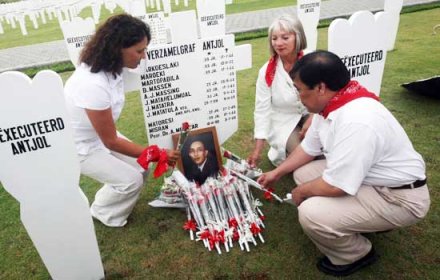


 Originally an Atlantic coast peoples — “Manhattan” is a Delaware word, although

