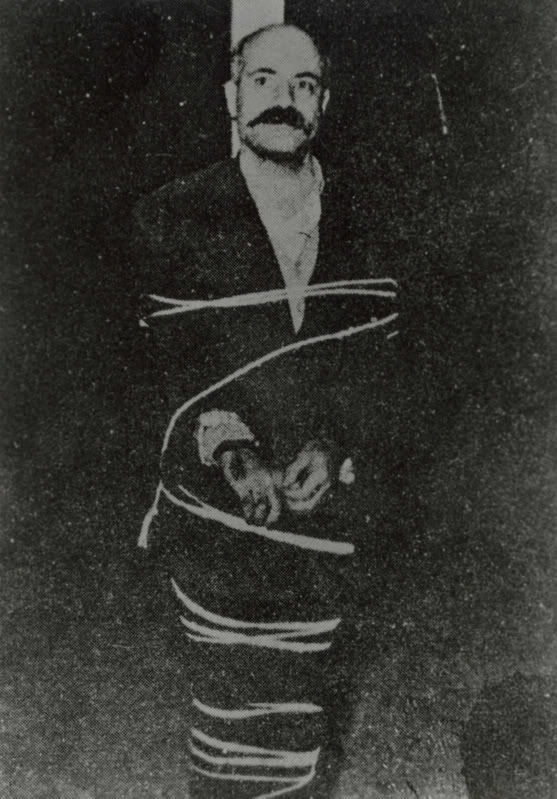
1958: Khosrow Roozbeh

On this date in 1958, Iranian communist Khosro(w) Roozbeh was shot in Qezel Qal’eh prison.

“A popular teacher at the Military Academy, Rouzbeh was the author of a number of pamphlets on chess, artillery warfare, and, together with Ovanessian, the country’s first political lexicon,” blurbs Tortured Confessions: Prisons and Public Recantations in Modern Iran.

He was also not only a communist, but a radical within the context of Iran’s communist Tudeh Party.

After the 1953 CIA-backed coup restored the Shah of Iran, his government persecuted Tudeh activists as a fifth column.

Thousands were arrested, and brutally tortured into betraying their comrades. While most weren’t put to death, Roozbeh was both a true militant — he opposed moderates’ attempt to make common cause with the liberal Mossadegh government that the Shah had deposed — and the organizer of a network of military infiltrators. The British embassy called him the “Red Pimpernel” for his uncanny talent for slipping traps and getting about in disguise. But that act never has a long shelf-life.

Roozbeh was finally winged in a 1957 shootout and taken into custody, where he was tortured into his own confessions (e.g., that he had assassinated Tudeh members who were too willing about their police collaboration). After spending his last night on this planet putting NaNoWriMo to shame by cranking out a 70-page political manifesto, he’s supposed to have met his executioners defiant to the last, refusing a blindfold and crying “Long Live the Tudeh Party of Iran! Long Live Communism! Fire!”

But the volley that silenced Roozbeh’s cry can be seen in retrospect to mark the definitive elimination of communism from Iran’s political stage, the piece de resistance for SAVAK’s campaign of suppression.

After Roozbeh, Tudeh slipped into irrelevancy (Spanish link) … leaving little but the outsized myth of its most renowned martyr.

On this day..

1474: Peter von Hagenbach, war crimes milestone

On this date in 1474, Peter von Hagenbach was tried in a remarkable judicial proceeding in the Rhine city of Breisach, found guilty, and publicly beheaded by the end of the day.

This Alsatian knight in the train of Charles the Bold had been installed by that Burgundian duke as his satrap in in the Upper Rhine, in lands that Burgundy held on lease from the Habsburgs.

He made a legendary villain of himself in the early 1470s:

His regime of arbitrariness and terror extended to murder, rape, illegal taxation and wanton confiscation of pivate property, and the victim[s] of his depredations included inhabitants of neighbouring territories as well as Swiss merchants on their way to and from the Frankfurt fair … the outrages of Hagenbach, remarkable even by the standards of the late fifteenth century, greatly contributed to forging what, until then, had been considered impossible, that is, alliances against Burgundy by all her neighbours: Austria, Berne, France, and the towns and knights of the Upper Rhine, all formerly at loggerheads with one another.

After overturning Burgundian authority in the Upper Rhine, that unique alliance aired its many grievances with Hagenbach at a unique tribunal. There, the ex-knight was prosecuted before judges drawn from the several Germanic and Swiss principalities who had allied against him.


Breisach: seems like a nice place to oppress. (cc) image from Routard5.

This unusual procedure gained a special prominence in the 20th century postwar era as historical precedent for “war crimes” prosecutions. Since that time, there’s been a going debate over just what kind of precedent it really makes.

Executed Today is pleased to welcome Prof. Gregory Gordon of the University of North Dakota law school — a rising star in international human rights law.

Gordon wrote a 2012 paper re-examining the Hagenbach case attempting to reconcile both the legal and historiographical perspectives on Peter von Hagenbach.

ET: You characterize the present-day understanding of the Hagenbach case as proceeding from Georg Schwarzenberger‘s recovery of the incident further to providing legitimizing precedent for the Nuremberg tribunals. Between 1474 and World War II, did anyone think of this case as one with a wider import for jurisprudence? (And if not, do we know anything about how Schwarzenberger unearthed it?)

GG: To the extent anyone did, from my research, it would have been historians, not jurists per se. Hagenbach was the object of a fair amount of historical scholarship but that had evolved over the years. In the initial period after the trial, Hagenbach was portrayed as the quintessential bogeyman. But over the centuries, historians began to view him in a different light. By 1945, a more nuanced view of Hagenbach had been established. I have not researched Schwarzenberger’s biography in great detail. So I’m not sure how his eureka moment arose. What is clear is that the Nuremberg trial caused him to focus on Hagenbach (my sense is that Hagenbach was fairly well known in Europe — his supposed mummified head was on display in an Upper Alsace museum, for example — but given the absence of anything resembling Nuremberg before Nuremberg, people tended to ignore the details of the Hagenbach legal proceedings).

And my sense is that Schwarzenberger had an agenda — he realized the case could help legitimize what many would claim to be illegitimate ex post facto law at Nuremberg. So he relied on the earlier historical accounts of the Hagenbach case (it seems he based his seminal Manchester Guardian article primarily on the account of French historian Prosper de Barante). And thus he created a fissure between legal scholars and contemporary historians.

Who tried Hagenbach, under what authority, and how were the different interested parties formally represented? Whose idea was all this? What can we tell of the public atmosphere surrounding the trial — was there bottom-up pressure to do this?

After the League of Constance (consisting of various regional polities fed up with Hagenbach) paid off his debt for him, Archduke Sigismund of Austria resumed control over the Upper Alsace territory mortgaged to Charles the Bold. And thus Sigismund made the decision to have Hagenbach tried by the international ad hoc tribunal (another inexplicable link in the chain: Hagenbach escaped lynch-mob justice on Easter Sunday, April 10, 1474 — only thanks to Breisach resident Friedrich Kappelar’s decision to arrest him and await instructions from Sigismund).

Diebold Schilling the Elder made this illustration of the proceedings for a chronicle in 1485.

Sigismund’s decision to convene an ad hoc international tribunal was utterly remarkable for the time. And it is not clear how or why Sigismund came up with it (although historians suggest it had something to do with the prominent position Hagenbach held as representative of the Duke of Burgundy).

Numerous representatives of sovereigns from around the region, twenty-eight in all — including sixteen knights, sat as part of this international ad hoc tribunal.

Eight of the judges were nominated by Breisach, and two by each of the other allied Alsatian and Upper Rhenanian towns [Strasbourg, Sélestat, Colmar, Basel, Thann, Kenzingen, Neuburg am Rhein, and Freiburg im Breisgau] as well as by Berne, a member of the Swiss Confederation, and Solothurn, allied with Berne.

In fact, each sovereign represented a member of the League of Constance (Berne being the only representative of the Swiss cantons).

Thomas Schutz, the chief magistrate of Ensisheim, was designated as the tribunal’s presiding judge. The nominal trial prosecutuor was the new Alsatian bailiff chosen by Sigismund to replace Hagenbach — Hermann von Eptingen. Eptingen, for his part, chose Heinrich Iselin, one of the commissioners from Basel (one of the League of Constance’s members), to present the prosecution’s case to the court. The other representative from Basel, Hans Irmy, took on Hagenbach’s representation. At some point later in the trial, Iselin resigned because, as the evidence came in, he felt the case lacked merit (and even made a motion to withdraw the charges). He was then replaced by Hildebrand Rasp. Hagenbach also requested additional attorneys and the tribunal assigned him two attorneys — one from Colmar and one from Selestat.

The trial was held in open air before the Breisach mayor’s residence and was attended by “a multitude” of people from Breisach and surrounding towns. It appears as if it were somewhat of a circus atmosphere.

Is there a degree to which the pre-modern characteristics of the belligerents — Burgundian duchies, Swiss cantons, the Holy Roman Empire patchwork — set a contradictory precedent for the postwar world?

Let me quote my paper:

Nothing in history leading up to that moment in 1474 would have suggested the remarkable course of action taken by Sigismund. It is tempting to see that decision as an historic anomaly that would not be repeated for centuries to come. But on closer inspection, Sigismund’s choice to hold a trial before an international court fits well within the historical narrative of that era.

It was a time of religious and political disintegration. The Holy Roman Empire was fading into irrelevance and the Catholic Church was on the verge of losing its European hegemony. It was the eve of the nation-state — a unique moment when the old collective structures were dying and the new ones had yet to be born. Given the interstitial political turbulence, the time was ripe for a plural approach to law enforcement in the cosmopolitan geographic center of Europe. Hagenbach’s inter-regional depredations, which helped forge a rare pan-Germanic consensus, provided the perfect forum to experiment with international justice during that fragmented time. The Westphalian order, already on the horizon, would foreclose any such future experiments until Nazi brutality put a chink in the Westphalian armor and inspired an unprecedented transnational justice operation in the wake of a truly global war. In that sense, although on much different scales, Breisach and Nuremberg have much in common. And should the nation-state ever manage to reassert its absolute supremacy again, Breisach will undoubtedly be on the lips of future international jurists seeking, as before, to end impunity at the expense of sovereignty.

You discuss a revisionist thesis about Hagenbach that essentially says he wasn’t a monster, and even that he was a forward-thinking but star-crossed reformer. Why do you think that we can, in fact, conclude that there’s something to the claim that Hagenbach was tyrannous or criminal? What do you consider the most credible charges, and the ones that to his judges would have distinguished Hagenbach from a run-of-the-mill brutal lord or military commander?

What evidence supports the view that the good burghers of Alsace were the victims of Sir Peter’s violence? Their treatment of the wayward knight after his arrest is most revealing in this regard.

While torture may have been commonplace in ordinary criminal inquisitions of the time, the severity of torment inflicted leads one to believe it was inspired by and directed at the kind of mass, depraved criminality of which Hagenbach has traditionally been accused. Significantly, in this regard, in addition to enduring horrific torture, he was stripped of his knighthood. Degradation of knighthood was exceedingly rare in the Middle Ages and reserved only for the most extreme and infamous crimes.

And there is other evidence to suggest Hagenbach’s culpability for atrocities. Most telling perhaps is the trial record itself.

Hans Irmy, it must be remembered, mounted a valiant and spirited defense to the very end. And yet the record does not reveal his even attempting to refute the charge that Hagenbach planned to exterminate the citizens of Breisach or that he murdered the four petitioning residents of Thann. At most, he offered the rejected defense of superior orders. Nor did Irmy (or Hagenbach, for that matter), directly deny the rape charges (merely objecting that taking women in this fashion was common practice and/or he had paid for services rendered). Rape, as opposed to murder, appears to have been Hagenbach’s preferred weapon of terror and atrocity.

And there is a plausible explanation for why Hagenbach would have wanted to murder the citizens of Breisach.

Hagenbach was aware of other towns that had plotted to kill him during the previous year and, when requesting entry to create defensive fortifications in anticipation of an attack by the League of Constance, he had already been denied admittance with his troops into Thann and Ensisheim. He was only able to gain entry into Breisach because his mercenaries were already present there. Given the animosity shown him in these other towns and the previous conspiracy to kill him, Hagenbach did not want to take any chances. Killing Breisach’s citizens would have permitted him to use the town as a defensive fortification without the risk of an uprising from its citizens.

Did Hagenbach slaughter thousands of innocent civilians in concentrated liquidation campaigns? There is no evidence to suggest he did — he was not a fifteenth century proto-Nazi. But the record suggests that he terrorized the local population by murdering civilians, raping numerous women and conspiring to commit a large-scale massacre in Breisach. It should be noted that the rape charges are the most persuasive as there are numerous examples and they were never directly refuted.

And Hagenbach’s back story further validates this view of him. He was the product of a Burgundian ducal culture that was steeped in and glorified violence — the reflection of its bellicose chief, Charles the Bold (known to his enemies as Charles the Terrible). The duchy was in almost a permanent state of war with one enemy or another during Charles’s reign. Charles the Bold’s Burgundy was in the practice of laying siege to towns and routinely killing civilians who resisted — Liege, Dinant, Neuss — all were subjected to horrific violence by Burgundian troops, and Hagenbach played a leading role in the first two. And within that violent culture, Hagenbach was Charles’s fiercest, most loyal lieutenant. In that regard, Sir Peter’s steadfast reliance on superior orders at trial speaks volumes.

And it is not to be overlooked that a criminal disposition was apparent even before Hagenbach cast his lot with Charles the Bold. The reported kidnapping of Marquard Baldeck, the Swiss banker for whom Hagenbach demanded ransom, is telling in that regard. As noted previously, Hagenbach supposedly demanded ransom from Baldeck’s family and the scheme was scuttled only when Philip the Good ordered Baldeck released without any extortion payment. Hagenbach also seems to have fabricated a murder plot against Charles the Bold, which he falsely pinned on a court rival to have him eliminated.

Add to this Hagenbach’s contempt for the emerging bourgeoisie and townspeople, as well as a deep animosity toward the Swiss, and his stewardship of the Upper Rhine represented the perfect storm. By 1474, he had indeed become the scourge of the Sundgau. In this regard, it is interesting to note Burgundy expert Richard Vaughan’s insight that, in fact, it may have been Hagenbach driving policy and tactics in Charles’s Alsatian territory, not the other way around:

Many of Hagenbach’s activities were undertaken at [Charles’s] express command, though often as a result of representations made to him by Hagenbach in the first place. It is possible, for example, that Charles only agreed to sign the treaty of St. Omer on Hagenbach’s persuasion. In the duke’s letters to Hagenbach of 8 August 1470 he orders him to undertake the siege and conquest of Ortenberg castle, ‘in accordance with your memorandum (advertissement)’, which seems to imply that Charles was here acting on detailed advice to take Ortenberg sent him by Hagenbach. As to other mortgaged places, the bailiff wrote to Charles describing how he had seized possession of Landser and seeking the duke’s approval, which was given on 6 January 1474. . . . On 26 December 1470 he wrote congratulating Hagenbach on taking Ortenberg . . .”

Finally, it should be pointed out that Hagenbach may be responsible for atrocities in the region, even if he personally did not commit or order or was unaware of all of them. In particular, the Picard and Wallon mercenaries he hired toward the end of his reign had a well-known reputation for being unruly, violent and hostile toward the local Alsatian population. French historian Emile Paul Toutey, for example, describes Picard soldiers engaging in mass rape of Breisach’s women toward the very end of 1473. These troops may have acted on their own initiative but Hagenbach was their superior and, at the very least, he bore command responsibility. And this may also have contributed toward the writing of Hagenbach’s black legend.

Did the Hagenbach case, in your opinion, actually break new legal ground relative to what had occurred up through 1473? Does it have any analogues you’re aware of over the next century or two, prior to the advent of the Westphalian system?

In my opinion, nothing in the historical record up through 1473 suggests the possibility (certainly not the likelihood!) of what actually took place in 1474.

Eminent German historian Hermann Heimpel does note that the contemplated trial was consistent with other legal actions in late fifteenth century Swabia. What must have seemed entirely unprecedented, though, was the make-up of the court that would sit in judgment of Peter von Hagenbach. He was not to be tried by a local judge. Instead, numerous representatives of sovereigns from around the region, twenty-eight in all — including sixteen knights — would sit as part of an international ad hoc tribunal. Nothing after this, until the Versailles Treaty’s Article 227 contemplated international ad hoc tribunal trial of Kaiser Wilhelm II post-World War I (which never took place since the Dutch refused to extradite), even suggested such a procedure.

Hagenbach tried to raise a “superior orders” type of defense, claiming that Charles the Bold had ordered him to do the nasty things that were imputed to him. The dismissal of this defense does sound pretty modern, but was it mere expedience on the part of the court since it had no way to compel evidence from Charles the Bold?

That’s a great question! I don’t think so. Why? Because Hans Irmy asked for a trial continuance to contact Charles the Bold to appear before the tribunal and corroborate Hagenbach’s claims of superior orders. The tribunal flatly denied the motion for continuance. There was not even an attempt to contact the Duke of Burgundy. Like the decision to try Hagenbach before an ad hoc international tribunal, the decision to deny the motion (and flatly reject the defense) seems nothing other than ground-breaking. In short, it was an epochal precedent.

What interpretive conflicts does this case raise for you when considering it as a legal scholar, versus as a historian? How do you think people today should understand Peter von Hagenbach’s prosecution?

Again, I quote from my paper:

My piece attempts to identify and resolve certain vertical and horizontal dissonances in Hagenbach scholarship. With respect to the former, this has amounted to an exercise in historiographic and historical archeology. The recent attention lavished on the case by international criminal law (ICL) experts is informed by a cartoonish conception of the defendant — an ultra-violent, sexually depraved monster who ran amok for years along the Upper Rhine and terrorized its population. Consistent with that interpretation, the authorities who captured and tried him engaged in a righteous and visionary justice enterprise. They came out on the winning side of a Manichean struggle that gave birth to ICL and ennobled its pedigree.

Digging deeper, though, one finds a very different narrative developed initially by nineteenth century historians and embraced by most of their twentieth century confreres. They saw Hagenbach as a would-be administrative reformer whose efforts were thwarted by xenophobic subjects and a parsimonious superior. In trying to transform a fragmented archipelago of city-states into a cohesive governmental entity, Hagenbach was despised because he threatened an ingrained culture of seigneurial privilege and parochial complacency. In his efforts to redeem property put in hock by Sigismund, he likely reinforced views of Burgundy as excessively acquisitive and bent on conquest (this was exacerbated by Charles’s own efforts to accede to the imperial throne). And in levying taxes to pay for good government, Hagenbach stoked local fears of financial servitude and ruin. But in doing the Duke’s bidding, he did not have the Duke’s support. And so he was left to flounder, his undoing hastened by his admitted crass and prurient behavior. They point out that his trial, a marketplace spectacle based on torture-extracted confessions, was little more than drumhead justice. It was akin to executing Charles the Bold in effigy. Peter von Hagenbach may not have been the most adroit governor and perhaps he did manifest contempt for the rising merchant and urban classes. But, the revisionists would contend, his final deserts were not just at all.

Digging deeper still, the bottom layer of historiography consists of the journalistic rough draft and the first generations of historians that followed. It is largely consistent with the modern ICL expert view but without the larger historical perspective and legal focus. And it is more regionally tinged and archaic. This layer is at once more reliable, given its comtemporaneity or relative proximity, and less reliable, given the inherent biases of its initial chroniclers and the disproportionate influence they exerted on sixteenth through eighteenth century historians.

But my piece demonstrates that each layer is not necessarily inconsistent with the others. In fact, there are many points of convergence. And it is there that a unified, coherent narrative can be stitched together. Hagenbach was coarse and confrontational. But he was also hardworking and loyal and wanted to do right by his master. His entire career had been built on pleasing Charles the Bold. He undoubtedly meant to reform and upgrade the administration of his Alsatian fiefdom. And consequently resentment of the bailiff grew over the years as he pushed while the Alsatians pulled. Hostilities boiled over in 1473 and matters came to a head in 1474. Charles’s loyal lieutenant with a criminal past and odd sexual predilections felt increasingly boxed in and he eventually lashed out. The almost exclusive procedural focus of his defense at trial strongly supports accounts of the resulting crime spree.

It should also be noted that modern Hagenbach scholarship is characterized by a certain horizontal dissonance as well — between jurists and historians. Given the historical points of convergence just noted, however, these two schools ought to find common ground too. Certain views of the revisionist historians concerning the Hagenbach judicial proceedings are not without merit. The Breisach ad hoc tribunal may not have been a kangaroo court but it bears no resemblance to the well-oiled machine of modern international criminal justice administration. The defendant was hideously tortured for days before the trial. He was given no notice of the charges or allegations against him in advance of the hearing. He had no time to speak with a lawyer before standing in front of the judges. The proceeding itself was held on a market square in a circus atmosphere and concluded within a matter of hours. He was not able to call his most important (and only) witness to the stand – Charles the Bold. And there is no indication of a high burden of proof or that any such burden even rested with the prosecution. The Breisach Trial was certainly not the paragon of due process.

On the other hand, this was the late Middle Ages — centuries removed from our modern notions of due process. Torture was part of standard pre-trial procedure at that time. And the trial itself seems relatively fair for that era. Hagenbach was represented by a zealous advocate in Hans Irmy and he was given two additional lawyers of his choice. There is as well a flip side to the “public spectacle” aspect of his trial — transparency. Hagenbach could have been summarily condemned in front of a secretive Star Chamber but his trial was held in public (and that was consistent with local custom). He was able to confront witnesses called against him. He had twenty-eight finders of fact (compared to twelve in the modern jury system). And Charles the Bold, his sole designated witness, was not allowed to testify because the defense of superior orders was rejected ab initio. As well, the proceedings lasted from early in the morning until late at night — which could equate to two or three modern court days. There seems to have been significant deliberation among the twenty-eight judges suggesting that a consensus was cobbled together after carefully sifting through the evidence. In an age of witch-hunts, trials by ordeal, the Star Chamber, and the Inquisition, this was an exceedingly fair trial.

And in many ways it seems inappropriate to use twenty-first century ICL terminology to analyze a fifteenth century judicial proceeding. But if that terminology is used, this piece has demonstrated that the Breisach Trial has many of the hallmarks of a modern international atrocity adjudication. As a threshold matter, regardless of anything else, it is the first recorded case in history to reject the defense of superior orders. In itself, that distinction invests the trial with universal historic importance in the development of atrocity law.

On this day..

1897: Five Barcelona anarchists

THE BARCELONA ANARCHISTS.

(Through Reuter’s Agency.)

BARCELONA, May 4.

The five Anarchists sentenced to death for complicity in the dynamite outrages here during the Corpus Christi procession last year were shot at 5 o’clock this morning in the moat of Monjuich Castle. The troops intrusted with the carrying out of the sentence fired repeated volleys at the criminals, who all met their doom calmly, their eyes fixed on the public, who were kept at a distance by a large force of soldiers. The condemned men, who all had their hands tied behind them, bowed to the public as they arrived at the scene of execution. Mas asked the firing party to come nearer. Nogues, Molas, and Alsina exclaimed: — “We are innocent! This is murder!” Just before the first volley was fired all cried together: — “Long live Anarchy! Long live Revolution!” Molas then gave the word for the soldiers to fire. Four of the prisoners fell dead immediately, but Alsina remained on his knees not even wounded. At the second volley he fell, but was not killed outright, and it was not till a third volley had been fired that he was pronounced to be dead. (London Times, May 5, 1897)

The “outrage” that occasioned the executions this date in 1897 was the previous June’s bombing of a Catholic processional, attributed by police to an unidentified anarchist and by anarchists to a police agent provocateur.*

Whoever chucked that egalitarian explosive triggered an outrage of the law, els procesos de Montjuic — wherein the wholesale arrest of hundreds of accused “terrorists” under a general suspension of civil liberties resulted not only in this day’s five executions but in countless tortures courtesy of the Inquisitorial equipment still on hand in the venerable Montjuic dungeons.

It was not only anarchists but liberals and republicans who felt the effects of this right-wing crackdown; 87 people were tried in camera by drumhead military tribunals under emergency antiterrorist legislation. Notary Salvador Dali Cusi, father of the famous painter, appeared as a defense witness in one trial, successfully persuading the court that one of his lefty friends nevertheless sported impeccable patriotic credentials and required “merely” exile.

The upshot of it all was to smash up the militant Catalan working class.

Said smashing notably failed to settle the small matter of who actually threw the bomb. As per their dying proclamations, it almost certainly had nothing to do with Lluís Mas, Josep Molas, Antoni Nogués and Joan Alsina — men who were alleged by the state to have been party to an ambitious bombing campaign all over the city. This campaign never went off and the only evidence supplied for its existence came from men tortured to describe it.

Tomas Ascheri, a militant anarchist whose confession helped get the others shot, has long been suspected a police plant, a hypothesis at odds with Ascheri’s shared presence at the wrong end of the firing squad this date. Occam’s Razor — and somebody probably used an Occam’s Razor on Ascheri in between the thumbscrews and the strappado — suggests that the guy’s betrayal was likewise nothing but an inability to withstand “enhanced interrogation.” (Nogues and Mas also signed “confessions” under torture. This public-domain Spanish text by another post-Corpus Christi torture victim denounces that nation’s methods both in Montjuic and in the Philippines.)

Torture in Spain, torture in Russia … the danse macabre proceeds in the dungeons of Mont-juich and St. Petersburg.

-Kropotkin, April 1897

Ongoing state violence in turn invited reciprocation.

Over in England, the Italian anarchist Michele Angiolillo was incensed by the executions, and the tortures suffered by Spanish refugees who had fled to England. “Angiolillo saw, and the effect surpassed a thousand theories,” wrote Emma Goldman. “The impetus was beyond words, beyond arguments, beyond himself even.”

Angiolillo made his way to Spain. On August 8, he joined the great tradition of anarchist avengers by assassinating the torture-happy Prime Minister, Antonio Canovas del Castillo.

* The argument for a false flag operation is a circumstantial one: the parade included a number of high muckity-mucks, like a right-wing general and the Bishop of Barcelona, detested by anarchists … and yet the bomber managed to let all the VIPs pass and attack only a knot of common people at the tail end of the train.

According to this book, a French journalist later reported that one of his countrymen by the name of Jean Girault, a genuine albeit “misguided” anarchist, did the deed. Girault fled to France and eventually to Argentina.

On this day..

1956: Jesus Maria de Galindez

(Thanks to Meaghan Good of the Charley Project for the guest post. -ed.)

On this date in 1956 or very shortly thereafter, Jesus Maria de Galindez was probably executed in the Dominican Republic.

Jesus Maria de Galindez

The previous day, he had vanished without a trace from New York City. According to unconfirmed but highly credible accounts, he was killed on orders from — and in the presence of — Dominican dictator Rafael Leonidas Trujillo.

Galindez’s disappearance caused an international incident. It was covered in numerous newspapers and periodicals, including Time and Life, and was the subject of much speculation and many conspiracy theories. In spite of an extensive search, his body has never been found. The case has remained in memory into the 21st century, however, as this 2001 New York Press article demonstrates.

Who was Galindez?

Born in Spain in 1915, he was a political activist, a committed anti-fascist and Basque nationalist. As a result, he ran into trouble with Spain’s dictator, Francisco Franco, and had to run for his life.

In 1939, Galindez set up shop in the Dominican Republic, only to find fascism polluting this country as well. He had to run again in 1946, this time to New York City.

While working on his Ph.D in political science from Columbia University, Galindez found the time to teach college classes, write a newspaper column which was syndicated throughout Latin America, and represent the Basque government-in-exile. He was a busy man.

He was also very afraid, and with good reason. Like most despots, Rafael Trujillo held grudges for a long, long time, and his henchmen kidnapped and/or killed many of his enemies, even those outside the country. One of Galindez’s friends was killed by Trujillo’s agents in Manhattan in 1952.

Galindez then wrote a letter to be opened in the event of his death or disappearance, stating that if he should come to harm, Trujillo was surely behind it.

On March 12, 1956, Galindez taught a class at Columbia and a student gave him a lift to the subway. This was the last time he was seen alive. When he was reported missing five days later, all his belongings were found undisturbed in his apartment. The FBI and the New York Police Department searched for him without result.

According to an investigation by Life magazine, which published its conclusions in 1957, Trujillo’s agents forcibly abducted Galindez on March 12, drugged him and bundled him aboard a small private plane piloted by an American, Gerald Murphy.

Early in the morning on March 13, Murphy stopped in Miami for fuel, then continued southward, stopping at Monte Cristi in the Dominican Republic. From there another pilot, Octavio de la Maza, took over. De la Maza was a tough character who had already committed one murder, in England. He flew Galindez to Ciudad Trujillo. Galindez was then shot to death in Rafael Trujillo’s presence and buried.

The Dominican government tried to buy off Murphy with a plum job as a flight captain, but pretty soon he started blabbing about his mysterious plane trip and its passenger, whom he’d at first thought was a wealthy invalid.

Pilot Octavio de la Maza: mopped up.

Thus was a second assassination necessary to cover the first: in December 1956, Murphy vanished without a trace in the Dominican Republic, only days before he was due to fly home to America. His body was never found. Now, his co-pilot had to be silenced, and a very neat job it was too: Octavio de la Maza was arrested and charged with Murphy’s murder. He had just enough time to get his parents out of the country before the ax fell, but never came to trial because he was found hanged in his cell in January … conveniently leaving a full confession in writing: Murphy had hit on him, and De la Maza lost his temper and pushed him off a cliff.

The world smelled a rat. Trujillo, of course, denied everything and went so far as to hire an American lawyer, Morris Ernst, to conduct his own investigation into Galindez’s disappearance. After ten months, Ernst issued a report predictably exonerating his employer. He claimed Galindez had stolen money earmarked for the cause of Basque Nationalism and simply walked out of his life.

And there the matter rests.

No charges were brought against anyone in Galindez’s disappearance. Columbia awarded him his Ph.D in absentia and his thesis, published as The Era of Trujillo, became a bestseller throughout Latin America.

What goes around comes around: Trujillo was himself assassinated in 1961. One of the men who plotted his murder was Antonio de la Maza, Octavio’s brother.

On this day..

1784: Anton Joseph Suter, Appenzell politician

On this date in 1784, 64-year-old former Landammann of Appenzell,** was beheaded in a nasty bout of local politics.

The amiable and fair-minded Suter (wee German bio), a tavernkeeper, won election to his position at the head of a popular party — in the process defeating a local aristocrat who expected the gig as his birthright and nursed a terrible grudge against Suter for the defeat.


The cantonal form of direct democracy by which Suter was elected, the Landsgemeinde, is still practiced in Appenzell. This (cc) image from Götz A. Primke shows the 2009 assembly in Appenzell, at which crotchety, longsword-bearing residents voted a ban on nude hiking.

This aggrieved aristocrat, Geiger by name, had to bide his time all through the 1760s and into the 1770s, until the political stars aligned against Suter.

It seems a neighboring town had been able to take possession of a lush alpine slope in Appenzell’s environs by dint of an unpaid mortgage, a terrible wound to Appenzell’s pride and no small inconvenience to its residents.

Suter pushed an attempt to force repurchase of this land in a suit at the Swiss Diet, a sort of United Nations of otherwise-autonomous Swiss cantons. But he lost the suit, and the Diet demanded that Appenzell cough up the court costs as well.

Accustomed as we are today to the suits and countersuits that constitute the very cogs of late capitalism, it’s a little hard to understand how the trifling matter of a court fee could suffice to topple a government — but it did. Geiger’s people prevailed upon the canton’s executive council to drop the suit (Suter pursued it on his own), and now persuaded it to drop Suter.

Well, persuaded. It’s more like, it did several days frantic retail politicking from the pulpits and in the streets, then showed up when the council met to shout down Suter and drag him out by force, not neglecting to disenfranchise Suter’s many supporters who fought them on the point. As Suter fled into exile, Appenzell pronounced him a rebel on the strength of some super-secret documents.

That really could have been that, but Suter’s foes were so intent on his head that they contrived a ruse to lure him back into the canton’s territory on the pretext of a secret meeting with his daughter — then arrested him, tortured him with thumbscrews and the rack, and finally sentenced him to death.

On the day appointed the scaffold was closely surrounded by troops. Suter, maimed and pale, was assisted to his place. Standing there a moment he addressed the people, declaring himself robbed and murdered by his country. He then knelt down and in clear tones thrice pronounced the Ave Maria. With the last word of the last repetition of the prayer the sword descended and his head fell …

The sight of the blood of the ex-Landamman filled the people with rage. They had looked for a reprieve to the very last; and now that all hope was gone, they fell upon such of the victim’s enemies as were to be found lingering in the streets and fought and struggled with them in their desperation … The enemies of Suter were found to form no exception to the rule that retribution pursues the murderer. No sooner was the ex-Landamman in his grave than the Furies took up their task … Geiger, who formerly had gone about demanding Suter’s life, now — a pitiable victim to remorse — went about acknowledging that for seven long years he had pursued him without a cause. It is related concerning the member of the Blood Court that they all ever afterwards were harassed by terrors of conscience, one to such an extent that he even became insane. The guilt of Suter’s murder settled upon Inner-Rhoden irretrievably … like the very brand of Cain. Time went by and changes occurred, but that remained. Finally in 1829, forty-five years after the execution, the Great Council met and, with a solemnity befitting he occasion, unanimously revrsed the findings of the court by which Suer had been banished, as also of that by which he had been sent to the block.

Another summary of Suter’s career and sad end can be found here.

* Thanks to the same public-domain source, we’ve visited Appenzell before.

On this day..

1856: Auguste Chapdelaine, saintly casus belli

On February 29, 1856, local Chinese officials in Guangxi beheaded French missionary priest Auguste Chapdelaine — and handed his countrymen a pretext for war.

Chapdelaine (English Wikipedia page | French) had gone illegally to the Chinese interior to proselytize Christianity.

The local mandarin Zhang Mingfeng was no doubt disposed to take such an harsh line against this provocation by virtue of the ongoing, Christian-inspired Taiping Rebellion, which had originated right there in Guangxi and was in the process of engulfing all of southern China in one of history’s bloodiest conflicts.

So Chapdelaine and his associates were snapped up, put to a few days’ dreadful torture, and on this date a Chinese convert and Chapdelaine were both summarily beheaded. (A female convert, Agnes Tsaou-Kong, expired under torture around the same time.)

Pietistic accounts of believers’ last extremes are here and here.


(Images from this French page.)

It took months for word of this martyrdom to reach French consular officials, and many months more for the gears of international diplomacy to turn — but when they did so, France pressed a demand for reparations.

Since pere Chapdelaine had been acting illegally in the first place, the Qing’s obdurate Viceroy Ye(h) adamantly refused to offer Paris satisfaction.

By 1858, this intransigence sufficed to license French entry (alongside Britain) into the Second Opium War, from which the Europeans won by force of arms a noxious treaty guaranteeing their right to push Christianity in China, extracting a couple million silver taels in damages, and (of course) assuring their right to traffic opium into China.

It would be rather ungenerous to hold all the ugly imperial consequences personally against our day’s martyr. August Chapdelaine was canonized by the Catholic Church in 2000 as one of 120 Martyrs of China.

China was not impressed by this celebration of a onetime colonial catspaw, and met the Vatican’s “anti-China” celestial promotion announcement with one of its own — charging that Chapdelaine “collaborated with corrupt local officials, raped women and was notorious in those areas [where he preached].”

On this day..

1845: Maria Trinidad Sanchez, Dominican Republic heroine

We’ve previously noted in these pages Francisco del Rosario Sanchez, one of the Dominican Republic’s founding heroes, who in 1861 was shot for propounding independence.

Martyrdom was the family business.

On February 27, 1845, his sister Maria Trinidad Sanchez (Spanish link) had been, well, shot for propounding independence. (More Spanish)

That date, February 27, also happens to be the Dominican Republic’s Independence Day celebration — because a year to the date before her death, Maria Sanchez, her brother, and others of the anti-colonial La Trinitaria proclaimed independence from a bloody 22-year Haitian occupation.

Maria Sanchez, together with another woman named Concepcion Bona, made the first Dominican Republic flag.


Sanchez and Bona’s original flag for the Dominican Republic.

This was all well and good, until the resulting head of state steered the Dominican Republic towards recolonization by Spain, as a hedge against reconquest by Haiti. La Trinitaria types took an understandably dim view of this gambit, so busting them up was part of the deal.

Many of the country’s founding heroes, including brother Francisco, were chased into exile; Maria was rounded up by the new government and tortured for information about the Trinitarian “plots” against the new regime. She refused to name any names, and was shot on the country’s first independence anniversary.

On this day..

1677: Five witches at the Gallowgreen of Paisley

On this date in 1677, Janet Mathie, Bessie Weir, Margaret Jackson, John Stewart, and Marjory Craig were hanged for having bewitched a Sir George Maxwell of Pollok.

These unfortunates were “sacrificed on the altar of popular superstition”, in the words of a later broadside — one element of that superstition being the belief in the superordinary insight of the deaf-dumb.

God hath taken away the tongue and ear of the dumb, and hath given them a rich gift of knowledge in the room of it; and by this would teach all of us his goodness to his creatures, and that we should study humility and sobriety of mind.

This is a culture working with some embarrassingly primitive forensics to begin with.

So, when the Pollok lord started ailing, the indications by “a young deaf and dumb girl, of unknown origin,” to the effect that a local family was doing him mischief by stabbing a wax effigy, well, that was enough to open a case. When they found a wax effigy right where the girl pointed, “The prosecution wanted no stronger proof.”

So they got the 14-year-old daughter (she was spared execution this date) to confess, and tortured her brother into agreeing that the devil appeared as a cloven-hooved Negro, and our unnamed detective-girl miraculously found not one, not two, but three different effigies all attributed to the diabolical voodoo parties to cinch the condemnation.

It’s rather embarrassing what tripe did then and can still now pass for persuasive indicia of guilt among parties already committed to convicting someone. Like show trial victims, even the condemned were swept into the act of auto-denunciation — one final tenuous strand to link an outcast to her community, even from the stake. At least, some of them were.

John and Annabel exhorted their mother to confess, reminding her of all the meetings which she had had with the devil in her own house, and that “a summer’s day would not be sufficient to relate what passages had been between the devil and her.” But Jennet Mathie was a stern, brave, high-hearted Scotch woman, and would not seal her sorrow with a lie. “Nothing could prevail with her obdured and hardened heart,” so she and all, save young Annabel, were burnt; and when she was bound to the stake, the spectators saw after a while a black, pitchy ball foam out of her mouth, which, after the fire was kindled, grew to the size of a walnut, and flew out into sparks like squibs. This was the devil leaving her. As for Bessie Weir … the devil left her when she was executed, in the form of a raven; for so he owned and dishonoured his chosen ones.

“The dumbe girl, Jennet Douglas, now speaks well, and knows Latine, which she never learned, and discovers things past!” says Sinclair. But she still followed her old trade. She had mesmeric visions, and was evidently a “sensitive;” and some of the people believed in her, as inspired and divine, and some came, perhaps mockingly, to test her. (From E.L. Linton)

Sometimes, at least, these malevolent professional accusers get their comeuppance.

The dumb girl herself was afterwards carried before the great council at Edinburgh, imprisoned, scourged through the town, and then banished to “some forraigne Plantation,” whence she reappears no more to vex her generation. God forgive her! She has passed long years ago to her account, and may her guilty soul be saved, and all its burning blood-stains cleansed and assoilzed!

On this day..

1942: Icchok Malmed

(Thanks to Meaghan Good of the Charley Project for the guest post. -ed.)

On this day in 1942, Icchok Malmed* was hanged on Kupiecka Street in the Bialystok Ghetto for throwing acid in a Nazi’s face and blinding him.

Zchor tells the story:

When the Nazis attacked the house at 29 Kupiecka Street, rounding up all of its residents into the street, a bold young man, Izchok Malmed, whipped out a jar of acid from his pocket, hurling it in the face of a Nazi soldier, who was blinded at once. Seeking revenge, the sightless Nazi fired his revolver several times, hitting another Nazi soldier and instantly killing him. In the melee, Malmed vanished.

Commandant Friedl, after learning what had happened, ordered that one hundred men, women and children living in the area where the incident occurred be rounded up and force-marched to a nearby garden, where they were lined up against the wall of an adjacent bet hamidrash and shot with machine guns.

Afterward Nazi soldiers captured another group of Jews, forcing them to dig a large pit for the bodies of the one hundred martyrs. A thin layer of earth covered them. Some were still alive, their hands groping upward through the earth.

The Nazi soldier accidentally shot by his colleague whom Malmed had blinded was carried to the Judenrat building, and his body was placed on [Judenrat Chairman Efraim] Barasz’s desk. Friedl then proclaimed to Barasz, “See what your Jewish criminals have done. Now we shall take revenge. You shall see what we can do.” Friedl issued an ultimatum for the perpetrator of the crime to surrender within twenty-four hours. Failing that, the entire ghetto would be destroyed with everyone in it.

Barasz knew the Nazis meant what they said. He sent word to Malmed to give himself up and thereby save thousands of Jewish lives. As soon as Malmed heard, he surrendered himself to the Nazis.

Tamarof’s diary described in detail Malmed’s courage. Asked why he killed the Nazi soldier, he replied: “I hate you. I regret I only killed one. Before my eyes my parents were murdered. Ten thousand Jews in Slonim were liquidated before me. I have no regrets.” Tamarof tried to slip poison to Malmed but failed. Even the police could not get near the prisoner.

The next morning, Izchok Malmed, a hero of the ghetto, was hanged in the square where he had performed his act of courage. Despite the horrible torture to which he had been subjected, Malmed cursed the Nazi murderers. After several minutes of hanging on the gallows, the rope broke and the body fell to the earth. Instantaneously, the Nazis riddled Malmed’s corpse with bullets and re-hanged the body for another forty-eight hours.

Kupiecka Street was renamed Malmed Street after the war. Near the site of Malmed’s execution is a plaque reading, in Polish and in Hebrew, “Icchok Malmed, the hero and fighter of the Bialystok Ghetto, was killed here by the Nazi murderers on 8 February 1943. In his honor.”

* The Zchor account spells his name “Izchok” but on the memorial plaque it says “Icchok”. It’s a form of the name Isaac.

On this day..

1579: Thomas Sherwood, Catholic martyr

On this date in 1579, young Catholic layman Thomas Sherwood was hanged at Tyburn, cut down while still alive, disemboweled, and quartered.

This casualty of the Elizabethan era’s dangerous struggle for the soul of Britain had popped across to the continent to begin his studies under the church’s auspices.

He had not yet completed them when, on a return trip, a Protestant recognized him and got him locked up in the Tower, where Sherwood was tortured for information about the whereabouts of the underground Catholic Mass — but “he was brave beyond his years, no racking, no cross-examination could make him name any one.”

Sherwood had the distinction during his confinement of being one of the last earthly creatures to receive the (attempted) aid of octogenarian fellow-Catholic William Roper, Sir Thomas More‘s son-in-law and first biographer. (Roper’s attempts to send money to the imprisoned Sherwood were intercepted, however.)

Sherwood’s brother recalled of the martyr,

He was of small learning, scarcely understanding the Latin tongue, but had much read books of controversies and devotion, and had used much to converse among Catholic priests, and by reason thereof, having a good wit and judgment, and withal being very devout and religious, he was able to give good counsel, as he did to many of the more ignorant sort, being much esteemed for his virtuous life and humble and modest behaviour: besides God did give a special grace in his [conversation] , whereby together with his good example of life, he much moved and edified others. He was a man of little stature of body, yet of a healthful and good constitution, and very temperate in his diet.

After his first racking in the Tower (which was said to be rigorous), being visited by a Catholic gentlewoman, he showed himself of that joyful and comfortable spirit as she was astonished thereat. As also his keeper with compassion giving him warning that he was to be racked again, he was so little moved therewith, as merrily and with a cheerful countenance he said these words: ‘ I am very little, and you are very tall; you may hide me in your great hose and so they shall not find me; ‘ which the keeper did afterwards report to divers, much marvelling at his great fortitude and courage. He was about the age of twenty-seven years when he was martyred.

On this day..