June 29, 1944, saw several noteworthy mass executions around Axis western Europe.
France: Seven Jewish hostages for the assassination of Philippe Henriot
Poet and journalist Philippe Henriot (English Wikipedia entry | French), the “French Goebbels”, was the Vichy government’s able chief propagandist.
On June 28, 1944, Henriot was assassinated by Maquis operatives disguised as milice paramlitaries.
Incensed, the real milice this morning gathered seven Jews already held in prison as hostages at Rillieux, drove them to the cemetery, and shot them one by one.
(Paul Touvier, who orchestrated this retaliatory execution, managed to stay underground until 1989. At his 1994 war crimes trial, he claimed that the Germans wanted 30 hostages killed, and therefore what he actually did was “save 23 human lives.” Touvier was convicted on the charge of crimes against humanity.)
Italy: Massacres in San Pancrazio, Cornia, and Civitella
As dawn broke this date, German soldiers retreating from liberated Rome fell upon several Tuscan villages.
German columns had been beset by partisans on the way, and standard operating procedure was to retaliate against partisans indirectly, by killing civilians — as in the notorious massacre in the Ardeatine caves. This vengeance was visited on the three towns: over 200 civilians were summarily executed on June 29, 1944.
“My mother later said she went to speak to my father,” remembered one San Pancrazio man. “A soldier turned her back and told her they were taking him to be tortured. She and my father both cried.” The father and those taken with him were shot in the basement of a farmhouse.
Caution: Graphic video.
The towns themselves have kept this date in remembrance, but the massacres were swept under the rug in the postwar settlement as Italy, Germany, and their former western enemies realigned for the Cold War. Only in the 21st century have they come to wider attention, when the discovery of secret archives documenting the atrocities enabled an Italian court to convict an aged German soldier in absentia.
There’s a CNN documentary on these events focusing particularly on San Pancrazio. Called “Terror in Tuscany”, it may be viewable here or here, depending on your location.
Thomas, too — then about 30 years old — was arrested during this same backlash, and put to torture for evidence against uncle Henry. Thomas had been exercising his covert ministry in England since 1599, after slipping English custody once before.
As a result of the Gunpowder Plot hubbub, Thomas Garnet was among 47 Catholic clerics shipped across the English Channel to Flanders in July 1606, where they were warned that they faced execution should they ever again be caught in England.
Thomas Garnet returned, of course. He was betrayed within weeks by another priest named Rouse — whom Garnet publicly forgave while being drawn, hanged, and quartered on this date in 1608. (His faith was treasonable because he refused to swear an oath of allegiance demanded of Catholics post-5.11.)
Garnet’s remains were translated back to his Catholic school on the continent. In more tolerant times, long after Garnet’s death, this English Jesuit school finally had liberty to relocate back to England proper. While Garnet’s relics were destroyed in the French Revolution, he remains the protomartyr (the first martyr associated with a place) of the venerable Stonyhurst College, now in Lancashire.
On this date in 1944, Jakob Edelstein, his wife Miriam, their twelve-year-son Arieh and his mother-in-law Mrs. Olliner were shot to death at the Auschwitz Concentration Camp in Poland. They had been inmates in Auschwitz since the previous December; Jakob had been in an isolation cell the whole time while the others stayed in the so-called “Family Camp.”
For two years prior they’d lived in Theresienstadt (also known by its Czech name, Terezin), a the former Czech fortress town that had been turned into a city just for Jews. Jakob Edelstein was named Eldest of the Jews and was nominally in charge of the place, but in practice he had no choice but to cater to the whims of the Nazis. He was assisted by a deputy and a council of twelve.
Edelstein, a Czech Jew born in 1903, had been a leader within the Jewish community in Prague and had had papers for himself and his family to emigrate to Palestine. But when the Nazis took over Czechoslovakia, Edelstein and the other Zionist leaders decided it was their duty to stay and do what they could for the community during this time of crisis.
He became a liaison between the Germans the Jewish community and tried to facilitate immigration to Palestine. From 1939 to 1941 he made several trips back and forth between Czechoslovakia and Palestine, with permission from the Germans, trying to find ways for more Jews to emigrate.
Theresienstadt was a strange place: neither concentration camp nor ghetto but something in-between, it was billed as a “paradise” and a “gift” from Hitler to the Jewish people.
Elderly Jews were sent there, as well as Jews who were “prominent” for some reason or had Aryan connections (such as Jews who had a non-Jewish spouse). It was advertised as a luxurious resort community where they could live out the rest of their lives in ease and plenty.
Residents were allowed to receive food packages from the outside, and send postcards (one per month, limited to 30 words, and censored).
Many people believed the propaganda and were persuaded to go there voluntarily, signing all their possessions and assets to the German government in exchange for what they thought would be a comfortable and peaceful retirement.
The 500-ish Danish Jews who weren’t evacuated to Sweden by the Danish Underground right after the Nazi invasion of Denmark were ultimately sent to Theresienstadt. Many talented artists, actors, musicians and scholars lived there. The Nazis would ultimately make a propaganda film about how wonderful life was in Theresienstadt, and a Red Cross delegation toured the place and came away satisfied.
As you might have guessed, living conditions within the fortress city didn’t exactly live up to what it said in the brochures.
It’s true that it was possible to survive in Theresienstadt for an extended time period, even for the duration of the war. There were no gas chambers and relatively few executions. Certainly it was worlds apart from, say, Auschwitz or Treblinka. But that was as close to “paradise” as it got.
Yes, there were stores, more than a dozen of them, but their stock consisted of “goods the Nazis had originally confiscated from the residents and later found they didn’t need or want.”
Theresienstadt, like the Lodz Ghetto, had a bank and its own money, but there was nothing to spend it on. “The ghetto crowns,” Berkley says, “were used mostly like Monopoly money in playing cards and other games. Still, the bank staff kept themselves busy balancing their books, and auditors arrived regularly from Berlin to ensure the accuracy of the bank’s essentially fictitious accounts.”
Theresienstadt’s population, at its peak, was 58,497, in a town which before the war had a population of less than 10,000. Nearly everyone had lice, toilets and taps were scarce, and disease was rampant.
Families were separated, with husbands, wives and children each residing in different barracks.
“Horrendous as Theresienstadt housing conditions may have been,” Berkley says, “they were not the residents’ chief source of daily suffering. Food, or rather, the lack of it, weighed on them much more heavily.” The menu, he explains,
consisted chiefly of bread, potatoes, and a watery soup. Some margarine and sugar — about two ounces a week of the former and less than one and one-half ounces of the latter — were sometimes included. The residents were also to receive up to four ounces of meat, mostly horseflesh, and up to eight ounces of skim milk a week, though many a week would see less or none of those foodstuffs available. No fruits were ever officially distributed, and turnips were the only vegetable to show up with any regularity.
Estimates of total per capita calories provided daily ranged from 1300 or less, to 1800, with the lower figure being more frequently mentioned. This should be compared with the “Special Regime” given the worst offenders in the Soviet labor camps which provided about 2,000 calories.
According to modern nutritional guidelines, to maintain a healthy weight, the average adult with an average level of physical activity needs 2,000 to 2,500 calories a day. At Theresienstadt all inmates between age 14 and 70 had to work long hours, many of them at strenuous jobs. In addition to being calorie-deficient, the Theresienstadt rations lacked essential vitamins and minerals. It’s no wonder that one survivor later recalled, “After three months in Theresienstadt, there was only one feeling left in my body: hunger.”
Six months after his arrival, Edelstein and the Council of Elders made a difficult decision about the food problem, as Berkley records:
It became apparent that an even distribution of the food supply would not allow the ghetto to survive. Those doing heavy work needed more than those doing normal work, and the latter needed more than nonworkers. In addition, children required extra rations, for they represented the Jewish future…
Thus, heavy workers … began to receive a little over 2,000 calories of food a day. Children were to get 1,800 and regular workers a little over 1,500. But the daily intake for nonworkers, which included most of the elderly, fell to less than 1,000 calories.
This terrible choice, however necessary to the population’s long-term survival, consigned thousands of people to death.
But even though starvation and disease took many lives, the most deadly aspect of life in Theresienstadt was deportation.
Contrary to what the propaganda messages said about people living out their lives in Theresienstadt, it was largely a transit camp. Most people who arrived would be sent on “to the east” sooner or later; some of them lasted only a few days in the fortress city before being deported.
Although certain classes of people, such as decorated World War I veterans, “prominent” people and those over 65, were in theory exempted from deportation, in practice anyone could be sent away and just about everyone ultimately was.
Approximately 145,000 denizens passed through Theresienstadt during the course of its existence, most of them from Czechoslovakia, Germany, and Austria. About a quarter of these inmates died within Theresienstadt itself. Another 88,000 were deported to Auschwitz and other camps in the East, almost all of them dying there. Out of about 15,000 children who passed through Theresienstadt, less than 2,000 survived, and some estimates put the number in the low hundreds.
When the camp was liberated, it had a population of about 17,000, and most of those had arrived in the during the final months of the war.
Jakob Edelstein didn’t know about the gas chambers when he became Eldest of the Jews at Theresienstadt in December 1941, but he knew that conditions in the East were very bad and realized that, in order for the community to sustain itself, as many people as possible had to remain within Czechoslovakia.
As a committed Zionist, he hoped that the young people in the camp would survive and go on to colonize Israel. Like most otherleaders of Jewish communities throughout Nazi-occupied Europe, he made the decision to cooperate with the occupiers in hopes of saving lives.
And as far as that goes, he failed, as the numbers quoted above indicate. But if he failed, so did everyone else.
Unlike many Jewish officials in the Nazi ghettos, he wasn’t corrupt and he wasn’t a toady to the Germans. It’s worth noting that he had many opportunities to flee the country with his family, even after the war started: all he had to do was not come back to Europe after one of his trips overseas.
But he stayed, because he felt he had a responsibility to his beleaguered people.
Edelstein did the best he could with what he had to work with, which is all you can say for anybody. He worked tirelessly, making himself available at all hours, and under his leadership the camp developed a welfare system as well as many cultural and sports activities.
His job as Eldest of the Jews in Theresienstadt, trying to play the balancing act between advocating for his people and not pissing off the Germans, was always extremely stressful, difficult and dangerous.
But things really started to go downhill for him after the city’s first commandant, Siegfried Siedl, got reassigned to Bergen-Belsen in July 1943.
Siedl’s replacement, Anton Burger, hated Czechs and took an immediate dislike to Edelstein as a result. He replaced Edelstein with Paul Eppstein [German language link, as is the next], a German, and demoted Edelstein to first deputy to Eppstein. Benjamin Murmelstein, an Austrian, became second deputy.
This wasn’t enough for Burger, however, as George Berkley records:
As leader of the Czech Jews, [Edelstein] naturally bore the brunt of Burger’s hatred for them. The new commandant had not only deported many of his countrymen and his chief aide … but had also moved Germans and Austrians into key positions formerly held by Czechs. Burger had apparently also stirred up his own superiors against him for during the fall some bakery workers, looking out the window, saw and heard Eichmann sharply dressing down Edelstein and even threatening to have him shot.
The incident alarmed Edelstein’s many loyal followers and the next day the leaders of Hechalutz, the largest Zionist organization in the camp, met with him to urge him to flee. They said they could help him escape … But though he suspected a Nazi scheme to get rid of him, Edelstein refused to run away.
In the end, the Nazis didn’t need to trump up any charges of insubordination or sabotage against their former Eldest of the Jews: they found some real “crimes.” It seems that Edelstein had been saving people from deportation by allowing them to remain in Theresienstadt, off the books, and adding the names of dead people to the transport lists to make the numbers match up.
He was immediately arrested. It was November 9, 1943, the fifth anniversary of Kristallnacht.
Edelstein was kept in custody in Theresienstadt until December 18, when he and his mother-in-law, his wife, and his young son were sent to Auschwitz with a transport of 2,500 others. The transport became part of the Auschwitz “Family Camp”, joining 5,000 Czech Jews who’d arrived there from Theresienstadt in September.
Edelstein’s family was allowed to join the Family Camp. Edelstein himself was put in the punishment block and subjected to interrogation although not, apparently, tortured. He gave nothing away.
In March 1944, the residents of the Family Camp who’d arrived in September were gassed. The December group was allowed to stay alive for the time being.
On June 20, an SS officer went to Edelstein’s cell and told him he’d been sentenced to death. While the condemned man (who’d become quite popular in jail) was taking leave of his fellow inmates, the SS officer got impatient and snapped, “quickly, quickly.”
Edelstein replied, “I am the master of my last movements.”
He was driven to the execution site and then the car went away to fetch Miriam, Ariah and Mrs. Olliner. Miriam had measles and had to be brought on a stretcher. The Nazis forced Jakob Edelstein to watch as his wife, child and mother-in-law were shot to death. He was the last of them to die.
The remaining residents of the family camp were gassed in early July 1944.
Paul Eppstein was executed in Theresienstadt in September. Murmelstein became Eldest of the Jews in his place and actually managed to survive the war. Because he had lived, he spent the rest of his life under a cloud of distrust and suspicion as a possible collaborator.
Siegfried Siedl was hanged for war crimes in 1947. Anton Burger escaped Allied custody (twice) after the war, assumed a new identity and died of natural causes in Essen in 1991. His true identity wasn’t discovered for years after his death.
After the war, the city of Theresienstadt reverted to its former name of Terezin, and the fortress became an internment camp for ethnic Germans, who found themselves quite unpopular in the newly liberated Czechoslovakia and were expelled from the country in droves. The internment camp closed in 1948.
The modern town of Terezin has a population of 3,500 and is noted for its manufacture of knitwork and furniture. Tourists from all over the world come to learn about its important role in one of the most tragic events in modern history.
On this date in 1699, Madame Angelique-Nicole Tiquet lost her beautiful head … eventually.
The talk of every Parisian in the spring of 1699 for attempting the life of her husband, Angelique-Nicole Carlier had been well-known in Paris circles since the 1670s; coincidentally or not, that was a period when a perceived boom in “husband-killing” burgeoned the phenomenon into an outright moralpanic.
In those bygone days, Mademoiselle Carlier did her manslaying metaphorically, wielding only her limitless charms (not excluding a wealthy inheritance left by her industrious albeit untitled late father). This reputed “masterpiece of nature,” alas, exchanged her magnum opus for deniers on the livre when she succumbed to the suit of Claude Tiquet, a respected councilor of the Parlement of Paris so bedazzled by the young woman that he did not pause to consider her liberalities. Although quite past her in age, Tiquet won her hand with the promise of wealth so capacious that he wooed his intended with a bouquet of flowers studded with 15,000 l. worth of diamonds — and plied her aunt with still more largesse to advance his case.
But actually, Monsieur Tiquet was not wealthy. He stretched his fortune to acquire these amorous bribes as, let us say, investments in a happy future.
“Thus they united their fortunes for life, equally blinded as to each other,” George Henry Borrow wrote. “Such are the steps that lead to the most unhappy destinies.”
The wife’s prodigality — and her belated discovery as she blew through the putative family fortune that it was he who had married the money, and not she — soon brought domestic relations to a frosty pass.
Madame kindled a more edifying romance with a young captain of the guards; Monsieur strove in vain to check her moves with locked doors and snooping skulks. They separated to distinct wings of the family house, seeing one another only rarely — and in deathly silence — while each schemed his or her embittered schemes. Years they wasted at this intolerable impasse.
Despairing at last of being rid of either her horrible husband or his horrible debts, Madame Tiquet took her plotting far enough to compass her spouse’s death. “It is impossible,” she cried in one unguarded moment to a friend, “for me to have any enjoyment of myself while my husband lives, who is in too good health for me to look for such a quick revolution of fortune.”
So she engaged the services of her porter and of a freelance villain, and on the evening of April 8, 1699, these two assassins ambushed Claude Tiquet as he returned from a friend’s house and shot him three times. One ball only barely missed the heart. Tiquet survived, and he demanded those who came to his aid take him not to his own house but back to his friend’s. Of enemies, he said, “I have none but my own wife.”
This scenario speedily became the talk of Paris, and it did not take long for sentiment to coalesce against the wife. The hired assassins implicated Madame Tiquet in a years-long conspiracy to murder her husband whose previous installments — a missed ambush; a failed poisoning — had come to naught. Both Madame Tiquet and the porter, Jacques Moura, received a sentence of death, each appropriate to their respective stations: she to lose her neck, and he to swing from his.
There nevertheless remained some ambiguity about her real guilt, for the evidence was mostly circumstance and inference and colored by the purely titillating qualities of the public scandal. And then there was the fact that she was an attractive woman.
Angelique’s brother, a guardsman like the condemned woman’s lover, organized a petition for pardon. Surprisingly, even Monsieur Tiquet threw himself at Louis XIV‘s feet to plead for the life of his would-be murderess and the mother of his children. But it is said that when the Sun King wavered in his firmness, the Archbishop of Paris himself insisted upon the sentence. That prelate’s warning that save Madame Tiquet’s head should drop, no man could feel safe in his house must have fallen very ominously from the lips of the executive manager of Parisian confessionals.
Madame Tiquet heard the final failure of her appeals this day from an official who in the springtime of life had himself numbered among Mademoiselle Carlier’s suitors. And because the condemned would still not consent to confess the plot, that admirer was further obliged to order her to the cruel water torture to extract her statement.
In this procedure, the poor sinner is stretched out as on the rack, and eight pots of water painfully forced down the gullet. Madame Tiquet endured only a single pot before she calculated her inability to withstand the procedure and admitted all. Even so she continued to insist on the innocence of her lover: “I took care not to let him into the secret, else I had lost his esteem forever!”
These justice-satisfying preliminaries dispensed with, the condemned were conducted to the Place de Greve to suffer the penalty of the law. Thousands crowded the streets and windows, as was becoming the style for the execution spectacle of the era. Genuinely contrite or else wanting to play the part, she conversed humbly with her confessor and her condemned porter, exchanging absolutions and exhortations to die with Christian firmness.
Proceedings were delayed by a thunderstorm, although Madame Tiquet showed nothing but equanimity to wait at the foot of the scaffold while the weather passed. Jacques Moura hanged first: the undercard attraction.
Then the talk of all the town mounted those beams to give her own final performance, one remarked upon by all observers for its poise and stagecraft. The later memoirs of the Sanson family, written after that name inscribed itself on the guillotine during the French Revolution, dramatized the scene. It includes the regrettable inability of their own ancestor Charles Sanson de Longval* to equal the doomed woman’s grace under pressure.
When Angelique’s turn was come, she advanced, gracefully bowing to my ancestor, and holding out her hand, that he might help her to ascend the steps. He took with respect the fingers which were soon to be stiffened by death. Mdme. Tiquet then mounted on the scaffold with the imposing and majestic step which had always been admired in her. She knelt on the platform, said a short prayer, and, turning to her confessor,
“I thank you for your consolations and kind words; I shall bear them to the Lord.”
She arranged her head-dress and long hair; and, after kissing the block, she looked at my ancestor, and said:
“Sir, will you be good enough to show me the position. I am to take?”
Sanson de Longval, impressed by her look, had but just the strength to answer that she had only to put her head on the block.
Angelique obeyed, and said again:
“Am I well thus?”
A cloud passed before my ancestor’s eyes; he raised with both hands the heavy two-edged sword which was used for the purpose of decapitation, described with it a kind of semicircle, and let the blade fall with its full weight on the neck of the handsome victim.
The blood spurted out, but the head did not fall. A cry of horror rose from the crowd.
Sanson de Longval struck again; again the hissing of the sword was heard, but the head was not separated from the body. The cries of the crowd were becoming threatening.
Blinded by the blood which spurted at every stroke, Sanson brandished his weapon a third time with a kind of frenzy. At last the head rolled at his feet. His assistants picked it up and placed it on the block, where it remained for some time; and several witnesses asserted that even in death it retained its former calmness and beauty.
For an interesting consideration of the Tiquet affair, including her posthumous use in polemical melodrama either critiquing or celebrating her repentance of a life of iniquity, there’s a freely downloadable academic paper here. It’s by the author of this wild true-crime mystery unfolding elsewhere in France at just about the same time.
* Charles Sanson de Longval was the first Sanson executioner, the founder of the dynasty of headsmen. He had fallen into the dishonorable profession from a much more respectable social station and had been transplanted to Paris from Rouen only a few years before.
On this date in 1705, two men were burned at the stake and two others broken on the wheel — Camisards all, put to death in Nimes, France.
The Camisards* were French Protestants of the mountainous southern Cevennes region who make their entry into these pages because the crown in 1685 revoked the Edict of Nantes, France’s guarantee of multiconfessional toleration.
Protestants were going to be bullied into conversion — or, in many cases, flight. (London’s Spitalfields textile industry, for instance, got a welcome shot in the arm from refugee Huguenot weavers.)
In 1702, the Cevennes Protestants pushed back.
“A persecution unsurpassed in violence had lasted near a score of years,” Robert Louis Stevenson wrote in his 19th century travelogue of the region. “This was the result upon the persecuted; hanging, burning, breaking on the wheel, had been in vain; the dragoons had left their hoof-marks over all the countryside; there were men rowing in the galleys, and women pining in the prisons of the Church; and not a thought was changed in the heart of any upright Protestant.”
On July 24, 1702, the Catholic torturer-priest running this show was assassinated, and the Camisard revolt was on.
Two years of dirty neighbor-on-neighbor violence mostly petered out in 1704 with the loss of the Camisards’ two main leaders — Jean Cavalier, the brilliant peasant-turned-commander who was bought off by an army commission and a royal pension, and Roland Laporte, who was betrayed as by Judas for 200 pieces of gold.
The prospect of a renewed rising drew them back — a bold and terrible stroke to mount a surprise massacre and kidnap the exiled English Duke of Berwick. Catinat returned from his hidey-hole in Geneva; Ravanel came the bush where he was the last notable Camisard commander in the field.
An informer spilled the secret and the conspirators were busted in Nimes before they could spring their trap.
They faced immediate trial and condemnation — Catinat and Ravanel, along with two younger fighters named Jonquet and Villas.
After a long bout of pre-execution torture on April 21 to reveal their conspirators,**
The next day, the 22nd April, 1705, they were taken from the prison and drawn to the place of execution in two carts, being unable to walk, on account of the severe torture to which they had been subjected, and which had crushed the bones of their legs. A single pile of wood had been prepared for Catinat and Ravanel, who were to be burnt together; they were in one cart, and Villas and Jonquet, for whom two wheels had been prepared, were in the other.
The first operation was to bind Catinat and Ravanel back to back to the same stake, care being taken to place Catinat with his face to windward, so that his agony might last longer, and then the pile was lit under Ravanel.
As had been foreseen, this precaution gave great pleasure to those people who took delight in witnessing executions. The wind being rather high, blew the flames away from Catinat, so that at first the fire burnt his legs only — a circumstance which, the author of the History of the Camisards tells us, aroused Catinat’s impatience. Ravanel, however, bore everything to the end with the greatest heroism, only pausing in his singing to address words of encouragement to his companion in suffering, whom he could not see, but whose groans and curses he could hear; he would then return to his psalms, which he continued to sing until his voice was stifled in the flames. Just as he expired, Jonquet was removed from the wheel, and carried, his broken limbs dangling, to the burning pile, on which he was thrown. From the midst of the flames his voice was heard saying, “Courage, Catinat; we shall soon meet in heaven.” A few moments later, the stake, being burnt through at the base, broke, and Catinat falling into the flames, was quickly suffocated. That this accident had not been forseen and prevented by proper precautions caused great displeasure to spectators who found that the three-quarter of an hour which the spectacle had lasted was much too brief a time.
Villas lived three hours longer on his wheel, and expired without having uttered a single complaint.
A hecatomb of Camisard executions followed, fed by the denunciations of frightened or avaricious people; still others were “merely” condemned to the galleys … bringing at last a sullen peace of arms to the turbulent province.
On this date in 1567, Wilhelm von Grumbach was dismembered along with two of his followers in the marketplace of Gotha.
Grumbach (English Wikipedia entry | German) was the cantankerous German instigator of the aptly-named Grumbachsche Handel, a messy clash of rights and prerogatives at the hinge of the old feudal order and centralized princely authority.
Grumbach was a knight who’s invariably described as an “adventurer”. As a young man he fought in the Peasants War, but as he headed into middle age he became your basic penniless minor nobleman chafing at the failures and obstructed opportunities life threw at him.
The thing he could not abide losing was the disappearing right of the nobility to enter into a feud or vendetta. This scans to the modern like rank anarchy, but feuds were part of the tapestry of medieval German society, long codified in law — an obvious descendant of clan and tribal obligations out of which the muddle of feudal vassalage had formed. “The passion for liberty and rights,” says this volume, “ran amok in Germany. Churchmen, princes, burghers, and peasants all wanted their independence and readily resorted to declarations of feud to secure and defend their rights.”
The standing right for miscellaneous minor lords to start miscellaneous private wars was quite naturally one that princes were ever keen to restrict. After centuries of two-steps-forward, one-step-back efforts to deal with the feud, the 1495 Imperial Diet formally codified a ban on feuding known as the Ewiger Landfriede, or “perpetual peace”. In Poli Sci 101 terms, this is the state finally monopolizing legitimate violence.
As with dueling, however, official proscription did not end the practice. It was, indeed, Grumbach’s defeat and execution that would eventually be remembered as the decisive nail in the coffin for knightly feuds.
And so in Franconia where we lay our scene will civil blood make civil hands unclean …
Grumbach’s liege was Melchior Zobel von Giebelstadt, the Prince-Bishop of Wurzburg. (Still another confusing dimension of the political map, some princes of Germany’s many statelets were simultaneously ecclesiastical authorities. For purposes of this post, the “-Bishop” part doesn’t enter into it.)
Knights’ basic problem — the reason they were vulnerable to losing their wacky old-time rights — was poverty, and it was in money that Grumbach’s feud was rooted. Grumbach’s personal twist on this was being the sort of irascible coot who could carry a grudge so far as to get himself sawed into pieces over it.
Immediately upon assuming the Prince-Bishopric in 1544, Melchior Zobel von Giebelstadt forced Grumbach to return an unauthorized cash gift his predecessor had paid to the knight, and then stiffed said knight out of six villages whose revenues Grumbach sought by way of compensation.
He had to deal with Grumbach’s feud for the remainder of his term, which was also the remainder of his life … right up until Grumbach murdered him.
The disaffected knight hooked up with the margrave* Albert Alcibiades and started making a right mess in the middle of Europe with a 1552-54 mini-war. When Albert got thumped, Grumbach had to evacuate to France, and his holdings outside Wurzburg were plundered and/or destroyed by his foes.
So now the guy was even more aggrieved, and even more pfennigless.
He was downright vengeful about his feud at this point, although it’s noteworthy relative to that monopolization-of-violence trend that he was still the only one: in days of yore, intra-elite wars might have spawned multiple self-reproducing vendettas.
The grumpy Grumbach now gravitated to another patron,** the deposed elector of Saxony Johann Friedrich II — another dude who felt hard done by in the Holy Roman Empire.
Grumbach evened his score with Melchior von Zobel by having the Prince-Bishop killed in Wurzburg in April 1558. (In present-day Wurzburg, three Zobelsaulen markers commemorate the Prince-Bishop’s assassination, one on the very spot of the murder.)
But that still left the money, and we know Grumbach wasn’t the type to write off a debt. In 1563, he successfully invaded Wurzburg with 1,300 soldiers and at swordpoint forced from the city a concession restoring his property.
For Grumbach, it was to prove a Pyrrhic victory.
In principle, he had achieved a great vindication of the ancient right of the feud, and for the hard-pressed nobility against the realms’ many princes. If others of his station had rallied to that banner, what a whirlwind Germany would have reaped.
Grumbach was in fact hatching an extravagant scheme† to liberate the entire German nobility … from the yoke of the princes. It was a radical aristocratic utopia … nobles were not only to be protected by the [Holy Roman] emperor from the princes, but to help him subdue them once and for all and to establish an hereditary monarchy in Germany. But despite Grumbach’s best efforts to incite the Franconian nobility, they did not line up behind him. Guidied by the captain of the Franconian Circle (Kreis), Georg Ludwig von Seinsheim, who denounced Grumbach’s undertaking as ‘against God, law and the emperor’, they formally turned away from him in 1564. In the view of the majority of them, the Knighthood was to maintain its autonomy by respecting the equilibrium between emperor and princes, not by irresponsibly challenging the latter. And it was this view, reassuringly transmitted to the princes, which carried the day.
Grumbach was outlawed by the empire and in 1566-67 was overcome with his protector Johann Friedrich at Gotha. Both men spent he remainder of their lives as imperial prisoners, with the notable difference that Johann Friedrich had the pull to live out his natural ration of days while Grumbach went straight to the dungeon for torture and thence to the scaffold in the town that had lately been his last redoubt. There, Grumbach was ripped apart — his dying eyes beheld the executioner wrench the heart out of his very chest and taunt him: “Behold, Grumbach, thy false heart!” The late knight’s rotting quartered remains got nailed up around town to broadcast the unmistakable message:
The noble right to feud was dead.
* Hereditary military commander.
** Among their other capers, Grumbach and his patron Johann Friedrich conspired with Torben Oxe‘s nephew Peder Oxe to depose the Danish king Frederick II in favor of the king’s grand-niece, Christina. (Christina will be known to Tudor-philes as the young woman who scuttled Henry VIII’s post-Anne Boleyn suit with the sharp remark, “If I had two heads, one should be at the King of England’s disposal.”) Nothing came of the plot. (Source)
† Christian Wieland writes that Grumbach deployed — unsuccessfully but still impressively — a 16th century multimedia propaganda campaign to state his case to the “common nobleman”: woodblock-illustrated printed leaflets, songs valorizing the attack on Wurzburg (sample verse: “Violence may be averted by violence / According to natural law”).
We’ve touched in these pages — one of our earliest posts, in fact — on Soviet war heroine Zoya Kosmodemyanskaya, a teenager executed by the advancing German army in November 1941 for conducting partisan attacks behind enemy lines.
Zoya’s story became known after the Red Army recaptured village of Petrishchevo, where she was hanged. A January 27, 1942 Pravda article recounted the gallows defiance of the young guerrilla, whom villagers knew only by her nom de guerre, “Tanya”. She had withstood German torture, refused to give them any information, and at her hanging incited her countrymen and -women to resist the invaders. She’s still to this day a beloved national martyr in Russia, which is why she’s also an Ace in our execution playing cards.
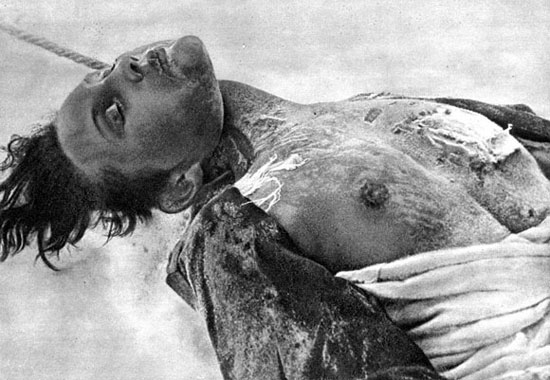
The young woman on the gallows, and in the ghastly post-mortem pictures with her left breast mutilated swiftly became propaganda grist for Moscow.
Zoya’s instant Joan of Arc-like legend invited investigation of the precise circumstances of her capture and death … and this in turn meant extremely dangerous scrutiny for any Soviet citizen in her environs whose behavior in those last days could be held to be in any way sub-heroic.
This brings us to today’s unfortunate entry, Vasily Klubkov, a humble mail-sorter before the war whose picture belongs in the dictionary next to “poor luckless sod.” Just him, Zoya, and everyone else on the terrible Eastern Front.
It was on this date* in 1942 that Klubkov paid the penalty for Zoya’s sacrifice.
Vasily Klubkov and Boris Krainov were other partisans who had been detailed along with Zoya Kosmodemyanskaya to torch some enemy assets on the same mission around Petrishchevo. Practically children all, they each acted independently from the others; long story short, Zoya and Vasily Klubkov were both captured.
Zoya fiercely endured every torture the Germans could throw at her, but Klubkov was made of softer stuff. When an officer pointed a gun at his head and demanded some answers, Klubkov started talking.
“I was a coward,” he later admitted. “I was scared I would be shot.”
Now, this admission very much against his own safety was made to the NKVD in March 1942, and since we already know that Vasily Klubkov was the sort to fold under torture, we can well imagine that the NKVD also got whatever it wanted out of the misfortunate young man. Considering the politicized quality of the trial and the circumstances of the “confession,” it has to be treated with caveats.
Under NKVD pressure, Klubkov signed off on a version of events that just so happened to mesh beautifully with the iconography already forming around the hanged “Tanya”: namely, that he was brought face-to-face with his fellow-prisoner and confirmed her identity, whereas she refused to breathe a word to her captors; that he saw her stripped naked and bashed with truncheons for hours and still summon the fortitude to refuse her interrogators the least satisfaction. Pavel Klubkov gave posterity firsthand evidence of Zoya Kosmodemyanskaya’s heroism in captivity.
“Klubkov may have been telling the truth, since it’s easy to imagine a terrified teenager on his first mission agreeing to his German captors’ demands,” notes Andrew Nagorski in The Greatest Battle: Stalin, Hitler, and the Desperate Struggle for Moscow That Changed the Course of World War II. “But there’s no way of knowing for sure how he really behaved, since he surely was just as terrified when he was interrogated by the NKVD. Or how much of what he said about Zoya was accurate, since the NKVD may already have been preparing the transcript with the idea of her elevation to mythic status.”
Heck, the reason the NKVD even had Klubkov to interrogate was that he escaped German custody, another big character red flag as far as the Soviets were concerned. That he escaped from the same custody that martyred Zoya Kosmodemyanskaya probably sealed his fate before he received his first pistol-whipping. NKVD records paint a kid who has already given up.
Well he might have. The verdict of the court was surely ordained from the start, but it was formally delivered on April 3: “Execution by shooting, without confiscation of property due to its absence.”
* Though there are some cites for April 3 out there, it appears that April 3 was the date of his conviction by a military tribunal and April 16 his execution date. This is a bit of a protracted delay by wartime Soviet tribunal standards, but then, Klubkov would have been a person of relevance to the state itself. The highest-ranking official who thought he could approve Klubkov’s execution without asking anyone else might have been a little further up the food chain than for your run-of-the-mill deserter.
On this date in 1944, Joseph Epstein* was shot with 18 others at Mont-Valerien outside Paris for their parts in the World War II French Resistance.
Joseph — “Jurek”, really — was born in Poland, but his communist politics got him harried out of Poland and Czechoslovakia and onward to France in the early 1930s.
There he completed his law studies, but was unable practice since he wasn’t a Frenchman.
But he was a perfect recruit for the international republican brigades of the imminent Spanish Civil War (he commanded an artillery battery named in honor of Tudor Vladimirescu).
War would drive Joseph Epstein hither and yon for his remaining years. After a spell in a French POW camp for Spanish Civil War refugees, Epstein signed up for the Foreign Legion, got captured and sent to a German POW camp, escaped to Switzerland, and returned to France.
There as “Colonel Gilles” of the communist resistance organization Francs-Tireurs et Partisans, he became the commissionaire of military operations for the capital and pioneered a shift in tactics towards guerrilla strikes using larger teams. Resistance fighter (and later, historian of the Resistance) Henri Nogueresexplained:
Most of the comrades adopted the three comrades system. But in Paris there were policemen and German soldiers everywhere: Joseph Epstein preferred to engage fifteen to twenty fighters per operation … [because] if in Paris during daylight, three persons only had to attack a military unit, there will always be a danger to be arrested that could lead to a partial or complete failure. By contrast, with a larger group, it was possible to gain a superiority if adopting a discrete strategy. The operations in Paris conducted in 1943 were placed under Colonel Gilles’ authority.
Epstein was arrested in the autumn of 1943 at a meeting with Missak Manouchian, and withstood months of brutal torture without so much as revealing his real name or national origin.
While this is a standard accomplishment in a Resistance martyrology, the proof of it in this case was that the ensuing “Manouchian Group” show trial, and the resulting famed “Affiche Rouge” poster, took great pains to depict Resistance members as foreigners and criminals.
As a Polish Jew who regularly ordered assassinations, Epstein would have made a fine exhibit … if the Nazis had known who he was. Instead, he’s conspicuous only by his absence.
The ironic consequence, according toanother Resistance veteran, was that “The man who, by far, was the greatest officer in all of France, the greatest tactician of the People’s War, is unknown to the general public. Of all military leaders, he was the most audacious, the most capable, the one who gave the French Resistance its originality compared to other European countries.”
In the early 15th century, France had stacked upon the woes of the Hundred Years War those of a civil war — between Armagnacs and Burgundians.
Burgundy, doughty duchy of Nibelungenlied renown, stretched to the Low Countries and was a gestating wealthy merchant state that perhaps had more in common with the English than with feudal, agrarian France. What Burgundy and England demonstrably had in common from 1419 was an alliance. Together, they bossed the northern half of what is now France during the endless Hundred Years War.
Thanks to this timely arrangement, the English came to occupy Paris — in Burgundian possession since 1418, when said party had bloodily ejected the French royalist Armagnacs.
Into this very low ebb of Valois fortunes entered Joan of Arc.
It is true that the king has made a truce with the duke of Burgundy for fifteen days and that the duke is to turn over the city of Paris at the end of fifteen days. Yet you should not marvel if I do not enter that city so quickly. I am not content with these truces and do not know if I will keep them.
-Joan of Arc, in a letter to Reims
Late in the 1420s, the illiterate farm girl somehow reversed the failing fortunes of the southerly French court. Joan, of course, will die at an English stake … but it is the Burgundians who will capture her.
At any rate, in 1429, Joan showed up and the French suddenly began going from victory to victory, knocking English and Burgundian heads in north-central France and culminating with having Charles VII crowned at Reims … which is actually north (well, northeast) of Paris.
Although Joan’s attack on Paris failed, advancing French arms put the fear of Holy Maid in the city and also cut off quite a lot of its rural food supply. “The capital itself was in a frightful state. As a result of interrupted communication and exposed supply routes, together with harassment by brigands and peasants, many Parisians were starving.”
Good times.
This naturally led some of the Armagnac-inclined citizens of Paris to think about ways to give the city back up to the French. We take up the narration of Anatole France, on a plot revolving around the “Seigneur de l’Ours,” or Jaquet Guillaume. (From here (HTML), or here (PDF).)
He was not of gentle birth and his arms were the sign of his hostelry. It was the custom in those days to give the title of Seigneur to the masters of the great Paris inns. Thus Colin, who kept the inn at the Temple Gate, was known as Seigneur du Boisseau. The hôtel de l’Ours stood in the Rue Saint-Antoine, near the Gate properly called La Porte Baudoyer, but commonly known as Porte Baudet, Baudet possessing the double advantage over Baudoyer of being shorter and more comprehensible. It was an ancient and famous inn, equal in renown to the most famous, to the inn of L’Arbre Sec, in the street of that name, to the Fleur de Lis near the Pont Neuf, to the Epée in the Rue Saint-Denis, and to the Chapeau Fétu of the Rue Croix-du-Tirouer. As early as King Charles V’s reign the inn was much frequented. Before huge fires the spits were turning all day long, and there were hot bread, fresh herrings, and wine of Auxerre in plenty. But since then the plunderings of men-at-arms had laid waste the countryside, and travellers no longer ventured forth for fear of being robbed and slain. Knights and pilgrims had ceased coming into the town. Only wolves came by night and devoured little children in the streets. There were no fagots in the grate, no dough in the kneading-trough. Armagnacs and Burgundians had drunk all the wine, laid waste all the vineyards, and nought was left in the cellar save a poor piquette of apples and of plums.
The Seigneur de l’Ours … was the proprietor of the house with the sign of the Bear (l’Ours). He held it by right of his wife Jeannette, and had come into possession of it in the following manner.
Fourteen years before, when King Henry with his knighthood had not yet landed in France, the host of the Bear Inn had been the King’s sergeant-at-arms, one Jean Roche, a man of wealth and fair fame. He was a devoted follower of the Duke of Burgundy, and that was what ruined him. Paris was then occupied by the Armagnacs. In the year 1416, in order to turn them out of the city, Jean Roche concerted with divers burgesses. The plot was to be carried out on Easter Day, which that year fell on the 29th of April. But the Armagnacs discovered it. They threw the conspirators into prison and brought them to trial. On the first Saturday in May the Seigneur de l’Ours was carried to the market place in a tumbrel with Durand de Brie, a dyer, master of the sixty cross-bowmen of Paris, and Jean Perquin, pin-maker and brasier. All three were beheaded, and the body of the Seigneur de l’Ours was hanged at Montfaucon where it remained until the entrance of the Burgundians. Six weeks after their coming, in July, 1418, his body was taken down from gibbet and buried in consecrated ground.
Now the widow of Jean Roche had a daughter by a first marriage. Her name was Jeannette; she took for her first husband a certain Bernard le Breton; for her second, Jaquet Guillaume, who was not rich. He owed money to Maître Jean Fleury, a clerk at law and the King’s secretary. His wife’s affairs were not more prosperous; her father’s goods had been confiscated and she had been obliged to redeem a part of her maternal inheritance. In 1424, the couple were short of money, and they sold a house, concealing the fact that it was mortgaged. Being charged by the purchaser, they were thrown into prison, where they aggravated their offence by suborning two witnesses, one a priest, the other a chambermaid. Fortunately for them, they procured a pardon.
The Jaquet Guillaume couple, therefore, were in a sorry plight. There remained to them, however, the inheritance of Jean Roche, the inn near the Place Baudet, at the sign of the Bear, the title of which Jaquet Guillaume bore. This second Seigneur de l’Ours was to be as strongly Armagnac as the other had been Burgundian, and was to pay the same price for his opinions.
Six years had passed since his release from prison, when, in the March of 1430, there was plotted by the Carmelites of Melun and certain burgesses of Paris that conspiracy which we mentioned on the occasion of Jeanne’s departure for l’Île de France. It was not the first plot into which the Carmelites had entered; they had plotted that rising which had been on the point of breaking out on the Day of the Nativity, when the Maid was leading the attack near La Porte Saint-Honoré; but never before had so many burgesses and so many notables entered into a conspiracy. A clerk of the Treasury, Maître Jean de la Chapelle, two magistrates of the Châtelet, Maître Renaud Savin and Maître Pierre Morant, a very wealthy man, named Jean de Calais, burgesses, merchants, artisans, more than one hundred and fifty persons, held the threads of this vast web, and among them, Jaquet Guillaume, Seigneur de l’Ours.
The Carmelites of Melun directed the whole. Clad as artisans, they went from King to burgesses, from burgesses to King; they kept up the communications between those within and those without, and regulated all the details of the enterprise. One of them asked the conspirators for a written undertaking to bring the King’s men into the city. Such a demand looks as if the majority of the conspirators were in the pay of the Royal Council.
In exchange for this undertaking these monks brought acts of oblivion signed by the King. For the people of Paris to be induced to receive the Prince, whom they still called Dauphin, they must needs be assured of a full and complete amnesty. For more than ten years, while the English and Burgundians had been holding the town, no one had felt altogether free from the reproach of their lawful sovereign and the men of his party. And all the more desirous were they for Charles of Valois to forget the past when they recalled the cruel vengeance taken by the Armagnacs after the suppression of the Butchers.
One of the conspirators, Jaquet Perdriel, advocated the sounding of a trumpet and the reading of the acts of oblivion on Sunday at the Porte Baudet.
“I have no doubt,” he said, “but that we shall be joined by the craftsmen, who, in great numbers will flock to hear the reading.”
He intended leading them to the Saint Antoine Gate and opening it to the King’s men who were lying in ambush close by.
Some eighty or a hundred Scotchmen, dressed as Englishmen, wearing the Saint Andrew’s cross, were then to enter the town, bringing in fish and cattle.
“They will enter boldly by the Saint-Denys Gate,” said Perdriel, “and take possession of it. Whereupon the King’s men will enter in force by the Porte Saint Antoine.”
The plan was deemed good, except that it was considered better for the King’s men to come in by the Saint-Denys Gate.
On Sunday, the 12th of March, the second Sunday in Lent, Maître Jean de la Chapelle invited the magistrate Renaud Savin to come to the tavern of La Pomme de Pin and meet divers other conspirators in order to arrive at an understanding touching what was best to be done. They decided that on a certain day, under pretext of going to see his vines at Chapelle-Saint-Denys, Jean de Calais should join the King’s men outside the walls, make himself known to them by unfurling a white standard and bring them into the town. It was further determined that Maître Morant and a goodly company of citizens with him, should hold themselves in readiness in the taverns of the Rue Saint-Denys to support the French when they came in. In one of the taverns of this street must have been the Seigneur de l’Ours, who, dwelling near by, had undertaken to bring together divers folk of the neighbourhood.
The conspirators were acting in perfect agreement. All they now awaited was to be informed of the day chosen by the Royal Council; and they believed the attempt was to be made on the following Sunday. But on the 21st of March Brother Pierre d’Allée, Prior of the Carmelites of Melun, was taken by the English. Put to the torture, he confessed the plot and named his accomplices. On the information he gave, more than one hundred and fifty persons were arrested and tried. On the 8th of April, the Eve of Palm Sunday, seven of the most important were taken to the market-place on a tumbrel. They were: Jean de la Chapelle, clerk of the Treasury; Renaud Savin and Pierre Morant, magistrates at the Châtelet; Guillaume Perdriau; Jean le François, called Baudrin; Jean le Rigueur, baker, and Jaquet Guillaume, Seigneur de l’Ours. All seven were beheaded by the executioner, who afterwards quartered the bodies of Jean de la Chapelle and of Baudrin.
Jaquet Perdriel was merely deprived of his possessions. Jean de Calais soon procured a pardon. Jeannette, the wife of Jaquet Guillaume, was banished from the kingdom and her goods confiscated.
Joan, for her part, had taken a noble prisoner named Franquet d’Arras. Anatole France says that after the plot was discovered, she attempted to exchange that hostage for Jaquet Guillaume. Having no affirmative reply, Joan proceeded to execute Arras shortly before her capture in May 1430 — a fact that was used against her at her trial.
On this date in 1944, the dashing Royal Air Force adventurer and prisoner of war Roger Bushell was shot for his key role orchestrating World War II’s most famous prison break — the Great Escape.
Richard Attenborough plays the Bushell-based character “Roger Bartlett” in The Great Escape, the film based on the story.
South African-born, Cambridge-educated, a pitch-perfect speaker of German and French, Bushell turned in his barristers’ briefs for fighter wings when World War II got underway.
But he was not meant to add Knight of the Air to his c.v., for his Spitfire was downed in its first engagement in May 1940. Bushell wound up in German custody, where he proved to possess a preternatural aptitude for escape.
He slipped German custody in June 1941 and made it within steps of Switzerland before a border guard nabbed him.
Nothing daunted, Bushell escaped again in October 1941 and successfully laid low in Czechoslovakia for months … long enough to finally get swept up in the reprisal roundups following the 1942 assassination of Reinhard Heydrich.
By now he’d wound up in Stalag Luft III, a POW camp adjacent the Silesian town of Sagan (today, Zagan, Poland). Here Bushell would author his breakout masterpiece.
In truth it was a collaborative effort of astonishing scale. Captured soldiers characteristically fled custody, as Bushell himself had before, in ones or twos, or in small groups.
In this camp, Bushell conceived and rigorously managed an industrial-scale operation aiming to bust out more than 200 inmates. “Only” 76 ultimately got out, more than enough for the utter consternation of the Third Reich.
Bushell was going to go big to go home; in fact, his alpha-male code-name among the escape plan’s initiates was “Big X”. Big X mobilized some 600 prisoners to work on three simultaneous escape tunnels, nicknamed “Tom”, “Dick” and “Harry”. Sunk 9 meters underground to stymie German anti-digging seismographs, the tunnels entailed a complex, months-long logistical operation for disposing of dirt, buttressing walls, pumping air. Nor did the escape plans end at the camp wire: teams prepared clothing, papers, maps, money. Every escaping prisoner had a plan and a cover story.
We had a mapping section which turned out 400 maps of the area. Forged passes, they worked day and night turning out some brilliant passes which passed stringent Gestapo checks later on. They were mostly artists, led by an artist called Tim Whelan who was later shot. The clothing department made very good clothes and suits. Compasses, food, you name it, intelligence of course. And train times, we knew all the train times.
One of the tunnels was found, and one was abandoned, but “Harry” was completed. 102 meters long, it stretched just beyond Stalag Luft III’s outer perimeter, and agonizingly shy of the nearby tree line. On the night of March 24-25 1944, 76 men (Bushell included) slipped out of “Harry” at intervals minutes apart, and into the freezing dark, scurrying into the woods with silent prayers that the nearby guard tower would not throw a spotlight in their direction. The 77th escapee was finally spotted emerging by camp sentries and captured, shutting down the whole operation.
Despite their prepared plans, the runners were very deep within German territory, and in the dead of a moonless night. Successfully completing their escapes would require crossing land on foot in the snow, navigating multiple Reich train platforms without catching the eye of now-hyper-vigilant inspectors, crossing hundreds of kilometers of territory, and passing off accents and forged papers with credible aplomb.
Not many could really manage this: the honor — the duty, as Bushell and many others thought — was in the attempt.
In all, 73 of the 76 escapees in this caper were recaptured within days. (Click here for the stories of the three who actually got away.)
A furious Adolf Hitler personally ordered everyone concerned executed when news broke of the escape, a flagrant violation of the laws of war. His advisors, concerned at triggering possible reprisals, managed to talk the boss down to the nice round number of 50 executions, a … 31.5% less extensive flagrant violation of the laws of war? Germans too suffered the regime’s fury; Hitler was talked off executing the camp commandant, but that guy lost his job. Some workmen from whom the escapees had stolen electrical cable for work on the tunnel were shot for having failed to report the theft.
And the 50 whom the Reich’s leadership had decided to kill* were shot out of hand at various times and places from March 29 to April 12.**
Their somewhat reduced ranks did not much lessen the ferocity of the Allies’ postwar manhunt for the parties involved in conducting it; the “Stalag Luft III murders” were announced in Parliament as soon as May 1944 and became the subject of a dedicated trial in 1947. The convictions in that case led to a mass hanging for war crimes in Hameln, Germany on February 27, 1948.
For his part, Bushell takes his final rest in Posnan, Poland. Although the men shot on this and succeeding nights for the Great Escape are interred at various spots, a monument near the old camp site at Sagan/Zagan permanently honors “the 50”.
* The specific 50 were chosen by Artur Nebe, who would later be executed by the Nazis himself. The selections were heavy on happenstance; while eastern Europeans and the escape leadership were predictably included, many others were in or out by the feeblest of reasons. For example, the Germans are thought to have passed on shooting escapees named “Nelson” and “Churchill” for no better cause than their conceivable relationship to the famous Britons of those names.

S. P. KRISTENSEN * 20. 8. 1887

 For two years prior they’d lived in


 This brings us to today’s unfortunate entry, Vasily Klubkov, a humble mail-sorter before the war whose picture belongs in the dictionary next to “poor luckless sod.” Just him, Zoya, and everyone else on the terrible Eastern Front.