1567: Pietro Carnesecchi, Florentine humanist and heretic

On this date* in 1567, Florentine humanist Pietro Carnesecchi was burned after beheading at the Ponte Sant’Angelo in Rome.

Carnesecchi (English Wikipedia entry | Italian) was born to a wealthy Florentine merchant family allied with the Medici; as a child, Carnesecchi probably dandled the infant Cosimo, the future ruler of the city. His education was patronized by the Medici cardinal who went on to become Pope Clement VII.

All these friends in high places would prove in time to be a poisoned chalice.

But the young man was in his glory in his twenties at Clement’s papal court, as notary and protonotary, excelling in his lucrative sinecures on the curial cursus honorum.

To his grief and/or glory, he met along the way the Spanish reformer Juan de Valdes, who had taken refuge in Naples from the Spanish Inquisition, and the spellbinding pulpit orator Bernardino Ochino, who was by the late 1530s to trend towards outright apostasy.

Intellectual curiosity was a quality dangerous to its owners during the Reformation. Carnesecchi had his own insider’s view of the Church’s warts to add to the influences of these brilliant associates, and by the 1540s was obliged by his affinities to seek his safety in the more liberal religious environment of Venice … and later, after a close first brush with the Roman Inquisition, to leave Italy altogether.

He wasn’t on the run per se, but his was a contingent life: a few years in a place, with the ever-present peril that a shift in the political winds could see him or his friends to the scaffold. He returned from France to Venice in 1552, spurned a summons to justify himself once more to the Inquisition under the furiously anti-Protestant Pope Paul IV, and was even able to move back to the Eternal City with the accession to St. Peter’s Throne of another Medici cardinal as Pope Pius IV. The Inquisition, nevertheless, drug its feet when it came to acquitting Carnesecchi once again.

“Nothing progresses!” he cries in one of his letters, for the Inquisitors “will not judge as right and duty dictate, for they suggest scrupulous hesitancy where there is no ground for it, and interpret that prejudicially which, rightly apprehended, is good and praiseworthy.” In other words: prosecutors.

As Popes are said to alternate fat with thin, and old with young, here they traded zealot of the faith with mellow humanist. When Pius IV died, the pendulum swung back against Pietro and the relentlessly orthodox** Pius V took charge.

Carnesecchi took refuge in his native Florence, governed by that baby Cosimo de’ Medici, all grown up now into an authoritarian state-builder. Cosimo had welcomed him before, and interceded on his behalf in the last go-round with the Inquisition; Florence, moreover, had a long-running rivalry with Rome in peninsular politics. Carnesecchi would have supposed himself as safe there as ever he had been in his peregrinations.

“But how did Ghislieri’s [Pope Pius V’s given name] reckless energy paralyse others!” as this book puts it. “Cosimo, too, was destined to feel its influence.”

Carnesecchi was a guest at his sovereign’s table when the friar Tomaso Manrique, the Master of the Papal Palace, was announced, as sent on a special mission to Florence, and desiring an interview with the Duke. The Pope had furnished his messenger with a letter bearing date June 20th, 1566, in which, after greeting Cosimo with the Apostolic Benediction, ‘he was called upon, in an affair which nearly affected obedience to the Divine Majesty and to the Catholic Church, and which the Pope had greatly at heart, as being of the highest importance, to give to the bearer of this letter the same faith as though His Holiness were present conversing with him.” Manrique claimed in the Pope’s name the delivering over of Carnesecchi into the hands of the Inquisition. The Duke made his friend and guest rise from the table and surrender himself on the spot to the Papal messenger. And he abjectly added, that, “had His Holiness — which God forfend — called upon him to surrender his own son for the same motive, he would not have hesitated one moment to have him bound and surrendered.”

Thanks, buddy.

Hauled immediately to a Vatican dungeon, Carnesecchi spent his last 15 months in prison, under interrogation, and sometimes on the rack.

“They would fain have me say of the living and of the dead things which I do not know, and which they would so fain hear,” Carnesecchi pleaded in (futile, intercepted) letters to old associates from the Curia. He admirably refused to incriminate anyone, but was convicted in September 1567 on 34 counts of obstinate heresy. They can all be read here — headlined by that hallmark of rank Protestantism, justification by faith alone.

Carnesecchi was stripped of his ecclesiastical ranks and his property, and turned over to the secular arm — the latter hypocritically “beseech[ed] … to mitigate the severity of your sentence with respect to his body, that there may be no anger of death or of shedding of blood,” which was, of course, the very intent and the effect of turning him over. Carnesecchi met his fate sturdily; his Catholic confessor complained that he was more interested in bantering ideas than penitence for his wrong opinions, and showed no proper fear of death.

In 1569, Pius V bestowed the title of Grand Duke of Tuscany on Cosimo.

Carnesecchi, long obscure to posterity, was exhumed almost literally when the Napoleonic Wars gave anti-clerical factions the opportunity to ransack secret Roman Inquisition archives. His meter-long file passed into a succession of private hands and was finally published in the mid-19th century, and as a result there are several public-domain volumes about the heretic in addition to the one we have already cited. Some of the original documents, with English translation, can be read in this volume; Italian speakers might give this one a go.

* There are a few citations out there for October 3. I can’t find a definitive primary source, and it may be that the original records are themselves ambiguous, so I’m going with the bulk of the modern and academic citations in favor of October 1.

** Anglos may recognize Pius V as the pope whose bull explicitly releasing Catholics from their allegiance to Queen Elizabeth put English followers of the Old Faith in an untenable position, much to the grisly profit of this here blog.

On this day..

1583: Elisabeth Plainacher, Vienna’s only witchcraft execution

The city of Vienna only has one documented execution for witchcraft to its illustrious history. It occurred on this date in 1583.

Elisabeth Plainacher (English Wikipedia entry | German) was a miller’s daughter from Mank who had lived most of her 70 or so years during the Protestant Reformation and the Catholic Counter-Reformation, that social conflict so productive of witchcraft accusations.

It would factor very specifically in Elsa’s case, since she herself was a Protestant in a very Catholic place.

Elsa’s daughter Margaret died in childbirth, and Elsa took all four of the surviving children into her own care while Margaret’s widower went his own way. Three of these children would die in her care; the fourth became an epileptic in her teens, finally leading Margaret’s (Catholic) former husband to accuse his mother-in-law of bewitching everybody.

The accusation was ill-timed for the “witch”: Jesuit zealot Georg Scherer got hold of the case and put the epileptic teenager through a gantlet of exorcisms that he claimed expunged 12,652 infernal spirits. Scherer’s accounting must have been as rigorous as his faith.

“Scholars and men of understanding know that devils have neither flesh nor limbs, but are spirits, and therefore need no place or space as do our bodies,” Scherer later wrote by way of explaining the crowded tenancy. “A hundred thousand legions of spirits could all be collected together on the point of a needle.” Scherer preached, and later published, a sermon this holy combat, titled “A Christian remembrance of the most recent deliverance of a young woman who was possessed by 12,652 devils.”

This was a relentlessness which Elsa Plainacher was not formed to resist. She was a humble miller with some family drama, and then suddenly she was under torture (German link) in the imperial capital with the day’s headline pulpit-basher at her throat. She soon admitted whatever devilries her torturers demanded of her: giving the epileptic over to the devil, desecrating the Host, all that sort of thing.

On September 27, 1583, she was drug by a horse to an open field where she was burned at the stake. Her ashes were consigned to the Danube. Plainacherin even persisted (more German) in the local vernacular for a time as a dirty word.

Posterity’s apology for this horrible fate comes in the form of a small Vienna street, Elsa-Plainacher-Gasse, named after her. (There’s also a Plainachergasse in her native Mank.)

On this day..

1537: Jurgen Wullenwever, Burgermeister of Lubeck

On this date in 1537, Jürgen Wullenwever was decapitated and quartered at Wolfenbüttel.

Photo by Agnete (Own work) [GFDL (http://www.gnu.org/copyleft/fdl.html) or CC-BY-SA-3.0 (http://creativecommons.org/licenses/by-sa/3.0)], via Wikimedia Commons

Wullenwever (English Wikipedia entry | German) was a merchant from Hamburg who came to the fore of a popular Lutheran movement in the Hanseatic port of Lübeck that claimed the power of its old aristocratic council for the city’s burghers.

In this capacity, Wullenwever maneuvered — vainly as it turned out — to arrest the century-long wane of the city’s influence. Lubeck in its day had been “the Queen of the Hanseatic League”. Come 16th century, it was struggling to maintain its trading preeminence against the inroads of Dutch merchants and the fragmentation of the once-mighty Hanse.

This project was doomed in its conception — there was nothing Lubeck could really have done to hold back the historical developments happening around it — and bungled in its execution. The merchant magnates of Wullenwever’s democratic coalition grew suspicious of (too-)popular religiosity.

And Wullenwever’s political high-wire act involved arrangements of convenience with the Anabaptist commune of Münster — spurring rumors of his own radical baptist conversion* — and fomenting Catholic peasant uprisings to meddle in the succession of the Danish-Swedish crown. Whatever else one could say of him, one can’t fault him for a want of daring, a quality that stood him in good stead with romantic era writers.

But Wullenwever’s allies lost their fights, and the political coalition that supported his municipal leadership soon broke up under the pressure of events.

The aristocratic party re-took power in 1535 and didn’t immediately persecute Wullenwever. But the hostile Archbishop of Bremen eventually seized the man on his territory and turned him over to a Catholic Saxon duke for punishment.

* I’m certainly not a specialist, but I’m skeptical of the claim in some sources that Wullenwever was an Anabaptist Manchurian candidate type. Wullenwever confessed to a great Anabaptist scheme … but that was under torture of enemies determined to do him to death, and it was retracted before his execution. The claim implies that all of northern Germany might have gone over to a radically democratic Anabaptism had not the ancien regime overthrown the Burgermeister, and for that reason it’s gained Wullenwever the surprising latter-day embrace of nationalists and revolutionaries.

On this day..

1631: Anna Katharina Spee

On this date in 1631, Bruchhausen vintner Anna Katharina Spee was burned at the stake for witchcraft.

She’s notable for being the remarried widow (German link) of Robert Spee, who was kin to* Friedrich Spee.

Spee is an honorable figure in the sad history of 17th century witch-hunting. This very year of 1631, he published — anonymously at first — his Caution Criminalis (Precautions for Prosecutors). This seminal volume took a heretical-for-the-time stance against the widespread contemporary practice of judicial torture. Spee argued, heatedly, that it was great at extracting confessions but not so reliable when it came to extracting accurate confessions.

Torture chair-illustrated title page of Hetty Kemmerich’s study of German witchcraft prosecutions, with Anna Spee’s plaintive titular cry. Sagt, Was Ich Gestehen Soll! has not been translated from German, but is available from Amazon.de.

“Why do we search high and low for wizards?” Spee jeered his contemporaries. “I will show them to you no matter where. Torture the Capuchins and Jesuits; they will confess … Torture the prelates and canons of the Church; they will confess … If you want still more, then torture you yourselves, and then torture me.”

There’s no known connection between Spee’s work and the fate of poor Anna Katharina, but she could certainly serve as a case in point.

In vain did she deny intercourse with the devil in September 1631 until she could withstand her interrogators no longer and gave them what they demanded of her. A German book about the witch hunts takes its title from Anna Spee’s plea to her tormenters: Sagt, was ich gestehen soll! Tell me what I should say next!

* Robert Spee was either a brother or a cousin of Friedrich Spee. According to the Spee family’s German Wikipedia page, she’s also a distant ancestor of singer Wolfgang Niedecken.

On this day..

509 B.C.E.: The Sons of Brutus

August 21 is the harvest-time feast of Consualia, honoring the Roman god of grain storage, Consus.

We mark on this occasion the legendary capital punishment inflicted by Lucius Junius Brutus when he was consul of the ancient Roman Republic upon two rebels — his own sons, Titus and Tiberius.

The great Brutus had been one of the leaders of the revolt that expelled Rome’s last king, Lucius Tarquinius — reputedly after the king’s son raped Lucius’s kinswoman Lucretia. (Brutus was also Tarquin’s nephew.)

Upon completing his coup, Brutus immediately summoned the populace to swear an oath that no king would ever rule Rome again. So potent was the civic memory of this event that even centuries later when the Republic was well gone, Rome’s emperors dared not appropriate such an incendiary title as “King”.

But that was for a later time, after the winners wrote the history.

The exiled Etruscan king, subsequent Romans’ eternal watchword for tyranny, got the boot about 510 B.C.E., and in 509 was still hanging about looking for an opportunity to re-seat his dynasty. The plot he hatched is known as the Tarquinian conspiracy, and Brutus, to his grief, would discover that his own children had adhered to it. The statesman’s willingness to put his own flesh and blood to death for the security of Rome would long stand as a parable of manful patriotism.

Our account here is from Livy (line breaks have been added for readability), and the excuse to approximate this undated execution to summer’s harvest-time is bolded therein.

liberty was well nigh lost by treachery and fraud, a thing they had never apprehended. There were, among the Roman youth, several young men of no mean families, who, during the regal government, had pursued their pleasures without any restraint; being of the same age with, and companions of, the young Tarquins, and accustomed to live in princely style.

Longing for that licentiousness, now that the privileges of all were equalized, they complained that the liberty of others has been converted to their slavery: “that a king was a human being, from whom you can obtain, where right, or where wrong may be necessary; that there was room for favour and for kindness; that he could be angry, and could forgive; that he knew the difference between a friend and an enemy; that laws were a deaf, inexorable thing, more beneficial and advantageous for the poor than the rich; that they allowed of no relaxation or indulgence, if you transgress bounds; that it was a perilous state, amid so so many human errors, to live solely by one’s integrity.”

Whilst their minds were already thus discontented of their own accord, ambassadors from the royal family come unexpectedly, demanding restitution of their effects merely, without any mention of return. After their application was heard in the senate, the deliberation on it lasted for several days, (fearing) lest the non-restitution might be a pretext for war, and the restitution a fund and assistance for war. In the mean time the ambassadors were planning different schemes; openly demanding the property, they secretly concerted measures for recovering the throne, and soliciting them as if for the object which appeared to be under consideration, they sound their feelings; to those by whom their proposals were favourably received they give letters from the Tarquins, and confer with them about admitting the royal family into the city secretly by night.

The matter was first intrusted to brothers of the name of Vitellii and those of the name of Aquilii. A sister of the Vitellii had been married to Brutus the consul, and the issue of that marriage were young men, Titus and Tiberius; these also their uncles admit into a participation of the plot: several young noblemen also were taken in as associates, the memory of whose names has been lost from distance of time. In the mean time, when that opinion had prevailed in the senate, which recommended the giving back of the property, and the ambassadors made use of this as a pretext for delay in the city, because they had obtained from the consuls time to procure modes of conveyance, by which they might convey away the effects of the royal family; all this time they spend in consulting with the conspirators, and by pressing they succeed in having letters given to them for the Tarquins. For otherwise how were they to believe that the accounts brought by the ambassadors on matters of such importance were not idle?

The letters, given to be a pledge of their sincerity, discovered the plot; for when, the day before the ambassadors set out to the Tarquins, they had supped by chance at the house of the Vitellii, and the conspirators there in private discoursed much together concerning their new design, as is natural, one of the slaves, who had already perceived what was going on, overheard their conversation; but waited for the occasion when the letters should be given to the ambassadors, the detection of which would prove the transaction; when he perceived that they were given, he laid the whole affair before the consuls. The consuls, having left their home to seize the ambassadors and conspirators, crushed the whole affair without any tumult; particular care being taken of the letters, lest they should escape them.

The traitors being immediately thrown into chains, a little doubt was entertained respecting the ambassadors, and though they deserved to be considered as enemies, the law of nations however prevailed.

The question concerning the restitution of the tyrants’ effects, which the senate had formerly voted, came again under consideration. The fathers, fired with indignation, expressly forbad them either to be restored or confiscated. They were given to be rifled by the people, that after being made participators in the royal plunder, they might lose for ever all hopes of a reconciliation with the Tarquins. A field belonging to them, which lay between the city and the Tiber, having been consecrated to Mars, has been called the Campus Martius. It happened that there was a crop of corn* upon it ready to be cut down, which produce of the field, as they thought it unlawful to use, after it was reaped, a great number of men carried the corn and straw in baskets, and threw them into the Tiber, which then flowed with shallow water, as is usual in the heat of summer; that thus the heaps of corn as it stuck in the shallows became settled when covered over with mud: by these and the afflux of other things, which the river happened to bring thither, an island was formed by degrees. Afterwards I believe that mounds were added, and that aid was afforded by art, that a surface so well raised might be firm enough for sustaining temples and porticoes.

After plundering the tyrants’ effects, the traitors were condemned and capital punishment inflicted. Their punishment was the more remarkable, because the consulship imposed on the father the office of punishing his own children, and him who should have been removed as a spectator, fortune assigned as the person to exact the punishment.

Young men of the highest quality stood tied to a stake; but the consul’s sons attracted the eyes of all the spectators from the rest of the criminals, as from persons unknown; nor did the people pity them more on account of the severity of the punishment, than the horrid crime by which they had deserved it.

“That they, in that year particularly, should have brought themselves to betray into the hands of Tarquin, formerly a proud tyrant, and now an exasperated exile, their country just delivered, their father its deliverer, the consulate which took its rise from the family of the Junii, the fathers, the people, and whatever belonged either to the gods or the citizens of Rome.”

The consuls seated themselves in their tribunal, and the lictors, being despatched to inflict punishment, strip them naked, beat them with rods, and strike off their heads. Whilst during all this time, the father, his looks and his countenance, presented a touching spectacle, the feelings of the father bursting forth occasionally during the office of superintending the public execution.


Bummer: Jacques-Louis David‘s 1784 painting, Lictors Bring Home the Sons of Brutus.

This Brutus was an ancestor of the Brutus who helped assassinate Julius Caesar, and that later et tu, Brutus is commonly represented as having been convinced to turn against his friend and patron by, in part, the example of his legendary namesake.

O, you and I have heard our fathers say,
There was a Brutus once that would have brooked
The eternal devil to keep his state in Rome
As easily as a king.

-Cassius to Brutus in Shakespeare’s Julius Caesar (Act 1, Scene 2)

* “Corn” meaning not American maize, of course — which was not available before the Columbian exchange — but the word’s earlier meaning of whatever was the local grain: wheat, barley, and millet in Rome’s case. (The word corn derives from the Latin granum.)

On this day..

1997: Chiang Kuo-ching, Taiwan wrongful conviction

On this date in 1997, Taiwanese airman Chiang Kuo-ching was shot for the rape-murder of a five-year-old girl the previous September.

Chiang was nominated as a suspect by a fellow enlistee just a day after the little girl’s body was found in a privy gutter.

So, he and three other early suspects were given “lie detector” tests. Because Chiang was the only one of these who “failed” to acquit himself by this ludicrous mummery, he became the subject of implacable official tunnel vision.

The case was referred — illegally and arbitrarily — to the country’s intelligence services, who subjected Chiang to 37 hours of torture in order to extract a confession: beatings, threats, sleep deprivation, and private screenings of “his victim’s” autopsy.

Chiang broke, and admitted to the crime.

That admission was the star witness against him in his ensuing military trial. Chiang had retracted it by then — but that was much too late to help himself, especially since potentially exculpatory forensic evidence was intentionally withheld from his defense.

As it turned out, the bloody handprint and the DNA trace recovered from the scene didn’t match Chiang at all. No evidence connected him to the crime, except the evidence of truncheons.

Another airman, Hsu Rong-chou, eventually admitted to the killing. (He’d already been convicted in two other child molestation cases, in 1997 and 2003.) In 2011, Hsu received an 18-year prison sentence for the crime that took Chiang Kuo-ching’s life. Chiang was posthumously acquitted that same year.

The latter-day reversal of the sentence was so sensational that Taiwan’s legislature enacted a special law to increase the compensation Chiang’s family received. The family also got an extraordinary televised apology from President Ma Ying-jeou, who bowed three times before an image of the wrongfully executed man.

On this day..

1864: Li Xiucheng, Taiping Rebellion general

On this date in 1864, Qing commander Zeng Guofan had executed his opposite number in the destructive Taiping Rebellion, previously surveyed in these pages.

Stephen Platt‘s acclaimed 2012 history Autumn in the Heavenly Kingdom: China, the West, and the Epic Story of the Taiping Civil War depicts this war along with Li, the illiterate peasant farmer whose brilliance in command flowered as the Taiping undid ossified class hierarchies.

Li’s generalship kept the Taiping in the fight for a long, long time: the war spanned 14 years, with some 20 million estimated killed. In July of 1864 the central government finally overran the rebel capital of Nanking/Nanjing and put that city to a frightful sack. Here’s Platt on Li’s fate:

Zeng Guofan seeded his reports on the fall of Nanjing with fabrications, claiming that a hundred thousand rebel soldiers had been killed in the fighting, inflating the glory of his family and his arm, masking their looting and atrocities against cvilians. He kept careful control over what the cout would know. To that end, from the day he arrived in Nanjing he took over the interrogation of Li Xiucheng for himself. The Hunan Army commanders had already secured a long confession from Li Xiucheng in the weeks since he had been captured — pages upon pages detailing his origins and the history of the war and explaining the tactical decisions he had made, many of which they still did not understand. The honor of beginning the questioning had fallen to Guoquan, who had taken to the job with undisguised relish; his primary tools were an awl and a knife, and he managed to cut a piece out of Li Xiucheng’s arm before the others made him slow down.

When Zeng Guofan took over the interrogations on July 28, at last the two hoary, weatherbeaten commanders in chief of the civil war faced each other in person for the first time: square-shouldered Zeng Guofan on the one side, the weary-eyed scholar, his long beard turning gray;wiry, bespectacled Li Xiucheng on the other, the charcoal maker who had risen to command the armies of a nation. It would be no Appomattox moment, however. There was no wistful air of regret and respect between equals. For the defeated, it was no prelude to reconciliation, to twilight years on a rolling plantation. This war ended not in surrender but in annihilation. Zeng Guofan would spend long hours of the following evenings editing his counterpart’s fifty-thousand-word confession, striking out passages that didn’t paint his own army in a good light and having it copied and bound with thread for submission to the imperial government, before casually ordering Li Xiuceng’s execution — in spite of orders he knew were coming from Beijing, that the rebel general be sent to the Qing capital alive.

On this day..

1578: Thee Bruges Minnenbroder

During the Dutch Revolt — a proto-nationalist conflict pitting the Low Countries against the Habsburg Empire, overlaid with a religious conflict pitting Calvinist against Catholic — the Low Countries principals came to an expedient arrangement to lay off fighting with one another in order to concentrate on controlling their respective internal revolts.

As we’ve previously discussed, this truce helped set up now-unmolested local religious majorities to do some internal purging.

Whereas Calvinist Ghent went after some Catholic monks on accusations of homosexuality, Catholic Bruges (today in Belgium) … went after some not-Catholic-enough monks on accusations of homosexuality.

The results, as described in Same-Sex Desire in the English Renaissance: A Sourcebook of Texts, 1470-1650, were depressingly similar.

In [illustrator Franz] Hogenberg‘s Scenes an engraving dated May 18, 1578, shows a lengthy procession of monks being marched out of a monastery in Bruges under armed guard. The title and verses explain that two Franciscans of Calvinist leanings were whipped and then interrogated (probably on account of their Protestantism). But they revealed that many in their order were tained by sodomy (Sodomi). The other monks admitted this (under torture?), and “they were all taken prisoners and led away to the gate for their godlessness.” Presumably depicting a result of this … [is] Execution for Sodomitical Godlessness in the City of Bruges … Three monks are about to be burned in a public square while two are being beaten. Underneath, the verses state, “in well-known Bruges in Flanders three Franciscans (Minnenbroder) have been burned. Also two others were well beaten with switches and two had to be banished. For they were young and inexperienced and had been seduced by the old ones, so that they unjustly practiced sodomy (unzuchtt) upon their bodies.” Though the circumstances of the monks’ trial are as yet unclear, such sentences were carried out by secular authorities. Minnenbroder (Franciscans) may be a satiric pun on the word minne (which had come to mean debauchery), suggesting “brothers in lust” as opposed to brotherly love. Hogenberg connects sodomy with “godlessness,” as was common.

… The investigations, convictions, and punitive displays in these monastic cases [in Bruges and in Ghent] had special topicality for inclusion because they not only afforded titillations of sexual scandal, censure, and public punishment, but also added alleged religious transgression and appealed to Protestant-Catholic rivalries of the time. Although Hogenberg’s sodomites are ecclesiastics, his engravings indicate how these public spectacles were managed, while also providing us one contemporary view of the attitudes attendant crowds displayed.

Detail view (click for the full images) of Hogenberg prints from this British Museum collection. Also see this slightly different version of the arrest print.

On this day..

1584: Balthasar Gerard, assassin of William the Silent

“If you succeed in your enterprise, the King will fulfill all his promises, and you will gain an immortal name besides.”

Christoffel d’Assonleville, to Balthasar Gérard

After 4 days of torture, on this date in 1584, Balthasar Gérard (Geeraerts) finally met his end by beheading on the wheel.

Gérard managed to be both historically important and wholly forgettable: an assassin working for Spain against the Netherlands, his regicide was met with a predictably stiff punishment. Then, no fault of his own, the subsequent course of history** pushed the assassin into obscurity while elevating his prey.
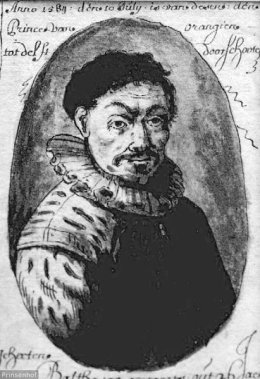
A lawyer by trade, Gérard was a fervent Catholic and supporter of the Spanish crown, which controlled the territory up the coast through the present-day Netherlands. At the peak of its power, Spain’s monarchy — led by King Philip II — had significant cause for concern at the rise in Protestantism.

The Spanish were Europe’s paladins of staunch Catholicism, and the sight of her troops did little to endear Spain to her colonized neighbors to the North.

For both religious reasons and political ones, the Dutch were looking for a way out from under the Spanish thumb, and a former noble named William, Duke of Orange, was a major instigator in the struggle. In his collected letters and addresses from the period, An apology or defence of William the First of Nassau, William states that, starting in 1559, he became increasingly concerned with plans against Protestants by the Spanish monarchy.

That also happens to be the year William was bestowed with stadtholdership of Holland, Zeeland, and Utrecht; in effect, he controlled the Dutch coast.

Though he was known as William the Silent, the Duke was endowed with both financial resources and widespread popularity, and he didn’t keep his mouth shut when it came to Inquisition courts in his realms.†

When the head enforcer of that policy, Cardinal Antoine Perrenot de Granvelle, left town, William got even noisier — declaring before the Council of State that Spanish policies were squelching religious freedom.

In 1566, the nobleman signed onto the Compromise of Nobles and began funding insurgencies across the northern provinces. As religious unrest grew, Calvinists and Protestants in the French and Germanic portions of Spain’s holdings quickly formed up behind William. An early attempt in 1568 to invade the Netherlands using German mercenaries and French Huguenots failed, but the resultant executions of Egmont and Hoorn put Spain on a long and winding road toward defeat.

The Dutch War was afoot, with William leading the way.

It would take and dozens of small-scale military victories over the next 15 years (during which William declared himself a Calvinist and fully broke his Spanish ties) for the Dutch to move to independence. The 1580 Union of Utrecht and 1581 Act of Abjuration officially ousted King Phillip II from the Netherlands and installed a new government.

Needless to say, Phillip reciprocated William’s love.

In 1580, Spain’s top man put a price on William’s head. Juan de Jáuregui tried to collect two years later by shooting the stadtholder, but the man holding the new title of Prince William I of Nassau recovered, while de Jáuregui was killed on the spot.

With 25,000 crowns at stake, there were bound to be other takers.

Our man Balthasar Gérard started looking for a close encounter with William the Target. At first, he joined the army in Luxembourg, which didn’t get him very far. It was time to gin up a real plot, which Gérard shopped to the Duke of Parma, Alessandro Farnese, in April 1584. Though the Duke offered no funding for the operation — Gérard ponied up the startup money he needed for the trip — and held out little hope that the lawyer would be successful, he gave Gérard assurances that his family would be taken care of in case of disaster.

Gérard first presented himself to William in June as the son of a martyred Calvinist from France. On 8 July, he returned and, badly in need of new clothes, managed to beg 50 crowns for a new set.

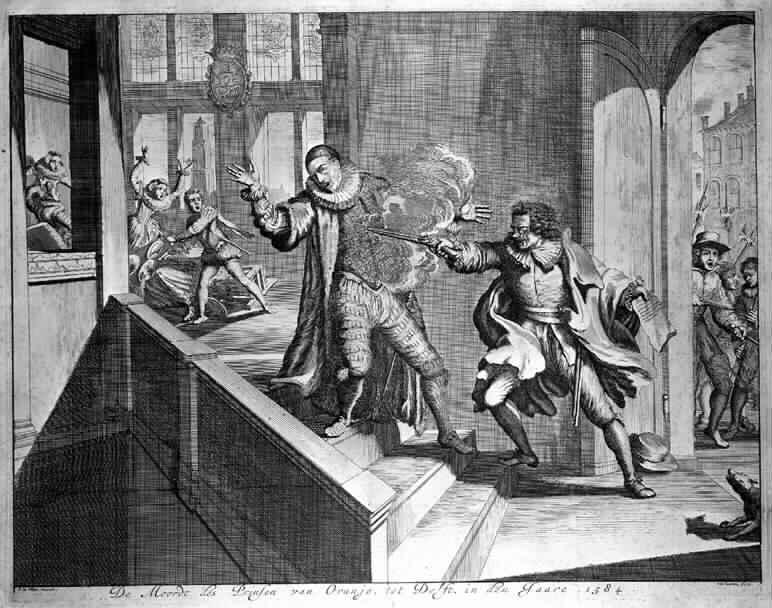
Instead, he bought a pair of pistols and, on 10 July, made history with a point-blank shot to William’s chest.


Detail view (click for the full image) of William the Silent’s 1585 assassination at the hands of Balthasar Gerard.

This assassination attempt didn’t fail. William became the second head of state to be killed by an assassin’s bullet,† — and his shooter the first such man to be juridically punished for the deed.

And, oh, how he was punished.

The regicide was beaten immediately after his capture, then subjected to a variety of cruelties, from wet leather boots which, when heated, both crushed and burned the feet, to daily floggings while hanging on a post outside the jail.

But on this day, his time of torture was up, and Gérard was finally put to death. You know, the usual:

It was decreed the right hand of Gerard should be burned off with a red-hot iron, that his flesh should be torn from his bones with pincers in six different places, that he should be quartered and disembowelled alive, that his heart should be torn from his bosom and flung in his face, and that, finally, his head should be taken off.


Gerard’s execution.

For all that he suffered as a regicide, Gérard left his family an impressive inheritance. Making good Parma’s assurances, King Phillip II gave them William’s former lands in three French provinces and took his siblings and their issue into his peerage.

Gérard’s cause carried on for another 60 years, until it was finally extinguished by the signing of the Peace of Münster by the Republic of the Seven United Netherlands and Spain.

* Foucault mistakenly identifies the torture as lasting 18 days, and the additional details he lays down for Gérard’s time on death row may be less-than-believable. However, all sources indicate that the tortures Gérard endured were quite spectacular, even by the standards of the day.

** See Dissident identities in the early modern Low Countries for a complete treatment of this period in The Netherlands and Belgium.

† For example, the city of Antwerp (Belgium), then under possession of the Spanish crown and considered the mercantile center of Europe for its vast sugar trade, featured over 100 executions for heresy from 1557-1562, twice as many as in all of Spain during that time.

‡ The first was James Stewart, 1st Earl of Moray, then Regent of Scotland. Stewart’s shooter, James Hamilton, escaped into exile, though others of the Hamilton clan answered for the murder.

On this day..

1655: Grete Adrian, Ruethen witch

On this date in 1655, Grete Adrian heard her final condemnation as a witch, then was ushered to the marketplace of Ruethen where she was beheaded and burned.

A remarried widow, Grete was the daughter of a woman who in her own day had been suspected of witchcraft; Grete had lost siblings to witch-hunts during the recent Thirty Years War.

The family history with devilry would help to implicate her when allegations arose that she had produced milk by conjuration and turned into a wolf to kill a neighbor’s horse. Grete didn’t stand up to the torture very long; within a couple of days she agreed that she had taken the devil as a lover, cast malevolent spells, attended witches’ covens, and all the usual Hexenprozesse stuff. All she asked was for quick execution.

In 2011, schoolchildren from Ruethen’s Friedrich-Spee-School — its namesake was a noted critic of torture and witch trials in the 17th century — successfully petitioned local authorities to issue a blanket posthumous pardon for 169 men, women and children executed for witchcraft between 1573 and 1660 … Grete Adrian included.

On this day..