1916: Yakub Cemil, Ottoman putschist

Ottoman officer Yakub Cemil was executed on this date in 1916 as an aspiring putschist.

A Circassian infantryman who served under Enver Pasha in the 1900s, Cemil was an early and ardent supporter of the Committee of Union and Progress. This onetime underground party ascended to national preeminence in 1908, after which Cemil became a sturdy “weapon of the organization”.

He did not shrink to imbrue his hands with blood; allegedly, he assassinated journalist Ahmet Samin Bey in 1910, and on campaign in Libya against the Italian invasion he privately murdered a black lieutenant out of some combination of suspected espionage and racial animus. His implacability was his great asset and his great liability; the eventual father of post-Ottoman Turkeuy, Ataturk is perhaps apocryphally supposed to have mused, “If I one day mount a revolution, Cemil is the first man I want by my side, and Cemil is the first man I will hang afterwards.”

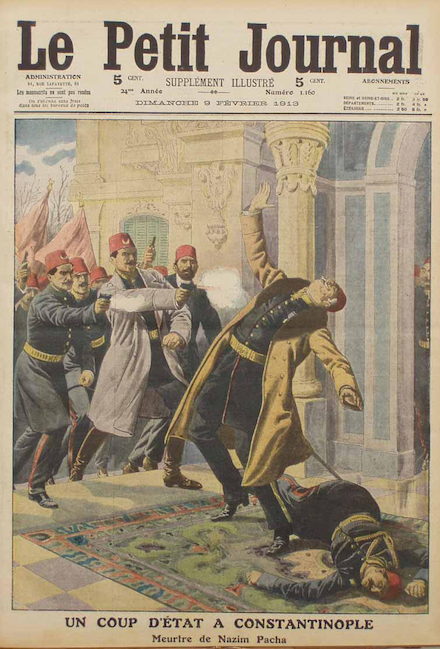
Such provincial homicides were but studies for the main deed of his days when in the 1913 Ottoman coup d’etat when he gunned down War Minister Nazim Pasha on the steps of the Sublime Porte as his CUP comrades barged in to force the resignation of the aging Grand Vizier and take the state firmly in hand.

It was an act that shook capitals around the world.


9 February 1913 edition of Le Petit Journal with a cover depiction of “un coup d’etat a Constantinople: muertre de Nazim Pacha”.

Ironically it was a desire for peace that brought his end. A couple of years deep into the catastrophe of World War I, Cemil rightly perceived the need to extricate his state from the conflict, and began making plans to topple the “Three Pashas” of the CUP whom he had helped to bring to power. His old friend Enver Pasha had no intention of approving the resulting death sentence — indeed, he had caught wind of it and tried persuasion to bring Cemil back onside — but when Enver Pasha was summoned to Berlin for a war council the fellow triumvir Talaat Pasha signed off on the execution with dispatch.

Rumors and legends abound concerning his death, such as shouting “Long live the Committee for Union and Progress!” before the firing squad opened up on him, and an agonizing half-hour bleed-out during which the expiring Cemil scrawled a patriotic slogan in the dirt with his own blood.

On this day..

1619: Melchior Grodziecki, Istvan Pongracz and Marko Krizin, Jesuits

Jesuits Melchior Grodziecki, Istvan Pongracz, and Marko Krizin earned martyrdom at the hands of the Calvinists 400 years ago today.

A Pole, a Hungarian, and a Croat, respectively, they were emissaries of their vast polyglot empire’s official religion who were unlucky to be in the wrong place when theological differences went kinetic and helped launch the Thirty Years War.

That wrong place was the Hungarian city of Kassa (today the Slovakian city of Košice) which was captured by Protestant Transylvanian prince Gabriel Bethlen on September 5, 1619. Confined to the Jesuit residence, these three were assailed by a mob of soldiers who broke in on the morning of September 7 and demanded their immediate apostasy, putting them to summary torture and eventual beheading when they refused.

All three were canonized in the 20th century.

On this day..

1917: Albin Köbis and Max Reichpietsch, Wilhelmshaven mutineers

On this date in 1917, German sailors Albin Köbis and Max Reichpietsch were shot at the Wahner Heide proving ground near Cologne.

They’d been convicted at court martial of being “ringleaders” of a mutiny of increasingly militant anti-war seamen from the battleship Prinzregent Luitpold, who on August 2 had marched into the port of Wilhelmshaven to resist their continued participation in the futile bloodbath.

“Nobody wanted a revolution, we just wanted to be treated more like human beings,” said one of their number, sentenced by the same military tribunal to 15 years. But this was a bit coy, considering that Kobis wrote his parents that “I die with a curse on the German-militarist state.”

And why not? The Russian Revolution was in full swing at this moment, while the navy had become a center of radicalized anti-war and anti-imperialist sentiment. In a year’s time another sailors’ mutiny would set off the events that finally forced an end to the Great War — and after the armistice, sailors like Rudolf Egelhofer were again prominent in revolutionary ventures like the Munich Soviet. If there is one thing we can state with confidence about the Wilhelmshaven event, it’s that some participants most certainly aspired to a revolution.

Likewise the contemporary left-wing press recognized in Köbis and Reichpietsch heroes and fellow-travelers; they were saluted as martyrs in their own day, and after World War II, East Berlin had a Köbisstrasse appropriately near to the naval headquarters. While some Communist martyrs were persona non grata on the other side of the Berlin Wall, West German television also aired a dramatization in 1969, called Marinemeuterei 1917.


Memorial to Reichpietsch (left) and Köbis (cc) image from Gordito1869.

On this day..

2013: Sushmita Banerjee, Escape from the Taliban author

On the night of September 4-5, 2013, Afghan author Sushmita Banerjee was kidnapped and summarily executed by the Taliban.

Born Hindu to a Bengali Brahmin family in Kolkata, India, Banerjee secretly married a Muslim businessman named Janbaz Khan and moved with him to Afghanistan, converting to Islam in the process.

She ran a women’s clinic there until goons from the rising Taliban movement beat her up and held her prisoner in 1995. In danger of being executed by her captors, she managed to escape and return to Kolkata.

She made her mark publishing a memoir of her harrowing experience. Kababuliwalar Bangali Bou (A Kabuliwala’s Bengali Wife) was the nondescript title; Bollywood punched it up for the silver screen as Escape from the Taliban.

This was Banerjee’s claim to fame or — Taliban perspective — infamy, and it’s possible it was the eventual cause of her murder.

“She had no fear,” a sister remembered of her. Fearlessly, or even recklessly, she returned to Afghanistan in 2013 — daring even to live in the militant-dominated border province of Paktika and refusing to wear the burka.

A Taliban splinter group disavowed by the Taliban itself ultimately claimed responsibility for kidnapping Banerjee on the night of September 4, 2013 and depositing her bullet-riddled body to be discovered the following morning; their charge was that Banerjee was an “Indian spy”.

On this day..

1588: Eight Catholics after the defeat of the Spanish Armada

On this date in 1588, Elizabethan England celebrated the defeat of the Spanish Armada with Catholic gallows spread throughout London, claiming eight souls in all.

It was earlier that August that English pluck, Dutch reinforcements, and the Protestant Wind had connived to see off that great Spanish fleet and the prospect of Catholic and continental domination.

Although Catholics were liable for life and limb throughout these years it’s hard to put down the large-scale public hangings (some with full drawing-and-quartering pains) of priests and laymen down to coincidental timing, particularly given the unusual choice to distribute them to several gallows all around London. Here, surely, was a triumphant gloat for the furtive adherents of the old faith to ponder.

The Catholic Encylcopedia’s entry on the Venerable Robert Morton, a priest who was put to death at Lincoln’s Inn Fields, surveys the carnage:

At the same time and place suffered Hugh Moor, a layman, aged 25, of Grantham, Lincolnshire, and Gray’s Inn, London, for having been reconciled to the Church by Fr. Thomas Stephenson, S.J. On the same day suffered (1) at Mile End, William Dean, a priest (q. v.); and Henry Webley, a layman, born in the city of Gloucester; (2) near the Theatre, William Gunter, a priest, born at Raglan, Monmouthshire, educated at Reims; (3) at Clerkenwell, Thomas Holford, a priest, born at Aston, in Acton, Cheshire, educated at Reims, who was hanged only; and (4) between Brentford and Hounslow, Middlesex, James Claxton or Clarkson, a priest, born in Yorkshire and educated at Reims; and Thomas Felton, born at Bermondsey Abbey in 1567, son of B. John Felton,* tonsured 1583 and about to be professed a Minim, who had suffered terrible tortures in prison.

Another priest, plus four additional lay Catholics, quaffed the same bitter cup on August 30.

* No relation, however, to the executed assassin John Felton forty years on: that man’s father made his way in the world hunting Catholic recusants to inform upon.

On this day..

2012: Seventeen Afghan civilians

Via Radio Free Europe/Radio Liberty:

Officials in Afghanistan say that 17 civilians, including two women, have been beheaded in the southern Helmand Province‘s Kajaki district.

The discovery comes on a particularly grim day, with 10 Afghan troops killed and two NATO soldiers shot dead in separate attacks, also in Afghanistan.

The civilians, including two women, were apparently beheaded overnight on August 26 near the village of Zamindawar in southern Helmand Province, a Taliban stronghold.

Helmand provincial government spokesman Daud Ahmadi told RFE/RL’s Radio Free Afghanistan that the insurgents appeared to have been seeking to punish the villagers for allegedly urging local people to stage an uprising against militants.

“These 15 civilian [men] and two women were killed allegedly for having contact with the government,” Ahmadi said. “The enemy is afraid, because people are increasingly rising up against them and people want them to leave their areas. I think [the people’s] plans were discovered.”

Ahmadi said it remained unclear who was behind the slayings.

Motive Uncertain

Some news agencies quoted local officials as saying the victims were punished for holding a mixed-gender music party.

Nematullah Khan, chief of nearby Musa Qala district, said the villagers had organized a party with music, and one local official said he suspected the two women had been dancing.

The Taliban, who are active in the area, have in the past been blamed for decapitating local villagers, mainly over charges of collaborating with Afghan and NATO forces.

News agencies quoted a tribal elder as saying the area has seen a surge in beheadings in recent months, and that at least three villagers were beheaded during the Muslim holy month of Ramadan.

On this day..

1217: Eustace the Monk, turncoat outlaw

On this date in 1217, the pirate Eustace the Monk was defeated in battle and summarily beheaded, scuppering an ongoing invasion that nearly seated a French dauphin on the English throne.

This colorful outlaw commenced life as the younger son of a Boulogne lord, but his conventional path into the Abbey Saint-Wulms was aborted by the murder of his father — leading Eustace to abandon his cowl for a vain attempt at vengeance.

“From a black monk becoming demoniac” — in the words of one chronicle — the man’s career thence proceeded, first rejoining the secular economy as a seneschal and then pivoting to outlawry when his former master turned against him.

His exploits in banditry are greatly embellished and romanticized in the medieval French verse titled Eustache the Monk (peruse in full here; helpful introduction here), including a number of charming and imaginary vignettes that double as moral parables and medieval slices-of-life.

Eustache spotted the Abbot of Jumièges as he was coming down the road. “Sir Abbot,” he said, “stop where you are! What are you carrying? Come now, don’t hide it.” The Abbot answered: “What’s it to you?” At this, Eustache was ready to hit him, but instead replied: “What’s it to me, fat-ass? Upon my word, I’ll make it my business. Get down, fast, and not another word out of you, or I’ll let you have it. You’ll be beaten up so badly you won’t be worth a hundred pounds.” The Abbot thought the man was drunk, and said, more politely this time: “Go away. You won’t find what you are looking for here.” Eustache responded: “Cut the bullshit and get off your horse fast, or you’ll be in for a lot of trouble.” The Abbot got down, frightened now. Eustache asked how much money he had with him. “Four marks,” said the Abbot, “in truth I only have four marks silver.” Eustache searched him immediately and found thirty marks or more. He gave back to the Abbot the four marks he claimed to have. The Abbot became duly furious; for, had he told the truth, he would have got back all his money. The Abbot lost his money only because he told a lie.

Around this time Eustace set up as a freelance English Channel pirate and was regularly employed by the English King John from about 1205 until 1212, when he switched his allegiance back to Philip II of France. Eustace tormented his former English patrons during the civil war in that country that led to the Magna Carta; the rebel barons in this war offered the English throne to the French heir Louis, and Louis invaded and held London and about half the realm, merrily aided by Eustace’s channel buccaneers.

Things went sideways for Louis and for Eustace in 1217; the former suffered a devastating reversal at the Battle of Lincoln.* Our man Eustace, attempting to reinforce Louis’s camp, was intercepted at sea and trounced at the Battle of Sandwich.**

Run-of-the-mill French knights were captured for ransom as per usual;

With Eustance, however, the case was different. When the ship was captured, the English instituted a search for him, and he was at length discovered down in the hold (Matthew Paris says in the bilge-water) by ‘Richard Sorale and Wudecoc’. Then Eustace offered a large sum of money for a ransom, ten thousand marks, as the writer of the Guillaume le Marechal puts it; ‘but it could not be.’ His addition offer (so Wendover) to serve the king of the English faithfully thereafter, if actually made, would have been only a reminder of his previous injuries. It was Stephen Trabe (or Crave) [or Crabbe -ed.], one of the mariners, ‘who had long been with him,’ that executed him, so the Histoire des Ducs de Normandie tells us; or as the poem of Guillaume le Marechal narrates it: ‘There was one there named Stephen of Winchelsea, who recalled to him the hardships which he had caused them both upon land and sea and who gave him the choice of having his head cut off either upon the trebuchet or upon the rail of the ship. Then he cut off his head.’ The head was subsequently fixed upon a lance and borne to Canterbury and about the country for a spectacle. The Romance concludes with the sentiment: ‘Nor can one live long who is intent always upon doing evil.’ (Henry Lewis Cannon


13th century illustration: Eustace gets the chop over the side of the boat.

Eustace’s defeat completely undermined Louis’s position, and the chancer was obliged to retreat to his homeland — where he’d become king in 1223. He’s known as Louis the Lion, which is pretty good, but he was rather convincingly surpassed by his son Saint Louis.

* Known to history as the “Lincoln Fair” for all the looting that occurred afterwards.

** The English maneuver on this occasion was to use an advantageous wind to hurl lime onto the French ships, blinding the enemy crews.

On this day..

1651: Christopher Love

(Thanks to English Presbyterian poet Robert Wild for the guest post in verse, celebrating the martyrdom of his coreligionist Christopher Love. Love died for seditious correspondence with the exiled Stuart then-pretender Charles II. Days after Love lost his head, Charles very nearly did likewise when he lost the decisive Battle of Worcester to Oliver Cromwell — famously escaping the rout by a harrowing, six-week flight that repeatedly came within an ace of landing him with his father in our deck of execution playing cards. -ed.)

THE TRAGEDY OF CHRISTOPHER LOVE AT TOWER HILL August 22. 1651.

Prologue.
New from a slaughtred Monarchs Herse I come,
A mourner to a Murthr’d Prophet’s Tombe:
Pardon, Great Charles his Ghost, my Muse had stood
Yet three years longer, till sh’had wept a flood;
Too mean a Sacrifice for Royall Blood.
But Heaven doe by Thunder call
For her attendance at Love’s Funerall.
Forgive Great Sir, this Sacriledge in me,
The Tear he must have, it is his Fee;
‘Tis due to him, and yet ’tis stol’n from Thee.

ARGUMENT.
‘Twas when the raging Dog did rule the Skies,
And with his Scorching face did tyrannize,
When cruell Cromwell, whelp of that mad Star,
But sure more firery than his Syre by far;
Had dryed the Northern Fife, and with his heat
Put frozen Scotland in a Bloody sweat:
When he had Conquered, and his furious Traine
Had chas’d the North-Bear, and pursu’d Charle’s waine
Into the English Orb; then ’twas thy Fate
(Sweet Love) to be a present for our State.
A greater Sacrifice there could not come,
Then a Divine to bleed his welcome home
For He, and Herod, think no dish so good,
As a Iohn Baptists Head serv’d up in blood.

ACT I.
The Philistins are set in their High Court,
And Love, like Sampsons, fetch’d to make them sport:
Unto the Stake the smiling Prisoner’s brought,
Not to be Try’d, but baited, most men thought;
Monsters, like men, must worry him: and thus
He fights with Beasts, like Paul at Ephesus.
Adams, Far and Huntington, with all the pack
Of foysting Hounds were set upon his back.
Prideaux and Keeble stands and cries A’loe;
It was a full Cry, and it would not doe.
Oh how he foyl’d them, Standers-by did swear,
That he the Judge, and they the Traytors were:
For there he prov’d, although he seem’d a Lambe,
Stout, like a Lyon, from whose Den he came!

ACT II.
It is Decreed; nor shall thy Worth, dear Love,
Resist their Vows, nor their revenge remove.
Though prayers were joyn’d to prayers, & tears to tears,
No softnesse in their Rocky hearts appears;
Nor Heaven nor Earth abate their fury can,
But they will have thy Head, thy Head, good Man.
Sure some She sectary longed, and in hast
Must try how Presbyterian Blood did tast.
‘Tis fit she have the best, and therefore thine,
Thine must be broach’d, blest Saint, its drink Divine.
No sooner was the dreadfull Sentence read,
The Prisoner straight bow’d his condemned Head:
And by that humble posture told them all,
It was an Head that did not fear a fall.

ACT III.
And now I wish the fatall stroke were given;
I’m sure our Martyr longs to be in Heaven,
And Heaven to have him there; one moments blow
Makes him tryumphant; but here comes his woe,
His enemies will grant a months suspence
If’t be but for the nonce to keep him thence:
And that he may tread in his Saviours wayes,
He shall be tempted too, his forty dayes:
And with such baits too, cast thy self but down,
Fall, and but worship, and your life’s your own.
Thus cry’d his Enemies, and ’twas their pride
To wound his Body, and his Soul beside.
One plot they have more, when their other fail,
If Devils cannot, disciples may prevail.
Lets tempt him by his friends, make Peter cry
Good Master spare thy self, and do not die.
One friend intreats, a second weeps, a third
Cries your Petition wants the other word:
I’le write it for you, saith a fourth; your life,
Your life Sir, cries a fift; pity your wife,
And the Babe in her: Thus this Diamond’s cut,
By Diamonds onely, and to terrour put.
Me thinks I hear him still, you wounding heart;
Good friends forbear, for every word’s a dart:
‘Tis cruell pity, this I do professe,
You’ld love me more, if you did love me lesse:
Friends, Children, Wife, Life, all are dear I know,
But all’s too dear, if I should buy them so.
Thus like a Rock that routs the waves he stands,
And snaps a sunder, Sampson-like these bands.

ACT IV.
The day is come, the Prisoner longs to go,
And chides the lingring Sun for tarrying so.
Which blushing seemes to answer from the skie,
That it was loath to see a Martyr die.
Me thinks I heard beheaded Saints above
Call to each other, Sirs, make room for Love.
Who, when he came to tread the fatall Stage,
Which prov’d his glory, and his Enemies rage.
His bloud ne’re run to his Heart, Christs Blood was there
Reviving it, his own was all to spare:
Which rising in his Cheeks, did seem to say,
Is this the bloud you thirst for? Tak’t I pray.
Spectators in his looks such life did see,
That they appear’d more like to die than he.
But oh his speech, me thinks I hear it still;
It ravish’d Friends, and did his enemies kill:
His keener words did their sharp Axe exceed,
That made his head, but he their hearts to bleed:
Which he concludes with gracious prayer, and so
The Lamb lay down, and took the butchers blow:
His Soul makes Heaven shine brighter by a Star,
And now we’re sure there’s one Saint Christopher.*

ACT V.
Love lyes a bleeding, and the world shall see
Heaven Act a part in this black Tragedie.
The Sun no sooner spide the Head o’th’ floore,
But he pull’d in his own, and look’d no more:
The Clouds which scattered, and in colours were,
Met all together, and in black appear:
Lightnings, which fill’d the air with Blazing light,
Did serve for Torches all that dismall night:
In which, and all next day for many howers,
Heaven groan’d in Thunder, and did weep in showers.
Nor doe I wonder that God Thundred so
When his Bonarges murthered lay below:
Witnesses trembled, Prideaux, Bradshaw, Keeble,
And all the guilty Court look’d pale and feeble.
Timerous Ienkins, and cold-hearted Drake
Hold out, you need no base Petitions make:
Your enemies thus Thunder-struck no doubt,
Will be beholding to you to goe out.
But if you will Recant, now thundring Heaven
Such approbation to Loves Cause hath given.
I’le adde but this; Your Consciences, perhaps,
Ere long, shall feele far greater Thunder-claps.

Epilogue.
But stay, my Muse growes fearfull too, and must
Beg that these Lines be buried with thy dust:
Shelter, blessed Love, this Verse within thy shroud,
For none but Heaven dares takes thy part aloud.
The Author begs this, least if he be known,
Whilst he bewailes thy Head, he loose his own.**

FINIS.

* A little wink by the author. The Saint Christopher was a supposed early Christian martyr depicted as either or both of a Canaanite giant or a dog-headed man — real tall-tale stuff. His historicity came under fire from iconoclastic critics of the Humanist and Reformation traditions; for example, Erasmus pooh-poohed this folklore in his In Praise of Folly.

** Wild usually worked anonymously in his time, for obvious reasons.

On this day..

1885: Pedro Prestan, isthmus rebel

On this date in 1885, the Colombian rebel Pedro Prestan hanged at a railroad at the town of Colon, on the isthmus of Panama that was then still a part of Colombia.

The Caragena-born Prestan was part of a liberal rebellion against the government of Rafael Nunez; in the end, Nunez is going to author Colombia’s 1886 constitution and write the words to its national anthem, so it would be fair to say that said rebellion was not crowned with victory.

Nevertheless, in his moment Prestan shook imperial capitals around the globe in the spring of 1885 when his attempt to receive a shipment of weapons at Colón during Ferdinand de Lesseps‘s initial attempt at canal construction was underway. This shipment was interdicted in port with the aid of an American warship, leading Prestan to seize four American hostages as a guarantee for his product. “At the first gun you hear fired from the vessel, shoot these men!” Prestan ordered.

The resulting crisis brought a landing by American marines (operating gingerly lest they provoke the execution of their countrymen), an incursion of Colombian troops, the wholesale burning of Colon, and a brush with war between the U.S. and Chile — the latter also dispatching its navy to the region as a precaution against the United States seizing Panama outright.

In the end, the hostages weren’t shot, Prestan didn’t get his guns, and the foreign interlopers all withdrew to settle the isthmus some other day.

The destruction of Colon was laid at Prestan’s feet once they caught him. A court-martial condemned him on the evening of August 17th; he was hanged the very next day before a large crowd, with a rail car (pulled from under his feet when the moment came to drop him) serving as his scaffold. Prestan protested his innocence of incendiarism to the last.

On this day..

1794: Charles-Louis Richard

Eighty-three-year-old Catholic theologian Charles-Louis Richard was shot by the army of revolutionary France on this date in 1794 in Mons, Belgium.

Although not a household name to posterity, this Dominican (English Wikipedia entry | French) was in his day one of his party’s great polemicists and adver

is called by Daniel-Rops the most distinguished apologist of the eighteenth century because of his Universal Dictionary of the Sacred Sciences (six folio volumes of almost 5,000 pages, completed 1765) written to counteract the famous Encyclopedie of Voltaire, the Bible of the Enlightenment. He also produced A General Dictionary of the Theological Sciences (Bibliotheque Sacree, 1822, in 29 volumes, the basis for many later works) and 79 polemical works, plus four volumes of sermons characterized by one critic as “simple, natural, intelligible to all; it instructs, touches and convinces.”

In 1778, he fled the Revolutionary Assembly of Paris to Brussels, but could not keep quiet when he found that the University of Louvain had become Josephist, and fled again to Lille and Mons where he wrote The Parallel, comparing the execution of Louis XVI by the French to the killing of the Messiah by the Jews. Hence when the Republican armies in 1794 entered Mons they arrested this octogenarian prophet. He refused a defender, admitted he had written The Parallel and declared he would sign it with his blood. To the condemnation he answered Deo Gratias, and in prison sang the Te Deum. Before his execution he divided what little he possessed with his barber and the jailers, saying, “Charity should be strong as death and zeal unyielding as hell.”

-From The Dominicans

It’s unclear to me whether this army of occupation afar in the field would have been aware at this moment that Robespierre’s Jacobin government had fallen days earlier … nor whether, if it was not so informed, such information would have directed a different course of action.

On this day..