1559: Anne du Bourg

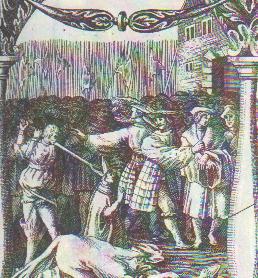
On this date in 1559, Protestant parliamentarian Anne du Bourg was publicly strung up and burned for his uncompromising defense of Calvinism.

All France burned, figuratively, with the Protestant Reformation — and literally, with Henri II‘s ruthless reaction against it. But that flame tempered and honed the Huguenots’ steel.

With the dissolute crowned head before him to attend a seating of Parlement considering the matter of the heretics’ suppression, Anne du Bourg delivered himself of a rebuke of “more courage than prudence” (Batiffol and Bodley):

While men are conducted to the stake for the sole crime of praying for their prince, a shameful license encourages and multiplies blasphemies, perjuries, debaucheries, and adulteries. (Martyn)

Incensed, the king had du Bourg and others of the “moderate” party arrested in Parlement and drug to the dungeon. And though his compatriots were satisfied to recant what imperiled them, du Bourg remained obdurate and even provocative, smuggling a pamphlet against the monarch out of prison.

Henri would not make good his vow to see du Bourg burnt, having been slain by a freak jousting accident. But it little availed du Bourg inasmuch as Henri’s untimely demise put the Catholic faction even more firmly in the saddle. The agitation of Protestants for du Bourg’s release went for naught, and the sharp-tongued minister of state had occasion to speak to posterity from the scaffold. “My friends, I am not here as a thief or a martyr, but for the evangelium.”

“His one speech did more harm to the Catholic Church than a hundred ministers could have done.”
-Eyewitness Florimond de Roemond, quoted in The Cambridge Modern History

The religious conflict that made an end of du Bourg soon exploded into civil war. Many more, like du Bourg, would find their triumph in death — until, after three bloody decades, a Protestant prince accepted triumph in apostasy by deciding that “Paris is worth a Mass.”

On this day..

1594: Alison Balfour

On this date in 1594, Alison Balfour was burned as a witch on the strength of a confession extracted under the hideous torture of her family.

Balfour had been implicated in a plot — probably entirely fictitious — to poison the tyrannical young Earl of Orkney, with some misshapen blob of wax appearing as evidence of her communion with the infernal.

She was tortured, but she denied the charges.

Her 81-year-old husband was tortured in front of her, but she denied the charges.

Her son’s feet were crushed in front of her, but she denied the charges.

When at last her seven-year-old daughter was put to thumbscrews in front of her, she broke down and “confessed.”

Before her execution, she renounced her confession in heartbreaking words to be read in the original records:

sche … declarit and tuik upoun hir saull and conscience, as sche wald ansuer att the day of judgement … that sche wes als innocent and wald die als innocent on ony point of Wichcraft as ane barne new borne … the tyme of hir first Depositioun sche wes tortourit diverse and severall tymes in the Caschielawis, and sindrie tymis takin out of thame deid,* … as lykewyis hir guidman being in the stokis, hir sone tortourit in the Buitis, and hir dochtir put in the Pilliewinkis, quhairwith sche and thay wer swa vexit and tormentit, that pairtlie to eschew ane gretar torment and pwneischement, and upoun promeis of hir lyffe, and guid deid be the said Personne, falslie, aganis hir saull and conscience, sche maid that Confessioun, and na uthirwyis.

Just two years later, another supposed perpetrator of this same plot was acquitted in Edinburgh — the evidence of Balfour’s case thrown out as unreliably obtained under torture.

* “taken out of them dead” — i.e., unconscious

On this day..

1596: Francisca Nunez de Carvajal, her children, and four other crypto-Jews of her family

On this date in 1596, the Inquisition sent nine Jewish converts to Christianity to the stake in Mexico City for Judaizing — a cruel fate offering a window into a secret history of New World settlement.

When Spain expelled its Jews (and subsequently its Muslims), those who did not flee had to convert. Conversions at swordpoint being of suspect sincerity, the Inquisition spent much of the following centuries hunting Conversos — so-called “New Christians” — who secretly preserved their outlawed faiths.

For some crypto-Jews, the New World held an appeal akin to that which would draw later generations of northern Europe’s religious minorities.

Latin America in particular attracted considerable numbers of New Christians. The advantage of these territories was that they offered the New Christians a familiar culture and the possiblity of direct — even if infrequent — contact with the mother countries … These factors also helped permit [crypto-Jews] to practice Judaism.

The Carvajals (or Carabajals) were just such a family, settling in Monterrey under the aegis of their kinsman, Spanish governor Luis de Carvajal y Cueva.

But in 1590, the governor’s sister Francisa was tortured by the Inquisition into implicating her entire family in Judaism.

They got off with a humiliating public recantation, but evidence of a relapse a few years later resulted in Francisca being burned at the stake at an auto de fe — along with her children Isabel, Catalina, Leonor and Luis, and four of their in-laws. The 30-year-old Luis left a testimonial to his faith and his tortures.

A headstone in New Mexico, USA, suggests crypto-Jewish descent. Image used with permission.

Despite the grisly doings of this day, however, the Inquisition never could extirpate Jews from its American territory.

These hidden communities filtered into Mexico and north to the present-day United States, keeping adapted versions of Jewish traditions secretly alive.

Still, crypto-Jews produced scant potentially self-incriminating documentary evidence. Although DNA testing has latterly entered the scene, the true extent and nature of these populations has been the subject of lively scholarly controversy.

But the Carvajals and others like them, seemingly lost to the Inquisition’s depredations, are coming alive again. This day’s executions are the subject of a modern opera and a spring 2008 Texas A&M symposium.

And the wider community of crypto-Jews have their own umbrella organization and a burgeoning body of historical literature.

Books about crypto-Jews

On this day..

1581: Edmund Campion, Ralph Sherwin and Alexander Briant

On this date in 1581, three English Catholic martyrs were hanged, drawn and quartered at Tyburn, casualties of the bloody confrontation between religious and secular power of the English Reformation.

Edmund Campion — later sainted — was the towering figure among them and the great attraction for those that thronged the Tyburn scaffold on a rain-drenched Friday.

A brilliant Oxford scholar once tipped as a possible future Archibishop of Canterbury, Campion abjured his Anglican holy orders in favor of Rome — a mortal peril in Elizabethan England.

He slipped away to Ireland, then to the continent and safety. But at age 40, after nearly a decade abroad, the missionary zeal of the converted called him back to Albion as part of a secret Jesuit mission. Hunted from the day he set foot back in Britain, he survived a year on the run, an underground minister to an illicit faith.

Though priestly investiture alone technically made him capitally liable, a government with millions of Catholic citizens grappled for some firmer ground upon which to condemn the renowned intellectual. Since Campion succumbed neither to torture nor to blandishments, nor to the surreal interludes when he was hauled out of his dungeon and made to debate with the Crown’s theologians, he was finally convicted on the strength of made-to-order witness testimony to the effect that his mission had some vague upshot of undermining Queen Elizabeth’s hold on her subjects.

In effect, it was very much like convicting him for his faith: the Anglican-Catholic conflict had crystallized, and dozens of priests would follow the route of Campion in the years to come. Between a mutually implacable state and church, either flesh or soul must burn.

Not a few of those who trod the martyr’s path would take inspiration from the beatific Jesuit — as young Henry Walpole, whose own route to Calvary is said to have begun when he was spattered by Campion’s blood this day and come full circle to his own execution 15 years later. Walpole’s embrace of martyrdom fairly glows from his proscribed tribute to Campion:

Hys fare was hard, yet mylde & sweete his cheere,
his pryson close, yet free & loose his mynde,
his torture great, yet small or none his feare,
his offers lardge, yet nothing coulde him blynde.
O constant man, oh mynde, oh vyrtue straunge,
whome want, nor woe, nor feare, nor hope coulde chaunge.

Yee thought perhapps, when learned Campion dyes,
his pen must cease, his sugred townge be still.
But yow forget how lowd his deathe yt cryes,
how farre beyond the sownd of tounge or quill.
yow did not know how rare and great a good
yt was to write those precious guiftes in bloode.

That famous eloquence was Campion’s legacy, so overwhelmingly so that he presents in the lineup of men who might have written Shakespeare.

His best-know work was “Campion’s Brag”, the scornful nickname his foes gave to an apologia he produced while underground in England … and to whose steady words Edmund Campion proved true this day:

[B]e it known to you that we have made a league — all the Jesuits in the world, whose succession and multitude must overreach all the practices of England — cheerfully to carry the cross you shall lay upon us, and never to despair your recovery [to Catholicism], while we have a man left to enjoy your Tyburn, or to be racked with your torments, or consumed with your prisons. The expense is reckoned, the enterprise is begun; it is of God, it cannot be withstood. So the Faith was planted: so it must be restored.

But Protestant England did withstand the enterprise. The generation to come saw Catholic ideas and writing put to withering siege, Campion’s not least among them. For all the tribute of history to the man of Christlike fortitude, it is by no means apparent that the enjoyments of Tyburn and the kindred “practices of England” did not, after all, lay a cross heavier than English Catholics could bear.

On this day..

1577: Soulmother of Kussnacht

On an uncertain date in November of 1577, a popular medium whose given name is lost to history was burned to death in a lakeside town for claiming to speak with the dead.

The Soulmother of Kussnacht ran a successful enterprise channeling spirits for those who survived them. Though her persecution by a Church ill-disposed to “wise women” seems a given in retrospect, she evidently ran this business openly for well over a decade, and was at least once before brought to the attention of authorities who found her harmless.


Kussnacht as seen in an old postcard. Image reproduced with permission.

Historian Carlo Ginzburg locates Die Seelenmutter within the cosmos of pre-Christian “shamanism” that persisted in Christendom under varying degrees of toleration. In Ginzburg’s Night Battles: Witchcraft and Agrarian Cults in the Sixteenth and Seventeenth Century, which chronicles the Inquisition’s crackdown on a sect of northern Italian occultists, the contemporaneous execution of the Soulmother is both barometer and precedent for Rome’s rising intolerance of heresy.

On this day..

1520: Stockholm Bloodbath

On this date in 1520, four days after the Danish King Christian II gained the Swedish throne, nearly 100 prominent supporters of Swedish independence were executed en masse as a civil war’s apparent victors purged their enemies.

The Stockholm Bloodbath followed years of conflict between supporters of the Danish-dominated Kalmar Union and independence advocates under the banner of Sten Sture the Younger. With Sture’s death in battle earlier in 1520, the unionists had gained the upper hand. Stockholm, the last outpost of resistance, had held against four months’ siege before accepting a general amnesty in exchange for capitulation.

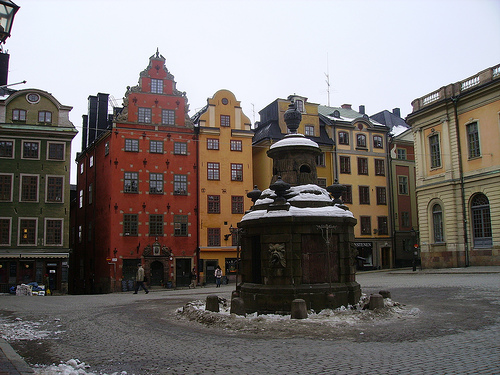
But with the city in hand, Christian — known to Swedish history as “Christian the Tyrant” — had its leaders charged for having deposed during the conflict the pro-union Archbishop Gustav Trolle, construed as an offense against the Church not in the temporal authority’s power to reprieve. Less than 24 hours after this legal maneuver was sprung, public beheadings of prelates, merchants and burgomasters were underway at Stortorget* — and Sture’s remains were exhumed and posthumously burnt at the stake.

Stortorget

It proved a Pyrrhic victory for the Danish party.

Inside of three years, Christian himself had been deposed with multiple lands and factions throughout his realm in open revolt. Gustav Vasa, whose father had been one of the Stockholm Bloodbath’s victims, would not only decisively break Denmark’s hold on Sweden but found the Vasa Dynasty under which Sweden would burgeon into one of Europe’s great powers.

*One Hans Brask survived the purge despite having endorsed the removal of Archbishop Trolle. Brask supposedly placed a note under his seal on this document saying “To this I am forced and compelled.” This cunning device gave the Swedish tongue the word Brasklapp — a secret reservation.

On this day..

1589: Peter Stubbe, Sybil Stubbe and Katharina Trump

On Halloween in 1589, the “Werewolf of Bedburg” was put to a horrible death for a supposed slew of crimes committed in lupine form in the environs of the German city of Cologne.

Our knowledge of the strange case of Peter Stubbe comes primarily from a single surviving account, and with many of the potential supplementary sources lost to the ravages of time and war, interpretations are inevitably speculative.

Stubbe reportedly confessed under (or facing) torture to having practiced witchcraft and claimed to have received a magic belt from the infernal powers enabling him to transform into a wolf. The doomed man owned, during the quarter-century riot of sin that ensued this youthful acquisition, to rape, murder, cannibalism, incest, filicide, slaughtering livestock and keeping a succubus in his bed. (Authorities were unable to recover this potent belt, and sighed that Satan must have reclaimed it.)

For these crimes, he was broken on the wheel, beheaded, then burnt — the latter punishment shared with his daughter and his mistress, apparently implicated as accessories.

Was there a real wolf terrorizing the vicinity? Was Stubbe an actual murderer with a supernatural cover story? Was he nursing a genuine delusion of lycanthropy? Did he back the wrong faith as strife over Protestantism rent Germany? Or was he just unluckily caught up in an instance of demonic hysteria?

Whatever the individual circumstances of Stubbe’s death might have been, it occurred during a surge of panic over the venerable superstition of were-beasts and shapeshifters (particularly pronounced in France) coeval with Europe’s crises of religious and political authority on the eve of the Thirty Years’ War.

Yet this troubled period bore the germ of a modernity whose pervasive social changes would upend, among other things, the idea of a real werewolf. As the sixteenth century closed, both medical and theological understandings of “werewolfism” increasingly located it in the realm of the psychological instead of the supernatural.

Within a few years of Stubbe’s torture, werewolves had left the hands of magistrates for those of doctors … bound eventually for the pens of screenwriters with Halloween fare in mind.

On this day..