1628: John Lambe murdered

Here Dr Lambe, the conjurer lyes,
Against his will untimely dies
The Divell did show himselfe a Glutton
In taking this Lambe before he was mutton
The Divell in Hell will rost him there
Whome the Prentises basted here.
In Hell they wondred when he came
To see among the Goats a Lambe.

Libel (one of many) on John Lambe’s murder

Friday the 13th of June in 1628 bore foul luck for John Lambe, an aged astrologer, magician, and folk healer so hated of Londoners that a mob fell on him as he returned from theater this evening and butchered him in the street.

While we hope to justify Lambe’s presence in these pages under our going interest in lynchings, his curious homicide transgresses the boundaries of Executed Today as surely as did Lambe transgress those of Stuart London.

North of 80 at the time of his death — although still vigorous enough at that age to defend himself with a sword — Lambe came to misfortunate public notoriety in the 1620s. These were crisis years when the crown sowed the dragon’s teeth that would in later years devour Charles I. Lambe’s slaughter was a little taste of worse to come.

Sources from the period view Lambe as both a shameless fraud and a vile wizard, with no consistency between the propositions save for their vitriol. Lambe seems like he got the worst of both perceptions at once: he faced a 1619 complaint to the Royal College of Physicians that he was a “mountebank and impostor.” [sic] Three years after that, he was in the dock for witchcraft

What Lambe did do was beat two charges in as many years that could easily have hanged him: the aforementioned witchcraft case in 1622, and a rape charge in 1624. Evidence in either case was underwhelming, but the charges themselves were incendiary; Lambe’s knack for slithering out of the hangman’s grasp must have suggested for the man on the street a channel to sinister higher powers.

Commoners bestirred themselves about this time against the realm’s own higher powers — the politically ham-fisted new king Charles and his grapples with Parliament to secure sufficient tax revenue for his inept war with France and Spain.

In all this mess, the Duke of Buckingham — royal favorite and possible lover of Charles’s father — was the number two man in the kingdom, and the number one object of hate.

In the mid-1620s, Lambe became conjoined in the public eye with Buckingham — as Buckingham’s demon-summoning henchman, say. Was it the Duke’s pull that spared his familiar the noose? Was it Lambe’s necromancy that captured the king in the thrall of his detested aide?

Did it even matter?

From the distance of centuries the particulars of the supposed affiliation between the two seems difficult to establish,* but it sufficed for Lambe’s death (and Buckingham’s too) that they were analogues for one another, that their respective villainies could be multiplied one atop the other.

Despite all that tinder lying around, we don’t know the exact spark for Lambe’s murder on June 13, 1628. A few months before, Buckingham had fled a humiliating military defeat in France; Parliament and King were at loggerheads that June, forcing the reluctant Charles to accede to a Petition of Right on June 7 that remains to this day a bedrock document of Britons’ liberties.

On the 13th, Lambe was recognized by “the boyes of the towne, and other unruly people” attending a play at the Fortune Playhouse.

As he left it, some began to follow him. Maybe it was just one insult too tartly answered that multiplied these hooligans, or maybe there was a ready rabble that immediately took to his heels. The frightened Lambe picked his way to the city walls menaced all the way by his lynch mob, hired a few soldiers as an ad hoc bodyguard, and by the dark of night tried desperately to find some sort of shelter from the crowd growing in both number and hostility. Under the mob’s threat, a tavern put him out, and a barrister likewise; his guards fled their posts; and someone at last laid his hands on John Lambe. By the time the frenzy had passed, Lambe’s “skull was broken, one of his eyes hung out of his head, and all parties of his body bruised and wounded so much, that no part was left to receive a wound.” Many contemporaries must have understood it as the just punishment that courts could not manage to exact.
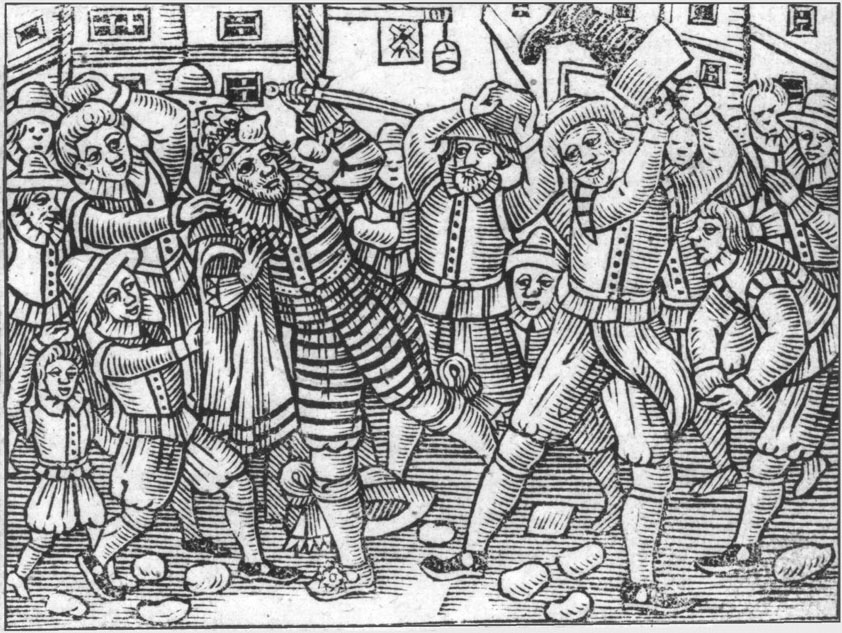

Woodcut of the assault on Lambe outside the Windmill Tavern, from the title page of A Briefe Description of the Notorious Life of Iohn Lambe (1628)

The libels now rejoiced openly in Lambe’s summary justice — nobody was ever prosecuted for his murder — and anticipated another one to follow it.

“Who rules the Kingdome? The King. Who rules the King? The Duke. Who rules the Duke? The Devill,” one menacing placard announced. “And that the libellers there professe, Lett the Duke look to it; for they intend shortly to use him worse then they did his Doctor, and if thinges be not shortly reformed, they will work a reformation themselves.”

Their thirst for “reformation” was not long delayed.

Ten weeks after Lambe’s murder, a disaffected army officer named John Felton at last enacted the swelling popular sentiment and assassinated Buckingham.

“The Shepheards struck, The sheepe are fledd,” one unsympathetic doggerel taunted, recalling the dead wizard whose supernatural exertions could no longer protect his wicked patron. “For want of Lambe the Wolfe is dead.”

The History of Witchcraft podcast has an excellent episode on Dr. Lambe here.

* So says Alastair Bellany, whose “The Murder of John Lambe: Crowd Violence, Court Scandal and Popular Politics in Early Seventeenth-Century England” in Past and Present, vol. 200, no. 1 is a principal source for this post. (It’s here, but behind academic paywalls.)

On this day..

1666: Andreas Koch, witch hunt skeptic

On this date in 1666, the pastor Andreas Koch suffered the pains of standing up against witch hunts in his town of Lemgo: Koch himself was beheaded as a wizard.

Lemgo recorded a busy witch-hunt record with an estimated 250 cases in the 16th and 17th centuries. But the bulk of those cases came surprisingly late — from 1653 to 1681, the period after the Thirty Years’ War witch-smelling acme.

As we’ve seen before in these grim annals, elites were not safe from the Hexenverfolgung; this, perhaps, is the reason that even we latter-day seculars still have such a visceral reaction to the term “witch hunt”.

Great is the honor for the one bold enough to stand athwart the inquisitor’s path, for great is the danger.

Andreas Koch, a Protestant pastor of the church of St. Nicolai, was a confessor to several condemned witches of Lemgo. As his position would indicate, Koch was no firebrand: he did not deny the presence of sorcerers and diabolical power in the world. But in 1665, he made bold to express skepticism about goings-on and even preached from the pulpit caution against reckless witchcraft accusations. He had found himself unsettled by the contradictory and illogical stories in supposed witches’ confessions, and finally convinced by the vow of innocence a condemned woman named Elisabeth Tillen gave him on the way to the stake. Lemgo was putting innocent people to death on spurious charges.

This epiphany, so obvious in retrospect, was a little too far ahead of his audience.

Rev. Koch was suspended from his ministry by that October, and amid new rumors circulating that he had himself been seen at the witches’ sabbaths, was arrested and put to torture the following spring. Koch was no better able to resist the interrogators’ torments than Elisabeth Tillen and her ilk had been, and obligingly confessed to diablerie. His only mercy was to die by the sword, rather than the flame; that he died before 5 in the morning might have been a mercy for his persecutors to minimize the public attendance at a potentially embarrassing scene.

Needless to say, it is Koch who has the judgment of posterity here. A present-day walking tour of Lemgo’s historic witch-hunt sites will not fail to stop at the monument that now stands in St. Nicolai’s to its devilishly skeptical former clergyman.


Detail view (click for full image) of the memorial to Andreas Koch at his former church in Lemgo. (cc) image from M. Ehret.

On this day..

1690: Old Mobb, witty highwayman

On this date in 1690, according to the Newgate Calendar,* the venerable gentleman rogue Thomas Sympson — better known as Old Mobb — was hanged for robbery.

Old Mobb — at least, the stylish and erudite version of the man given us in the Calendar — preyed the roads of late 17th century England for many a year, perhaps all the way back to the ill-fated reign of Charles I.

His rollicking adventures could have formed the fair corpus of a durable legend; in some alternate world Ainsworth chose Old Mobb as for Rookwood and it is he and not Dick Turpin who has the television serial and the pub nameplates.

A nobleman Sir Bartholomew Shower, whose name might also be the safeword at a leather masquerade, was apprehended by Old Mobb one day nearly penniless as to his person; taking exception at being shorted by such a wealthy grandee, Mobb forced him to write up a bill for 150 quid to draw on the goldsmith of nearby Exeter, leaving Shower trussed up under an obliging hedge “as security for the payment” while he went into town to cash the cheque.

The annals have next a widow, bound for Bath no less in tribute to the classics, and had a jolly battle of the sexes with her over her condition which of course Old Mobb won, since he had the gun. His target, you see,

wept very plentifully, in order to move him to pity; she told him she was a poor widow, who had lately lost her husband, and therefore she hoped he would have some compassion on her. “And is your losing your husband then,” says he, “an argument that I must lose my booty? I know your sex too well, madam, to suffer myself to be prevailed on by a woman’s tears. Those crocodile drops are always at your command; and no doubt but that dear cuckold of yours, whom you have lately buried, has frequently been persuaded out of his reason by their interposition in your domestic debates. Weeping is so customary to you, that everybody would be disappointed if a woman was to bury her husband and not weep for him; but you would be more disappointed if nobody was to take notice of your crying; for according to the old proverb, the end of a husband is a widow’s tears; and the end of those tears is another husband.”

The poor gentlewoman upon this ran out into an extravagant detail of her deceased husband’s virtues, solemnly protesting that she would never be married again to the best man that wore a head, for she should not expect a blessing to attend her afterwards; with a thousand other things of the same kind. Old Mobb at last interrupted her, and told her he would repeat a pleasant story in verse which he had learned by heart, so, first looking round him to see that the coast was clear on every side, he began as follows: —-

A widow prude had often swore
No bracelet should approach her more;
Had often proved that second marriage
Was ten times worse than maid’s miscarriage,
And always told them of their sin,
When widows would be wives agen:
Women who’d thus themselves abuse,
Should die, she thought, like honest Jews
Let her alone to throw the stones;
If ’twere but law, she’d make no bones.

Thus long she led a life demure;
But not with character secure:
For people said (what won’t folks say?)
That she with Edward went astray:
(This Edward was her servant-man)
The rumour through the parish ran,
She heard, she wept, she called up Ned,
Wiped her eyes dry, sighed, sobbed, and said:

‘Alas! what sland’rous times are these!
What shall we come to by degrees!
This wicked world! I quite abhor it!
The Lord give me a better for it!
On me this scandal do they fix?
On me? who, God knows, hate such tricks!
Have mercy, Heaven, upon mankind,
And grant us all a better mind!
My husband — Ah that dearest man!
Forget his love I never can;
He took such care of my good name,
And put all sland’rous tongues to shame. —
But, ah! he’s dead –‘ Here grief amain,
Came bubbling up, and stopped the strain.

Ned was no fool; he saw his cue,
And how to use good fortune knew:
Old Opportunity at hand,
He seized the lock, and bid him stand;
Urged of what use a husband was
To vindicate a woman’s cause,
Exclaimed against the sland’rous age;
And swore he could his soul engage
That madam was so free from fault
She ne’er so much as sinned in thought;
Vowing he’d lose each drop of blood
To make that just assertion good.

This logic, which well pleased the dame,
At the same time eludes her shame:
A husband, for a husband’s sake,
Was what she’d ne’er consent to take.
Yet, as the age was so censorious,
And Ned’s proposals were so glorious,
She thought ’twas best to take upon her,
A second guardian of her honour.

“This,” says Old Mobb, “is an exact picture of woman-kind, and as such I committed it to memory; you are very much obliged to me for the recital, which has taken me up more time than I usually spend in taking a purse; let us now pass from the dead to the living, for it is these that I live by. I am in a pretty good humour, and so will not deal rudely by you. Be so kind, therefore, as to search yourself, and use me as honestly as you are able; you know I can examine afterwards, if I am not satisfied with what you give me.” The gentlewoman found he was resolute, and so thought it the best way to keep him in temper, which she did by pulling out forty guineas in a silk purse, and presented them to him. It is fifty to one but Old Mobb got more by repeating the verses above than the poor poet that wrote them ever made of his copy. Such is the fate of the sons of Apollo. [dear reader, why not take this opportunity to click on an ad? -ed.]

We certainly have in these puffed-up knaves torn down for our amusement a little window into the romance of the road where by means of Stand And Deliver one attains the liberty to put put hypocrites in their place whilst usurping the abundance that is the latter’s usual wages.

Old Mobb robs a famous astrologer whose constellations fail to predict the engagement; to a doctor who upbraids him, he retorts, “I only take [my victims’] money away from them; but you frequently take away their lives: and what makes it the worse you do it safely, under a pretence of restoring them to health.”

As pieces de resistance, Old Mobb gets the better of two of Restoration England’s most infamous grandees.

The Duchess of Portsmouth, the widely hated French Catholic mistress to Charles II,** Old Mobb improbably manages to trap in her stagecoach giving him leave to excoriate her in words similar to those that real 17th century Britons must have muttered many times while in their cups. “I know you to be the greatest whore in the kingdom; and that you are maintained at the public charge. I know that all the courtiers depend on your smiles, and that even the K— himself is your slave,” Mobb says, rubbishing her sex and her nationality all at once. “That haughty French spirit will do you no good here. I am an English freebooter; and insist upon it as my native privilege to seize all foreign commodities. Your money indeed is English, and the prodigious sums that have been lavished on you will be a lasting proof of English folly; nevertheless, all you have is confiscated to me by being bestowed on such a worthless b—h. I am king here, madam, and I have a whore to keep on the public contributions as well as King Charles.”

The ruthless hanging judge Lord Jeffreys Old Mobb likewise pays in his own coin when Jeffreys threatens our marauder with potential damnation, speaking as it were through Jeffreys to the obsequious blackguards who afflict the public life of every time and place.

When justice has overtaken us both, I shall stand at least as good a chance as your Lordship; who have already written your name in indelible characters of blood, by putting to death so many hundred innocent men, for only standing up in defence of our common liberties, that you might secure the favour of your Prince. It is enough for you to preach morality upon the Bench, where nobody dares to contradict you; but your lessons can have no effect upon me at this time; for I know you too well not to see that they are only calculated to preserve money.

* The Newgate Calendar positively avers a hanging of Friday, May 30, 1690, but there are some complicating data points. There’s his purported campaign with William “the Golden Farmer” Davis, who was supposed to have left a parting note for Old Mobb upon Davis’s December 1690 execution. (However, 1690 was the year when May 30 was on a Friday, not 1691.)

The invaluable Old Bailey Online has none of this, though the date range is a period of spotty recordkeeping. It does give us a nondescript and lamely apologetic “Old Mobb” hanged on the 18th of September 1691; although this guy had done some highway robbery, he doesn’t otherwise bear an obvious resemblance to the Newgate Calendar’s colorful character. He might be the same guy, or they might just share a cant alias. “Mob” — short for mobilevulgus, the “fickle crowd” — was just establishing itself in English at this point with a usage a bit more flexible than it has for us today; our criminals’ point of contact might be simply that each lasted unusually long in the profession, and therefore each received a nickname meaning something like “Old Man”. Jonathan Swift complained bitterly of this truncated neologism in 1710, writing that “I have done my utmost for some years past to stop the progress of Mobb and Banter, but have been plainly borne down by numbers, and betrayed by those who promised to assist me.” (Sorry, buddy … English is a living language.)

At any rate, I don’t know whether Old Mobb is one guy or two, nor am I fully confident of the best date of execution. These are the least of our difficulties when it comes to veracity, considering that the man’s attributed exploits likely comprise 100% shameless fabrication. It’s just that kind of post.

** Careful how you speak of her: she’s an ancestor (via the late Princess Diana) of the current royal princes.

On this day..

1651: Jeane Gardiner, Bermuda witch

From Slaves and Slaveholders in Bermuda, 1616-1782:

The witchcraft trouble [in Bermuda in 1651-55] began in May 1651, when Goodwife Jeane Gardiner, the wife of Ralph Gardiner of Hamilton Tribe, was accused of bewitching a mulatto woman named Tomasin. Jeane Gardiner was heard to say “that she would crampe Tomasin” and reportedly “used many other threatenninge words tending to the hurt and injurie of the said mullatto woman.” Gardiner’s victim was then “very much tormented, and struck blind and dumb for the space of twoe houres or thereabouts.” Jeane Gardiner may have been known in her neighborhood as the wife of Ralph Gardiner, a laborer who had come to Bermuda in 1612. A contentious man, he twice accused neighbors of stealing his poultry and was himself found guilty of stealing a fish gig. The assize record mentions that Jeane Gardiner, in addition to practicing witchcraft on Tomasin, “at divers tymes in other places … did practice the said devilish craft of witchcraft on severall persons in the hurt and damage of their bodyes and goods.” A panel of 12 women, including the wives of several men who possessed black, Inian, or mulatto servants or slaves, found a witch mark, a suspicious “blewe spott” in Gardiner’s mouth. As a further test, Gardiner was “throwne twice in the sea” where she was found to “swyme like a corke and could not sinke” — according to the lore of witchcraft, a sure sign of guilt.


/mandatory

A white, middle-aged woman, wife of a laborer, Goodwife Gardiner was a typical candidate for witchcraft charges in Bermuda.

Of Tomasin, the mulatto woman who was Jeane Gardiner’s alleged victim, nothing is known except her name. Since she is not identified as belonging to any master, it is possible that Tomasin was a free woman. Perhaps she was a neighbor of Gardine’s. Jeane Gardiner and Tomasin may have lived near each other, but nothing is known of their relationship. Did Tomasin, in word or action, offend Jeane Gardiner? Did Gardiner, the wife of a laborer, feel threatened by, or jealous of, Tomasin? On the connection between this white woman and her mulatto neighbor the record is silent, but Bermuda’s legal system inflicted the full measure of punishment upon the mulatto woman’s malefactor: Jeane Gardiner was hanged “before many spectators” on May 26, 1651.

On this day..

1625: Not Helene Gillet, beheading survivor

On this date in 1625, Helene Gillet went to the scaffold in Dijon to suffer beheading for infanticide.

But it was the executioner and not Helene who came down from it in pieces.

Helene was the beautiful 21-year-old daughter of a royal chatelain, the sort of well-to-do folks who would own monogrammed blankets that proved quite incriminating when found wrapped around an abandoned dead infant in the woods. Helene would claim that its origin was a family tutor who forced himself upon her, and also insist without further explanation on her innocence of the child’s fate — though the latter little entered the picture since an edict from 1556 made it capital crime to conceal pregnancy and childbirth.

Thanks to her status, she was entitled to the dignity of a beheading, rather than an ignoble dispatch by rope. But all else for Helene Gillet was shame: her father disowned her and forbade any intervention on her behalf; only Helen’s mother accompanied her to Dijon to appeal against the sentence.

It is said that in the course of her appeals to the Parlement of Dijon, the mother attracted the sympathy of the Bernadine abbey there, one of whose inmates ventured to prophesy that “whatever happens, Helene Gillet will not die by the hand of the executioner, but will die a natural and edifying death.”

Parlement begged to differ.

On Monday, May 12th, the young woman was led to the hill of Morimont (present-day Place Emile-Zola) by the executioner of Dijon, Simon Grandjean. Monsieur Bourreau was in an agitated state that day, whether from pity for his victim, or from an ague that had afflicted him, or from whatever other woes haunted his life. When you’re the executioner of Dijon you can’t just call in sick or take a mental health day.

The scaffold on which the whole tragedy was to unfold was a permanent edifice, albeit far less monumental than the likes of Montfaucon. Its routine employment was attested by the permanent wooden palisade and the small stone chapel comprising the arena — features that would factor in the ensuing scene.

Having positioned Gillet on the block, our troubled executioner raised up his ceremonial sword and brought it crashing down … on her left shoulder. The blow toppled the prisoner from the block, but she was quite alive. To cleanly strike through a living neck with a hand-swung blade — to do so under thousands of hostile eyes — was never a certain art; there are many similar misses in the annals. Often, an headsman’s clumsiness in his office would incite the crowd: the legendary English executioner Jack Ketch was nearly lynched for his ten-thumbed performance beheading Lord Monmouth; the hangman of Florence had been stoned to death by an enraged mob after a badly botched execution in 1503.

The Dijonnaise were no more forgiving of Grandjean. Hoots and missiles began pelting the platform as the pitiable condemned, matted with blood, struggled back to the block — and Grandjean must have felt the rising gorge and sweated hands of the man who knows an occasion is about to unman him.

Grandjean’s wife, who acted his assistant in his duties, vainly strove to rescue her man’s mettle and the situation. One chop would do it: the struggling patient would still, the archer detail would restrain the angry crowd. Madame Grandjean forced Gillet back to the block, thrust the dropped sword back into the executioner’s hands with who knows what exhortation.

What else could he do? Again the high executioner raised the blade and again arced it down on the young woman’s head — and again goggled in dismay. Somehow, the blow had been half-deflected by a knot of Helene Gillet’s hair, and nicked only a small gash in the supplicant’s neck. Now hair is a decided inconvenience for this line of work and it was customary to cut it or tie it up — even the era of the guillotine gives us the infamous pre-execution toilette. Even so, the idea of a strong and vigorous man brandishing a heavy executioner’s sword being so entirely frustrated by a braid puts us in mind of an athlete short-arming a free throw or skying a penalty kick for want of conviction in the motion.

This is, admittedly, a retrospective interpretation, but if Grandjean had any inkling of what was to follow one could forgive him the choke.

Having now seen the vulnerable youth survive two clumsy swipes, the crowd’s fury poured brickbats onto the stage in a flurry sufficient to drive the friars who accompanied the condemned to flee in fear for their own lives. Grandjean followed them, all of them retreating to the momentary safety of the chapel as the attempted execution collapsed into chaos.

The steelier Madame Grandjean tried to salvage matters by completing what her husband could not — and seized the injured Gillet to haul her off the platform to the partial shelter of the stone risers by which they had ascended, like a tiger dragging prey to its lair. No longer bothering with the ceremonial niceties of the office, Madame Grandjean simply began kicking and beating Gillet as she drew out a pair of shears to finish her off in violent intimacy.

But the raging mob by this time had pushed through the guards and overrun the palisades, and fell on the melee in the midst of Madame Grandjean’s fevered slashing. The executioner’s wife was ruthlessly torn to pieces, and the cowering executioner himself soon forced from his refuge to the same fate.

Helene Gillet, who had survived a beheading, was hauled by her saviors bloody and near-senseless to a nearby surgeon, who tended her injuries and confirmed that none of them ought be fatal.

What would happen to her now?

The prerogatives of the state insist against the popular belief in pardoning an execution survivor.

We don’t have good answers for this situation even today; that a person might leave their own execution alive seems inadmissible, even though it does — still — occur.

But Helene Gillet was obviously a sympathetic case, and as a practical matter, the office of Dijon executioner had suddenly become vacant. The city’s worthies petitioned as one for her reprieve.

As it happened, King Louis XIII’s younger sister Henrietta Maria had on the very day preceding the execution been married by proxy to Louis’s ill-fated English counterpart Charles I. This gave the French sovereign good occasion for the very palatable exercise of mercy, “at the recommendation of some of our beloved and respected servants, and because we are well-disposed to be gracious through the happy marriage of the Queen of Great Britain.”

The Parlement of Dijon received the royal pardon on June 2, and formally declared Helene Gillet’s official acquittal.

The fortunate woman, having had a brush with the sublime, is said to have retired herself to a convent and lived out the best part of the 17th century there in prayer.

There’s a 19th century French pamphlet of documents related to this case available from Google books.

On this day..

1624: Antonio Homem, at the hands of the Portuguese Inquisition

On this date in 1624, Coimbra University theologian Antonio Homem was burned at the stake in a Lisbon auto de fe.

Homem came from a “neo-Christian” family, Jews who had been forced to convert to Christianity. Considering the compulsion, one could fairly question the piety of such “Christians”; in a great moment in damned-if-you-do, damned-if-you-don’t, the Spanish Inquisition fired up to probe the potential un-Christian activity of neo-Christians.

Neighboring Portugal was just a beat behind Spain in all this; Spain expelled its Jews — the ones who weren’t willing to convert — in 1492, and Portugal did so in 1497. The Portuguese Inquisition began in 1536 and, like Spain’s, took conversos as a primary focus.*

Homem’s family’s response was to be more Catholic than the Pope and have Antonio trained for the clergy; he became canon of the Cathedral of Coimbra and a doctor at the University of Coimbra.

Homem was in his fifties when it became known among his colleagues that he was of New Christian stock, and this circumstance soon attracted unwanted attention — and eventually, his denunciation for allegedly leading a secret Judaic cell. Homem, it is said, “often took the part of priest”; The Other Within: The Marranos, Split Identity and Emerging Modernity describes a Kippur ceremony from the Inquisition records.

The public, all fasting and dressed in white, used the Christian Bible (the Vulgate) to recite Latin Psalms that expressed a Jewish-Marrano sentiment (Psalms such as “When Israel came out of Egypt,” “On the rivers of Babylon,” and “From the Abyss I called you, O God”). In those ancient Jewish poems the Marranos expressed their own, specific sense of exile and yearning for redemption. A few “priests of the Law of Moses,” replicating a Catholic ceremony, dressed Homem in a long elegant garment and put “a sort of miter” on his head, decorated with golden plaque. There was an altar there, and incense, and painted images of Moses and of a Marrano martyr or saint “who had been … burned as a Jew.”

The inner life of the converso is a great riddle from our distance of time and context. It is immediately tempting to perceive religious martyrs here, people who were forced underground but still kept what they could of the faith of their fathers at risk of life and limb.

Such a reading paradoxically allies us with their persecutors, for it is by the Inquisition’s hand that we have the evidence — and this is a source whose evidence we greet very skeptically when it, for instance, charges conversos with murdering Christian children. Inquisitors all around Europe were after all involved in these very years in scaring up secret witches’ covens to incinerate, and it was not unknown for the deadly judicial apparatus to be borrowed here and there from restraining the minions of Hell in order to service business opportunities, political aspirations, or private grudges of the personal or professional variety. Try asking a present-day academic how easy they’d sleep knowing their colleagues on the tenure committee also had a few buddies in the Holy Inquisition.

Antonio Jose Saraiva’s The Marrano Factory: The Portuguese Inquisition and Its New Christians 1536-1765** contends that most “Judaizing” Christians were just plain Christians — caught up like accused witches and warlocks could be in some specious neighborhood rumor that became a self-fulfilling accusation. “Inevitably,” says Saraiva, “a family quarrel or a commercial intrigue would lead to several series of denunciations, followed by arrests. Arrests led to trials which spiraled into new rounds of arrests and trials.” Saraiva argues that Homem’s recently-exposed Jewish heritage probably just made him a ready target when a commercial dispute of some sort led the Inquisition’s Coimbra tribunal to seize “scores of merchants engaged in the triangular commerce between Brazil, Oporto and Amsterdam.”

Whether Homem really did head a covert cult with 100-plus adherents reading Old Testament verses from the Latin Bible — or whether this was what an inquisitor goaded by Homem’s enemies supposed a secret Jew might do — he was left to rot in prison several years† after his 1619 condemnation while the Inquisition investigated dozens of his alleged adherents. These included other cathedral canons, professors and students at the university, nuns from four nearby convents, and other persons of some stature. (Homem, to his credit, refused to accuse anyone else.)

Homem was eventually among eight burned (Portuguese link) at an auto this date at the Ribeira de Lisboa, and his house was torn down to be replaced with a pillar inscribed “Praeceptor infelix”. Prior to their destruction they were favored with the preachings of Friar Antonio de Sousa who railed against the insidious Semitic threat to homeland security.

For our sins of the last years people of quality have been cross-breeding with these perverse Jews to whom I am referring. They became corrupted by their contact with them and have become Jews like they are. Just a few years ago only low-class, trashy Jews were paraded at the autos-da-fe. See what now appears for sentencing in the autos-da-fe and in this very one at which I am preaching: ecclesiastical personnel, friars, nuns, holders of master’s degrees, licentiates, doctors and professors with family connections to the nobility, people only half of New Christian origin, or a quarter, or an eighth, all confessing and convicted of Judaism. (Translated excerpt via Saraiva)

Readers with Portuguese proficiency can find more on this case in this 1999 book exploring the Inquisition’s Coimbra archives, or in Antonio Homem e a inquisição.

* For the setting of this post, the 1620s, Spain and Portugal are under the personal union of a common monarch, Philip IV.

** We’ve mentioned it before.

† One of the great (and eventually fatal) inefficiencies of the auto-de-fe system was its tendency to leave its future exhibits to languish for years in prisons before the prescribed spectacle could be properly arranged.

On this day..

1683: Yaoya Oshichi, fire horse

On this date in 1683,* Yaoya Oshichi gave her life for her red-hot love … and the want of a little white lie.

The greengrocer’s daughter Oshichi (English Wikipedia page | Japanese) legendarily fell in love with a priest of the nearby temple while taking refuge there during one of Edo’s many fires (Japanese link), and in a truly adolescent outburst proceeded to start another fire in the hopes of meeting him again. (Alternate version: it was Oshichi’s gesture that actually started the linked conflagration.)

As a 16-year-old, Oshichi was just barely eligible to suffer the full weight of the law for a capital crime.

In an age of scanty documentation, however, the pitying magistrate (Japanese link) hearing her case is supposed to have asked her in a hinting sort of way, “you’re 15, right?”

Either not catching his drift or else honest to a fault, Oshichi replied that, no, she was 16, thank you very much, and reiterated the point when it was followed-up … thus dooming herself to the stake.


Yaoya Oshichi’s execution.

A few years after this outstandingly tragic demise, poet Ihara Saikaku popularized the tale in his Five Women Who Loved. She’s been waxing immortal ever since in every manner of artistic interpretation, and remains a popular figure for joruri and bunraku and kabuki.

(When next in Tokyo, pay your own respects at her tomb.)

Meanwhile, Yaoya Oshichi’s apparent birth in the zodiacal “fire horse” year of 1666 — fire horses are supposed to be an especially passionate, impulsive bunch — followed by her unfortunate fiery end helps make such cycles superstitiously inauspicious for prospective parents, especially prospective parents of girls.

The year of a fire horse only rolls around once every six decades; in the last one, in 1966, Japanese “fertility dropped by over 25%;” even “the fertility rate of Japanese Americans in California and Hawaii also dropped by 3.3% and 1.8%, respectively, in the same year.”** The abortion rate in Japan for that one year spiked nearly 50% above expected without any other apparent cause.† It’s something to watch for when the next batch of little fire horses are due, in 2026.

* “The 29th day of the 3rd month” is widely cited as “March 29”, but it actually appears to refer to the 29th day of the 3rd month of the third year of the “Heaven’s Blessing” era. That third month spanned the Gregorian dates of March 28 through April 26, 1683.

** Jungmin Lee and Myungho Paik, “Sex Preferences and Fertility in South Korea during the Year of the Horse,” Demography, Vol. 43, No. 2 (May, 2006).

† Kanae Kaku, “Increased induced abortion rate in 1966, an aspect of Japanese folk superstition,” Annals of Human Biology, Vol. 2, No. 2 (1975).

On this day..

1642: George Spencer, pork loin

On this date in 1642, George Spencer paid the penalty at the New Haven (Connecticut) colony for a pig-fucking that he probably never perpetrated.

Seven and a half weeks previous, a farmer named John Wakeman had reported to magistrates that his pregnant sow had delivered a litter of healthy piglets … plus one abomination from the nightmares of H.P. Lovecraft and Ron Jeremy.

Itt had no haire on the whole body, the skin was very tender, and of a reddish white collour like a childs; the head most straing, itt had butt one eye in the midle of the face, and thatt large and open, like some blemished eye of a man; over the eye, in the bottome of the foreheade which was like a childes, a thing of flesh grew forth and hung downe, itt was hollow, and like the mans instrument of generation.

Genetics is a funny thing. Once in a while the little variations in a new generation will produce an adaptive advantage that takes the species another step down its evolutionary path.

And then other times what you get is dickface swineclops.

As so often with a proper monster story, it was the frightened townsfolk who produced the real horror.

The resemblance of this poor (and mercifully stillborn) pig to a man — “nose, mouth and chinne deformed, butt nott much unlike a childs, the neck and eares had allso such resemblance” — looked like palpable divine anger to New Haven worthies, and inspired a suitably inquisitorial response.

Its target was localized to George Spencer, a former servant to the pig’s former owner. Spencer had a bum eye himself plus a reputation as a “prophane, lying, scoffing and lewd speritt.” With a model of heredity we might strain to credit as primitive, it emerged as widespread suspicion that soon manifested into fact that Spencer had fathered the penis-headed chimera.

Maybe George Spencer really did go hog wild. Who really knows? But the account of the “investigation” — in which the only actual evidence was Spencer’s own confession plus his mutant “progeny” — has every hallmark of the false confessions whose prevalence is only lately becoming well-understood. European and American “witches” were also telling their persecutors just what they wanted to hear in the mid-17th century.

Spencer denied the charges at first. The magistrate Stephen Goodyear(e)* interrogated him: did Spencer not “take notice of something in [the monster pig] like him”? Goodyear implied that they already knew Spencer was guilty.

During a nervous pause, which Goodyear took to be Spencer preparing his soul to unburden itself but a less hostile viewer might have taken to be the frightened farmhand fretting about how he was going to escape with his neck, Goodyear hit him with Proverbs 28:13. It’s a nice dual-purpose verse to stamp the divine imprimatur on the good cop-bad cop approach: “He that covereth his sins shall not prosper: but whoso confesseth and forsaketh them shall have mercy.”

Spencer wasn’t getting anywhere denying everything. He decided to try confessing and getting in on that mercy.

(Even at this, he told someone else that he had only confessed “for favor”. Upon hearing this, Goodyear stalked back to Spencer’s cell and made him commit to the confession.)

The next day, a team of town grandees showed up to get the details. Again, Spencer denied it, but now his previous day’s remarks hemmed him in. His story was shifty; he changed the location of the sin from the sty to the stable, varied between a half-hour and two hours engaged in his sin.

By the time of the trial that commenced on March 2, Spencer — perhaps now realizing that the proverb he ought to have heeded was “don’t talk to police” — was back to full denial. This time he stuck to it all the way through the proceedings, and little good it did him as witness after witness who had heard various iterations of his confession reported the admission. The judges had to decide how to adjudicate this kind of case at all, and they decided to go straight to the Pentateuch.

according to the fundamentall agreement, made and published by full and generall consent, when the plantation began and government was settled, that the judiciall law of God given by Moses and expounded in other parts of scripture, so far as itt is a hedg and a fence to the morrall law, and neither ceremoniall nor tipicall, nor had any referrence to Canaan, hath an everlasting equity in itt, and should be the rule of their proceedings. They judged the crime cappitall, and thatt the prisoner and the sow, according to Levit. 20 and 15, should be put to death.

By hanging-day on April 8, Spencer was still refusing to admit the charges, and he even continued his obstinacy to the gallows — giving only the sort of standard-issue hanging-day exhortation to straighten those laces and not skip church that everyone always gave. To this he still “joyned a denyall of his fact.”

Only at the very last, with the noose about his neck, “and being tolde it was an ill time now to provoke God when he was falling into his hands, as a righteous and seveere judge who had vengeanc at hand for all his other sins, so for his impudency and atheisme, he justified the sentence as righteous, and fully confessed the bestiality in all the scircumstances,” meanwhile blaming for the probable damnation of his soul a sawyer in the audience named Will Harding who tried to keep the flesh alive by counseling Spencer to just keep his damned mouth shut and not confess anything in the first place. This death’s-edge admission would have satisfied onlookers, but ought not satisfy us; the complex psychology of false confessions with their underlying fear of punishment and need to please a captor are potentially even sharper at the communal performance of a public execution — the offender’s last opportunity to spiritually rejoin his own community. Spencer knew he was doomed; he knew everyone thought he was lying; he would presumably have genuinely feared hell and deeply desired to give his own certain death meaning. Somewhere in this id soup is surely reason enough to say the thing his friends and neighbors all but willed him to say.

Thing said, the poor sow was butchered under Spencer’s eyes first (as Leviticus demands). Then Spencer was strangled on hemp, “God opening his mouth before his death, to give him the glory of his rightousnes, to the full satisfaction of all then present.”

* Goodyear(e)‘s daughter Hannah would eventually marry the son of John Wakeman, whose sow it was that gave birth to the pig that started all the ruckus. In the early 1650s, Stephen Goodyear would favor colonial authorities with suspicions of a witch in his very own household, but that poor servant managed to avoid execution.

On this day..

1690: Jack Bird, pugilist

On this date in 1690, the somewhat comic thieving career of Jack Bird came to an end at Tyburn.

Bird ran away from an apprenticeship to serve as a foot-guard under the Duke of Monmouth in the Low Countries, and “here,” says the Newgate Calendar, “he was reduced to such necessities as are common to men who engage themselves to kill one another for a groat or fivepence a day.”

Jack fled his enlistment and commenced a life of larceny.

His first experience wasn’t so good.

After stealing a bit of silk from an Amsterdam merchant, he was put to twelve months’ hard labor, and upon fainting away at the initial brutal work was punished by being chained to the floor of a flooding cistern for an hour where he was “obliged to pump for his life … [for] if the water had prevailed he must inevitably have been drowned, without relief or pity.”

Released back to Old Blighty, Bird’s want of fortune or employment prospects — and possibly England’s want of the flooding cistern punishment — led him to the road, where he robbed with mixed results.

On the one hand, the Newgate Calendar credits him with one of the more humiliating failures in the annals of crime, when he held up a former seaman who had lost both his hands. As Bird was obliged to frisk his fingerless mark to obtain his valuables, he brought himself close enough that the victim, a “boisterous old tar,” “suddenly clapped his arms about his neck, and spurring his own horse pulled our adventurer from his; then falling directly upon him, and being a very strong man, he kept him under, and mauled him with his stirrups.” Bird ended up in Maidstone jail, where he was lucky to have a hanging sentence commuted.

On the other hand, he’s credited with a folklorish encounter with “the mad Earl of P–“.* Ordered to deliver his purse, the Earl counteroffered: “I will box you fairly for all the money I have, against nothing.” Jack thought this a merry lark and accepted straight away. The Earl’s chaplain insisted on doing the honors in his master’s stead and Bird — clearly toughened up from his younger self — duly pummeled the divine. Honor-bound to a fault, the Earl paid up.

Our pugilist’s downfall was the gentler sex. Somewhat gentler, anyway. One night when out with a bawd, Jack and his date chanced across a passerby between Dutchy Lane and the Great Savoy Gate in the Strand whom they fell upon and robbed. The opportunistic footpads fled into the dark, but the woman was caught. Jack went to visit her at Newgate and maybe buy off her victim/prosecutor, but instead found himself arrested on suspicion of being her absconded male accomplice.

In a last act of gallantry, the 42-year-old outlaw made a guilty plea and successfully took all the blame on himself.

* From a sift through Wikipedia’s list of English Earldoms, I think this must refer to the notoriously violent Earl of Pembroke, who himself only avoided being hanged for murder by dint of availing the privilege of the Peerage. Whether the alleged boxing round has any basis in fact …

On this day..

1686: James Morgan, a Warning to you all

From Cotton Mather’s Magnalia Christi Americana: Or the Ecclesiastical History of New England from 1620 – 1698:


On March 11, 1686, was Executed at Easton, one James Morgan, for an Horrible Murther. A Man, finding it necessary to come into his House, he swore he would run a Spit into his Bowels; and he was as bad as his Word.

He was a passionate Fellow; and now, after his Condemnation, he much bewail’d his having been given to Cursing in his Passions.

The Reverend Person, who preach’d unto a great Assembly, on the Day of this poor Man’s Execution, did in the midst of his Sermon, take occasion to read a Paper which he had receiv’d from the Malefactor then present in the Assembly. It was as followeth.

I, James Morgan, being condemn’d to die, must needs own, to the Glory of God, that He is Righteous, and that I have by my Sins provok’d him to destroy me before my time. I have been a great Sinner, guilty of Sabbath-breaking, of Lying, and of Uncleanness; but there are especially two Sins whereby I have offended the Great God: one is that Sin of Drunkenness, which has caused me to commit many other Sins; for when in Drink, I have been often guilty of Cursing and Swearing, and Quarrelling, and striking others. But the Sin, which lies most heavy upon my Conscience, is That I have despised the Word of God, and many a time refused to hear it preach’d. For these things I believe God has left me to that, which has brought me to a shameful and miserable Death. I do therefore beseech and warn all Persons, young Men especially, to take heed of these Sins, lest they provoke the Lord to do to them as he has justly done by me. And, for the further Peace of my own Conscience, I think my self oblig’d to add this unto my foregoing Confession, That I own the Sentence which the Honour’d Court has pass’d upon me, to be Exceeding Just: inasmuch as (though I had no former Grudge and Malice against the man whom I have kill’d, yet) my Passion at the time of the Fact, was so outragious, as that it hurried me on to the doing of that which makes me now justly proceeded against as murderer.

After the Sermon, a Minister, at his Desire, went unto the Place of Execution with him. And of what passed by the way, there was a Copy taken, which here ensueth.


The entire interview — as reported by Cotton Mather, the “reverend person” who attended the doomed soul — is here.

“Secure the Welfare of your Soul,” Mather implored Morgan on the morning of the latter’s hanging, “and this (now) pinion’d, hang’d, vile Body of yours will shortly be rais’d unto Glory, Glory for evermore.”

The terrors of the sentence had already worked the clergyman’s part before Mather himself turned up. Whatever Morgan’s conduct day by day in life, he had grown up in the same universe of New England Puritans as Mather, and breathed the same ideology. We find him not so much assenting to his minister’s exhortations, as soliciting them, almost leading the conversation at some points.

Sir, as for the Pain that my Body must presently feel, I matter it not: I know what Pain is; but what shall I do for my poor Soul? I’m terrified with the Wrath of God: This, this terrifies me, Hell terrifies me: I should not mind my Death, if it were not for that.

Mather runs with this for a while, perhaps a little too far — “those exquisite amazing Torments … such as never have an End. As many Sands as could lie between this Earth and the Stars in Heaven, would not be near so many as the Ages, the endless Ages of these Torments.”

Morgan steers his confessor towards solutions with a leading question.

But is there not Mercy for me in Christ?

(Two things to bear in mind: first, Morgan at “I think about thirty” years old would have been the elder figure in this conversation with 23-year-old Cotton Mather; second, this is Mather’s own account of Mather’s private conversation, as composed in a self-consciously literary “dialogue” form for the purposes of publication.)

This conversation hones by mutual consent of the speakers on the classics of the condemned cell: drinking, Sabbath-breaking, and bad company as the root sins that watered the gallows-tree, mitigated by the redemptive opportunity to turn one’s own public strangulation into a pedagogic moment for the gawkers.

Morgan was right on board. (They didn’t all come so easy.)

Mather records his charge’s last speech, made from the hanging-ladder before he is turned off.

I Pray God that I may be a Warning to you all, and that I may be the last that ever shall suffer after this manner. In the fear of God I warn you to have a care of taking the Lord’s Name in vain. Mind, and have a care of that Sin of Drunkenness: For that Sin leads to all manner of Sins and Wickedness: (mind, and have a care of breaking the sixth Commandment, where it is said, Thou shalt do no Murther) for when a Man is in Drink, he is ready to commit all manner of Sin, till he fill up the Cup of the Wrath of God, as I have done by committing that Sin of Murder.

I beg of God, as I am a dying Man, and to appear before the Lord within a few Minutes, that you may take notice of what I say to you. Have a care of Drunkenness, and ill Company, and mind all good Instruction; and don’t turn your Back upon the Word of God, as I have done. When I have been at Meeting, I have gone out of the Meeting-house to commit Sin, and to please the Lust of my Flesh. Don’t make a mock at any poor Object of Pity; but bless God that he has not left you as he has justly done me, to commit that horrid Sin of Murder.

Another thing that I have to say to you, is, to have a care of that House where that Wickedness was committed, and where I have been partly ruin’d by. But here I am, and know not what will become of my poor Soul, which is within a few moments of Eternity. I have murder’d a poor Man, who had but little time to repent, and I know not what is become of his poor Soul. O that I may make use of this Opportunity that I have! O, that I may make Improvement of this little, little time, before I go hence and be no more. O, let all mind what I am saying now I am going out of this World. O, take Warning by me, and beg of God to keep you from this Sin, which has been my Ruine.

O Lord, receive my Spirit: I come unto thee, O Lord, I come unto thee, O Lord, I come, I come, I come.

On this day..