2013: Xia Junfeng, chengguan slayer

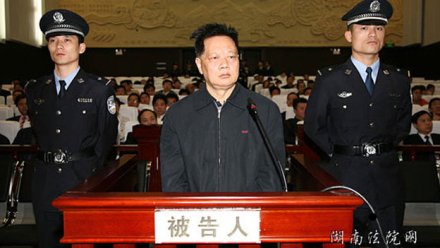
China has announced the execution this day of “homicide criminal” Xia Junfeng, a kebab vendor from Shenyang.

This case has been in the public eye for several years, and the predominant sentiment has been sympathetic towards the condemned man.

Xia and his wife Zhang Jing were part of China’s vast population of working urban poor, Xia having found his way into job insecurity by virtue of a layoff from the state electricity company. In the entrepreneurial spirit of the age, Xia started up an unlicensed business selling sausages and the like.

These denizens of the gray economy are, as a class, afflicted by the attentions of the City Urban Administrative and Law Enforcement Bureau, better known as the chengguan. Their benign job description entails administering municipal regulations, but this much-loathed force’s relationship to everyday citizens is perhaps best illustrated by the word chengguan‘s status as a shorthand neologism for bullying and abuse. Too many people know this goon squad firsthand, and too many stories of their worst excesses have circulated. Just this past July, the chengguan made headlines by killing a watermelon vendor.

“Chengguan abuses are an open scandal in China,” said Human Rights Watch’s China director. “The chengguan’s ability to flout China’s laws and inflict harm on members of the public is a recipe for greater public resentment and more violent confrontations.”

In the violent confrontation at issue in today’s execution, the chengguan chengguanned Xia Junfeng in May 2009. Xia fought back with his meat-carving knife, and slew two of his tormenters.

Death penalty cases redolent of the social stratification and institutional corruption that ordinary Chinese people experience have proven to be lightning rods in recent years.

Xia Junfeng’s turned, legally, on his claim that he killed protecting himself from the chengguan‘s beating.*

“Extralegal violence, thus employed to compensate for inadequate regulation and an absence of authority and legal deterrence, is no longer individual behavior. Such violence exists everywhere with the permission of the authorities. It is needed because of an overriding concern for “city image” and “urban management.” Finally, when extralegal violence is not monitored by the people and the media, and not punished by the law, it is only natural for Chengguan members to feel justified. Using violence with impunity enables the Chengguans to see violence psychologically as their “privilege,” a sign of status and pride. Since the legal and political status of Chengguan is unclear, it is only natural for its members to seek personal gain, vent their anger, and prey on the citizens they were intended to protect.”

-from the closing argument of Xia’s defense attorney

This allegation didn’t fly in court, where brother chengguan denied that they’d been abusing the shishkebaber, but it’s won in a rout when it comes to the court of public opinion. “His life and death are more than just a legal matter, but a bellwether of the era, with the tsunami-like public opinion firmly on the side of Xia Junfeng,” wrote author Yi Chen today.

Particularly galling for many is the disparity in treatment between Xia Junfeng and the likes of Gu Kailai, the latter a powerful business and political figure who was able to avoid execution despite being convicted of a scandalous contract murder. And Chengguan themselves never seem to be at risk of harsh punishment for any misbehavior; had Xia Junfeng been the one to leave that confrontation in a body bag, there certainly wouldn’t have been a death penalty case.


Anonymous cartoon circulated on Weibo criticizing Xia Junfeng’s condemnation. (Via) The drawing of the boy in the background was done by Xia’s son, whose art school fees were earned by his father’s roadside business.

Chinese speakers might want to peruse the Weibo feed of Xia’s widow.

* Several years ago, self-defense helped a Beijing migrat worker avoid execution for killing a chengguan who attempted to confiscate his bicycle cart.

On this day..

1864: Li Xiucheng, Taiping Rebellion general

On this date in 1864, Qing commander Zeng Guofan had executed his opposite number in the destructive Taiping Rebellion, previously surveyed in these pages.

Stephen Platt‘s acclaimed 2012 history Autumn in the Heavenly Kingdom: China, the West, and the Epic Story of the Taiping Civil War depicts this war along with Li, the illiterate peasant farmer whose brilliance in command flowered as the Taiping undid ossified class hierarchies.

Li’s generalship kept the Taiping in the fight for a long, long time: the war spanned 14 years, with some 20 million estimated killed. In July of 1864 the central government finally overran the rebel capital of Nanking/Nanjing and put that city to a frightful sack. Here’s Platt on Li’s fate:

Zeng Guofan seeded his reports on the fall of Nanjing with fabrications, claiming that a hundred thousand rebel soldiers had been killed in the fighting, inflating the glory of his family and his arm, masking their looting and atrocities against cvilians. He kept careful control over what the cout would know. To that end, from the day he arrived in Nanjing he took over the interrogation of Li Xiucheng for himself. The Hunan Army commanders had already secured a long confession from Li Xiucheng in the weeks since he had been captured — pages upon pages detailing his origins and the history of the war and explaining the tactical decisions he had made, many of which they still did not understand. The honor of beginning the questioning had fallen to Guoquan, who had taken to the job with undisguised relish; his primary tools were an awl and a knife, and he managed to cut a piece out of Li Xiucheng’s arm before the others made him slow down.

When Zeng Guofan took over the interrogations on July 28, at last the two hoary, weatherbeaten commanders in chief of the civil war faced each other in person for the first time: square-shouldered Zeng Guofan on the one side, the weary-eyed scholar, his long beard turning gray;wiry, bespectacled Li Xiucheng on the other, the charcoal maker who had risen to command the armies of a nation. It would be no Appomattox moment, however. There was no wistful air of regret and respect between equals. For the defeated, it was no prelude to reconciliation, to twilight years on a rolling plantation. This war ended not in surrender but in annihilation. Zeng Guofan would spend long hours of the following evenings editing his counterpart’s fifty-thousand-word confession, striking out passages that didn’t paint his own army in a good light and having it copied and bound with thread for submission to the imperial government, before casually ordering Li Xiuceng’s execution — in spite of orders he knew were coming from Beijing, that the rebel general be sent to the Qing capital alive.

On this day..

2003: He Xiuling, Ma Qingxui, Li Juhua and Dai Donggui

On this date in 2003, four women all condemned for drug offenses were among a group executed by shooting at Wuhan, in central China. This mass execution (conducted in secret but preceded by a humiliating public trial) was scheduled around the June 26 International Day against Drug Abuse and Illicit Trafficking. China has a very long history of looking askance at drug-dealing, and it usually uses the prelude to June 26 for some pointed, well-publicized executions.

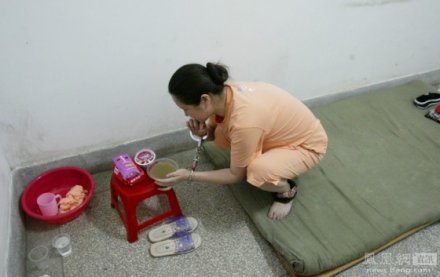
In 2003, photographer Yan Yuhong spent 12 hours with this quartet of women on the eve and morning of their executions at Detention Center No. 1. Only years later did the photographs get out: a moving glimpse of ordinary people under the pall of death and the guards and prisoners around them, they made worldwide news in 2011. Apparently their distribution in 2003 was quashed on authorities’ concerns that they were a bit too moving for the big anti-drug message.

Select images follow; the entire series can be perused here or here, and in poignant timeline form here.

He Xiuling

He Xiuling is the most immediately recognizable among them, a pudgy 25-year-old who looks inordinately mirthful in many pictures, but sobs openly just before she is led away to be shot. Follow-up reporting paints the picture of a simple country girl lured by a boyfriend into being a drug mule. She was evidently led to believe, up until the last, that her sentence would be commuted: “I’ll still only be 40 when I’m free!”

Had she been spared, she would be 35 now.


She thought the white top made her look “too fat”, and a guard kindly provided a black one.


Several pictures how He Xiuling smiling and laughing. Here, she enjoys breakfast on the morning of the 25th. She has about four hours to live.


Weeping moments before her execution.

Ma Qingxui

The oldest of the women and seemingly the only one of the quartet who could be characterized as something more than a small-time mule, 49-year-old Ma Qingxui from Baokang county of Hubei province was on her fourth conviction for smuggling more than 8 lbs. of narcotics.


Dressed all in red, Ma Qingxui donates her clothes to another inmate.


Ma Qingxiu being escorted out of the detention center for the execution grounds at 7:21 a.m.

Li Juhua and Dai Donggui

The prisoners least seen in the series and those of whom the least has been reported in the west.


An ordinary (non-condemned) prisoner paints Li Juhua’s toenails on the morning of the latter’s execution.


She dictates her last will and testament to a fellow-prisoners.


On the evening of June 24th, Dai Donggui carefully folds the execution clothes a guard has purchased for her.


A last supper. Reportedly, McDonald’s food is routinely served at the facility for this occasion.

On this day..

1991: Li Xinming, fecund

We seem to lack an exact date to attribute the evocative action so economically described in this May 30, 1991 Reuters wire story:

BEIJING — A man in northwest China has been executed for hacking to death the children of an official who punished him for violating China’s strict birth control rules, the Xinjiang Legal News said.

Farmer Li Xinming murdered his village chief’s two sons and seriously injured his wife after the chief informed him of his punishment for having a third child, the newspaper said in a recent edition reaching Beijing on Thursday.

The execution was carried out immediately after a public trial, the newspaper said.

The world’s most populous country punishes violators of its strict birth control policies, which restrict most couples to one child, with heavy fines and administrative penalties.

On this day..

1926: Shao Piaoping, journalist

On this date in 1928, Chinese journalist and social activist Shao Piaoping was shot at Beijing’s Tianqiao execution grounds — fulfillment of his lifelong motto, “To die as a journalist.”

The intrepid Shao blazed a trail for print media in his native country, bucking a prejudice that mere journalism was a bit on the declasse side.

He co-founded and edited Hanmin Daily in 1911, just in time to get his support for the Xinhai Revolution into newsprint.

But Shao was no propagandist, and, post-revolution, was repeatedly arrested for his scathing critiques of Yuan Shikai and the various other illiberal strongmen taking roost. He had to duck out to Japan twice during the 1910s; there, he kept cranking copy, now as a foreign correspondent for Shanghai’s top newspapers. As the decade unfolded, he also became a theoretician of journalism without abating his prodigious ongoing output.

“I saw my role as that of helpful critic and believed it wrong to praise petty people simply to avoid trouble,” this pdf biography quotes Shao saying of himself. “I was determined not to dispense with my responsibility.”

By the late 1910s, he was publishing his own capital-city newspaper, Jingbao (literally “The Capital”) and developing his academic thought as a teacher at Peking University. He was perhaps China’s premier journalist; even so, he still had to slip into exile in Japan in 1919 after openly supporting the May Fourth student movement.

Shao left an impressive mark on his students, perhaps none more so than a penniless young leftist working in the university library, Mao Zedong.

As a guerrilla, Mao — still at that time an obscurity to most of the outside world — remembered Shao fondly to journalist Edgar Snow. In contrast to many other Peking University scholars who gave the provincial twentysomething short shrift, Shao “helped me very much. He was a lecturer in the Journalism Society, a liberal, and a man of fervent idealism and fine character.” Word is that Shao even loaned Mao money.

Shao’s acid pen and unabashed sympathy for agitators led to his arrest in 1926 by the warlord Zhang Zuolin — whose wrath Shao incited by denouncing bitterly a horrific March 18 massacre of students.

But the martyr journalist’s heroic career — not to mention his accidental link with the future Great Helmsman — insured his elevation into the pantheon, even though Shao’s underground membership in the Communist party was not known for decades after his death. Mao personally declared him a hero of the revolution, and intervened to see that his widow and children were cared for. China has any number of public monuments in Shao’s honor.

On this day..

2013: Naw Kham, Mekong drug lord

Today in Kunming, China, Burmese drug lord Naw Kham was executed by lethal injection along with three of his associates.

Naw Kham (or Nor Kham), a Burmese Shan, ran a sizable gang of drug traffickers/paramilitaries/pirates, the Hawngleuk Militia, in the Golden Triangle.

In addition to heroin smuggling, this gang also shook down for protection money the many Chinese commercial shippers coming down the Mekong River, and wantonly raided shippers that held out on them. He was untouchable in his lawless zone (with the possible protection of Burmese military to boot) for more than a decade.

Times may have started passing Naw Kham by in the 2000s.*

China’s economic boom has driven more shipping, and a search for investment outlets for Chinese capital, both inevitably increasing its presence on the economically developing Mekong. Ultimately this had to come at Naw Kham’s expense.

He had hit Chinese shippers before to the annoyance of Beijing, but matters came to a head when the kingpin allegedly retaliated against the flouting of his “taxes” by massacring 13 Chinese sailors in 2011 on board two tightfisted merchantmen. (“Allegedly” because Naw Kham blamed the Thai military for this slaughter, and some people believe him.)

At any rate, China put the screws to the drug lord, not only pressuring Southeast Asian governments for his capture but directly hunting him with special forces. Early in 2012, Naw Kham was arrested and his gang broken up after a multinational manhunt; the leader was extradited from Laos to face Chinese justice with five of his associates.** The accused had little recourse but to throw themselves on the mercy of the court.

Executed with Naw Kham — and underscoring the multinational complexion of his outfit — were Hsang Kham (a Thai), Zha Xika (a Lao), and Yi Lai (stateless). The other two defendants received a suspended (reprieved) death sentence, and an eight-year prison term.


Naw Kham being led to an execution van on March 1, 2013. Two hours of footage of the “Mekong River murderers” walking their green mile was broadcast on CCTV News, although not the executions themselves.

The case isn’t entirely closed with his date’s executions, however. China is still pressuring Thailand to bring to book Thai troops whom China says colluded (at the very least) in the Mekong murders. The future direction of that investigation is quite unclear.

* China, Burma, Thailand, and Laos, inked a 2001 pact to regularize shipping on the Mekong. It contained no provision allowing for stateless narco-buccaneers.

** It’s noteworthy that this is a non-Chinese citizen being extradited to China for a crime not on Chinese soil.

On this day..

2010: Zeng Jinchun, corrupt anti-corruption official

On this date in 2010, a former Communist Party of China (CPC) anti-corruption official was shot … for corruption.

Zeng, former secretary of the Chenzhou Municipal Commission for Discipline Inspection of the CPC and vice secretary of the CPC Chenzhou Municipal Committee, gorged on 31 million yuan ($4.7 million) in bribes from 1997 to 2006, doling out lucrative mining contracts and sinecures in exchange.

Although known in the Hunan coal-mining city as “a modern-day Heshen” — Chenzhou residents whose businesses had been widely subject to Zeng’s crude protection-racket shakedowns set off fireworks to celebrate his arrest — Zeng was all but impossible to dislodge.

Zeng bribed up to higher officials for protection as effectively as he squeezed those below. It’s just another piece of the graft so endemic in China that it’s frankly represented in popular literature. (And has often appeared on the execution grounds, too.)

“Officials, especially high-ranking ones, are basically not held accountable for paying bribes,” a journalist who wrote a book about Zeng told NPR. “This is because China’s judiciary is not independent enough.” Zeng wasn’t even charged with this crime — just extortion.

Zeng’s well-placed protectors defeated at least three investigations. He was only overcome by an order from the very top: President and Party Chairman Hu Jintao, who scribbled onto a secret report of Zeng’s antics,

“To Comrade Wu Guanzheng: Put more effort into investigating corruption in Chenzhou. Signed, Hu Jintao, July 19, 2006.”

Three months later, Zeng was under arrest.

The effects of power, corruption, privilege, and cutthroat economies did not go with him. After all, on the same date Zeng was put to death, officials elsewhere in Hunan province also announced the execution of one Chen Haitao for torching an airport shuttle bus. The blaze killed two and seriously injured three others.

Chen committed the arson to revenge society as he had “blamed his business failure on social injustice,” the court said in a statement.

On this day..

1930: Yang Kaihui, Mao Zedong’s wife

(Thanks to Meaghan Good of the Charley Project for the guest post. -ed.)

On this date in 1930, Yang Kaihui was executed in Changsha, China.

The 29-year-old mother of three was beheaded for her refusal to renounce the Chinese Communist Party and Mao Zedong. She was technically Mao’s second wife; a previous marriage had been arranged for Mao by his parents, but he and the woman never lived together and the marriage was never consummated.

Yang and Mao grew up together in Changhsa — she was the daughter of one of his teachers — and fell in love as young adults. Yang, like Mao, was an enthusiastic Communist. She joined the CCP in 1921, becoming one of its earliest members. She never held any official position in the CCP, however, and wasn’t terribly active in the movement, since she had to raise the children.

Mao and Yang truly loved one another. Phillip Short, in his biography of Mao, writes of this period: “Perhaps for the only time in Mao’s life, he had a truly happy family to come home to … It was a surprisingly traditional Chinese household.”

But Mao became more and more absorbed in dangerous revolutionary work, and he and Yang were often separated when he traveled. The last time she saw her husband was in 1927, the year the Chinese Civil War started and Mao became a guerrilla leader, hiding in the mountains, far from his family. They maintained sporadic contact after that, but often what little she knew about his activities came from the papers.

During the final years of her life, Yang missed her husband desperately and had thoughts of suicide. “No matter how hard I try,” she wrote once, “I cannot stop loving him.”

Yang predicted she might meet with a violent death. She was right: on October 24, 1930, a warlord loyal to the nationalists captured her and one of her sons.

She did not break under threats and torture, and refused to give in and publicly repudiate her husband and Communism, even though her captors offered to spare her life if she did so. She became one of the CCP’s earliest martyrs.

Yang was executed more for being Mao’s wife than she was for anything she’d done herself. She wasn’t the only woman who would be killed for being married to a prominent member of the CCP; the wife of Zhu De had met with the same fate in 1929.

Mao, who had always called Yang his true love, was reportedly devastated by her death and wrote, “the death of Kaihui cannot be redeemed by a hundred deaths of mine!” He wrote a poem about her in 1957 that suggests he still grieved for her even then. But it must be noted that he never tried to rescue her or his sons when he knew their home had turned into a battleground and their lives were in danger.


Propaganda poster of Yang and Mao.

Tragedy followed the lives of Yang and Mao’s three sons.

The youngest boy, Anlong, died of dysentery in Shanghai at the age of four, soon after his mother’s execution. The oldest, Anying, was killed in the Korean War. Middle child Anqing lived to be 83, but perhaps as a consequence of watching his mother being put to death as a youth, he suffered bouts of mental illness throughout his life. He died quietly in China in 2007.

On this day..

1646: Zhu Yujian, the Prince of Tang

On this date in 1646, Zhu Yujian was captured and summarily executed at Tingzhou.

This gentleman went under the title Prince of Tang, making him Beavis and Butthead’s favorite Ming despot. Indeed, he was a direct descendant of the founder of that illustrious dynasty. Unfortunately for the Prince of Tang, that descent was of the ninth generation, which meant that the Ming were well into their decadence and decline.

The Prince of Tang had spent essentially the whole of his adult life seeing the state eaten away by sclerotic bureaucracy, internal revolts, economic breakdown … and, as a consequence of all that erosion, by the incursions of the Manchus.

The first ruler of those people’s successor Qing dynasty was already on the Chinese throne at this point, having seized the capital Beijing in 1644. The splintering thereafter of Ming officials and loyalists led to, among other transitional formations, a “Southern Ming dynasty” — far southern, almost to Burma. The Prince of Tang would accede to this contingent remnant of a once-glorious dominion, and enjoy the conceit of the purple and its prospect of imminent violent death for the last 14 months of his life.

When his able military commander Zheng Zhilong saw the writing on the wall and defected, Qing soldiers pouring through defenseless passes and over the Qiantang River swiftly routed the demoralized southern Ming in the summer of 1646.

The Longwu Emperor — that’s what the Prince of Tang was styling himself, the name inaptly meaning “plentiful and martial” — spent his last days being driven from pillar to post ahead of the Qing before he was finally overtaken and put to summary death with his wife.

The Southern Ming would fight on another fifteen years, but the particular familial branch embodied by the Prince of Tang met an unceremonious end long before the Ming as a whole succumbed. Zhu Yujian’s younger brother succeeded him as “the Shaowu emperor” that December and squandered the scant resources of his statelet — “lacking court dress, the thousands of officials who were appointed to the Shaowu government … had to buy theatrical robes from local actors” — on a few weeks’ counterproductive civil strife with a rival Ming claimant until the Qing utterly overran them.

On this day..

1895: The Vegetarian perpetrators of the Kucheng Massacre

On the morning of September 17, 1895, in the presence of the British and American consuls, seven perpetrators of a Chinese massacre of western Christian missionaries were beheaded at Foochow.

Anticipating the better-known Boxer Rebellion by four years, the Kucheng Massacre (there are many other transliterations of “Kucheng”) was likewise a response to the Celestial Empire’s frustrating second-class status as against European interlopers.

Christian missionaries had been a point of friction in China for decades. Though their rights to proselytize had been guaranteed in a hated treaty dictated to China by force of arms, they often met resentment or worse on the ground.

“You bring incense in one hand, a spear in the other;” one evangelist reported being told: that is, however honorable the immediate intentions of many individual missionaries, their presence looked like a stalking horse for less reputable western interventions like the opium trade. (That’s how it looked to many Chinese. Professional western diplomats themselves found the impolitic preachers a hindrance to their statecraft, according to Ian Welch’s 2006 paper “Missionaries, Murder and Diplomacy in Late 19th Century China: A Case Study” (pdf).*)

On August 1, 1895, these frustrations unleashed a river of blood at the village of Huashan in Gutian County, where a Buddhist secret society — known as “Vegetarians” in the western press for their characteristic dietary vow — fell upon a group of vacationing British Anglican missionaries still abed at dawn and ruthlessly slaughtered eleven of them. (There are some 1890s books paying tribute to the fallen available online: Robert and Louisa Stewart: In Life and in Death, and The sister martyrs of Ku Cheng : Memoir and Letters of Eleanor and Elizabeth Saunders (“Nellie” and “Topsie”) of Melbourne.)

“The attack came,” said a physician from a nearby town who was summoned to the bloody scene, “like a thunderbolt from a clear sky, not one of the victims having received the slightest intimation of the intended assault.”

Word of the carnage struck western powers with similar force.

Incensed newspaper-readers literally demanded** gunboat diplomacy, and literally got it, especially when Chinese authorities drug their feet on the condign punishment the missionaries’ countrymen were clamoring for.

All this put British diplomacy on a sticky wicket, which Welch (pdf) deals with in detail. To satisfy the domestic audience, the government had to be seen to be taking a hard line on avenging the outrages; at the same time, London was wise to the Chinese state’s shakiness and wary that a “barbarous holocaust” perpetrated against the Vegetarians would trigger a mass backlash and bring the whole thing down.

An obdurate Chinese viceroy impeded the quick resolution everyone was after by making inflammatory public proclamations against Christians, and releasing without explanation six of the thirteen men who had initially been condemned to death in the month of August. The seven who were executed on this date were therefore only the vanguard of 26 humans ultimately put to death for their involvement in the atrocity.

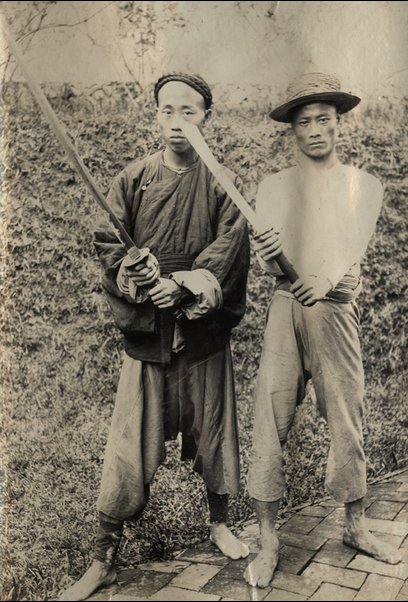
Some of the execution photographs that follow are Mature Content. They’re obtained via Visual Cultures in East Asia; some also available at USC Digital Library.


Raids and investigations to bring the Vegetarian movement to heel continued for several months thereafter, and the whole affair ultimately was quelled without doing any of the wider damage that might have been feared — not even to missionaries who continued pouring into China.

And that, effectively, kicked the can down the road on the anti-foreigner sentiments afoot in the land … sentiments that would find much costlier expression a few years later when another secret society kicked off the Boxer Rebellion.

* I’ve relied heavily on Welch for this post. He’s also collected a massive trove (over 1,200 pages) of primary documents from this incident available in a series of pdfs (some quite large) from the Australian National University website:

** This was not universally so. The wife of missionary Stephen Livingston Baldwin, who knew some of the victims of the attack, urged a “charitable” response and sensitivity that “the Chinese feel that all the world is against them, and they are not far from right.” (New York Times, Aug. 10, 1895) In letters responding to intemperate coverage elsewhere, she acidly compared (pdf) western editorialists’ high dudgeon to their look-forward-not-back dismissal of recent stateside anti-Chinese violence.

It was ten years yesterday since more Chinese were killed, and burned alive and left to die wounded, in one hour, at Rock Springs, Wyoming (the very same Territory in which the recent massacre occurred) than have been Americans and English in China in the thirty-four years I have personally known that land, being a resident there twenty years and closely connected with it ever since. Ten years yesterday since that awful Rock Springs massacre, and up to date no one arrested, much less punished! The anti-Chinese papers of the town and neighbourhood gloating over the awful details and assuring all that there would be “no Congressional investigation,” and no waste of “enterprising newspaper eloquence” over the woes of the Chinese, “though their blood flow like rivers, as they had no votes and no friends.” In less than four weeks after the Ku-Cheng massacre, arrest, investigation and execution have all taken place for the Ku-Cheng massacre. Would that our colored, red and yellow brethren, so helpless in our so-called civilized and Christian land, had some power behind them to bestir Ministers Plenipotentiary, wave flags, and run gunboats to the front, to bully, if necessary, our pusillanimous Government into some sort of civilization — I will not say Christian justice!

On this day..