On this date in 1528, Anabaptist Ambrosius Spittelmayr was beheaded in Cadolzburg, Bavaria.
Baptized by Hans Hut only the year before, Spittelmayr propounded his outlaw adult-baptism creed as a wandering preacher in Upper Austria and southern Germany before his arrest.
The energetic Spittelmayr left his interrogators a 3,000-word confession of faith that has been of great value to scholars probing Hut’s own theology, which was deeply influential in southern Germany. Spittelmayr’s confession emphasizes a Godly life, including a version of primitive communism that called on the faithful to share their worldly effects — a prominent feature in much Anabaptist thought that helped certainly raised the hackles of those with property to protect.
Nobody can inherit the kingdom unless he is poor with Christ, for a Christian has nothing of his own; no place where he can lay his head. A real Christian should not even have enough property on earth to be able to stand on it with one foot. This does not mean that he should go and lie down in the woods and not have a trade, or that he should not have fields and meadows, or that he should not work, but alone that he might not think they are for his own use and be tempted to say: this house is mine, this field is mine, this dollar is mine. Rather he should say it is ours, even as we pray: Our Father. In summary, a Christian should not have anything of his own but should have all things in common with his brother, that is, not allow him to suffer need. In other words, I will not work that my house be filled, that my larder be supplied with meat, but rather I will see that my brother has enough, for a Christian looks more to his neighbor than to himself. Whoever desires to be rich in this world, who is concerned that he miss nothing when it comes to his person and property, who is honored by men and feared by them, who refuses to prostrate himself at the feet of his Lord … will be humbled. (Via)
On this date in 1905, “baby farmer” Elisabeth Wiese was beheaded in Hamburg.
In a luridly reported case “revolting in the extreme, proving the woman to be a monster of iniquity” Wiese stepped into a quintessential fin de sieclemoral panic as a former convict whose larcenous past had forced her trade away from the legitimate field of midwifery towards the more shady precincts of mercenary fostering.
From scandal-averse single mothers in England as well as Germany, she collected children with maintenance fees running to US $1,000 plus a hush-money surcharge tacked on. For this donative, she represented a capacity to distribute these whelps to willing adoptive families: in reality, most of them she disposed of with morphine. (As an added inflammation to public opinion, she had also forced her own illegitimate daughter into prostitution; Paula, whose own infant was among Wiese’s victims, repaid that ill turn by appearing as a witness against her mother.)
When Wiese fell under suspicion, the neighbors’ reports of her kitchen glowing like hellfire and belching revolting stenches led police to the remains of these little ones burnt up in her stove.
Condemned for five murders — it’s thought that the true count must have run much higher — Wiese is known as the “angel-maker of St. Pauli” after the suburb where she plied her trade.
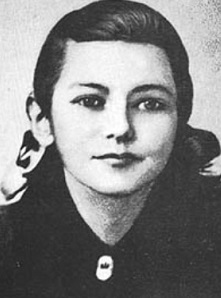
On this date in 1944, Soviet partisan Zinaida Portnova was executed by the Germans occupying Belarus.
The youngest-ever female Hero of the Soviet Union (she was posthumously decorated in 1958), the Leningrad-born Portnova had a rude start in insurgency when the German blitz swept past her summer camp in Belarus and trapped her behind lines.
Said to have been radicalized when occupying soldiers struck her grandmother, the girl joined the youth arm of the local resistance, dubbed the “Young Avengers”.
From surveilling enemy troop deployments and assembling weapons caches, Zinaida Portnova graduated to sabotage and ambushes … and capture. Even then she pulled off an action hero escape by snatching a gun and shooting her way out of custody, only to be re-arrested shortly thereafter.
On this date in 1945, Polish Gentile Karolina Juszczykowska was executed at the prison in Frankfurt am Main for her attempt to save two Jewish men in Tomaschow, Poland, the previous year. She was 46 years old.
The people she tried to rescue have never been identified; only their first names, Paul and Janek, are known. According to Karolina, she met them on the street and they offered her 300 zloty a week to hide them. She kept them in her home and locked them inside when she went off to work during the day; they slept on the floor at night.
The arrangement lasted only about six weeks before they were betrayed.
The Gestapo raided Karolina’s home on July 23, 1944 and found Janek and Paul hiding in the cellar. Karolina was arrested and the two men were summarily executed.
Karolina emphasized that she only took them in because she needed the money to support herself. The judges who presided over her case seemed to believe her and, although they issued the mandatory death sentence, recommended clemency, writing, “The accused is in a difficult financial situation and succumbed to the temptation to improve her life.”
Karolina was indeed poor. “I have no assets,” she said in her statement to the police, “and don’t expect to have any in the future.” She’d worked menial jobs her whole life: farm work, construction, domestic service, and most recently in the kitchens of Organization Todt, the Third Reich’s civil and military engineering division. She had never been to school and was completely illiterate; she signed her police statement with three crosses.
But, as Yad Vashem points out when writing of her case, no matter what she said, it’s highly unlikely that Karolina Juszczykowska’s reasons for hiding Jews were primarily mercenary.
The wartime Polish economy had shattered, inflation had soared, and 300 zlotys wouldn’t have even been enough to cover the costs of feeding two extra people. No rational person would risk her life for that — the sentence for a Pole caught helping Jews was nearly always death.
found it impossible to explain to anyone who did not live through those times why they acted as they did. In war, there were no rules. The familiar seemed strange, and the bizarre seemed normal. In retrospect, rescuers’ behavior, in some instances, was not understandable even to them. How could they have endangered their families? How could they have done what they did or said what they said?
In Fogelman’s estimation, many rescuers were motivated by simple morality, either of a religious or purely personal kind.
Moral rescuers had a strong sense of who they were and what they were about. Their values were self-sustaining, not dependent on the approval of others. To them, what mattered most was behaving in a way that maintained their integrity. The bystanders who ultimately became rescuers knew that unless they took action, people would die …moral rescuers typically launched their rescuing activity only after being asked to help or after an encounter with suffering and death that awakened their consciences. Scenes of Nazi brutality touched their inner core and activated their moral values … For the most part, when asked for help, moral rescuers could not say no.
We will never know for sure, but it could have happened like this: In 1943, Karolina, while working for Todt, either witnessed or heard about the liquidation of the Tomaschow Ghetto and the accompanying violence and brutality. Most of the ghetto’s Jews were sent to Treblinka in January 1943; the last few hundred were taken away in May. Janek and Paul went into hiding and managed to stay off the radar for a year or so, but by the time they met Karolina they’d been run to ground and were desperate. They asked for her help. She couldn’t say no.
Although Karolina’s judges recommended she be pardoned, the death sentence was carried out anyway. There were no survivors and all we know about this case comes from court documents. But her sacrifice did not go unnoticed.
On May 17, 2011, over 65 years after her death, Israel recognized Karolina Juszczykowska as Righteous Among the Nations, its official honorific for Gentiles who aided Jews during the Holocaust.
AP caption: “The expression on the face of this Hun posing for the camera standing by the gallows from which a woman is hanging, Jan. 3, 1945 shows a lack of concern. The name and nationality of the unfortunate woman is unknown. One of the many victims of Nazi terror. The German soldiers seem to be quite used to this kind of sights for them a picture like this is just a souvenir.” (Via)
On this date in 1757, Catholic priest Andreas Faulhaber was hanged at the order of Frederick the Great to defend the seal of the confessional.
Frederick had been appointed by the Heavenly Father, and a cruel earthly one, to a task far too monumental to tarry with theology: lifting the Kingdom of Prussia from the morass of German principalities and into the ranks of Europe’s great powers. Frederick was nominally a Protestant, as was the bulk of his domain, and der Alte Fritz once remarked that this profession pleasingly liberated his sovereignty from papal interference; his real doctrine was nothing but pragmatism.
Accordingly, the great enlightened absolutist sponsored Jesuit educators where schools were needed and Jewish merchants where trade was needed.
Disgusted at Frederick’s aggressive war on Austria, Voltaire scribbled to a friend,
I’ve seen his good intentions dropped
At the first trumpet blast.
They are nothing more than kings;
And live their lives with bloody things,
They take or rape a few provinces
To suit their ambitious ends
I give up, say goodbye princes
I want no one now but friends.
(Source)
But Voltaire did not in fact break with his royal admirer and correspondent over Silesia.
Frederick christened his new reign in 1740-42 by ripping the wealthy* province of Silesia away from the Habsburgs.
The Habsburgs were Prussia’s Catholic rivals for preeminence in central Europe and Silesia too was heavily Catholic, so Frederick extended over that province as liberal a grant of religious toleration as he might.
But the attachments of men for the kings of their forefathers are not always so easily displaced, and neither are those of kings for the most lucrative soil of their patrimony. Austria made two subsequent attempts to retrieve Silesia; together with Frederick’s initial invasion, these are the Silesian Wars.
The last of the three was itself just one theater of the gigantic Seven Years’ War. The conflict between Prussia and Austria over Silesia, and the complex continental diplomatic entanglements** each power effected in its pursuit, were among the root causes of that entire globe-spanning conflict.
Prussia won the first two Silesian Wars handily, but the third was a much more doubtful affair — indeed, Prussia was well on its way to defeat before the shock death of the Russian empress delivered that country into the hands of an unabashed Germanophile who pulled Russia out of the war.
But in view of Frederick the Great’s strained situation prior to this providential deliverance, some of his Silesian subjects made free to prefer their prospective Catholic/Austrian allegiance to that of their recent conqueror.
Desertions among Silesian conscripts, some of them even escaping to Austrian lines, called down the dark side of the religious toleration policy. Frederick let people pray as they liked so that he could rule as he liked; here, when he suspected the Silesian Catholic clergy of countenancing wartime disloyalty among their flock, those religious scruples had overstepped their proper sphere.
And so at last we come to our day’s execution.
One young man caught attempting to desert Frederick’s army was captured and interrogated by his commanders. He allowed that he had undertaken the sacrament of confession before escaping, and expressed to the priest his intention to abandon the army.
The priest, Father Andreas Faulhaber, was arrested on this basis, but between his calm defense of himself and the deserter’s shifting, unreliable story, the military court found little basis to proceed. The impression one gets is that the contemplated desertion was not the main thrust of the confession and that Father Faulhaber accordingly discouraged the sin in passing but didn’t bother to dwell on the point.
The impression is difficult to substantiate because the padre rigorously kept the seal of the confessional — another imposition demanded by faith that secular authorities who had armies to field preferred not to honor.
But evidently looking to serve notice that the monarch’s religious indifference could not be used to abrogate subjects’ responsibility to the state, Frederick himself ordered Faulhaber’s sudden execution for the morning of December 30.
The unfortunate priest only discovered his impending fate moments before it was enacted, but still refused under the makeshift gallows to give up anything incriminating about his parishioner. “Hang up the Jesuit Faulhaber, but let him not have a confessor,” read the order, according to this decidedly Catholic account, which adds that Faulhaber was not actually a Jesuit at all, and the word only added to invoke the going 18th century prejudice against that order.
Prussia won this war, too. It kept Silesia in Prussian hands, and then German hands, for two centuries. The bulk of Silesia was transferred to Poland after World War II.
** For the Seven Years’ War, Austria made common cause with its traditional foe, France: one consequence of this arrangement was the betrothal of the Austrian princess Marie Antoinette to the future French king Louis XVI.
We owe this discomfiting executioner’s-eye view from the ranks of German soldiers as they gun down Poles in the town of Bochnia on December 18, 1939 to a partisan attack two days prior by a Polish underground organization called White Eagle. Fifty-six civilians were executed in retaliation.
Most judges are content to inflict their atrocities with a gavel, but on this date in 1578, a magistrate turned freebooter named Kort Kamphues was beheaded at Bevergern.
Just a few months before his July 1553 death, Prince-Bishop Franz von Waldeck set Kamphues up for his interesting career arc by appointing him Stadtrichter of Coesfeld.
Kamphues’s overbearing presumptions on the perquisites of that sinecure, coming on more than one occasion to physical violence, led other city leaders to petition unsuccessfully for his removal in 1569.
But his attempt in 1572 to assemble a mercenary army on the pretext of getting involved in Spain’s war in the Netherlands led to a definitive break with Coesfeld — which tried to arrest him, and then outlawed him when he escaped with his armed posse into the Westphalian countryside.
For several years, Kamphues and gang marauded merrily until a clumsy bid to frighten a new Coesfeld magistrate led to an arson attack on the city. Kort Kamphues was captured on June 19, 1578, and tortured into confessing to arson, banditry, and breaching the peace — gaining a permanent place in folklore at the small expense of his head.
The Kamphues Dagger, a beautiful 14th century artifact later documented in the Coesfeld treasury, is supposed on sketchy evidence to have been captured from this brigand.
A replica of the Kamphues Dagger, at the city museum in Walkenbrückentor. (cc) image from Günter Seggebäing.
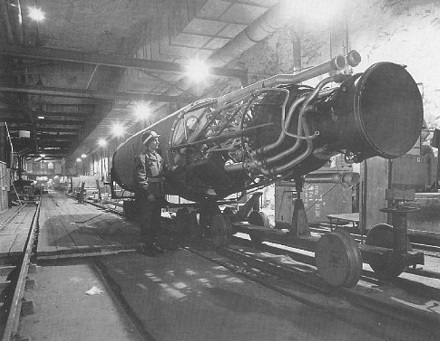
Casting about the Third Reich for a suitable spot to base the missile team, the rocketeers settled on the Kohnstein, a hill in Thuringia already hollowed out by gypsum mines. This tunnel network was readily adapted into a subterranean munitions factory called Mittelwerk — difficult for the Allies to find, and once they found it, difficult to bomb.
A U.S. Army soldier poses with a half-assembled V-2, one of about 250 such rockets found in the Mittelwerk labyrinth when the facility was captured.
With the facilities and the big brains in place, only one thing was missing: millions of man-hours of labor.
Nazi Germany had that in plentiful supply.
Beginning in late 1943, concentration camp inmates at Buchenwald began to be funneled out to a new facility, Mittelbau-Dora. Initially just a Buchenwald sub-camp, Dora grew over the course of 1944 into an immense facility holding 50,000 prisoners — a handful of German undesirables, but mostly captured foreign nationals: French, Dutch, Polish, Czech, and Russian. Short of food, sleep, and clothing for the 1944-1945 German winter, they were systematically worked to death in the Mittelwerk shafts to build a better bomb.
Our day’s principal, Hans Möser/Moeser (English Wikipedia entry | German) was an SS-Obersturmführer who made a living throughout the war years pulling guard detail in a number of concentration camps.
On May 1, 1944, Möser was transferred from Auschwitz to Mittelbau-Dora. It was the last job he would ever hold, but were Möser on the market today his C.V. would laud his team-player orientation and project management skills on a high-priority initiative. No doubt he was just the sort of reliable agent who understands how things are done that the world’s mad bombers need at their back.
“Ninety percent of the prisoners lived and worked in the tunnel of the mine,” testified one German who worked at Dora as a secretary and doctor’s aide.
As a result of the uninterrupted work in the mines and the absence of any installation for forced draft and ventilation, there prevailed a stuffy cold atmosphere, which made breathing difficult. The prisoners also slept in the subterranean tunnel in big chambers hewed out of the rocks, in five beds on top of each other. Already in 1944 3,500 prisoners used to sleep in such a room. In the tunnel of the mine there was no ater, the prisoners got absolutely insufficient quantities of tea for drinking purposes. But for weeks they were not able to wash themselves. As a result of the heavy work in the mines and of the bad food numerous prisoners died from exhaustion during their work.
According to that same testimony, the camp received a frightful order on Good Friday, which fell on March 30 in 1945: drive every last prisoner into those tunnels and bring down the caves around them. “No prisoner should be allowed to fall into Allied hands alive.”
The facilities themselves, too, were to be destroyed as part of Hitler’s scorched-earth “Nero Decree” intended to deny the benefit of German industry and infrastructure to the arriving conquerors. But Hitler’s War Production Minister Albert Speer was intentionally ignoring that order, a decision that might well have helped him avoid hanging at the Nuremberg trials.
Mittelwerk was a valuable capture indeed for the Allies. The Americans who first occupied it, and then the Russians who took it over a few months later, ransacked it for parts and technical specifications. The V-2 was the first man-made object to reach space, blasting at the speed of sound to the edge of orbit before plummeting back with its payload into the heart of London or wherever. It’s the ancestor of the long-range, intercontinental ballistic missiles that would come later, as well as the space programs of the countries who could build such missiles.
And of course, it wasn’t just the parts.
Wernher von Braun himself was the top prize of all — the young genius (he was just 33 when World War II ended) with the weapons of the future in his skull. As Germany collapsed in 1945, von Braun and his team of engineers had resolved to surrender themselves to the Americans rather than the Russians, but they too were subject to an order given the SS to execute the scientists if their capture appeared imminent. The Fuhrerbunker knew as well as the Allies how valuable this asset was.
In the event, von Braun managed to give himself up to a surprised American private. He disappeared into American custody, the crown jewel of “Operation Paperclip” that grabbed some 1,500 scientists from Germany and helpfully whitewashed their past misdeeds — misdeeds like Nazi party affiliation, and participating in slave labor camps.
Firing guided rockets into space was one thing. Unfortunately for our man Möser, his own skill set of bullying subordinates was not in short supply for either of the Cold War antagonists.
Möser was the one defendant (among 15) condemned to death at the resulting trial of Dora camp personnel. Rocket scientists, naturally, were not present for the occasion; Wernher von Braun and his team were hard at work at this time at Fort Bliss, Texas adapting the V-2 to the American Hermes program.
But at Dora, it had been Möser’s job to oversee camp discipline and labor strength for the slaves doing the grunt work manufacturing von Braun’s brainchild. Testimony convinced the court that the SS man had done this far too brutally, and perhaps with sadistic pleasure.
Several witnesses testified Möser frequently beat prisoners and participated in executions, often shooting at the men who were hanged for camp infractions — while they were hanging, or after they were taken off the gallows. (And of the latter, some already dead and some still alive.) “The accused told the twelfth witness that it was a pleasure to give the mercy shots, like shooting a deer.”
Möser for his part countered that he took no joy himself in the beatings and killings that he had to conduct as part of his job — and that the camp commandant had early on reprimanded him for leniency, threatening that “in view of the importance of the V-weapons operation, this could be interpreted as sabotage because it reduced the work efficiency.” How’s that for a hostile work environment?
(There’s a large .pdf of the entire trial summary here. Möser’s section begins on page 36 of the pdf (page 68 per the numbering in the scanned book pages).)
His presence on this here site betrays the outcome. On this date in 1948, Hans Möser was hanged at Landsberg Prison along with several other (unrelated) convicted war criminals.
On this date in 1593, Nuremberg executioner Franz Schmidt beheaded one of that city’s finest con artists.
Gabriel Wolff, a burgher’s son, had gone on a picaresque swindling bender through central Europe and all the way to Constantinople, posing as a V.I.P. in various courts for fun and profit.
As Schmidt recounted it, Wolff first “called himself George Windholz, Secretary to the Elector at Berlin, also took the name of Ernst Haller and Joachim Furnberger, borrowed 1,500 ducats from a councillor here in Nuremberg by means of a forged letter in the Elector’s name and under the seal of the Margrave John George in Berlin; was arrested at Regensburg and delivered over to Nuremberg.”
And this was far from all.
The inveterate trickster had made off with 1,400 crowns from the Duke of Parma in the Netherlands and fled to Ottoman Turkey. He had had a misadventure with an Italian abbess, netting a silver clock for his trouble; conned a Knight of St. John out of his mount; and ensconced himself as the Habsburg emperor’s personal attendant in Prague, where he perpetrated “many other frauds, causing false seals of gentlemen to be cut, wrote many forged documents and was conversant with seven languages; carrying on this for twenty-four years.” In his time he got the best of “a councilor at Danzig, the count of Ottingen, his lord at Constance, two merchants at Danzig, a Dutch master,” and similar worthies crisscrossing Europe from Lisbon to Crete to Krakow to London and seemingly every point worth mentioning in between.
As Schmidt’s biographer observes, it’s more than likely that the crowd under the scaffold beheld Wolff with admiration as much as opprobrium, for this native son’s silver tongue and brass balls had enabled him to spend a lifetime in material luxury, hobnobbing with the masters of Europe — and certainly ensured him an afterlife in pleasurable folklore he could scarcely have conjured had he spent his days respectably haggling for a better price on the ell. Frankly, we in drab modernity could ourselves do with a Gabriel Wolff book.

 In a luridly reported case “
 The youngest-ever female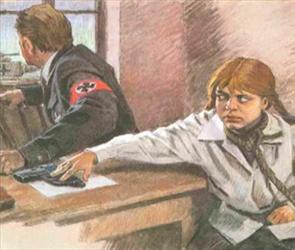
 The people she tried to rescue have never been identified; only their first names, Paul and Janek, are known. According to Karolina, she met them on the street and they offered her 300


 Our day’s principal, Hans Möser/Moeser (