1945: Johann Georg Elser, dogged assassin

(Thanks to Meaghan Good of the Charley Project for the guest post. -ed.)

On this date in 1945, in the dying days of the Third Reich, 42-year-old Johann Georg Elser was executed by gunshot in the German concentration camp Dachau. He died for a failed attempt on Adolf Hitler’s life more than five years before.

It goes without saying that, had he been successful, he would have changed history immeasurably.

Elser, who went by his middle name, didn’t fit the profile of someone who would try to kill Hitler.

He wasn’t a Jew, a Communist or a member of any of the other minority groups the Nazis persecuted. He wasn’t political at all, in fact.

A carpenter by trade, with one illegitimate son, his hobbies included playing the zither and the double bass.

He was the kind of ordinary, working-class German the National Socialists tried to reach out to. But from the very start, he made it clear how much he despised them and all that they stood for.

British historian Roger Moorhouse, in his book Killing Hitler: The Plots, the Assassins, and the Dictator Who Cheated Death, summed it up very nicely when he said Elser harbored a “deep and personal hatred for Hitler.”

He was a practical man at heart and was not interested in political discussions. He had no desire to change other people’s minds, but he steadfastly refused to make any accommodation to the new regime. When Hitler’s speeches were broadcast, he would silently leave the room… In May 1938, a Nazi parade threaded its way through his hometown of Königsbronn. Elser, like many others, turned out to watch, but as those around him gave the Hitler salute, he refused to do likewise. When a colleague reminded him that it might be sensible to conform, he replied curtly, “You can kiss my ass.” He then ostentatiously turned about and started whistling to himself.

How Elser’s silent, passive resistance turned into action is unclear, but by the autumn of 1938 he had made up his mind to kill the Führer.

Unsure how to accomplish this, he traveled to Munich to get some ideas. Every year on “Die Neunte Elfte”, the November 8-9 anniversary of the Beer Hall Putsch, Hitler came to the Bürgerbräukeller and gave a speech to the old guard.

That day in 1938, actually just hours before another would-be assassin tried to kill Hitler, Elser slipped into the beer hall pretending to be an ordinary customer and “noted the layout of the room, the position of the lectern and the patent lack of effective security measures.”

He had found his place and his time: he decided that the following year, he would plant a bomb in the Bürgerbräukeller, timed to go off right in the middle of Hitler’s big anniversary speech and kill him and as many Nazis as possble.

Elser’s meticulous planning and preparations over the next twelve months were nothing short of amazing. He stole a fuse and some gunpowder, and got a job at a quarry specifically so he could acquire some explosives. Knowing nothing about bombs, he made countless prototypes and tested them in empty fields in the countryside.

In the spring of 1939, he went back to Munich and the Bürgerbräukeller to make some detailed sketches of the building and find an appropriate place to hide the bomb. He chose a thick stone pillar behind the lectern, which supported a balcony. In August, he brought his tools and bomb-making materals to Munich to set about with his final phase of the plan.

The fastidious assassin’s modus operandi was shockingly simple, and shockingly bold.

He would visit the Bürgerbräukeller every night at around 9:00 to take his evening meal. An hour or so later, he would sneak up to the gallery of the function room, where he would hide in a storeroom until the bar closed and the building was locked.

Thereafter, he was free to work by flashlight until the bar staff returned at around 7:30 a.m., when he could sneak out of a back entrance.

His first priority was to chip out a cavity in the stone pillar to hold the bomb. But, finding the pillar was now dressed with wooden cladding, Elser was forced to spend three nights sawing a hole in the wooden surround.

Every sound had to be muffled, every speck of sawdust collected and disposed of: he could afford to leave no evidence of his presence. Even the sawn wooden panel was fashioned into a flush-fitting secret door.

Good thing he was a carpenter.

Having accessed the pillar, he could now begin to dig out a recess for the bomb. Using a hand drill and a hammer and chisel, he spent most of the following month loosening mortar and prising out bricks — all of which, of course, had to be meticulously tied and removed from the scene in a cloth sack.

Progress was painfully slow.

In the cavernous hall, every hammer blow he struck echoed like a gunshot, and to escape detection he had to time his blows to coincide with external sounds, such as the passing of a tram or the automatic flush of toilets. Working by night preparing the pillar in the Bürgerbräukeller, he labored by day putting the finishing touches to his bomb and, of course, the elaborate timing mechanism.

It all took two months.

On November 2, six days before the Big Day, Elser finally concealed his bomb, which had been put in a wooden box lined with cork to muffle the ticking sound of the timing mechanism, in its hidey-hole. Hitler’s speech was scheduled to start at 9:00 p.m. on November 8 and would last for an hour. The bomb was set to go off at 9:20.

It did so, right on time, with a spectacular explosion that smashed the stone pillar, brought down the overhead balcony and ceiling, shattered windows, blasted out doors, killed eight people and injured 67 more.

The only problem was, Hitler wasn’t among the dead or wounded. In fact, he wasn’t even there.

He had pressing business in Berlin and wanted to get back that same night, so he had rescheduled his speech for 8:00 p.m. instead of nine. He finished and left the building at 9:07, thirteen minutes before the big reception Elser had prepared for him. By the time the bomb went off, Hitler was already on the train back to Berlin.

That Elser failed was through no fault of his own: it was just sheer, terrible, rotten luck.

British Prime Minister Benjamin Disraeli once said, “Assassination has never changed the history of the world.” Perhaps he is right in most cases, but it’s hard to believe that statement is true when it comes to Hitler. In this case, thirteen minutes substantially altered the history of Europe for the rest of the century.

Getting back to Elser: ever the careful planner, he knew what to do to protect himself once the bomb went off. He was miles away from Munich at the time, trying to sneak over the border into Switzerland. Unfortunately, he was caught by German border guards.

At first they thought it was a routine arrest, but then they saw the contents of his pockets, which included a postcard of the Bürgerbräukeller and sketches of his bomb design. The guards didn’t yet know about the assassination attempt, of course, but what they saw made them suspicious and they turned him over to the Gestapo.

On November 13, Elser confessed everything. When a flabbergasted Hitler read the preliminary investigative report which supported Elser’s lone-bomber story, he demanded, “What idiot conducted this investigation?”

He couldn’t wrap his mind around it, and neither could anyone else.

In the wake of the assassination, mass arrests were made: anyone who seemed unusually interested in the Munich speech, or didn’t express sufficient enthusiasm for the Nazi Party, could fall under suspicion of being part of the plot.


At Munich’s Feldherrnhalle on Nov. 11, Hitler conducts a memorial ceremony for the victims of Elser’s assassination bid.

As Moorhouse explains,

To many Nazis, Elser was simply an enigma. He was an ordinary German. He exhibited none of the typical signs of “degeneracy” that they claimed to be combating: apart from his brief flirtation with Communism, he was a virtual teetotaler, not promiscuous, did not consort with Jews, and was not close to the Church. In fact, he was exactly the sort of solid, upstanding, working-class German that they thought they had won over — and, indeed, that had become the backbone of the Nazi Party.

Unable to believe Elser’s claims of full responsibility, the Nazis concluded he must have been “led astray” at the very least, perhaps by agents of British intelligence. In spite of beatings, torture, and other coercion, however, Elser stuck to his story, even building another bomb, identical to the first, right in front of his interrogators to prove he could do it by himself.

He never managed to fully convince them; in fact, for decades after the war, historians and other scholars theorized about who else was in on his plan. Some speculated that the attack was even engineered by Hitler himself, to gain support for his cause and to create an excuse to crack down on dissidents.

It wasn’t until 1970 that two German historians who studied the matter announced there was no evidence that Elser had acted in concert with anyone else or even told anyone about his plans.

It may seem surprising that Elser managed to live for four and a half years after his attempt on Hitler’s life, but there was a explanation perfectly reasonable from the standpoint of a totalitarian bureaucracy.

After his confession, Elser was sent to the the Sachsenhausen Concentration Camp. He was given enough to eat, and two rooms, and even allowed to play the zither again, but he was kept in solitary confinement all those years. The Nazis — still operating on the theory that the British were ultimately behind the assassination attempt — stashed Elser away as a witness in a show trial against British leaders after the German invasion of the British Isles. Talk about hubris.

Of course, this invasion never happened, and as the tide of war turned against the Germans it became clear that Elser had outlived whatever usefulness he might have had. In February 1945, he was transferred from Sachsenhausen to Dachau.

He met his end quietly, taken outside his cell by a young SS officer and shot in the back of the neck. A week later, it was reported that he had been killed in an Allied bombing. By the end of the month, Dachau was in Allied hands.

At least six cities in Germany, including Königsbronn and Stuttgart, have places named after him, or monuments or plaques erected in his memory.

On this day..

1686: A man and a woman broken on the wheel in Hamburg

The New York Times of Dec. 30, 1900 provides this date’s entry, featuring the unusual scene of a woman being broken on the wheel.


In the diary of that remarkable man, Gen. Patrick Gordon, who left Scotland in 1651 a poor, unfriended wanderer, and, when he died, in 1699, had his eyes closed by the affectionate hands of his sorrowing master, the Czar Peter the Great, the following entry is to be found, under date Hamburg, March 22, 1686:

This day, a man and a woman, a burgher of the towne being the womans master, for murthering, were carted from the prisone to the house where the murder was committed; and there before this house, with hotte pinsers, the flesh was torren out of their armes, and from thence were carted to the place of justice without the towne, and there broken and layed on wheeles.


Executions by breaking wheel: early 18th century engraving. (Source: Wikipedia).

On this day..

1942: Jakub Lemberg and family

(Thanks to Meaghan Good of the Charley Project for the guest post. -ed.)

On this date in 1942, on the first day of Purim, Jakub Lemberg was executed together with his family in the Nazi ghetto in Zdunska Wola, Poland.

Lemburg, a 43-year-old internist and pediatrician, was head of the Judenrat in Zdunska Wola and thus it was his task to do the Nazis’ dirty work, such as putting together lists of his fellow-Jews for deportation.

He revealed himself to be a man of exceptional character and courage, and the circumstances of his death, as recorded in Louis Falstein’s The Martyrdom of Jewish Physicians in Poland, should not be forgotten:

The Gestapo chief ordered Dr. Lemberg to deliver ten Jews to be hanged for the ten hanged sons of Haman. Dr. Lemberg replied that he could deliver only four Jews: himself, his wife and their two children. Hans Biebow, “the Butcher of Lodz,” seized Dr. Lemberg and turned him over to the executioners, who killed him in the cemetery.

The Zdunska Wola ghetto was liquidated five months later. And in 1947, Biebow got his.

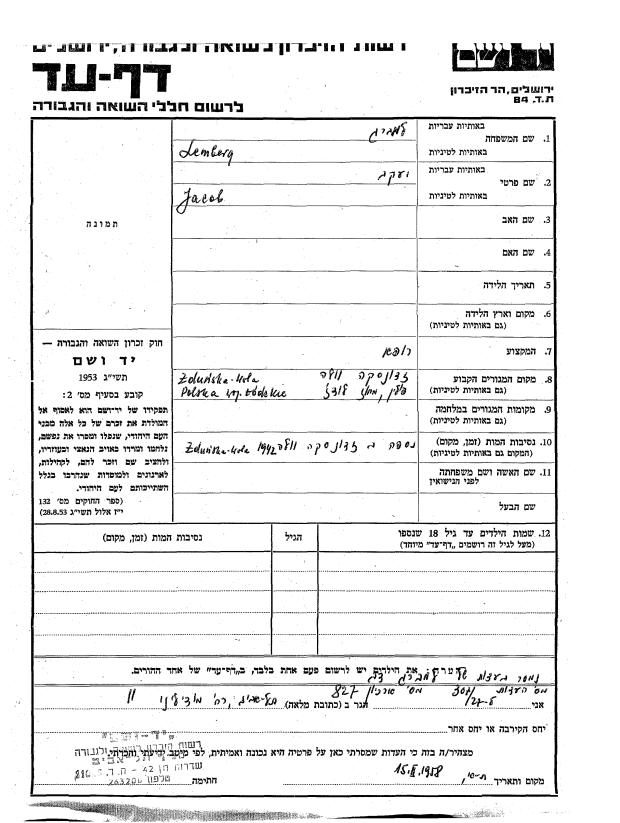
Here’s an image of Lemberg testimony (in Hebrew) from the Yad Vashem database.

On this day..

1942: Five Jews in Sokal

(Thanks to Meaghan Good of the Charley Project for the guest post. -ed.)

The synagogue at Sokal.

On this day in 1942, the Nazis shot five Jewish men from Sokal, which was then part of Poland and now belongs to the Ukraine.

During the first years of the war, the Germans had designated Sokal as a Judenstadt (literally “Jew-town”), a central destination point for all Jews expelled from nearby towns and villages. Or, as diarist Moshe Maltz put it, “A solitary island in a sea of blood.”

It was Maltz, an Orthodox Jew and native of Sokal, who recorded the executions described in this entry. He kept regular notes throughout the war about the plight of Sokal’s Jews — not a diary exactly, but a chronicle, meant for the benefit of history.

On February 24, five Jews from Sokal were taken to a place somewhere on the outskirts of town and shot. One of them was Yeshaye, son of Yankel the coachman. In 1940, during the period of Soviet occupation, Yeshaye had been a coachman working for the NKVD. Now the Gestapo called him and ordered him to turn over to them the reins of his horses. They said to him, “We’ll give you three days to deliver those reins to us. If we don’t get them by that time, we’ll have you shot.” Yeshaye thought that the Gestapo must be joking. How could he go on working as a coachman without his reins? Unfortunately for Yeshaye, the Gestapo men were in dead earnest.

Also among the five shot was Dr. Knopf, a lawyer who had converted to Christianity. The Germans had ordered him to dismiss his Gentile maid so that she could be sent to work in Germany. Knopf petitioned the Gestapo to let him have his maid back. That’s why the Germans shot him. Despite his baptism, he was simply not an Aryan. The third victim was blind Yankel, who was found guilty of buying and slaughtering a calf. Under German occupation regulations, cattle can be slaughtered only by officially approved butchers.

In October 1942, the Jews of Sokal were confined to a ghetto. The following month Maltz wrote, with the same dispassionate tone, of the murder of his fourteen-month-old daughter at the hands of the Nazis.

Later in November he escaped from the ghetto with his wife and surviving son. They had made an arrangement with a Polish woman who lived nearby, and moved into her hayloft, above the pigsty.

Eventually fourteen people from three families in all would come to live in the hayloft. All of them survived except Maltz’s sister, who died of fever while in hiding. The others staggered out into daylight, barely able to walk, when the Russians liberated the area in July 1944.

Maltz and his entire family eventually emigrated to the USA.

After his death in 1993, his diary was translated and published under the title Years of Horror, Glimpse of Hope: The Diary of a Family in Hiding. In 2009, a Pennsylvania State University professor made a prize-winning documentary based on the book, called No. 4 Street of Our Lady. You can watch it on Netflix or read an article about it here.

On this day..

1942: Icchok Malmed

(Thanks to Meaghan Good of the Charley Project for the guest post. -ed.)

On this day in 1942, Icchok Malmed* was hanged on Kupiecka Street in the Bialystok Ghetto for throwing acid in a Nazi’s face and blinding him.

Zchor tells the story:

When the Nazis attacked the house at 29 Kupiecka Street, rounding up all of its residents into the street, a bold young man, Izchok Malmed, whipped out a jar of acid from his pocket, hurling it in the face of a Nazi soldier, who was blinded at once. Seeking revenge, the sightless Nazi fired his revolver several times, hitting another Nazi soldier and instantly killing him. In the melee, Malmed vanished.

Commandant Friedl, after learning what had happened, ordered that one hundred men, women and children living in the area where the incident occurred be rounded up and force-marched to a nearby garden, where they were lined up against the wall of an adjacent bet hamidrash and shot with machine guns.

Afterward Nazi soldiers captured another group of Jews, forcing them to dig a large pit for the bodies of the one hundred martyrs. A thin layer of earth covered them. Some were still alive, their hands groping upward through the earth.

The Nazi soldier accidentally shot by his colleague whom Malmed had blinded was carried to the Judenrat building, and his body was placed on [Judenrat Chairman Efraim] Barasz’s desk. Friedl then proclaimed to Barasz, “See what your Jewish criminals have done. Now we shall take revenge. You shall see what we can do.” Friedl issued an ultimatum for the perpetrator of the crime to surrender within twenty-four hours. Failing that, the entire ghetto would be destroyed with everyone in it.

Barasz knew the Nazis meant what they said. He sent word to Malmed to give himself up and thereby save thousands of Jewish lives. As soon as Malmed heard, he surrendered himself to the Nazis.

Tamarof’s diary described in detail Malmed’s courage. Asked why he killed the Nazi soldier, he replied: “I hate you. I regret I only killed one. Before my eyes my parents were murdered. Ten thousand Jews in Slonim were liquidated before me. I have no regrets.” Tamarof tried to slip poison to Malmed but failed. Even the police could not get near the prisoner.

The next morning, Izchok Malmed, a hero of the ghetto, was hanged in the square where he had performed his act of courage. Despite the horrible torture to which he had been subjected, Malmed cursed the Nazi murderers. After several minutes of hanging on the gallows, the rope broke and the body fell to the earth. Instantaneously, the Nazis riddled Malmed’s corpse with bullets and re-hanged the body for another forty-eight hours.

Kupiecka Street was renamed Malmed Street after the war. Near the site of Malmed’s execution is a plaque reading, in Polish and in Hebrew, “Icchok Malmed, the hero and fighter of the Bialystok Ghetto, was killed here by the Nazi murderers on 8 February 1943. In his honor.”

* The Zchor account spells his name “Izchok” but on the memorial plaque it says “Icchok”. It’s a form of the name Isaac.

On this day..

1536: The Münster Rebellion leaders

On this date in 1536, Bernhard Krechting, Bernhard Knipperdolling, and Jan van Leiden were chained to stakes in the Münster public square, tortured with flesh-ripping tongs for more than an hour, killed with daggers thrust into their hearts, and their remains hoisted in cages in the city cathedral as a warning against any kindred misbehavior in the future.


Detail view (click for the full image) of Jan van Leiden et al being put to death in Münster. In the background, the Lambertuskirche spire shows the three cages in which the victims’ remains were gibbeted.

And the point was taken: the appalling deaths of these men also marked the death of early Anabaptism’s pretensions to secular political power.

These three unfortunates were the top surviving leaders of the Münster Rebellion, a revolution that turned that city into an Anabaptist commune for more than a year.

Just a few years before, southern Germany had been shaken by an apocalyptic peasant rebellion led by Thomas Muntzer, a sort of proto-Anabaptist.*

Though northern Germany was spared that particular maelstrom, that same religious tension and social discontent soon blew a hyperborean wind.

In the early 1530s, “Melchiorites” — Anabaptist followers of radical preacher Melchior Hoffman — proliferated rapidly among workers of the long-prosperous but now-waning Hanseatic territories in northern Germany and the Low Countries.

And these converts did not intend the meek example of evangelical martyrdom. They meant to rule.

In 1535, Democratic-Anabaptist types stormed the Amsterdam city hall; in a separate action, others seized and fortified a Friesland monastery before being overrun. An allied movement, less theologically distinct, won temporary control of Lübeck in 1533, before being expelled by force of arms.

Only in Münster did the Anabaptists realize the full flower of their project, albeit for a very brief period of time. Winning power over the course of the year 1533 by dint of internal politicking, energetic recruitment, and fortuitous imperial distraction, Münster Anabaptists booted out the 1% and started turning the place into a visionary “New Jerusalem.”

Among those visions, the most notorious was polygamy (pdf), introduced by Jan van Leiden when he inherited leadership after the charismatic firebrand Jan Matthys died in a sortie against a siege in April 1534. The story has it that van Leiden wanted to marry Matthys’s attractive widow Divara, though whether motivated by considerations of the loins or legitimacy is up to the reader’s good conscience.

There’s quite a controversial historiography surrounding their polygamous turn: while contemporary enemies were pleased to ascribe it to libertine devilries, German Communist intellectual Karl Kautsky vociferously defended the Münster Anabaptists — arguing that they resorted to polygamy for social stability when the gender disparity in the city had fallen past 3:1 owing to the vicissitudes of war.

And war, as Kautsky noted, was the commune of Münster’s essential condition, just like that of Paris.

Community of goods was the basis of the whole Baptist movement. For its sake the great fight was waged at Münster. It was not, however, the chief factor in determining the character of the Münster Baptist government, that factor being the siege. The town was a great war-camp; the demands of war took precedence of all other matters, and sentiments of freedom and equality were active only in so far as they were compatible with military dictatorship.

After a year and more under siege, Munster finally succumbed to Prince-Bishop Franz von Waldeck.

Jan van Leiden, by this time dignified the “King of Jerusalem”, was taken along with two of his chief aides and designated for this superlative punishment (many others less exalted faced less exalted executions, too).


For decades after the execution, the Anabaptists’ remains rotted publicly in cages on the tower of St. Lambert’s — like these still displayed there to this day. (cc) image from Rüdiger Wölk, Münster.

For Anabaptists as a whole this catastrophe commenced a long period of persecution and reckoning. But from such travails would the movement leave its mark. Indeed, it was also in January 1536 that a young Dutch priest named Menno Simons accepted adult baptism … and began a religious career that would make him the founding namesake of the Mennonites.

Dan Carlin’s “Hardcore History” podcast treats the Münster rebellion here.

On this day..

1629: Anna Gurren, in the Mergentheimer Hexenprozess

On this date in 1629, the German city of Mergentheim burned its late mayor’s widow for witchcraft.

Anna’s remains: the inventory of the late sorceress’s estate taken by its new owner, the city of Mergentheim.

Witch-hunting was a growth industry for Thirty Years’ War-torn Germany in the late 1620s.

Not long before, a Mergentheim Teutonic knight had been petitioned for help extracting a schoolboy from Wurzburg, where the absentee father feared he was running with a devilish crowd. Once the authorities heard that witchy stuff, all the inhuman gears came to life.

Instead of returning the tyke to his concerned dad, Wurzburg arrested the boy, strongarmed him into admitting his Satanic ties, and burned him at the stake. Nine years old.

That was Wurzburg. But back where the allegation originated, writes H.C. Erik Midelfort, “the discovery in Mergentheim that children might be guilty of witchcraft was to have serious consequences.”

Like a fresh plague outbreak, a witch persecution broke out in Mergentheim and neighboring Markelsheim, with some schoolchildren hounded by inquisitors within a few weeks of their compatriot’s execution over in Wurzburg. From there, it became epidemic all over town. By October 1628, the first witches were shrouded in flames for their neighbors’ edification. Over the course of 1629, the peak year for the Mergentheimer Hexenprozess, 91 humans were put to death as Satanic wizards — not counting those who were tortured to death.

Nor was this strictly confined to the weakest prey, your outcasts and servants.

Our victim today was big game, a wealthy city elite, and she wasn’t the only such. These must have made some kind of hedgerow gossip, but the general hysteria of the place made it dangerous to sustain any public controversy even about the downfall of the recently well-connected.

Midelfort, again, on the very relatable circumstance of a prosperous innkeeper who was a little too incensed for his own good at seeing Anna Gurren die.

Thomas Schreiber had a strong sense of justice. When the trials in Mergentheim had run only two months, he had already lost faith in the judicial procedure. On December 1, 1628 when Martha, wife of Burgermeister Hans Georg Braun, was executed, Schreiber was heard by many persons exclaiming that she had been done a gross injusice. Schreiber even let slip that “King Nero” had also conducted such bloodbaths. Six weeks later Schreiber was again appalled when the extremely wealthy widow of Lorenz Gurren was convicted of witchcraft and executed on January 12, 1629. When attending the execution of the lady, he had the temerity to express amazement over her confesion. The Amtmann Max Waltzen turned to him and said pointedly, “Ha, ha, those who know the devil should not be so amazed.” That kind of talk perturbed Schreiber, and when magistrates began avoiding him, he prepared to flee. During this time he repeatedly denounced the court for its unjust trials and declared that “if anything happens to me, let every pious Christian fear for himself.” He also prayed that “God might preserve everyone from Neuenhaus [the jail and torture chamber], for even the most pious if put in there would be found to be a witch.” The trials, he insisted, were bloodbaths, and the magistrates were out to “wash their hands in my blood.”

Schreiber fled town on February 1, having heard that people had started denouncing him. But he didn’t make it long.

He, too, was dead by the end of May — as a confessed (just like he predicted) witch.

On this day..

1942: Three Bialystok Jews

(Thanks to Meaghan Good of the Charley Project for the guest post. -ed.)

On this day in 1942, three anonymous Jewish residents of the Bialystok Ghetto in Nazi-occupied Poland were hung in the public square across the street from the Judenrat (Jewish Council) building. The three worked at the ghetto’s oil factory, and had been caught smuggling sunflower seeds.

The residents of the ghetto paid little attention to the execution, accepting it with resignation. It was hardly remarked on.

But this event was yet another small indication of dire events looming in the near future. Compared to those in other Nazi ghettos, such as those at Warsaw and Lodz, the Bialystok Jews had it pretty good. The ghetto, noted Sara Bender in her 2008 book The Jews of Bialystok During World War II and the Holocaust, was “organized, industrious, and even prosperous. Unlike other ghettos, it never experienced starvation or abject poverty.”

And it was seen as relatively safe. This day’s sort of vicious, arbitrary executions for minor rule infractions, which were so common elsewhere, were not at all frequent in Bialystok. Neither were the mass deportations that had by late 1942 decimated almost all the other ghettos.

Well, Bialystok’s turn was coming.

Unbeknownst to the Bialystokers, just as the sunflower seed smugglers were meeting their end, the powers that be in Berlin were debating the future of the ghetto. The Nazis in immediate charge of the ghetto wanted to keep it, and had logical reasons for doing so: namely, that it was a center of great industry, producing all kinds of goods for the German Army at almost no cost.

Killing off tens of thousands of hardworking slaves during wartime makes about as much sense as hanging three people over sunflower seeds, but this is what Berlin decided to do.

In early- to mid-February 1943, there was a surprise Aktion in the ghetto: 2,000 were killed and a further 10,000 deported to the Treblinka Extermination Camp. About 30,000 remained.

Once it was over, most of the surviving Bialystokers breathed a sigh of relief and hoped against hope that the worst was over — while a small underground group quietly organized an uprising for when the time came.

The rebellion, however, never really had time to get off the ground. When the final deportation occurred in August 1943, almost everyone went quietly in shock to their deaths. A cell of less than 100 fighters put up a few days’ struggle, enough to earn a footnote in history, before the last of the ghetto blew away with the ashes.

On this day..

1941: Eight Russian POWs at Flossenburg

Seventy years ago today, eight unknown Russians — prisoners of the Wehrmacht’s ultimately self-defeating thrust into the Soviet Union — hanged at Flossenburg concentration camp.

By way of a moving 1995 New York Times article, these anonymous Red Army men give us a glimpse at the world of the pink triangle.

Between 10,000 and 15,000 homosexuals may have been incarcerated in the camps, Dr. [Klaus] Mulller said, out of approximately 100,000 men who were arrested under Paragraph 175 of the German criminal code, which called for the imprisonment of any “male who commits lewd and lascivious acts with another male.” (The law was silent on lesbianism, although individual instances of persecutions of lesbians have been recorded.)

Perhaps 60 percent of those in the camps died, Dr. Muller said, meaning that even in 1945, there may have been only 4,000 survivors. Today, Dr. Mliller knows of fewer than 15.

Their travails did not end at liberation. They were still officially regarded as criminals, rather than as political prisoners, since Paragraph 175 remained in force in West Germany until 1969. They were denied reparations and the years they spent in the camps were deducted from their pensions. Some survivors were even jailed again.

Old enough to be grandfathers and great-grandfathers, the survivors scarcely courted attention as homosexuals, having learned all too well the perils of notoriety. “It is not easy to tell a story you were forced to hide for 50 years,” Dr. Mullers said.

One of the first men to break his silence was the anonymous “Prisoner X. Y.,” who furnished a vividly detailed account of life as a homosexual inmate in the 1972 book, The Men With the Pink Triangle, by Heinz Heger, which was reissued last year by Alyson Publications.

By a coincidence that still astonishes him, Dr. Muller said, Prisoner X. Y. — “the best documented homosexual inmate of a camp” — turned out to be Mr. [Josef] Kohout.


The Men With the Pink Triangle inspired the play Bent, later made into a motion picture.

After his arrest in 1939, Mr. Kohout was taken to the Sachsenhausen camp and served at the Klinker brickworks, which he called “the ‘Auschwitz’ for homosexuals.” Prisoners who were not beaten to death could easily be killed by heavy carts barreling down the steep incline of the clay pits.

In 1940, he was transferred to Flossenburg. On Christmas Eve 1941 inmates were made to sing carols in front at a 30-foot-high Christmas tree on the parade ground. Flanking it were gallows from which eight Russian prisoners had been hanging since morning. “Whenever I hear a carol sung –no matter how beautifully — I remember the Christmas tree at Flossenburg with its grisly ‘decorations,’ ” he wrote.

On this day..

1655: Henry Manning, Protectorate spy

“There certainly can be no doubt,” wrote a Venetian diplomat late in the rule of Oliver Cromwell, “that Charles [II] is betrayed by some of those who stand about him, otherwise it would be impossible for Cromwell to find out the secret plans he meditates.”

And indeed, on this date* in 1655, just such a one was shot by the exiled royalists as a Protectorate spy.

Henry Manning, the son of a royalist colonel who died fighting for Charles’s late beheaded father, had impeccable credentials for the Stuarts. The alleged English king was now parked on the continent, trying to conjure up some route back to the throne.

So when the pedigreed Manning turned up at exile camp, packing “a considerable sum of money” he was willing to give to the cause, he was welcomed with open arms.

Too open.

While royalist courtiers blabbed, Manning was filing enciphered reports for Cromwell’s spy chief (and the source of that considerable sum of money) John Thurloe. And these reports disclosed royalist collaborators in England who were rounded up in great numbers in 1655 — a year in which Cromwell dissolved parliament and resorted to direct military rule, growing correspondingly more worried about plots against his person.

It seems that Cromwell’s intelligence men lacked a certain subtlety, however. After an English traveler illicitly met with Charles on the continent during the dead of night, and was picked up for questioning when he returned to the island, the Stuart men naturally reasoned that only the small handful of people involved in that meeting could have been the mole. Manning was done for as soon as his apartments were searched.

Under interrogation, Manning gave up everything he knew, trying desperately to save his skin by offers of turning double-agent and exploiting his relationship with the Protectorate for the royalists’ benefit.** As late as December 14 the captured spy — hearing “sad rumours of a sudden end intended me, nay, to-morrow morning” — addressed a letter to royal aide Edward Nicholas, “humbly crav[ing] you would once more try his most gratious Majesty.”

His Majesty’s concern, however, was of fading into ridiculousness and irrelevance, and the play here was to make an example of treachery. Without apparent legal sanction — the word of the shadow king Charles was law enough here, and his German hosts were content to look the other way — Manning was pistoled to death in a woods outside of Cologne, and the fact made known abroad.

Everyone who’s had a look at Henry Manning agrees that the guy was a small and abject man, easy prey for these great ministers of state. But then, when Thurloe himself was arrested for treason upon the monarchy’s eventual restoration, he procured his own parole by spilling his secrets to King Charles.

* The Gregorian date, per the Holy Roman Empire where Manning was shot — not the Julian date still in use in England. Note as well that the 15th is the most readily inferred date from the available evidence, particularly Manning’s letter of the 14th, but that the event itself does not appear to have been affirmatively recorded on this (or any) specific date by contemporaries. There’s little room for variance, as correspondents are commenting on the death of Manning by the end of December.

** “The end and aim of spying in all its five varieties is knowledge of the enemy; and this knowledge can only be derived, in the first instance, from the converted spy. Hence it is essential that the converted spy be treated with the utmost liberality.” –Sun Tzu

On this day..