1835: Patrick O’Brien, Francis Spaight apprentice boy

On or very near this date in 1835,* a Limerick ship’s boy named Patrick O’Brien lost a casting of lots … then lost his life to feed his ravenous shipmates.

The spanking new 457-ton barque Francis Spaight was on the return leg of her second-ever run to Quebec to fetch timber back to her home port of Limerick. The ship was named for her owner, a big landowner and shipping magnate who had thriftily sent 216 passengers on the voyage’s first leg. As Spaight would explain to a state commission a decade later amid the Great Famine, replacing ballast with emigres on outbound voyages was pure profit. In a sort of microcosm of Ireland’s terrible economic machinery,** Spaight’s own commercial interests on land and sea dovetailed nicely in filling his hulls with Ireland’s surplus population. For example, when Spaight gained the 4,200-acre Tipperary estate of Derry Castle in 1844 he smoothly set about depopulating it** — as Ciaran O Murchada describes in The Great Famine: Ireland’s Agony 1845-1852:

He [Spaight] did this by obligating unwanted tenants to emigrate to America on board his own ships and at his cost. It was all done extremely cheaply since the ships were cargo vessels which were empty on each outward voyage in any case. By 1847 Spaight’s businesslike approach had rid him of half the Derrycastle tenants, and by the time his consolidation was completed two years later he had removed some 2,000 persons in an operation which was admired by other landlords for its efficiency and the fact that it was done without arousing any overt protest on the part of the tenants.

As to the ship that bore the master’s name, discharged of her Irish exiles and loaded with Canadian lumber, she departed her last port of call in Newfoundland on November 24. Aboard were eighteen souls: fourteen crew and four boys among whom we find our principal Patrick O’Brien — a penniless 15-year-old bound over from the Limerick workhouse as an apprentice to Mr. Spaight approximately on the eve of the Francis Spaight‘s departure. He was destined never to lay eyes on his native soil again.

On December 3, the ship capsized.† Three men were lost at sea; the other 11 crew and all four boys clambered aboard a dinghy, adrift and unprovisioned in the frigid Atlantic. There the torments of privation worked them until they slaked their hunger on their comrades’ flesh, as the Irish and then the English press related months later to their titillated readers — such as this entry from Manchester Times, June 25, 1836.

On the 19th of December, the sixteenth day since the wreck, the captain said they were now such a length of time without sustenance, that it was beyond human nature to endure it any longer, and that the only question for them to consider was, whether one or all should die; his opinion was that one should suffer for the rest, and that lots should be drawn between the four boys, as they had no families, and could not be considered so great a loss to their friends as those who had wives and children depending on them.

None objected to this except the boys, who cried out against the injustice of such a proceeding. O’Brien, in particular, protested against it; and some mutterings were heard amongst the men that led the latter to apprehend they might proceed in a more summary way. Friendless and forlorn as he was, they were well calculated to terrify the boy into acquiescence, and he at length submitted.

Mulville now prepared some sticks of different lengths for the lots. A bandage was tied over O’Brien’s eyes, and he knelt down resting his face on Mulville’s knees. The latter had the sticks in his hand, and was to hold them up one by one demanding whose lot it was O’Brien was to call out a name, and whatever person he named for the shortest stick was to die. Muville held up the first stick, and demanded who it was for? The answer was “for little Johnny Sheehan,” and the lot was laid aside. The next stick was held up, and the demand was repeated, “on whom is this lot to fall?” O’Brien’s reply was, “on myself,” upon which Mulville said, that was the death lot — that O’Brien had called it for himself.

The poor fellow heard the announcement without uttering a word.

This same story, said to have been related by an unnamed survivor of the Spaight, appeared in a number of papers with slightly varying embroideries around this time. Some versions suggest that this blind man’s bluff lot-drawing was rigged to target O’Brien as the least popular crewman; whether or not that was the case, even the “fair” version of the game was rigged at the outset to exclude the adult crew members and leave only the apprentice boys for gobbling.

The lot having been cast, we resume the ghastly narrative with Bells Life in London and Sporting Chronicle, June 26, 1836:

The men now told him he must prepare for death, and the captain said it was better it should be done by bleeding him in the arm, to which O’Brien made no objection. The captain then directed the cook, John Gorman, to do it, telling him it was his duty; but Gorman strenuously refused. He was, however, threatened with death himself by the men if he continued obstinate, and he at last consented.

O’Brien then took off his jacket without waiting to be desired, and after telling the crew, if any of them ever reached home, to tell his poor mother what had happened to him, bared his right arm. The cook cut his veins across twice with a small knife, but could bring no flow of blood, upon which there seemed to be much hesitation among the men as to what could be done.

They were relieved by the boy himself, who immediately desired the cook to give him the knife, as he could not be looking at him putting him to pain. When he got the knife, and was about to cut the vein, the captain recommended him to try the left arm, which he accordingly did. He attempted to open the vein at the bend of the elbow with the point of a knife, as a surgeon would, but like the cook he failed in bringing blood.

A dead consternation now fell upon all; but in a minute or two the captain said, “This is all of no use, ’tis better to put him out of pain by at once bleeding him in the throat,” and some of them said it was true.

At this O’Brien, for the first time, looked terrified, and begged hard that they would not do so, but give him a little time; he said he was cold and weak; but if they would let him lay down and sleep for a little, he would get warm, and then he would bleed freely.

To this wish there was some expression of dissent from the men, and the captain shortly after said to them, “that it was useless leaving the boy this way in pain; ’twas best at once to lay hold of him, and let the cook cut his throat!”

O’Brien, now roused, and driven to extremity, seemed working himself up for resistance, and declared he would not let them; the first man, he said, who laid hands on him, ‘twould be worse for him; that he’d appear to him at another time; that he’d haunt him after death.

The poor youth was, however, among so many, soon got down, and the cook was again called upon to put him to death. The man now refused more strenuously than before, and another altercation arose: but, weak and irresolute, and seeing that his own life would absolutely be taken instead of O’Brien’s, if he persisted, he at length yielded to their menaces.

Some one at this time brought him down a large case knife that was on the poop, instead of the clasp-knife that he had first prepared, with which, pale and trembling, he stood over O’Brien, who was still endeavouring to free himself from those who held him. One of them now placed the cover of the tureen (which they before used to collect rain) under the boy’s neck, and several cried out to the cook to do his duty.

The horror stricken man, over and over again, endeavoured to summon up hardihood for the deed, but, when he caught the boy’s eye, his heart always failed him, and then he looked supplicatingly to the men again.

Their cries and threats were, however, loud for death — he made a desperate effort — there was a short struggle — and O’Brien was no more.

As soon as this horrid act was perpetrated, the blood was served to the men; but a few of them, among whom was Mahony, refused to partake of it.

They afterwards laid open the body, and separated the limbs; the latter were hung over the stern, while a portion of the former was allotted for immediate use.

Shocked, as, for the sake of human nature, it is to be hoped many were at the scene they had just witnessed, a gnawing hunger came upon them all when they saw even this disgusting meal put out for them, and almost every one, even the unwilling boys, partook more or less of it.

This was the evening of the sixteenth day. They ate again late at night, and some greedily; but the thirst, which was before at least endurable, now became craving, and as there was no more blood, they slaked it with salt water.

They then lay down to rest, but several were raving and talking wildly through the night, and in the morning the cook was observed to be quite insane — his eyes inflamed and glaring, and his speech rambling and incoherent; he threw his clothes about restlessly, and was often violent. His raving continued during the succeeding night, & in the morning, as his end seemed to be approaching, the veins of his neck were cut, and the blood drawn from him. This was the second death.

On the night of that day, Michael Behane was mad, and the boy George Burns on the following morning; they were both so violent, that they were obliged to be tied by the crew, and the latter was bled to death, like the cook, by cutting his throat. Michael Behane died unexpectedly, or he would have suffered the same fate.

Next morning the captain came off deck, and, feeling too weak and exhausted to keep a look-out any longer, desired some one to take his place above. Harrington and Mahony went up very soon after; the latter thought he could distinguish a sail, and raised a shout of joy, upon which those below immediately came up. A ship was clearly discernible, and apparently bearing her course towards them.

Signals were hoisted with as much alacrity as the weakness of the survivors would allow, and, when she approached, and was almost within hail, their apprehension of her passing by was so great, that they held up the hands and feet of O’Brien to excite commiseration.

The vessel proved to be the Agenoria [sic — Agenora is the correct name of the ship], an American. She put off a boat to their assistance without any hesitation, although the weather was so rough at the time, and the survivors were saved.

The Francis Spaight was channeled almost straight from such reports by Jack London into a shocking short story.

The notoriety of cannibalism did not translate to any sense that the famished survivors ought to be prosecuted: they were objects of pity and the survival of those who made it was rather celebrated than disdained since even weeks later as they arrived back at Limerick they presented an appearance “ghastly and spectre like with a singular woe-be-gone expression of countenance.” (Quoted in Neil Hanson’s book about a later instance of cannibalism, The Custom of the Sea)

Francis Spaight — the oligarch, not his barque — wrote an appeal that the public sustain with charity his own invalided employees … for, “mutilated by the frost and otherwise rendered helpless” they would “be unable not only to obtain bread, but to labour for it during the rest of their lives.” What, you think I’m going to hire them? (Actually the skipper who orchestrated O’Brien’s death went back to work captaining Spaight’s ships.) Spaight put in ten quid for the lot of them, something like US $1,000 in present-day money.

And the grief-stricken mother of Patrick O’Brien haunted Spaight’s country estate “where her hysterical cries were truly heart-rendering.” (Source)

* Understandably calendar-keeping was not foremost on the minds of the Francis Spaight survivors. Many sources give the 18th as the date of O’Brien’s sacrifice; I’m gingerly preferring the 19th in deference to the immediate newspaper reports such as the one quoted in this article. This also appears to square with rescue on the 23rd: by the quoted narrative, the cook is slaughtered two days after O’Brien (hence, the 21st), and Michael Behane and George Burns die on the following day (the 22nd), only for the survivors’ salvation to appear “the next morning.”

** “Irish genius discovered an altogether new way of spiriting a poor people thousands of miles away from the scene of its misery … instead of costing Ireland anything, emigration forms one of the most lucrative branches of its export trade.” –Marx

† Though useless to our survivors in their hour of need, the Francis Spaight did not sink. She was recovered, pumped out, and returned to service. Years later she went down for good at Table Bay, near the Cape of Good Hope.

On this day..

1780: Gerald Byrne and James and Patrick Strange, for carrying off the Miss Kennedy’s

Today’s short and plaintive broadsheet arrives via James Kelly’s Gallows Speeches From Eighteenth-Century Ireland, a source we have enjoyed often in the past.

Though we have seen elsewhere via Kelly the capital prosecution of Catholic-Protestant marriages; these, however, appear by the thin text to be instances of the old tradition of bride-stealing — a practice which could straddle the vast distance from elopement ritual and kidnapping/rape.

The implication of these texts is that the men did the former, but got prosecuted for the latter: whether that’s down to an initial misunderstanding between the partners, to a change of heart by the wives Kennedy, to the pressure applied by disapproving in-laws, or some other cause, one can only guess.


The Last Speech, Confession and Dying Declaration of Gerald Byrne and James and Patrick Strange

Good People,

As we have for some time past excited the publick attention, it may be expected in our last moments to say a few words regarding the cause for which we suffer. As to our births; we have come from respectable families near Graigenamana, in the counties of Ki[l]kenny and Carlow; from an early acquaintance with the Miss Kennedy’s, we unfortunately conceived an affection for them, grounded on the most virtuous and honourable terms; they received our addresses and seemed to approve of our passions by the mutual exchange of their love for ours; but alas! how we have been deceived.

Thus encouraged with the many repeated assurances that we were not disagreeable, made us imprudently determine to take them away, which resolution we unhappily put in execution, and immediately after, married them, and during the time of their living with us no woman could be happier, as we used them in the most tender, loving and affectionate manner; however, illnatured people have shamefully propagated, that we treated them ungentleman-like; but such ill-natured reports have been founded and circulated by malice, and, we hope, in the humane and honest mind will have no weight.

We freely forgive our unnatural wives, beseeching the Searcher of all Hearts, when they appear before his awful tribunal, will mitigate the cruelty they have shown to us, and receive them into the mansions of bliss. We die members of the Church of Rome, in peace with the world, in the 23d and 20th years of our age, and may the Lord have mercy on our Souls

Gerald Byrne, James Strange


The last Speech of Patrick Strange, who was executed for aiding and assisting in taking away the Miss Kennedy’s

Good Christians,

As it is usual for persons in my unhappy situation to give some account of their past life, I shall only trespass on the public, to mention, that I was born in the county of Carlow, come from a reputable family, and always preserved an unblemished character, the cause I die for was of assisting Mess Byrne and Strange, in carrying away the Miss Kennedy’s. I forgive my prosecutors, requesting the prayers of all good Christians, and depart in peace with mankind, in the 24th year of my age.

Patrick Strange

ENISCORTHY: Printed by R. JONES

On this day..

1787: Margaret Savage, repeat offender

(Thanks to Meaghan Good of the Charley Project for the guest post. -ed.)

On this date in 1787, Margaret Savage was publicly hanged in front of Newgate Prison in Dublin, Ireland for armed robbery.

Savage’s first brush with the law came in 1781, when she was convicted of stealing 18 yards of black calico, the value of which was £2. Three years in prison seems a harsh punishment for what was essentially shoplifting, but Savage was lucky — in those days, even minor thefts were capital offenses.

In August 1782, Savage and 31 other prisoners petitioned George Nugent-Temple Grenville, 1st Marquess of Buckingham, the new Lord Lieutenant of Ireland, for clemency. The petitioners, 29 of them female and most of them convicted of theft, pointed to their “signs of reformation and contrition,” successfully: the Lord Lieutenant pardoned Savage and released her from custody, less than a year into her sentence. She had been doubly fortunate.

Five years later, however, Savage got into trouble again after she and a fifteen-year-old male accomplice were convicted of robbing a woman at gunpoint, stealing 18 shillings. Aware of her previous record, this time the Dublin Recorder sentenced her to death.

Brian Henry notes in his book Dublin Hanged: Crime, Law Enforcement and Punishment in Late Eighteenth-Century Dublin,

Her hanging conflicted with the state funeral procession of the Duke of Rutland [another Lord Lieutenant of Ireland]. This prompted the Hibernian Journal to report that Savage’s “wretched situation seemed to have less effect upon her than the neglect of the populace, in not gracing her exit with their appearance on so deplorable an occasion.”

The fate of Savage’s young accomplice was not recorded.

On this day..

1942: Tom Williams, IRA martyr

Irish revolutionary Tom Williams was hanged at Belfast’s Crumlin Road Gaol on this date in 1942.

A plaque at 46 Bombay Street in Belfast marks the home Tom Williams shared with his grandmother.

The 19-year-old Belfast Catholic had been the chief of a six-man Irish Republican Army team that mounted an Easter Sunday attack intended to divert Northern Ireland’s Royal Ulster Constabulary from preventing Republican marches to commemorate the Easter Rising. The attack killed an RUC officer, and all six IRA men were arrested and sentenced to death.

As the acknowledged leader, Williams alone paid that forfeit; the five others all had their sentences commuted. (Notably, their number included 21-year-old Joe Cahill, who was destined for an illustrious career in the movement; he would go on to co-found the Provisional IRA in 1969, and to become a prominent exponent of the peace process in the 1990s.)

“Tom Williams walked to that scaffold without a tremor in his body. The only people who were shaking were us and the hangman,” his priest said later that day. “I’ve one other thing to say to you. Don’t pray for Tom Williams, pray to him, for at this moment Tom is a saint in heaven.”

That’s about the size of Williams’s place in the Republican memory. After the prison was closed, Williams was reburied with honors (Gerry Adams attended) in 2000. He’s commemorated in a ballad.

Tom Williams (Irish republican) from REBELS OF IRELAND on Vimeo.

On this day..

1909: Richard Justin, child batterer

(Thanks to Meaghan Good of the Charley Project for the guest post. -ed.)

At eight in the morning on this date in 1909, Richard Justin was hanged at Crumlin Road Prison in Belfast, Ireland (now Northern Ireland) for the murder of his four-year-old daughter. Little Annie Thompson — she was born illegitimate, but her parents married a few months before her death — had died at their home at 84 Lepper Street in Belfast on March 12, supposedly from falling out of bed.

A myriad of witnesses, however, reported that Justin abused the child horribly. Her longtime nanny had noticed bruises, a swollen chin, a black eye and one tooth knocked out, but in February, before she could take any action, Annie was removed from her care. Others reported seeing marks and bruises on the child.

When concerned adults asked Annie how she had been hurt, she complained her father had hit and kicked her. People had also heard heartrending cries coming from 84 Lepper Street. One neighbor, for instance, testified she’d heard Annie’s mother wail, “Hit me, and let the child alone.”

The locals were reluctant to intervene in the family’s domestic problems, but after a Mrs. McWilliams saw that Annie’s “wee elbow” was swollen, her wrist was burned and “the skin was off her back,” she told Annie’s mother she was going to complain to the child abuse authorities. She decided not to, though, after Annie’s mother gave her word of honor that the abuse would stop.

It didn’t stop.

The very day of Annie Thompson’s demise, someone had written a letter to the Society for Prevention of Cruelty to Children, saying they’d been concerned about her for months and would someone please go to her house and check on her welfare? The anonymous writer added that he or she had meant “to drop you a note last week.”

Too little, too late.

From a forensic standpoint there was the autopsy, which revealed

a litany of injuries. These included some thirty bruises to the chest, arms, thighs and head, though most were several days old. Professor Symmers, who conducted the medical investigation, even went as far as to say they were the worst injuries to a child he had ever seen.

He actually compared her tortured remains to a case he’d seen where a man had been whipped 100 strokes with a cat o’ nine tails. The primary cause of death, however, was a brain hemorrhage

At Richard’s trial in July, ample evidence of child abuse was presented and the prosecution argued that Annie had died of injuries accumulated from the effects of months of beatings. The defense denied that the accused man had ever mistreated his daughter and argued that her death was an accident. Their star witness was Richard Justin’s oldest son, Richard Jr.

According to Richard Jr., he, his younger brother, and Annie were sharing a bed, the girl being closest to the wall. She woke up at 7:00 a.m. and started climbing over the boys to get out of bed, but tripped on the hem of her nightdress, fell off the bed and struck her head on the metal strut of her parents’ bed, an arms’ length away. Annie moaned and wouldn’t move after that. Richard Jr. picked her up and put her back in bed without waking their brother. Richard Sr. then found her lying dead two hours later.

When asked about this in court, Professor Symmers reluctantly allowed the boy’s story about Annie’s fall, if accurate, could explain the brain hemorrhage that had caused her death.

Nevertheless, the jury returned a guilty verdict.

“The defence,” writes Steven Moore in his book Hanged at Crumlin Road Gaol: The Story of Capital Punishment in Belfast,

with some justification, considered that Richard Justin hadn’t been given the benefit of what appeared to be reasonable doubt. There was a possibility, it was felt, the jury had believed him guilty of scheming to kill the child, and that the plot had not succeeded only because of an unfortunate accident. In other words, even if he hadn’t actually murdered Annie, there was no reason to consider him innocent when he had evil intent to the girl. A petition sent to the Lord Lieutenant asking for a reprieve was turned down.

A large crowd gathered outside the prison as Richard Justin was hanged, but there was nothing to see: his execution took place within the prison walls, and even the custom of raising the black flag at the moment of death had been abandoned. He reportedly “walked firmly to the scaffold and had shown great remorse for his crime.”

On this day..

1820: Stephen Sullivan, for murdering the Colleen Bawn

The hanging this date in 1820 of Stephen Sullivan for killing a 15-year-old a year before closed the real-life case that inspired the popular Irish play The Colleen Bawn.

In the play — which in its own turn is based on the 1829 Gerald Griffin novel The Collegians — an older landowner unhappily wed to an unsuitable younger wife has the marriage murderously annulled by the offices of a loyal factotum.

In The Colleen Bawn, these figures are Hardress (the husband), Eily (the wife),* and Danny (the hunchbacked murderer). It’s still performed today, both on stage and in an operatic adaptation, The Lily of Killarney.

In 1819, their real-life equivalents were John Scanlon, his wife Ellen Hanly, and our man Sullivan, the killer.

Scanlon, the regretful groom and instigator of the murder, had already been captured and executed at a previous assize; Sullivan likewise blamed his patron with his dying breath for “when I looked in her innocent face, my heart shuddered, and I did not know how I could do it!” Somehow he found a way.

The final scene, courtesy of Edinburgh’s Caledonian Mercury, August 14, 1820

* Eily is also the play’s title character — from the Gaelic cailín bán, “fair girl”.

On this day..

1728: John Audouin, “happy is the Man whom God correcteth”

From The Last Speech and Dying Words of Mr. John Audouin, who was executed at Dublin, on Wednesday the 29th of May last 1728 for the Murder of his Maid Margaret Kief; at the place of Execution he delivered the following Paper to the Sheriffs. (Courtesy of the National Library of Scotland):


It is usual for Persons under my unfortunate Circumstance, to say some thing on these melancholy Occasions; or at least it is expected by most People, who come to be Witnesses of their tragical End; as I see so many are of mine this Day; but nevertheless I should be silent, to the Disappointment of this Multitude, were it not for the Glory of God, my own Justification, and a Warning to those I leave behind me, that I think it incumbent on me, to deliver these my last Words with a clear Conscience, and in the fulness of Truth; for this is a Time, that I should not Lie to the Almighty, nor call him to witness a Falshood.

What have I to fear, That I should now conceal the worst Actions of my by past Life? or what have I to hope for, that I should dissemble with the World, and deceave my self? No! God forbid that I should now provoke my Saviour, who’ I have often done it before, which has now brought the Weights of his Judgments upon me; but as all my Hopes, ends in his Mercy, according to his Promises to the Penitent I hope that this Day, there will be that heavenly Joy over my Soul, as over, a repenting Sinner, more than over Ninty and Nine just Persons, as he himself has testified.

The Sum of which I have to say and of what is expected to me, whether I am guilty or innocent of the Fact laid to my Charge, or not, and for which I am brought here to die. I now, as I always did, do declare solemnly in the Presence of God (before whom I shall soon be judged) and do testify it here under my Hand (which I desire may be published accordingly) and that I am entirely innocent thereof.

I sincerely forgive all my Prosecutors, Enemies and Slanderers, and all other whatsoever, and hope, that in christian Charity, these my last Words will meet with Credit, since I can propose no worldly Advantage by concluding my Life with asserting a Falshood, to the Dishonour of God, and Slander of my neighbour.

I shall conclude with the Words of Job, the 1st Chapter and 17th Verse [sic: it’s actually Job 5:17 -ed.], viz. Behold happy is the Man whom God correcteth; therefore dispise not thou the Chastning of the Almighty.

JOHN AUDOUIN

Edinburgh, Re-printed in the Year M. DCC. XXVIII.

On this day..

1725: John Coamber

The Dublin hanging of John Coamber on this date in 1725 for the previous year’s notorious mugging/murder of a city counselor named Richard Hoar(e) arrives to us, as have several previous posts, via James Kelly’s Gallows Speeches From Eighteenth-Century Ireland.

In this instance, Kelly gives us two rival “last speeches.” It’s a genre that he says was exploding in the 1720s, with the burgeoning of print culture and the importation of similar purported gallows unburdenings.

And as we saw in a 1726 exemplar from the same book, the publishers who flooded this burgeoning market were at daggers drawn with one another over precedence for inside information and autobiographical authenticity. This is another case where one of the documents — Cornelius Carter’s — takes space to take a shot at the rival tract.

We also see here in Carter’s more detailed (and here, sarcastic) narrative that two different, innocent, men were hanged for the murder some time before one of the three real killers saved his own neck by shopping Coamber.


The Last Speech, Confession and Dying Words of

John Comber

who is to be Hang’d and Quarter’d this present Wednesday, being the 5th, of this Inst. May 1725. Near St. Stephen’s-Green; for Murdering Councellor Hoar, in January last.

Good Christians,

My Heart has been so hard hitherto, that I had no Manner of thought of either Soul or Body, but now I seeing Death plainly before my Face, causes me to consider of my latter End; and praise God for giving so much Grace so to do; therefore I am resolv’d to make a Publick Confession of my past Life and Conversation, which is as follows.

As to my Birth and Parentage, it is but a folly to relate, yet I can say I came from very honest Parents, who took what Care they could to bring me up in the Love and Fear of God, but I contrary to the Laws of God and Man, have gon [sic] astray, and follow’d Loose Idle Company, which brought me to this untimely Death; and how it came to pass was thus.

I being Entimitly Acquainted with one Patrick Freel, and David McClure, with whom I went to a House in New-street, where we then (after several meetings) made a Plot to get Money, by reason it was scarce with us, at length we Consulted the 19th, of January last, to Robb the first we wou’d meet with, and being over perswaided by the Devil, I went to the House of Mr. Carter and meeting a Child of his, bid him fetch his Dady’s Pistol, and I would fetch him some sweet things, upon the same promise, the Child brought me a Pistol, and then I, in Conjunction with the above Named Persons, went towards Stephen’s-Green, where we met with Mr. Kennedy, Mr. Leeson’s Clerk, whom we Robb’d of a Ten Peney Piece, from that we proceeded to Henry-street, where we met the Deceased Gentleman, to whom I went up, and Demanded his Money, with that he moving his Arm, and I having the Pistol Cock’d, caused the same to go off, tho’ as I shall Answer my God I did not think of being his Butcher; and when I found the Pistol went off, I never staid to know whether he had Money or no, but took to my Heels as fast as I could.

Then I went to the Sign of the Black Swan in Mary’s-Lane, where I and my Comrads met; from that my Prosocuter Patrick Freel and I, went to the Country where we staid for some small Time, then I came back, and as God, who never suffers Murder to be Conceal’d, I was soon Apprehended and put to Goal, upon Suspission, where I lay as good as a Month, but a Proclamation being Isued out, concerning the Murder, he came in and made Oath that I was the Person that Shot the Councellor, which to my sorrow is True.

Having no more to say but beging the Prayers of all good Christians, I die a Roman Catholick, and in the 22d. Year of my Age, and the Lord have Mercy on my poor Soul Amen.

Dublin: Printed by C.P. 1725.


The Last Speech, Confession and Dying Words of

John Coamber

who is to be Hang’d, Drawn and Quarter’d this Day, being the 5th of this Instant May 1725. For the Murder of Councellor HOAR in Henry Street the 19th of Jan. last.
Deliver’d to the Printer hereof C. CARTER the 5th of May, and to no other, By me John Coamber. And All others are Imposing on the Publick.

All you my Spectators,

This is to give you the following Account, I was born in the Town which is Call’d Thurles, in the County of Tipperary in Munster, of very honest Parents, that brought me up in the fear of God, and Wou’d give me good Learning, but I was too Head-strong, and wou’d not be Rul’d or Guided by my tender Parents, but left ’em and went to serve a Tobacco-twister, which I work’t at for about 5 years, being weary of that I came for Dublin, being a stranger, I turn’d Porter about Cork-hill, where I stood and follow’d that business for near 3 years, all this time I behav’d my self very honestly, and was well belov’d by all that knew me, especially in the above Neighbourhood, being weary of that, I took a fancy to Cry News about this City, which in a little time, I began to get a great many pence by it, and in sometime after, I became Acquainted with Idle and loose Company, Viz. and in the process of time I came to be acquainted with particular Persons and some others who first brought me in Company among Whores to Drink and spend my Money &c. Which was the first Cause of my Destruction.

Afterwards I went of my own Accord, and follow’d the said Evil Custom and other ill Actions, then I became as obdurate and as Wicked as the worst of my Ring-leaders.

I have Reason to Curse them Idle fellows which made me first acquainted with the whores and Pick-pockets in this City, of which there is abundance too many.

But finding Money not Answering to keep the above Company, being acquainted with one David McClure who was my chief Comrade, and who made his Escape to France after the Murder was Committed, he and I stuck together, and followed a very Idle Course of Life, and we Committed several ill Facts in this City and Liberties thereof.

All our shifts not Answering, I, McClure, and Patrick Freel (who was the first Evidence against me) Resolv’d to turn Robber, but never did design to be Guilty of Murder, and did design when we got a Sum of money that was worth While, to leave the Country.

I confess, that Patrick Freel, David McClure and I went on the 19th of January last at Night, to Henry Street, with a Design to Rob, or Plunder the first Gentleman that came that way; which was the luck of that worthy honest Gentleman Councellor Hoar, though I declare before God I did not design to hurt him, or any Man else that time.

I do also Confess that I did own to the Blind Boy, Lawrence Dugan, (who was the t’other Evidence against me) that Patrick Freel, David McClure and I myself, were all Guilty of the Murder for which I now suffer, but I wonder he did not Discover, it when one Pitts and another one Hand, had like to suffer for this Murder. (emphasis added -ed.)

I further Declare, tho’ it was falsely and Scandalously Publish’d in Print, by one Mrs. Needham and her Son Dickson; that I had got Mr. Carter’s Pistols from his young Son about 8 years of Age, (we had but one Pistol among us) and as I am a Dying Man I got no such thing from the said Child, nor none of his Family, neither did I steal any such thing out of his House in my Life time.

I accused one Daniel Field and Michael Tankard falsly, which I am heartily sorry for, but it was by the Advice of Winfred Dunn and Patrick Dunn the 2 Informers, that swore against Pitts and Hand that was Try’d the last Term for this Fact.

I beg of my great God to forgive my Prosecutors, and all my Enemies, as I do forgive them from the bottom of my heart.

I hope this my untimely End will be a Warning to my Comrades, and also to all young Men, which I pray to God it may. For my own part I own I am Guilty of the Fact for which I Die, And I hope the Lord of his infinite Goodness, will have Mercy on my Soul and forgive me.

I am about 19 Years of Age I dye a Roman Catholick, and Desires the Prayers of all Good Christians, and the Lord have Mercy on my poor Soul. Amen.

JOHN COAMBER

DUBLIN: Printed by Corn. Carter. 1725.

On this day..

1940: Peter Barnes and James McCormack, the last IRA men hanged

“The two that swung in Birmingham, with ordered step
From off the gallows floor.”

Brendan Behan

On February 7, 1940 — Ash Wednesday, as it happened to be — Peter Barnes and James McCormack became the last Irish Republican Army men executed by the British

They were condemned by the outraged British after a then-shocking terrorist bombing that has largely vanished from the historical memory, subsumed by the simultaneous outbreak of World War II.

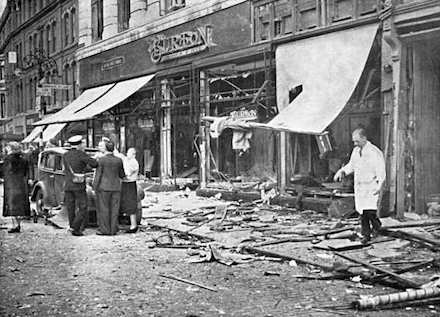
Although it was neither the first nor the last strike in the 1939-1940 campaign of Irish Republican attacks on English soil aimed at forcing London to relinquish control of Northern Ireland, the five-pound bicycle-mounted bomb that ripped apart Broadgate on August 25, 1939, might have been the one that most hardened British hearts against the authors.* Five people were killed in the explosion and some 70 injured; the scene resembled a war zone.**

The resulting investigation — explored in great detail here — never laid hands on the man who actually planted this bomb, eventually revealed to be Joby O’Sullivan.

Many years later and near his death, O’Sullivan claimed that the bomb was supposed to be parked at the Coventry police station; other reports have it destined for an electrical station, and the decision to abandon the ticking bicycle in a crowded street a freelance cock-up by O’Sullivan. Maybe. What is known is that on August 24, London police had busted an IRA plot to place explosives at Westminster Abbey, Scotland Yard, and the Bank of England — all timed to explode at the very same moment as the Coventry package, 2:30 the next afternoon. Had that coordinated fourfold bombing occurred, it would have rated one of the bloodiest and most spectacular terrorist events in history.

But the single blast that did take place was more than enough to bring down the crown’s fury.

Five faced trial for their lives, even though no hand among them had actually set the Coventry bomb. In Ireland and many other places, this latter stipulation made the entire affair an outrageous injustice, especially if one takes as a given that the bomb was not meant to hit civilians. We leave that interesting question of justice to the reader’s consideration, but it must be understood that our hanged men were certainly party to the IRA’s bombing project. The accused, for a trial that December, were:

  • Barnes, an IRA operative in London who had delivered bomb components to Coventry
  • McCormack, part of an IRA cell in Coventry who had rented the house where the bomb was constructed
  • Joseph and Mary Hewitt, and Mary’s mother Brigid O’Hara, Irish immigrants who had taken on McCormack as a lodger

Little evidence could be produced against Hewitt family, who appeared to be quite innocent of their tenant’s intentions. The latter three were cleared of all charges, and then vengefully deported.

McCormack kept stoically silent during the trial, rising only at his sentencing to announce “that the part I took in these explosions since I came to England I have done for a just cause. As a soldier of the Irish Republican Army I am not afraid to die, as I am doing it for a just cause. I say in conclusion, God bless Ireland and God bless the men who have fought and died for her.”

Barnes, whose role on the far end of the supply was even more remote from the final detonation, said as he would maintain to the end, “I am innocent and later I am sure it will all come out that I had neither hand, act or part in it.”

The pair hanged together in Birmingham’s Winson Green Prison. The return of Barnes and McCormack’s remains from that gaol’s unmourned yards to Irish soil soon became a running national demand; the remains were finally repatriated (to great fanfare) in 1969.

Amid the patriotic encomia, civil war veteran Jimmy Steele gave an address on the occasion of the republicans’ reburial critical of the Sinn Fein leadership — an address that is often considered a milepost en route to the imminent (December 1969) splitting-away of the Provisional IRA.

* And in a less justifiable expression, against the Irish generally; Coventry’s Irish immigrant populace faced an immediate racist backlash.

** A chilling preview, for the next year Coventry was devastated by German planes — one of the cities hardest hit by the Reich’s bombing campaign.

On this day..

1725: Anne Pepper, for a petticoat

We return today to one of our occasional sources, the gallows broadsheets in James Kelly’s Gallows Speeches From Eighteenth-Century Ireland — for a thief who paid everything back except for one crucial object.


Last Speech and Dying Words of Anne Pepper

who is to be Executed at St. Stevens-Green on Saturday the 22d of this Inst January 1725

Good Christians,

Since it is my hard Fortune to come to an untimely end, I will give the Publick an Account of my past Life, which you may take as followeth, Viz.

I was born in Dublin, in the Parish of St. Brides, of poor and honest Parents, who gave me Education suitable whereby I might have got honest Bread.

I was desirous to go to Service, and I had my wish, The first place I went to was to Mr. Paris’s in York Street, and after to Mr. John Wards, and several other Credible Services; At length I unfortunately Married to one Pepper, who was Cooke to an Honourable Gentleman; This Marriage was the beginning of my Misfortunes, and the chief Cause of my coming to this shameful, untimely end; As I am a dying Woman, I never knew Man before my Husband, but God forgive me I have known several since, and for the most part other Women’s Husbands, once I turn’d loose I embrac’d what came in my way, as Roberies, &c.

The first that I Rob’d was my Master a French Minister and made off with the Robery to Holly-Head in Wales, from thence I went to London; and remain’d there five Years, where my Husband follow’d me, and brought my Mother and Brothers and Sisters with him, where they all remain (except my Husband) to this Day, if alive, it is now about two Years and a half since I left them.

I by the time of my return to Dublin, came acquainted with Several Thieves and Robbers, and was concern’d in Several Roberies; and in particular this for which I dye.

I was Encourag’d by one Sarah Kenny a Running Broker, who promis’d that any Thing I brought to her, should never be brought to Light, after I had Committed this Robbery for which I justly Die. I was going Directly to the said Sarah Kenny’s Room in Patrick’s Close, and was met by one Patrick Hoy, Butcher a Notorious T_______se, just in the Close, who took by Force from me a Petticoat belonging to the Robbery, and said he would have it for his share, and so he took it to the said Sarah Kenny before me:

The said Petticoat is the Reason of my loosing of my Life, for all that was taken was Return’d except that Petticoat, and if they could have got that Petticoat, the Gentle woman that own’d it would not have prosecuted me.

Tho’ I have seen several persons suffer here for varieties of Facts, yet it did no way daunt me, nor made no impression in my obdurate Heart, till now. I heartily begg of my Great and Merciful God to Bless me and save my Soul, I hope this will be a warning to all ill People.

Having no more to say, I begg the Prayers of all good Christians. I Dye a Protestant of the Church of England in the 33d Year of my Age, and the Lord have mercy on my poor Soul, Amen.

I leave my blessing with good Mr. DERRY, for the great care he took of my Soul.

This is my true Speech, given by me to the Printer hereof, and all others are false, and Scandalous.

Ann Pepper.

Dublin. Printed by C. Carter 1725.

On this day..