1348: The Duke of Durazzo, all in the family

The Neapolitan King Robert “the Wise”* dominated Italian politics for his 34-year reign, but his death in 1343 left a disastrously disputed succession.

Robert, who hailed from the French House of Anjou, had had only two sons, and they both predeceased him. So Robert’s will designated his granddaughter Joanna as his successor, and her sister Maria as no. 2 in line should Joanna die without an heir.

But Joanna was 16 years old, and Robert had had three brothers whose lines each coveted a taste of Neapolitan for themselves. In particular, the family of Robert’s oldest brother, whose descendants had managed to establish an Angevin ruling dynasty in Hungary, arguably had a better claim that Robert himself. So in an effort to cement the Joanna-plus-Maria succession plan, Robert married Joanna off to a child of that branch, Andrew, Duke of Calabria.

Maria, for her part, had been intended for another dynastic marriage, but after Robert’s death she got abducted by the heirs to the youngest of Robert’s brothers and married off to Charles (or Carlo), Count of Gravina and Duke of Durazzo (English Wikipedia entry | Italian). This set their branch up to be a player for Robert’s patrimony, too; as one may infer from this character’s presence on this here execution blog, the play didn’t go to plan.

Dumas reckoned Charles an inveterate, and a sinister, schemer, “one of those men who to gain their end recoil at nothing; devoured by raging ambition and accustomed from his earliest years to conceal his most ardent desires beneath a mask of careless indifference, he marched ever onward, plot succeeding plot … His cheek grew pale with joy; when he hated most, he smiled; in all the emotions of his life, however strong, he was inscrutable.”

Now that we have the dramatis personae … to the action!

Nice knowin’ ya, Andrew. 1835 watercolor of his murder by Karl Briullov.

Robert was scarcely cold in his coffin when Joanna’s husband Andrew (supported by a faction within the Neapolitan court) began maneuvering for more power. Days before he was to capture a strategic hilltop in that campaign by becoming crowned in his own right in September 1345, a conspiracy of his rivals surprised Andrew on a hunting trip and murdered him — violently subduing the resisting teenager until they could strangle him to death and pitch him out a window. Joanna cowered in her bed as her shrieking husband was snuffed; the suspicion of her involvement in the plot would follow her all the 37 years she had left on this earth, although she defeated the charge when she was formally investigated.

With this stunning act, peninsular politics got almost as messy as the Angevin family tree.

Andrew’s murder, which was succeeded by no simulation of punishing any guilty parties, opened a power vacuum and simultaneously supplied all Andrew’s power-hungry kinsmen the ideal pretext for elbowing their respective ways into it. The Hungarian Angevins, led by the murdered Andrew’s big brother King Louis I swept into Naples, routing Joanna** who was forced in 1348 to flee to the pope at Avignon, maybe on the very ships that were at this very moment introducing the Black Death from Sicily to ports all over Europe.

Cousin Charles made an expedient alliance with cousin Louis and joined the fun, angling to add Naples to his own domains once the dust settled and Hungarian affairs pulled Louis away. But almost immediately after expelling Joanna, the Hungarian king turned on Charles, too. In Dumas’s dramatic rendering, he accuses Charles of complicity in Andrew’s murder and treachery against his own royal person.

Traitor! At length you are in my hands, and you shall die as you deserve; but before you are handed over to the executioner, confess with your own lips your deeds of treachery towards our royal majesty: so shall we need no other witness to condemn you to a punishment proportioned to your crimes. Between our two selves, Duke of Durazzo, tell me first why, by your infamous manoeuvring, you aided your uncle, the Cardinal of Perigord, to hinder the coronation of my brother, and so led him on, since he had no royal prerogative of his own, to his miserable end? Oh, make no attempt to deny it. Here is the letter sealed with your seal; in secret you wrote it, but it accuses you in public. Then why, after bringing us hither to avenge our brother’s death, of which you beyond all doubt were the cause,–why did you suddenly turn to the queen’s party and march against our town of Aquila, daring to raise an army against our faithful subjects? You hoped, traitor, to make use of us as a footstool to mount the throne withal, as soon as you were free from every other rival. Then you would but have awaited our departure to kill the viceroy we should have left in our place, and so seize the kingdom. But this time your foresight has been at fault. There is yet another crime worse than all the rest, a crime of high treason, which I shall remorselessly punish. You carried off the bride that our ancestor King Robert designed for me, as you knew, by his will. Answer, wretch what excuse can you make for the rape of the Princess Marie?

Charles was put to summary death upon this accusation on January 23, 1348.

As for the Princess Marie, who at this point was 18 years old and had already borne Charles five children in almost continuous succession, she wasn’t done being abducted: another nobleman, the Lord of Baux, snatched her from the Castel dell’Ovo later that same year and had four more children with her before Maria had him murdered in 1353. Then she married yet another cousin and had five more kids by him.

* Fruit of the Angevin dynasty that had dispossessed the Hohenstaufens the previous century.

** Joanna tried to shore herself up ahead of the invasion by remarrying another cousin, Louis of Taranto.

On this day..

Feast Day of Saint Agnes

January 21 is the feast date and traditional martyrdom date (in the year 304) of Agnes of Rome, a 13-year-old put to death in the Diocletian persecutions who has the distinction of being among the seven women mentioned by name in the Catholic Canon of the Mass.

Agnes means “chaste” in Greek,* and this was precisely the problem.

As prosperous as she was pulchritudinous, she was pious even moreso and spurned the many suitors for her hand and bed. Eventually one or the other of them peevishly reported her as a Christian.

Upon arrest, the abstinent youth was allegedly subjected to an official program of sexual assault, including displaying her naked in public and forcing her into a brothel. It’s said that divine intervention prevented her violation in these ordeals. (The flowing locks in the Ribera portrait of her at right are part of that myth, supposed to have sprouted long enough to save her from her public shaming.)

Considering that her defining characteristic is her virginity, Agnes has quite the lurid legend — and that does not exclude her very martyrdom. Per the erotically-charged poetic account of the 4th-5th century Christian poet Prudentius,** Agnes rejoiced sensually in the executioner sent to to render her to her heavenly bridal-bed:

I rejoice that there comes a man like this,
A savage, cruel, and wild warrior,
Rather than a languid, soft,
Womanish youth fragrant with perfume,
Come to destroy my life with the death of my honor.

This lover, this one at last, I confess, pleases me.
I shall rush to his eager steps
And not demur from his hot ardor.
I shall welcome the entire length of
His blade into my bosom, drawing the sword-blow
To the depths of my breast.

Original Latin here from Prudentius’s Liber Peristephanon (Crowns of Martyrdom)†

Agnes, whose purported relics are interred in the Roman church Sant’Agnese in Agone, is the patron saint of an entire pantheon of feminine sexual incipience: chastity, virgins, young women, and betrothed couples.‡

Little surprise, then, that the legend arose in Christendom that a maid could invoke the vision of her future husband by performing certain suggestive rituals — like lying supine and naked on her bed — on the eve of St. Agnes (that is, the night of January 20).

It’s upon this occasion that Keats pins his narrative poem The Eve of St. Agnes§ (full text here or here), in which a young woman performing these rites is in her dreamlike state deflowered by the desired suitor her family forbids — and then the two slip away by night “o’er the southern moors.”

Beyond a mortal man impassion’d far
At these voluptuous accents, he arose,
Ethereal, flush’d, and like a throbbing star
Seen mid the sapphire heaven’s deep repose;
Into her dream he melted, as the rose
Blendeth its odour with the violet,–
Solution sweet: meantime the frost-wind blows
Like Love’s alarum pattering the sharp sleet
Against the window-panes; St. Agnes’ moon hath set.


The Eve of St. Agnes, by John Everett Millais (1863) shows Keats’s Madeleine about to disrobe before taking to bed on that occasion. The Keats poem was very popular with Millais’s pre-Raphaelite crowd.

* It’s also similar to the Latin word for lamb, agnus; consequently, the lamb is Agnes’s usual iconographic symbol.

** Prudentius, best-known for his seminal allegorical verse Psychomachia, composed a number of hymnal poems. Some are still in use today — such as “Of the Father’s Love Begotten”.

† Translation has a few tweaks of my own but is primarily that of Colbert I. Nepaulsingh in “The Afrenta de Corpes and the Martyrological Tradition,” Hispanic Review, Spring, 1983.

‡ She’s also the patron saint of rape victims.

§ Tennyson later wrote a short poem of his own touching the same theme, “St. Agnes’ Eve”.

On this day..

404: St. Telemachus, gladiator-slayer

January 1, 404 is the date of the last known gladiatorial combat in Rome, and therefore also the traditional martyrdom date of St. Telemachus — who gave his life to end the games.

Rome’s infamous bloodsport dated to the foggy natal days of the Republic, perhaps beginning as funerary rituals borrowed from the Etruscans or Campanians. Its efflorescence into ubiquitous public entertainment diversified for special occasions by stupefyingly wasteful grotesques like naval battles in a flooded stadium or exotic animal fights marks — moralistically if not materially — the empire’s decadence and decline. Fitting indeed that Rome’s most impressive lower-class rebellion originated with a gladiator, Spartacus.

The spectacle was as popular as it was dangerous. For trainers and recruiters, it was also enormously lucrative, yet it was simultaneously distasteful in its own time and gladiators (for their brief lives) were a stigmatized caste.

No public crime scandalized Rome’s Senatorial class historians like an emperor who showed genuine relish for the games. Cassius Dio had to personally sit in the stands and applaud the notorious tyrant Commodus who styled himself Hercules and fought personally on the blood-drunk sands of the Colosseum; he revenges himself in his history expanding sneeringly on his former sovereign’s degrading exploits — Commodus “took great pride in the fact that he was left-handed. His antagonist would be some athlete or perchance a gladiator armed with a wand; sometimes it was a man that he himself had challenged, sometimes one chosen by the people, for in this as well as in other matters he put himself on an equal footing with the other gladiators, except for the fact that they enter the lists for a very small sum, whereas Commodus received a million sesterces from the gladiatorial fund each day.” Commodus “of course won” his fights against opponents who had no choice but to yield to the emperor; the bouts were “like child’s play.”

Gladiatorial games’ long-term decline might have set in motion because they were so godawful expensive and a Rome gradually less vast and omnipotent just didn’t have the resources to burn on a new Super Bowl every time some frontier general marched into town to proclaim himself emperor for the next six months.

But Christians especially lodged early and vociferous critiques of the games and curtailing — and finally eliminating — gladiatorial combat is a signal contribution to humanity by the early faith. Tertullian composed a letter, On Spectacles, dedicated to proving to Christians with a weakness for low pleasures that men slaying one another for sport are idolatry and murder.

Christianity’s growing strength in the empire would eventually position it to put a stop to the evil show. The upstart faith’s first regnant champion, Constantine, laid down the first imperial ban on gladiator fights (“Those who were condemned to become gladiators for their crimes are to work from now on in the mines. Thus they pay for their crimes without having to pour their blood.”). As was his wont, Constantine was less than constant about following his own directive, intermittent directives by emperors over the decades to come testify to the ancient sport’s deep-rooted popularity but also to the steady pressure that ascendant Christianity continued to apply against it.

Its fade was gradual, but the closest thing we have to a specific end point is January 1, 404, games sponsored by the teenage Western Roman emperor Honorius to celebrate Stilicho‘s parrying the latest Gothic thrust.

Into this carnage, it is said, strode a Greek monk, Telemachus who publicly objected to the unfolding spectacle. For his trouble he was killed by mob action or official order. The story of what exactly happened has evolved over time but its upshot was that Honorius proceeded to ban the ungodly exhibition. It never again resumed (at least in the West), leaving the field clear in future centuries for Rome’s other degenerate sport, charioteering.

In these games of Honorius, the inhuman combats of gladiators polluted for the last time the amphitheatre of Rome. The first Christian emperor may claim the honour of the first edict which condemned the art and amusement of shedding human blood; but this benevolent law expressed the wishes of the prince, without reforming an inveterate abuse which degraded a civilised nation below the condition of savage cannibals. Several hundred, perhaps several thousand, victims were annually slaughtered in the great cities of the empire; and the month of December, more peculiarly devoted to the combats of gladiators, still exhibited to the eyes of the Roman people a grateful spectacle of blood and cruelty. Amidst the general joy of the victory of Pollentia, a Christian poet exhorted the emperor to extirpate, by his authority, the horrid custom which had so long resisted the voice of humanity and religion. The pathetic representations of Prudentius were less effectual than the generous boldness of Telemachus, an Asiatic monk, whose death was more useful to mankind than his life. The Romans were provoked by the interruption of their pleasures; and the rash monk, who had descended into the arena, to separate the gladiators, was overwhelmed under a shower of stones. But the madness of the people soon subsided: they respected the memory of Telemachus, who had deserved the honours of martyrdom; and they submitted, without a murmur, to the laws of Honorius, which abolished for ever the human sacrifices of the amphitheatre. The citizens, who adhered to the manners of their ancestors, might perhaps insinuate that the last remains of a martial spirit were preserved in this school of fortitude, which accustomed the Romans to the sight of blood, and to the contempt of death: a vain and cruel prejudice, so nobly confuted by the valour of ancient Greece and of modern Europe! (Gibbon)

On this day..

1502: Vitellozzo Vitelli and Oliverotto da Fermo, Borgia casualties

On New Year’s Eve 1502, Cesare Borgia had two treacherous condottieri put to summary death at Senigallia.


The Showtime series The Borgias got canceled before it reached this particular depredation in Cesare Borgia’s career.

The “nephew” — that is, son — of Pope Alexander VI, Cesare resigned a cardinalcy in 1498 to follow his true passion, bloodshed, and set up as one of the Italian peninsula’s warring dukes. He had many a martial adventure before getting ambushed by a party of Spanish knights in 1507. Machiavelli considered him an able leader compromised by owing his temporal power to the pope’s territorial allotment. In The Prince, Machiavelli remarks on the lesson of Borgia’s reign, that “he who has not first laid his foundations may be able with great ability to lay them afterwards, but they will be laid with trouble to the architect and danger to the building” — and yet Cesare Borgia’s own fall months after his patron paterfamilias passed “was not his fault, but the extraordinary and extreme malignity of fortune.”

Cesare went from victory to victory in the first years of the sixteenth century, enough so that he threatened to make himself hegemonic in Italy. Several of his own allies, of which our day’s principals Vitellozzo Vitelli (his family ruled Citta di Castello) and Oliverotto da Fermo* (lord of Fermo) were two, began plotting against him and sent out feelers to build an anti-Borgia alliance among small powers who fretted the prospective domination of Cesare. (Though Borgia had them killed on a separate occasion, the others of note for purposes of this post are two members of the powerful Orsini family — Francesco Orsini, known as the Duke di Gravina; and, Cardinal Pagolo.)

As Florence’s own representative to Borgia’s court during the events in question, Machiavelli had a first-person view of events and recorded them in some detail. Taken on the back foot momentarily, Borgia stalled, firmed up his relations with friendly cities like Florence, and beat a brief tactical retreat. He came to terms with his friends-cum-rivals, who once more resumed campaigning on Borgia’s side.

Putatively back on the same team, several of the plotters soon found themselves at a stalemate besieging Senigallia, which refused to surrender to any but Borgia himself. They were therefore required to summon the dangerous prince from Lombardy. True to his name, Borgia did not miss the opportunity of an innocent invitation to destroy his foes.

Borgia marched into Seniallia with 10,000 infantrymen and 2,000 cavalry for a friendly little reunion. According to Machiavelli (who in this passage refers to Borgia as Duke Valentino, or simply as “the duke”),

Vitellozzo, Pagolo, and the Duke di Gravina on mules, accompanied by a few horsemen, went towards the duke; Vitellozo, unarmed and wearing a cape lined with green, appeared very dejected, as if conscious of his approaching death — a circumstance which, in view of the ability of the man and his former fortune, caused some amazement. And it is said that when he parted from his men before setting out for Sinigalia to meet the duke he acted as if it were his last parting from them. He recommended his house and its fortunes to his captains, and advised his nephews that it was not the fortune of their house, but the virtues of their fathers that should be kept in mind. These three, therefore, came before the duke and saluted him respectfully, and were received by him with goodwill; they were at once placed between those who were commissioned to look after them.

But the duke noticing that Oliverotto, who had remained with his band in Sinigalia, was missing — for Oliverotto was waiting in the square before his quarters near the river, keeping his men in order and drilling them — signalled with his eye to Don Michelle, to whom the care of Oliverotto had been committed, that he should take measures that Oliverotto should not escape. Therefore Don Michele rode off and joined Oliverotto, telling him that it was not right to keep his men out of their quarters, because these might be taken up by the men of the duke; and he advised him to send them at once to their quarters and to come himself to meet the duke. And Oliverotto, having taken this advice, came before the duke, who, when he saw him, called to him; and Oliverotto, having made his obeisance, joined the others.

So the whole party entered Sinigalia, dismounted at the duke’s quarters, and went with him into a secret chamber, where the duke made them prisoners; he then mounted on horseback, and issued orders that the men of Oliverotto and the Orsini should be stripped of their arms. Those of Oliverotto, being at hand, were quickly settled, but those of the Orsini and Vitelli, being at a distance, and having a presentiment of the destruction of their masters, had time to prepare themselves, and bearing in mind the valour and discipline of the Orsinian and Vitellian houses, they stood together against the hostile forces of the country and saved themselves.

But the duke’s soldiers, not being content with having pillaged the men of Oliverotto, began to sack Sinigalia, and if the duke had not repressed this outrage by killing some of them they would have completely sacked it. Night having come and the tumult being silenced, the duke prepared to kill Vitellozzo and Oliverotto; he led them into a room and caused them to be strangled. Neither of them used words in keeping with their past lives: Vitellozzo prayed that he might ask of the pope full pardon for his sins; Oliverotto cringed and laid the blame for all injuries against the duke on Vitellozzo. Pagolo and the Duke di Gravina Orsini were kept alive until the duke heard from Rome that the pope had taken the Cardinal Orsino, the Archbishop of Florence, and Messer Jacopo da Santa Croce. After which news, on 18th January 1502, in the castle of Pieve, they also were strangled in the same way.

* Machiavelli also wrote up Oliverotto in The Prince.

On this day..

69: Vitellius, “yet I was once your emperor”

Were 69 C.E. known as the Year of the Three Emperors, maybe the long and glorious era of the porcine Vitellius would still be celebrated today.

Unfortunately for Vitellius, 69 was the Year of the Four Emperors … and our Emperor No. 3 had his brief reign brutally aborted at the Gemonian Stairs on December 22.

Vitellius came from a political family; his father as Governor of Syria deposed Christ‘s reluctant judge Pontius Pilate.

In time, Vitellius’s own ruin would emerge from the Levant.

But first he had a run down Roman elites’ cursus honorum of Roman offices; he served as Consul in the year 48. Even so, he’s described to us as a ridiculous character, so much so that Vitellius himself supposedly mocked astrologers over the self-evidently preposterous prediction that he of all people could become emperor.

“Addicted as he was to luxury and licentiousness,” Cassius Dio reports, Vitellius “no longer cared for anything else either human or divine. He had indeed always been inclined to idle about in taverns and gaming-houses, and devote himself to dancers and charioteers.”

According to these chroniclers, the dissipated Vitellius entered history by the side door. The first emperor of our august year was Galba, who overthrew Nero late in 68. Galba appointed Vitellius to command the restive Rhine legions, who had notably put down the revolt of one of Galba’s early supporters and were now getting short shrift from the Galba administration. The plan here is a little sketchy; Suetonius says it was “rather through contempt than favour,” perhaps that this no-account fop would deprive the Germanic forces of an adequate figurehead for revolt. Vitellius’s dismayed creditors could scarcely be prevailed upon to let him leave Rome.

Now, Suetonius and Cassius Dio are extremely hostile witnesses who wrote (respectively) during the Flavian dynasty that Vitellius’s own usurper established, and in the wake of that period.* The facts on the ground are that Vitellius had been Consul as well as a provincial governor, was appointed by Galba to manage the vital German frontier, and leveraged the position into mastery (however brief) of the Roman world. Even these historians give Vitellius grudging credit for some of his wise civic reforms once he took power. And at the end, when all was hopeless, Vitellius’s loyalists furiously resisted their foes in the streets of Rome herself, fighting “in a solid mass opposed the victors and to a man fell giving blow for blow, dying with faces to the foe” (Tacitus, who wrote after the Flavians had passed, but whose family was elevated during that dynasty). Read without interlocutors’ gleeful character assassination, we might better incline to perceive not a buffoon but a capable political leader whom fortune (and a very large army) contrived to crush at the moment of his glory.

Be that as it may, the Caput Mundi was to find in the generations ahead that men of mediocre stature could readily be wrapped in purple by a willing army. More often than not it proved a purple shroud — as it did with Vitellius.

These Rhine legions had their grievances and whether Vitellius was a great man or small, he was emperor material enough for them. On New Year’s Day of 69, when they were supposed to take an oath to the sitting emperor, they instead cast down images of the much-resented Galba and acclaimed their new governor in his place. But even as the rebellious legions strapped on their greaves, Galba was being overthrown and executed within the walls of Rome itself.

That left Emperor No. 2, Otho, vainly endeavoring to find an arrangement with Vitellius and his marching German ranks. Even though Vitellius et al had rebelled against Galba (not Otho) they were now entirely too committed to their treasonable endeavor to just turn around and march home. In April, Vitellius won the decisive Battle of Bedriacum and Otho made his fame by nobly taking his own life rather than protracting a bloody civil war: “Let Vitellius be victor, since this has pleased the gods; and let the lives of his soldiers also be spared, since this pleases me. Surely it is far better and far more just that one should perish for all than many for one, and that I should refuse on account of one man alone to embroil the Roman people in civil war and cause so great a multitude of human beings to perish.” (Cassius Dio)

Otho’s scruples were not shared by all, including devoted supporters who could hardly fail to be moved by the sacrificial gesture. Most of these declared with the eastern provinces for the general Vespasian, lately engaged in smashing the Jewish revolt in Judea.

Vespasian was destined to be the ultimate winner in the Year of the Four Emperors — the man who could claim power, and hold it, and pass it on to his heirs. With the East came Egypt’s grain supplies, upon which Rome depended. He moved methodically but by October 69 one of his generals was penetrating Italy. By coincidence, the forces of the rival emperors again met at a second Battle of Bedriacum. Once again, it was won by the upstart.

Vitellius was offered appealing surrender terms by the approaching army but his negotiations with Vespasian’s brother were aborted by his own supporters, who besieged that enemy envoy on the Capitoline Hill and eventually put him to death over Vitellius’s objections. Yet as furiously as the Vitellian faction in Rome resisted Vespasian’s conquest that December, the balance of forces decided the outcome in advance. The Flavians at length broke through and on the 22nd of December a desperate Vitellius was captured hiding himself in the palace and making ready to flee once night fell. “Tearing off his tunic,” Cassius Dio writes,

they bound his hands behind his back and put a rope round his neck. And thus they led down from the palace the Caesar who had revelled there; along the Sacred Way they dragged the emperor who had often paraded past in his chair of state, and they conducted the Augustus to the Forum, where he had often addressed the people. Some buffeted him, some plucked at his beard; all mocked him, all insulted him, making comments especially upon his riotous living, since he had a protuberant belly. When, in shame at this treatment, he lowered his gaze, the soldiers would prick him under the chin with their daggers, in order to make him look up even against his will. A German who witnessed this could not endure it, but taking pity on him cried: “I will help you in the only way that I can.” Thereupon he wounded Vitellius and slew himself. Now, Vitellius did not die of the wound, but was dragged to the prison, as were also his statues, while many jests and many opprobrious remarks were made about them. Finally, grieved to the heart at what he had suffered and what he had been hearing, he cried: “And yet I was once your emperor.” At that the soldiers became enraged and led him to the Stairway, where they struck him down. Then they cut off his head and carried it about all over the city.

The Roman History podcast covers Vitellius in Episodes 71 and 72

* Suetonius was also directly self-interested: his father fought for Otho, and against Vitellius, at Bedriacum.

On this day..

1806: Fra Diavolo, royalist guerrilla

On this date in 1806, the Neapolitan partisan Michele Pezza was hanged as a bandit.

Better known by his infernal nickname “Fra Diavolo” — “Brother Devil” — Pezza (English Wikipedia entry | Italian) was forced into the army of the Kingdom of Naples as punishment for manslaughter in 1797, just in time to experience its thrashing at the hands of the French Republicans rolling down the peninsula.

By 1799, Naples was no longer a kingdom at all, but a French-modeled and -backed republic, one of several in Italy.

Populist, Catholic resistance to these impositions commenced almost immediately. Fra Diavolo was destined to become the enduring legend of this sanfedismo movement.

Pezza’s band, which eventually numbered as much as 4,000, stalked the roads around Rome and Naples, terrorizing French soldiers and Republicans. They had a reputation for cruelty.

Francis Maceroni, a writer and an aide (and eventual biographer) for Napoleonic marshal Murat, charges that Fra Diavolo was merely “a well known assassin and highwayman [who] could not but be infamous, in any service. Brief, he was put upon his trial, — found guilty of as many horrid felonies as would fill a dozen volumes like that of ‘Rookwood,’ and hanged upon a gibbet of extraordinary height, at the Ponte della Maddalena at Naples.” The author is disgusted that the name Fra Diavolo “has not only been immortalized by his atrocious crimes, but by the appliances of fine music and operatic representation” for the outlaw “was a most unmitigated mass of evil, without one redeeming point.”

Actually, his effectiveness with irregulars was a very significant redeeming point in a dirty-war environment.

After Naples’ Parthenopean Republic was deposed by France’s foes, Pezza was retired with an aristocratic title, a substantial pension, and a trophy bride: just the Bourbons’ way to say thanks.

But he was recalled to the field when the French re-invaded Naples in 1806, briefly installing Napoleon’s brother Joseph Bonaparte as the new Neapolitan king, and again set to raiding with a mass of guerrillas. This time the French hunted him to ground, defeating his irregulars in an October 1806 engagement and capturing Fra Diavolo himself days later.

Pezza hanged as a brigand in Naples, but the city’s exiled royalty funded a funeral mass for their lost commander in the cathedral of Palermo.

Maceroni wasn’t kidding about the “fine music and operative representation,” by the way. Daniel Auber composed a hit 1830 debut, Fra Diavolo.

On this day..

1480: Cicco Simonetta

On this date in 1480, Francesco Simonetta — known as Cicco to his contemporaries — was beheaded at the Castello of Pavia.

Simonetta (English Wikipedia entry | Italian) was your basic 15th century polyglot Italian humanist, whose aptitude saw him into the service of the condottiero Francesco Sforza.

Simonetta’s honors and appointments multiplied as Sforza’s reach expanded; when Sforza died, and then Sforza’s heir was assassinated, a 7-year-old became Duke of Milan.

The late 1470s saw a bitter power struggle during the child duke’s minority for effective control of the state: on the one hand, the boy’s uncle Ludovico; on the other, the boy’s mother Bona of Savoy. Simonetta was the able minister of state for Bona, and his faction briefly prevailed and saw Ludovico into exile.

Simonetta had put several years of hustle into balancing the political factions that kept Bona — and via Bona, himself — in control. Alas for their cause, Bona was eventually induced via her lover, a natural rival of Simonetta’s, to just go and invite Ludovico to return to Milan

Simonetta looked grave, as he well might, when he heard the news. “Most illustrious duchess,” he said to Bona the next day, “do you know what will happen? My head will be cut off, and before long you will lose this state.”

And so it was.

Bad news for Francesco Simonetta, sure, but Ludovico would one day use his position to commission Da Vinci’s The Last Supper.

Simonetta’s legacy beyond peninsular politics is somewhat less august. His treatise on code-breaking, Regule ad extrahendum litteras ziferatas sine exemplo (Rules for Decrypting Coded Documents), is a tipsheet for busting elementary substitution ciphers: determine the language, look for common words, exploit the letter patterns caused by standardized word endings (like -ing and -ed in English), isolate the vowels.

On this day..

Sometime around 19 AD: Some wicked priests of Isis (… allegedly)

(Thanks to Meaghan Good of the Charley Project for the guest post. -ed.)

October 28 marked the start on the Roman calendar of the Isia, a dayslong festival in honor of the Egyptian goddess Isis, who enjoyed a wide following in the Roman Empire. (There’s a temple of Isis in the ruins of Pompeii.)

In recognition of the Isia, we’re unearthing an extremely dubious but suitably execution-related slander of the Isis cult by the Roman-Jewish historian Flavius Josephus — who writes that at some unspecified date around 19 AD, during the reign of Emperor Tiberius in Rome, a freewoman named Ide and some priests from the cult of Isis were crucified for their role in a wacky conspiracy.

It is known from several ancient historians that followers of both Isis and Yahweh were banished from Rome at about this time, but the specific immediate causes are unclear. Both were “foreign” (and still more, eastern) religions, so might have come in for a bit of expedient demagoguery; the emperor Augustus, only five years dead at that point, had been down on Isis-worship in general thanks in part to his rival Cleopatra, who associated herself with the goddess.

Suetonius says that Tiberius “abolished foreign cults, especially the Egyptian and the Jewish rites, compelling all who were addicted to such superstitions to burn their religious vestments and all their paraphernalia.” Cassius Dio attributes the Jews’ punishment to their successful proselytizing; such a pattern also intermittently worried future emperors with respect to Isis, and could be consistent with the Senate’s decree that those who renounced their cult(s) could stay.

Josephus alone offers scandalous specific triggers for these expulsions in his twenty-volume Antiquities of the Jews, which covers the history of the Jewish people from Adam and Eve right up to the First Jewish-Roman War.*

There’s a different backstory for each community’s expulsion, according to Josephus — very much at pains to distinguish cases we today, and Josephus’s contemporaries, might naturally take to be connected. Both stories have a novelistic feel of collective punishment for particular crimes, but it’s noticeable that while the Jews’ fate is mildly attributed to a couple of individual criminals (already outcast by the Jews) defrauding a Roman convert who wanted to donate to the temple in Jerusalem, the Egyptian rite gets fabulously shown up as systematically corrupt and a menace to the honor of good Roman matrons.** Josephus is mining here an existing Roman stereotype of Isis-worship as a libertine cult, but he wrote Antiquities in about 93-94 CE, a time when Isis had waxed in the favor of the emperor Domitian as well as his predecessor Vespasian.

Second-century Roman statue of Isis, which can be seen in Rome’s Capitoline Museums

Per Josephus, Paulina, wife of Saturninus, was a wealthy married woman “of a beautiful countenance” and “great modesty,” and a devoted follower of Isis. Decius Mundus, a prominent Roman aristocrat, fell in love — or more like in lust — with her, and tried to seduce her. She rejected him. He offered her presents; she refused them. Finally he offered the staggering sum of 200,000 Attic drachmae for, as Josephus tactfully puts it, “one night’s lodging.” Paulina was outraged by his suggestion.

Despondent, Decius Mundus went home and declared his intent to starve himself to death. A freed slave in his household, a woman named Ide who was “skillful in all sorts of mischief,” couldn’t stand to watch him waste away like this and took pity on him. She could get Paulina to sleep with him, she promised, and she’d do it for the bargain rate of 50,000 drachmae, 75% off.

Knowing that Paulina could not be bought at any price, and also knowing of her devotion to the cult of Isis, Ide resorted to trickery: she went to two corrupt Isis priests and promised to split the 50,000 drachmae with them if they would help deceive the lady. They agreed, rejoicing at the prospect of being 25,000 drachmae richer.

The elder of the two priests went to Paulina with a stunning revelation: the jackal-headed Egyptian god Anubis had noticed her piety and fallen in love with her, and desired to spend a jackal-headed night with her.

Paulina, who in another era would probably have bought the Brooklyn Bridge and some oceanfront property in Arizona, was delighted by the news. She passed the message on to her husband, asking for permission to “sup and lie” with the God, and Saturninus, “full satisfied with the chastity of his wife,” agreed to share her.

So she want to the temple and had dinner with Anubis (who remained invisible and silent during the meal), then the priest escorted her to the bedroom, put out the lights and shut her in.

Whereupon Decius Mundus emerged from his hiding place and made sweet love to Paulina all night long in the dark, slipping away at dawn.

Whether he wore the jackal’s mask has not been recorded.

Paulina went home in a cloud of post-coital bliss, enraptured by her encounter with the god. She told her husband all about it, and all her friends, who weren’t sure whether to believe her. None of them challenged her, though, such was her reputation as a modest and religious woman.

Decius Mundus let her spread the story around for three days, then came to her and told her the truth, and laughed in her face. She may have rejected him while he was Mundus, he added maliciously, but she had sure liked him when she’d thought he was Anubis!

Furious and humiliated, Paulina tore her own clothes in hysterics when she realized what she’d done. She demanded Saturninus go complain to Tiberius about how she’d been treated, and her embarrassed husband complied.

Tiberius was not one of Rome’s nicer emperors, but he took ample action to avenge Paulina’s dishonor: he razed the temple of Isis to the ground, threw her statue into the river, and suppressed the cult. Lastly, Tiberius ordered that Ide and the Isis priests involved in the conspiracy be crucified.

But Decius Mundus? He got off lightly, merely being banished from Rome. Tiberius decided there were mitigating circumstances, namely that “what crime he had committed was done out of the passion of love.”

* Josephus himself was a rebel Galilean commander in this war; he was captured by the Roman general Vespasian when Josephus weaseled out of a group suicide pact as the Siege of Yodfat ended in a bloody rout. Taken as prisoner to his opposite number, Josephus boldly hailed Vespasian as future emperor. Vespasian did indeed achieve the purple, and pensioned Josephus as a house historian (and Roman citizen) under his own protection.

** See Horst Moehring, “The Persecution of the Jews and the Adherents of the Isis Cult at Rome A.D. 19,” Novum Testamentum, Dec. 1959.

On this day..

1567: Pietro Carnesecchi, Florentine humanist and heretic

On this date* in 1567, Florentine humanist Pietro Carnesecchi was burned after beheading at the Ponte Sant’Angelo in Rome.

Carnesecchi (English Wikipedia entry | Italian) was born to a wealthy Florentine merchant family allied with the Medici; as a child, Carnesecchi probably dandled the infant Cosimo, the future ruler of the city. His education was patronized by the Medici cardinal who went on to become Pope Clement VII.

All these friends in high places would prove in time to be a poisoned chalice.

But the young man was in his glory in his twenties at Clement’s papal court, as notary and protonotary, excelling in his lucrative sinecures on the curial cursus honorum.

To his grief and/or glory, he met along the way the Spanish reformer Juan de Valdes, who had taken refuge in Naples from the Spanish Inquisition, and the spellbinding pulpit orator Bernardino Ochino, who was by the late 1530s to trend towards outright apostasy.

Intellectual curiosity was a quality dangerous to its owners during the Reformation. Carnesecchi had his own insider’s view of the Church’s warts to add to the influences of these brilliant associates, and by the 1540s was obliged by his affinities to seek his safety in the more liberal religious environment of Venice … and later, after a close first brush with the Roman Inquisition, to leave Italy altogether.

He wasn’t on the run per se, but his was a contingent life: a few years in a place, with the ever-present peril that a shift in the political winds could see him or his friends to the scaffold. He returned from France to Venice in 1552, spurned a summons to justify himself once more to the Inquisition under the furiously anti-Protestant Pope Paul IV, and was even able to move back to the Eternal City with the accession to St. Peter’s Throne of another Medici cardinal as Pope Pius IV. The Inquisition, nevertheless, drug its feet when it came to acquitting Carnesecchi once again.

“Nothing progresses!” he cries in one of his letters, for the Inquisitors “will not judge as right and duty dictate, for they suggest scrupulous hesitancy where there is no ground for it, and interpret that prejudicially which, rightly apprehended, is good and praiseworthy.” In other words: prosecutors.

As Popes are said to alternate fat with thin, and old with young, here they traded zealot of the faith with mellow humanist. When Pius IV died, the pendulum swung back against Pietro and the relentlessly orthodox** Pius V took charge.

Carnesecchi took refuge in his native Florence, governed by that baby Cosimo de’ Medici, all grown up now into an authoritarian state-builder. Cosimo had welcomed him before, and interceded on his behalf in the last go-round with the Inquisition; Florence, moreover, had a long-running rivalry with Rome in peninsular politics. Carnesecchi would have supposed himself as safe there as ever he had been in his peregrinations.

“But how did Ghislieri’s [Pope Pius V’s given name] reckless energy paralyse others!” as this book puts it. “Cosimo, too, was destined to feel its influence.”

Carnesecchi was a guest at his sovereign’s table when the friar Tomaso Manrique, the Master of the Papal Palace, was announced, as sent on a special mission to Florence, and desiring an interview with the Duke. The Pope had furnished his messenger with a letter bearing date June 20th, 1566, in which, after greeting Cosimo with the Apostolic Benediction, ‘he was called upon, in an affair which nearly affected obedience to the Divine Majesty and to the Catholic Church, and which the Pope had greatly at heart, as being of the highest importance, to give to the bearer of this letter the same faith as though His Holiness were present conversing with him.” Manrique claimed in the Pope’s name the delivering over of Carnesecchi into the hands of the Inquisition. The Duke made his friend and guest rise from the table and surrender himself on the spot to the Papal messenger. And he abjectly added, that, “had His Holiness — which God forfend — called upon him to surrender his own son for the same motive, he would not have hesitated one moment to have him bound and surrendered.”

Thanks, buddy.

Hauled immediately to a Vatican dungeon, Carnesecchi spent his last 15 months in prison, under interrogation, and sometimes on the rack.

“They would fain have me say of the living and of the dead things which I do not know, and which they would so fain hear,” Carnesecchi pleaded in (futile, intercepted) letters to old associates from the Curia. He admirably refused to incriminate anyone, but was convicted in September 1567 on 34 counts of obstinate heresy. They can all be read here — headlined by that hallmark of rank Protestantism, justification by faith alone.

Carnesecchi was stripped of his ecclesiastical ranks and his property, and turned over to the secular arm — the latter hypocritically “beseech[ed] … to mitigate the severity of your sentence with respect to his body, that there may be no anger of death or of shedding of blood,” which was, of course, the very intent and the effect of turning him over. Carnesecchi met his fate sturdily; his Catholic confessor complained that he was more interested in bantering ideas than penitence for his wrong opinions, and showed no proper fear of death.

In 1569, Pius V bestowed the title of Grand Duke of Tuscany on Cosimo.

Carnesecchi, long obscure to posterity, was exhumed almost literally when the Napoleonic Wars gave anti-clerical factions the opportunity to ransack secret Roman Inquisition archives. His meter-long file passed into a succession of private hands and was finally published in the mid-19th century, and as a result there are several public-domain volumes about the heretic in addition to the one we have already cited. Some of the original documents, with English translation, can be read in this volume; Italian speakers might give this one a go.

* There are a few citations out there for October 3. I can’t find a definitive primary source, and it may be that the original records are themselves ambiguous, so I’m going with the bulk of the modern and academic citations in favor of October 1.

** Anglos may recognize Pius V as the pope whose bull explicitly releasing Catholics from their allegiance to Queen Elizabeth put English followers of the Old Faith in an untenable position, much to the grisly profit of this here blog.

On this day..

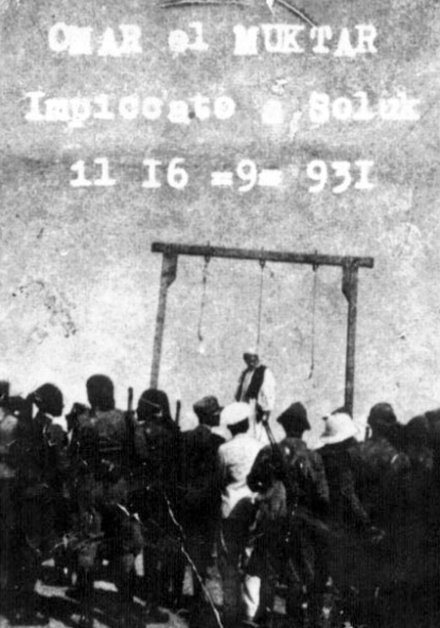
1931: Omar Mukhtar, Libyan revolutionary

On this date in 1931, Libyan independence martyr Omar [al-]Mukhtar was publicly hanged by the Italians at their concentration camp in Suluq.

Mukhtar (English Wikipedia entry | Italian) was born an Ottoman subject back in 1858 and had lived long enough to see his native Libya seized in the 1911-12 Italo-Turkish War.

Mukhtar, a religious teacher and follower of the Senussi movement, became the leader of the Libyan resistance that dogged the Italian occupation. Mukhtar proved an energetic and successful desert guerrilla fighter, and he had to be given the Italians’ mechanized military.

The Italians executed an estimated 4,000 Libyans in the 1920s, and drove hundreds of thousands into concentration camps, and gradually, only gradually, gained the upper hand on their adversaries.

Captured in battle after he abandoned a 1929 truce, Mukhtar was denied prisoner-of-war status and subjected to a snap military tribunal in one of the small coastal enclaves actually controlled by Italy — “a regular trial and consequent sentence, which will surely be death,” as the Italian general directed. It surely was.

He’s played by Anthony Quinn in the 1981 film Lion of the Desert — a better movie than you might think given that it was bankrolled by Muammar Gaddafi.

A national hero for contemporary Libyans across any social divide you’d care to name, Omar Mukhtar was valorized by the rebels who recently overthrew the aforementioned Gaddafi (here’s Mukhtar on a billboard in rebel-held Benghazi). “The whole world knows what Omar al-Mukhtar did,” Mukhtar’s 90-year-old son told media during the civil war. “That’s where they get their energy from. Ask the youth, they’ll tell you they are all the grandsons of Omar al-Mukhtar.”

His steely profile can be seen on Libya’s 10 10 dinar note.

On this day..