82 BCE: The defeated populares of the Battle of the Colline Gate

On November 1 of 82 BCE, the Roman general Sulla clinched victory in his running civil war against the liberal populares by smashing them at a decisive battle at Rome’s Colline Gate. And on November 2 the victorious dictator* had his captured foes put to death en masse in the Villa Publica while Sulla himself laid out the new order in an address to the cowed Senate.

The roots of this climactic — although not literally final — battle stretch back years, decades even, to the populist Gracchi in the 130s and 120s, and even further than that. Rome’s burgeoning had strained her original social contract past the breaking point. Terms were renegotiated in bloody civil conflicts that saw Sulla emerge this date as master of the Caput Mundi.

The Gracchi all those years ago had tried (until the oligarchs’ faction assassinated them) to rebalance an increasingly stratified Roman society by introducing land reform and an early bread subsidy.

The Gracchi banner would eventually fall to Gaius Marius, a successful general noted among other things for defeating Jugurtha. His “Marian reforms” thoroughly overhauled military organization; crucially for the Roman social crisis, he opened to the propertyless masses service in the legions — formerly the preserve of the very landed citizen-farmer being squeezed out by the empire’s concentrating wealth.**

Marius’s program addressed two problems simultaneously: it gave the Roman poor a vector of upward mobility; and, it professionalized an army whose fighting capacity had slipped behind Rome’s imperial reach.

Because the capstone to a career in the newly-professionalized army would be a grant of land secured by Marius himself, it also introduced a dangerous personal alliance between vaunting commander and his troops, the seed of later centuries’ cycles of incessant rebellion.

During the decade of the 80s, a now-aged Marius was still the populares‘ standard-bearer, but was opposed now by the patrician general Sulla, Marius’s own former lieutenant during the war against Jugurtha.

Marius’s attempt to displace Sulla from command of a planned Roman expedition to the East to punish King Mighridates of Pontus for his abuse of Roman citizens in Asia Minor brought the two to open blows. Calling on his troops’ personal loyalty to him, Sulla broke an ancient taboo by marching on Rome itself.

Marius fled into Africa, a death sentence nipping at his heels. (Various artists have imagined him chilling in the ruins of Carthage.) Once Sulla sailed for Asia, however, Marius allied with the consul Lucius Cornelius Cinna and roared back from exile, seizing the capital and instituting a reign of terror against his political enemies. Plutarch:

whenever anybody else greeted Marius and got no salutation or greeting in return, this of itself was a signal for the man’s slaughter in the very street, so that even the friends of Marius, to a man, were full of anguish and horror whenever they drew near to greet him. So many were slain that at last Cinna’s appetite for murder was dulled and sated; but Marius, whose anger increased day by day and thirsted for blood, kept on killing all whom he held in any suspicion whatsoever. Every road and every city was filled with men pursuing and hunting down those who sought to escape or had hidden themselves. Moreover, the trust men placed in the ties of hospitality and friendship were found to be no security against the strokes of Fortune; for few there were, all told, who did not betray to the murderers those who had taken refuge with them.

He died about the age of 70 in 86 BCE, days into his unprecedented seventh consulship.

While all this transpired, Sulla had been several years detained in fighting Mithridates. By 83, he’d hung up the “Mission Accomplished” banner and made ready to march on Rome for the second time.

Marius was dead; his ally Cinna had also been killed in a mutiny. The populares party was now headed by Marius’s altogether less formidable son Gaius Marius the Younger and a plebeian consul named Carbo — guys nobody today has heard of, which pretty much tells you what happened next.

Attempting to stop Sulla in the south, Marius the Younger was thrashed and forced to retreat to Praeneste, where he would be bottled up harmlessly until he took his own life in desperation. Further north, Carbo was trounced and chased into exile (and eventual execution) by Sulla’s ally Pompey, the future Triumvir who got his possibly-sarcastic honorific “the Great” from his action in Sulla’s civil war.

The populares general Pontius Telesinus made the last stand of his movement hurling a force of Samnites and Roman Marian supporters at the capital where, at the Colline Gate, they momentarily pressed Sulla’s wing dangerously against the city wall before another future Triumvir, Crassus, overcame them from the opposite flank.

The ensuing slaughter on this date in 82 settled the Marius-versus-Sulla civil war: Sulla published a large proscription of former Marius supporters who were put to death by the thousands before the general resigned his dictatorship at the end of the year 81.†

Dan Carlin’s Hardcore History podcast series covers these events in Death Throes of the Republic, episode 3. In the indispensable History of Rome podcast, the relevant episodes are 31a. Marius | 31b. Marius | 32. The Social War | 33. Marius and Sulla | 34. No Greater Friend, No Worse Enemy.

* Sulla would be acclaimed dictator by the Senate a few weeks later, reviving an office that had been unused since Hannibal threatened Rome more than a century before.

** Pliny the Elder, writing in the first century AD:

there is a famous utterance of Manius Curius, who after celebrating triumphs and making a vast addition of territory to 290 B.C. the empire, said that a man not satisfied with seven acres must be deemed a dangerous citizen; for that was the acreage assigned for commoners after the expulsion of the kings. What therefore was the cause of such great fertility? The fields were tilled in those days by the hands of generals themselves, and we may well believe that the earth rejoiced in a laurel-decked ploughshare and a ploughman who had celebrated a triumph, whether it was that those farmers treated the seed with the same care as they managed their wars and marked out their fields with the same diligence as they arranged a camp, or whether everything prospers better under honourable hands because the work is done with greater attention. The honours bestowed on Serranus found [297 B.C.] him sowing seed, which was actually the origin of his surname. An apparitor brought to Cincinnatus his commission as dictator when he was ploughing his four-acre property on the Vatican, the land now called the Quintian Meadows, and indeed it is said that he had stripped for the work, and the messenger as he continued to linger said, ‘Put on your clothes, so that I may deliver the mandates of the Senate and People of Rome’. That was what apparitors were like even at that time, and their name itself a was given to them as summoning the senate and the leaders to put in an immediate appearance from their farms. But nowadays those agricultural operations are performed by slaves with fettered ankles and by the hands of malefactors with branded faces! although the Earth who is addressed as our mother and whose cultivation is spoken of as worship is not so dull that when we obtain even our farm-work from these persons one can believe that this is not done against her will and to her indignation. And we forsooth are surprised that we do not get the same profits from the labour of slave-gangs as used to be obtained from that of generals!

† Surviving the proscription was the son-in-law of the late consul Cinna, one Julius Caesar. He was able to pull strings with Sulla to get himself off the list.

On this day..

1418: Beatrice di Tenda

On this date in 1418, the Duke of Milan annulled his marriage at the headsman’s block.

Beatrice (English Wikipedia entry | Italian) was initially the wife of the condottiero Facino Cane, a brutal but successful warrior who gained de facto control of the Duchy of Milan when it was inherited by a teenage Duke.

That teen’s younger brother, Filippo Visconti, spent the early 1400s packed away in Pavia, sickly and marginal, wondering which of the deadly machinations of state playing out above him might unexpectedly come crashing down on his own head. It seems doubtful that Beatrice ever had reason to give the little twerp a thought.

Delivery for Filippo came in May 1412. Big brother was assassinated while Facino Cane lay dying and suddenly the 19-year-old called the shots in Milan. In his day, he would become known as a cunning and cruel tyrant, and would make Milan the dominant power in northern Italy.

And it all was possible because of May 1412, which not only elevated Filippo but widowed our principal Beatrice. From her puissant late husband she inherited 400,000 ducats and huge … tracts of land. Her virtues could hardly fail to appeal to the whelp of a Duke, even at twenty years his senior; indeed, it was Cane himself who sketched out this succession plan from his deathbed.

It seems, however, that having taking possession of the wealth and legitimacy that came with Beatrice’s hand, Filippo soon grew irritated with the rest of her — enough so that he at last determined to put her aside. His paranoid Excellency wasn’t the quietly-retire-you-to-a-monastery type; instead, he went for the full Anne Boleyn.

Accusing his consort of consorting with a young troubadour in her court, Michele Orombelli, Filippo had the accused cuckolder and two of Beatrice’s handmaidens tortured until they produced the requisite confession/accusation of faithlnessness. Upon that basis he had Orombelli and Beatrice di Tenda both beheaded at the castle of Binasco. A plaque placed there to commemorate the spurned wife is still to be seen today.


(cc) image from Jk4u59.

Bellini’s second-last opera was based on this tragic story. Beatrice di Tenda premiered in 1833; it’s noteworthy in Bellini’s biography because deadline disputes in its composition ruined the composer’s longstanding collaboration with librettist Felice Romani.

On this day..

1530: Francesco Ferruccio, victim of Maramaldo

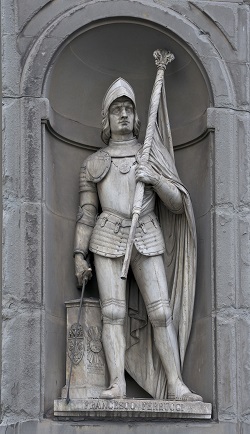
On this date in 1530, Francesco Ferruccio (or just Ferrucci) and his executioner Fabrizio Maramaldo clinched their immortality at the Battle of Gavinana.

The battle was the tragic final scene of the War of the League of Cognac, in which an alliance of Italian city-states tried to expel the Habsburg Holy Roman Emperor Charles V from the peninsula. Charles had already in effect decided matters by forcing the French out of the fight, which also brought about the capitulation of the Vatican.

Left alone in the fray, doughty Florence — ever so briefly at this moment restored as a Republic, having given the Medici the boot — continued to hold out against impossible odds. A vast imperial army swollen by landsknechts whose mercenary arms were now unnecessary elsewhere in Italy besieged Florence on October 24, 1529.


The Siege of Florence, by Tuscan Renaissance Man Giorgio Vasari.

The intrepid Florentine commander Francesco Ferruccio (English Wikipedia entry | Italian) strove to take his hopeless fight to the enemy. After a plan to coerce papal support by striking Rome was vetoed, Ferruccio mounted a march through the Apennines to threaten the Imperials’ rear.

He was intercepted at Gavinana, a battle decided by the arrival of landsknecht reinforcements under the command of the notoriously cruel condottiere Fabrizio Maramaldo.

Maramaldo would elevate himself for posterity out of the ranks of his merely brutal brethren by finding Ferruccio, badly wounded, his prisoner, and putting him to immediate death by his own hand — an execution that resulted in Florentine capitulation one week later, and the installation of Alessandro de’ Medici as Duke of the now ex-Republic.*

While admittedly borderline as an “execution” suitable for this here site, Ferruccio’s defiance in the face of his killer and his last denunciation of Maramaldo — “Coward, you kill a dead man!” — became the stuff of legend in a later Italy. (It also helped Ferruccio’s case for the nationalist pantheon that he died fighting against the Germans, not against the next city-state over.)

The romantic novelist Francesco Domenico Guerrazzi** made Ferruccio the subject of his magnum opus L’Assedio di Firenze, and before you knew it the name was on the lips of every risorgimento Tom, Dick and Francesco. Garibaldi invoked him in speech; Goffredo Mameli wrote him into the national anthem.


Every man has the heart
and hand of Ferruccio …

Under the Italian state those men helped to make, Ferruccio was appropriated as the name of a battleship; fascist Italy especially found Ferruccio congenial to the national-pride project and valorized the martyr relentlessly.


1930 Fascist Italy stamp depicting — for the 400th anniversary of the occasion — Fabrizio Maramaldo murdering his prisoner Francesco Ferruccio. Other Februccio stamps from the same period can be found on the man’s Italian Wikipedia page.

For Maramaldo, a less flattering but possibly more durable legacy: Italian gained the noun maramaldo, the adjective maramaldesco, and the verb maramaldeggiare to signify bullying or cruel domineering.

* Alessandro had a reputation for despotism, and was assassinated a few years later by his cousin Lorenzino de’ Medici in a tyrannicide that was Brutus-like in both its motivation and effect. That later affair is the subject of the 19th century play Lorenzaccio.

** Guerrazzi also did his bit for the legend of Beatrice Cenci.

On this day..

1517: Cardinal Alfonso Petrucci, plotter

On this date in 1517, the Italian cardinal Alfonso Petrucci was put to death for a conspiracy to murder Pope Leo X.

Leo had been acclaimed pope in 1513 at a conclave noted for nearly electing the worst possible pontiff when cardinals hedging their first-ballot votes while they took the temperature of the room all happened to vote alike for the feeblest candidate on the expectation that nobody else was voting for that guy.

Chastened by the near-miss, the leading candidate Giovanni de’ Medici promptly cut a deal with his chief legitimate rival for St. Peter’s seat, Raffaele Riario.*

This arrangement boosted to St. Peter’s throne the first of four popes from the Medici, intriguingly done with the acquiescence of Riario, who was kin to one of the prime movers of the anti-Medici Pazzi Conspiracy from many years before. Both Giovanni de’ Medici and Raffaele Riario were too young to have played a part in those events, but the lingering familial animosity might well bear on what transpired in the papacy of Giovanni de’ Medici — or rather, as we shall know him henceforth, Pope Leo X.

Leo was an entirely worldly character, whose enthusiasm for the peninsular politics that shaped his native habitat would help lead a German cleric to nail 95 theses to the door of a church in Wittenberg later this same year of 1517. “Why does the pope, whose wealth today is greater than the wealth of the richest Crassus, build the basilica of Saint Peter with the money of poor believers rather than with his own money?” Martin Luther demanded (thesis 86) of Leo’s increasingly shameless indulgences racket.

Acting more the Medici than the Vicar of Christ, Leo in 1516 deposed the tyrant of Florence’s neighbor and rival, Siena. The declining Sienese Republic was a prime target of Florence’s expansionist ambitions, and indeed it would be gobbled up in the mid-16th century by the Florence-based and Medici-led Grand Duchy of Tuscany.

In Leo’s time, his coup shattered Siena’s ruling Petrucci family** to the injury of one of Leo’s fellow churchmen, Cardinal Alfonso Petrucci English Wikipedia entry | the much more detailed Italian). Alfonso now had cause to use his office for the agenda of his family and his city, and sought a countervailing anti-Medici arrangement with the condottiero Francesco Maria I della Rovere, whom Leo was even then fighting a war against.

The arrangement came to nothing and Leo assured Alfonso of safe conduct for his return to Rome. It was just a lot of scheming Italian oligarchs doing what they always did, some of them while wearing cassocks.

Except upon Alfonso’s return, Leo had the Petrucci cardinal and another cardinal friendly to him clapped in prison for an alleged plot to poison the pontiff.

Cossetted court cardinals suddenly found themselves accused papicides under the threat (and, for some, the reality) of torture. Hard-to-credit “confessions” duly ensued with Leo enlivening the spring and summer of 1517 with preposterous security theatrics.

On June 8 they assembled in Consistory, when the Pope burst out into complaints. He had evidence, he said, that two other Cardinals whom he had trusted had joined in the conspiracy against him; if they would but come forward and confess he would pardon them freely; if they refused to confess he would have them carried to prison and would treat them like the other [accused]. The Cardinals gazed on one another in alarm, and no one moved. The Pope asked them to speak, and each in turn denied … Leo X’s dramatic stroke was a failure; he could not succeed in his unworthy attempt to induce some unsuspected person to criminate himself. (Source)

It’s hardly past thinking that rival factions would poison off a pope, and there’s been some latter-day research suggesting that something really was afoot. For that matter, Leo’s actual death in 1521 has often been suspected of being aided by an apothecary’s philter.

But outside the dramatics, Leo scarcely handled his prisoners in 1517 as if he were much in genuine fear for his life.

Instead, the practical pontifex maximus used it as a shakedown opportunity against anyone who could be denounced a confederate of the hotheaded young Petrucci. The Genoese Cardinal Sauli, arrested together with his friend Petrucci, was forced to buy his liberty for 50,000 ducats; Cardinal Riario, Leo’s old opposite number from the 1513 conclave, was implicated by Petrucci and Sauli as knowing himself the prospective beneficiary of the plot, and Riario was forced to retire to Naples upon payment of an exit tariff of 150,000 ducats plus his Roman palace. (It remains papal property to this day as the Palazzo della Cancelleria.) Further downmarket, Cardinals Soderini and Adrian fled Rome in despair of discharging the 25,000-ducat fines affixed upon each of them.

Money, however, would not suffice for Cardinal Petrucci, the active center of whatever conspiracy existed. Petrucci probably did murmur something one could construct as treason against his Holy Father, if one regarded them in their ecclesiastical rather than their dynastic positions, and he evidently engaged the Pope’s surgeon Giovanni Battista da Vercelli as an instrument of the proposed assassination or at least made loose talk to that effect.

While the doctor, along with Petrucci’s private secretary, were hauled through the streets to a demonstrative gibbeting, Petrucci was strangled privately in his cell on July 16, 1517. It was done by a Moor out of consideration for the impropriety of a Christian slaying a father of the Holy Church.

Beyond the rent-seeking and the rival-eradicating, Leo leveraged the purported plot to appoint 31 new cardinals in July 1517, basically doubling the College of Cardinals at one stroke while stocking the ranks with men who could offer him political support or timely bribes.

* Riario’s legacy can still be seen around the Vatican to this day: he’s the guy who brought Michelangelo to Rome.

** Leo’s coup deposed one Petrucci and raised up a different, more compliant Petrucci.

On this day..

1944: Ferruccio Nazionale, Ivrea partisan

On this date in 1944, the fascist frogman unit Decima Mas Flottiglia MAS (English Wikipedia link | Italian) executed and publicly gibbeted the partisan Ferruccio Nazionale in Ivrea.


The placard around his neck claims the hanged man “made an armed attack on the Decima.”

The square where he’s hanging in these images is today named in his honor — Piazza Ferruccio Nazionale.

On this day..

1310: Badoer Badoer, Venetian rebel

A Venetian rebel was beheaded on this date in 1310.

Our grim tale actually tacks back to an altogether different death: the sudden January 31, 1308 demise of Azzo VIII d’Este, lord of Venice’s neighbor Ferrara.*

The resulting power vacuum saw Venice under the Doge Pietro Gradenigo tangle for influence in Ferrara with the Papal States of Pope Clement V.

This controversial intervention briefly put a Venetian puppet ruler in charge of Ferrara, but it also led Clement to excommunicate Gradenigo and place La Serenissima under a papal interdict.

The moral force which the condition of society lent to such a measure was immense … It paralyzed trade; it dried up the sources of industrial wealth; it laid a country under every civil and religiou disability; it shed over society an atmosphere of gloom; it affected every relation of life … At home it fomented agitation, gave colour and pretext to the worst motives, and evoked all the latent distempers of the public mind. Abroad, it legitimized rebellion, imparted to moribund antipathies a new vitality, and transformed wavering allies into open enemies. (From History of the Venetian Republic, vol. II, whose detailed narrative of the events relevant to this post continues in Volume III)

Clement also had more temporal weapons to fight with, and he used them to ruthless effect.

In August 1309, papal troops overran the Venetian garrison at the Ferrara fortress of Tedaldo and handled the prisoners like they had the Dolcinians, choking the Po with Venetian corpses.

Conditions were ripe for some disturbances in La Serenissima. The Ferrara thing was a complete debacle, and not only was the same guy still in charge, but his previous foreign policy resume basically consisted of being repeatedly outmaneuvered by Genoa.

Hotheads of three leading families of the Venetian opposition who had vainly counseled neutrality in the Ferrara affair, the Quirini, the Badoer, and the Tieopolo, embarked an audacious plot to mount a coup d’etat toppling the Doge and the whole Ground Council of noblemen by whom he ruled. The conspirators were to act on the morning of June 15 — but hours before that, a vacillating confederate had betrayed them. As a result, when the ferocious Marco Quirini arrived at the Piazza San Marco that morning with his men-at-arms, the Doge had a surprise force waiting to rout him under a furious downpour.

Quirini at least had the honor of dying in hopeless battle for his cause. His son-in-law and co-conspirator Bajamonte Tiepolo, who was to arrive at the same square via the Mercerie, dithered and showed up only when Quirini was already defeated and dead. Legend has it that a woman named Giustina Rosso killed Tiepolo’s standard-bearer dead by hurling (or just accidentally dropping) a mortar upon the rebels as they advanced up the street. (Present-day tourists traversing this upscale shopping street can catch a small bas-relief commemorating this character near the clock tower where the Mercerie opens onto St. Mark’s.)

Tiepolo belatedly charged the square, and was like Quirini repulsed; however, he was able to fall back across the Grand Canal, cutting the bridge against his pursuers, and holed up in a makeshift fortress hoping for reinforcements from the last-arriving of their fellows, Badoer Badoer.

The latter, however, was intercepted on his way to reinforcing the revolutionaries’ position and taken prisoner, which defeat of his hopes led Tiepolo and Doge alike to prefer a negotiated surrender to the charnel house that would have resulted from storming the redoubt. His followers were amnestied and Tiepolo himself sent into exile.

But Badoer Badoer was not covered by this deal. The Council he had proposed to overturn instead tried him for treason, and voted his condemnation on June 22 — a sentence put into immediate effect.

The exiled Tiepolo’s home was razed to the ground and replaced with a column eternally damning his memory:

This land belonged to Bajamonte
And now, for his iniquitous betrayal,
This has been placed to frighten others
And to show these words to everyone forever.

That column today has been removed to a museum — evidently one needs special permission to find it — but a worn stone outside a souvenir shop labeled “Loc. Col. Bai. The. MCCCX” marks the spot where it stood for four centuries.

The plot’s other legacy to Venice was the Council of Ten, a sort of inner secretariat of the Grand Council. Introduced in July 1310 as an emergency measure, the Ten soon became a permanent feature of the state, and an increasingly powerful one into the 17th century. The “temporary” council ended up lasting until the Napoleon finally toppled a by-then tottering Venetian Republic in 1797.

* In the Inferno, Dante accuses Azzo of assassinating his father.

On this day..

Feast Day of St. Vitus

June 15 is the feast date of the early Christian saint and martyr Vitus.

The 6th century roster Martyrologium Hieronymianum gives us “In Sicilia, Viti, Modesti et Crescentiae”. From this nub grew a legend of the young child of a Roman Senator who turned to Christianity and would not apostatize, fleeing finally to Lucania with his tutor Modestus and his nanny Crescentia and eventually exorcising a demon possessing the son of the Christian-hunting, Empire-quartering Roman sovereign Diocletian. They were all — boy, tutor, and nanny — tortured to death for their troubles; that occurred either by means of or (manifesting God’s customary disdain for the pagan persecutors) after surviving execution in a boiling pot, which has become Vitus’s most typical iconographical emblem. (For example, as seen on the coat of arms of the Austrian town Sankt Veit im Pongau.)


The Martyrdom of St. Vitus, anonymous c. 1450 painting

This story doesn’t have much historical merit, but shrines and chapels to Vitus date as far back as the 5th century so Vitus, whomever he was, had real importance to early Christians.

His cult became especially prominent in medieval central Europe. Prague’s imposing Gothic cathedral bears his name, because Wenceslaus, Duke of Bohemia* allegedly retrieved for it the saint’s arm in a reliquary.**

While many places are dedicated to St. Vitus in Germany, Hungary, and Croatia, the man has red-letter treatment in Serbia — owing to this also being the date in 1389 that the Serbs’ Tsar Lazar was martyred by the Turks at the Battle of Kosovo. As a result, the feast date Vidovdan is a major celebration in Serbia (and to some extent Bulgaria and Macedonia), where it is observed on June 28th — the Gregorian date presently corresponding to the Julian calendar’s June 15th.

The same Vitus who cheers Balkan nationalists trod a completely different path into medical textbooks.

For centuries, Europeans were known to break out in curious ecstatic mass dancing, even sometimes dancing themselves to death. Generally believed today to be psychosocial afflictions, these dancing manias became widely associated with St. Vitus (his patronage includes both dancers and epileptics), whose intercession would be sought to calm the capering souls.

Dancing manias stopped happening in the 17th century or so, but the link between Vitus and involuntary rollick gave the name St. Vitus’s Dance to the condition Syndenham’s chorea — which is characterized by uncontrolled dance-like movement.

* The very Good King Wenceslaus who looked down on the feast of Stephen.

** Speculatively, Sanct Vid might have been selected for Christian veneration in this area to facilitate replacement of the similarly-named Slavic god Svantovid. An active (albeit declining) pagan community persisted in Prague as late as the 12th century.

As with most Slavic deities, Svantovid’s exact characteristics and the extent of his veneration are very poorly documented; however, in 1168, the Wendish fortress of Arkona was conquered by the Danes and the forced Christianization of its inhabitants is commemorated in Laurits Tuxen‘s late 19th century image of Archbishop Absalon casting down Arkona’s idol of Svantovid. (It’s also commemorated by the name of the neo-pagan Russian metal band Arkona.)

On this day..

1155: Arnold of Brescia

At some point in the first weeks of June 1155 — nobody knows the exact date, but it precedes June 18 — the Roman authorities disposed of Arnold of Brescia.

For a decade the tongue of a fragile new Roman Republic, Arnold was a student of the cutting-edge theologian (and castrated romantic) Peter Abelard. Arnold held the temporal pretensions of the Vatican invalid, a theology sublimely according with the popular revolt that from 1143 overturned Rome’s overweening princes and even slew a pope in a melee on the Capitoline.

The Senate long forsaken was re-founded by this new Republic and an equestrian order re-founded to resume to the rights of a now-growing middle rank. The slain pope’s successor became a refugee tenant of the neighboring cities, orchestrating crusades against Turks, Moors, and Wends — but dying at Tivoli in 1153 still awaiting a prince who would restore his own person to the authority of the Eternal City.

That prince, however, had just begun to stir. The Hohenstaufen king Frederick I had concluded in the months before Pope Eugenius’s death a compact to restore the pontiff, which policy dovetailed nicely with an intent to show the German power against other wayward cites in Italy. It was Frederick’s Italian subjects, and conquests, who gave this man the distinctive name by which history recalls him: Barbarossa, or “red-beard”.

All these years — or at least, from 1145, when he surfaced in the rebellious city from past years’ exile in Zurich — Arnold of Brescia’s “eloquence thundered over the seven hills.” (Gibbon)

Blending in the same discourse the texts of Livy and St. Paul, uniting the motives of Gospel, and of classic, enthusiasm, he admonished the Romans how strangely their patience and the vices of the clergy had degenerated from the primitive times of the church and the city. He exhorted them to assert the inalienable rights of men and Christians; to restore the laws and magistrates of the republic; to respect the name of the emperor: but to confine their shepherd to the spiritual government of his flock. Nor could his spiritual government escape the censure and control of the reformer; and the inferior clergy were taught by his lessons to resist the cardinals, who had usurped a despotic command over the twenty-eight regions or parishes of Rome.

The absentee pope excommunicated Arnold in 1148. It was to no effect until Barbarossa’s legions neared the city.

As King Frederick approached, Pope Adrian IV* applied a deft turn of the screw by laying Rome itself under an interdict, depriving his quarrelsome flock of both spiritual balm and pilgrim revenue and at long last forcing the heresiarch’s ejection.

Arnold was seized in Tuscany and delivered to the Roman curia for punishment; the record of when or where this occurred is lost, but it is specified in the particular that his corpse was reduced to ashes that were scattered to the Tiber — proof against the prospect of a plebeian graveside shrine.

On June 18 even as his soldiers tamed Rome’s resisting republicans, Barbarossa accepted the crown of the Holy Roman Empire from the hands of Pope Adrian in St. Peter’s Basilica.**

Though Arnold had vanished into the Tiber’s silt, the thirst of his former flock for spiritual succor beyond that which the worldly Vicar of Christ could offer did not die so easily. Succeeding movements — indeed, perhaps, one continuous movement — took up Arnold’s objection to the clergy’s worldly emoluments and his summons to plain virtue. There are the Arnoldists to start with, but a bare few years after Arnold’s death emerge Peter Waldo of the heretical Waldensians, as well as the Cathars in southern France; a generation on finds St. Francis of Assisi, giving way to 13th and 14th centuries thick with oft-suppressed popular reform currents — the Beguines, the Apostolic Brethren, even the Fraticelli who criticized other followers of the aforementioned St. Francis for having already abandoned the poverty of his order.

Later Protestants would claim all these, and Arnold too (Arnold reportedly opposed infant baptism), as their forebears, which is why we have the nice Colosseum’s-shadow picture above from Foxe’s Martyrs’ Mirror. Just how literally one should take that lineage might be a matter of debate, but there is little doubt that Arnold of Brescia’s critique maintained its potency into that era and keeps it still in the modern age — one reason that the incinerated firebrand could still make a powerful subject for a risorgimento writer like Giovannini Battista Niccolini 700 years later.

* Born Nicholas Breakspear, Adrian remains to this day the only English pope ever.

** Popes and Holy Roman Emperors were most usually rivals rather than allies in peninsular politics; indeed, the Roman Republic had issued its own summons to Frederick’s predecessor to come to its aid — and rule Rome with its support — to humble the pretensions of the papacy. Arguably, Barbarossa missed a trick by not availing that potential alliance and instead exalting the pontifex maximus in the manner of his coronation: Barbarossa probably thought so himself often enough during his running rivalry over the ensuing generation with Pope Alexander III.

On this day..

1784: Angelo Duca, primitive rebel

On this date in 1784, Italian bandit-hero Angelo Duca was hanged at Salerno.

“Angiolillo” haunted the Basilicata region, which surmounts the arch between the “toe” and the “heel” of southern Italy’s boot.

His biography, hopelessly intertwined with folklore, holds that he abandoned farming over the oppression of the overweening Duke of Martina — just like any self-respecting social bandit.

Soon a gang of about 20 Italic outlaws had flown to his camp and naturally they “gave alms, bought grain, endowed the dowries of poor girls,” and generally forcibly redistributed some small portion of the rentier class’s gorgings to the poor whose care ought to have been a noble lord’s concern.

As the 18th century came to a close, revolutionaries with steel souls and guillotines would come to dominate the narrative of resistance. But they never completely usurped the romance of the road, especially in rural parts like Angiolillo’s. Eric Hobsbawm informs us that “in the Capitanata under Joachim Murat there were something like seventy [robber] bands, in the Basilicata of the early [eighteen] sixties thirty-nine, in Apulia some thirty.”

Primitive Rebels is the title of the volume we’re quoting here, an antecedent to Hobsbawm’s classic Bandits. In Primitive Rebels the late godfather of the social bandit concept situates these bands and their susceptibility to popular mythologizing as “an endemic peasant protest against oppression and poverty: a cry for vengeance on the rich and the oppressors, a vague dream of some curb upon them, a righting of individual wrongs.”

The eternally seductive dream of righting the injuries of an unjust world by the manly exertions of gold-hearted thieves and knights of the road unfortunately for our principal (and no small number of his fellows) arrives with its own fatal paradox. Social bandits want a better king, not a headless king, but in this they also concede the crown the powers its malice abuses. A king will get the best of a desperado sooner or later.

Upon his own capture, Duca was hauled directly to the Bourbon ruler King Ferdinand. Ferdinand did not experience a cathartic reawakening on account of his prisoner’s implied critique; instead, he simply ordered the nettlesome brigand’s immediate beheading, sans judicial procedure, after which the corpse was torn limb from limb for public exhibition.

On this day..

1698: Guido Franceschini, The Ring and the Book inspiration

Robert Browning‘s long narrative poem The Ring and the Book concerns the murder trial of the nobleman Guido Franceschini — a real-life case that saw the defendant in question executed in Rome on this date in 1698 for murdering his wife Pompilia as a suspected adultress. (And her parents just because.)

The 21,000-line work was Browning’s greatest success in life, though many particulars of Browning’s spin on events have been challenged by the 2001 study Roman Murder Mystery.

We’ll be content this day to take Browning’s audience’s-eye view of the jealous husband’s scaffold comeuppance on execution-day.

To mount the scaffold-steps, Guido was last
Here also, as atriciousest in crime.
We hardly noticed how the peasants died,
They dangled somehow soon to right and left,
And we remained all ears and eyes, could give
Ourselves to Guido undividedly,
As he harangued the multitude beneath.
He begged forgiveness on the part of God,
And fair construction of his act from men,
Whose suffrage he entreated for his soul,
Suggesting that we should forthwith repeat
A Pater and an Ave with the hymn
Salve Regina Coeli, for his sake.
Which said, he turned to the confessor, crossed
And reconciled himself, with decency,
Oft glancing at Saint Mary’s opposite,
Where they possess, and showed in shrine to-day,
The blessed Umbilicus of our Lord,
(A relic ’tis believed no other church
In Rome can boast of) — then rose up, as brisk
Knelt down again, bent head, adapted neck,
And, with the name of Jesus on his lips,
Received the fatal blow.

The headsman showed
The head to the populace. Must I avouch
We strangers own to disappointment here?
Report pronounced him fully six feet high,
Youngish, considering his fifty years,
And, if not handsome, dignified at least.
Indeed, it was no face to please a wife!

The “old yellow book” of original case notes that Browning found at a Florentine market and subsequently served as his reference source is available here. The poem itself is, of course, in the public domain; read it in its entirety here, or get hours of free audio reading here.

On this day..