1791: Alessandro Cagliostro condemned

On this date in 1791, the Inquisition in Rome condemned magician Alessandro Cagliostro to death — a sentence immediately commuted to imprisonment for the remainder of his life, which turned out to be only four more years.

Cagliostro’s rich career as European courts’ thaumaturge of choice might have been decreed by the stars right down to his pitch-perfectly sinister moniker. Is this the shadowy diabolist whom the title character of in The Cabinet of Dr. Caligari is meant to evoke?

In fact, his birth name was Giuseppe Balsamo.

Naughty by nature from the time of his youthful expulsion from the Order of St. John, Balsamo — the hobgoblin familiar haunting the adult prophet’s cimmerian shadows — hailed originally from a penniless Sicilian family. (Though Cagliostro claimed for himself a suitably exotic childhood in Arabia and Egypt)

What he wanted in native wealth he more than made up for in enterprise — both for self-education in sorcery, alchemy, and other forbidden arts, and for leveraging his expertise in lustrous capers.

Hopping from court to court, Cagliostro carved out a career moving forgeries of spiritual or temporal potency alongside his legitimate profession as a doctor and chemist and his growing public profile as an influential spiritualist. He broke through as a young man in the train of a cardinal in Rome, using this in to market on the side fake artifacts alleged to have been pilfered from the Vatican’s mysterious Egyptian troves, as well as to seduce a local girl named Serafina whom he married at age 18. Serafina would be his lifelong companion on his adventures.

Cagliostro turned up over the ensuing two decades in Russia, Poland, Germany, and England, where he was inducted into the Freemasons in 1776. He’s been credited with creating masonry’s Egyptian Rite, and with energetically propagating it in the 1780s;* indeed, it was his adherence to Freemasonry — and his sacrilegious boldness opening a masonic lodge in Rome under the nose of the pontiff — that led to his 1789 arrest.

His seances and magic potions made him a great favorite of the Versailles court for a number of years, until a glancing association with the Affair of the Diamond Necklace so damaging to the reputation of Marie Antoinette forced Cagliostro’s expulsion from France.

Considering his Mephistophelian** reputation, now very well known in Europe, Cagliostro’s return thereafter to the belly of papal power seems most unwise. Perhaps (as this biographer supposes) it was the influence of Serafina, homesick after so many years separated from her native haunts. Cagliostro’s next ports of call were the Vatican’s Castel Sant’Angelo and (after an escape attempt) the lonely Fortress of San Leo — and even his end was so shrouded in mystery and conjecture that the subsequent conqueror Napoleon commissioned an official investigation to convince everyone that he’d really shuffled off the mortal coil.

Giuseppe Balsamo, attainted and convicted of many crimes, and of having incurred the censures and penalties pronounced against heretics, dogmatics, heresiarchs, and propagators of magic and superstition, has been found guilty and condemned to the said censures and penalties as decreed by the Apostolic laws of Clement XII and Benedict XIV, against all persons who in any manner whatever favour or form societies and conventicles of Freemasonry, as well as by the edict of the Council of State against all persons convicted of this crime in Rome or in any other place in the dominions of the Pope.

Notwithstanding, by special grace and favour, the sentence of death by which this crime is expiated is hereby commuted into perpetual imprisonment in a fortress, where the culprit is to be strictly guarded without any hope of pardon whatever. Furthermore, after he shall have abjured his offences as a heretic in the place of his imprisonment he shall receive absolution, and certain salutary penances will then be prescribed for him to which he is hereby ordered to submit.

Likewise, the manuscript book which has for its title Egyptian Masonry is solemnly condemned as containing rites, propositions, doctrines, and a system which being superstitious, impious, heretical, and altogether blasphemous, open a road to sedition and the destruction of the Christian religion. This book, therefore, shall be burnt by the executioner, together with all the other documents relating to this sect.

By a new Apostolic law we shall confirm and renew not only the laws of the preceding pontiffs which prohibit the societies and conventicles of Freemasonry, making particular mention of the Egyptian sect and of another vulgarly known as the Illumines, and we shall decree that the most grievous corporal punishments reserved for heretics shall be inflicted on all who shall associate, hold communion with, or protect these societies. (Source)

Thereafter widely denounced and renounced as a rank charlatan, Cagliostro at the very least rates as of the more outstanding adventurers of his time — a distinction that bequeathed him an impressive artistic afterlife from Alexandre Dumas to Christopher Walken.

Nor have his grander poses entirely wanted for supporters in posterity, particularly among adherents to the still-extant Masonic rite he initiated. (Aleister Crowley also suggested that he might have been Cagliostro in a previous incarnation.)

W.R.H. Trowbridge’s 1910 biograhy Cagliostro: The Splendour and Misery of a Master of Magic is in the public domain and available free online.

* Cagliostro might also have written a classic occult volume, The Most Holy Trinosophia.

** “Mephistophelian” might be the literally applicable word. When the mysterious Cagliostro’s possible identity as the exiled Sicilian swindler Balsano was first exposed, eventual Faust author Johann von Goethe happened to be in Palermo — and he took it upon himself to investigate personally by calling on Balsano’s family. (“You know my brother?” “All Europe knows him.”)

On this day..

1937: Desta Damtew, Haile Selassie’s son

On this date in 1937, Ethiopian prince Desta Damtew — the son-in-law of Emperor Haile Selassie — was captured by the Italian troops occupying his country, and summarily executed.

An aristocrat who married Selassie’s eldest daughter, the Ras* Desta Damtew (English Wikipedia entry | Italian) became governor of the southern Sidamo Province upon his father-in-law’s ascent to the Ethiopian throne in 1930.

When Italy invaded Ethiopia in 1935, it committed a disproportionate quantity of its forces to the northern reaches of its target. Consequently, resistance was stronger in the south — and Ras Desta was one of its chiefs. In January 1936 he led Ethipoian forces at the Battle of Ganale Doria.

Though the two sides had forces of similar sizes, Italy’s was the mechanized, industrial army — and the Ras was routed by Gen. Rodolfo Graziani. It was a milepost for Graziani on his way to lasting infamy in Ethiopia as the conquered realm’s brutal Viceroy for 1937. (He was recalled at year’s end.) Graziani vowed that Italy would dominate Ethiopia “at whatever cost” and threatened “extreme severity towards anyone who resisted.”

On February 19, 1937 — Yekatit 12 by the Ethiopian calendar — two ethnic Eritreans expressed their resistance by pelting Graziani with grenades. He had shown his viceregal person at a hearts-and-minds almsgiving, and having been received with such cordiality, he returned immediately to the Extreme Severity plan.

While doctors dug shrapnel out of Graziani, somehow saving his life, an aide named Guido Cortese condemned untold numbers of humans to punitive death with a dread order:

Comrades, today is the day when we should show our devotion to our Viceroy by reacting and destroying the Ethiopians for three days. For three days I give you carte blanche to destroy and kill and do what you want to the Ethiopians.

For the next several days, Italian forces delivered a punitive rampage to their new subjects, claiming up to 30,000 lives.**

Desta Damtew, who had been lucky to flee the battlefield slaughter after Ganale Doria, was not directly a casualty off this three days’ bloodbath, but when he was captured in the bush along with fellow insurgent commander Beyene Merid, no-quarter treatment was a given. Both men were immediately shot.

The Jamaican Pan-Africanist Marcus Garvey penned a poetic eulogy for our man:

The flow’r of a nation’s strength
Had thrown their valour and their might
Against the charging hordes of death
In history’s most unequal fight!
One man remained — the last of them —
To stand for Ethiopia:
All else surrendered, died or fled
But, he, the lion-hearted-Ras Desta.

Graziani, Italian butcher
Had valiant Desta quickly shot,
To seal his lips and tie his hands
In fear of what he called a plot.
With death of such a noble man,
A reign has passed to history;
But time will bring to us again
More men to fight for victory.

Ras Desta left a number of children. One of them, Iskinder Desta, became a Rear Admiral in the Ethiopian navy and was among the officials slaughtered in the Derg’s 1974 “Black Saturday” purge.

* Ras is a title, literally meaning “Head” and akin to “Prince” or “Duke”. Before he was royalty, Haile Selassie was born Tafari Makonnen, and then eventually known as Ras Tafari … hence, rastafarianism.

** According to Ethiopian figures. Italy’s numbers put the post-Yekatit 12 casualties “merely” in the hundreds.

On this day..

1513: Pietro Boscoli and Agostino Capponi, but not Niccolo Machiavelli

Niccolo Machiavelli‘s exile from Florentine politics — and subsequent entry into the intellectual canon — was cinched this date in 1513 when two of his friends (or possibly co-conspirators) were executed for a plot against the Medici.

Before he was an adjective, Machiavelli was a powerful minister of state for the Florentine Republic — the polity ensuing the 1498 execution of Savonarola.

Days after that stern friar burned to ashes on the Piazza della Signoria, Machiavelli was named the secondo segretario fiorentino,* alongside a primo segretario counterpart, the older and more cautious Marcello Virgilio Adriani.

What a moment this was to be a Florentine! The mighty Medici had been chased out of Florence and with the fall of Savonarola and his grim morals police the humanist dream of a classical republic suddenly seemed within grasp.

Machiavelli was just 29 years old when he reached this office, bursting with a patriot’s reckless exuberance — and a virile young man’s hedonism. He delighted in whores and in boozing around with his Chancery cronies Agostino Vespucci** and Biagio Buonaccorsi.

The correspondence of these indiscreet young Turks fill with profane and cutting takes on the leading citizens of Florence; Machiavelli, who was known in his own time as a playwright and not a political philosopher, was even bold enough to put such ridicule in print. The 1504 play Le Maschere is tragically lost, but by surviving accounts it lampooned “under feigned names, many citizens who were still living.”†

A few books about Niccolo Machiavelli

While not scribbling pasquinades and getting laid, the Second Secretary had matters of state to attend to. We have met him in these pages, as the Florentine ambassador to the court of Cesare Borgia; Machiavelli could not help but admire the condottiero‘s ruthlessness. Machiavelli also represented Florence in Rome, Spain and France.

Showing an equal aptitude for politics by other means, Machiavelli moved the Florentine military muscle towards a citizen militia, presciently replacing its dependence on mercenaries. In 1509 this force captured Pisa.

But Machiavelli’s excessive regard for this strategic advance married to his excessive affinity for the republic of Piero Soderini undid him in the end. While the First Secretary, Adriani, quietly cultivated contacts of various political persuasions, Machiavelli went all in against the stirring Medicean party. This became a problem when the fortunes of peninsular war drove Florence’s French allies away, leaving the city ripe for recapture by Giuliano de’ Medici, who also happened to be the brother of the pope in waiting.

In 1512, a hastily-assembled city militia of about three or four thousand infantry and 100 men-at-arms met an overwhelming Spanish-Papal-Medicean force at Prato. Scrambling to defend a lost cause, Machiavelli had mustered about a third of the militia and was trying to organize the city’s defenses. Florence’s crushing defeat in this battle and the ensuing civic massacre in Prato (with “countless murders, sacrileges and rapes”) convinced the Florentines to depose Piero Soderini and throw open the gates to Giuliano de’ Medici.

This was the end of Machiavelli the statesman … and, of course, the birth of Machiavelli the philosopher. The ensuing 15 years’ frustrating exile left him no other outlet for his political passions save his pen; needless to say, works like The Prince and Discourses on Livy retain exalted seats in the canon down to the present day. (They made little impression on Machiavelli’s contemporaries; Florentines still knew him for the plays he kept writing.)

A few books by Niccolo Machiavelli

When evening comes, I return home and enter my study; on the threshold I take off my workday clothes, covered with mud and dirt, and put on the garments of the court and palace. Fitted out appropriately, I step inside the venerable courts of the ancients, where I nourish myself on that food that alone is mine and for which I was born; where I am unashamed to converse with them and to question them about the motives for their actions, and they, out of their human kindness, answer me. And for four hours at a time I feel no boredom, I forget all my troubles, I do not dread poverty, and I am not terrified of death. I metamorphose into them completely.

-Machiavelli, December 10, 1513

The cautious primo segretario Adriani, who could better see where the winds were blowing, survived the transition by having the wisdom not to align himself with the losing party. Whatever the verdict of posterity, the 1510s were Adriani’s time to bask in the center of events while Machiavelli did his work of ages in obscurity.

But what cinched Machiavelli’s unhappy permanent banishment from Florentine politics — notwithstanding unctuous expedients like dedicating The Prince to the Medici ruler — were the events culminating in two February 23, 1513 beheadings.

Machiavelli had been dismissed in November 1512. Four months later, a nascent (or wildly exaggerated) anti-Medici conspiracy led by a republican named Pietro Boscoli came to light. Its chief, and paltry, evidence was little more than a written list of around 20 fellow-travelers, upon which appeared the name of Niccolo Machiavelli. It’s more than likely that the “treason” comprised merely to the idle chatter of some disaffected republicans, but after a generation in exile the newly restored Medici dynasty wasn’t taking any chances.

For the onetime Second Secretary, this meant prison and torture by the strappado. Three months on, he was released to his estate with no political succor save the haunts in his head.

But the head he got to keep — and that was better than one could say for Pietro Boscoli.

Boscoli and one Agostino Capponi were beheaded early in the morning of February 23, a bare eight hours after their death sentences were announced. Their last hours were recorded as a Recitazione by a young friend named Luca della Robbia: the tender Passion scene of Boscoli in particular struggling to come to grips with his shockingly sudden fate. The full narrative can be found in translation by Alison Knowles Frazier in The Art of Executing Well: Rituals of Execution in Renaissance Italy. We excerpt a little taste below:

At about 8 o’clock, having had his supper, Boscoli was brought with his legs in irons to the chapel where … he was told that he had to die …

Pietro Paolo cried out “Oh Pietro Paolo, oh poor Pietro Paolo! What has become of you!”

Then I, moved by the greatest compassion, seeing my beloved friend in such great distress, went first to him as lovingly as I could, with a gesture full of mercy, and greeted him like this: “God save you, dearest friend. ‘Do not fear those who kill the body, for they cannot kill the soul.’

Poor Pietro Paolo struggles on here for 15-odd pages in evident anguish, veering between practical considerations of the family he is leaving behind and whom to rustle up as his last-minute confessor, and his uncertain spiritual readiness for death (he was particularly upset at being told of his fate after dinner, for “I am too loaded down with food, and I have eaten salty things, so that I don’t feel able to join my spirit to God”). Della Robbia stays with him the whole time; in the latter’s introduction, he says he “noted diligently all his words, both questions and replies, and kept them in my memory … that such a great and well-formed example of strength and spiritedness would not be lost” and recorded them faithfully later on.

By the end, Boscoli has reconciled his mind to the scaffold.

He is escorted down the stairs from the chapel of the Bargello to its interior courtyard where

leaving the first step, he encountered the Confraternity’s‡ crucifix.

“What am I to do?” [Boscoli] said.

“This is your captain, who comes to arm you,” the friar responded. “Greet him, honor him, ask him to make you strong.”

Then he said, “Greetings, Lord Jesus. I adore you, hanging on the cross. Make me, I beg you, like to your Passion. True Lord, I ask you for peace.”

And thus, going down the second step, he kept commending himself, saying, “‘Into your hands, Lord, I commend my spirit. You redeemed me, Lord, God of truth.’” When he was on the little platform of the stair, he said, “Is it enough, a good preparation towards God? For I feel some battle. Recall to me those three things.”

Then I, who was behind him, said, “Well you know that it is enough. Say to him, Fra Cipriano, that verse by David, ‘Your ear heard the preparation of their heart, Lord.’

“Okay, yes,” the friar replied, “Your ear heard the preparations …,” and told him once again the three things.§

And he answered, and said, “‘Let your ear hear the preparation of my heart, Lord Jesus.'”


Then the executioner, because he wanted to put a kerchief over his eyes, asked his forgiveness and offered to pray to God for him.

“Go ahead and do your duty,” Pietro Paolo said. “And when you have put me at the block, leave me like that for a bit and then finish me off, and that you pray God for me, I accept.”

The reason why he asked for a little time at the block, was that he had all night long always desired a great joining with God and he didn’t feel that he had achieved it as he desired, so that he hoped in that last moment to make a great effort and so to offer himself wholly to God …

And placing himself down, and the executioner, giving him the shortest time, cleanly removed his head, which, so cut, continued to move its mouth for a time.

Agostino Capponi, whom della Robbia has seen only glancingly over his long narrative, follows Boscoli. Although Capponi required two blows of the executioner’s blade, he perhaps went into the hereafter with a soul better at peace — for he “retained on his face a certain wry expression, perhaps not distant from true sincerity.”

* Summary of Machiavelli’s career based on William Landon’s Politics, Patriotism and Language: Niccolò Machiavelli’s «Secular Patria» and the Creation of an Italian National Identity.

** Machiavelli’s clerk Agostino Vespucci — a cousin of the explorer Amerigo Vespucci for whom the American continents were named — made the headlines recently when discovery of a scribble he left in the margin of a 16th century text established the identity of the long-mysterious first lady of Renaissance art, Mona Lisa: she was Lisa del Giocondo, the wife of a Florentine cloth merchant.

† Landon says the primo segretario Adriani encouraged Machiavelli to publish this play, even though Adriani himself is one of its targets — in Landon’s view, because Adriani was playing a long game for power, and revenge: quietly encouraging Machiavelli’s excesses while positioning himself politically to profit from his consequent fall.

‡ The Confraternity of the Blacks: a lay brotherhood associated with Florence’s [former] Chiesa di Santa Maria Vergine della Croce al Tempio, tasked with the spiritual assistance of prisoners condemned to death.

§ Shortly before proceeding to execution, Boscoli steeled himself for the ordeal by resolving that “In this journey I have to have three things. I have to believe the faith. I have to have firm hope that God will pardon me. And the third is that I have to suffer this death for love of Christ and not for others.”

On this day..

904: Pope Leo V and Antipope Christopher, at the dawn of the Pornocracy

Around this time in 904, Pope Sergius III allegedly had one or both of his deposed predecessors put to death in prison.

Sergius held the throne of St. Peter for seven years, which was a longer incumbency than achieved by his seven immediate predecessors combined:* they march speedily through the Vatican’s annals like so many third-century Caesars, acclaimed by one faction within Rome’s political vipers’ nest only to offer flesh for their rival factions’ fangs; most are eminently forgettable save when they are utterly insane.

So pell-mell turned the scepter from one pretender to the next that the Church has even waffled in its official histories on just who was legitimate. Officially, Leo V is considered Sergius’s immediate predecessor; in reality, Leo was deposed and imprisoned two months after his July 903 election by a fellow named Christopher who was counted as a pope on canonical papal rolls until the 20th century. Today, he’s considered an antipope who was illegitimately elected.

“Legitimacy” in this period meant little but who had the muscle make their election stick. And though Sergius was the beneficiary, the man doing the flexing in this instance was Theophylact, Count of Tusculum along with his wife Theodora. For the next century the papacy would be a bauble of the Theophylacti family, who liberally plundered its perquisites. It is this Count who is thought to have forced the murder of Pope Leo — and possibly (Anti)pope Christopher, although Hermannus Contractus says Christopher was merely exiled to a monastery.

The resulting stability (relatively speaking) was the ascent with Sergius of the so-called “pornocracy”, or “Harlot State”.** The harlots in question are the Theopylacti women in a vicious bit of historiographical branding sourced ultimately (since there are very few to choose from) to the highly partisan histories of Liutprand of Cremona.

The count’s wife, Theodora, elevated to the unprecedented rank of “senatrix”, was the first voracious woman so designated and the possibly spurious charge that it was she who steered the Count’s hand is of course meant to redound to the detriment of both. Theodora’s daughter, Marozia, is alleged to have become Pope Sergius’s concubine at age 15.

As Marozia grew into womanhood, she would succeed as the de facto ruler of Rome, and become for propagandists the principal Pornocrat: “inflamed by all the fires of Venus,” gaped Liutprand; “a shameless whore … [who] exercised power on the Roman citizenry like a man.” She married the Duke of Spoleto and later the Margrave of Tuscany and was reputed to have manipulated numerous other paramours with her charms.

“A more inquisitive age would have detected the scarlet whore of the Revelations,” mused Edward Gibbon, who speculated that Marozia’s domination of the papacy might have sparked the later legend of a female “Pope Joan”. Our age might better see a ruthless conqueror entitled to indulge a Triumph or two. She made and unmade pontiffs in her own lifetime, and no fewer than six men tracing lineage directly to Marozia were Bishop of Rome in the next century and a half:

  • Marozia’s son (by either Pope Sergius or by the Duke of Spoleto) John XI, whose election Marozia forced in 931 when John was all of 21 years old;
  • Her grandsons John XII and Benedict VII;
  • Her great-grandsons (we’re into the 11th century for these) Benedict VIII and John XIX; her great-great-grandson Benedict IX

* In fact, you have to go back to Nicholas the Great (858-867) to find a longer-serving pope than Sergius.

** Saeculum obscurum, or Dark Ages, is historiography’s less colorful term.

On this day..

205: Plautianus, purple proximity

On this date in 205, the Roman patrician Gaius Fulvius Plautianus was put to summary execution for aspiring to the purple.

Maternal cousin and longtime ally to Septimius Severus, Plautianus had helped himself to a generous slice of power and wealth when his friend became emperor. He got his bristly mug onto imperial coinage and even dynastically married his daughter to Severus’s nasty son and heir* Caracalla.

And so liberally did Plautianus wet his beak on the perquisites of this power that, Cassius Dio reports, “the populace in the Circus once exclaimed: ‘Why do you tremble? Why are you pale? You possess more than do the three.'” The three meant Severus himself and his two sons.

Severus for a time blithely ignored his friend’s aggrandizement, and Plautianus made the political personal by appropriating for himself the estates of numerous senators whose proscription he helped Severus implement.

But the enormous influence of his prefect soon began to present a threat that the emperor could not afford to ignore. In the coming years of the Third Century Crisis, this pattern would repeat itself with numbing regularity: the prestige of some figure would raise the prospect of his seizing the throne; the mere possibility would then thrust sovereign and potential usurper into a destructive mutual dash towards pre-emptive violence.

It’s anyone’s guess whether Plautianus was already contemplating a putsch as the natural progression of his authority, but the decision was made for him by the contempt with which Caracalla treated that daughter he’d been made to marry. The heir “was exceedingly hostile to the the girl, and to her father too,” and even “daily promised to kill her and her father as soon as he became sole ruler of the empire.” (Herodian of Antioch)

Resolving to strike before the young hothead was in a position to effect his threats, Plautianus allegedly engaged one of his loyal servants to assassinate the imperial family.**

The plot was instead betrayed, and Plautianus was produced before his former colleague to be handled as they had once handled those proscribed senators. After his immediate execution, his body was cast into the streets and Caracalla’s unwanted wife sent to a miserable exile.†

The History of Rome podcast covers the reign of Severus and the fate of Plautianus in episode 101, “And All Was of Little Value”.

* Co-heir, with his brother Geta — whom Caracalla murdered at the first opportunity after dear old dad died.

** The would-be assassin presented Severus with a written order for his death in the hand of his master. Cassius Dio quite justly suspects this a stitch-up: “These circumstances in particular betrayed the fraud; for Plautianus would never have dared to give such instructions either to ten centurions at once, or in Rome, or in the palace, or on that day, or at that hour, and especially not in writing.”

† Caracalla had his former wife murdered in 212.

On this day..

1476: Israel, the last execution of the Trent blood libel trial

We have covered in these pages the horrific blood libel trial that sent most of the Jews of Trent to execution for the supposed ritual murder of the child Simon of Trent.

The moral panic (and torture-aided interrogation) that broke out when Trent’s Jews were suspected of having killed a Christian child led to a batch of executions in June 1475. But that was only the first act of a drama that would reach all the way to the courts of popes and emperors in the subsequent months … a conflict that would not end even when the last “murderer”, Israel, was broken on the wheel on January 19, 1476.

Trent lay at the southern fringe of the Habsburg Holy Roman Empire,* literally halfway from Vienna to Rome … and Trent’s ambitious prince-bishop Johannes Hinderbach was likewise beholden to both those poles of authority.

The sitting pope, Sixtus IV, was pretty sympathetic to Jews in general and very definitely not okay with Hinderbach’s theater of torture and execution. Sixtus was certainly also feeling plenty of pushback from other Jewish communities in Europe to make sure Trent wouldn’t be a precedent for similar freakouts in the future, and from Christian elites who didn’t want muddleheaded fanatics running around.

In Trent, “the Jews” meant literally three households — a tiny handful of people. By contrast, in cosmopolitan, humanist Rome, Jews were prominent among the intelligentsia and their presence taken for granted. Sixtus had Jewish “advisors and physicians in the papal court. They were teachers of music, theater, and science. Rome was a center of Hebrew literature and publishing … Sixtus IV, like most of his predecessors, took his role as a defender of Jews from violence more or less for granted.”**

Sixtus ordered the proceedings halted “because many and important men began to murmur,” and instituted an apostolic commission to investigate.

But Hinderbach and the Trentini refused to cooperate (Italian link) with the investigation. Hinderbach, for his part, was all-in on the Simonino story: just like today, nobody on the hook for a wrongful execution is going to advance his career by acknowledging that fact.

Resentfully, Hinderbach put his unwelcome papal visitor Battista Dei Guidici up in a crappy room, and “many people, moved more by furor than reason, temerity than devotion, threatened to kill the commissioner in the streets of the city, if he did not confirm the miracles and the asserted martyrdom” of little Simon. If anyone in Trent thought otherwise, he did not dare make it known to the closely-watched investigator.

Trent still had Jews in prison at this point, but Hinderbach resolutely prevented the pope’s agent from interviewing with them. “It was to be feared,” Hinderbach said, “that if he talked to them, he or his men could give some sign to the Jews, who would be rendered more obstinate, since they were always saying, ‘A man will come to free us.'”

Book CoverThese quotes are via R. Po-Chia Hsia’s Trent 1475: Stories of a Ritual Murder Trial, which is likewise our guide for the tense diplomatic battle ensuing over the autumn of 1475.

After having bribed a servant to deliver word to the imprisoned Jewish women that they had an advocate, Dei Guidici relocated to nearby Venetian territory — “where innocent people are not killed, where Christians do not plunder Jews, as it was in Trent” — and papers started flying.

Dei Guidici appealed to — and eventually ordered — Hinderbach to release the remaining Jews in his custody, while the pope sent out directives quashing any preaching on Simon’s “martyrdom.” Italian Jews poured into Dei Guidici’s offices appealing for their fellows and attesting that they could not travel through Trent for fear of mob violence.† A verse from a Veronese rabbi dating to late 1475 curses the nearby city: “Hills of Trent, may you not have rain or dew / Seven times may you fall and not rise.”

Hinderbach, for his part, sent his own envoys to German cities that had persecuted Jews for ritual murder in the past to get his own paper trail establishing that, yes, the Hebrew liked a good drink of Christian blood. More significantly, as a prince-bishop, Hinderbach also sent his own appeals up the Holy Roman Empire’s secular chain of command, objecting to the ecclesiastical meddling.

Hinderbach’s only concession to his apostolic scold was to release the children he had in custody. In October 1475, his political machinations with the Habsburgs yielded authorization from the powerful Tirolean Archduke Sigismund to resume judicial proceedings against “the Jewish men and women you have in prison” and “render justice as it should be, and let the death sentences be carried out.”

Interrogations for six Jewish men still in custody resumed on October 25, again with the aid of the horrible strappado to confirm and elaborate upon the already-determined official story of Simon’s martyrdom.

Denial — or even confessing, but guessing the wrong detail to “admit” — was not an option, as this October 26 interrogation record indicates.

He was asked whether he saw the murdered boy.

JOAFF [one of the Jewish households’ servants]: In the ditch.

PODESTA: Think again.

JOAFF: In the antechamber of the synagogue.

PODESTA: Anywhere else?

JOAFF: No.

He was ordered stripped, tied by the rope, and hoisted up.

JOAFF: Let me down, I’ll speak the truth.

PODESTA: Speak it on the ropes.

JOAFF: I have never done anything evil.

He was hoisted up and dropped.

This continues until Joaff has been dropped enough times to agree that he saw Simon’s body on Saturday night, on a bench in the synagogue. They knew that was the truth because it confirmed what they already wanted to hear.

This would be the end of Trent’s Jewish men in January 1476.

Israel, a 23-year-old copyist, was the last to die, and his fate is particularly poignant.

He had half-escaped the pall of death by accepting baptism the previous spring, and lived freely during the following months under the name Wolfgang. Dei Guidici interviewed him, one of the few productive sessions the pope’s man was able to arrange in Trent, and learned thereby of the details of Hinderbach’s interrogations.

Once Dei Guidici withdrew to Venetian soil, Jews of that principality would begin reaching out to “Wolfgang” in their efforts to communicate with the remaining imprisoned Jews.

This skullduggery came came apart when the persecution fired back up in October, and Israel was re-arrested, and put again and repeatedly to the rope. He was a man bound to be crushed by the legal machinery arrayed against him, but it was not only that. As Israel was well-traveled, he was tortured for information about ritual murders in other German cities; his forced denunciation of 14 named Jews in Regensburg initiated a blood-libel proceeding in that city that was only aborted by intervention from the Emperor himself.

And while Israel struggled to portray himself as a faithful convert and appeal to little Simon for an exculpatory miracle that never came, he at least once threw aside the mask to give his tormenters a piece of his mind.

PODESTA: What did he think of the Christian faith?

ISRAEL: He wants to say the truth. He does not believe in anything of the Christian faith … It is a joke to say that God came down from heaven to earth, walked around and lived among men. He believes only in God and nothing more. He believes also that the Jewish faith is right and holy.

PODESTA: Does he believe that it is right, according to Jewish law, that Jews kill Christian children and drink and eat their blood as he himself had said.

ISAREL: He believes firmly that it is right that Jews kill Christian children and eat their blood. He wants to have Christian blood at Easter, even now that he is baptized he wants to die a Jew.

Four other Jews from Trent died by hanging earlier in January 1476. The last one put to death was Israel on January 19 — “thief, eater and drinker of Christian blood, poisoner, blasphemer, traitor, and an enemy of Christ and Godly majesty.”

Even his death did not finally put a stop to the affair, for the women of the Jewish community were still in prison, and still being tortured as late as March. They would eventually accept baptism as the price of their release.

Meanwhile, Hinderbach and Dei Guidici carried their scrap to the curia. Hinderbach’s dogged advocacy of his burgeoning cult of Simon — and the odd ad hominem against his foe here and there — won some allies against Dei Guidici’s protests against “the peril which would be incumbent on the Christian religion, on account of the dealings in Trent, and the lies that would reach the ignorant.”

In the end, the Church decided it on political grounds. It could not encourage more Trents; neither could it invite the scandal of disavowing the one that had already taken place. It upheld Hinderbach’s conduct while also reiterating standing prohibitions against blood-libel trials or oppressing the Jews.

Hinderbach very naturally took this as vindication and spent the balance of his life propagating the Simonino cult. Artwork throughout northern Italy, some of it still visible in situ today in its original public monuments and chapel frescoes, attested to his success.


The Martyrdom of Simonino, by Gandolfino d’Asti.


The Martyrdom of Saint Simonio, from the Trento school of Nicklaus Weckmann. (Via)

Indeed, the city of Trent itself‡ still has a street-viewable bas-relief depiction of Simonino’s ritual murder, with the Latin inscription:

In the dungeons of these buildings, where once a synagogue stood, and now a shrine, the blessed martyr Simon of Trent, in his 29th month of life, was killed with excruciating pain by the Jews in the deep of the night of April 10, 1475 A.D.

The Simon of Trent cult — never the face of Christianity that the institutional church really wanted to feature — was only officially suppressed in the 20th century with the Second Vatican Council.

* Trent’s position on the frontier of the Italian and German worlds is also the reason the next century’s major anti-Reformation Council of Trent was held there.

** Sixtus wasn’t all good news for Jews. More from political necessity than affirmative desire, he also authorized the Spanish Inquisition and appointed Torquemada.

† During this time, Dei Guidici also managed to extract a Trent resident named Anzelino Austoch. Under Dei Guidici’s torture, Austoch accused the man named der Schweizer, “the Swiss” — the very man who had suggested that the Jewish homes be searched for Simon’s body — of committing the murder. Dei Guidici clearly believed that either the Schweizer, or Austoch, or both, had actually killed Simon and intentionally framed the city’s Jews.

‡ Trent does not, of course, still avow the legitimacy of these proceedings; the city has elsewhere put up plaques apologizing for it.

On this day..

1477: Gerolamo Olgiati, ducal assassin


Dramatization of events in this post for the video game-derived film Assassin’s Creed: Lineage.

On this date in 1477, the assassins of the Duke of Milan suffered bitter death for fame eternal.

Famous for both his astute political machinations and for cruelty verging on the sadistic, Galeazzo Maria Sforza inherited leadership of Milan in at the age of 22 with the passing of his father, the great condottiero Francesco Sforza.

Francesco, the founder of the Sforza dynasty, had dynastically married himself to one Bianca Maria Visconti, a daughter of Milan’s previous ruling house.* But not all of the Visconti were at home with the Sforza.

A brash young man of that noble family, Carlo Visconti, as full of humanistic idealism as he was of bile for the licentious Duke’s alleged violation of his sister, joined a conspiracy also compassing two other gentlemen, Giovanni Andrea Lampugnani and Gerolamo Olgiati, to do Galeazzo Sforza to death.

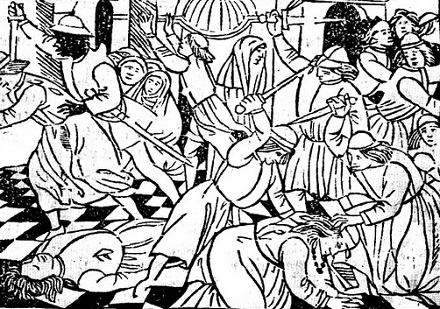
At a St. Stephen’s Day service in a basilica christened to Stephen Lampugnani approached the prince feigning supplication for some audience, then produced a hidden blade and stabbed Galeazzo Sforza. Visconti and Olgiati then rushed on Sforza as well and before anyone realized what was happening the Duke, croaking some half-heard invocation of Mary, was falling dead on the church floor.


Illustration of Galeazzo Sforza’s murder on the title page of a 1476 Lament for the Duke decrying the assassination.

Pandemonium ensued, and in the ensuing helter-skelter, Sforza’s bodyguards fell on Lampugnani and killed him on the spot, while Olgiati managed to escape.**

“It now only remains for us to consider those dangers which follow after the execution of a plot,” Machiavelli mused in his “Of Conspiracies” typology of his Discourses. “These in fact resolve themselves into one, namely, that some should survive who will avenge the death of the murdered prince. The part of avenger is likely to be assumed by a son, a brother, or other kinsman of the deceased.”

Well, yeah.

The assassins of the Duke of Milan appear not to have burdened themselves overmuch with advance consideration of this danger, possibly indulging the dream of Brutus that by a dagger’s stroke alone they could restore the lost republic.

Needless to say, this beautiful hope vanished in the bloody revenge carnival that actually ensued the murder. Just a few days after the assassination, having taken refuge with a priest — his justly frightened family had closed its door on him and needed to make theatrical denunciations of his treason for their own safety — Olgiati was captured, put to a torturous interrogation, and publicly butchered. He had outlived the Duke by only a week, and his gashed carcass was hung up in sections around town by way of warning. The rotting heads of the conspirators remained impaled on lances on the city’s bell tower well into the 1490s.

According once again to Machiavelli, Olgiati “exhibited no less composure at his death than resolution in his previous conduct, for being stripped of his apparel, and in the hands of the executioner, who stood by with the sword unsheathed, ready to deprive him of life, he repeated the following words, in the Latin tongue, in which he was well versed

“‘Mors acerba, fama perpetua, stabit vetus memoria facti.'”

That is,

‘Death is bitter but fame is eternal, and the memory of the deed will endure.’

This attempt, quixotic and doomed, to depose an Italian tyrant by murdering him in church might well have formed the blueprint for a similar plot in Florence in 1478, the Pazzi conspiracy. That version was even less successful than its Milanese predecessor: at least Olgiati and company could say that they actually managed to kill their target before everything else hit the fan.

And republic or not, Sforza’s murder did shake up the polity. It put the Duchy of Milan in the hands of his wife, as the unsteady regent of a seven-year-old heir. A few years later, the late duke’s brother Ludovico displaced the regent and effectively bossed Milan until the French imprisoned him in 1500 during the Italian Wars.

While he had the run of the place, Ludovico Sforza commissioned of Leonardo da Vinci a monumental equestrian statue in memory of his brother that da Vinci never finished.† Quite strangely, the master’s notes were plumbed by a 20th century Pennsylvania airline pilot who dedicated the latter part of his life to actually casting “Leonardo’s Horse”.

* The names Visconti and Sforza are also associated with some of the earliest tarot decks and among the first to introduce to playing cards the use of trionfi, or “triumph” cards — that is, “trumps”. One can readily purchase present-day reprints of this historic pack.

** There is a positively maddening inconsistency, thus far irresolvable for this author, between accounts (here’s one example | and another) asserting that Carlo Visconti was slain by Sforza’s bodyguards directly after the assassination, and other accounts (like Gregory Lubkin’s 1994 history of Sforza’s Milan) that put Visconti on the scaffold beside Olgiati.

† Da Vinci’s ponderously slow progress on this high-profile project led Michelangelo to cattily impugn the rival artist’s bronze-casting aptitude.

On this day..

1502: Ramiro d’Orco, discarded by Cesare Borgia

On this date in 1502, Ramiro d’Orco (Ramiro de Lorqua or de Lorca) was put to death in the main square of the city he had governed mere days before.

In 1498, Cesare Borgia, the bastard son of Pope Alexander VI, resigned his cardinalate* to pursue a conqueror’s laurels.

Dynastically allied with France and backed by il papa‘s ducats and decrees, Cesare seized control of Romagna after Alexander helpfully pronounced his vicars there deposed.

As Borgia extended his sword up and down the peninsula, he left his Spanish steward Ramiro d’Orco in Romagna’s capital of Cesena as his governor. D’Orco was a capable, cruel ruler. But his fall likely owed as much to his master’s gifts for the condotierro racket as to d’Orco’s overeager resort to torture and public executions .

Borgia’s conquests multiplied his rivals, fellow condotierri who feared that he could soon come to dominate Italy. The discovery of one plot by former allies against him might have inspired Borgia to consider the damage that the captain of Romagna could do, should he shift his loyalties.

Borgia, not present for events, had d’Orco arrested by surprise on December 22. He was on Christmas condemned to death for graft, and by the next day’s light his black-bearded head surmounted a bloody pike. Borgia also thereby reaped the benefits of d’Orco’s brutality while also dissociating his own person from the resentment those methods had engendered.

Niccolo Machiavelli, Florentine emissary to the Borgia court, watched Cesare’s career closely. In The Prince, Machiavelli is full of skepticism for rulers who come to power through the “fortune” of inheritance or another ruler’s patronage — but Cesare Borgia rates an exception. The conqueror “laid sufficiently good foundations to his power.”

When the duke occupied the Romagna he found it under the rule of weak masters, who rather plundered their subjects than ruled them, and gave them more cause for disunion than for union, so that the country was full of robbery, quarrels, and every kind of violence; and so, wishing to bring back peace and obedience to authority, he considered it necessary to give it a good governor. Thereupon he promoted Messer Ramiro d’Orco, a swift and cruel man, to whom he gave the fullest power. This man in a short time restored peace and unity with the greatest success. Afterwards the duke considered that it was not advisable to confer such excessive authority, for he had no doubt but that he would become odious, so he set up a court of judgment in the country, under a most excellent president, wherein all cities had their advocates. And because he knew that the past severity had caused some hatred against himself, so, to clear himself in the minds of the people, and gain them entirely to himself, he desired to show that, if any cruelty had been practised, it had not originated with him, but in the natural sternness of the minister. Under this pretense he took Ramiro, and one morning caused him to be executed and left on the piazza at Cesena with the block and a bloody knife at his side. The barbarity of this spectacle caused the people to be at once satisfied and dismayed.

* In fact, he was the first cardinal ever to resign the position.

On this day..

1204: Alexios V, precipitated Byzantine emperor

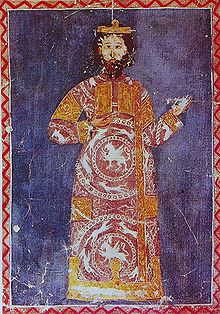
Around this time in the year 1205, the fleeting Byzantine emperor Alexios V Doukas was put to a dramatic death in Constantinople’s Forum of Theodosius by being hurled from the top of the ancient Column of Theodosius.

Nicknamed “Mourtzouphlos” for his prominent brow, Alexios obtained his Pyrrhic purple by being the only elite with wit and courage in Constantinople during the horror of the its sack by a Venetian Crusader army.

Vanity, vanity, all is vanity! Hands in mailed gauntlets and silk gloves grasping after glory and treasure were our Emperor Eyebrow’s rise and his fall.

The prime desideratum was the prime desideratum, Jerusalem. In a monument to bad management, a Crusader army of 12,000 was mustered to Venice in 1202 for a flotilla suitable to thrice its number. Venice had taken on an enormous contract to assemble this fleet and since the soldiers who showed up could in no way pay what the Serene Republic had been promised, Venice simply repossessed the army to make good its debt by means of pillage.

First, it sacked Venice’s Dalmatian rival Zadar. Then, having picked up the exiled nephew of the reigning Byzantine emperor — the uncle had overthrown the father to get the job — the Crusader-mercenaries made for Constantinople, become now shameless Praetorians by dint of young Alexios’s assurance of all the liberalities the East’s treasuries could bear.

Constantinople in 1202 was the jewel of Christendom. Its mighty walls had preserved the city inviolate since antiquity — a city of half a million souls reposing in the splendors of the Roman world, augmented by eight more centuries’ imperial surplus.

A morsel so ripe needs but one unguarded moment for some ruffian to pluck it. The Crusaders’ attack so happened to catch Constantinople, at long last, at such a moment. The city was lightly defended and unable to summon more aid — while under the direction of an emperor, Alexios III, who had been cruel and profligate in the enjoyment of his power but vacillated fatally when he was required to defend it.

In a matter of days in July of 1203, Alexios’s rule collapsed, and the emperor himself fled, when the Crusaders besieged Constantiople. These Crusaders of course installed their scheming moppet as Emperor Alexios IV, actually co-emperor with his father who despite having been brutally blinded by his brother was liberated and acclaimed by the populace.

The ensuing months make painful reading — and surely much worse than that to experience at first hand. The new emperors feuded with each other despite their kinship. They also had to squeeze every revenue they could for the Crusader army, which stubbornly refused to depart as its leader, the nonagenarian Doge of Venice, schemed to establish lasting Venetian authority in Byzantium. Irritated residents, enduring the continued presence of a Crusader army that thought it was supposed to be going to Jerusalem all along, rioted and fought with one another.

(For a ready summary of this situation and the entire buildup of the Fourth Crusade, grab episode 15 of Lars Brownworth’s outstanding 12 Byzantine Rulers podcast.)

The bottom line was that young Alexios was no more impressive in power than had been his predecessor and he had the added disability of having been installed by a foreign invader. He also discovered to his chagrin that the staggering sum of 200,000 he had so lightly promised the Venetians in exchange for his throne was double what he could actually find in the capital. When the situation unmanned him in January of 1204, he cowered in the imperial palace and sent his chamberlain to petition the Crusaders to back him in the latest exigency.

That chamberlain was our man, Alexios Mourtzouphlos.

Acting with an alacrity that might have spared Constantinople a horror had an earlier prince exercised it, Alexios instead arrested the co-emperors and spirited them off to a dungeon where they were quietly murdered.

The usurper then turned the city’s energies towards reinforcing its battered defenses and attempted to mount an attack against the Crusaders. This proved, however, much too late to spare the Second Rome its most awful tribulation.

In a matter of days in April 1204, the rude band of Latins who set out to win Jerusalem for Christ overran glorious Constantinople and put it to the sack. Tourists today who gawk at the bronze horses decorating Venice’s St. Mark’s Basilica are in fact enjoying the plunder of Byzantium. In time Constantinople would be retrieved from the Latins, but neither the city itself nor the Byzantine Empire ever fully recovered from the blow. This is also the event that made the schism between Eastern and Western confessions of Christianity permanently irretrievable.*

It was not given Alexios Mourtzouphlos to see what horrors ensued for Constantinople, never mind to get a start on finagling an imperial comeback of his own. Fleeing the sack of the city, he wound up in Thrace in the company of yet another deposed ex-emperor. But after first allowing Mourtzouphlos to marry his daughter, that old schemer had Alexios V blinded and in November 1204 abandoned him to an advancing Latin army — and its eventual death-by-precipitation — while his former in-laws fled to Corinth.

* One of Alexios IV’s promises to his Crusader buddies was to submit the Byzantine patriarchate to Papal authority — another pledge that could never have been realistically delivered.

On this day..

1329: Alberghettino II Manfredi, upstart condottiero

On this date in 1329, Italian condottiero Alberghettino II Manfredi was beheaded in Bologna.

He was the poor fruit of the Manfredi family, the lords of Faenza. Posterity doesn’t know a tremendous amount about Alberghettino, but one can infer a certain state of mind from his actions. While dad ran Faenza, his brother Ricciardo was on the condottiero cursus honorum as the temporary captain of nearby Imola.

In the mid-1320s, Alberghettino got his Fredo Corleone on by allying with the lord of Forli, a Faenza rival, in a treasonable (not to say Freudian) plot to supplant his father’s position.

He enjoyed a temporary run of the place from 1327-28 but was ousted by papal troops.

Forced to retire to Bologna, he returned immediately to conspiring with an attempt to make Bologna’s first man L-o-u-i-s, as in the Holy Roman Emperor Ludwig IV — at that moment barging about the Italic peninsula setting up antipopes.

That plot, too, failed. After that, on top of all his other woes, Alberghettino stood a head shorter than his more fortune-favored relations.

On this day..