1944: Six Jesuits in Palau

On this date in 1944, six Spanish Jesuit missionaries were executed in Palau by the island’s increasingly desperate Japanese defenders.

Fr. Elias Fernandez Gonzalez, Fr. Marino de la Hoz, and Br. Emilio del Villar were on hand to spread Catholicism in the island, which fell into Japan’s lap at the end of World War I and was therefore incorporated into the Asian hegemon’s economic plans.

Taking no chances with these foreign proselytizers, Japan had them confined when the Pacific War broke out in 1941.

By 1944, with the writing clearly visible on the wall, they were joined by three other Jesuits captured from nearby Yap, now a part of the Federated States of Micronesia, Fr. Luis Blanco Suarez, Fr. Bernardo de Espriella, and Br. Francisco Hernandez.

After a few months’ confinement, all six were summarily executed. Their remains have never been recovered; they were allegedly exhumed and burned shortly before Allied occupation, a bit of evidence-destruction similar to Wake Island.

There was a Japanese officer arrested for these executions and other war crimes, but he committed suicide before he could face judgment.

On this day..

1951: Antonio Riva and Ruichi Yamaguchi

On this date in 1951, the first two foreigners — Italian merchant Antonio Riva and Japanese bookseller Ruichi Yamaguchi — were convicted and immediately executed in Beijing for a supposed plot to assassinate Mao Zedong.

According to Time magazine’s coverage of the affair, Radio Peking said that

“the streets they passed through [en route to execution] were thronged with people who expressed their feelings .. . with shouts of ‘Down with imperialism! Suppress counterrevolutionaries! Long live Chairman Mao!'”


No relation.

Riva (English Wikipedia entry | Italian) was a World War I fighter ace who had relocated to Beijing/Peking in the 1920s to peddle aircraft and training the Chinese Koumintang.

(In 1936, Riva married Catherine Lum, the daughter of American wood block artist Bertha Lum and sister of Eleanor Peter Lum, who took after mom.)

When the guys those planes were being used against won the Chinese Civil War, Riva mulled an expedient departure, but reportedly declared (Spanish link) that he could do business under any regime type.

The Communist government decided he had a different sort of business in mind. Citing Chinese state media, the London Times (Aug. 18, 1951) described the plot thus:

the conspirators planned to fire mortar shells at a reviewing stand outside the Tien An gate of the forbidden city in Peking during a procession to celebrate China’s national day on October 1 last year.

Several others, both Chinese and foreigners, drew long prison sentences as part of the “conspiracy” uncovered in a one-hour trial. The most illustrious of those was the Italian bishop Tarcisio Martina.*

Though Riva and Yamaguchi were the first foreigners officially executed by the new Chinese government, they were far from the last. All the more remarkable, then, that in a country that carries out thousands of executions per annum, Antonio Riva is thought to have been the last European citizen put to death there until Akmal Shaikh in 2009.

The Shaikh case helped rekindle interest in Riva’s execution — a timely confluence, since a recent book, L’ uomo che doveva uccidere Mao, critiqued the case against the Italian aviator.

* American diplomat Col. David Barrett, safely beyond the reach of the Maoists at Formosa, was a supposed ringleader.

On this day..

2009: Hiroshi Maeue, suicide website murderer

One year ago today, Japan hanged three men, among whom the most notorious was Internet suicide-club serial sex killer (you can see why he made the headlines) Hiroshi Maeue.

After a couple brushes with the law over asphyxiation-oriented assaults in the 1990s, Maeue found his medium in hypertext.

Trolling a Japanese “cyber-suicide” site — they’re notoriously popular in Japan — the late-30s Maeue lured two young women and a 14-year-old schoolgirl to separate meetings for the ostensible purpose of committing joint suicides.

M.O.: get the “partner”/victim into a car on the pretext of doing the carbon monoxide poisoning thing together, then tie her up and throttle her. Rape doesn’t seem to have been a part of it, but word was that Maeue “confessed to deriving sexual pleasure from seeing people suffocate.”

He got that treatment himself little more than two years after he was sentenced. Hanged along with Maeue in Osaka this date was Yukio Yamaji, who raped and murdered two sisters in 2005. On the same day in Tokyo, Chinese national Chen Detong got the rope for a 1999 triple homicide.

Perhaps not coincidentally, these high-profile executions occurred just weeks before national elections that were looking bad (and turned out worse) for the then-governing Liberal Democratic Party.

Update: Japan observed the one-year anniversary by hanging two more people this same date in 2010, executions personally witnessed by anti-death penalty Justice Minister.

“It made me again think deeply about the death penalty,” said Keiko Chiba. “and I once again strongly felt that there is a need for a fundamental discussion about the death penalty.”

They were the first executions under the Democratic Party government elected shortly after Maeue’s hanging.

On this day..

1910: Ahn Jung-geun, Korean nationalist

A century go today, Korean independence martyr Ahn Jung-geun (or An Jung-geun) hanged at Port Arthur for assassinating Japanese statesman Ito Hirobumi.

Ahn Jung-geun, who was also a skilled calligrapher (his epigram, “Unless reading everyday, thorns grow in the mouth” is well-known in Korea), actually had a more visionary pan-Asianist agenda than his nationalist byline might initially suggest.

But he militantly opposed Japan’s annexation of the peninsula, and won his hero stature for gunning down Ito in Manchuria.

Ito, for his part, is a national hero in Japan for establishing that country’s parliamentary government and serving as its first Prime Minister.

So, yeah. Still a spot of tension over this incident.

Because the Japanese worried that “if Ahn Jung-geun’s body is handed over to the surviving family or impudent Koreans … it will not be good in the future,” its ultimate deposition has become an enduring historical mystery, with China the current likely suspect. Koreans’ intensified hunt for records pointing to Ahn’s grave has been much in the news during the centennial run-up.

Wherever his bones rest, the Korean patriot (as the saying has it) lives on. He’s even been posthumously promoted by the South Korean army to the rank of “General”.

The recent Korean film 2009 Lost Memories is premised on an radically different alternate timeline starting when Ahn is prevented from killing Ito. Here’s its aesthetically appealing climax, when history is righted.

Scrabbel put the Ahn Jung-geun story to music.

On this day..

1771: Green Tea Hag, the beginning of Dutch Learning

The typical turning-point execution features an illustrious protagonist upon the scaffold: a royal dethroned, a politician overthrown, a revolutionary laid low.

On this day in 1771, an obscure woman executed for everyday crimes launched a new era in Japan.

The Kyoto resident, nicknamed “Aochababa” — roughly translated as the Green Tea Hag — sparked a scientific revolution that would span decades, push Japan into its own Age of Reason called Dutch Learning, and keep an island nation astride goings-on from thousands of miles away in spite of isolationist practices.

The Tokugawa Shogunate, which ruled Japan from the early 1600s through the mid-1800s, was widely regarded as anti-Western for closing down trade with several European nations.

Concerned with what it saw as colonial aspirations in the Americas, the Shogunate clamped down on Catholic missionaries from Spain and Portugal. Starting in the 1630s, the island nation officially enacted the Seclusion Laws, which effectively allowed trade only with China, Korea, and the Netherlands; contact with the last was only legitimated through the Dutch trading outpost in Dejima, an isolated island with strictly controlled access.* Because of these limitations, Japan became a repository of non-Christian Dutch paraphernalia.**

The execution of Aochababa itself is practically forgotten: she was hanged in Kyoto’s Kozukappara (the present day Arakawa ward) in Meiwa 8, the second year of a 15-year drought gripping Japan. Her crime is unknown, and her execution would have been as un-noteworthy as dozens of others that year had her body not been secured for science.

However, under the reign of (though little due to) Shogun Tokugawa Ieharu, Dutch influence was increasing dramatically in Japan.

As a result, Aochababa’s corpse was brought to a medical facility, where Sugita Genpaku, Maeno Ryotaku, Nakagawa Jun’an, Toyo Yamawaki, and others performed and viewed an autopsy. Their medical training was Chinese; their medical texts were a mixture of Chinese and Dutch; as Genpaku reports in his later book Rangaku Kotohajime:†

Ryotaku opened the book and explained according to what he had learned in Nagasaki the various organs such as the lung called “long” in Dutch, the heart called “hart,” the stomach called “maag” and the spleen called “milt.” They looked so different from the pictures in the Chinese anatomical books that many of us felt rather dubious of their truths before we should actually observe the real organs.

Comparing the things we saw with the pictures in the Dutch book Ryotaku and I had with us, we were amazed at their perfect agreement. There was no such divisions either as the six lobes and two auricles of the lungs or the three left lobes and two right lobes of the liver mentioned in old medical books. Also, the positions and the forms of the intestines and the stomach were very different from the traditional descriptions.

After the dissection was over, we were tempted to examine the forms of the bones too, and picked up some of the sun bleached bones scattered around the ground. We found that they were nothing like those described in the old books, but were exactly as represented in the Dutch book. We were completely amazed.

In short, their medical results matched those of the Dutch and flew in the face of a millennium of Chinese anatomical teachings.

Genpaku was intrigued. As he tells it (40-some years after the fact), Ryotaku, Jun’an, and he immediately laid down a plan to translate the Dutch text into Japanese.

The process was a slog. Lacking a dictionary or translator for anatomical studies, the team — bolstered by the Shogun physician Katsuragawa Hoshu — was forced to reverse-engineer the Dutch language using a short phrase book, occasional contacts with the Dutch themselves, and a host of educated guesses based on the anatomical features they were attempting to describe. In addition to the problems of simple translations — turning a language with definite and indefinite articles into one with no such concept — many anatomical features had never been named in Japanese before; Genpaku and his collaborators invented dozens of words just to get by. A brief history is given here.

Finally, in 1774, Kaitai ShinshoThe New Book of Anatomy — based mostly on the Dutch book Ontleedkundige Tafelen (itself a translation from German), was published, the first translation of a Western text into Japanese. The book was four volumes (three of text, one of illustrations) and scribed in a Chinese-based writing style known as Kanbun.‡


An image (more can be seen here) from the 1774 Japanese anatomy treatise.

Topical historical literature, recommendation via Reddit.

The translation was the first in a long line of texts that the Japanese would eventually use to quietly capture the technology of the West.§

Genpaku was at the forefront of Dutch Learning, and his second masterwork, Rangaku Kotohajime (“Beginnings of Dutch Learning”), published in 1815, provides a thorough description of the events which led to these advances in science and medicine in Japan.

It would be 80 years before the United States Navy forced its way into Japanese harbors and used gunship diplomacy to end Japan’s seclusion. During that time, the Japanese reproduced everything from telescopes to automata to steam engines using borrowed texts and dissection of imported goods. Dutch Learning kept Japan abreast scientific advancements even while it maintained its isolation.

The enduring legacy of Dutch Learning was the late-19th century Meiji Restoration, wherein a Japan now officially opened swiftly modernized efficiently enough to trounce Russia in the Russo-Japanese War at the end of the century.

A fairly complete description of the evolution of Japan under Dutch Learning is given in Wakabayashi’s Modern Japanese Thought and De Bray et al‘s Sources of Japanese Tradition (Vol 2).

Today, many of the Dutch words imported to describe new objects, anatomical and otherwise, remain in the Japanese language as a testament to Dutch Learning. Sugita Genpaku is also the namesake of a modern-day attempt to translate texts to Japanese. And Toyo Yamawaki, through his help with dissections of the era, prompted an interesting ritual of memorializing cadaver donors in medical schools. For physical specimens, a museum with sections devoted to Dutch Learning can also be visited at Nakatsu.

* The Dutch were allowed to stay because they weren’t Catholic. The Shogun also enacted laws forbidding missionaries and Christian prosteletyzing, as well as officially outlawing the practice of Christianity; however, an underground group of Christians remained in the country.

** Initially, all foreign texts were outlawed. However, beginning with Shogun Tokugawa Yoshimune, Dutch texts were allowed into the country, generating a new wave of books that were, for several decades, largely illegible to their owners. To go with the anti-Christian theme, however, the Japanese authorities continued to blot out all Christian references.

† Translation by Ryozo Matsumoto, available here.

Kanbun is a mapping of Chinese ideograms and writing style into Japanese-comprehensible language using classic symbolic meanings (a standardized shape to represent a tree) and sound equivalents (using the same standard shape to represent the the sound of the word “tree” rather than its meaning), as well as sentence structure and purpose markings. Using this style, direct Chinese-to-Japense translation is possible, but the onus is on the author to properly annotate the text.

§ Strangely, there is as yet no Dutch-Japanese dictionary in print.

On this day..

1974: Mun Segwang, errant assassin

This morning in Seoul, Mun Segwang (various similar transliterations possible) was hanged for an assassination attempt four months earlier.

Mun, a Japanese-reared Korean who needed a translator for his subsequent trial, tried to gun down dictator Park Chung-hee at a Independence Day speech Aug. 15.

Mun missed Park, but he did kill two others: a high school student; and, Park’s wife Yuk Yeong-su, the seated white-clad figure in the middle of the assassination footage who can be seen beginning to crumple on stage as the camera pans away.

South Korea figured him as the agent of a North Korean/Communist plot, which conclusion Japan and the North rejected vehemently. (Trial evidence also indicated that he read The Day of the Jackal.)

Park got lucky this time, but the autocrat was successfully iced five years later by his own intelligence chief. (Guess what happened to him.)

On this day..

1876: The samurai leaders of the Hagi and Akizuki rebellions

Unless you’re a Jedi knight, feudal warrior castes and industrial civilization go together like sashimi and fries. So, when the Meiji Restoration made its choice for Japanese modernization, it gained the enmity of the samurai it necessarily dispossessed.

A news nishiki-e woodblock depicting the defeat of the Hagi Rebellion, with the conquering Miura Goro on horseback. (Click for a wider, three-panel image.) From here.

In many cases, said samurai were especially burned at having initially backed the restoration’s restoration of the emperor and attendant jingoistic sloganeering, only to find themselves on the outs as soon as the new government got its feet under it.

Over the 1870’s, the samurai caste was essentially abolished, and it lost its sword-toting privileges along with (come the advent of a new conscript army) its military import.

Small wonder that once-haughty military folk fought this unwelcome progress katana and wakizashi.

In 1876, the Shimpuren Rebellion helped spark sympathetic retrograde uprisings both named for their locations, Akizuki and Hagi. In all of these, the aggrieved samurai made desperate bids to reassert their lost position and reverse Japan’s westernization.

In all of these, they failed.

Leaders of both the Akizuki and Hagi Rebellions — Wikipedia gives it as two from the former (Masuda Shizukata and Imamura Hyakuhachiro) and seven from the latter (notably Maebara Issei) — were beheaded together this date in Fukuoka.

On this day..

2008: Michitoshi Kuma, “It can’t be undone now”

On this date in 2008, during a record-setting year for executions, Japan hanged Michitoshi Kuma, 70, and Masahiro Takashio, 55.

Michitoshi Kuma attracts our notice in particular not simply because he insisted throughout his trial and appeal that he was innocent of abducting and murdering two seven-year-olds in 1992 … but because the circumstantial evidence that convicted him was buttressed by a DNA testing regime that has fallen into disrepute.

One crucial piece of evidence against Kuma was the DNA samples taken from blood near the victims’ bodies. The samples were tested with DNA typing of the MCT118 locus.

The same method of testing was used in the case of the murder of a young girl in Ashikaga, Tochigi Prefecture, in 1990, known as the Ashikaga case. The test result was seen as crucial evidence in supporting the life sentence handed down to the accused, Toshikazu Sugaya.

However, the result was overturned when the DNA was tested again as part of the immediate appeal filed by Sugaya’s defense counsel after his request for a retrial was dismissed.

Sugaya, 62, was freed from prison on June 4, 17 years after police had arrested him.

“At first glance, DNA tests look scientific. That’s why it’s dangerous to have complete faith in them,” Iwata said.

“The tests were carried out in a particularly sloppy way in the early 1990s, when the Iizuka and Ashikaga cases occurred,” he said, adding that the Iizuka case likely was another example of a wrongful conviction.

“It can’t be undone now,” one of the defense lawyers lamented upon hearing of the hanging — conducted, as per usual in Japan, in secret and without prior notice to either the inmate or his attorneys.

The Ashikaga case, in which another prisoner convicted about the same time as Kuma and with the same DNA technology was exonerated and released a few months after Kuma’s hanging, embarrassingly reversed what had once been a signal judicial triumph for early DNA testing.

“The media treated the science as if it were invincible, like Atom Boy,” [one of Toshikazu Sugaya’s attorneys] said sarcastically. “They just kept admiring the DNA judgment without reservations.”

The objections Sugaya’s exoneration prompted about Kuma’s conviction, of course, arrived a bit too late.

On this day..

1949: Yoshio Kodaira, soldier turned serial killer

Sixty years ago today, Yoshio Kodaira counted himself “fortunate to be able to die on such a calm and peaceful day.”

For the year after Japan’s wartime surrender to the World War II Allied powers (beginning slightly before that surrender), former Imperial Navy soldier Yoshio Kodaira terrorized Tochigi and Tokyo with a rape-murder binge believed to have claimed ten victims.

Even our monsters — especially our monsters — are creatures of their own milieu.

For Kodaira, that was the Japanese occupation of China, where he slew an unknown number of Chinese soldiers and civilians in his official capacity under the banner of the rising sun … followed by the “anarchy of the postwar years.”

(In between the two, he served a jail term in the 1930’s for killing his father-in-law in a berserk rage when his wife left him.)

Expat author David Peace novelized the 1945-46 Kodaira crime spree in Tokyo: Year Zero, musing (in the voice of the killer),

You know, none of it makes much sense to me … they give us a big medal over there for all the things we did, but then we come back here and all we get is a long rope.

(Here’s an interview with the author.)

On this day..

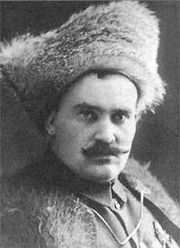
1946: Grigory Semenov, anti-Bolshevik

At 11 p.m. this date in 1946, White general turned Japanese collaborator Grigory Semenov (or Semyonov) was hanged for a generation’s worth of anti-Soviet depredations in the Far East.

The tsarist officer Semenov joined the Russian Civil War as a notoriously vicious White commander with the grandiosely retro title of Ataman of the Baikal Cossacks.

According to G. Patrick March, Semenov’s “penchant for killing, torturing, and looting” extended to executing a captured socialist by tossing the man into his locomotive’s fuel chamber.

Although also a rival in the suicidally fractious White political jostle, Semenov was the designated successor of Aleksandr Kolchak when the latter was shot in 1920, but by that time there wasn’t much left to succeed.

Knocking around the interwar era in gloryless exile, Semenov was an easy recruit for the Japanese war machine, which was in the market by the late 1930’s for locals with command experience and a grudge against Moscow and put him on retainer in Manchuria. Like the Soviet-Japanese front in general after Khalkin Gol, nothing much came of that enterprise; the Ataman’s last great hurrah was but a footnote for Japan, and his death would be a footnote in the annals of postwar victors’ justice.

Having picked a loser two wars in a row, Semenov was captured during the short-lived Soviet invasion of Manchuria at the tail end of the war and packed off for the inevitable. Five co-defendants, including Semenov’s son Mikhail, suffered death as well — although they were simply shot, while Semenov was ignominiously hanged. (According to White Terror: Cossack Warlords of the Trans-Siberian, the hanging was either botched or engineered to be an ugly strangulation job.)

On this day..