1924: Not Onisaburo Deguchi or Morihei Ueshiba, Japanese new religion exponents

On this date in 1924, a group of Japanese Oomoto* sect members was lined up for execution by a Manchurian warlord — only to be saved at the last moment by the intervention of the Japanese consulate.

These inordinately lucky folk were the remnants of a bizarre “spiritual army” under Onisaburo Deguchi, who set out to plant a utopian colony on the Mongolian steppe.


Onisaburo (left) and Ueshiba, shackled together for deportation after their near-execution. Onisaburo’s part of this image looks a little touched-up.

Oomoto got started as a splinter sect from Shinto with an illiterate peasant woman named Nao Deguchi, who began receiving spiritual visions in the in the 1890’s. Onisaburo was her follower, and then her son-in-law, and certainly the foundling cult’s greatest exponent.

With his guidance, it blossomed as one of the early 20th century’s most successful “new religions”, a term encompassing the dizzying array of novel religious movements in Japan after the Meiji Restoration.**

A born showman and innovative communicator, Onisaburo was a natural to

[mediate] between traditional and modern Japan in a time of national transformation.

… he was no less a master at what Eric Hobsbawm termed the “invention of tradition.” …

Onisaburo’s imaginative rituals and personal presentation (he loved to star in movies, and to dress as a shaman or Shinto deity) combined enough folk tradition to seem familiar, yet always with a new twist suggesting up-to-date modernity and “scientific” awareness to boot.

-Robert Ellwood’s Feb. 2011 review in Nova Religio of Nancy Stalker’s Prophet Motive: Deguchi Onisaburo, Oomoto, and the Rise of New Religion in Japan

In private communication with this site, Ellwood compared the advent of new religions like Oomoto to the roughly contemporaneous advent in the west of movements like Christian Science and Religious Science. Both of these, like Oomoto, explicitly aimed to yoke tradition and modernity together.

“In Japan the leap from a closed-off feudal society to a modern industrial powerhouse was particularly profound, and naturally disturbing to a lot of ordinary people,” Ellwood said. “The new religions tried to combine old and new, giving people baffled by change and the breakup of traditional peasant communities and ways of life something to hold on to. They said in effect, ‘We understand your problems; we can show how it all makes sense, how it will come out good in the end, and how you can fit in, be part of exciting times, and gain power in the process.'”

Onisaburo’s brand of evangelical, grassroots millenialism hit the big time in the 1910s and 1920s.

It also attracted official censure from authorities wary of deviation from the official Shinto religion.

Onisaburo did a short stint in prison for subversion in 1921, and shifted his attentions abroad.

“Onisaburo considered himself strongly internationalist in an idealistic way, and therefore was led to challenge the increasing nationalism of his time and even the Emperor himself, whereas many of the other new religions accommodated themselves to the prevailing political currents,” Ellwood observed. Later, Onisaburo would actually be prosecuted for lese majeste for his insufficient accommodation to imperial authority.

At any rate, as part of feeling out the proper spiritual direction after his first stint as a ward of the state, Onisaburo and some followers quietly slipped out of Japan in early 1924.

They made for Manchuria, then a de facto independent principality under the Tokyo-allied warlord Zhang Zuolin.

There, they recruited one of Zhang’s subordinates on a mission to form up a “spiritual army” to invade Outer Mongolia.

According to Stalker, this adventure initially had Zhang’s blessing — but he quickly soured on the freelance militia, a leader now calling himself the Dalai Lama, and the gang’s escalating aspiration to unite all of Mongolia on his borders. Zhang surrounded and suppressed the expedition, summarily executing most of the Chinese personnel.

On this day, the Japanese too were about to be disposed of. Onisaburo was reciting death poetry.

Even if my body is exposed
on the plains of Mongolia
I will still keep the dignity of a Japanese

Farewell!
I will ascend to Heaven and protect
not only Japan but the whole world

Far away from Japan
I will now join the gods
in the sky of Mongolia

But the execution was dramatically aborted when Onisaburo was fortuitously able to hail a Japanese consular official who protected his countrymen.

Scarcely chastened — indeed, the adventure with its miraculous escape drew romantic media coverage back home — Onisaburo returned to Japan to rebuild Oomoto. He would continue dabbling in both internationalism (Oomoto adopted the sometimes-persecuted artificial language Esperanto) and Japan’s right-wing fringe (Stalker says that Onisaburo wisely declined Ikki Kita‘s invitation to finance a disastrous right-wing revolt).

Oomoto was violently suppressed in the 1930s, but retained many adherents and still exists today.

Martial artist Morihei Ueshiba was one of Onisaburo’s disciples to escape execution this date. Upon returning to Japan, the man parted ways with Oomoto and instead created the martial art form aikido.

* Alternatively, Omoto, or Omotokyo.

** And continuing to the present day. While Oomoto is also a going concern, the “new religion” most widely familiar to most readers will be the Aum Shinrikyo sect — notorious for carrying out the 1995 sarin gas attack on the Tokyo subway.

This master’s thesis (pdf) sets the scene for new religions (and specifically Oomoto) in early 20th century Japan.

On this day..

1868: Kondo Isami, Shinsengumi

On this date in 1868, Shinsengumi commander Kondo Isami was beheaded at Itabashi as the civil war between the Tokugawa Shogunate and the rising Meiji government that would replace it unfolded.

A commoner raised to samurai, Kondo is famous for commanding the Shinsengumi, a sort of shogunate paramilitary renowned for hunting pro-imperial samurai.

This, of course, was ultimately a nonstarter, notwithstanding the Shinsengumi’s flair for dramatic success.

Kondo had little power to reverse the Tokugawa Shogunate’s deteriorating position even though his skill earned him progressively higher appointments in its service.

In the event, however, our principal lost the Battle of Koshu-Katsunuma, and was captured shortly thereafter.

From there, nature took its course.

He was brought in a cage to Itabashi, near Yedo, where he was beheaded. His head was put in spirits and sent to Kioto, where it was exposed in the dry bed of the Kamogawa near the fourth bridge. This most shameful of all punishments was inflicted upon Kondo Isami because, as chief adviser of his lord, the prince of Aidru, he had made himself especially hateful to the southern clans. (Source)

As a result, Kondo wouldn’t be around to say “I told you so” when the victorious Meiji scrapped their samurai-friendly xenophobia and replaced their former supporters in the warrior caste with a modernized army.

But he and his doomed band of upwardly-mobile swordsmen in romantic service of a historical dead-end are still with us. Shinsengumi adventures and Kondo Isami characters remain a staple of popular culture.

[flv:https://www.executedtoday.com/video/Shinsengumi_trailer.flv 440 330]

On this day..

1872: Yoarashi Okinu, geisha

On this date in 1872, geisha Yoarashi (“Night Storm”) Okinu was beheaded at Tokyo’s Kozukappara execution grounds after killing her lover to run away with a kabuki actor.

A notorious dokufu, so-called “poison-women” that captivated that country in the late 19th century, Night Storm (English Wikipedia entry | Japanese) was of humble origins but became a sought-after geisha in Edo.

Her celebrity affairs are treated here (reliability: unknown), but the reason she’s in this here blog is poisoning off the second-last of them with arsenic in order to get free to run off with kabuki actor Arashi Rikaku.

Rikaku himself was up to his eyeballs in this same plot, and was arrested — our source says, during a kabuki performance! — and initially condemned to death. Since Okinu was pregnant, however, her execution was put off pending childbirth; eventually, Rikaku’s sentence was moderated from capital punishment altogether.

Okinu’s head was cut off, and displayed in public for several days. Her lover served three years in prison, then rebuilt his kabuki career as Ichikawa Gonjuro.

* The date was the “20th day of the 2nd month of the fifth year of Meiji”, using Japan’s system of dating years from the start of the current emperor’s reign. Helpful in nailing down the date: Tokyo’s first daily newspaper published its first issue on the very next day.

On this day..

1879: Takahashi Oden, dokufu and she-demon

On this date in 1879, Takahashi Oden was put to death for murder at Tokyo’s execution grounds — the last woman beheaded in Japanese history.

Oden confessed to slaying her lover, and was also suspected of poisoning off her husband.
This made her perhaps the most infamous of Japan’s dokufu, poison-women — a perceived epidemic of the early Meiji period. Oden’s infamy thrust her into the crime genre’s characteristic harvest pulp literature, like Takahashi Oden yasha monogatari. (Takahashi Oden, the She-Demon’s Tale)

“Oden’s body became part of a scientific discourse that worked to produce ‘knowledge’ about feminine norms based on determinist biological differences,” Sharon Chalmers observes. “Deviancy was also characterised in terms of ‘masculine’ traits … [and] female transgression was read as sexual excess.”

And the feeding frenzy of the popular press around each new dokufu only exaggerated the effect: the sexual rapacity angle moved media.*

Since Japan was all about divining the secrets of the human form from the condemned, Oden was dissected after her death.

According to Murder Most Modern: Detective Fiction and Japanese Culture, the anatomizing team was especially keen on delineating that scientific discourse of feminine deviance. And, of course, the pamphleteers were keen on publicizing it. In this case, standing as we do today outside the surgeons’ intellectual framework, we can readily discern the corpse’s role for these men as grist for the ideological mill.

Immediately following her execution, her body was taken to the hospital affiliated with the Metropolitan Police Office (Keishicho) and dissected by an army surgeon and three regular doctors. Some accounts of this autopsy reveal that these doctors focused their attention on Oden’s genitalia during the procedure. Her bizarre autopsy is said to have been prompted by a newly emerging field of study called zokaki ron, roughly “the study of (re)productive organs.” A cross between sheer superstition and legitimate study of anatomy, zokaki ron was getting much scholarly as well as popular attention as one of the branches of science recently introduced from the West. After the autopsy, the primary operating surgeon, Osanai ken (1848-85), made the following report on Oden: “Abnormal thickness and swelling of the labia minor. Over-development of clitoris. Enlargement of vagina.” For Osanai — a skilled physician who is credited with having performed the first operation in Japan with chloroform and even makes an appearance in Shibue Chusai (1916), a novel by Mori Ogai (1862-1922) about a doctor of Chinese medicine in late Edo period Japan — such physical abnormalities explained Oden’s violent nature: after all, she ruthlessly slit her victim’s throat and left him in a pool of his own blood, and it took several blows for the authorities to execute her as she kicked and screamed in resistance.


Autopsy of Takahashi Oden, from Takahashi Oden yasha monogatari.

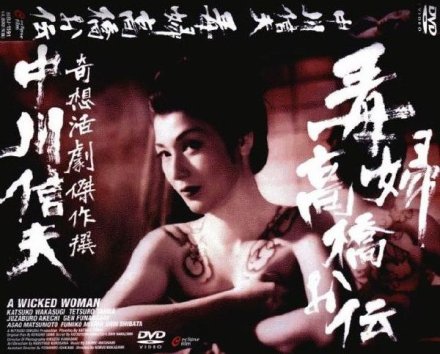
Though a lot of water has passed under the bridge since Oden’s day, she was the subject of a 1958 Nobuo Nakagawa film, Dokufu Takahashi Oden.


Katsuko Wakasugi as the title character in Dokufu Takahashi Oden.

* For more on the Oden story as crime literature, see Mark Silver’s “The Lies and Connivances of an Evil Woman: Early Meiji Realism and ‘The Tale of Takahashi Oden the She-Devil'” in Harvard Journal of Asiatic Studies, June 2003 — or, his book Purloined Letters: Cultural Borrowing and Japanese Crime Literature, 1868-1937.

On this day..

1911: Sugako Kanno, radical feminist

On this date in 1911, Japanese anarchist writer Sugako (“Suga”) Kanno was executed for the High Treason Incident — the only woman ever hanged for treason in Japan.

Radicalized by suffering rape in her teens, Kanno was known for her discomfiting engagement with Japan’s unsettled “woman question.”

More to the point, she was one of the handful of the treason trial subjects who was directly involved in the actual plot to assassinate the emperor. (Her diaries are full of anguish for those tried with her who were merely guiltly by association.)

Kanno is often subsumed in retrospective accounts by Shusui Kotoku, the more famous male anarchist who was also her lover.

But Kanno was also one of her country’s first female journalists, first notable feminists … a prolific writer of fiction and nonfiction, and a radical intellectual in her own right.

Her voluminous diaries in the run-up to her hanging are reprinted in Reflections on the Way to the Gallows: Rebel Women in Prewar Japan.

[E]ven among anarchists I was among the more radical thinkers [she told her interrogators]. When I was imprisoned in June 1908 in connection with the Red Flag incident I was outraged at the brutal behavior of the police. I concluded that a peaceful propagation of our principles could not be conducted under these circumstances. It was necessary to arouse the people’s awareness by staging riots or a revolution or by undertaking assassinations … Emperor Mutsuhito, compared with other emperors in history, seems to be popular with the people and is a good individual. Although I feel sorry for him personally, he is, as emperor, the chief person responsible for the exploitation of the people economically. Politically he is at the root of all the crimes being committed, and intellectually he is the fundamental cause of superstitious belief. A person in such a position, I concluded, must be killed.

Succinct. Little wonder she admired Russian assassin Sophia Perovskaya … and that she shared Perovskaya’s fate.

She mounted the scaffold escorted by guards on both sides. Her face was covered quickly by a white cloth … She was then ordered to sit upright on the floor. Two thin cords were placed around her neck. The floor-board was removed. In twelve minutes she was dead.

-newspaper account

Sugako Kanno is profiled more extensively in Treacherous Women of Imperial Japan: Patriarchal Fictions, Patricidal Fantasies.

She was back in the news in 2010 when a long-hidden secret message of hers surfaced, corroborating the orthodox historical take that while Kanno was up to her eyeballs in a real plot to murder the emperor, Shusui Kotoku was not part of it.

On this day..

1911: Shusui Kotoku and ten other anarchists

A century ago today, eleven Japanese anarchists were hanged for plotting the assassination of the Emperor.

Radical journalist Shusui Kotoku challenged Meiji Japan from the insurrectionary anarchist left.

A socialist early on — he helped translate The Communist Manifesto into Japanese — Kotoku turned towards anarchism when he read Kropotkin while serving time for opposing the Russo-Japanese War. He “had gone [to jail] as a Marxian Socialist,” he said, “and returned as a radical Anarchist.”

After his release, and a trip to America which had just birthed the anarcho-syndicalist Industrial Workers of the World, Kotoku returned to Japan as his nation’s patriarch of anarchism.*

All of this, naturally, drew a Sarah Palin-sized targetsurveyors’ symbol on Kotoku’s back.

So, when police uncovered an apparent plot by other radicals to off Emperor Meiji, and opportunistically used it to sweep up as fellow-travelers a nationwide “conspiracy” of twenty-plus alleged plotters, Kotoku was naturally one of the bad apples they were pleased to indict.**

The twelve ultimately doomed to death were slated to receive their judicially appointed sanctions on this occasion, just six days after conviction. (The rest of the anarchist movement was harshly suppressed in the years ahead.)

Among the most noteworthy of these Japanese Saccos and Vanzettis:

The first eleven (all men) took so long that the twelfth doomed soul, Suga Kanno — Kotoku’s lover and a genuine bomb-plot participant, who enjoys the distinction of being the only woman her country ever hanged for treason — had her execution put off to the 25th for want of daylight.

Though he’s never been officially [judicially] exonerated, Kotoku’s native Nakamura voted in 2000 to declare his rehabilitation. A secret letter that surfaced only in 2010 appears to support that position.

* Shusui Kotoku in turn greatly influenced Chinese anarchism.

Some of Kotoku’s writing is available online in Japanese here.

** George Elison translated a Kotoku Shusui letter denying any interest in the anarchist assassination racket. It appears as “Discussion of Violent Revolution, From a Jail Cell,” in the Vol. 22, No. 3/4 (1967) Monumenta Nipponica.

How is the anarchist revolution to be brought about if not by bomb-throwing attempts upon the life of the sovereign? The Japanese word for “revolution” — kakumei — is Chinese in origin. In China, the term was used to describe the process in which the emperor of dynasty A, receiving the Mandate of Heaven, replaced the emperor of dynasty B; so it signified mainly the change of emperors, the change of sovereigns. Our “revolution” has quite a different meaning. We do not place much value upon the mere transfer of power between potentates; we do not use the word “revolution” except to mean a fundamental change in the governmental system and in the organization of society.

… they who for the sake of universal peace and liberty participate in this revolution must endeavor as best they can to avoid violence, to avoid producing victims to the revolution. For it seems that the great revolutions of the past were accompanied by much violence and required a great number of victims … I only hope for the disappearance of the misconception that the anarchist revolution has as its objective the assassination of the sovereign …

the prosecution and the examiners first put the title “Violent Revolution” to what I had said and contrived the stern-sounding phrase “death-defying band,” with other similar phrases. And I believe they condemned us under this syllogism: “The anarchist revolution is concerned with the destruction of the Imperial Family. But Kotoku’s plan was to carry out a revolution by violence. Therefore, all who were party to this plot planned to commit the crime of High Treason.” So the fact that these people used to discuss such things as direct action and the revolutionary movement has now served to get them into trouble! This I deeply regret.

On the other hand, Kotoku openly celebrated the assassination of Ito Hirobumi by a Korean nationalist.

Part of the Daily Double: The High Treason Incident.

On this day..

1870: Kumoi Tatsuo

On this date in 1870, Japanese samurai Kumoi Tatuo was beheaded for attempting to topple the Meiji government.

Briefly a bureaucrat under the restored emperor, Tatsuo like many samurai grew disillusioned with the new state and its eclipse of the old ways.

Suspected of plotting an attack on senior government officials, he was arrested and beheaded with eleven others.

At death, I fear no dying;
In life embrace not living;
The brilliance of the sun
Is rivaled by integrity.
Execution has no terror,
Though it be a boiling cauldron;
But how insignificant my poor person,
Against the Great Wall!

-Kumoi Tatsuo

Tatsuo’s verse would later inspire the developing People’s Rights movement against the Meiji government’s authoritarianism, as well as nascent pan-Asianism.

Still, where art’s concerned, everyone is a critic. Japanese intellectual Shiga Shigetaka, addressing another young poet around the turn of the century, implored him to rise above Tatsuo.

You are only twenty-seven or -eight of age and your future is greatly promising. Above all, you must aim to be a great man in maturity and, without becoming content with temporary honor, work hard from this moment, striving to leave a name imperishable for a thousand years in the history of English literature. Tatsuo … has left nothing for the history of Japan, let alone for the history of the world. It is merely that because his poems are inept (they are, yes, inept when viewed in Chinese literature), because they meet the taste of those without a discerning eye as readers, a handful of students, who just want to feel good, recite them. You must draw your own conclusion from Tatsuo’s example.

On this day..

1943: Six POWs, inscribed on a ouija board

Here lie the remains of 3529270 Pte T Jackson Manch Reg. CQMS C Anderson FMSVF, A S H Justice USS Houston. 33271– Pte Mar- … here the letters had been eaten away. At the bottom of the board there were several more words which it was not possible to decipher but still discernible were the words

Executed 1/11/43

The WW2 People’s War is an online archive of wartime memories contributed by members of the public and gathered by the BBC. The archive can be found at bbc.co.uk/ww2peopleswar.

This date’s execution — contributed to WW2 People’s War by Chris Comer of Stockport Libraries on behalf of Arthur Lane — concerns six Commonwealth POWs who were shot for attempting to escape at Thambazayat, a prison camp in Burma.

They’re remembered by a fellow-prisoner from their time at the Thailand prison camp Chungkai, where the prisoners pulled off a memorable caper with a ouija board and some of their guards.


Chungkai War Cemetery, on the site of camp’s POW burials. (From Australian War Memorial)

These executions did not reshape history. But this story of a few men under the shadow of a senseless death has the spark of humanity that animates these pages. Read it in its entirety here: part 1 | part 2.

On this day..

1943: Leonard Siffleet, beach beheading

On this date in 1943, Australian World War II commando Leonard Siffleet was beheaded on Aitape Beach in Papua New Guinea, along with two Ambonese, H. Pattiwal and M. Reharing

A photograph of the Japanese soldier Yasuno Chikao an instant before he strikes off Siffleet’s head was taken from the body of a Japanese casualty later in the war. Published in Life magazine, it became one of the war’s most iconic photos.

On this day..

1942: Three Doolittle raiders

On this date in 1942, three captured American airmen who had bombed Japan in the Doolittle Raid were shot in Tokyo.

The Doolittle Raid — named for its commander, Jimmy Doolittle — was America’s April 1942 retaliation for the Japanese attack on Pearl Harbor a few months before.

The mission: bomb the Japanese homeland.

Later in the war, American advances in the Pacific would enable the Yankee to do this regularly. In 1942, it was all but a suicide mission.

The plan involved launching 16 B-25s from an aircraft carrier — an unprecedented feat in itself — to fly light with arms and heavy with fuel to just make it 400 miles to Honshu, and with any luck on to China before the tanks ran dry.

Considering that the bombers had to launch in a panic when the carrier group was spotted a couple hundred miles too early, the raid’s success was downright miraculous: all 16 bombers made it on to (or near enough) the mainland without being shot down, where the crews bailed out and, for the most part, escaped to allied forces. Jimmy Doolittle would title his autobiography I Could Never Be So Lucky Again.

But not all were quite as lucky as Lt. Col. (later, General) Doolittle.

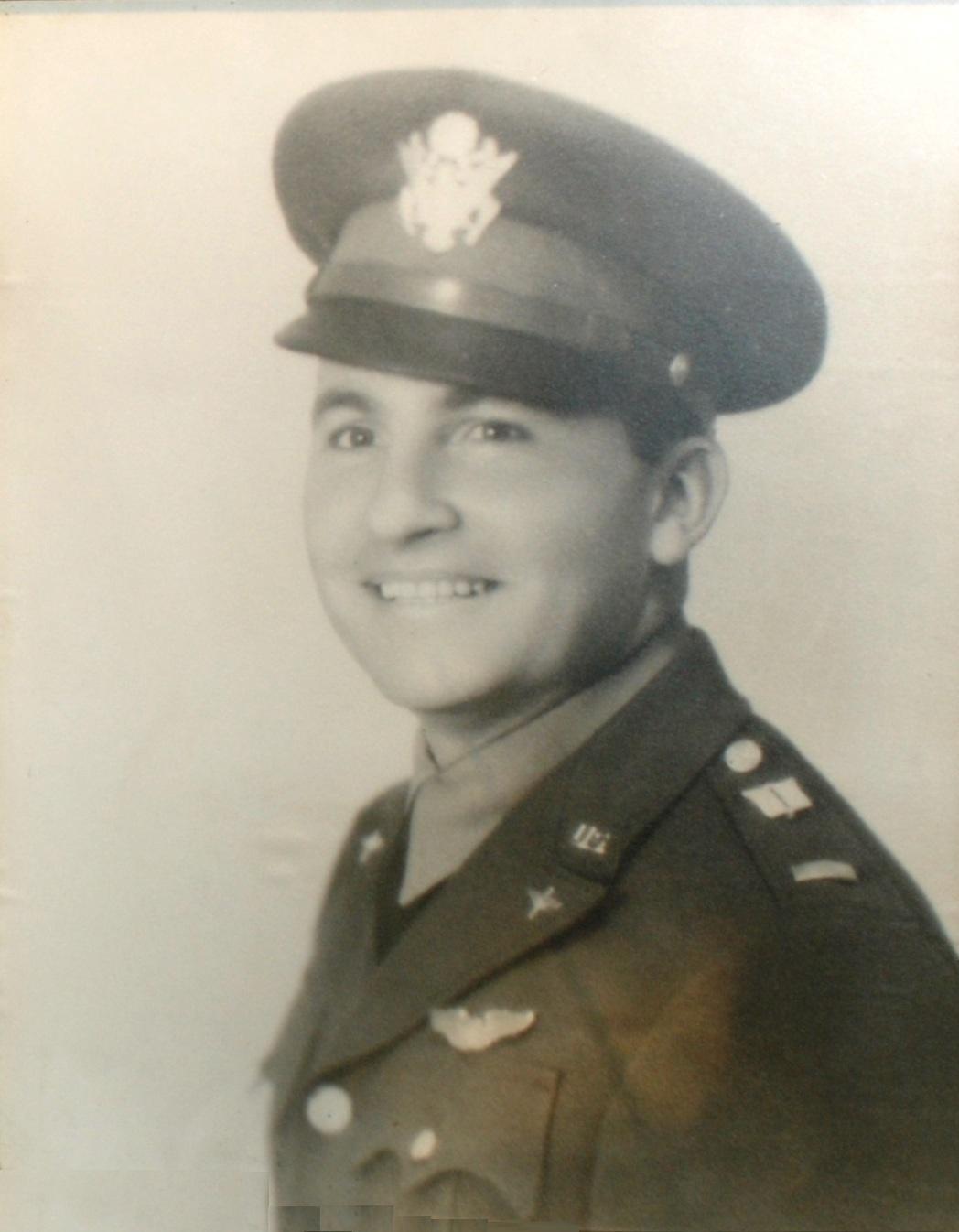
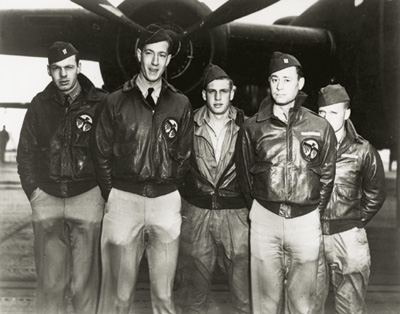
Farrow (left) and Hallmark. Spatz was a member of Farrow’s crew, and is pictured center in that plane’s crew shot here.

Two (out of eighty) drowned when their ride was ditched in the drink. Eight others were captured by the Japanese.

Four of those eight captives would survive the war to tell the tale. A fifth died in captivity. And the other three — pilots William Farrow and Dean Edward Hallmark, and (for somewhat unclear reasons) gunner Harold Spatz — were shot this day in a Shanghai cemetery following a sketchy military trial which condemned them for hitting civilian targets.

Designed largely for its psychological effect, the morale-boosting Doolittle raid has attracted interest from countless other sources who treat it in greater depth. DoolittleRaid.com and DoolittleRaider.com both provide detailed online information about the raid.

For more traditional media, one could do worse than bomber pilot Ted Lawson’s book, and its subsequent propaganda film adaptation, Thirty Seconds Over Tokyo.

On this day..