On this date in 1945, Japanese forces occupying Indonesia cut off Dr. Achmad Mochtar’s head for a medical experiment gone horribly awry.
Officially, Dr. Mochtar had been responsible for a supposed vaccine whose administration killed hundreds of Indonesian forced laborers.
Latter-day research, however, indicates that it was the Japanese military who administered the vaccine (Indonesian link), an experimental tetanus-cholera-typhoid-dysentery combination shot, getting a trial run before it was administered to Japan’s own soldiers. When this drug proved lethal to most of its recipients, Mochtar and his staff at the Eijkman Institute were arrested in 1944 and subjected to harrowing torture.
According to Jakarta-based British researcher Kevin Baird, Mochtar agreed to take the fall for the experiment in exchange for the release of his colleagues.
“We think of this sort of heroism as the reserve of military men and not learned intellectuals,” Baird told the Guardian. “Achmad Mochtar was not only a hero of Indonesia, but a hero of science and humanity.”
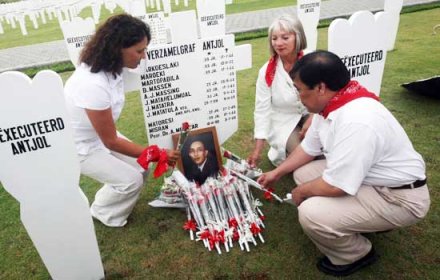
Present-day Eijkman Institute director Sangkot Marzuki (right), and two descendants of the executed man, Monique Mochtar (left) and Jolanda Mochtar (center) lay flowers at a 2010 memorial event after the doctor’s location in a mass grave was discovered. Achmad Mochtar’s name also graces a Sumatran hospital.
The Okudaira, allies of the wars’ eventually-victorious Tokugawa clan, found themselves besieged by the Takeda. This would result in the important Battle of Nagashino.
Kurosawa’s masterpiece Kagemusha imagines the Takeda where the (real) late daimyoShingen was succeeded after his (real) 1573 death (fictitiously) by an imposter thief posing as the great commander. In the film, the imposter is unmasked and deposed, but witnesses the climactic Battle of Nagashino … and then makes a futile charge under the Takeda banner after that side is slaughtered.
After an initial Takeda attempt to take the fortress by storm, the Takeda settled in for a brief siege — knowing the defenders to have only a few days’ supplies on hand. Enter Torii Suneemon.
Under cover of darkness on the night of the 22nd-23rd, Suneemon slipped out of the Yagyu gate and picked his way through Takeda tripwires to escape the investment … and summon help.
Torii Suneemon embarks on his mission: 19th century woodblock print of Yoshitoshi‘s “24 Accomplishments of Imperial Japan” series. The same artist also depicted that event in this triptych.
He made it on the 23rd to Tokugawa Ieyasu and Oda Nobunaga, who upon hearing his report pledged to dispatch a relief force the very next day.
Alas for him, Suneemon’s attempt to sneak back into the encircled fortress to deliver the good news was detected on the 24th, and he came as a prisoner to the Takeda commander. The Takeda prevailed upon their helpless captive to exchange his life for a signal service: approach the fortress walls and shout to the garrison that no help was on the way.
This Suneemon agreed to do.
The legends differ as to whether he walked on up to deliver this bogus bad news, or whether the Takeda lifted him up on a cross to impress upon their new agent the penalty for any funny business. Either way, Torii Suneemon had the last laugh: he immediately began hollering to the defenders that help was coming if they could just hang on a few more days.
The besiegers, of course, crucified him immediately … but everyone could appreciate the doomed man’s heroism.
While the grateful Okudaira elevated his family to samurai rank, even an enemy Takeda commander who witnessed the event was so moved that he adopted the image of the defiantly crucified soldier for his battle standard.
Nor was the brave soldier’s sacrifice in vain. The garrison did hold on — and their allies did relieve them, and did rout the Takeda in the resulting Battle of Nagashino. (The scenario is widely reproduced in video games nowadays).
* Some sites give this as “May 16”, but I believe the primary sources here actually indicate the 16th day of the 5th month on the traditional Japanese lunisolar calendar. This date corresponds to June 24, 1575 of the Julian calendar. (1570s conversion aid in this pdf, or use this converter).
On this date in 1945 — morning after a devastating U.S. air raid that destroyed much of Fukuoka — eight previously-captured American airmen* were summarily executed there in retaliation.
In a precedent that dated back to the Doolittle raids, Japan officially considered as a prospective war criminal any enemy airman who could be connected to indiscriminate bombing. Tokyo didn’t follow this logic to the point of executing all downed Americans — indeed, late in the war, beleaguered Japanese civilians became increasingly hostile towards the government for allowing excess legalism to stand in the way of exacting some satisfying revenge for the cities burning under American bombs — but it did execute some, and it had sanctioned legal theorems that could have accommodated quite a bit more bloodletting.
Finding Tokyo short of prison space, the government ordered on May 1, 1945, that the various armies should no longer send to the capital any downed airmen they captured. In the chaos of the war’s last months, this would create the context for local commanders at the Western Military District in Fukuoka to put those legal theorems to seriously nasty use.
Four captured airmen held in Fukuoka were stuck in an indeterminate judicial process which the army realized was going nowhere slowly. The others were just plain underfoot. Over the period of May-June, between a couple of ambiguously-worded orders and the officers’ annoyance at having to divert scarce resources to these captives, an understanding formed if “the air raids increased and conditions became more chaotic, the prisoners would be executed without a trial.”
About 3,000 tons of … incendiary bombs … were released by the B-24s from low level starting about three a.m. … The three cities [Fukuoka, Toyotashi and Shizuoka] were tasting for the first time the bitter flames of war, roaring over factories, shops and thousands of congested homes.
Timothy Lang Francis, whose “‘To Dispose of the Prisoners’: The Japanese Executions of American Aircrew at Fukuoka, Japan, during 1945” from the November 1997 Pacific Historical Review traces the confluence of factors that made possible this day’s executions, describes the fate that was unfolding for Fukuoka’s eight captive airmen at about the same time those words were going to press.
All were blindfolded and had their hands tied in front. Several swords were obtained from the Legal Section. [Yusei] Wako** then told the twenty or so assembled Japanese that, “in compliance with the Commanding General†’s orders, we were going to execute the plane crash survivors.” One officer, Lt. Michio Ikeda of the Medical Section, volunteered himself, and Wako ordered Probationary Officer Tamotsu Onishi, since he was skilled in kendo, to assist him as a third executioner. Sato watched the proceedings from one side.
The first flyer was brought to the edge of the pit and made to sit on his haunches. Wako then ritually washed one of the swords and stood behind the prisoner, slightly to the left. Raising the sword above his right shoulder with both hands, Wako brought it down on the flyer’s neck. “Both the body and head fell into the pit,” remembered Wako; “I washed my sword and ordered the guard to bring another flyer to the pit. I killed this flyer exactly the same way I had killed the first one.” Onishi then executed a third prisoner in the same manner.
In the pause that followed, Lt. Kentaro Toji, an officer attached to Western Army Headquarters, approached Sato. According to his pretrial affidavit, Toji said to Sato, “My mother was killed in the air raid on Fukuoka this morning, and I think it would be fitting that I be the one who execute these American flyers.” Sato told him to wait while Wako ordered Ikeda to execute the fourth flyer. Toji, after borrowing a sword from Onishi, beheaded the last four prisoners. The pit was then filled with dirt.
This is all well and good, but Tokyo’s orders to its armies had been to do the juridical legwork on these cases themselves — and not just to summarily kill prisoners. So, in a bit of ex post facto bureaucratic butt-covering, the Western District Army’s legal section proceeded to close the matter by shipping the central government a report saying that all these prisoners had been killed during the previous night’s air raid. Problem solved!
No known direct connection to this particular atrocity, but there’s a recent documentary about an elderly Japanese man who used to serve at Fukuoka that looks worth the watching.
* Six of the eight were Robert J. Aspinall, Merlin R. Calvin, Jack V. Dengler, Otto W. Baumgarten, Edgar L. McElfresh, and Ralph S. Romines. The other two remain unidentified. These eight were, maybe, the lucky ones: Fukuoka had had 16 prisoners from downed bombers, but the other eight weren’t around to be beheaded because they’d previously been given over to the local hospital to suffer ghastly deaths in vivisection experiments.
** A Judge Advocate who had also been involved in the Doolittle trials.
† Gen. Isamu Yokoyama. When he’d been briefed prior to the June 19 raid that the army was fixing to just dispose of its prisoners if it came to that, Yokoyama had done the Pontius Pilate act and informed Wako, “I have decided to concern myself only with the decisive battle and hereafter do not bother me with the problem of the flyers.”
On this date in 1942, Jose Abad Santos was shot by the Japanese forces occupying the Philippines.
Brother of a famous socialist agitator who fought the Japanese from the bush, Jose Santos had an impeccably mainline elite career: university degrees in America, corporate lawyering gigs, followed by a stint in the Ministry of Justice and elevation to the high court.
In December 1941, Santos administered the oath of office to re-elected president Manuel Quezon even as the archipelago was being invaded by the Japanese. Quezon would evacuate, forming a government-in-exile.
Santos preferred to stay, and would spend his last remaining weeks as the Philippines’ Acting President.
“It is an honor to die for one’s country,” he would say to his son, after their capture. (The son survived.) “Not everybody has that chance.”
On this date in 1947, Hisakazu (or Hisaichi) Tanaka was shot by the Chinese Koumintang for war crimes committed during the Japanese occupation of China.
Captured in Canton at the end of the war, Tanaka was tried by the Allied occupiers for permitting the execution of a downed American airman on April 6, 1945. That unnamed airman had been tried in wartime Japan for targeting civilians during his bombing raid, a judgment that Tanaka’s tribunal vociferously disputed.
Though he drew a hanging sentence for that offense, it was not carried out: instead, the doomed general was handed over to the Chinese nationalists to answer for the depredations of his 23rd army.
No surprise, the outcome there was pretty much the same.
On this date in 1932, the Japanese shot Korean Yoon (or Yun) Bong-Gil for bombing a parade dais in Shanghai.
A parade to celebrate the emperor’s birthday may be standard enough fare on the home front, but in a China being swallowed by said emperor’s empire it was a provocative act.
In the first months of 1932, Japan had merrily exploited — or incited — anti-Japanese incidents in Shanghai as pretext for an imperialist mini-war, won handily by Japan.
When the aggressors presented their celebratory pageant of arms in the city’s Hongkou Park (today, Lu Xun Park), our young Korean terrorist* “threw a narrow tin box high in the air. In an ear-splitting roar, the grandstand flew apart like a mechanical toy.” (Time magazine, excerpted in this useful Axis History Forum thread.) All seven of the Japanese VIPs on the dais were casualties, and two of them died: one instantly and another succumbing to his injuries a month later.
“A young Korean patriot has accomplished something tens of thousands of Chinese soldiers could not do,” remarked an admiring Chiang Kai-shek. Coming just months after another Korean activist had taken a whack at Hirohito in Tokyo, the generalissimo couldn’t help but appreciate his brothers in resisting colonization.
For this accomplishment Chiang would later go to bat for postwar Korean independence. But for his part, the patriotic Yoon got only a free trip to Japan for military trial and execution.
You’ll find another subtle memorial to this incident in pictures from the decks of the USS Missouri, where a Japanese delegation surrendered to end World War II on September 2, 1945. Leading the delegation is a distinguished gentleman with a top hat and a cane: it is Mamoru Shigemitsu, walking with an artificial leg thanks to Yoon Bong-Gil’s bomb 13 years before.**
Mamoru Shigemitsu aboard the USS Missouri.
* Note: calling Yoon Bong-Gil a “terrorist” is controversial in Korea. We use the word without moral censure.
** Mamoru Shigemitsu had been Japan’s ambassador to China at the time of the assassination bid.
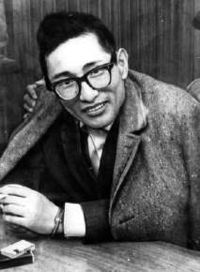
On this date in 1970, Japanese serial killer Akira Nishiguchi was hanged for murder.
Born in 1925, Nishiguchi (English Wikipedia entry | Japanese) spent the war years in juvenile detention but emerged in time to work as an interpreter for the U.S. occupation.
He was arrested repeatedly (Japanese link) as a con man during the 1950s. Police had him pegged as a nonviolent serial fraud artist, but in 1963 he killed two drivers to steal from them, then went on the run in Tokyo.
For 78 terrifying days, his face — those fraud convictions came with fingerprints that identified him as the killer — gazed out of wanted posters as Nishiguchi scraped by in cheap hotels and desperate disguises, committing three more murders in the process. Finally, an 11-year-old girl recognized him, posing as a lawyer.
On this date in 1600, the emergent Tokugawa Shogunate beheaded three men as rebels in Kyoto after they lost one of the pivotal battles in Japanese history.
The Battle of Sekigahara, on Oct. 21 of that same year, had pitted the shogunate’s founder Tokugawa Ieyasu against a coalition known as the Western Army.
This was the culmination of Japan’s bloody process of national unification.
The preceding ruler, Toyotomi Hideyoshi, had more or less unified Japan under central authority to end a century of civil war. But when Hideyoshi shuffled off leaving a five-year-old heir, a squabbling coterie of regents began elbowing for position.
The political scene eventually crystallized into one of those regents — the said Tokugawa Ieyasu — against all the others. Give yourself a gold star if you guessed that the guys who had their heads lopped off by the Tokugawa Shogunate played for the “all others” team.
Ishida Mitsunari
Ishida Mitsunari, a daimyo who served the late national unifier Hideyoshi, became the focal point of the opposition to Ieyasu.*
Mitsunari failed in a 1599 assassination bid on Ieyasu, and so the two came to outright warfare the following year — a war that Ieyasu economically won by routing Mitsunari at the Battle of Sekigahara.
That, in turn, cleared the way for Tokugawa Ieyasu eventually to take the title of shogun and found his eponymous dynasty — a dynasty whose intellectuals circled that decisive battle as the keystone in the arch.
“Evildoers and bandits were vanquished and the entire realm submitted to Lord Ieyasu, praising the establishment of peace and extolling his martial virtue. That this glorious era that he founded may continue for ten thousands upon ten thousands of generations, coeval with heaven and earth!”
On this date in 1594, legendary Japanese outlaw and folk hero Ishikawa Goemon was boiled to death in oil for attempting to assassinate Toyotomi Hideyoshi.
And he’s supposed to have had his son thrown into the kettle* with him, and, boiling to death himself, to have held the boy aloft out of harm’s way.
Just what his beef with national unifier Toyotomi Hideyoshi might have been is also subject to the exigencies of the story at hand. Let it be oppression or something, good enough for one of those classic outlaw-with-a-heart-of-gold retorts against condemnation for his thieving career.
It is you who are the robber who stole the whole country!
He gets to be the title character of the 2009 film Goemon:
Thanks to the inevitable marketing tie-ins, the world also has a Goemon action figure.
Personally, and especially because I would lose all these nifty accessories, I much prefer the adorable Goemon Cosbaby series.
* As a result of this famous exit, a Goeomon-buro (Goemon bath) in Japanese refers to a large iron kettle-shaped bathtub.
On this date in 1898,* the second patriarch of the Donghak religion was put to death in Korea.
Like neighboring Japan, Korea was ripe for “new religions” late in the 19th century and into the 20th. And to the concussive effects of modernity were added, for Korea, those of colonialism: a fading dynasty pressured by both western and Japanese empire-building.
“Donghak arose at a time when Korea was on the verge of radical transformations,” writes Kirsten Bell.**
Internally, society was stagnating under a rigid Confucian social hierarchy, which saw destitute peasants over-taxed and generally ill-used by corrupt government officials and landed gentry (yangban). External forces such as the West’s encroachment into the East were also causing considerable alarm. Donghak arose in these circumstances and was … explicitly envisioned … as a rebuttal to the growing influence of the West in Korea; further, Donghak was constructed in explicit opposition to Roman Catholicism, known as “Western Learning.”
Donghak, or Tonghak, was “Eastern Learning” (that’s its literal meaning), a sort of synretic liberation theology for the peasantry in a put-upon peninsula.
This egalitarian movement, light on the dogma beyond the notion that an omnipresent divine inheres to every person, yielded its founder up to the laurels of martyrdom in 1864. That gentleman, Choe Je-u, passed leadership to his kinsman, our day’s subject, whose proselytizing and organizing built the religion over two succeeding generations.
“Despite ongoing government persecution, Donghak proved popular with the disaffected masses,” Bell notes.
Choe Si-hyeong published the Donghak scriptures and planted countless secret Donghak societies around Korea. Rooted as they were in a lower class with an axe to grind, these burgeoning cells tended increasingly towards the revolutionary. In 1894, they tended all the way: the Donghak Peasant Revolution.
In this dramatic affair, a surging peasant-nationalist army marched on Seoul with every prospect of overturning the decrepit monarchy — which unworthily preserved itself by inviting a Chinese intervention.†
This, in turn, precipitated an (uninvited) Japanese response, which became the First Sino-Japanese War, whose titular belligerents had it out all over the Korean peninsula.
Japan, with its modern army, cleaned up in the fight, a signal of its rise as regional hegemon. (It would soon annex Korea altogether.) And just in passing, it routed that ambitious peasant army late in 1894, scattering Donghak adherents to the hills.
Choe Si-hyeong was finally captured and put to death in 1898. Still, that wasn’t the end of the line for Donghak: rebranded Cheondoism after its original moniker became unfortunately affixed to the word “revolution,” the faith is still going strong with well over one million adherents in present-day South Korea.
* The precise date is asserted in Buddhism in the Modern World but generally not extremely easy to come by. I’d rather have access to a clear primary source or a larger consensus of secondary sources or a pony.
** “Pilgrims and Progress: The Production of Religious Experience in a Korean Religion,” Nova Religio: The Journal of Alternative and Emergent Religions, August 2008.
† The Qing were about to be squeezed by a similar domestic movement, the Boxers.



 Brother of


 A parade to celebrate the emperor’s birthday may be standard enough fare on the home front, but in a China being

 Born in 1925, Nishiguchi (


