1789: Thomas Phipps the elder and Thomas Phipps the younger

From the Newgate Calendar (with thanks to frequent guest poster Meaghan Good of the Charley Project for the find):


These malefactors were father and son; and their final exit from this life was attended by circumstances of the most heart-rending and melancholy description.

The father was a man of good property, and lived on his own estate at Llwyney Mapsis, in Shropshire; and he and his son were indicted for uttering a note of hand for twenty pounds, purporting to be that of Mr. Richard Coleman of Oswestry, knowing the same to have been forged.

It was proved on their trial that Mr. Coleman never had had any transactions with Mr. Phipps that required the signing of any note whatever; that about the Christmas before, Mr. Coleman was served with a copy of a writ at the suit of Mr. Phipps the elder, which action Mr. Coleman defended, and for want of further proceedings on the part of the plaintiff, a non pros. was signed, with two pounds three shillings costs of suit against Phipps.

Upon this an affidavit was drawn up and sworn by Phipps the elder, Phipps the younger, and William Thomas, their clerk, for the purpose of moving the Court of Exchequer to set aside the judgment of non pros. and therein they swore that the cause of action was a note of the said Coleman’s for twenty pounds, which was given as satisfaction for a trespass by him committed in carrying some hay off the land of one of Mr. Phipps the elder’s tenants.

The Court thereupon granted a rule to show cause why the judgment should not be set aside; but Mr. Coleman insisting that the note was a forgery, the present prosecution was instituted against the father, son, and Thomas.

After a full hearing at the assizes at Shrewsbury, the father and son were pronounced “Guilty of uttering and publishing the note, knowing it to be forged;” and William Thomas was found “Not Guilty.”

Though convicted on the fullest evidence, the unhappy men, until the morning of their execution, persisted in their innocence; but when about to leave the jail, young Phipps made the following confession: “It was I alone who committed the forgery: my father is entirely innocent, and was ignorant of the note being forged when he published it.”

They were taken in a mourning-coach to the place of execution, accompanied by a clergyman and a friend who attended them daily after their condemnation.

On their way to the fatal tree the father said to the son, “Tommy, thou hast brought me to this shameful end, but I freely forgive thee;” to which the son made no reply. It being remarkably wet weather, their devotions were chiefly performed in the coach.

When the awful moment arrived, Mr. Phipps said to his son, “You have brought me hither; do you lead the way!” which the youth immediately did, and in the most composed manner ascended the ladder to a temporary scaffold erected for the purpose of their execution, followed by his father.

When their devotions were finished, and the halters tied to the gallows, this most wretched father and son embraced each other, and in a few moments the scaffold fell, and they were hand-in-hand launched into eternity, September the 5th 1789, amid a vast concourse of pitying spectators.

The father was forty-eight, and the son just twenty years of age.

On this day..

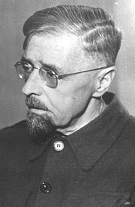
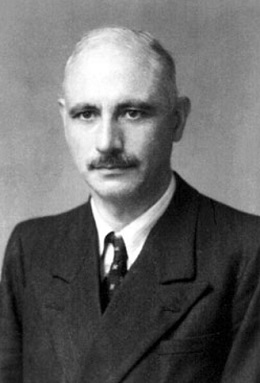
1946: Leon Rupnik, Erwin Rosener, and Lovro Hacin, for the occupation of Slovenia

On this date in 1946, the postwar state of Yugoslavia executed a trio of World War II occupation figures.


Left to right: Leon Rupnik, Erwin Rosener, and Lovro Hacin.

An Austro-Hungarian subject by birth, Leon Rupnik followed his native Slovenian soil into (proto-)Yugoslavia after the empire collapsed in World War I, and climbed the military ranks in the interwar era.

General Rupnik, as he could then be called, was the man tasked with engineering fortifications along the Italian and Austrian borders to ward off a fascist invasion. Modeled on the Maginot Line and every bit as effective, the Rupnik Line was little more than a speed bump when the Germans and Italians swept in during April of 1941.

But Gen. Rupnik was an open Nazi sympathizer, so sentimentality for his failed bunkers scarcely deterred him from joining the new occupation government as an enthusiastic collaborator, and he served or a time as the president of the German puppet province and the mayor of its capital, Ljubljana.

Erwin Rosener was a onetime brownshirt who became an SS General and was tasked by Heinrich Himmler with suppressing partisan resistance in Slovenia. He did the usual dirty things such a job entails, ordering torture and executions of hostages; Gen. Rosener also helped Gen. Rupnik organize the right-wing paramilitary Home Guard (Domobranci).

Lovro Hacin, the third member of the doomed party, was the police chief of Ljubljana.

Rupnik was shot. Rosener and Hacin were executed by hanging.


Rupnik (leftmost on the platform) reviews fascist Dombranci militia with Bishop Rozman and (rightmost) Gen. Rosener, January 30 1945.

Three others escaped execution at the same trials. Vilko Vizjak and Mha Krek both drew prison terms; Bishop Gregorij Rozman did as well, but his trial occurred in absentia and Rozman lived out his in exile.

On this day..

1430: La Pierronne, visionary

On this date in 1430, the Breton visionary La Pierronne was handed over to the secular authorities and burnt for blasphemy.

Not much is known of La Pierronne, save that she was a companion and follower of Joan of Arc — one of several women, who all shared Joan’s confessor, an itinerant monk known as Friar Richard. (Not much is known of him, either.)

La Pierronne was captured by the English at Corbeil in the spring of 1430, along with a younger companion whose name is not known. Rumor had it that she and Joan had both taken communion multiple times the previous Christmas, which was an irregular activity but not technically an outlawed one.

Still, cavalier behavior with the Host plus a surfeit of fealty to the Maid put our seer squarely in the sights of the Grand Inquisitor Jean Graverent. It was a preview of the sort of interrogation Joan herself would soon face.*

Like Joan of Arc, La Pierronne maintained that God spoke to her — and not only spiritually but in the shape of a physical apparition. This was clear heresy in the Church’s eyes — a direct ticket to the fire in the absence of speedy abjuration.

On the third of September, both women were presented with their options in the form of a sermon presented in the presence of the stakes that would otherwise receive them. Joan herself would face this test of faith, and would fail it on her first encounter. Here, the younger woman recanted — but La Pierronne held to her visions at the cost of her life.

Two women, who about half a year before had been captured at Corbeil and brought to Paris, had a sermon preached over them in the court before Notre Dame. The elder of these was Pierronne, and she was from Bretagne speaking Breton. She asserted and maintained that dame Joan (the Maid), who fought for the Armagnacs, was a good woman, and that what she did was well done and according to God.

Also she admitted having received the precious Body of our Lord twice in one day. Also she asserted and swore that God often appeared to her in human form, and spoke to her as one friend speaks to another, and that the last time she had seen Him, He was clad in a long white robe with a crimson doublet under it; which is nothing short of blasphemy. And she would never retract this statement that she often sees God clothed in this form, for the which, on this same day, she was sentenced to be burned, and so it was done and she died on the Sunday named persisting in this assertion, but the other woman was set at liberty at the same time.

* Joan had been captured by the Burgundians in May 1430. The Inquisitor Graverent was engaged by a different inquisition when Joan was prosecuted, so he didn’t take part in her trial.

On this day..

1914: Eugene Odent, the mayor of Senlis

On the second of September in 1914, the mayor of Senlis, France, was shot by the occupying Germans in the opening weeks of World War I.


Detail view (click for the full image) of a map of the British Expeditionary Force’s retreat in northern France during the first days of World War I.

The beautiful ancient town, where the Carolingian dynasty met its end (King Louis V was killed in a hunting accident there in 987, enabling Hugh Capet to take the throne), unhappily found right in the path of the German army smashing its way towards Paris as France and her allies gave way.

German troops reached Senlis by the first of September, and overwhelmed the city in a minor battle.

On guard from the experience of being picked off by franc-tireur snipers during the Franco-Prussian War many years before, the Germans entered this urban skirmish with far more concern for the safety of their troops than for that of noncombatants. A number of civilians were seized for use as human shields by the Germans as they moved through the streets, and some others reportedly executed summarily. Numerous buildings were torched.

In doing all this, the occupying army considered itself entitled not to suffer the resistance of its new (if ever so temporary) subjects — indeed it insisted upon the point with lead. On September 2, the German firing squads shot several French civilians accused of firing at German soldiers. The French Wikipedia page on the affair gives these names:

  • Romuald-Emile Aubert, 52
  • Jean-Stanislas Barber, 66
  • Cottereau Arthur-Lucien, 17
  • Pierre Dewert, 45
  • Mégret Gabriel, 52
  • Jean-Baptiste Pommier, 67
  • Rigault Arthur, 61
  • Louis Simon, 36

Hours later, the town’s mayor Eugène Odent heroically shared their fate. He had been accused by the Germans of orchestrating “terrorist” civilian resistance — shuttering buildings for the convenience of snipers, failing to demand orderly submission from his neighbors, and generally inconveniencing the new boss. (Most of Senlis’s 7,000 residents had fled town ahead of the approaching attack, presumably shuttering up in the process.)

The stunning German attack seemed on the brink of capturing Paris at this point, but just days later the disordered French “miraculously” — it’s literally known as the Miracle of the Marne — threw the invaders back at the Battle of the Marne.

This battle crushed Berlin’s dream of a knockout victory and allowed the combatants to settle in for four bloody years of miserable trench warfare. It also enabled the French to recapture Senlis, whose horrors — Eugene Odent and all — were collected for early entry into the war’s annals of barbaric-Hun propaganda.

On this day..

1944: Jacques Stosskopf

For most prisoners at the Netzweiler-Struthof concentration camp in Alsace, the fall of 1944 marked a time of disbursement to other detention sites — a clear sign that Allied forces were close at hand.

But both the disbursement order (in mid-September) and the Allied arrival at Struthof (in November) were just a little too late for Jacques Stosskopf, who was executed by the Nazis on Sept. 1 that year, even as the Germans were beginning preparations to disband the camp. How he was executed is unclear; stories from witnesses differ about whether prisoners at the camp were hanged, shot or gassed.

But it isn’t Stosskopf’s end that catches attention; rather, it is how he spent the war years, and his involvement, as a Frenchman, in the German U-boat war.

A native of Paris (born Nov. 27, 1898, in the City of Light), Stosskopf was of Alsatian heritage and spoke fluent German. He joined the French artillery in 1917 and received the French Croix de Guerre for his actions in World War I.

After the war, he entered the Ecole Polytechnique and earned a degree in marine engineering. As World War II approached, Stosskopf was appointed to lead the naval construction unit at Lorient, on the French coast. He eventually was promoted to the rank of Chief Engineer, 1st Class.

In June 1940, the German army took control of Lorient and began using the naval facility there to repair and resupply their U-boats. When they realized that the U-boats were vulnerable to attack by Allied air forces, the Germans set about fortifying the base as a refuge for their submarines.

Stosskopf worked with the Germans to design the new U-boat station, creating one of the most famous and impenetrable naval bases of the war: the double roof over the bunkers allowed them to withstand even a direct bomb hit, so even though the city of Lorient itself was almost 90% destroyed by Allied bomb raids, the bunkers continued to stand.

Between 1940 and 1944, the Germans built three such bunkers, capable of sheltering more than 25 submarines; from these fastnesses, German U-boats carried out relentless attacks against both military and civilian targets.

Because of his involvement with the naval station, Stosskopf was considered a collaborator by the local French citizenry. So when he disappeared in February 1944, they assumed that he had been promoted by his German compatriots and had been called to work in Germany.

In fact, all the while he was working on the U-boat port, Stosskopf had been collaborating not with the Germans but with the Alliance Reseau, a French resistance group headed by Marie-Madeleine Fourcade. Each week, he met with his resistance contact, providing information about boats going out to sea, the names of their captains, and the location of the missions. Because of these reports, many U-boats were intercepted at sea and their captains killed in Allied attacks.

In the end, Stosskopf was given up by a captured member of the Resistance, and he was caught up in the German Nacht und Nebel (Night and Fog) program. This roundup of suspected resistors of the Reich was undertaken by the Germans as a last-ditch attempt to regain some control over a war they could see slipping away; Nacht und Nebel abductees were spirited away at night and disappeared “into the fog” — never to be heard from again.

Stosskopf’s ultimate fate lay at Natzweiler-Struthof, a small concentration camp in the Vosges Mountains, in the Alsace region. Struthof, as it was called, was the only camp built on French territory, and it was the primary holding place for captured members of the French Resistance.

It was also the first camp liberated by the Allies (on Nov. 23, 1944), but by that time, most of the detainees had been evacuated. (For more detailed information on this camp and its prisoners, go to www.scrapbookpages.com/Natzweiler. Or, for a different perspective, read Night and Fog, by Arne Brun Lie, a prisoner’s account of life at Struthof, or the novel Necropolis, by Boris Pahor, a story based on his own experiences at the camp.)

At war’s end, the citizens of Lorient were amazed to learn the truth of Stosskopf’s activities, which were made public when he posthumously received the French Legion of Honour (1945). In 1946, the submarine base at Lorient was renamed in his honor. Today, visitors can tour the base at Lorient and see how it was operated.


Submarine Base Chief Engineer Stosskopf
Arrested and deported by the Gestapo Feb 21, 1944, for his activity in the resistance.
Disappeared.

To get a personal look at Jacques Stosskopf, read Jacques Camille Louis Stosskopf 1898-1944, a book of documents and testimony about his life compiled by his children, Francois Stosskopf and Elizabeth Meysembourg-Stosskopf.

On this day..

1807: Jenkin Ratford, Chesapeake-Leopard affair casualty

On this date in 1807, the British navy hanged Jenkin Ratford from the yardarm of the HMS Halifax off the coast of Maryland — an incident destined to become a rallying cry for the United States in the ill-fated War of 1812.

The U.S. at this moment was an upstart young country and naturally enough chafed at the lordly interpositions of her recent mother country. Great Britain had the navy, however, so the Americans could chafe all they liked. In the words of the tune that had emerged in the 18th century with Britain’s globe-straddling sea power

Rule, Britannia! Rule the waves
Britons never will be slaves.

The Britons who got to do the grunt work of wave-ruling might disagree.

Seaman in the Royal Navy, and that huge navy needed many seamen, was a harrowingly brutal position often filled by press gangs empowered to grab anyone not able to produce immediate evidence of exemption and have them by next morning swabbing the nearest frigate on a ration of wormy hardtack. Desertion was correspondingly popular and more radical resorts not unheard-of; the mutiny on the Bounty had occurred in 1789; two other mutinies much more alarmingly proximate to Old Blighty took place in 1797.

Britain’s willingness to extend impressment to stopping American ships and seizing crew members who couldn’t produce American identity papers made a great affront to the young Republic — an insulting reminder of its third-rate* place among the nations. Years before while American colonists were kicking redcoat ass in the Revolution, they had dreamt among other things of correcting America’s aggravating dependence on the British fleet. “No country on the globe is so happily situated, or so internally capable of raising a fleet as America. Tar, timber, iron, and cordage are her natural produce,” wrote Thomas Paine in Common Sense. “Ship building is America’s greatest pride, and in which she will, in time, excel the whole world.”

Congress got a start on that project with a 1794 naval act creating the original six frigates of the U.S. Navy. The USS Constitution is the most famous of these; one of her five sisters, the Chesapeake, will figure in the action of this date’s post.

In 1806, two French ships, the Cybelle and the Patriot, struggled into Maryland’s Chesapeake Bay for repairs after being crippled by a storm at sea — stalked by British ships that blockaded the mouth of the Chesapeake to trap them there.

The proximity of American soil proved an irresistible inducement for at least four sailors on the British ships to desert. Three of them — William Ware, Daniel Martin and John Strachan — were American victims of British impressment. The fourth, our man Jenkins Ratford, was a Limey. They then enlisted in the American Navy.

Great Britain’s demands for their return met with steady refusal on the American side. Knowing that the deserters had been posted to the Chesapeake, which was then outfitting for deployment to the Mediterranean, British ships in the vicinity of the North American coast were ordered to stop the Chesapeake on sight to recover the absconders.

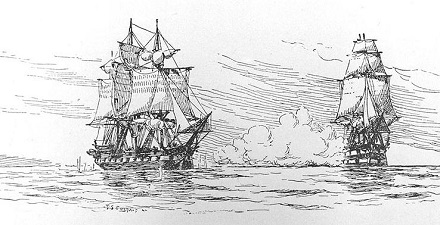
This the HMS Leopard did do on June 22, 1807, and with a singular lack of subtlety: the Leopard battered the Chesapeake with broadsides. Shocked and unprepared, the Americans couldn’t even fire back before striking colors and yielding to a humiliating British search that hauled off Ware, Martin, Strachan and Ratford.


The HMS Leopard (easily recognizable since it’s the only ship firing!) vs. the USS Chesapeake.

While these unfortunates were sailed off to Halifax, Nova Scotia** for their trial, outrage spread on American shores — immediately advised of the incident since the Chesapeake† had had to limp directly back to Norfolk, Va., for repairs. Outrage at the British, but also outrage at the captain who failed to so much as resist the attack (he was court-martialed, and suspended from command for five years), and outrage for the national honor. Some, more vengeful than sensible, wanted immmediate hostilities with Great Britain. “Never since the battle of Lexington have I seen this country in such a state of exasperation as at present, and even that did not produce such unanimity,” U.S President Thomas Jefferson wrote to his friend, the French emigre Dupont de Nemours.‡

Ratford, the only actual British citizen among the shanghaied sailormen, was the only one executed. The Americans “merely” got prison sentences.

At the political level, President Jefferson had a thorny problem. The British could in no way be induced to meet the American demand to end impressment, for simultaneous with the scandal Napoleon was finalizing victories that would knock Britain’s continental allies out of an altogether more urgent war. No derogation of security interests could be entertained, and so for America, no diplomatic satisfaction could be forthcoming.

Instead of war, Jefferson responded by convincing Congress to enact an embargo on trade with Europe. It proved to be a counterproductive policy that damaged the U.S. far more than the European export markets it had intended to punish.

The U.S. and U.K. would come to blows soon enough, and if the War of 1812 was hardly fought because of the Chesapeake-Leopard affair, that incident was certainly among the contributing grievances.

Injuries more directly attributable were not hard to come by, however. When James Barron, the suspended former commander of the Chesapeake, sought reinstatement to the navy, early American naval hero Stephen Decatur opposed him with vehemence sufficient to induce Barron to challenge Decatur to a duel. Decatur was slain in the fight, shockingly pinching out one of America’s leading military figures at the age of 41.

The Chesapeake herself fared little better. The ship was captured by the British in the ill-fated War of 1812, and recommissioned into the hated Royal Navy. Sold off for scrap in 1819, its timbers were repurposed for a long-lived (and now historic) Hampshire watermill — the Chesapeake Mill.

* See what I did there.

** Halifax the city is where they were tried; the HMS Halifax, which was Ratford’s ship prior to desertion, is where Ratford was executed. It’s Halifaxes all the way down.

Thanks to this incident, the very name “USS Chesapeake” became so blackened in American naval history that it has barely been touched for any vessel since.

‡ Father of the DuPont who founded the DuPont chemical company and made that family perpetual American plutocrats down to the present day.

On this day..

1587: Thomas Conodale, A Sea Faringe man

Today’s obscure mariner hanged at the Wapping execution dock comes from a tidbit unearthed years ago by the now-inert blog ReScript:

30 Awgust Ano 1587: burial

Thomas Conodale beinge A Batchelor He was Borne in Glossester beinge A Sea Faringe man and executed at wappinge For pyracye the xxxth daye of Awgust in ano 1587 betwixt the ower of too and three of the clocke was Buried the Sayde xxxth Daye of awgust in ano 1587 beinge xxviij yeares owlde no parishioner For the minester ijs For the grownd in the common churche yeard xijd For the Second clothe xd For the pitt & knell ijs viijd For the clarkes atendance viijd For the Sextenes attendance iiijd he was exicuted at Waping.

To the best of your correspondent’s knowledge, this constitutes the entirety of the relatively accessible information available about this forgotten corsair — although as ReScript notes, the Davy Jones’ locker of admiralty records might yet keep Conodale’s story.

On this day..

1783: William Wynne Ryland, court engraver

On this date in 1783, British engraver William Wynne Ryland hanged at Tyburn* before a throng of gallows-voyeurs such as “had not been seen on a like occasion since the execution of Dr. Dodd.” (Morning Chronicle and London Advertiser, Aug. 30, 1783)

“[H]is evil genius prompted him, for gold, to debase his talents in engraving,” the Newgate Calendar opined. “By one fatal act, he entirely ruined his reputation as a man: but his name as an artist will ever stand in the highest estimation.”

French- and Italian-trained, Ryland was a premier court artist in his day, noted for importing stipple engraving from the continent to England. He earned a royal pension for his portraits of Hanoverian elites.


Some Ryland portraiture, from the National Portrait Gallery: King George III and his queen, Sophia Charlotte.

Although Ryland’s first attempt to parlay his draftsmanship into a print-selling business had gone bankrupt in 1771, he does not seem to have been entirely neglected by the muse of business acumen, either. Over the subsequent decade he had discharged all his previous debts and stockpiled assets to the amount of £10,000. “I am rich beyond temptation,” he protested to the jurors who tried him for his life. The Crown could produce little in the way of an immediate motive for the forgery. (“It is impossible for us to penetrate so far into the heart of man as to know what his inducements are.”)

But lucre is its own motivation, and the facts of the case weighed heavily against Ryland.

He had come into (legitimate) possession of £200 bill of exchange issued by the East India Company and dated October 5, 1780. Somehow it transpired that Ryland then exchanged two copies of this bill — one on September 19, 1782 with the banker Sir Charles Asgill, and then once again on November 4, 1782 to a banking firm with the Dickensian name of Ransom & Co.

Both bills were identical to every inspection, with the same amount, date, and cheque number, and Ryland the expert engraver could give no convincing account of the second note’s provenance. In the public’s mind, the fact that he had fled the indictment and then dramatically attempted suicide when his capture was imminent surely cinched the case.

Ryland’s attempts to inspire in the jurors a sufficient doubt as to whether the East India Company might not have accidentally circulated two identical bills was fatally undone when it turned out that a difference between the two bills could be found after all — by the paper manufacturer, who proved to the court that the second bill was inscribed on paper whose watermark established that did not exist on its purported date of issue.

this sheet of paper was made at the mill, on that particular mould, it has a defect on it; on the 21st of January, 1782, of the same mould of which this note is now shewn me, I made this sheet of paper; there is a defect of the mould, either by an injury it has received, or in consequence of the quantity of paper made on it, the bill has the same defect; and there is likewise a defect which the bill has not, so that the sheet of paper on which the bill was written, was made from that mould. This could not happen in the same places, and situations in any two moulds.

The jury needed only half an hour to convict him.

By the Morning Chronicle and London Advertiser‘s account, he was London’s star attraction on his hanging day.

At half past nine a man on the steps of newgate called out, “Mr. Ryland’s coach,” upon which a mourning-coach, that was standing opposite the Sessions-house, drew up to the door of the prison, and in about two minutes after the unhappy man walked down the steps at a brisk pace, and entered the vehicle; presently after which [fellow condemned prisoner John] Lloyd went into another mourning coach. The Ordinary of Newgate, another clergyman, a gentleman in mourning, (said to be a relation of he convict’s) and a sheriff’s Officer, went in the coach with Mr. Ryland …

These coaches, which immediately followed the Sheriffs’ carriages, having drawn a few yards from the door of the prison, two carts were drawn up; [James] Brown, [Thomas] Burgess, and [John] Edwards were tied in the first, as was [James] Rivers in the last cart …

The gallows was fixed about 50 yards nearer the park wall than usual. About five minutes before 11 o’clock, Ryland’s coach drew on the right of the gallows, as did Lloyd’s on the left; and between them the cart; soon after which a violent storm of thunder, lightning, and rain came on, when the Sheriffs gave orders for a delay of the execution. When the storm had subsided, and some time had been employed in prayer, Rivers was lifted from one into the other cart, which backing to Lloyd’s coach, he alighted therefrom, and entered the vehicle, and after the ropes had been fixed about the necks of these unfortunate men, Ryland stepped from the coach to join his unhappy fellow sufferers. After a conversation of at least ten minutes between Ryland and Mr. Villette, Ordinary of Newgate, and the same time employed in an earnest discourse between Lloyd and Burgess, all the malefactors joined in singing the hymn, called, “The Sinners Lamentation”


Editor’s note: I’m not certain whether this is the hymn alluded to.

Ryland was the object that attracted the general attention, from Newgate to Tyburn, the sound that reverberated from every quarter, amidst the immense multitude was, “Which is ryland? There, that is Ryland in the first coach!” Exclusive of the usual accommodations, a vast number of temporary stages were erected; and gentlemens and hired carriages were innumerable. Some rooms, for accommodating private companies, were actually let at the enormous rate of from six to ten guineas.

Notwithstanding the vast press of the crowd, amidst the astonishing number of horsemen, carriages, and people on foot, we have not heard that any body was materially hurt, though many were forced down and trod on.

Ryland was in mourning, and wore a tail wig … Through the whole of this trying scene [he] conducted himself with remarkable serenity and fortitude, strongly indicating that he was prepared for, and perfectly reconciled to his fate.

The wheel of fortune turning against the mighty — especially when they should hazard their lives for a needless pittance — being irresistible to other artists, Ryland is the title character of a a comedic play.

* One of the very last hangings at Tyburn.

On this day..

1648: Sir Charles Lucas and Sir George Lisle, royalists

The Death of Sir Charles Lucas and Sir George Lisle, Monday, Aug. 28, 1648

By the old wall at Colchester,
With moss and grass o’ergrown,
The curious, thoughtful wanderer
Will note a small, white stone.
Tis sunken now — yet slight it not;
That stone can speak, and tell
A tale of blood; it marks the spot
Where Lisle and Lucas fell.

On earth there is no abject thing
So abject as a fallen king.
And Charles, despoiled, cashiered, discrowned,
In his own halls a captive bound,
Spurned, crushed by countless ills forlorn,
Drinks to the dregs the cup of scorn.

Yet in that hour of blank despair,
Lisle, Lucas, Capel, Compton dare
Their wrecks of shattered strength to call
To Colchester’s beleaguered wall;
Round Charles, in hope ‘gainst hope to cling
Proclaim, e’en yet, that Charles is king;
And one more mighty effort try
For honour, love, and loyalty.

Vain all the dauntless venture — vain
Their valour, piety, and pain.
Who in the field the foe repels
Grim Famine in the city quells.
The soldier, gaunt and staggering, crawls
From post to post along the walls;
With leaden eyes the townsmen meet,
Like spectres, in the howling street.
No bread within — without, the foe —
No friend, no succour nigh —
The leaguer closer drawn — they know
They needs must yield, or die.

They yield — and Fairfax, bloody heart!
Ere yet the shades of evening part,
Dooms to a sudden, felon grave
Lisle, Lucas, bravest of the brave;
And Ireton, in exultant glee,
Hastes on the murderous tragedy.

“Haste on the murderous tragedy!
Nor let them live another night,
Nor mother, sister, brother see;
Nor give them space to order right
Their souls to meet their Maker’s sight!”

One hour — brief respite! So to prayer,
Last refuge of the soul, they went —
To prayer, and blessed Sacrament;
And then rose up, refreshed, to bear
Whate’er of added scorn or sting
The circumstance of death might bring.

“Lead Lucas forth!” Forth Lucas came,
And on the files of musqueteers
Smiled as in scorn; in step and frame
No trembling, and in soul no fears.
But, as from fields of carnage wet,
He oft had marched to victory,
Though vanquished, fettered, doomed to die,
He stands the victor-hero yet;
And cried, “In battle’s stern embrace
Oft I and death met face to face;
See now in death I death defy,
And mark how Lucas dares to die.”

He bowed his knees a little space,
With clasped hands, and eyes lift up;
And craved of Jesu parting grace
To sweeten pain’s last bitter cup;
Then laid his bosom bare, and cried,
“I’m ready: rebels, do your worst;”
Fell on his face, and groaned, and died,
Pierced with four savage wounds accurst.

“Haste on the murderous tragedy!
Yea, howl aloud for victims more;
And with remorseless butchery,
Let Lisle be bathed in Lucas’ gore.”

He treads the stage of death, his eye
Glancing defiance round —
He sees his brother’s body lie
Stretched on the bloody ground.
Tis more than e’en a Lisle can bear —
The mighty heart gives way;
He weeps amain, and kneeling there
Beside his dead, in love’s despair
Kisses the lifeless clay;
And sobs his requiem: “Oh, my friend,
My brother, thou hast reached thy goal!
Christ is thy rest — Christ me defend;
My spirit with thy spirit blend,
Thou peerless and unspotted soul!”

Then stands erect, the anguish past;
And marks in lines the levelled gun —
“Come nearer, men.” “Nay,” answered one,
“Fear not, good Sir, we’ll hit you fast.”
“Ah!” cried the warrior, “oft in fight
Nearer to me than now ye came;
In field and fort, by day and night
I met you, and ye missed your aim.
And oh, how oft as well ye know,
In hottest blood and deadliest strife,
I checked my hand, and spared the blow,
And sheathed my sword, and gave you life.
I die content; my God shall bring
Grace for my soul’s anneal;
I die for faith, for Charles my King,
And for my country’s weal.”

With invocations loud and deep
On Jesu’s blessed name.
E’en as he prayed, he fell asleep
When the death-volley came.
Where Lucas fell, there Lisle lay dead —
They slept on one same gory bed.
One in their common death; in life
One in the same dread, glorious strife;
As one to live in honour high,
So one in mighty heart to die.
One grave contains the sacred dead —
Go, ponder there awhile;
Then say with pride, “My country bred
A Lucas and a Lisle.”

On this day..

1824: Johann Christian Woyzeck, non compos mentis?

Johann Christian Woyzeck was publicly beheaded on this date in 1824 for fatally daggering his lover in a jealous wrath.

He was a rudderless orphan to whom the Napoleonic Wars gifted the stopgap profession of soldiering, but once the fighting stopped, Woyzeck wandered back to his native Leipzig and gave rein to his many vices.

Suicidal, drinking heavily, and unable to hold down steady work, Woyzeck frequently abused his special lady friend, the widow Johanna Christiane Woost. He would later say that he was often urged by voices in his mind to slay her — and on the night of June 21, 1821, after she canceled a rendezvous, he did so at last.

A pathetic exit from life turned out to be an entrance into judicial and literary history.

There was no question but that Woyzeck’s hand had taken Woost’s life, but proceedings against the killer dragged on for three years as courts vacillated on his mental competence. Woyzeck had been wildly depressed and owned to hallucinations and unbalanced moods that his contemporaries could readily recognize as falling near the pall of madness.

Nevertheless, Woyzeck had initially been slated for execution in November 1822 based on the evaluation of celebrated Leipzig physician Johann Christian August Clarus, but another doctor — academics will recognize the irksome intervention of reviewer no. 2 here — horned in with a missive questioning the conclusion.

That stay invited an 11th-hour stay and five more examinations worth of billable hours for Dr. Clarus, who studied up his man again and came to the same conclusion: that Woyzeck, though disturbed, was cogent enough to bear responsibility for his actions. It was in the end by this verdict that the executioner’s sword-arm swung.

The lost soul’s end on a Leipzig scaffold on this date would eventually inspire the writer Georg Buchner to pen the play Woyzeck. Though left unfinished when Buchner died young, the play has been frequently staged down to the present day, and even adapted for the silver screen by Werner Herzog:

On this day..