1864: William Howe, deserter

From the Philadelphia Daily Age, Aug. 30, 1864.


In view of the coming draft the Government has found it necessary to hang a man.

The victim selected was a poor man, with a wife and children living in Perkiomen township, Montgomery county. He was a small farmer, with six acres, and engaged occasionally in the manufacture of tobacco and cigars. He lived in a Democratic county and township, where trouble was possible as to the draft, and certain at the election.

He was a man of good character, and ordinarily of gentle disposition. His dying words were: “I commend my wife and little ones to the charity of the world, and I ask pardon of those I may have injured and hope they will forgive me and pray for my soul.”

He was a brave man, had proved it on the battle-field, and as the press report says he told his counsel, “he faced the last music like a soldier.”

Such, in brief, was William H. Howe, of Montgomery county, who, on Friday last, was hanged at Fort Mifflin, where, one of the “loyal” newspapers of this city remarks, “the proceedings were conducted most harmoniously.”


Fort Mifflin as it appeared in 1870. William Howe was the only prisoner ever known to have been executed there.

But this is not all: the Government, in selecting this victim and making this example, was determined to show the Democrats of Montgomery county, that no antecedent merits or services could soften its heart or mitigate its doom of vengeance.

Howe was one of those unfortunate men who, excited by prevalent enthusiasm, and imagining that the authorities would protect their soldiers, enlisted two years ago in a Pennsylvania volunteer regiment. He entered the service in August, 1862, just before Antietam — when Pope‘s army was defeated, and Washington was threatened, and Mr. Lincoln frightened out of his wits.

Howe was one of those of whom Mr. Seward wrote to Mr. Dayton: “Our new levies are coming in in great numbers and in high spirits.” He went through the whole campaign at Fredericksburg, being

one of the five men who came off the field with the colors of his regiment! He exchanged his musket for an Enfield rifle, and again went upon the field with our skirmishers, and remained there all night till next day. He escaped by swimming the Rappahannock river.

Such were his merits, who was ignominiously hanged last Friday.

Now, a word as to his delinquencies. We again quote the loyal reports:

At the time he left the regiment he was suffering from inflammation of the bowels, and the regimental hospital being burned down, and having neither surgeons nor medicines, he, with some twenty others, determined to look out for themselves for treatment and reported themselves to the hospitals at Washington. Afterwards he and Augustus Beiting, a member of his company, returned to their homes.

For some two months afterwards Howe was confined to his bed.

This, we presume, was called “desertion.”

Two poor fellows, wasted by the most agonizing of diseases, with no hospital roof to cover them, and, mark this! gentle reader, who hear of champagne dinners and tableaux in our suburban hospitals, “having neither surgeons nor medicines,” wander back to their homes, and lay their wearied limbs and throbbing temples on the humble bed in Perkiomen. This was the initiate crime, though not the one for which he died. Let us see what that was, for we have no wish to do injustice to the executioners. We do not at all agree with the Press, which says “that having once given the facts, a further statement is superfluous.”

The scene of the crime was his home in Montgomery county.

That county has a Perkiomen township, and a Chiltern township, not many miles apart. Little over a year ago, in the latter township, a poor but most respectable white man, Mrs. Butler’s gardener, walking quietly on a public road, was shot down like a dog by a negro soldier, and died in agony.

For this dark deed of blood, the penalty was a mild conviction for manslaughter, — which it as much resembled as it did arson or burglary, — a sentence for a few years, and, if we mistake not, a pardon.

The negro ruffian, unlike poor Howe, had never done a deed of valor, or probably fired a musket till he pulled the trigger at the wayfarer on the Chiltern lanes. He was one of the League pets — a Chestnut street darling, and had a claim on the sympathy and mercy of those who judge always gently a negro’s fault.

Not so William H. Howe, the white Perkiomen soldier.

His deed of wrong was this: About midnight of the 21st June, 1863, he was awakened from a deep sleep — till then the sleep of innocence — by an alarm supposed to be given by the companion who had accompanied him home, that the Provost Marshal was coming to arrest him.

The first impulse was incredulity. The next, to try to escape. The last, resistance.

The words Provost Marshal, associated in a soldier’s mind with thoughts of severity, and cruelty, and sternness, have an awful sound by day or night. Those who think all Provost Marshals resemble the effeminate fribbles who superintend the draft in our streets, can form no idea of the real spectre.

Howe seized his musket, probably the one he brought in triumph from the bloody field of Fredericksburg, and fired it in the darkness, killing the enrolling officer.

The negro’s deliberate homicide is manslaughter. The white man’s rash or passionate misadventure is capital murder.

“I never,” said Howe on the scaffold, “sought the life of the man I killed. I never wished it, and I feel God will pardon me for taking it as I did.”

This, then, is the deed for which this poor fellow was condemned and died — and for which, in view of the draft, no mercy was found in the hearts of Joseph Holt and Abraham Lincoln.

Of the trial by some unknown, irresponsible military court, of which the prisoner’s prosecutor was the President, we do not care to speak. We think of it as history does of the judges who, a hundred years ago, sent to his bloody grave, according to the forms of martial law, a gallant English sailor, whom the hard-hearted monarch of that day refused to pardon, but executed “to encourage the others.” It is a sad record altogether.

And then the feeble attempt at a habeas corpus in the Federal Court, and the citation of Wolfe Tone‘s case, with its suggestive hint at suicide! The whole thing seems like a hideous mockery.

The Judge’s idea that Howe, like Tone, had waived the writ by appearing before the court martial, seems a little odd, but we do not presume to criticise judicial action, and we are very sure the Judge must have been reluctant to deny relief to a Montgomery county man, one of his former constituents. The writ, however, was refused, and last Friday, the white man was hanged, and the enrolling officer was avenged.

Howe died like a brave man. He parted with his wife and three little children with deep emotion, and then his work was done.

He was taken in an ambulance by a back way from the Penitentiary, now, it seems, used as a military prison, to the river and thence in a boat to Fort Mifflin.

“Neither guard nor prisoner,” says the North American, “uttered one word during the run down to the Fort.” There was quite a crowd to welcome him.

“The steamer Don Juan,” says the Press, “was chartered for the purpose and took down the members of the Press club.”

“The gallows,” kindly loaned by the Inspectors of the County Prison, says the same paper, “was the one on which the Scupinskis, Arthur Spring and Maddocks were hanged.” In other words, the brave Fredericksburg soldier — the Perkiomen volunteer — was ostentatiously disgraced by being put on a level in this respect with mean, mercenary murderers — and Howe died without a murmur or complaint, keeping his word that “he would face the music like a soldier.” And thus the hideous narrative concludes: “The body was taken down and placed in charge of Mr. Black, the Government undertaker, who had it embalmed yesterday afternoon and sent to Howe’s widow.”

And it will be carried to his home — and the embalmer, proud of his skill, will take off the coffin lid, and the widow and the three little children will look at the swollen and blackened features of him they loved so well, and they will think of the pride with which he used to tell, and the interest with which they used to listen to the tale of his rescuing the regimental flag at Fredericksburg — and the neighbors will come and look, and in many a lacerated and agonized heart the question will be asked, “why was there no mercy for him?”

The Fishing Creek Confederacy details Civil War draft resistance in a different Democratic region of Pennsylvania.

To us the whole thing seems simply horrible; and badly as we think of it, doubly atrocious will have been the deed, if the reason given for this execution be the true one. The Press, which may certainly be considered the organ of the Administration here, thus accounts for the severity in this case:

The deceased exhibited great bravery at the first battle of Fredericksburg, and after several color bearers had been shot down, he seized the standard and bore it through the heat of the contest. These were noble traits, which he is yet entitled to. It is very evident that he did not intend to kill Mr. Bartlett, but society at that time, in that part of Pennsylvania, was tainted with Copperheadism, and it may be well supposed that the draft resisting, dark lantern conspirators had the effect to instil in the mind of Howe some of the poison for which their victim was hung instead of themselves.

According to this, this brave soldier was hanged because he lived in a Democratic region. The negro of the Chiltern Hills was spared because Government bankers, and Abolition lecturers and shoddy contractors there do congregate, and the township gives a Republican majority.

The patience of the people of Pennsylvania really seems inexhaustible; and all we can hope to do is to help to make up the awful record of atrocity for the long deferred, but inevitable day of retribution.

On this day..

1792: Barnabé Farmian Durosoy, royalist journalist

Litterateur Barnabé Farmian Durosoy was guillotined in Paris on this date in 1792.

Playwright, poet, and (most problematically) journalist, Durosoy‘s newspaper Gazette de Paris took issue with the French Revolution’s radical and anti-clerical turn — incurring the dangerous denunciation of Marat.

Durosoy had the boldness to denounce in print the 10 August coup whereby Georges Danton and the Paris Commune* toppled the monarchy.

“If these rebels dare to degrade the king then they dare to judge, and if they judge then their verdict is death!” Durosoy thundered.

He would not even live long enough to see his prophecy fulfilled: the Gazette was immediately suppressed and Durosoy brought to trial as “cashier of all the Anti-revolutionists of the interior.” (Carlyle)

He was the first journalist guillotined in revolutionary France — noting that he died as a royalist ought on the feast day of St. Louis.

* No, not that Paris Commune.

On this day..

1851: Samuel Whittaker and Robert McKenzie lynched in San Francisco

On this date in 1851 — mere hours after a similar exercise of summary justice took place in Sacramento — the San Francisco Vigilance Committee strung up two accused crooks.

This was the throes of the California Gold Rush — and San Francisco was its epicenter.

San Francisco entered the gold rush an unassuming port of perhaps a thousand souls … but she exited it as one of the American West’s leading cities.

It made an unruly adolescence for the boom town as penniless treasure-hunters poured in from every quarter of the globe. “Turbulent, gold-hungry men,” wrote Herbert Asbury in his The Barbary Coast: An Informal History of the San Francisco Underworld “transformed the once peaceful hamlet of San Francisco into a bawdy, bustling bedlam of mud-holes and shanties.” Suddenly, San Francisco had a huge crime problem — not to mention the conflagrations* that repeatedly devastated the fast-growing tangle of tinderworks shacks.


San Francisco in 1850

In an effort to sustain some measure of order, a number of the city’s respectable citizens banded together to create a famous or infamous Vigilance Committee.

Sworn in their published constitution of June 9, 1851 “to do and perform every lawful act for the maintenance of law and order,” the Committee declared itself “determined that no thief, burglar, incendiary or assassin shall escape punishment, either by the quibbles of the law, the insecurity of prisons, the carelessness or corruption o the Police, or a laxity of those who pretend to administer justice.”

Two days later, they proved their chops by hanging on no authority but their own emigre from Australia named John Jenkins for stealing a safe. A month later, James Stuart, also late of Sydney, was lynched at the Vigilance Committee’s hands, too.

Detail view (click for full image) of Whittaker and McKenzie’s lynching.

Though not the first Vigilance Committee hangings, Samuel Whittaker and Robert McKenzie might be the best-known.

Like their predecessors, Whittaker and McKenzie had arrived from Australia** — which had aptly bequeathed to gold rush San Francisco a criminal colony of its own in the form of a network known as the Sydney Ducks. Scrambling to save his own neck, Stuart had informed on a number of these confederates.

Whittaker and McKenzie were arrested based on Stuart’s information, as the Vigilance Committee tried to smash up the Ducks. Though extrajudicial, the Committee’s investigations were at least as meticulous as one might expect from the law at this moment in time, and the minutes of its witness interviews can be read here.

In the end, the two were basically convicted not so much for any individual crime as for their lengthy careers of robbery, often violent — for “divers offences, whereby the safety of Lives and property have been endangered” (as read the executive report on Whittaker) that rendered each “a hardened offender, and dangerous to this community … it would be unsafe to hand him over to the Authorities or mete out to him a less Penalty than Death” (as read the report on McKenzie).

Such an arrangement of juridical powers, exercised in lieu of “unsafe” Authorities, can scarcely persist long-term. Here, the governor of California, John McDougall determined to intervene in order that the fracturing of the Australians’ vertebrae would also vindicate the majesty of the law.

McDougal arrived to San Francisco and secured a writ to seize the suspects from the Vigilance Committee’s hands, tucking them away in the county jail.

Although in principle this orderly and lawful prosecution of malefactors was exactly what the Committee wanted to see happen, Gov. McDougal’s intervention when they were on the brink of consummating their own process left everyone with a frustrating sensation of justice interruptus.

And so that next Sunday — August 24, 1851 — when prisoners were removed from their cells to a chapel for the salvation of their souls and the jail’s guard detail was reduced by the proportion of gendarmes attending services of their own, a party of 36 Vigilance Committee men barged into the jail, overpowered all concerned, and seized their prey.

“Never before was San Francisco so excited,” editorialized the Steamer Alta California (Sept. 1, 1851).

Through every street, in all directions, the hurrying crowd of humanity rushed with the utmost precipitation — no one knew whither, no one knew for what. The bell of the Vigilance Committee had sounded its alarum note — and instantly the streets were living, swaying masses of human beings — uncertainty and conflicting fears and hopes ruled the hour … with a sweep like the rushing of a torrent of lava they bend their course towards the Rooms of the Vigilance Committee. Almost instantly California street, Battery street, and all their approaches, are filled with one dense mass of human beings. From lip to lip the news flies that the two criminals, Mackenzie and Whittaker, have been taken by force from the jail, by an armed posse of the Vigilance Committee. On the eager and excited multitude press toward the Rooms. On, on, on — the crowd becomes denser and broader. Wonder is stamped on every face — a solemn, almost awful silence pervades the thousands who are anxiously gazing up at the building, when quickly the doors are opened — a moment of preparation — and the numberless multitude holds its breath as the two malefactors are seen suspended by the neck — a struggle or two, a spasmodic heaving of the chest — and each spectator feels a thrill of terror coursing his veins as he involuntarily utters — dead, dead, dead!

Yes, they were dead! The two men — Whittaker and Mackenzie — who were taken from the hands of the Vigilance Committee a few nights since, by virtue of a write of habeas corpus, had been torn from the ail by force, in the middle of the day, and at the risk of life, hurried to the Committee rooms, and executed without scarcely a moment’s preparation. It is a most terrible tragedy! Well, indeed, might one exclaim, “I have supped full with horrors!”

Such are the terrible effects of misrule — these are the fruits of maladministered laws — these the results of official corruption, neglect and malfeasance. Well may the patriotic and the good turn in sadness and grief from the contemplation of such horrors. The timid may shrink from beholding them — the quiet desire an end to them; but neither fear, regret, nor desire will accomplish our security. It must go abroad over the land that this community possesses the power and the will to protect itself against every species of wrong, and that it is resolved to do it at all hazards.

Whilst we regret that the Vigilance Committee have by this act, been brought into direct collision with the constituted authorities, we cannot but approve their course in executing the two criminals. This condition of affairs was not sought by the committee; it was rather forced upon them by the action of the authorities. True, the authorities acted rightly in rescuing the men; but the course they took has proved to be unnecessary and injudicious. No one doubts the guilt of the men executed, and no one believes but that they deserved the punishment they received. The Vigilance Committee felt this, and believing that the public welfare would be promoted by the act, they had resolved to execute Whittaker and Mackenzie. But the officers of the law, with unusual adroitness, prevented the decision from being carried into effect. The Vigilance Committee have now redeemed their honor, and carried out their original determination, by recapturing the prisoners and executing them. The line of division between the legitimate civil power and the Vigilance Committee is therefore plain, broad and unmistakable.

And what is to result? We see nothing disheartening or dispiriting in the prospect. On the contrary, we think we perceive that settled determination on the part of the body politic to have justice done, which is to be the great lever of our salvation. When crime is convinced, as it must now be, that nothing is capable of preserving it from speedy and avenging punishment — when the abandoned feel, as they will now feel, that there is no safety for them here — when all bad men shall understand, as they may now understand, that their unworthy acts will surely be visited with condign reward — then will the country rise above its tribulations and its sorrows.

But this is a dreadful storm! If we did not know the ship, the crew and the passengers, we might despair of our reaching port. As it is, we speak confidently. We feel that there is gloom around us, but there is nothing to alarm the honest and patriotic. The guilty may, and ought to, flee before the gale of popular indignation; but it is through such trials that our voyage is ultimately to become a prosperous and fortunate one. Through the watches of the night of darkness which now surrounds us, there is a gentle voice whispering “Be firm, be calm, be just, and the welcome daylight will soon come!”

The Vigilance Committee disbanded itself a few weeks later. Its last act in 1851† was to prevent the lynching of a sea captain by sailors angered at his brutality, an expression of class solidarity in the definition and punishment of crime as timeless as America herself. (Source)

* These fires were widely feared to be the product of arson motivated by the opportunity to loot. This is likely a reversal of cause and effect. One inclines here to reckon with Tolstoy that cities have a natural tendency to kindling fire, and those fires are liable to blaze out of control in inverse proportion to the city’s administrative faculties.

The late San Francisco police officer and amateur historian Kevin Mullen puts together an argument here that merchants opportunistically torching excess stock to sustain gold rush price gouging was also a contributing factor.

** Both men were born in England; many of the Sydney Ducks hailed originally from the British Isles.

† Like Batman, the Vigilance Committee later emerged from retirement to fight crime again, in 1856.

On this day..

1925: The Egyptian assassins of British Gen. Lee Stack

On this date in 1925, “seven men were led from their cells and executed at intervals of 40 minutes,” reported the Evening Independent — all for the assassination the of the British proconsul governing Egypt and Sudan.

Egypt had theoretical sovereignty at this point, but under British occupation — a tense situation that had frequently spawned deadly riots. It’s hardly surprising in such an atmosphere that the British high military commander Sir Lee Stack was gunned down along with his driver and an aide motoring through Cairo.


This photo captures only a staged reconstruction of Stack’s murder, not the actual shooting.

The British did not take kindly to this anti-colonial propaganda of the deed. In a furious diplomatic note handed by Lawrence of Arabia supporting character Edmund Allenby to the pro-independence Prime Minister Saad Zaghloul* they accused Egypt’s native leaders of “a campaign of hostility to British rights and British subjects in Egypt and Sudan, founded upon a heedless ingratitude for benefits conferred by Great Britain, not discouraged by Your Excellency’s Government.”

Indeed, His Excellency’s Government would only outlive the murdered sirdad by five days, for Zaghloul resigned (but urging calm) in the face of London’s demands to “vigorously suppress all popular political demonstrations,” a £500,000 fine levied on Egypt, and the seizure of customs houses.

Meanwhile, there was the most immediate reprisal of all: the search for Stack’s assassins. Sydney Smith, a self-educated New Zealander and pioneer of forensic science, had a star turn in the investigation by positively connecting the firearms and the bullets** to some of the suspects.

Smith published an analysis of this affair that became one of the foundational texts of the emerging firearm forensics field — and not incidentally helped to propel Smith’s own fame to household-name levels.

* Zaghloul had formerly been imprisoned by the British for his nationalist agitation.

** The bullet points had been hand-flattened by the shooters in an attempt to make them into dumdum (expanding) projectiles.

On this day..

1572: Thomas Percy, Earl of Northumberland and rebel

On this date in 1572, Thomas Percy, 7th Earl of Northumberland, lost his head for treason.

The latest patriarch of a northern family illustrious in rebellion, little Tom was all of nine years old when his father the 6th Earl of Northumberland got his own head lopped off for rising in support of the Pilgrimage of Grace.

That was back in 1537, but the ensuing decades had scarcely settled the realm’s religious strife … much to the profit of these here morbid annals.

Like his father, Thomas Percy was a chip off the Old Religion’s block. That suited everyone just fine as the young man earned his spurs in war during the reign of the Catholic Queen Mary. Everything got awkward again when Mary died childless and left England to the Protestant daughter of Anne Boleyn.

Catholic hopes accordingly attached themselves to Mary, Queen of Scots, who soon became mired in — and then defeated by — a civil war. While Mary still fought her corner there was at least a Catholic monarch afoot in the land; when she was beaten she had to surrender herself to the English.

Rightly supposing that Elizabeth would prove extremely reluctant ever to set Mary loose ever again,* Percy teamed up with another discontented northern Catholic, the Earl of Westmoreland, to launch the aptly-named Northern Rebellion. The object of this revolt was to liberate the Catholic queen and if possible restore Briain to the Church

Forasmuch as divers disordered and well-disposed persons about the Queen’s Majesty, have, by their subtle and crafty dealings to advance themselves, overcome in this Realm, the true and Catholic Religion towards God, and by the same abused the Queen, disordered the Realm, and now lastly seek and procure the destruction of the Nobility; We, therefore, have gathered ourselves together to resist by force, and the rather by the help of God and you good people, to see redress of these things amiss, with the restoring of all ancient customs and liberties to God’s Church, and this noble Realm. (Soure)

This rebellion was handily defeated and not a few of the couple thousand followers cobbled together by the aristocrats faced summary nooses for their treachery (for instance, 66 of the garrison that the rebel lords made bold to plant at Durham were executed when that city was recaptured). The lords, however, escaped to Scotland and sought passage out of England. Westmoreland made it;** his partner was caught in Scotland in 1572 by Regent Moray and turned over to English justice.

Herafter, hopes of Catholic restoration reposed not in civil war but in conspiracy … where they fared just as poorly.

* She never did: Mary made her exit from prison courtesy of the scaffold.

** Westmoreland died in the end the penniless — but never-executed — exile dependent of the King of Spain. Westmoreland’s wife, however, would live to see her brother Thomas Howard executed for the 1572 Ridolfi Plot, another Catholic conspiracy.

On this day..

1811: Barbara Zdunk, the last witch (sort of)

Barbara Zdunk was executed on this date in 1811 in the Prussian city Rößel (today the Polish city Reszel).

Zdunk is the chronologically latest candidate for the elusive distinction of “the last witch execution in Europe”. Devastating fires that hit Reszel in 1806 and 1807 activated her neighbors’ suspicions of Zdunk witchery; however, enlightened Prussia had dispensed with its witch-burning laws long before the 19th century so Zdunk must have been formally prosecuted simply as an arsonist — whatever the superstitions animating that charge. The idea was that she caused the conflagration by torching the house of her faithless fiance.

Reszel Castle, the 14th century citadel whose dungeon entombed Ms. Zdunk for a couple of years prior to her execution, is today an atmospheric hotel, allegedly haunted by spirit of its famous former inhabitant.


Reszel Castle. (cc) image by Leszek Kozlowski.

On this day..

1946: Vojtech Tuka, Slovakian Prime Minister

Slovak fascist politician Vojtech Tuka was hanged on this date in 1946 by the postwar Czechoslovakian government.

A lawyer, academic, and journalist, Tuka spent the decade leading up to World War II in prison for inciting Czechoslovakia’s Slovakian half to break with the Czechs.

These calls found their footing in 1938-39 when the Third Reich’s expansion crippled Czechoslovakia; a newly autonomous Slovak region under Prime Minister Jozef Tiso soon began pushing for outright independence.

In fact, one of the last actions of the pre-war Czechoslovakian state was to deploy troops to occupy Slovakia under martial law and (momentarily) depose Tiso on March 9, 1939. This desperate attempt to preserve Czechoslovakia was the action triggering Germany’s outright takeover of Czech territory. Tiso was in full support, and in reward he got restored as leader of the now “independent” Slovakia … in reality a German client state.

Tuka was right there for the ride.

In October 1939, Tiso became President of Slovakia, and appointed our man Vojtech the Prime Minister. Tuka would hold that office for the bulk of the coming war years, until ousted by the Slovak National Uprising late in 1944, and distinguish himself early for his enthusiasm in deporting Jews to German camps — and implementing comprehensive domestic anti-Semitic laws.*

But that decade in prison had not done Tuka’s health any favors. He suffered a stroke late in the war, and emigrated, wheelchair-bound, to Austria. He was arrested there and returned to Slovakia; by the time of his trial, he had suffered multiple strokes and was partially paralyzed.

Nevertheless, he was condemned as a war criminal for throwing Slovakia into war against the Soviet Union and for the defeated Slovak Republic’s anti-Jewish measures.

* Dieter Wisliceny, an Eichmann assistant, was a key German liaison to the Slovaks.

On this day..

1901: Three Boer rebels against the Cape Colony

On this date in 1901, Petrus Jacobus Fourie, Jan van Rensburg, and Lodewyk Francois Stephanus Pfeiffer were shot by the British at Graaff-Reinet.

They were among the numerous subjects of the British Cape Colony whose sympathy with the independent Boer republics which Britain was in the process of conquering extended so far as aiding their Dutch brethren’s resistance. In this case, the young men joined the famed Boer guerrilla Gideon Scheepers — and whatever one might say about the fuzziness of ethnic and national identity in a frontier region, this rated in London’s eyes as rebellion.

On July 6, 1901, Scheepers executed a raid on the town of Murraysburg — “Scheepersburg”, he called it — and put loyalist houses to the torch.

The British Gen. John French sent columns of men into the rugged Camdeboo Mountains in an effort to trap the irksome commando. Scheepers and most of his troop of about 240 men escaped, but about 27 or 28 Cape Colony rebels were captured (along with a few free staters, who could not be charged as rebels).

A particularly revolting incident happened in the execution of the three who were shot. This was, that the firing parties were a body of ten men, five with ball, and five with blank cartridges. After the word “present,” which brings the rifle to the shoulder, one of them “‘pulled off” before the command “fire” was given, and the bullet blew off the top of one man’s head.

-British guard Wilfrid H. Harrison in his Memoirs of a Socialist in South Africa

Eight of these people were executed as rebels over the ensuing weeks, with the aid of Jan Momberg, one of their erstwhile mates who turned Crown’s evidence against them to save his own life.

After Fourie, van Rensburg and Pfeiffer were shot on Aug. 19, Ignatius Nel and Daniel Olwagen — both teenagers — died at Graaff-Reinet on August 26; and, Hendrik van Vuuren, Fredrick Toy and Hendrik Veenstra were shot at Colesberg on September 4.

Though the British made an effort to obscure the final resting-places of these potential martyr figures, their graves were located. Fourie, van Rensburg and Pfeiffer, along with Ignatius Nel and Daniel Olwagen, are among the men subsequently exhumed and placed in a collective grave. A monument in Graaff-Reinet honors these and three other guerrillas executed there … one of whom is Gideon Scheepers himself, who was captured in October of 1901 and executed the following January.

There’s a good deal more about Scheeper’s rebels, and these men in particular, in a two-part article by a descendant of van Rensburg here: part 1 | part 2.

On this day..

1899: Armstead Taylor and John Alfred Brown, horribly

From the Wilkes-Barre (Pa.) Times, Aug. 18, 1899:

ROCKVILLE, Md., Aug. 18 — Armstead Taylor and John Alfred Brown, negroes, were hanged here this morning for the murder of Mr. and Mrs. Rosenstein at Slidelle in March last.

The drop fell at 10:15[?]. The hanging was a horrible botch. the knot did not slip but the drop was long enough. The men writhed, groaned and uttered inarticualate [sic] sounds for nearly ten minutes.

The murders for which they were convicted and sentenced to be hanged were committed at Slidelle, a little station two miles north of Boyds, Md. on March 13 last.

Louis Rosenstein, the postmaster of the hamlet[,] lived with his aged parents in the rear of the post office. They were said to have plenty of money. Early one morning they were attacked and the man’s skull was crushed and the woman’s head pounded with some blunt instrument.

The store was ransacked and a little over $3,000, a pair of shoes and several articles were taken.

Louis Rosenstein died the day after of his injuries and Mrs. Rosenstein lingered until May when she succumbed in a hospital at Baltimore.

Taylor went to Washington and soon attracted attention by spending money in a lavish manner in Georgetown. Suspicious neighbors gave the police the information that led to his capture.

Before Taylor was arrested, however, Sergeant Fritz Bassau of the Washington police force gave up his life. Taylor shot him down as he was climbing the stairs to arrest him, where he was concealed in the house at Georgetown. He also shot Officer Gowon in the hand.

Taylor was taken back to Montgomery county, but did not stand trial for injuring the policemen. His trial was begun at Frederick on July [?] and Brown’s a week later. Both were convicted and sentenced to be hanged August 18.

Strong efforts were made to have Brown respited, it being believed by many that he was only an accessory after the fact.

The men mounted the scaffold at 10:15. They were both calm and exhibited nerve. As they were placed on the door the sheriff asked if they had anything to say. Taylor made a rambling statement in an almost inaudible voice. He appeared weak and swayed upon his feet. He said:

Gentlemen, I done both the killings myself. My Uncle Brown is not guilty. I am the guilty man, but I expect to go to heaven.

Brown refused to make any statement beyond that he had forgiven his enemies and had found salvation.

The deputies then adjusted the rope, before placing the black caps on their heads. Both men smiled and Brown said good-bye to some friends in the crowd who spoke to him.

Sheriff Thompson tok [sic] a board about six feet in length, walked over to the side of the scaffold, reached down and inserted the end of a plank in the wire ring and sprung the trap.

The bodies fell through simultaneously and began to writhe and sway in a horrible manner. Taylor seemed to be conscious and appeared to be trying to speak.

The priests pronounced it the most horrible execution they had ever seen.

On this day..

1915: Leo Frank lynched

One hundred years ago today, Leo M. Frank was lynched to an oak tree at Marietta — one of the most notorious mob murders in American history.

Methodically extracted hours before from the Midgeville State Penitentiary by an Ocean’s Eleven-style team of coordinated professionals, Frank’s murder was as shocking in 1915 as it reads in retrospect.

The well-heeled Jewish Yankee was factory superintendent at the National Pencil Company in Atlanta when a 13-year-old girl in his employ was discovered in the factory’s basement — throttled and apparently raped. That was in 1913; for the ensuing two years, the prosecution of Mary Phagan’s boss as her murderer would play out in sensational press coverage.
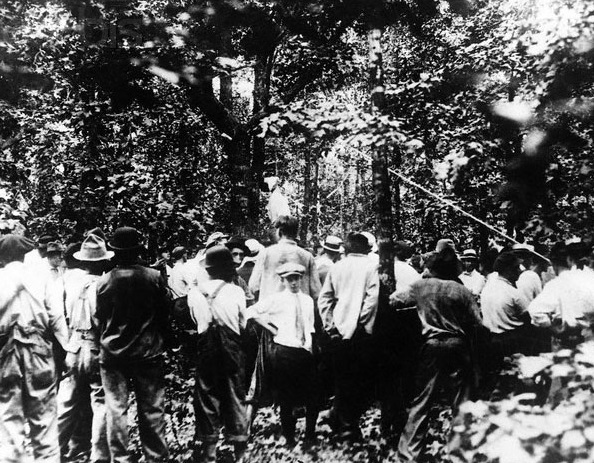
Frank is today widely thought innocent of the crime, although the Georgia Board of Pardons and Paroles has balked at issuing an unconditional pardon since so little of the original evidence survives. (A 1986 pardon came down “without attempting to address the question of guilt or innocence” in recognition of the slanted trial and the failure to protect Frank from lynchers.) But this was much more than a courtroom drama; the Frank affair crackles with the social tensions of early 20th century America. Industry and labor; integration; sexual violation; sectional politics; race and class and power.

Populist Party politician Thomas E. Watson, whose magazines made a dishonorable intervention by openly agitating for (and then celebrating) Frank’s lynching, captures the Zeitgeist for us as he fulminates against the nationwide campaign to grant the convicted murderer a new trial: “Frank belongs to the Jewish aristocracy, and it was determined by the rich Jews that no aristocrat of their race should die for the death of a working-class Gentile.” Frank came to enjoy (if that’s the right word) the editorial support of most of the country’s major papers, but the meddling of northern publishers, and of fellow Jews in solidarity,* arguably led Georgians to circle wagons in response. Present-day Muslims called upon to disavow every bad act by every other Muslim would surely recognize this no-win position.

But then we must also add that Watson himself, a lawyer, had been approached by Frank’s defense team hoping to enlist his bombast to defend their man at trial. The white supremacist demagogue would have been perfect for the job, for the legal battle pitted the credibility of a black janitor named Jim Conley against that of Frank.

Here amid the nadir of American race relations Frank’s team made its own ugly and unsuccessful pitch for racial solidarity with his neighbors. When formulaically asked by the court that had convicted him for any statement to mitigate the impending sentence, Frank replied that

my execution will make the advent of a new era in Georgia, where a good name and stainless honor count for naught against the word of a vile criminal; where the testimony of Southern white women of unimpeachable character is branded as false by the prosecution, disregarded by the jury and the perjured vaporings of a black brute alone accepted as the whole truth.

This violent collision of two vulnerable minorities each with the keen sense that one or the other of them was being outfitted for WASP America’s nooses makes for riveting and sometimes bizarre reading. Newspapers could hardly fail to note that the all-white jury (Leo Frank’s defense team struck all the blacks) had, as Frank complained, privileged the account of just the sort of “black brute” that Southern courts were accustomed to scorn, or railroad. Thus we have the NAACP organ The Crisis taking umbrage that “Atlanta tried to lynch a Negro for the alleged murder of a young white girl” but “a white degenerate has now been indicted for the crime.” It was likewise reasoned by some that since Conley was a young black man with a criminal record who was a potential suspect in the Deep South in the murderous sexual assault of a little white girl, “the mere fact that Conley did not long ago make his exit from this terrestrial sphere, via a chariot of fire is convincing proof that he, at least, is not the man who committed the deed.”** (New York Age, Oct. 29, 1914.)

In the end it was a zero-sum game between Jim Conley and Leo Frank: one of them was the murderer; each accused the other. Their respective desperate interests permeated to their respective communities. After Frank’s lynching, hundreds of Jews left Georgia; many who remained took pains to downplay their Jewishness.

By whatever circumstance police zeroed on Frank and the white community’s passion followed — tunnel vision that would eventually manifest itself in a circus courtroom atmosphere where the prosecuting attorney was cheered and defense witnesses hooted at and the ultimate outcome more demanded than anticipated. The judge feared that an acquittal would result in the summary lynching of not only Frank but his defenders.


Mary Phagan was killed on Confederate Memorial Day, the “holiday” this ballad alludes to.

Unusually for the time, appeals on the case reached the U.S. Supreme Court which declined to intervene — although two justices filed a dissent citing the egregious trial atmosphere.

Mob law does not become due process of law by securing the assent of a terrorized jury …

This is not a matter for polite presumptions; we must look facts in the face. Any judge who has sat with juries knows that in spite of forms they are extremely likely to be impregnated by the environing atmosphere … we think the presumption overwhelming that the jury responded to the passions of the mob …

lynch law [is] as little valid when practiced by a regularly drawn jury as when administered by one elected by a mob intent on death.

But that mob would still have its say. On the eve of Frank’s scheduled June 22, 1915 hanging, outgoing governor John Slaton commuted the sentence.

“Feeling as I do about this case, I would be a murderer if I allowed this man to hang,” the governor said. “It may mean that I must live in obscurity the rest of my days, but I would rather be plowing in a field than feel for the rest of my days that I had this man’s blood on my hands.”†

Frank was spirited away to the penitentiary under cover of darkness; it was hoped that the remote and reinforced edifice would deter any reprisal. It turned out that the furies who hunted Franks could not be dissuaded by mere inconvenience: a committee calling itself the Knights of Mary Phagan formed with the open object of organizing the intended mob vengeance — and indeed it was almost superseded in July of that year by a fellow-prisoner who slashed Frank’s throat as he slept.

Frank survived that murder attempt only to await the next one. Who knows what fancies frequented him in those weeks when he ducked from the shadow of the gallows to that of the lynching-tree, object of pity or hatred. He had time on the last day to savor his impending fate when the Knights methodically cut their way into the penitentiary — snipping the phone wires and disabling the vehicles — and marched their man out with nary a shot fired. Then, a convoy of automobiles “sped” (at 18 miles per hour) all the way back to a prepared execution-site at Marietta. The drive took seven or eight hours over unpaved country lanes, and for every moment of it Frank surely knew how it would end.

* Frank was a chapter president of the Jewish fraternal organization B’nai B’rith; the Anti-Defamation League of B’nai B’rith was founded in 1913 as a direct outgrowth of the Frank campaign.

As a contrasting response, the American Jewish Committee declined to participate in the Frank campaign for fear of lending counterproductive credence to charges such as those voiced by the New York Sun (Oct. 12, 1913):

The anti-Semitic feeling was the natural result of the belief that the Jews had banded to free Frank, innocent or guilty. The supposed solidarity of the Jews for Frank, even if he was guilty, caused a Gentile solidarity against him.

** Maurianne Davis’s Strangers and Neighbors: Relations between Blacks and Jews in the United States has a trove of interesting editorial comment from Frank’s contemporaries in the black press, and the Jewish press. Conley was actually the confessed accessory, and served a year in prison for it: he said that he complied with Frank’s order to hide the body for fear that his “white” boss could easily get Conley lynched for the crime. Conley also wrote (under Frank’s directive, he said) the preposterous “murder notes” found with the body that purported to be Mary Phagan’s dying indictment of Newt Lee, the African-American night watchman.

† The allusion to political suicide suggests Slaton’s mind was on the precedent of Illinois Gov. John Altgeld, whose career was destroyed by pardoning some of the Haymarket anarchists. If so, Slaton was quite correct; he actually had to flee Georgia altogether and could not return to the state for more than a decade.

On this day..