1864: Klatsassin and four fellow Tsilhqot’ins

On this date in 1864, five Tsilhqot’in warriors were hanged as common criminals in Quesnel, British Columbia, for resisting white incursion during the Chilcotin War.

The only possibly authentic image of Klatsassin extant. (From this image archive.)

An indigenous nation in northern B.C., the Tsilhqot’in or Chilcotin* had been relatively insulated — though not completely isolated; they had well-established fur-trading contacts from the early 19th century — from the colonization that had swept the continent over the preceding centuries.

In 1862, two cataclysms turned that world upside down.

First, a smallpox epidemic sweeping out of mining camps decimated the Tsilhqot’in population.

Second, gold was discovered in the adjacent inland Cariboo region — and the ensuing gold rush to the inaccessible vein saw whites laying multiple roads through Tsilhqot’in territory. At least one of the entrepreneurs racing to complete the first road might have exploited tribal labor and forced women into prostitution.

The specific internal mechanisms and deliberations that triggered the response are lost to us, but the community must have felt itself under siege — and certainly the building projects, unchecked, would serve to project crown authority into the tribal land. The roads, too, are a specific trigger in the European encounter with North American natives. If it had not been gold, it would have been something else, and soon.

The Chilcotin War or Chilcotin Uprising erupted in April 1864 when a Tsilhqot’in party slew a civilian road-building crew. Bloodthirsty rumors (sometimes unreliable) of Indian atrocities quickly set abroad in the colonial capitals.

Despite almost limitless land to disappear into, the leader, Klatsassin (or Klattasine, or Klatsassan), was captured that August with seven of his followers by the expedient of luring him under assurance that they would be treated as prisoners of war.

Instead, they were tried as common murderers. Five were condemned — including both Klatsassin and his son. (Two others were arrested the following year, and one of them hanged as well.)

In 1993, the government of British Columbia apologized for the executions.

There’s an out-of-print (but available used) book, The Chilcotin War by a descendant of one of the whites killed in it. Several links in this piece go to the excellent canadianmysteries.ca site on this incident, which contains a trove of text from primary documents of the time.

And “Canadian Mysteries” is the apt title. “Klatsassin,” in the native tongue, simply means, “we do not know his name.”


The peak in the center of this photograph is “Mount Klattasine,” and the glacier stretching towards the upper right is also named for the hanged war chief.

* Many other transliterations are possible: e.g., Tsilqut’in, T?inlhqot’in, Chilkhodin, Tsilkótin, Tsilkotin.

On this day..

2007: Five young men

Last year on this date, according to a Deutsche Presse-Agentur report of the Syrian news service, five youths were publicly hanged in Aleppo, Syria.

Syria executed five youths by hanging in a public square on Thursday after they were convicted of murder and robbery, the Syrian news agency reported.

The hanging was carried out in Bab al-Faraj, a public square in the centre of the city of Aleppo, 350 kilometres north of Damascus, in the early hours on Thursday, according to the agency.


Bab al-Faraj square.

A military court had convicted the men, aged between 18 and 23, of premeditated murder for the purpose of committing robbery, according to the online news service, Syriano.

Syrian human rights groups have called for the abolition of military courts, which were installed under emergency law in 1963.

On this day..

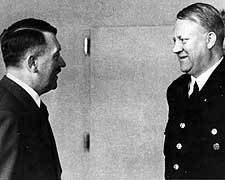
1945: Vidkun Quisling, who made his name as a traitor

On this date in 1945, eponymous Nazi collaborator Vidkun Quisling was shot at Oslo’s Akershus Fortress for high treason.

By the time of his death, the Nazi collaborator (English Wikipedia page | Norwegian) had already given his surname to English and other languages as a synonym for traitor.

Just deserts for his efforts as chief of the fascist party Nasjonal Samling to aid the Nazi conquest of his home country. Quisling interrupted a radio broadcast on April 9, 1940 to proclaim himself Prime Minister* and order cooperation with invading Germans.

Although Quisling’s lack of popular support compromised his value even as a puppet, he remained as Minister President of Norway through the war — a crucial tool in Germany’s counter-encirclement jousting with Britain, nicely explained at the outset of Frank Capra’s American propaganda flick Why We Fight:

He enjoyed public regard commensurate with his station.


A 1944 cartoon in Sweden (which remained tenuously neutral and unoccupied during the war) indicates that Quisling had already made his name a byword for treachery. The caption reads:
“I am Quisling.”
“And the name?”

Norway had abolished capital punishment in 1905, but its government-in-exile reinstated it expressly for dealing with high-level collaborators.

Though Quisling himself may have deserved this and worse, the justice and legality of so doing has been controversial ever since.


The site of Quisling’s execution. Some other shots from his trial are in this 60-year Norwegian-language retrospective.

* Thought to be the first on-air putsch in history.

On this day..

Feast Day of Boethius

(Thanks to Jeffrey Fisher [jeffreyfisher at me.com] for the guest post.)

Today is the feast day of Neoplatonic philosopher and Christian theologian Boethius (Anicius Manlius Severinus Boethius), author of The Consolation of Philosophy, and according to tradition martyred in 524 or 525, or possibly 526, by the Ostrogothic king Theodoric.

Well, maybe.

We know roughly as much about why Boethius was killed as when or how. We do know that he came from a line of prominent Romans (including a couple of popes back there, depending on who you count as “pope”), was himself consul in 510, and his sons were rather astonishingly joint consuls in 522. At that time he moved up to Ravenna accepting an appointment at Theodoric’s court as the Master of Offices, something like the equivalent of chief of staff, managing the work of Theodoric’s officers.

But then things went horribly wrong.

There is a long tradition, going back at least to the eighth century, regarding Boethius as having been executed for maintaining the Catholic faith against the Arian Theodoric. While Theodoric was probably paranoid about spies representing the Catholic eastern emperor-in-waiting Justinian (who would, in fact, later “reconquer” the Italian peninsula), and Boethius claims in the Consolation that he was hated for being smarter than everyone else, the truth is probably that he was caught up in the usual machinations of an imperial court.

A member of the Senate was accused of treasonably conspiring with Justinian’s predecessor Justin I against Theodoric. Boethius defended the accused (apparently the only person to do so, although the charges were surely trumped up), and in the Consolation, Boethius says he was only defending the Senate (implying that the accusations were meant to undermine the authority of the Senate by challenging its loyalty to the king).

In any event, the sources we have say that Boethius was condemned by the Senate (who appear to have thrown him under the bus) without being able to speak in his own defense. After an indeterminate time of imprisonment, he was executed.

It was while he awaited death that he wrote his most famous and arguably most influential work, The Consolation of Philosophy.

A few of the many editions of The Consolation of Philosophy available. Others are available free at Project Gutenberg (here, here and a Latin one here), as is a podcast version.

Boethius’ translations of and commentaries on ancient Greek philosophy were the only such texts available in Europe for much of the Middle Ages, but the Consolation was translated and widely read even outside of the philosophical circles in which his other work was so important.

Written in the form of Menippean satire (alternating verse and prose) as a dialog between Boethius and Philosophy, the Consolation is Boethius’s attempt to think through and make sense of the sad state of his affairs.

Ultimately, it was both the universal nature of the problem (why are these horrible things happening to me?) and the compelling way in which he tackled the problem (a combination of Plato, Aristotle, and Stoicism) that have made this text so widely read and imitated.

There is no way in this space to do justice to the Consolation, which addresses the very idea of philosophical discourse (“would you like us to clash together our arguments, for perhaps out of a conflict of this kind some beautiful spark of truth my fly out?”), the nature of time and God’s perspective outside of time, the difference between providence and fate, and the nature of and way to the Good itself.

But the gist of Boethius’s argument about the sufferings of the good person maybe be quickly summarized. In short, Boethius has forgotten his true nature, which never changes, and gotten caught up in the things of this world, which come and go. If he but remembers himself, he will have something no injustice, no turning of the wheel of fortune, can take away from him. And as for the unjust and the evil, they also have their “reward”:

But since goodness confers on each man his reward, he will only lack it when he has ceased to be good. [ . . . Now] since the good itself is happiness, it is clear that all good men are made happy for this reason, that they are good. But those that are happy, it is agreed, are gods; and therefore that is the reward of good men, which no time can lessen, no man’s power diminish, no man’s wickedness obscure, to become gods. These things being so for good men, no wise man can doubt either of the punishment inseparable from evil men; for since good and evil, and also punishment and reward, are directly opposite to one another, what we see added in the case of the good man’s reward must necessarily be reflected in an opposite manner in the evil man’s punishment. As therefore goodness itself is the reward for good men, so for wicked men wickedness is itself the punishment.

On this day..

1858: Marion Ira Stout, for loving his sister

It’s the sesquicentennial of a then-sensational, now-forgotten hanging in Rochester, N.Y.

At dawn on December 20, 1857, the city had awoken to the discovery of a mangled corpse by the Genesee River’s High Falls … and more than enough evidence to have the corpse’s killers in hand by tea time.

Marion Ira Stout — he just went by Ira — had made a dog’s breakfast of the job, according to History of Rochester and Monroe County New York from the Earliest Historic Times to the Beginning of 1907.

[W]hen they got near the edge of the bank, Ira struck his victim a sudden blow with an iron mallet, smashing the skull and producing death instantly. Stout then threw the body over the precipice, supposing that it would fall into the river and be swept into the lake before sunrise, but instead of that it landed on a projecting ledge thirty feet below the upper level. Perceiving that there had been some failure in the matter, Ira started to go down a narrow path that led sideways along the cliff, but in the darkness he missed his footing and fell headlong, breaking his left arm in the descent and landing beside the corpse. Summoning all his remaining strength he was just able to push the body over the bank, when he sank in a dead faint. On recovering from which in a few minutes, he called to his sister, who was still above, to come and help him. When she started to do so, the bushes to which she clung gave way; she stumbled, broke her left wrist, and fell beside her prostrate brother. But it would not do to remain there, wretched as was their plight. So, after searching in vain for Ira’s spectacles, which they had to leave behind them, but taking with them the fatal mallet, they scrambled slowly and painfully up the bank and made their way laboriously to their home on Monroe Street.

In lieu of a last statement, Stout referred his audience to this writing, which was published posthumously. Courtesy of the New York State Historical Association Library, Cooperstown, N.Y.

Sure enough, the glasses were waiting near the victim for the cops to find come daylight.

How did Ira, his sister, and the late Charles Littles — the sister’s husband — find themselves in this macabre dance?

That’s the murky bit, though it’s fair to say there was some negative energy in the family.

Littles was a violent, jealous, philandering drunk. His wife Sarah seems like the classic abused spouse. Ira was an ex-con who seemingly had his life back together. Oh, and Ira and Sarah were sleeping together — professedly true in the literal sense (they were observed to sleep in bed together in their underthings), and possibly true in the Biblical sense.

Now, where in this tangled knot of incestuous desire, domestic violence, protectiveness, jealousy and intrigue lies the motive is less than self-evident, but Ira and Sarah most definitely schemed to lure Charles to his demise. (Charles was found with a club which he’d brought to clobber a lover of Sarah that he’d been told would make a rendezvous.)

Still, the condemned charmer garnered sympathy for having saved his sister from an abusive marriage; Susan B. Anthony and Frederick Douglass rallied to his defense, and a female admirer smuggled him poison to cheat the hangman … which said admirer managed to end up ingesting herself, and barely survived.

Death got all ten-thumbed around Ira Stout, it seems. His hanging was no different.

The New York Times‘ archive has free access to the report of Stout’s execution, interestingly detailing the upward-jerking “sudden suspension” hanging apparatus in use for the job:

The gallows is the same which has always been in use in the jail — the rope, a hempen cord, alone being new. A weight of 186 pounds rests upon a swing door set in the garret floor of the jail. From this weight, the rope runs over two pulleys above, and the end of it drops through two doors, and nearly to the main floor of the jail. The weight falls about eight feet, jerking the slack end that distance. The halter attached to the main rope is a long distance below the main enginery of death, and the latter is not seen by the spectators or prisoner. The Sheriff stood at the foot of the stairs, some forty feet from the prisoner, and by a small cord pulled the latch which let the fatal weight fall.

But since this is Ira Stout, you know it didn’t come off without a hitch.

The death of the ill-fated man was not as sudden as could be desired. His struggles for eight or ten minutes were severe, and caused the spectators to turn away in disgust.

His neck was probably not dislocated, and he died by a slow process of strangulation. Doctors Hall, Avery, James and Miller stood near, and in eight minutes after the drop fell they said his pulse was as full as in life.

Sort of puts a grim twist on Stout’s own (fairly self-pitying) letters to the papers, in one of which he remarked, “I do not wish to show a cowardly tenacity for life, but I consider it my right and duty to live as long as I can.”

According to a feature story in the newsletter of Mount Hope Cemetery where Ira Stout takes his eternal rest, he might have tried to hang on quite a bit longer.

A rumor was current last night at a late hour that Stout was not dead, and that efforts were being made to resuscitate him by the use of galvanic batteries and other means sometimes employed for the restoration of persons supposed to be dead. How much truth there is in the rumors thus made we cannot say, as we have not taken pains to inquire at the house of Mrs. Stout.

No surprise, that didn’t work either.

On this day..

1407: Chen Zuyi, Zheng He’s prisoner

On an uncertain date this month in 1407, a Sumatran pirate was put to death in Nanking (or Nanjing) to the glory of the Yongle Emperor.

The day’s subject is not the corpse, but Zheng He (also known as Cheng Ho or Ma Sanbao), the Muslim Chinese eunuch-mariner whose early 15th century expeditions to the South China Sea, the Indian Ocean and beyond* pointed the way to a sea-striding colonial future that his country turned its back upon.

On the first of Zheng’s seven expeditions, his enormous fleet did battle with Chen Zuyi, whose own substantial armada based in Palembang controlled the strategic Strait of Malacca.

Five thousand pirates are said to have gone to Davy Jones’ locker in Zheng’s victory; his captured enemy got a ride back to the Chinese capital to be made an example of.

But Zheng’s heroics in this adventure and others did not long outlive the emperor Zhu Di.

He had rivals at court. Enormous treasure ships don’t come cheap, and though they brought back curiosities like giraffes, they didn’t earn back their investment in new tribute; the state budget had competing priorities, while China’s concern with the sea was so overwhelmingly fear of piracy that it all but shut down maritime activity for a time.

Though the pat story of Chinese isolationism might be a tad overstated, hindsight from New World locales with Spanish or English or French names rather than Chinese ones still can’t help but see the aborted age of discovery as a turning point.

An enormous, wealthy, centralized state on the rim of the Pacific Ocean, with the baddest seafaring flotilla around. If you had to pick the world’s probable leading colonial power of the coming centuries, you’d probably have put your money on China in October 1407.

Chen Zuyi sure would have.

* To America ahead of Christopher Columbus? To Italy to launch the Renaissance? To 1955 to inspire Chuck Berry? Hey, whatever pays the bills.

Point. Counterpoint.

On this day..

1865: Champ Ferguson, Confederate guerrilla

On this date in 1865, Champ Ferguson was controversially hanged at Nashville for the “murders” he committed as a Confederate guerrilla.

There seems to be some slight difference of opinion (and do click that link) over Champ‘s role in the War Between the States.

Had the Confederate cause prevailed, he probably would have been a hero. Since history is written by the winners … here he is instead.

For reasons that lie in the uncertain junction between personal enmity and sectional loyalty, the war’s start saw Ferguson terrorizing Union supporters in the Kentucky-Tennessee borderlands, operating primarily around Sparta, Tenn.

These were not only state borders, but borders between the rival federal and Confederate territories. Civil War borders, obviously, were hazy and violently contested affairs: Kentucky was northern-controlled but claimed by both sides (it had rival governments); Tennessee seceded only after Fort Sumter.

Loyalties within Kentucky and Tennessee were divided as well. Ferguson’s own brother died fighting for the Union, and his cousin was killed by Ferguson’s own men. But the main battles were fought far away, leaving the conflict to play out locally.

In many cases … guerrillas identifying with the Confederacy operated well outside Confederate lines and Confederate control, leading to a certain ambiguity in official attitudes, since they did have their uses.

Guerrilla activity was … a feature of those up-country or back-country areas of states like North Carolina, Georgia, Alabama, Tennessee and Kentucky, in which there were significant internal divisions in terms of sympathy for Confederacy or Union … guerrilla conflict was the only direct face of war experienced by many in Tennessee and Kentucky, since the movements of the main armies remained distant from them throughout. Unionist guerrillas, for example, controlled many of the counties of eastern Tennessee, while Confederate guerrillas disputed Union control of western Kentucky and middle Tennessee. One of the ironies of the situation in the Appalachians, the Cumberlands and the Ozarks was that, while these areas of rugged terrain were favoured by Confederate guerrillas, they were also the very areas within the Confederacy which most Union sympathisers inhabited

-Ian Beckett, Modern Insurgencies and Counter-Insurgencies

That was Ferguson — a “legendary Confederate partisan and guerrilla” or little better than a bandit, depending on your point of view. Either way, he was feared by area Unionists and renowned for killing prisoners. Stories of his savagery — severing heads and the like — made the rounds. Ferguson would argue (and did) that he did nothing his enemies weren’t also doing. (The New York Times printed a lengthy account (.pdf) of Ferguson’s versions of the many killings he was accused of — disputing some, frankly acknowledging many.)

That brings us back to winners and losers.

Ferguson, of course, got the losers’ treatment after the war; while vendettas against rank and file Confederate officers were not on the agenda, Ferguson’s irregular status and unbecoming reputation set him up for a war crimes trial. All attempts to claim wartime protections were rejected.

The Times account of his hanging this day — witnessed by his wife and 16-year-old daughter; their alleged rape is sometimes given as the reason for Ferguson’s campaign — is picturesque. (.pdf)

He stood composedly on the drop some twenty minutes, while the charges, specifications and sentence were read by Col. Shafter. He nodded recognition to several persons in the crowd, and shifted his position in an impatient manner while the sentence was being read. To some specifications he inclined his head in assent. To others he shook his head. That about Elam Huddleston caused him to say, “I can tell it better than that.” When the speaker read, “To all of which the prisoner pleads not guilty,” he said, “I don’t now.”


An 1865 Harper’s illustration of the hanging. See the way the troops surround the scaffold? There’s a bit of folklore that the military did that in order to fake the hanging and cut him down still alive.

Along with Henry Wirz, commandant of the notorious Confederate prison Andersonville, Ferguson was the only Confederate executed for Civil War “war crimes.”

Arguably somewhat neglected as a Civil War figure, Ferguson still has a few books detailing his life. An interview with the a author of the newly-published Cumberland Blood: Champ Ferguson’s Civil War is here.

A few books about Champ Ferguson

On this day..

2005: Wang Binyu, desperate migrant laborer

On this date in 2005, a Chinese murderer who became the unlikely symbol of migrant laborers’ desperate plight was — quickly and quietly — put to death.

Binyu knifed four people to death, which isn’t the typical stuff to earn a public outpouring. In the course of things, he’d ordinarily have gone to his grave in the anonymity that attends most Chinese executions, perhaps not even a number to international monitors who struggle to ballpark China’s executions to the nearest thousand.

But the government news service published a surprisingly sympathetic interview of him, raising the case up for public comment that state authorities surely did not intend.

Jobbed

Wang earned his sentence during an altercation that occurred as he tried to collect years of unpaid back wages from his employer. It was the last of several encounters of escalating desperation driven by Wang’s father’s need for expensive medical treatment. Wang’s boss kept refusing to settle with his man, ultimately barring him from the factory premises.

In a China shaken by industrialization — proletarianization — Wang’s plight struck a chord. (Although there may have been a mistaken sense that he killed the nasty boss; in fact, the victims were the foreman and other factory employees who’d been detailed to force him out.) China has 200 million migrant workers like Wang, collectively owed billions in unpaid wages they have scant prospect of recovering.

I want to die. When I am dead, nobody can exploit me anymore. Right?

Exploitation at an end, Wang Binyu became the subject of a Pulitzer Prize-winning profile* in the New York Times; some additional coverage is here. The briefly vigorous conversation about his case in China, however, was forcibly shut down.

* The Pulitzer was actually awarded to the Times’ Joseph Kahn and Jim Yardley for a series of articles on the Chinese justice system; the linked story on Wang Binyu is one of eight.

On this day..

31: Sejanus, captain of the Praetorian Guard

Over the course of this day in 31, Lucius Aelius Seianus went from virtual master of the Roman Empire to strangulation at the order of the Senate.

Patrick Stewart as Sejanus in I, Claudius.

Known simply as Sejanus, he was of equestrian stock who rose to prefect the Praetorian Guard when Tiberius succeeded Augustus as Rome’s first citizen.

It was not yet the “infamous Praetorian Guard”. Sejanus would make it so: his were the institutional aggrandizement — long outliving Sejanus — that would position the Guard to arbitrate imperial succession; his the persecutorial internal policing that made it a swords-and-sandals Gestapo.

Sejanus maneuvered skillfully towards supreme power in Rome — and ruthlessly enough that he is suspected of having murdered Tiberius’s son and heir Drusus. Though the Emperor refused a dynastic marriage with Drusus’s widow that would have set Sejanus up for official succession, the Praetorian had the purple in all but name in the late 20’s when Tiberius decamped for the dissolution of Capri.

The usual sort of thing ensued: spies, informers, purges and political murders.

The Republic had been down this road before. After the peace of Augustus, it was a chilling preview of Imperial Rome’s coming attractions.

Unlike most of those, the Sejanus issue was ultimately resolved without civil war. Finally wise to his captain’s game, Tiberius snuffed out the threat in a single blow without bestirring himself from his island retreat by sending word to convoke Sejanus and the Senate to elevate the soldier to the tribunate … and having a letter there read which demanded the soldier’s arrest.

That august old body — “men fit to be slaves,” in Tiberius’s estimation — took it from there. Sejanus was summarily executed this very evening, his body torn apart by the mob, and a witch hunt for his lieutenants and supporters immediately began.

Nice coverage of Sejanus and Tiberius on the History of Rome podcast.

[audio:http://c1.libsyn.com/media/17332/58-_Partner_of_my_Labors.mp3]

On this day..

1622: Anne de Chantraine, young witch

On this date in 1622, Anne de Chantraine was burned at the stake for witchcraft in Waret-la-Chaussee, Belgium.

Our day’s heroine answers most prominently to fictional modern interpretations — about which more in a moment — but Anne de Chantraine was a flesh-and-blood person, at least for 17 years.*

In outline form, Anne is said to have faced the usual litany of sorcerous allegations and the usual ordeals to demonstrate guilt, with the usual result: confession, execution. Here in the opening years of the Thirty Years’ War coeval with the the conflicts of the Protestant Reformation, one cannot but suspect the fearful hand of endangered authority in witch-hunts. Historian Hugh Trevor-Roper argued that

this recrudescence of the witch-craze in the 1560s was directly connected with the return of religious war … It can be shown from geography: every major outbreak is in the frontier-area where religious strife is not intellectual, a dissent of opinion, but social, the dissidence of a society. … Thereafter, almost every local outbreak can be related to the aggression of one religion upon the other.

Anne de Chantraine’s environs fit the theorem.

The Walloon region of Liege at this point was governed by a Catholic Prince-Bishop of Habsburg stock, just as the Holy Roman Empire was putting down the Protestant stirrings in Bohemia that would initiate Europe’s epochal war and send armies to and fro through the Low Countries. Said Prince-Bishop, name of Ferdinand of Bavaria, would win renown as a zealous persecutor of the diabolical in his realms.

Alas for Anne.

She’s a bit better documented among Francophones (see this biography in French, for instance, full of sensual details like the gorgeous red hair, a spurned lover accusing her, and the rough play of medieval torture; there’s also a brief roundup in German here), but worldwide, she’s a literary character of some consequence — most notably, perhaps, through the work of Belgian author Francoise Mallet-Joris: her 1968 Trois âges de la nuit (translated to English as simply The Witches) presents Anne de Chantraine as the focal point of one of three vignettes reimagining real historical “witches” as persons struggling for spiritual growth.

Anne, in this version, does participate in (staged, not-really-supernatural) witches’ sabbaths, plus a lesbian affair with a fellow participant. Her seekings both godly and infernal (paralleled by lifestyles both monastic and hedonistic) fall short of satisfactory; in the end, exercising magic unto her own death is a form of self-actualization among fellow people who, unable to recognize her humanity, brutalize or ignore her.

Players of the long-running video board game Atmosfear (or Nightmare) will also recognize Anne de Chantraine as a recurring witch character. The series uses recordings (VCR tapes originally; DVDs now) played during gameplay; “the witch” is featured as the central character in Atmosfear III/Nightmare III:

(In the comment thread for this video on YouTube, the French actress Frederique Fouche drops in to confirm her part as the witch. According to this French interview, the role caused her to become an emigre in Australia.)

* Some reports say she was burned at age 17, others that she was arrested at 17, which would have made her 18 or 19 at her death.

Part of the Themed Set: Belles Epoque.

On this day..