This afternoon in Paris, 1793, the French Revolution devoured the Queen.
Thirteen-year-old Madame Antoine — a year before marriage, and rebranding as Marie Antoinette. A vast gallery of her portraiture awaits here.
Among the most emblematic death penalty victims in history, Marie Antoinette — the “widow Capet,” as she was styled in egalite, after the guillotine shortened her husband — had the bad luck to personify the decadence of the ancien regime under the hegemony of the sans-culotte.
(And, of course, the good luck to be born heir to all the perks of absolutism she enjoyed for the first thirty-plus years of life. So, you know: a mixed bag.)
Those infamous excesses — and her infamous alleged bon mot, “let them eat cake” — are said to have been greatly exaggerated, nothing that everyone wasn’t doing, nothing that wasn’t understandable under the circumstances.
She had a gift, it seems, for accumulating to her personal reputation the outrage incurred by every gross and petty indulgence of the old order. And she had a popular press, the libelles, ready to embroider them salaciously.
Jacques-Louis David sketched this portrait of a haggard Marie Antoinette en route to the guillotine.
Cruel, wanton, senseless … her death was all of these, but then many others in the Terror suffered the same, as many others had under the Bourbons.
As royal dynastic pairings go, she’d been dealt a bad hand.
Her mere presence in France was fruit of the controversial policy of alliance with the Austrian Habsburgs from the Seven Years’ War, and she was trundled off with her dowry and her teenage wiles to the foreign snakepit of Versailles just as the minister advancing that policy fell. Distrusted by the French as an Austrian catspaw, castigated by her family for her inadequacies thereto, socially expected to display conspicuous regal largesse during a budget crisis not of her making, and unable for the longest time to get a successful coition from her indifferent and/or impotent husband, it must have seemed to her some days like every play was a losing one.
She struggled to gain traction at court. But she would lose much more than influence.
I was a queen, and you took away my crown; a wife, and you killed my husband; a mother, and you deprived me of my children. My blood alone remains: take it, but do not make me suffer long. (WikiQuote)
Her bearing she kept forever: in a kangaroo court with a foreordained outcome where her imperious dignity still managed to turn aside an accusation of sexual abuse her son had been cajoled into supplying; on the scaffold, when she did not neglect courtesy to the executioner whose foot she trod:
“Monsieur, je vous demande pardon. Je ne l’ai pas fait exprès.”
For much more queenliness, Marie-Antoinette.org delivers what the url promises, in quantity. If this figure or this period appeals, be sure to browse its forums.
Naturally, the doomed queen has had plenty of attention from printed word as well:
At 5 a.m. this date in 1917, Margaretha Geertruida Zelle — better known as Mata Hari — was awoken at Saint-Lazare Prison to news that it was her last day on earth.
She died in a muddy drill field outside Paris, facing a firing squad as she had lived: self-possessed, mysterious, her eyes (she refused a blindfold) open.
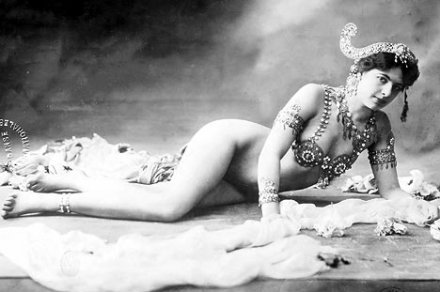
For the oldest profession, it may be there is nothing truly original, nothing new under the sun. But Mata Hari — thanks in no small part to her genuinely fatale end — redefined it for the dawning age of mass visual media and tapped the power of sexual allure for a commercial century.
She was already pushing 30 when she got into the exotic dance game, with a failed May-December marriage behind her from what a wag might call her first sexual bargain, to get out from under the thumb of her family and see the world. In Paris in the belle epoque, there were assuredly dancers younger, prettier. Margaretha, who here debuted the show name by which history would know here, surpassed them with showmanship.
She exploited her exotic olive-toned looks — there were rumors of Javanese or Jewish blood even in her childhood — and claimed to be an Indian princess; her talent for repackaging oriental exoticism with just the right amount of otherness combined with her willingness to push boundaries of eroticism made her an instant sensation. Naturally gregarious and unprudish, she segued into the courtesan biz on the side with dashing officers and wealthy industrialists.
Not bad for a thirty-something mother of two.
She comes at the start of our own era: sensual postcards and posed photos of Mata Hari were at once her pitch and her product; celluloid was just coming online, and 14 years after her death, she’d be portrayed by silver screen femme fatale Greta Garbo:
That’s her with the last object of her affections, a Russian aviator young enough to be her son, and a reminder that the birth of Greta Garbo’s era was also the death of Mata Hari’s own.
She was aging, for one thing. For another, of course, war shattered Europe. Famous, decadent, polyglot … those things that had been her passport suddenly became her liabilities. Globetrotting travel? Payoffs from a multinational cast of officers for her companionship?
There’s no take here on whether she was really, as convicted, a German spy of any variety at all — she seems to have been approached, to have tried her hand clumsily or to have been set up by either French or German intelligence, or simply to have behaved indiscreetly. Once she was caught up against events, her maneating reputation did her no favors.
Spying, she was terrible at. Commanding men’s attention? As a British correspondent reported, Margaretha Zelle owned her role to the very last.
The first intimation she received that her plea had been denied was when she was led at daybreak from her cell in the Saint-Lazare prison to a waiting automobile and then rushed to the barracks where the firing squad awaited her.
Never once had the iron will of the beautiful woman failed her. Father Arbaux, accompanied by two sisters of charity, Captain Bouchardon, and Maitre Clunet, her lawyer, entered her cell, where she was still sleeping – a calm, untroubled sleep, it was remarked by the turnkeys and trusties.
The sisters gently shook her. She arose and was told that her hour had come.
‘May I write two letters?’ was all she asked.
Consent was given immediately by Captain Bouchardon, and pen, ink, paper, and envelopes were given to her.
She seated herself at the edge of the bed and wrote the letters with feverish haste. She handed them over to the custody of her lawyer.
Then she drew on her stockings, black, silken, filmy things, grotesque in the circumstances. She placed her high-heeled slippers on her feet and tied the silken ribbons over her insteps.
She arose and took the long black velvet cloak, edged around the bottom with fur and with a huge square fur collar hanging down the back, from a hook over the head of her bed. She placed this cloak over the heavy silk kimono which she had been wearing over her nightdress.
Her wealth of black hair was still coiled about her head in braids. She put on a large, flapping black felt hat with a black silk ribbon and bow. Slowly and indifferently, it seemed, she pulled on a pair of black kid gloves. Then she said calmly:
‘I am ready.’
The party slowly filed out of her cell to the waiting automobile.
The car sped through the heart of the sleeping city. It was scarcely half-past five in the morning and the sun was not yet fully up.
Clear across Paris the car whirled to the Caserne de Vincennes, the barracks of the old fort which the Germans stormed in 1870.
The troops were already drawn up for the execution. The twelve Zouaves, forming the firing squad, stood in line, their rifles at ease. A subofficer stood behind them, sword drawn.
The automobile stopped, and the party descended, Mata Hari last. The party walked straight to the spot, where a little hummock of earth reared itself seven or eight feet high and afforded a background for such bullets as might miss the human target.
As Father Arbaux spoke with the condemned woman, a French officer approached, carrying a white cloth.
‘The blindfold,’ he whispered to the nuns who stood there and handed it to them.
‘Must I wear that?’ asked Mata Hari, turning to her lawyer, as her eyes glimpsed the blindfold.
Maitre Clunet turned interrogatively to the French officer.
‘If Madame prefers not, it makes no difference,’ replied the officer, hurriedly turning away. .
Mata Hari was not bound and she was not blindfolded. She stood gazing steadfastly at her executioners, when the priest, the nuns, and her lawyer stepped away from her.*
The officer in command of the firing squad, who had been watching his men like a hawk that none might examine his rifle and try to find out whether he was destined to fire the blank cartridge which was in the breech of one rifle, seemed relieved that the business would soon be over.
A sharp, crackling command and the file of twelve men assumed rigid positions at attention. Another command, and their rifles were at their shoulders; each man gazed down his barrel at the breast of the women which was the target.
She did not move a muscle.
The underofficer in charge had moved to a position where from the corners of their eyes they could see him. His sword was extended in the air.
It dropped. The sun – by this time up – flashed on the burnished blade as it described an arc in falling. Simultaneously the sound of the volley rang out. Flame and a tiny puff of greyish smoke issued from the muzzle of each rifle. Automatically the men dropped their arms.
At the report Mata Hari fell. She did not die as actors and moving picture stars would have us believe that people die when they are shot. She did not throw up her hands nor did she plunge straight forward or straight back.
Instead she seemed to collapse. Slowly, inertly, she settled to her knees, her head up always, and without the slightest change of expression on her face. For the fraction of a second it seemed she tottered there, on her knees, gazing directly at those who had taken her life. Then she fell backward, bending at the waist, with her legs doubled up beneath her. She lay prone, motionless, with her face turned towards the sky.
A non-commissioned officer, who accompanied a lieutenant, drew his revolver from the big, black holster strapped about his waist. Bending over, he placed the muzzle of the revolver almost – but not quite – against the left temple of the spy. He pulled the trigger, and the bullet tore into the brain of the woman.
Mata Hari was surely dead.
* Inevitably, a story got around that she’d opened her funereal coat to the firing squad, revealing no clothing beneath it.
On this date in 1959, a disturbed Japanese serial killer was hanged for eight murders.
A past generation’s emblem of monstrousness, Genzo Kurita (English Wikipedia page | Japanese) was invoked on the floor of the Diet as a reason to keep the death penalty.
And no wonder.
He was caught early in 1952 for murdering a 24-year-old and her 63-year-old aunt, and defiling the younger woman’s body. Those murders led to a death sentence a few months later, but they also led to a string of unsolved homicides: another murder-necrophilia crime the previous summer, and the notorious Osen Korogashi incident, when he threw a rape victim’s family over the Osen Korogashi cliffs.*
He got a separate death sentence for those murders (plus two other earlier ones) later in 1952.
A touch unstable — obviously — Kurita withdrew his own appeals in 1954 to get it over with, but it still took the ponderous Japanese death penalty system the best part of the decade to see him to the gallows.
Most of what’s online about Genzo Kurita is in Japanese, like this more detailed survey of his life in crime.
* The raped mother, and three children; one of the children survived. The Osen Korogashi (or Osenkorogashi) cliffs, as it happens, have their own eerily topical legend of the generous daughter of a cruel lord being thrown over the precipice in her father’s place, prompting him to see the error of his ways.
On this date in 1660, the restored House of Stuart began a week of bloody justice against Charles I‘s regicides by hanging, drawing and quartering Thomas Harrison at Charing Cross.
Stuart Little
Charles’ son and heir Charles II had been stuck on the continent during the 1650’s, until the Commonwealth came apart from its own internal contradictions after the death of Oliver Cromwell.
The first thing on everyone’s mind was what to do about the little matter of having lopped off his dad’s head.
Political reality drove the settlement: nearly everyone in the English gentry had in some manner acquiesced to the Commonwealth during its decade-plus turn steering the ship of state; an expansive line on treason would be a nonstarter. At the same time, His Soon-To-Be-Royal-Again Majesty expected a few examples made to do right by the old man and keep king-killing well off his future subjects’ agenda.
Weeks of frantic negotiating between the parties and private settlements of borderline cases with the royalist camp preceded the action. But Thomas Harrison wasn’t part of any of it.
… Entrails you Lose.
The rigid Puritan, one of 59 who signed the last king’s death warrant and at one time the commander of England’s armies, had been on the outs with everyone since Cromwell set up the Protectorate in 1653. Godly Tom was a “Fifth Monarchist,” anticipating the imminent return of Christ perhaps in conjunction with the imminent year 1666 … and no government felt safe about these millenarians. He’d been imprisoned several times by the Protectorate, too.
Though many attainted regicides fled for Europe or America, Harrison (possibly motivated by age and infirmity) hung out, waited for arrest, and took his punishment stolidly.
God hath covered my head many times in the day of Battle. By God I have leaped over a wall, by God I have runned through a Troop, and by my God I will go through this death.
Specifically meaning, drawn on a hurdle from Newgate to Charing Cross (with a fine vantage for the doomed on Whitehall, where Charles I had met his end), hanged but revived, his genitalia cut off and bowels carved out and burned while still conscious, and finally beheaded and his body divided into quarters for gruesome public display around town.
You have selected regicide.
Harrison died on a Saturday, and his was the opening act of a busy week in the bowel-burning business; nine other fellow regicides condemned with him would share that fate during the week ahead:
John Carew, on Monday the 15th;
John Cook and Hugh Peters, on Tuesday the 16th;
Thomas Scot, Gregory Clemen, Adrian Scroop and John Jones, on Wednesday the 17th;
Francis Hacker and Daniel Axtel, on Friday the 19th.
[h]e was a fierce and bloody enthusiast. And it was believed, that, while the army was in doubt, whether it was fitter to kill the king privately, or to bring him to an open trial, that he offered, if a private way was settled on, to be the man that should do it. So he was begun with. But, however reasonable this might be in itself, it had a very ill effect: for he was a man of great heat and resolution, fixed in his principles, and so persuaded of them, that he never looked after any interests of his own, but had opposed Cromwell when he set up for himself. He went through all the indignities and severities of his execution, in which the letter of the law in cases of treason was punctually observed, with a calmness or rather a cheerfulness that astonished the spectators.
“As cheerful as any man could do in that condition”
And this coda is attested by the age’s famous diarist, Samuel Pepys, whose neat and oft-quoted summation of Harrison’s fate runs thus:
I went out to Charing Cross, to see Major-General Harrison hanged, drawn, and quartered; which was done there, he looking as cheerful as any man could do in that condition … Thus it was my chance to see the King beheaded at White Hall, and to see the first blood shed in revenge for the blood of the King at Charing Cross.
Who overcomes by force hath overcome but half his foe
As might be expected, vindicated royalists sought more blood than the handful of exemplars could furnish. What compromise could expiate the sin of regicide?
Poet and polemicist John Milton, having been propagandist-in-chief for the now-abortive revolution, endured the jeers of his enemies for the conspicuously apolitical stuff (a grammar book!) by which he would set his table in the years ahead.
Upon John Milton’s not suffering for his traiterous Book when the Tryers were executed, 1660.
That thou escaped’st that vengeance, which o’ertook,
Milton, thy regicides, and thy own book,
Was clemency in Charles beyond compare:
And yet thy doom doth prove more grievous far.
Old, sickly, poor, stark blind, thou writest for bread:
So for to live thoud’st call Salmasius from the dead.
Early this morning in 1915, the German military occupying Belgium shot aid worker Edith Cavell at Brussels for aiding the British war effort.
The matronly nurse had been condemned only the day before by a German military court for helping Allied soldiers escape from behind German lines — charges Cavell readily admitted. The British chaplain who attended her the night before her death reported her saying (not actually her last words, but recalled as her parting sentiment, as it were):
But this I would say, standing as I do in view of God and eternity, I realize that patriotism is not enough. I must have no hatred or bitterness toward any one.
So naturally, she immediately became the Entente’s bloody banner of the barbarous Hun, helping dramatically ramp up recruitment for the other team’s set of moral cretins.
The thing is, the Germans actually had a point. Cavell ran a nursing school in Brussels, and courageously stuck around when the Germans smashed through Belgium as World War I opened. She’s sometimes remembered as getting in hot water for treating the wounded regardless of nationality, but she did a lot more than that: she got involved with an underground railroad funneling Allied soldiers back to enemy countries.
It was one of those impossible trials of conscience that wartime brings: Cavell, whose hospital was subsumed by the Red Cross during the war, should technically have remained neutral; her actions did bring material aid to Germany’s foes.
However, Belgian, French and English troops caught behind lines by the Germans’ lightning advance were in danger themselves of summary execution, as were civilians who harbored them. Neutrally treating them and handing them over as POWs might have been tantamount to killing many of them, especially in the first few months of the war. Though Edith Cavell said that “I am happy to die for my country,” her actions look more humanitarian than nationalistic — the best choice to be made when no good ones are available. Patriotism of a higher order, if you like.
Probably Cavell’s was a case tailor-made for executive clemency, but Germany was keen to send one of those proverbial messages: civilians in occupied countries had best stay out of the war. Despite the frantic lobbying of England’s ambassadors (and, ominously for Germany, those of the United States), the sentence was carried out on both Cavell and a fellow-traveler in her network, Belgian Philippe Baucq.
Clumsy propagandists, the Kaiser’s boys badly misjudged the message so sent.
In the face of intense international outcry, Germany soon found itself defending its actions (.pdf), and then commuting the sentences (.pdf again) of Cavell’s other collaborators.
None of this abated Cavell’s stupendous propaganda value to Germany’s enemies. And — holy wow, the graying 49-year-old gets made over into quite the heartbreaker in most of these.
The nurse’s repute — and she was said to have struck a Joan of Arc-like chord in those parts — caused a renaissance for the name “Edith” among French and Belgian newborns, most notably singer Edith Piaf (born in December 1915). While Cavell’s sacrifice did nothing to stem her name’s declining Anglo (or at least American) popularity, there is a Mount Edith Cavell named for her in Canada, and a plethora of monuments and public spaces dedicated to her throughout the Allied powers’ lands. (Here are just a handful.) And she still packs enough symbolic punch for the current British Prime Minister Gordon Brown to deploy her in the propagandist’s subtler modern arts.
There’s plenty more about her online, but world headquarters (with information about the Cavell Festival) is edithcavell.org.uk. There’s also a stupendous collection of text and images (several already used in this post) at the sometimes slow-loading but endlessly fascinating site The Great War in a Different Light.
On this date in 1936, the Spanish composer Antonio José was shot by Falangists during the Spanish Civil War.
The 33-year-old Burgos native (English Wikipedia page | the more detailed Spanish) was a rising young star, a writer, teacher and “folklorist” who had only that April earned plaudits for a paper on popular songs at an international musicology conference.
That July, the Spanish Civil War erupted … and the fascists clapped him in irons and shot him in the marshes near Estepar, Spain. I have not been able to find any clear documentation as to specifically how he earned the death sentence — which is not to say that the Spanish Falange deserves the benefit of the doubt for the regularity of its judicial procedures.
Despite Maurice Ravel’s (pre-Civil War) opinion that Jose would become “the Spanish composer of our century,” Jose’s work vanished into obscurity after his untimely death. Pieces like this Sonata Para Guitarra have only recently been widely rediscovered.
On the tenth day of the tenth month — Double Ten Day, as it has since been remembered in China and the Chinese diaspora — the quick execution of a few revolutionaries signaled the surprising end of China’s 2,000-year-old imperial government.
The Qing Dynasty was a tinderbox. But one never knows what spark will set the flame.
On October 9, 1911, revolutionaries in the central China town of Wuchang — today merged with neighboring towns into the city of Wuhan — lit the fuse literally when a bomb they were building for a planned insurrection accidentally went off.
In the ensuing scramble, police raided the joint and found incriminating lists of thousands of revolutionary recruits. Arrests followed fast, and several (three*) of the arrested were summarily put to death on the morning of the tenth.
But the plot’s apparent misfortune actually turned out to be its spur to victory.
Realizing that their identities were exposed to the authorities, and that they were in danger of immediate execution, the revolutionaries … revolted.
While the central government dilated, insurrectionary Wuchang appealed to the provinces for solidarity, and within weeks the Wuchang Uprising had blossomed into full-fledged revolution: the Xinhai Revolution, to be exact. By the following February, China’s last child-emperor had been forced to abdicate.
For the first time in millennia, the fallen dynasty was not succeeded by another dynasty. Though the new state was itself heir to the myriad contradictions and weaknesses that dogged the Qing, it was a definitive turning point: China became Asia’s first democratic republic, the polity that today is Taiwan.
* The names Peng Chufan, Liu Yaocheng and Yang Hongsheng are proposed in this history.
The Argentinian-born doctor turned Cuban revolutionary icon and the man who wrote the book on guerrilla warfare had put abroad to foment insurgency. His efforts in the Congo foundered; his bid to replicate the Cuban revolution in Bolivia was doing likewise when he was captured.
After holding him overnight, the government sent a coded order to execute him in the field. Che had done the same thing with his own hands to several who betrayed the Sierra Maestra guerrillas.
CIA asset (and George Bush Sr. confidante) Felix Rodriguez took his watch as a trophy. The rest of Che Guevara belongs to the world.*
This site could hardly attempt a definitive rendering of such a towering and controversial figure, a task fit for two, three, many biographies.
Lengthy video documentaries are here and here. Many of Che’s own words are collected here. Declassified U.S. National Security Archive documents relating to his capture and death are here.
On this date in 1997, serial killer Ricky Lee Green died by lethal injection in Texas.
The radiator repairman was executed specifically for castrating and stabbing to death Steven Fefferman in 1986, but he killed at least three other people — two women and a 16-year-old boy — and investigators associated his m.o. with up to eight other unsolved murders. (Green also copped to another murder after his conviction, possibly to help another man, William Chappell, avoid execution. It didn’t work; Chappell was executed for that crime in 2002.)
“They all deserved it. They were kind of the dregs of society.”
“A Jekyll and Hyde thing” is how Green’s true-crime biographer characterized him — a lifetime of physical and sexual abuse and a drug habit dating to childhood had seriously warped the dude.
And the most famous serial killer from tiny Boyd, Texas might’ve kept getting away with it if wasn’t for his darn estranged wife.
Someone sure was grateful for Sharon Dollar Green’s help: even though she’d participated in some of the murders, she shopped hubby and skated with ten years’ probation as more Green’s victim than his accomplice.
Green went the popular “death row conversion” route while awaiting the inevitable, or so — atheists in foxholes and all — maintained his last statement.
I want to thank the Lord for giving me this opportunity to get to know Him. He has shown me a lot and He has changed me in the past two months.
I have been in prison 8 1/2 years and on death row for 7, and I have not gotten into any trouble. I feel like I am not a threat to society anymore. I feel like my punishment is over, but my friends are now being punished.
I thank the Lord for all He has done for me.
I do want to tell the …
But the lethal cocktail had begun, and the sentiment went to the grave with Ricky Lee Green.
On this date in 1943, after Japanese-occupied Wake Island was subjected to a withering bombardment from the United States Navy, garrison commander Shigematsu Sakaibara ordered the summary execution of 98 American prisoners of war.
It was strategically situated halfway between Hawaii and the Philippines. That’s why the Japanese wanted it — and that’s why the Americans wanted it back.
Caught in the middle were 1,600-plus Americans captured when Wake fell in December 1941, 1,100 of them civilian contractors of construction conglomerate Morrison Knudsen there to build a naval base. Most of these, and all military personnel, were shipped to POW camps in China early in 1941; only 700 contractors would survive their four-year sojourn in Japanese captivity.
By September 1942, only 98 Americans remained* on Wake Island — all contractors, the last remnants of the prison labor force who had been forced to lattice the island with defensive fortifications against the expected American invasion.
U.S. forces bombed Wake Island repeatedly during World War II — rare respites from the monotony of forced labor — but the most intense attack was an orchestrated naval bombardment and aerial attack beginning Oct. 5. Shigematsu Sakaibara feared it was the prelude to a long-anticipated landing attempt. And he wasn’t the only one: reporting the attack, the New York Timestried to read the tea leaves of the official pronouncements:
The fact that Wake was attacked yesterday by surface bombardment as well as aeriel bombing probably indicates that a major reduction of Wake is now intended. The atoll, which is the closest Japanese base to Pearl Harbor with the exception of a few islands in the Marshalls group, is a key stepping stone on Japan’s fastest aeriel route to her other central Pacific possessions in the Marshalls and Gilberts southwest of Hawaii.
Still,
[o]ccupation by United States forces of Wake Island, which is 1,033 miles from Midway, has been predicted for some time, but there is no indication that such an operation is probable immediately.
Sakaibara, unfortunately, didn’t have a Times subscription.
Expecting a landing, and fearing the prisoners would rise up as a “fifth column” against their captors when it came, Sakaibara had the 98 prisoners machine-gunned en masse on the beach. One of them managed to survive and escape the slaughter, but was recaptured shortly after, and is supposed to have been personally beheaded by the admiral. It’s said that unidentified man carved a (misdated) testimony to the crime on a nearby coral rock known as “98 Rock”: “98 US PW 5-10-43”.
As it turned out, the landing never did come. The U.S. Navy bypassed Wake Island, allowing it to languish under a blockade as it advanced elsewhere in the Pacific, and received Sakaibara’s peaceful surrender after the bombings of Hiroshima and Nagasaki.
Although the Japanese had hastily exhumed the murdered POWs and reburied them in a cemetery as the end of the war approached, the cover story on the “Wake Island Massacre” soon cracked. For this day’s affair, Sakaibara was convicted of war crimes by an American tribunal, and hanged in Guam on June 18, 1947.



 A past generation’s emblem of monstrousness, Genzo Kurita (
 The
The 


