1849: Lajos Batthyány and the 13 Martyrs of Arad

On this date in 1849, the shining lights of Hungary’s 1848 revolution met the Austrian Empire’s firing squadsexecutioners. (Correction: Most were hanged, not shot. See comments.)

Probably no polity in Europe stood more fundamentally in danger from the wave of 1848 revolutions than the Habsburg Empire. While governments would be overthrown and power renegotiated across the continent, the Austrian state’s dynastically welded hodgepodge of mingled ethnicities appeared existentially at odds with the nationalist stirrings afoot.

And none of those ethnicities answering to Vienna stirred as vigorously as the Hungarians.

The Hungarian Diet established a national government under Lajos Batthyány (English Wikipedia page | Hungarian) (or Louis Batthyani) in the spring of 1848* and soon pushed for more self-determination than Austria was prepared to countenance.

When Austrian troops turned on Hungary, the aspiring nation issued an 1849 declaration of independence full of vituperation for the ancient noble line.

[T]he house of Hapsburg-Lorraine, as perjured in the sight of God and man, has forfeited its right to the Hungarian throne …

Three hundred years have passed since the Hungarian nation, by free election, placed the house of Austria upon its throne, in accordance with stipulations made on both sides, and ratified by treaty. These three hundred years have been, for the country, a period of uninterrupted suffering.

This dynasty … which can at no epoch point to a ruler who based his power on the freedom of the people, adopted a course toward this nation from father to son, which deserves the appellation of perjury.

The house of Austria has publicly used every effort to deprive the country of its legitimate independence and constitution, designing to reduce it to a level with the other provinces long since deprived of all freedom, and to unite all in a common link of slavery.

Guess how that turned out.

Lajos Batthyany portrait by Hungarian painter Miklos Barabas.

It wasn’t much of a contest in the field, leaving this day’s doings the shooting of Batthyany at Pest (the city later merged with Buda and Obuda to form Budapest) and 13 Hungarian generals — the so-called 13 martyrs of Arad — in a Translyvanian city that is today part of Romania.

This was not, however, the last the Habsburg dynasty would hear of Hungary’s frustrated national aspirations.

Three years later, a Hungarian nationalist attempted to assassinate the youthful Emperor Franz Joseph,** and the strength of the Magyar lands’ self-determination movements would eventually drive a formal ratification of Hungarian privileges that rechristened the state as the Austro-Hungarian Empire, or simply Austria-Hungary.

All that stuff we said about you Habsburgs? Bygones.

While becoming half of a dual capital opposite Vienna meant a late 19th-century renaissance for Budapest, this cure by the Empire for its internal pressures proved almost as harmful as the disease. The pressures immediately discharged would pale in comparison to the conflicts Hungarians’ now-privileged status helped provoke with Slavs and other ethnic minorities (exacerbated by Hungarians’ ability to block Austrian foreign policy). In an early preview of a now-familiar pattern, the proto-nation-state of Hungary was a nastier piece of work for its ethnic minorities than the decadent old melting-pot ruled from Vienna … and the road from this day’s executions to the Austro-Hungarian Compromise ran straight on to 1914 Sarajevo and the graveyard of Habsburg history.

As for the executions this day, Batthyany was saluted by the great Hungarian composer Franz Liszt in his Funerailles:

More prosaically and much more pervasively, a legend that Austrians were jovially toasting the death of the 13 Martyrs as they were being executed translated into a still-active tradition against clinking beer glasses in Hungary.


The Martyrs of Arad (Sixth of October) by Janos Thorma

* Hungary’s March 15 National Day derives from this period.

** Franz Joseph was no mere abstract emblem of imperial absolutism: he had assumed the Austrian throne in December 1848 upon the abdication of his feebleminded uncle specifically to free the crown from the oaths his predecessor had taken to various reforms. From the Hungarian perspective — and the declaration excerpted above dwells at length on the perfidy of this maneuver — he was installed to crush the revolution.

On this day..

2007: A factory manager in a packed stadium

Last year on this day, six people were reportedly trampled to death when a massive crowd stampeded after watching the execution of a 75-year-old factory manager in North Korea.

The man, who is not named in English-language sources I’ve perused, had fabricated his father’s past as a good Communist when in fact dad worked to suppress the reds. That con kept the family among North Korea’s privileged elite for years.

According to the South Korean nonprofit Good Friends, he faced a snap tribunal and immediate execution in Suncheon this day, in a stadium with 150,000-plus* onlookers, part of a campaign of stepped-up public executions that Good Friends says (.doc) has been driven by the insular country’s decade-long famine. (See another one — illicitly filmed graphic video included — here.)

And he wasn’t the only one to depart the premises in a body bag. The stampede is said to have occurred after the proceedings as spectators were leaving; the cause, if there was one, is sketchily described, although some news reports call it a “melee.” Thirty-four others were reportedly injuried in the crush.

* The figure 170,000 is also cited.

On this day..

1621: Not Katharina Kepler, thanks to her son Johannes

On October 4, 1621, the Duke of Württemberg declared Katharina Kepler free of a witchcraft charge for which she had barely avoided execution … with the help of her son, the astronomer Johannes Kepler.

The famous scientist was very well along his career, and his mother (German Wikipedia link) a too-old-for-this-crap 69, when authorities in her native town of Leonberg initiated proceedings in 1615.

It says here she was an eccentric, cantankerous old dame, just the sort liable to face a gossip campaign that would promote her into partnership with the Evil One. She was only one of a number of people targeted in the town’s witch-spasm, noticeably occurring as the Catholic-Protestant conflict was stoking that crucible of modernity, the Thirty Years’ War — a fine time and place for infernal superstition.

Several of the suspected were put to death.*

Kepler, whose heterodoxy and heliocentrism made him a touchy figure in a fraught time for scientists, might have done her no favors with his trippy Dream, whose overt musings on “daemons” and the like might have drawn suspicion onto the family. Johannes made six years of atonement struggling — ultimately successfully — to keep his mother alive and untortured.

Commuting back and forth from his work in Linz (showing an admirable capacity for keeping his head while others about him were in danger of losing theirs, Kepler discovered his third law of planetary motion in 1618; apparently he also read Galileo’s father on one of the trips between Linz and Leonberg), he organized his mother’s defense and wrote her briefs in his own hand.

It finally paid off.

The judicial college at the University of Tübingen — Kepler had matriculated there as a younger man — opened the door to Katharina’s release by declaring the evidence insufficient either way, and issuing a split-the-baby conviction directing that she be shown but not subjected to the instruments of torture.

On September 28, 1620, the Feast of St. Wenceslas, the executioner showed Katharina Kepler the instruments of torture, the pricking needles, the rack, the branding irons. Her son Johannes Kepler was nearby, fuming, praying for it to be over. He was forty-nine and, with Galileo Galilei, one of the greatest astronomers of the age — the emperor’s mathematician, the genius who had calculated the true orbits of the planets and revealed the laws of optics to the world. Dukes listened to him. Barons asked his advice. And yet when the town gossips of Leonberg set their will against him, determined to take the life of his mother on trumped-up charges of witchcraft, he could not stop them.

There were tidal forces at work in this little town. The events around the duchy of Württemberg would gather into themselves all the violent changes of the day, for by their conviction of Katharina, the consistory (the duke’s council), the magistrates, and the Lutheran church authorities had bundled together their fear of Copernicus and their anger against Johannes, a man they had already convicted of heresy. The Reformation, like an earthquake, had cracked Western Christianity, stable since the fifth century, into Catholics and Protestants, and the Protestants into Lutherans, Zwinglians, Calvinists, Anglicans, and Anabaptists, with the many camps drifting apart like tectonic plates. Even the heavens had begun changing, and Kepler had been a part of that change. … Fear ruled Europe — fear of difference, fear of change.

And there, in one corner of Swabia in southern Germany, the mother of a famous man, a mathematician and scientist, a respected, pious Lutheran, nearly paid with her life.

Early that morning, she was led to the torturer by Aulber, the bailiff of Güglingen, who was accompanied by a scribe for recording her confession, and three court representatives. The torturer, with the bailiff standing to one side, then shouted at her for a long time, commanding her to repent and tell the truth and threatening her if she didn’t. He showed her each instrument and described in detail all that it would do to her body — the prickers, the long needles for picking at the flesh; the hot irons for branding; the pincers for pulling and tearing at the body; the rack; the garrote; and the gallows for hanging, drawing, and quartering. He adjured her to repent, to confess her crimes, so that even if she would not survive in this world, she could at least go to God with a clear conscience.

Stubborn Katharina was having none of it.

Do with me what you want. Even if you were to pull one vein after another out of my body, I would have nothing to admit. (Source)

Having survived the “torture,” she was in the clear; at her son’s relentless insistence, the Duke ordered her released six days later.

Katharina Kepler died naturally the following April. There’s a school named for her (German link) in nearby Güglingen, Germany, where ma Kepler spent 14 months in prison. (German again)

* This German timeline of Leonberg says the witchsmeller got nine out of 10 targets. Other versions have slightly different head counts for the persecution; at any rate, Katharina wasn’t alone.

On this day..

1795: Tula, Curacao’s Nat Turner

On this date in 1795, the slave whose rebellion had shaken the Dutch Caribbean colony of Curaçao was publicly tortured to death with his chief confederates.

The Landhuis Knip commands the plantation where Tula’s revolt began — the dark history behind the Dutch Antilles’ charming facade.

On August 17, 1795 Tula (English Wikipedia page | Dutch) launched a well-planned insurrection on the island, one of the major transit points in the Atlantic slave trade.

Inspired by the Haitian Revolution — and reasoning that, since France occupied the Netherlands, that whole Declaration of the Rights of Man thing ought to be trickling down to Dutch colonies — the rebels freed slaves plantation to plantation and quickly swelled near 1,000.

Of course, Jean-Jacques Rousseau aside, the slaves were also irate that they were damn slaves.

Although the outside forces of international geopolitics played a role in inspiring the 1795 revolt, slaves could find sufficient justification for insurrection in the domestic policies that Dutch planters employed to keep their slaves laboring in Curacao. The planters maintained a harsh regime in which many privileges that had traditionally been bestowed upon slaves had been removed in order to heighten productivity and increase plantation profitability. By 1795, most slaves were being forced to work on Sundays, which had generally been a day of rest in the past, and many planters hired their slaves out to maximize profits by exploiting their labor. It had also become customary for all of the slaves on a plantation to be punished in response to the offense that an individual slave among them had committed. (Source)

A priest was sent as envoy from the worried white community to the rebel encampment, with an offer of amnesty for submission.

Tula (sometimes surnamed as Tula Rigaud) and fellow leaders Bastiaan Karpata (or Carpata), Pedro Wakao (or Wacao) and Louis Mercier received him politely, hosted him overnight, and told him to get lost. This is Tula:

Father, do not all the persons spring from Adam and Eve? Was I wrong in liberating twenty-two of my brothers who were unjustly imprisoned? Father, French liberty was a disaster for us. Each time one of us is punished, we are told: “Are you also looking for your freedom?” One day I was arrested, and I begged mercy for a poor slave; when I was liberated, my mouth was bleeding. I fell on my knees and I cried to God: “O Divine Majesty, O Most Pure Spirit, is it Your will that we are ill-treated? Father, they take better care of an animal.”

And subhuman was the torture Tula, Karpata and Wakao* bore for their insistence on freedom when a fellow slave finally — inevitably? — betrayed them.

At a spot now commemorated by a beachfront monument, the three had their bones systematically shattered with an iron rod, their heads lopped off, and their bodies tossed into the sea. (Despite the metadata on this post, it wasn’t precisely “breaking on the wheel” — but the bone-shattering was pretty much the same idea.)

Curacao remains today a Dutch possession; slavery was abolished there in 1863. August 17, the dawn of these Dutch slaves’ inspiring and fatal revolt for freedom, is now honored on the island — and off it.

* It’s unclear to me whether Mercier, who was captured earlier, was also executed with the others, or whether Mercier’s sentence had already been carried out by this time.

On this day..

1780: Major John Andre, Benedict Arnold’s handler

On this date in 1780, the honorable British Major John Andre got what Benedict Arnold had coming to him.

Piqued that his (quite considerable) brilliance in the field did not earn honors he thought his due, General Benedict Arnold contrived to betray West Point to the British during the American Revolution — the plot that made his name a synonym for treachery.

As the scheme ripened, the turncoat asked Sir Henry Clinton for “a personal interview with an officer that you can confide in.”

Enter Clinton’s adjutant John Andre, head of British Special Intelligence.

The dashing officer, well-liked in society on either side of the permeable divide between Tories and Patriots on the continent, slipped into Haverstraw, N.Y. to make the arrangements. On his way back — when he already thought himself safely clear of American-held territory — he was nabbed with the incriminating documents.

The narrowly-averted betrayal was mirrored by the narrowest of escapes: luckily for Benedict Arnold, Andre was received in custody by a subordinate officer of his, whose initial report to Arnold alerted the general to his danger and enabled him to escape to the British a whisker ahead of the law.

Treason, of the blackest dye, was yesterday discovered. General Arnold, who commanded at West Point, lost to every sentiment of honor, of private and public obligation, was about to deliver up that important post into the hands of the enemy. Such an event must have given the American cause a dangerous, if not a fatal wound; happily the treason has been timely discovered, to prevent the fatal misfortune. The providential train of circumstances which led to it, afford the most convincing proofs that the liberties of America are the object of Divine protection.

It was a gentlemanly war, and Andre didn’t seem like the guy to hang in the whole exchange. But his argument before a court-martial that he was merely availing “an advantage taken in war” by agreeing to talk to an enemy general who wanted to hand them the keys to a fort didn’t fly: he’d been behind enemy lines, out of uniform, sneaking around. That made him a spy.

And the British refused to obtain Andre’s liberty by trading the man the Americans really wanted to execute.

Instead, by year’s end, the hero of Saratoga was commanding redcoats in the field — perhaps a little nervously; when he asked a captured American what might happen to him should he be taken, the reply was “Cut off your right leg, bury it with full military honors, and then hang the rest of you on a gibbet.”

John Andre was left holding the bag, to the dismay of just about everyone American and British alike. This extended account of the luckless major’s last moments* is from the pen of Continental Army surgeon James Thacher.

Major Andre is no more among the living. I have just witnessed his exit. It was a tragical scene of the deepest interest. During his confinement and trial, he exhibited those proud and elevated sensibilities which designate greatness and dignity of mind. Not a murmur or a sigh ever escaped him, and the civilities and attentions bestowed on him were politely acknowledged…

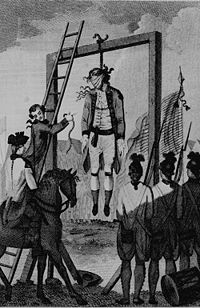
The fatal hour having arrived, a large detachment of troops was paraded, and an immense concourse of people assembled; almost all our general and field officers, excepting his excellency [George Washington] and his staff, were present on horseback; melancholy and gloom pervaded all ranks, and the scene was affectingly awful … Major Andre walked from the stone house, in which he had been confined, between two of our subaltern officers, arm in arm; the eyes of the immense multitude were fixed on him, who, rising superior to the fears of death, appeared as if conscious of the dignified deportment which he displayed. He betrayed no want of fortitude, but retained a complacent smile on his countenance, and politely bowed to several gentlemen whom he knew, which was respectfully returned. It was his earnest desire to be shot, as being the mode of death most comformable to the feelings of a military man, and he had indulged the hope that his request would be granted. At the moment, therefore, when suddenly he came in view of the gallows, he involuntarily started backward, and made a pause. “Why this emotion, sir?” said an officer by his side. Instantly recovering his composure, he said, “I am reconciled to my death, but I detest the mode.” While waiting and standing near the gallows, I observed some degree of trepidation; placing his foot on a stone, and rolling it over and choking in his throat, as if attempting to swallow. So soon, however, as he perceived that things were in readiness, he stepped quickly into the wagon, and at this moment he appeared to shrink, but instantly elevating his head with firmness, he said, “It will be but a momentary pang,” and taking from his pocket two white handkerchiefs, the provost-marshal, with one, loosely pinioned his arms, and with the other, the victim, after taking off his had and stock, bandaged his own eyes with perfect firmness, which melted the hearts and moistened the cheeks, not only of his servant, but of the throng of spectators. The rope being appended to the gallows, he slipped the noose over his head and adjusted it to his neck, without the assistance of the awkward executioner. Colonel Scammel now informed him that he had an opportunity to speak, if he desired it; he raised the handkerchief from his eyes, and said, “I pray you to bear me witness that I meet my fate like a brave man.” The wagon being now removed from under him, he was suspended, and instantly expired; it proved indeed “but a momentary pang.” He was dressed in his royal regimentals and boots, and his remains, in the same dress, were placed in an ordinary coffin, and interred at the foot of the gallows; and the spot was consecrated by the tears of thousands.

Thus died, in the bloom of life, the accomplished Major Andre, the pride of the royal army, and the valued friend of Sir Henry Clinton. He was about twenty-nine years of age, in his person well proportioned, tall, genteel and graceful. His mien respectable and dignified. His countenance mild, expressive and prepossessing, indicative of an intelligent and amiable mind. … considered as a skilful, brave and enterprising officer, and he is reported to have been benevolent and humane to our people who have been prisoners in New York. … The heart of sensibility mourns when a life of so much worth is sacrified on a gibbet. General Washington was called to discharge a duty from which his soul revolted; and it is asserted that his hand could scarcely command his pen, when signing the warrant for the execution of Major Andre. … Could Arnold have been suspended on the gibbet erected for Andre, not a tear or a sigh would have been produced, but exultation and joy would have been visible on every countenance.

Andre makes a sort of loyalist counterpart to Nathan Hale. Interestingly, Thacher’s account — in which he uses his old diaries for a book that was published in 1823 — footnotes an extended narration of Nathan Hale in a comparative vein, complaining that “whilst almost every historian of the American Revolution has celebrated the virtues and lamented the fate of Andre, Hale has remained unnoticed, and it is scarcely known that such a character ever existed.” Today, in terms of their public recognizability, the two are rather reversed.

* Andre was to have been hanged October 1, but the matter was stayed when a British deputation arrived under flag of truce to make one last parley for their man’s life.

On this day..

1957: Jacques Fesch: playboy, cop killer, saint?

On this date in 1957, the dissolute son of a wealthy banker went to see Jesus on the guillotine at Paris’ La Santé Prison.

Annoyed that his estranged father wasn’t keen to finance his dream of moving to the South Pacific for a life on permanent vacation, Jacques Fesch robbed a moneychanger on the Rue Vivenne to raise the revenue — and then shot dead a police officer who gave him chase, orphaning a four-year-old girl.

Outrage at the murder of a policeman was redoubled as the callow hedonism — adultery, an abandoned illegitimate kid, and nary a hard day’s work in his life — of its privileged perp became widely known. Then, too, there’s the novelty of a financial sector scion requiring a firearm for larceny.

Fesch’s Catholic lawyer, Paul Baudet, undertook the Dostoyevskyan mission of saving client’s life and soul alike. The disinterested kid called him “Pope Paul” or “Torquemada,” but gradually — and then all of a sudden — something got through there.

Little by little I was led to change my ideas. I was no longer certain that God did not exist. I began to be open to Him, though I did not yet have faith. I tried to believe with my reason, without praying, or praying ever so little! And then, at the end of my first year in prison, a powerful wave of emotion swept over me, causing deep and brutal suffering. Within the space of a few hours, I came into possession of faith, with absolute certainty. I believed, and could no longer understand how I had ever not believed. Grace had come to me. A great joy flooded my soul and above all a deep peace. In a few instants everything had become clear. it was a very strong, sensible joy that I felt. I tend now to try, perhaps excessively, to recapture it; actually, the essential thing is not emotion, but faith. (Source)

Almost overnight he gave himself to monklike asceticism, but the legal situation was not as promising as the spiritual. French President Rene Coty declined to spare him under pressure from police, and on grounds that leniency to a cop-killer would blow back on officers then trying to quell rebellion in Algeria.

Tell your client that he has all my esteem and that I wanted very much to reprieve him. But if I did that, I would put the lives of other police officers in danger. (Source)

Fesch didn’t want to die, but he accepted his penalty with resignation.

Now, my life is finished. ‘Like a little spring flower which the divine Gardener plucks for His pleasure,’* so my head will fall — glorious ignominy — with heaven for its prize! (Source)

His prison writings have filtered out widely since his beheading, and fed a burgeoning personal cult; he is often compared with the penitent “good thief” crucified with Christ. The valence of that conversion for the death penalty as a contentious political or theological issue, however, is not necessarily abolitionist. Fesch himself mused that imminent execution might have been the very thing that moved his soul.

Do you know, sometimes I think, in good faith and with horror, that the only way I can be saved [in God] is perhaps not to be saved [from the guillotine] in the human sense of the word? (Source)

Controversially, the layabout who slew a policeman has been latterly proposed for canonization within the Catholic Church — although Fesch’s defenders here observe that saints from Paul on down have often had unsavory backstories.

The young man is much better known in Romanic lands than among Anglophones — here’s an Italian homily for him:

* Quoting St. Therese of Lisieux, an apt inspiration.

On this day..

1952: George Muldowney, for loving and killing the original Bond girl

On this date in 1952, Irish steward George Muldowney was hanged at Pentonville Prison for the rather pathetic murder of a dashing Polish spy who had survived much greater villains.

Allowing that nobody ought to die on the floor of the Shelbourne Hotel with a sheath knife stuck in their chest, Christine Granville in particular really deserved a better exit.

Before the outbreak of World War II, she was Krystyna Skarbek, daughter of a Polish aristocrat sinking into poverty. After Germany overran Poland, she went off the marriage meatmarket and on Her Majesty’s Secret Service for a stunning career as a stunning spy that still has ’em sighing today.

Rechristened “Christine Granville” by Britain’s Special Operations Executive, she spent most of the war carrying out feats of cloak-and-dagger derring-do, with a Bond-like aplomb for extricating herself from tricky situations.

If only half the stories they tell about her are true …

  • Commuting between Hungary and Poland by skiing over the Tatra Mountains to gather intelligence and pull other agents out of harm’s way.
  • Getting herself and a fellow agent released from arrest by feigning tuberculosis by chewing her tongue until it bled.
  • Escaping capture at a checkpoint by pulling the pins on two grenades and daring the guards to shoot her.
  • Marching alone into a not-yet-liberated concentration camp to have POW’s reprieved from execution — by telling the Nazi commandante that he’d get the same treatment unless he spared them.
  • Snatching spymaster Francis Cammaerts from the Gestapo ahead of his execution.

And the love affairs! Or that’s what they say — including fellow agent Ian Fleming.

Granville earned the French Croix de Guerre, the George Medal for Special Services, the Order of the British Empire and other decorations, although merely surviving so much time in the field might have been her greatest achievement … but when the war ended, she was just another unwelcome Polish refugee, scrounging for service work in a recovering economy with no welcome waiting for her in her Soviet-dominated homeland.

From here on in, the trite and the tawdry eclipse the heroic.

A stewardess gig on a cruise ship attracted the attentions of her eventual murderer; his crush unreciprocated, and her companionship with another man jealously noticed, Muldowney stalked her and — on the very eve of Granville’s departure to reunite with a wartime confederate/lover — murdered her at her Kensington hotel.

To read the London Times‘ accounting the last moments of this woman so recently outfoxing the Nazis is to behold the face of banality triumphant.

Mr. Ian Smith, for the prosecution, said that, in a written statement at Kensington police station, Muldowney …

“describes how he waited outside the hotel and saw her go in. He went in after her and asked her for some letters he had exchanged with her. She said she had burned them. He did not believe her, and then says: ‘She told me she did not want anything to do with me and was off to the Continent and would see me in two years’ time.’

He then says: ‘Then I took the knife from the sheath which I had in my hip pocket and stabbed her in the chest, and then somebody came up.'” It was a deep stab wound up to the hilt of the knife, and penetrated the heart.

Muldowney didn’t fight the charge; he’d been planning to poison himself after the murder, and tried it when he was in custody. He declined legal aid and pleaded guilty at trial, seemingly eager to expiate his sin or join his would-be lover in death. It was less than 16 weeks after the crime that he stood on the gallows.

While Muldowney moulders in well-deserved obscurity, his victim reportedly inspired her former lover to create the character of Vesper Lynd — the original femme fatale secret agent in the original James Bond novel, Casino Royale. (And the smashing cocktail named for her in the same volume.)

She — Christine, not Vesper — is buried under a spadeful of symbolic Polish soil in St. Mary’s Roman Catholic Cemetery in London.

On this day..

1979: Francisco Macías Nguema, President for Life

In the early afternoon this date, Equatorial Guinea’s former President for Life was sentenced to death with six aides at the end of a four-day trial for murder, treason, embezzlement, and genocide.

That evening, the seven were shot at Malabo’s Blabich Prison.

Nguema Biyoto Masie, nee Francisco Macías Nguema, rose from the Spanish colonial bureaucracy to win the first post-independence presidency of the minuscule African state.

He quickly created a one-party state and increasingly nutty cult of personality, answering to such horror-comic nicknames as “Unique Miracle”.

Nguema’s Unique Miracle for Equatorial Guinea was a Pol Pot-style catastrophe, killing or driving out most of the population (including Nguema’s own wife), eviscerating the economy, and getting into military brinksmanship with neighboring Nigeria.*

His nephew, Teodoro Obiang Nguema Mbasogo, overthrew him a few weeks before this date. Despite the speedy resolution of the case, international observers on the scene considered it a fair enough trial and the dictator’s guilt duly established; procedurally, the execution happened immediately because he was tried by the highest court in the land and there was nowhere to appeal.


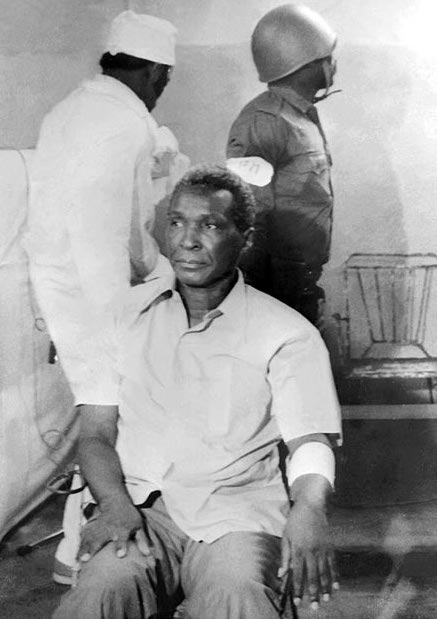
Francisco Macias Nguema during his trial.

Still, the shooting itself was handled by hired Moroccan troops, rather than citizens of Equatorial Guinea: Nguema had convinced quite a lot of people that he had magic powers, and the locals weren’t eager to be the ones to test the proposition.

Bloody but necessary first step to parliamentary democracy?

Not quite. Teodoro Obiang Nguema Mbasogo, one of the worst dictators you’ve never heard of, still runs Equatorial Guinea in much the manner of his predecessor to this day.


Did we mention that Equatorial Guinea has oil?

* Francisco Macias Nguema’s daughter, “Empress Bella Syttam Macias”, lives in Utah and defends her dad. She seems to have been too young to have been personally involved in anything unsavory in the 70’s.

On this day..

1402: False Olaf

On this date in 1402, a Prussian commoner was put to death on the road between Falsterbo and Skanor in Sweden for masquerading as the long-dead King Olaf IV.

The real Oluf IV Haakonsson — or Olav, or Olaf — had inherited the crowns of Denmark and Norway and a claim to that of Sweden’s but died at the age of 17 in 1387. His mother, Margaret I (or Margrethe I), the real power behind the teenager, ruled outright upon her son’s death.

She proved an able hand and far-sighted ruler, cautiously welding Denmark, Sweden and Norway into the Kalmar Union that would hold until the 16th century. They called her “the Semiramis of the North,” centuries before Catherine the Great nicked the nickname.

But her son’s youthful demise had set persistent rumors abroad — that he was poisoned, for instance, and more to the point for our purposes, that he wasn’t dead at all.

So when his spitting image was recognized, and hailed as the prince of the realm … well, back in the day, equally audacious identity theft was attempted for much smaller stakes than a throne.

Anyway, “Olaf” got some robes befitting Olaf’s station and banged out some letters to Margaret demanding his kingdom back, and Margaret said, come on down.

That goes to show how far looks will take you in life.

Unfortunately for Olaf, his regal jawline wasn’t capable of enunciating Danish speech … so the jig was up as soon as he got to Margaret. One hopes he got a good ride out of his brief masquerade, because he was burned to ashes — possibly after being broken on the wheel — along with those presumptuous letters.

The date of False Olaf’s death comes from Horace Marryat’s 19th century Scandinavian travelogues, One Year in Sweden; including a visit to the isle of Gotland and A Residence in Jutland, the Danish Isles, and Copenhagen (both free reads at Google Books). In both volumes, Marryat identifies the date as the morning before Michaelmas.

The traditional last day of the harvest season celebrated on September 29, Michaelmas was once a four-star holiday on the medieval calendar.

There’s a fair amount of commentary online saying that an “Old Michaelmas” used to be celebrated on October 10 or 11. But that looks to this writer like an interesting inversion stemming ultimately from the celebration’s fall into obscurity as the entity once known as Christendom has become more secular and less agrarian — although it’s admittedly nothing to do with the fate of False Olaf, or Semiramis for that matter.

In 1752, when England finally switched to the Gregorian Calendar, the switch took place in early September.*

For logistical pragmatism (the harvest wasn’t going to come in 11 days earlier just because the calendar changed), the then-imminent Michaelmas got pushed back 11 days to October 10. October 10 then became known as “Old Michaelmas,” no longer Michaelmas by the church calendar but the 365-day interval from when it used to be celebrated, and more importantly, the real end of the harvest season.**

In the next century, the difference between Julian and Gregorian calendars would have advanced to 12 days, placing Old Michaelmas on the 11th; by this present day, it’d be 13 days in principle, but the original meaning of the holiday and the host of cultural traditions associated with it have fallen away … so “Old Michaelmas” is a footnote still pinned to October 10th or 11th, and moderns rediscovering it suppose from the name that it’s the former date of the feast.

* People inclined to think of their death dates as foreordained in heaven’s celestial notebook protested the switch: “give us back our 11 days!” This reform, incidentally, also moved the official beginning of the New Year to January 1 from Michaelmas’ springtime “Quarter Day” counterpart, March 25; winter dates from years prior are often written with both years, e.g. 1738/9. “Old Lady Day“, April 6, is still the beginning of the fiscal year in England, and Thomas Hardy uses its traditional contractual character in Tess of the D’Urbervilles (Aside: Tess’s hanged real-life inspiration) when the title character takes a farm job running through that date:

Tess was so wrapt up in this fanciful dream that she seemed not to know how the season was advancing; that the days had lengthened, that Lady-Day was at hand, and would soon be followed by Old Lady-Day, the end of her term …

At length it was the eve of Old Lady-Day, and the agricultural world was in a fever of mobility such as only occurs at that particular date of the year. It is a day of fulfilment; agreements for outdoor service during the ensuing year, entered into at Candlemas, are to be now carried out. The labourers — or “work-folk”, as they used to call themselves immemorially till the other word was introduced from without — who wish to remain no longer in old places are removing to the new farms.

… With the younger families it was a pleasant excitement which might possibly be an advantage. The Egypt of one family was the Land of Promise to the family who saw it from a distance, till by residence there it became it turn their Egypt also; and so they changed and changed.

** Residents of the former Soviet Republics who switched to the Gregorian calendar in the 20th century still celebrate both the familiar January 1 New Year’s and “Old New Year’s” 13 days later, and the same trick with the (lesser, there) holiday of Christmas too … packing four party occasions into a three-week span.

Part of the Themed Set: Semiramis.

On this day..

1976: Three terrorists in Syria

On this date in 1976, three Abu Nidal terrorists were hanged before the Hotel Semiramis in Damascus, barely 24 hours after they had entered it and taken 90 hostages in a bid to win release of Palestinian prisoners.

Palestinians Muhammad al-Barqawi and Mouatassem Jayyoushi and Iraqi Jabbar Darwish suffered Syria’s first public execution since an accused Israeli spy more than a decade before — and as the late Syrian strongman Hafez al-Assad had pledged, justice was swift and ruthless.

The security of the citizen is sacred. We shall not be soft in this matter. We shall hit back very hard and we denounce this criminal action committed by the gang, which acted as if it was in Israel.

They were the surviving 75% of a quartet of gunmen who early the previous morning had seized the hotel, barricaded themselves on the fifth floor, and attempted to make their trade. Plainly, it didn’t quite work out; the attempt precipitated a battle with Syrian troops which saw the fourth terrorist killed, along with four of the hostages. The Supreme State Security Court condemned the captured men to death overnight; the sentence was carried out between 6:00 and 6:30 the next morning.

New York Times coverage of the raid and the execution is unfortunately behind the paper’s paid-login firewall, but a photo of the execution shows onlookers ringing a single wooden frame for what must have been a short-drop hanging. An unused fourth noose, possibly symbolically present for the killed fourth terrorist (or possibly not; there’s no explicit comment on it), hangs beside the dead men.

So why the grievance? That June — “Black June,” to the Palestinians — Syria had bailed on hard-line Palestinians and entered the Lebanese Civil War on the side of Phalangist Christians,* just as they were on the verge of being overrun. It was the second time in six years that a neighboring Arab power had turned its guns on Palestinians. (In 1970, Jordan had expelled the Palestine Liberation Organization in “Black September.” Lots of black in the Palestinian annals.)

And why the Iraqi, among the hanged?

Palestinian terrormeister Abu Nidal had hung out his shingle in Iraq, then under the control of a rising young dictator destined for the gallows himself, but who grasped the opportunist potential of backing the Palestinian cause while states like Jordan and Syria visibly sold it out. Television crews had a few words in edgewise with the doomed men the evening before their hanging, and they claimed to have trained for their abortive mission in Iraq.

* This put Damascus on the same side as Israel.

Part of the Themed Set: Semiramis.

On this day..