1896: Dr. Jose Rizal, father of the independent Philippines

December 30 is Rizal Day (Araw ng Kabayanihan ni Dr. Jose Rizal in Tagalog) in the Philippines, for the execution that date in 1896 of the great martyr of Philippine independence.

Also available free at gutenberg.org (the HTML version is very well-illustrated).

At Jose Rizal’s birth in 1861, it had been 340 years since Magellan had reached (and died at) the Philippines under the Spanish flag.

In Rizal’s century of romantic nationalism, independence movements stirred abroad in the Spanish Empire … too weak yet in the Philippines and elsewhere during the mid-1800s, but unmistakably prefiguring those national destinies that this day’s victim would come to embody.

Oddly, Jose Rizal was not even the most “revolutionary” of his farming family’s 11 children. That distinction went to older brother Paciano, who was under an official cloud before Jose hit adolescence for his relationship with the Gomburza priests, and would later serve as a brigadier general in the revolutionary army of Emilio Aguinaldo.

Jose was less strident — and more brilliant.

Though reputedly an adept fencer and crack shot with a pistol, the renaissance man’s gifts ran more to the life of the mind.

At the Universidad Central de Madrid, the University of Paris, and the University of Heidelberg, Jose Rizal studied ophthalmology and anthropology, and pursued the variegated artistic interests of his youth.

His two novels published from Europe, Noli Me Tangere and El Filibusterismo*, both criticized colonial authorities and their Vatican adjutants and struck nationalist chords that put him on the Spanish government’s watch list.

“I die without seeing the dawn brighten over my native land! You, who have it to see, welcome it — and forget not those who have fallen during the night!” -From Noli Me Tangere

Rizal also penned essays and editorials in a less symbolic vein, like this one skewering the stereotype of the lazy native by turning the mirror upon colonial agents who were waiting to prey on the fruit of native labor:

How is it strange, then, that discouragement may have been infused into the spirit of the inhabitants of the Philippines, when … they did not know whether they would see sprout the seed they were planting, whether their field was going to be their grave or their crop would go to feed their executioner? What is there strange in it, when we see the pious but impotent friars of that time trying to free their poor parishioners from the tyranny of the encomenderos by advising them to stop work in the mines, to abandon their commerce, to break up their looms, pointing out to them heaven for their whole hope, preparing them for death as their only consolation?

Man works for an object. Remove the object and you reduce him to inaction The most active man in the world will fold his arms from the instant he understands that it is madness to bestir himself, that this work will be the cause of his trouble, that for him it will be the cause of vexations at home and of the pirate’s greed abroad. It seems that these thoughts have never entered the minds of those who cry out against the indolence of the Filipinos.

(This essay and both novels are available in the original Spanish and in English at gutenberg.org, along with various translations of Rizal’s various fiction and non-fiction work.)

Fire-eating stuff in the eyes of the Spanish crown, but Rizal wasn’t the bomb-throwing type himself.

As the Philippine Revolution that would break the Spanish yoke on the islands took shape in the summer of 1896, Rizal applied to go to Spanish Cuba to treat victims of the yellow fever, and even explicitly disavowed the revolution.

Countrymen: I have given proofs, as well as the best of you, of desiring liberty for our country, and I continue to desire it. But I place as a premise the education of the people, so that by means of instruction and work they may have a personality of their own and that they may make themselves worthy of that same liberty. In my writings I have recommended the study of the civic virtues, without which there can be no redemption. I have also written (and my words have been repeated) that reforms, to be fruitful, must come from _above_, that those which spring from _below_ are uncertain and insecure movements. Imbued with these ideas, I cannot do less than condemn, and I do condemn, this absurd, savage rebellion, planned behind my back, which dishonors the Filipinos and discredits those who can speak for us. I abominate all criminal actions and refuse any kind of participation in them, pitying with all my heart the dupes who have allowed themselves to be deceived. Go back, then, to your homes, and may God forgive those who have acted in bad faith.

This stance on the revolution — the fact that he thought and wrote but never struck a blow — has engendered some controversy over the rightfulness of Rizal’s place in the national pantheon, as has his anti-clericalism and a disputed Vatican claim that Rizal retracted his criticisms of the Church before his death. One Spanish contemporary called Rizal “the Tagalog Hamlet.”

But mostly he is seen as the Spanish government at the time saw him, and as many revolutionaries did as well: as the lodestar of the Philippines’ national aspirations.

Rizal was arrested en route to his humanitarian assignment in Cuba and returned to Manila to face trial for sedition, rebellion and conspiracy, by which point, of course, the verdict was quite preordained. He was shot in the back by a firing squad, uttering the Christ-like last words “consummatum est” — “it is finished.”

Rizal’s execution, and the events preceding it, are depicted in this long excerpt of a 1998 film:


Jose Rizal’s execution.


Near the spot Rizal was actually executed, his martyrdom depicted in statuary.

There are any number of Jose Rizal tribute sites online. JoseRizal.ph and JoseRizal.info are two good places to delve deeper.

* A filibuster is a private military expedition, and more typically associated with Anglo American campaigns against the Spanish-speaking lands to the south, like those of William Walker.

On this day..

1871: Eight Cuban medical students

On this date in 1871, eight first-year medical students, aged 16 to 19, were shot in Havana Place de la Punta by Spanish colonial authorities in one of the most notorious episodes of that island’s independence struggle.

Cuba was three years into the Ten Years’ War, the first of three major 19th century insurrections that would eventually throw off Spanish rule, but popular support for independence was far from universal.

This book is the English translation of the classic Cuban text written by their schoolmate.

A vocal pro-Spanish element opposed the rebels to the extent of mobilizing right-wing volunteer goon squads to rough up demonstrators and menace the government into dealing with them only at bayonet-point … proto-brownshirts, albeit from a more well-heeled class position.

Mostly middle- or upper-class peninsulares, they were able by sheer force of numbers to cow [liberally inclined Captain-General Domingo] Dulce into acceptance of their views … Their journal, La Voz de Cuba, accused Dulce of working for the rebels …

The volunteers were a foretaste of those twentieth century lower middle-class mobs of young men who often protest violently against the end of empire. Shouting Viva Espana! in the Villanueva Theatre, foreshadowing the pieds noirs of Algeria, they bridge the gap between Carlism and Fascism. (Cuba, Or, The Pursuit of Freedom by Hugh Thomas)

The Volunteers would make themselves felt this day.

The editor of that Volunteer paper La Voz de Cuba was assassinated in 1870. The fatal accusation against the students was that they had desecrated the grave of that editor.

In Cuba in 1871, vandalism with the wrong politics was good enough to get you shot … four days after the supposed crime. In that environment, it’s practically beside the point that one of the eight wasn’t even in town at the time and the “desecration” was so exaggerated (the link is a Spanish backgrounder) as to be essentially fabricated.

The procedural rigging dignified with the word “trial” wasn’t going to get hung up on that detail, but it was also on the verge of an acquittal or a light sentence when a Caribbean Brooks Brothers riot steamrolled it (Spanish again) into sentencing eight to death and most of the others to significant prison terms.

Defense attorney Frederico Capdevila alone distinguished himself (more Spanish) at this circus with an indignant and energetic defense, despite being attacked at one point by the Volunteer mob. At its appalling conclusion, he drew his sword and theatrically broke it over his knee — a gesture of contempt for the military tribunal that cost him his military career and made his reputation to posterity.

Radical writer Jose Marti, 18 years old at the time of this execution, summoned the image frequently and helped raise 27 Noviembre de 1871 into an enduring emblem of the worst of colonialism.

Che Guevara would say of the martyrs, “El único delito era el de ser cubano” — “Their only crime was to be Cuban.”

On this day..

1817: Policarpa Salavarrieta, Colombian independence heroine

This morning in 1817, a Colombian seamstress was shot in Bogota for spying on the Spanish forces fighting to quell South America’s Bolivarian independence movements.

Policarpa Salavarrieta — it was the name her brother used for her; her legal given name and origin are romantically lost — was infiltrated into Bogota during the reconquista, when a Spain recovering from Napoleon’s intrusion deployed in force to quash the separatist aspirations of its New World colonies.

It was the day of Simon Bolivar, but Spain had completed its apparent pacification of New Granada* in 1816, and established a stronghold in Bogota. Subversives had to mind their P’s and Q’s.

Although she was a known agitator in the city of Guadas, “La Pola” could slip into Bogota without drawing attention.

There, she used her skills as a domestic to hang around royalist households, sewing up clothes while snooping around, and helping revolutionaries recruit soldiers.

She was arrested when the Spanish busted the network, (the link is in Spanish) and shot publicly with her lover, Alejo Sabarain, and a number** of others — all men, none of them half so well-remembered or beloved as Salavarrieta. She was supposed to have ignored the priests murmuring te deums in her ear on the scaffold in order to exhort the onlookers to resistance.

Over the years to come, she would become an emblematic martyr of independence; just see how many times her theme is visited in this history of Colombian painting (Spanish again). She’s also the only historical (not mythological/allegorical) woman ever used on Colombian currency.

As will be readily surmised, of course, she merits her tribute because the movement in whose service she died soon rallied and carried the day.

* The Spanish territory of New Granada encompassed most of the ice cream of the South American cone.

** Various numbers are given for the day’s total execution count. This site (Spanish) says a total of nine — Policarpa Salavarrieta and eight men, including Alejo Sabarain — and persuasively names all of them.

On this day..

1841: Hermano Pule and his surviving followers

On this date in 1841, Apolinario de la Cruz was shot at Tayabas for leading a revolt against Spanish occupation of the Philippines.

Known to history as Hermano Pule, the young de la Cruz had dreamt of entering the priesthood — but finding that most barred native Filipinos, he founded the Cofradia de San José (Confraternity of St. Joseph).

Organizing secretly and outside of the approved channels, it gained the enmity of both civilian and religious authorities, though it doesn’t on the surface look like a seditious entity; rather, it attracted Filipinos (and Filipinas) excluded from the official organs. Suddenly, that looked like trouble to Spain.

Condemnation helped the Confradia’s numbers burgeon, and forced its programme towards radicalism: where freedom of religion was forbidden, worship was a revolutionary act.

Matters came to a head when a government raid precipitated armed resistance by Pule and his followers, with the inevitable closing act postponed by an inspiring but short-lived rebel victory at arms. Pule and his followers were overrun on Nov. 1, rounded up as fugitives by the next day, and put to death outside the Tayabas courthouse — with Pule’s head, hands and feet cut off for salutary public display in his adjacent hometown of Lucban (or Lukban).

On this day..

1618: Walter Raleigh, age of exploration adventurer

On this date in 1618, schemer, explorer, and lover Walter Raleigh fell permanently out of favor.

One of the biggest wheels of Elizabethan England, Raleigh (who also rendered his name Rawleigh, Rawley, and most commonly, Ralegh) charmed his way into the Queen’s inner circle, and possibly her pants, and was even thought to be a contender for her hand.

In between gorging on royal monopolies, scribbling poetry, popularizing tobacco, and introducing the potato to Ireland [allegedly], Raleigh got his New World on by attempting to colonize Virginia,* helping fund it with privateering operations against England’s rivals in the land-grab game. The city of Raleigh, North Carolina — present-day North Carolina was part of the Virginia Colony back in the day — is named for him.

Proud, powerful, and the queenie’s pet. Just the sort of courtier other noble suckups loved to hate.

When the palace fave secretly dallied with one of the Queen’s ladies-in-waiting, he went on the royal outs and got real familiar with the Tower of London. Though he managed to patch up with Elizabeth, things were never quite the same for Sir Walter. Elizabeth’s successor James I put him back in prison (suspending a death sentence) for supposedly participating in the Main Plot.

Raleigh passed the time under lock and key burnishing his Renaissance man rep by writing various poetry and treatises, including an account of his voyage to Guyana. Convinced the legendary city of El Dorado was in the vicinity, Raleigh eventually prevailed upon James to release him to make another run at it.

But a dust-up with a Spanish outpost in South America left his son dead, and the Spanish ambassador hopping mad. Raleigh was arrested upon his return, and the death sentence reinstated.

At 66 years of age or so, Walter Raleigh had had a pretty good run.

He took his punishment with equanimity, writing tenderly to his wife, and examining the blade that would take off his head on the scaffold with the observation,

“This is a sharp Medicine, but it is a Physician for all Diseases.”

His wife creepily kept the severed head for the remaining 29 years of her life.

There’s a more detailed tour of Raleigh’s life here, and a site linking many works by and about Raleigh here.

* As Governor of Virginia, Raleigh forbade injuring Indians on pain of death, according to Giles Milton’s Big Chief Elizabeth. Raleigh’s “imperialism with a human face” policy had exchange programs of Indians visiting England, most notably Pocahontas.

On this day..

1936: Antonio José, forgotten composer

On this date in 1936, the Spanish composer Antonio José was shot by Falangists during the Spanish Civil War.

The 33-year-old Burgos native (English Wikipedia page | the more detailed Spanish) was a rising young star, a writer, teacher and “folklorist” who had only that April earned plaudits for a paper on popular songs at an international musicology conference.

That July, the Spanish Civil War erupted … and the fascists clapped him in irons and shot him in the marshes near Estepar, Spain. I have not been able to find any clear documentation as to specifically how he earned the death sentence — which is not to say that the Spanish Falange deserves the benefit of the doubt for the regularity of its judicial procedures.

Despite Maurice Ravel’s (pre-Civil War) opinion that Jose would become “the Spanish composer of our century,” Jose’s work vanished into obscurity after his untimely death. Pieces like this Sonata Para Guitarra have only recently been widely rediscovered.

On this day..

1811: Miguel Hidalgo y Costilla, for Mexican independence

On this date in 1811, Mexican independence icon Miguel Hidalgo was shot for treason at the government palace in Chihuahua.

The subversive priest had set the spark to the Mexican War of Independence in the hours before sunrise of September 16, 1810. There, he rang the parish bell in the small town of Dolores and issued his “Grito de Dolores” — “Cry of Dolores” — summoning native Amerindians and mestizos to throw off the Spanish.

The movement got added juice from the fact that the Spanish jackboot was then being worn by Napoleon, who had installed his brother as king.*

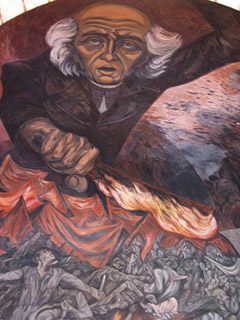
Hidalgo tributes are a mainstay of every Mexican town. This Orozco mural is in a government building in Guadalajara.

Hidalgo’s fired-up downtrodden mob slaughtered the local garrison and gathered numbers on a march towards Mexico City before the professional Spanish soldiery rallied to stop it. But the priest wouldn’t make his father-of-the-country credentials in generalship: he’d been relieved of command after repeated combat debacles by the time the insurrection’s leaders were betrayed in March.**

While his comrades Ignacio Allende, Jose Mariano Jimenez and Juan Aldama were shot on June 26, Hidalgo got an old-school detour through the ecclesiastical arm for defrocking (and a highly suspect alleged retraction).

When he was shot this day, he directed the firing squad to aim for the hand he placed over his heart.

Then, his head was cut off and stuck on a pike as a warning.

The struggle lived on, long past Hidalgo’s execution and Bonaparte’s fall, and finally resulted in Mexican independence in 1820. Today, the padre whose call to action not only started the revolt but made it a mass movement is the face on the 1,000-peso note, and his Grito de Dolores is repeated every Diez y Seis de Septiembre as an independence day tribute by Mexican authorities — as in this from 2006:

* Inspiring this blog’s banner in the process.

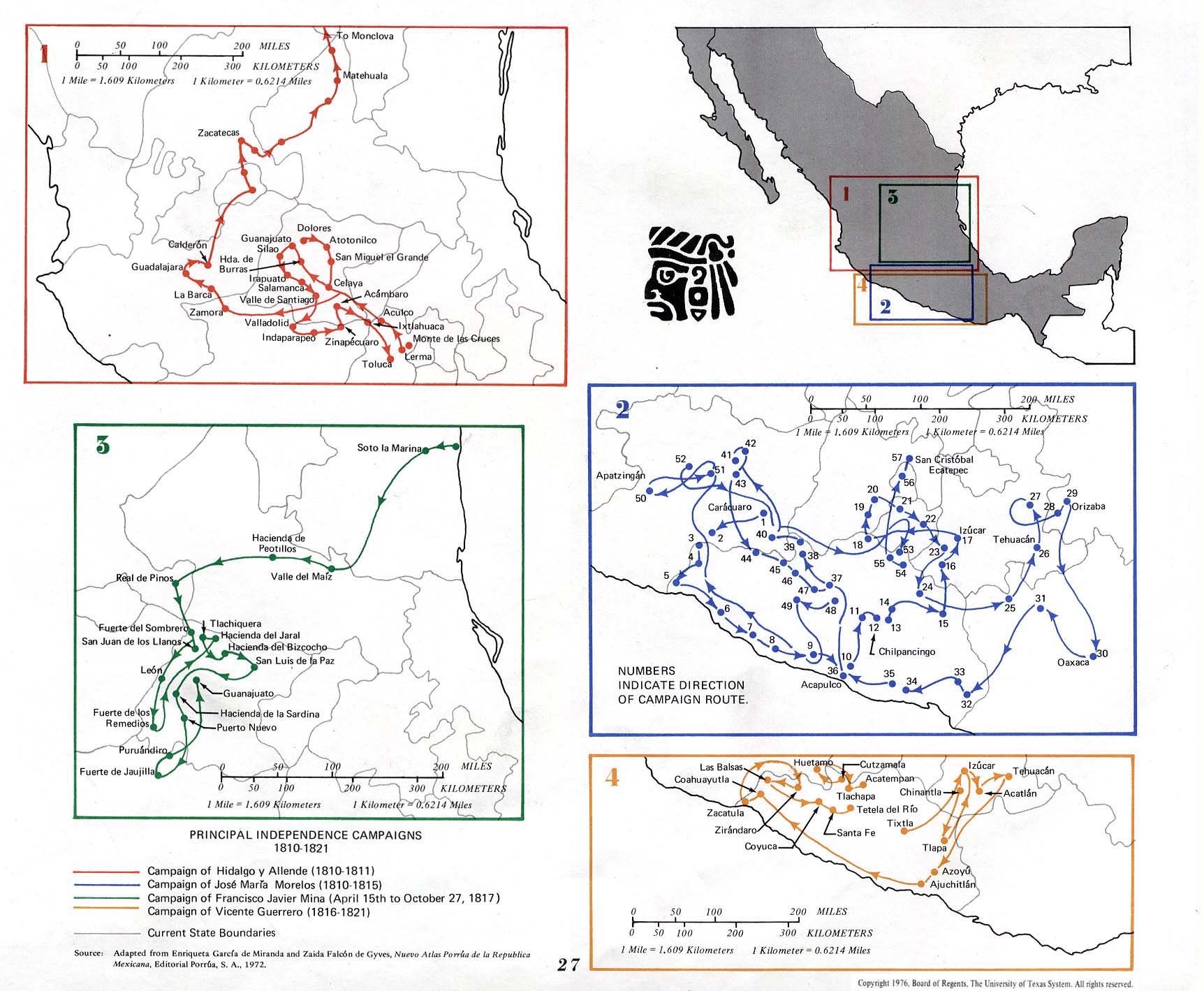
** There’s a map of Hidalgo and Allende’s army’s movements — and subsequent campaigns in the war — here.

On this day..

1573: Wigbolt Ripperda, Haarlem city governor

On this date in 1573, Wigbolt Ripperda was beheaded in Haarlem’s Grote Markt for having led a stubborn seven-month resistance to a Spanish siege.

Ripperda had been a Calvinist with a hand in the iconoclastic spasm against Catholic churches that had led to the beheadings of Counts Egmont and Hoorn a few years prior.

In the intervening years, relations between the Low Countries and the Spanish crown that ruled them had deteriorated into outright revolt — the germ of the decades-long struggle that would result in Dutch independence.

Haarlem had initially tried to keep its head down in the conflict, but had declared against Spain in 1572. That brought it into the sights of a vengeful Spanish army that greatly outnumbered Haarlem’s 4,000 defenders. Spurning any talk of compromise or capitulation, city governor Ripperda rallied his garrison and held out against the Spanish siege throughout the winter and spring.

In the end, starvation did the work that engines of war could not. Haarlem fell on July 12, 1573.*

Ripperda was beheaded with a lieutenant a few days later, but in winning the battle, Spain had suffered a setback in the war: besides the seven-month delay, other Calvinist strongholds took heart from the effective resistance and got a lot less cowed by the royal army.

While this day’s martyrdom made “Ripperda” a fixture in Haarlem place names, and despite a somewhat illustrious family tree that also includes a signatory of the Peace of Munster and a fascinatingly disreputable 18th century politician, actual Ripperdas are apparently hard to find in present-day Holland. According to American Tom Ripperda, who runs the family site ripperda.org, the name lives on only in the U.S. and Germany.

“In the 1830s the last of the Dutch Ripperdas died,” Ripperda told me. “There are no Ripperdas in the Netherlands since they moved to Germany (about 200 or so) and on to America (about 600 or so).”

* As to the vengeful mass executions visited on Haarlem, John Lothrop Motley conveys this anecdote.

Instead of Peter Hasselaer, a young officer who had displayed remarkable bravery throughout the siege, the Spaniards by mistake arrested his cousin Nicholas. The prisoner was suffering himself to be led away to the inevitable scaffold without remonstrance, when Peter Hasselaer pushed his way violently through the ranks of the captors. “If you want Ensign Hasselaer, I am the man. Let this innocent person depart,” he cried. Before the sun set his head had fallen.

On this day..

1568: The Counts of Egmont and Hoorn, insufficiently Inquisitorial

On this date in 1568, two Flemish nobles were beheaded at Brussels’ Grand Place for treason to the Spanish crown that then ruled the Low Countries.

Lamoral, Count of Egmont and Philip de Montmorency, Count of Hoorn had a beef with the introduction of the Inquisition into the Netherlands by Egmont’s cousin, King Philip II, and got to hanging around with dubious characters like William of Orange.

Unluckily for this day’s duo, William didn’t teach them to read the writing on the wall.

After the Counts went easy on an outbreak of Protestant Iconoclasm, the Catholic king sent the hammer in the person of the Duke of Alba (or Alva).

Let this long-expired generation counsel posterity to find itself elsewhere when one’s door is darkened by a man known as “the Iron Duke”. William had the wit to get out of town. Egmont and Hoorn hung around, depending on their (professedly) clean consciences.

Oops.

Count Egmont Before His Death, by Louis Gallait

The beheadings were widely protested both locally and abroad, and festered as a grievance against the empire — a grievance that, as the nascent conflict evolved into a revolution that would detach the Netherlands from Spain, elevated these distinctly non-revolutionary wealthy nobles into freethinking martyrs of independence.

Two centuries later, Goethe put the story on the stage with his play Egmont (original German | English translation), a production for which Beethoven subsequently composed gorgeous orchestral companion pieces.

Here’s the lovely, lovely Ludwig Van’s beloved (including by Goethe himself) Overture to Egmont, Op. 84:

On this day..

1569: Dirk Willems, for loving his enemy

On this date in 1569, Dirk Willems paid the penalty for a famous act of charity.

Willems was condemned by the still-ascendant Catholic church as an Anabaptist, but escaped prison.

Fleeing a pursuer across a frozen pond, Willems had an opportunity to make good his escape when his persecutor crashed through the ice. But he turned back to save the drowning man:

One good turn did not deserve another: the man arrested Willems, and the compassionate Protestant found himself burned to death* this day at Asperen.

Hundreds of Anabaptists suffered similar fates, many of them registered in the Martyrs Mirror (available online here). But Dirk Willems’ story has always been one of the most affecting and popular with the Mennonite communities who trace their lineage to the Anabaptists:

[W]hen he fled he was hotly pursued by a thief-catcher, and as there had been some frost, said Dirk Willems ran before over the ice, getting across with considerable peril. The thief-catcher following him broke through, when Dirk Willems, perceiving that the former was in danger of his life, quickly returned and aided him in getting out, and thus saved his life. The thiefcatcher wanted to let him go, but the burgomaster, very sternly called to him to consider his oath, and thus he was again seized by the thief-catcher, and, at said place, after severe imprisonment and great trials proceeding from the deceitful papists, put to death at a lingering fire by these bloodthirsty, ravening wolves, enduring it with great steadfastness, and confirming the genuine faith of the truth with his death and blood, as an instructive example to all pious Christians of this time, and to the everlasting disgrace of the tyrannous papists.

(Bygones, tyrannous papists: last year, a Mennonite delegation to the Vatican gave Pope Benedict XVI a framed picture of Willems saving his romish persecutor.)

Few are the faiths that lack a martyrology, but notwithstanding the incendiary language of our 17th-century source, the place of martyrs (“Dirk Willems warns Mennonites not to expect to be rewarded for good works — a sharp contradiction to the American gospel of success”) and the right way to commemorate them without stoking confessional hostility occupy unusually nuanced places in Mennonite thought.

* The burning came off badly, the Martyrs Mirror records:

[A] strong east wind blowing that day, the kindled fire was much driven away from the upper part of his body, as he stood at the stake; in consequence of which this good man suffered a lingering death, insomuch that in the town of Leerdam, towards which the wind was blowing, he was heard to exclaim over seventy times, “O my Lord; my God,” etc., for which cause the judge or bailiff, who was present on horseback, filled with sorrow and regret at the man’s sufferings, wheeled about his horse, turning his back toward the place of execution, and said to the executioner, “Dispatch the man with a quick death.” But how or in what manner the executioner then dealt with this pious witness of Jesus, I have not been able to learn, except only, that his life was consumed by the fire.

On this day..