Sometime around this date in 1503, the Spanish destroyed the independent territory of Xaragua on Hispaniola in a bloodbath of native caciques — capped with the ignominious public hanging of the Taino queen Anacaona.
The widow of the chief Caonabo (Spanish link), who had been captured and shipped to Spain by Christopher Columbus himself, Anacaona inherited leadership of one of the principle Taino realms of Hispaniola, present-day Haiti and Dominican Republic.
Spain had the werewithal to be extremely crappy to the Hispaniola “Indians”, but it would take a few years to have sufficient presence to conquer them all.
Calling a meeting with the Xaragua caciques, Ovando’s troops enjoyed the Taino hospitality. Bartolome de las Casasdescribes the festivities:
Xaraqua is the Fourth Kingdom, and as it were the Centre and Middle of the whole Island, and is not to be equalled for fluency of Speech and politeness of Idiom or Dialect by any Inhabitants of the other Kingdoms, and in Policy and Morality transcends them all. Herein the Lords and Peers abounded, and the very Populace excelled in in stature and habit of Body: Their King was Behechio by name and who had a Sister called Anacaona, and both the Brother as well as Sister had loaded the Spaniards with Benefits (pdf) and singular acts of Civility, and by delivering them from the evident and apparent danger of Death, did signal services to the Castilian Kings. Behechio dying the supreme power of the Kingdom fell to Anacaona: But it happened one day, that the Governour of an Island, attended by 60 Horse, and 30 Foot (now the Cavalry was sufficiently able to unpeople not only the Isle, but also the whole Continent) he summoned about 300 … noblemen to appear before him, and commanded the most powerful of them, being first crouded into a Thatcht Barn or Hovel, to be exposed to the fury of the merciless Fire, and the rest to be pierced with Lances, and run through with the point of the Sword, by a multitude of Men: And Anacaona herself who (as we said before) sway’d the Imperial Scepter, to her greater honor was hanged on a Gibbet. And if it fell out that any person instigated by Compassion or Covetousness, did entertain any Indian Boys and mount them on Horses, to prevent their Murder, another was appointed to follow them, who ran them through the back or in the hinder parts, and if they chanced to escape Death, and fall to the ground, they immediately cut off his Legs; and when any of those Indians, that survived these Barbarous Massacres, betook themselves to an Isle eight miles distant, to escape their Butcheries, they were then committed to servitude during Life.
Contemporary writers … have concurred in representing Anacaona, as remarkable for her native propriety and dignity. She was adored by her subjects, so as to hold a kind of dominion over them, even during the lifetime of her brother; she is said to have been skilled in composing the areytos or legendary ballads of her nation, and may have conduced much towards producing that superior degree or refinement remarked among her people … After the massacre ot Xaragua, the destruction of its inhabitants still continued. The favourite nephew of Anacaona, the cacique Guaora who had fled to the mountains, was hunted like a wild beast, until he was taken, and likewise hanged. For six months the Spaniards continued ravaging the country with horse and foot, under the pretext of quelling insurrections; for, wherever the affrighted natives took refuge in their despair, herding in dismal caverns and the fastnesses of the mountains, they were represented as assembling in arms to make a head of rebellion. Having at length hunted them out of their retreats, destroyed many, and reduced the survivors to the most deplorable misery and abject submission, the whole of that part of the island was considered as restored to good order; and in commemoration of this great triumph, Ovando founded a town near to the lake, which he called Santa Maria de la verdadera Paz. (St. Mary of the true Peace.)
Such is the tragical story of the delightful region of Xaragua, and of its amiable and hospitable people. A place which the Europeans, by their own account, found a perfect paradise, but which, by their vile passions, they filled with horror and desolation.
The martyred artist-queen continues to inspire art of her own.
On this date in 1851, Venezuelan-born adventurer Narciso Lopez was garroted in Havana for his repeated expeditions to overturn Spanish dominion in Cuba.
Narciso Lopez had fought for the Spanish against Simon Bolivar, and migrated to Cuba when Bolivar carried the day.
Initially a loyal government functionary, Lopez gradually became sweet on the anti-Spanish cause, and fled Cuba for the United States (pursued by a death sentence in absentia) when a treasonable conspiracy of his was discovered.
Like MacArthur, he meant to return — and did.
Lopez crisscrossed the United States, drumming up support for filibustering raids on Cuba meant to detach it from Spain and make it an American slave state.
In this proposed enterprise, wedded alike to both national expansionism and southern sectionalism, Lopez rubbed shoulders with the likes of Jefferson Davis and Robert E. Lee, even helping precipitate criminal charges against a former U.S. Senator who backed him.
But the five expeditions went from bad to worse, until Lopez was captured in August 1851.
Between the wide Gulf sky and the waters of Havana harbor, the Gothic Morro Castle’s high tabby walls gleamed in the Sunday morning light on September 1, 1851. Though it was barely seven o’clock, a noisy crowd of four thousand already had gathered in a public plaza just across the harbor from the Morro. The plaza spread below the walls of the Punta, a small citadel guarding the western side of Havana’s finger-shaped harbor. At the center of the crowd’s attention on the cloudless dawn was a ten-foot high wooden scaffold that rose from the plaza. At its top was a garrote, an iron chair with a pair of clasps on its back. The mechanics of this grim machine were simple: just below its clasps, designed to grip the condemned man’s head, was a metal collar for his throat. With a turn of the screw on the garrote’s back, the collar tightens, strangling the prisoner.
…
Lopez was brought out at seven o’clock. At age fifty-four, with his mustache, white hair, and dark piercing eyes, he remained a handsome man. Accompanied by a line of Spanish soldiers, he wore a long white gown and a white cap. His wrists were tied in front. Another rope, binding his elbows, was knotted from behind, its strands held by guards. With two friends who had been allowed to join him, Lopez climbed the steps of the wooden tower. At the top he knelt in prayer for a moment, then rose and faced the crowd. “Countrymen,” he said in a steady voice that observers would recall as one of remarkable composure, “I most solemnly, in this last awful moment of my life, ask your pardon for any injury I have caused you. It was not my wish to injure anyone, my object was your freedom and happiness.” When an officer interrupted, Lopez quickly concluded, “My intention was good, and my hope is in God.”
He bowed, took his seat in the iron chair, and eased his head back. The executioner, a black man, placed the iron clamps around Lopez’s throat. His feet were then tied to bolts on the sides of the chair. He exchanged a few words with his friends and kissed a small cross. Then, with a turn of a screw, Narciso Lopez’s three-year campaign to vanquish Spain’s dominion over Cuba came to an end.
This forbidding example put a real damper on American plans to annex Cuba (for a while), but hardly stanched the North American appetite for filibustering.
Despite the bad end of his own project, Lopez managed to bequeath the eventually independent Cuba the flag (Spanish link) which it still flies today.
On this date in 1942, anarchist, trade unionist and anti-fascist Joan Peiro was shot with six others at Paterna, Spain.
Joan (or Juan) Peiro (English Wikipedia page | Spanish) was a Barcelona glassworker of anarcho-syndicalist politics.
As Secretary General of the Confederacion National del Trabajo (CNT) and editor of the anarchist rag Solidaridad Obrera, Peiro mixed it up in the rough-and-tumble interwar political scene, eventually becoming Minister of Industry for Republican Spain — an untoward position to more orthodox anarchists.
When the Spanish Republic lost the Civil War, Peiro fled to France, where he was nabbed and extradited.
The nationalist general Emilio Mola had said before the war’s conclusion,
Whoever is, openly or secretly, a supporter of the Popular Front, must be shot … we must sow terror … eliminating without scruple or hesitation those who do not think as we do. (Source)
In practice, reprisals weren’t that vicious (maybe because Mola himself had died in a plane crash and wasn’t managing them) — but the leadership and intelligentsia who could rally an anti-Franco political bloc were purged ruthlessly.
The imprisoned Peiro was offered — repeatedly — a sellout package to oversee Franco’s house unions, and he repeatedly refused.
He earned martyrdom for his troubles, and after Franco’s death re-entered the public sphere as the sort of bloke to name streets after. (As an anti-Stalinist, Peiro had had all the right enemies.)
Placa Joan Peiro, a major square in Barcelona.
The Spanish judiciary, however, has thus far declined (Spanish link) to overturn his sentence.
On June 28, 1578, five Catholic monks were burnt to death in Ghent for homosexuality.
The five holy men being prepared for execution, in this drawing by Franz Hogenberg. (Click for larger view.)
At our scene in the Spanish-controlled Low Countries, the revolt that would become known as the Eighty Years’ War and secure Dutch independence still had about 70 of those years to run.
StadtholderWilliam of Orange, aka William the Silent, has his hands full with the Habsburg forces determined to crush their disobedient subjects.
Half civil war, half proto-nationalist revolution, this conflict overlaid disputes over both political and religious authority, complicated by a catastrophic Spanish bankruptcy.
Of this compelling history much beyond our scope, the piece of most moment for our unfortunate monks was a grudging agreement to chill out the sectional suppression as part of a temporary truce between the warring sides. Said “slackening of persecution inspired Reformed public worship and attempts to topple the Catholic stewpot.” (Source)
Late in 1577, a political coup in the commercial powerhouse of Ghent did just that, part of a mini-Renaissance of Calvinist city-republics that Spanish arms would truncate in the 1580’s. But here in the 1570’s, the newly elevated slate of Calvinists implemented a “Reform” agenda that included aggressive moves against Catholic authority.
On 18-22 May [1578], the Reformed launched an attack on the four mendicant monasteries. Their churches were purified and made ready for Reformed worship. On 1 June the first public preaching was organized in the Dominican and Carmelite churches. (Source, a pdf)
Rumors of homosexuality in the religious orders swept the overheated city (assuming they were not put about intentionally), and this day opened a summer’s terror that saw 14 monks burned (pdf) for the love that dare not speak its name.
Kenneth Borris translates the inscription on the Franz Hogenberg image linked above thus:
“five monks are being burned in Flanders, in the city of Ghent. Four are Franciscans (Minnenbruder*) and the fifth Augustinian. Also three have been quickly flogged with switches on the market square as they deserve, because of their outrageous sexual offenses (unzuchtt) that greatly offended the authorities. That is why the four mendicant orders have now been driven out of Ghent.”
William the Silent, made of more statesmanlike stuff than these zealots, would actually enter Ghent himself the next year to disarm the ruling clique, realizing that firebrands were driving Catholic cities back into Spanish arms.
But he could not contain the schism. Spain ultimately kept the Catholic-leaning territories that today comprise Luxembourg and Belgium (including Ghent), while the Protestant Netherlands fought onward to independence.
* “Minnenbroder,” Borris explains, “may be a satiric pun on the word minne (which had come to mean debauchery), suggesting ‘brothers in lust’ as opposed to brotherly love. Hogenberg connects sodomy with ‘godlessness,’ as was common.”
On this date in 1831, Mariana Pineda died for her flag.
The problem, in the eyes of feckless royal troglodyte Ferdinand VII, was that Pineda’s flag stood for “Equality, Freedom and Law.”
The widowed 27-year-old (English Wikipedia page | the much more detailed Spanish) had become a devotee of the liberal Zeitgeist that contended in post-Napoleonic Europe with absolutism.
Spain had had the briefest of flings with liberal government in 1812, only to have Ferdinand reverse Spain from one of the most progressive governments in Europe to one of its most backward. The man even reintroduced the Spanish Inquisition.
By the 1830’s, tensions between constitutional liberals and unreconstructed royalists had Spain on the point of civil war, which would in fact erupt upon Ferdinand’s death two years hence.
Mariana Pineda swam with liberal circles, even helping a death-sentenced cousin escape prison. In 1831, the authorities found a flag in her home embroidered with the “Equality, Freedom and Law” slogan.
Pineda refused to name accomplices, and Ferdinand threw the book at her. Pineda remained adamant.
Before suffering public garrotting in her native Granada (while the offending flag was burnt before her), Pineda declared,
“The memory of my ordeal will do more for our cause than all the flags in the world.”
Her prediction wasn’t so far off.
Pineda’s posthumous repute as heroine has migrated from the particular cause of her day to the general pantheon of Spain. These days, a Granada public holiday (festivities held in the square named in Pineda’s honor) commemorates her sacrifice. Her name is also a byword for the struggle of women to win full political participation (there’s a Centro Europeo de Las Mujeres “Mariana de Pineda”). And martyred playwright Federico García Lorca turned her story into a theatrical classic — his first successful play.
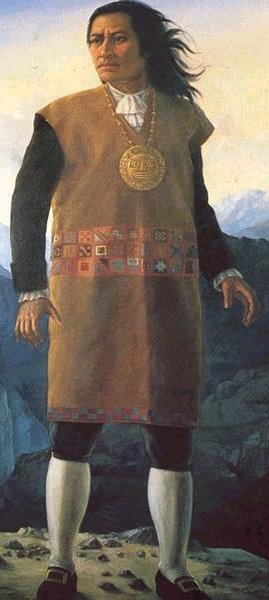
On this date in 1781, the last name in Incan rebellion met a horrible end in the ancient Incan capital of Cusco.
José Gabriel Condorcanqui — rechristened Tupac Amaru II, as he was a distant descendant of the last Incan king — was a member of the privileged indigenous population depended upon by the Spanish to administer the forced and extorted labor that made its New World empire worth having.
“From this day, no longer shall the Spanish feast on your poverty!”
This attention-grabbing entry onto the political chessboard was followed with an exemplary victory over Spanish forces. His revolt rapidly metastasized into an ethno-religious crusade, with all the accumulated bitterness of the Indians’ two-plus centuries maltreatment ferociously visited upon the Spanish.
It was a heady moment — but only a moment; within a few months, the Spanish had rallied and Tupac Amaru was betrayed into their hands.
The rebel had seized Incan symbology for his own purposes — speaking at ancient shrines, for instance — and the Spanish sentence against him included not only the inevitably horrific execution (of both Tupac Amaru and his wife and family) but a comprehensive and explicit programme of cultural annihilation to consign the Incan identity to the past. This lengthy sentence is well worth the read. (Sourced here, a pdf file; the bolded sections are my highlights.)
I must and do condemn José G. Túpac Amaru to be taken out to the main public square of [Cuzco], dragged out to the place of execution, where he shall witness the execution of the sentences imposed on his wife, Micaela Bastidas [Spanish link]; his two sons, Hipólito and Fernando Túpac Amaru; his uncle, Francisco Túpac Amaru; and his brother-in-law, Antonio Bastidas, as well as some of the principal captains and aides in his iniquitous and perverse intent or project, all of whom must die on the same day.
And once these sentences have been carried out, the executioner will cut out his tongue, and he will then be tied or bound by strong cords on each one of his arms and feet in such a way that each rope can be easily tied or fastened to others hanging from t he saddle straps of four horses, so that, in this position, each one of these horses, facing opposite corners of the square, will pull toward his own direction; and let the horses be urged or jolted into motion at the same time so that his body be divided into as many parts and then, once it is done, the parts should be carried to the hill or high ground known as “Picchu,” which is where he came to intimidate, lay siege to, and demand the surrender of this city; and let there be lit a fire which shall be prepared in advance and then let ashes be thrown into the air and a stone tablet placed there detailing his main crimes and manner of his death as the only record and statement of his loathsome action.
His head will be sent to the town of Tinta where, after being three days on the gallows, it shall be placed on a stake at the most public entrance to the town, one of his arms will go to the town of Tungasuca, where he was chief, where it will be treated in like manner, and the other in the capital of the province of Carabaya; one of the legs shall likewise be sent for the same kind of demonstration to the town of Libitaca in the province of Chumbilcas, while the remaining one shall go to Santa Rosa in the province of Lampa along with the affidavit and order to the respective chief magistrates, or territorial judges that this sentence be proclaimed publicly with the greatest solemnity as soon as it arrives in their hands, and on the same day every year thereafter; and they will give notice in writing of this to their superiors in government who are familiar with the said territories.
Since this traitor managed to arm himself and form an army and forces against the royal arms by making use of or seducing and leading with his falsehood the chiefs who are the second in command in the villages, since these villages, being of Indians, are not governed by such chiefs but rather by mayors who are elected annually by the vote or nomination of the chiefs: let these same electoral communities and the chief magistrates that care to give preference to candidates who know Spanish, and who are of the best behavior, reputation, and customs so that they will treat their subjects well and lovingly, honoring only those who have demonstrated honestly their inclination and faithfulness, eagerness, respect, obedience, submission, and gratitude to the greater glory of our great Monarch through the sacrificed of their lives, properties, or ranches in deference of their country or religion, receiving with brave disdain the threats and offers of the aforesaid reel leader and his military chiefs, yet taking care that these elected leaders are the only ones with the right to the title of chief or governor of their ayllus [communities] or towns, and that they cannot transmit their position to their children or other family members.
To this same end, it is prohibited that the Indians wear heathen clothes, especially those who belong to the nobility, since it only serves to symbolize those worn by their Inca ancestors, reminding them of memories which serve no other end than to increase their hatred toward the dominant nation; not to mention that their appear is ridiculous and very little in accordance with the purity of our relics, since they place in different parts images of the sun, which was their primary deity; and this prohibition is to be extended to all the provinces of this southern America, in order to completely eliminate such clothing, especially those items which represent the bestialities of their heathen kings through emblems such and the unco, which is a kind of vest; yacollas, which are very rich blankets or shawls of black velvet or taffeta; the macapaycha, which is a circle in the shape of a crown from which they hand a certain emblem of ancient nobility signified by a tuft or tassel of red-colored alpaca wool, as well as many other things of this kind and symbolism. All of this shall be proclaimed in writing in each province, that they dispose of or surrender to the magistrates whatever clothing of this kind exists in the province, as well as all the paintings or likenesses of their Incas which are extremely abundant in the houses of the Indians who consider themselves to be nobles and who use them to prove their claim or boast of their lineage.
These latter shall be erased without fail since they do not merit the dignity of being painted in such places, and with the same end in mind there shall also be erased, so that no sign remains, any portraits that might be found on walls or other solid objects; in churches, monasteries, hospitals, holy places or private homes, such duties fall under the jurisdiction of the reverend archbishops or bishops of both viceroyalties in those areas pertaining to the churches; and in their place it would be best to replace such adornments with images of the King and our other Catholic sovereigns should that be necessary. Also, the ministers and chief magistrates should ensure that in no town of their respective provinces be performed plays or other public functions of the kind that the Indians are accustomed to put on to commemorate their former Incas; and having carried out the order, these ministers shall give a certified account to the secretaries of the respective governments. In like manner shall be prohibited and confiscated the trumpets or bugles that the Indians use for their ceremonies and which they call pututos, being seashells with a strange and mournful sound that celebrate the mourning and pitiful memorial they make for their antiquity; and there shall also be prohibited the custom of using or wearing black clothing as a sign of mourning, a custom that drags on in some provinces in memory of their deceased monarchs and also of the day or time of the conquest which they consider disastrous and we consider fortunate since it brought them into the company of the Catholic Church and the very loving and gentle domination of our Kings.
With the same goal it is absolutely forbidden that the Indians sign themselves as “Incas,” since it is a title that anyone can assume but which makes a lasting impression on those of their class; and it is ordered, as is required of all those who have genealogical trees or documents that prove in some way their descent, that they produce them or send them certified and without cost by mail to the respective secretaries of both viceroyalties so that the formalities may be observed by those persons responsible to their excellencies the viceroys, consulting His Majesty where necessary according to each case; and the chief magistrates are charged to oversee the fulfillment of such requirements, to seek out and discover anyone who does not observe them correctly, in order to have it done to collect the documents with the aim of sending them to the proper authorities after giving their owners a receipt.
And so that these Indians renounce the hatred that they have conceived against the Spaniards, and that they adhere to the dress which the laws indicate, adopting our Spanish customs and speaking Castilian [Spanish], we shall introduce more vigorously than we have done up to now the use of schools, imposing the most rigorous and fair penalties on those who do not attend once enough time has passed for them to have learned the language; the duties and responsibilities involved in this plan going to the very reverend ecclesiastical prelates so that, in the opposition between parishes and doctrinas, they take care that those candidates bring affidavits from the provincial judges as to the numbers of people who speak the Said Castilian in those provinces … it being left up to the sovereign discretion of His Majesty to reward and honor those towns whose inhabitants have rendered, under the present circumstances, their due loyalty and faithfulness.
Finally, the manufacture of cannons of all kinds shall be prohibited under the penalty that any noble found manufacturing such items will be sentenced to ten years of prison in one of the presidios in Africa and any commoner will receive two hundred lashes as well as the same penalty for the same time period; reserving for a future time a similar resolution with regards to the manufacture of powder. And since there cannons of almost every caliber in the many ore-crushing mills and timber yards in these provinces, they will be gathered up by the magistrates once of the pacification of this uprising has been completely terminated in order to give account of them to the respective captaincy general so that he may determine whatever use he deems proper for them. Thus have I visualized, ordered, and signed: this is my final judgment.
José Antonio de Areche.
Tupac Lives.
The Spanish campaign to eradicate his name and identity didn’t exactly have legs.
The savagery of the crackdown helped generate Incan support for the rebellions that would shake off Spanish authority in the generations to come. He entered the official iconography of the post-colonial state, and can be found on Peruvian currency.
On this date in 1521, the day after winning the decisive battle in the Castilian War of the Communities, royalist forces beheaded its three principal leaders in Villalar.
Even while the Spanish Empire was burgeoning in the New World, its home peninsula remained a house divided.
The Iberian Kingdoms of Aragon and Castile had joined in a personal union with the marriage of Ferdinand and Isabella in the late 15th century.
When the couple passed, it was not a given that their conjoined territory would become, as it did, the germ of a unified Spain.
Instead, the royal power couple’s crazy daughter was kept under lock and key while her infant son grew into the redoubtable Emperor Charles V. To exacerbate the local annoyance, Chas had continent-spanning territories, and ambitions; Spain was not his base, merely one of his provinces. (He’d grown up in Flanders. Ah, dynastic politics.)
The Emperor was only a teenager when his Castilian subjects rose against his levies, and against the paradoxical perception that the first true King of Spain was a foreign ruler.
A riot in Toledo mushroomed into a revolt, and everyone started drawing up sides. (Spanish link) Things went south when the commoner rebels started adopting an unwelcome radicalism (beyond rebelling against the king, that is), enabling the imperial rep (and future pope) Adrian of Utrecht to pull back into the royalist camp rebellious nobles increasingly fearful of expropriation at the hands of the firebrands.
The Execution of the Comuneros of Castile, by Antonio Gisbert. Segovian Juan Bravo allegedly asked to die first, so as not to witness the death of so good a knight as Padilla.
The demise of the “Caballeros Comuneros” pretty much squelched the revolt — although Padilla’s widow Maria Pacheco defended the rebel ground zero of Toledo for several months more.
The comuneros have lived on ever since as a symbol in literature and propaganda, among monarchists (for whom they are a symbol of perfidy), liberals (rather the reverse) and Castilian nationalists. Though “comuneros” was for a period an all-purpose smear against agitators in the Spanish dominions, April 23 (the date of the fateful battle) has been Castile and Leon Day, a public observance, since 1986.
This monolith in the Villalar town plaza commemorates the Comuneros. Image (c) Julio Alvarez, and used with permission.
On this date in 1548, the Spanish crown cemented its authority over the territory of the former Incan Empire by beheading its rebellious conquistador authorities.
Gonzalo Pizarro (English Wikipedia entry | Spanish) had served in the force that late elder half-brother Francisco used to destroy the Incas. The poor bloke was always second banana in the conquistador game; when he wasn’t being one-upped by his flesh and blood, he was bailing on the expedition that “discovered” and navigated the Amazon River. (Francisco de Orellana earned those honors instead.)
No, Gonzalo had a more prosaic specialty: killing.
While big bro went off to pacify more territory, Gonzalo along with siblings Hernando and Juan, the Baldwin brothers of New World conquest, chilled in the former Incan capital Cusco and sparked a rebellion in the 1530’s with their iron-fisted rule.
Appointed Governor of Quito in 1541 — he forced the appointment with some exemplary hangings — Gonzalo was just the sort to get a burr in his saddle when the Emperor Charles V promulgated the New Laws requiring slightly less crappy treatment of the natives.
And that was a low bar to clear indeed.
Although the following passage is not particular to Gonzalo Pizarro, gadfly monk Bartolome de las Casasdescribed (perhaps exaggeratedly, but still) the previous Spanish depredations in “Perusia”:
[T]he Spaniards, without the least provocation on their part, as soon as they entred [sic] upon these Territories, did burn at the Stake their most Potent Caciq Ataliba, Prince of the whole Country, after they had extorted from him above Two Millions of Gold, and possessed themselves of his Province, without the least Opposition … As also some few days after, the Ruler of the Province of Quitonia, who was burnt, without any Cause given, or Crime laid to his Charge … and in like manner, burnt the Feet of Alvidis, the greatest of all the Quitonian Lords, and rackt him with other Torments to Extract from him a discovery of Ataliba’s Treasure, whereof as appear’d after, he was totally ignorant …
[T]hese Eyes of mine the Spaniards for no other reason, but only to gratifie their bloody mindedness, cut off the Hands, Noses, and Ears, both of Indians and Indianesses, and that in so many places and parts, that it would be too prolix and tedious to relate them. Nay, I have seen the Spaniards let loose their Dogs upon the Indians to bait and tear them in pieces, and such a Number of Villages burnt by them as cannot well be discover’d: Farther this is a certain Truth, that they snatched Babes from the Mothers Embraces, and taking hold of their Arms threw them away as far as they would from them: (a pretty kind of barr-tossing Recreation.) They committed many other Cruelties, which shook me with Terror at the very sight of them, and would take up too much time in the Relation …
More urgent than “recreation,” Pizarro (and many of the New World’s new landholding elite) were miffed that meddlesome European bleeding hearts types were going to cut into their profit margins.
Pizarro revolted, enlisting the brilliant officer Francisco de Carvajal, a longtime fixture of the Old World battlefield. Now an octogenarian, he had lost neither vigor in command, nor cruelty in conquest. (He played bad cop to Gonzalo’s good cop.) The two killed the guy sent to impose the emperor’s decree.
This uprising forced the next Spanish viceroy to repeal the hated New Laws in order to win political support against Pizarro and Carvajal — a happy outcome for Pizarro’s base, but not for the conquistador himself.
Pedro de la Gasca’s adroit diplomacy caused the entire rebel force to desert before the fight at the “Battle” of Jaquijahuana in Sacsayhuaman.
The two principals were quickly arraigned. Carvajal, at his age, could be wry about being singled out for punishment: “very merciful is the Lord President; for, if the victory had been ours, there would have fallen on this spot nine hundred men.”
Carvajal was hanged and Pizarro beheaded, both of them winding up on pikestaffs at the gates of the city Francisco Pizarro had founded — Lima.
Their partnership — and the arc of Spanish exploits in the New World — is covered in this Google Books freebie.
On this date 1,150 years ago, Eulogius of Cordoba was beheaded for blasphemy in Muslim Spain.
Islamic rule in Spain was a century and a half old at this time; a period of relative comity among the Abrahamic faiths, it was nevertheless far from painless for Christians.
Islamic law exerted some (usually) non-lethal pressure on subject Christians by tolerating them as second-class citizens, subject to restricted civic privileges and additional taxes. With apostasy from Islam to Christianity punishable by death, it engineered a steadily increasing Muslim proportion of the populace.
Around 850, and continuing for the ensuing century, some Christians’ resistance to this arrangement would provoke periodoc repressions and a regular supply of martyrs.
Eulogius, a priest renowned for his eloquence and education, became a prominent exponent of the emerging trend of missionary martyrdom — Christians intentionally blaspheming Mohammad to a Muslim judge for purposes of drawing an exemplary death sentence.
We can readily infer that Eulogius’s support for such behavior was controversial; surely missionary martyrdom escalated tensions between the comingling communities in ways potentially troublesome for the go-along, get-along crowd. And Christians had good reasons to go along and get along: they could enjoy positions of wealth, influence and comfort, along with unencumbered worship.
Bishop Reccafred of Cordoba attempted to squelch any appearance of official support for these fire eaters, and threw Eulogius and other priests in prison after promulgating a decree against the martyrdoms in 852. Naturally, this made him a sellout in the eyes of the militants; Eulogius took a firm line against any attempt to derogate the martyrs of a fellow monotheism as unequal to the ancient martyrs of pagan Rome.
Those who assert that these [martyrs] of our own day were killed by men who worship God and have a law, are distinguished by no prudence … because if such a cult or law is said to be valid, indeed the strength of the Christian religion must necessarily be impaired. (Cited here)
The Cordoban martyrs’ movement claimed a few dozen lives over the 850’s — a hagiography records 48 — some taking inspiration from Eulogius’ Exhortation to Martyrdom. The author of that tract eventually followed his own advice.
Caught sheltering an apostate Muslim (she was executed a few days after Eulogius), the priest got into it with the Islamic judge, denounced the Prophet, and earned himself a death sentence. The story says he even literally “turned the other cheek” when struck by a guard en route to his decapitation.
In all the time since, Eulogius’s words have had a resonance for at least some segment of Christendom: when martyrdom has waxed popular, or confrontation with Islam loomed large. As his entry in Medieval Iberia: An Encyclopedia puts it,
Eulogius’s apologetic treatises are important, then, not only as evidence of the wide spectrum of Christian responses to life under Muslim rule — from outright rejection to almost complete assimilation — but also as one of the earliest extant sources for Western views on Islam.
This date in 1530 marked the end of the pre-Columbian Tarasco Empire, when the Spaniard Nuño Beltrán de Guzmán lashed its last independent king (Spanish link) to a tree and burned him to death.
Legendary even by conquistador standards for his cruelty, Beltran de Guzman eliminated the Tarascan state in western Mexico — a onetime Aztec rival which had got off relatively easy during Cortes’s 1520s incursion by cooperating with the Spanish.
Beltran de Guzman had set out from Spanish holdings on the hunt for gold, butchering the many natives on his westward jag unable or unwilling to comply with his demand for more and better treasure.
Tangaxuan — or Tangaxoan, or Tanganxoan, or Tangaxhuan, and other such variants — met his foreign-born visitor peacefully with some gifts of gold and silver. This only whetted Nuno Beltran de Guzman’s appetite, and he promptly had the king detained and tortured for more pelf before dispatching him by dragging by horses and burning alive at the confluence of the Río Lerma and the Río Angulo. (Spanish, again.)
The monumental Juan O’Gorman mural in Michoacan, the present-day Mexican state occupying what was once Tarascan land, depicts this day’s execution above the inscription, “Tangaxhuán, the last monarch of the Purhépecha Indians was tortured and assassinated by the ferocious hordes led by the sadistic, vile, Nuño de Guzmán.”
Although even other Spanish officials viewed our bloodthirsty conquistador with distaste, his depredations were ultimately rooted in the logic of imperial expansion, and the conquest of Tarasco consolidated (Spanish link) the colonial power’s grip on “New Spain”.

 The widow of the chief Caonabo (Spanish link), who had been captured and shipped to Spain by Christopher Columbus himself, Anacaona inherited leadership of one of the principle Taino realms of Hispaniola, present-day Haiti and Dominican Republic.
 Joan (or Juan) Peiro (

 The problem, in the eyes of feckless royal troglodyte

 José Gabriel Condorcanqui — rechristened


 Gonzalo Pizarro (

