On this date in 1834, one day after overrunning the Alava village of Gamarra, Carlist General Tomás de Zumalacárregui had 118 of its defenders shot.
Zumalacárregui was the outstanding Carlist (read: conservative, absolute-monarchist) officer of the day. (Here‘s a public-domain memoir of his campaigns.)
We meet him on the march in 1834, adroitly reversing the grim royalist position in the First Carlist War — a liberal-vs.-conservative civil war that also mapped onto ethnicity, geography, and royal succession.
On this occasion, he overwhelmed a contingent of liberals and Basques fighting for the child-queen Isabella II. The survivors were taken prisoner and (despite objections from some of Zumalacárregui’s underlings) given a fusillade the next day in the neighboring town of Heredia.
Día 17. Permanecimos en Heredia donde se fusilaron 118 peseteros. (“Day 17: We remained in Heredia, where we shot 118 Chapelgorris.”)
The Fusilamientos de Heredia — still notorious to this day — were distinguished by their number, but they were hardly unique. Both sides in the civil war unapologetically carried out summary executions of prisoners they had no resources to detain and did not care to turn loose. (And in the more everyday interests of sowing terror, or avenging the last time the other guys sowed terror.)
An English peer eventually brokered the Lord Eliot Convention, an arrangement by which both Carlists and Cristinos agreed to stop slaughtering prisoners and exchange them so that they could properly slaughter one another on the battlefield instead.
On this date in 1974, in the face of an international controversy, Spain executed anarchist Salvador Puig Antich — the very last execution by garrote.
Handsome young Salvador radicalized as a youth in the 1960s under the oppressive semi-fascist Franco dictatorship.
As was the style at the time, the Catalan nationalist’s philosophy soon migrated to anarchism, and he brought his army experience to the Movimiento Ibérico de Liberación (MIL), whose direction-action credo entailed bank robberies branded as “expropriation.”
Puig Antich was caught in a police ambush that also claimed the life of a police officer — at least some of the bullets seemingly delivered by police friendly fire.
But his defense that his own gun discharged only as he was beaten senseless by the gendarmes never had a chance, since between arrest and trial, another set of proscribed leftists assassinated Prime Minister Luis Carrero Blanco.
Blanco’s successor went by the handle “Butcher of Malaga” for his depredations as a nationalist prosecutor during the Spanish Civil War.
So there was no quarter forthcoming from the Spanish regime, notwithstanding domestic general strikes and worldwide gnashing of teeth.
Spain soon did away with the discomfiting garrote; its very last executions were carried out by firing squad.
Salvador Puig Antich was the subject of a 2006 film, Salvador. (Here is a hostile anarchist review.)
The junior partner in the day’s twin killing, Heinz Ches, was himself the subject of a documentary, Nobody’s Death: The Enigma of Heinz Ches, exploring the weird near-total obscurity of the man who shared the headlines with Salvador Puig Antich. (A clip can be viewed here.)
On this date in 1872, reformist Filipino priests Mariano Gomez, Jose Burgos and Jacinto Zamora (together, the first syllables of their surname formed the acronym “Gomburza”) were garroted in Manila for their alleged support of an anti-Spanish mutiny.
These three clerics were leading exponents of liberalization; they notably pressed the rights of the native-born clergy as against the powerful religious hierarchy of imported Spanish priests.
While that critique had a somewhat receptive ear under the forward-thinking governorship of Gen. Carlos-Maria de la Torre, a more reactionary successor did not look as kindly on such agitation.
When naval shipyard workers rebelled in the 1872 Cavite Mutiny — over higher taxes, including a surcharge to avoid forced labor, not over the Gomburza priests’ agenda as such — the colonial administration used it as a pretext to seized the priests and condemn them for subversion.
Alas, Spain couldn’t manage to garrote away its subject peoples’ aspirations.
A bad end for Gomez, Burgos and Zamora was just the start for reform and independence agitation in the Philippines.
Only five days before, Martin Merino y Gomez (Spanish Wikipedia link) had slipped into the palace wearing his clerical robes, and planted a dagger in the Queen’s side. (Non-fatally; her corset partly shielded the blow.)
Despite some speculation that he might have been connected to some more elaborate plot, investigation found him to be a lone nut, “crazed with Liberal doctrines, disordered vanity, and bilious disease.”
Neither a clear motive nor a real link to any other actor was ever established. Merino died as a lone nut, and then his parricidal remains were burned to ashes and scattered to the winds.
Something of a career troublemaker, Murillo had had a few scrapes with the crown’s agents over his patriotic aspirations for the territory the Spanish called Upper Peru.
Unfortunately for the self-proclaimed Junta Tuitiva, neither masses nor elites really rallied to their side, and the Spanish swiftly crushed the uprising.
July 16, the date these dreamers declared independence, is still celebrated in La Paz.
And why not? Though militarily overwhelmed, this quixotic enterprise turned out to be one of the opening acts in a (largely successful) generation-long struggle for independence throughout the Spanish possessions in the New World.
On this date in 1897, days after Philippine independence hero Jose Rizal was shot by the Spanish, 13 martyrs to the same cause suffered the same fate at the same execution grounds.
They were casualties of Spanish pressure against the revolutionary Katipunan and/or its Rizal-rounded parent organization La Liga Filipina.
Not all this grab-bag of sacrificial patriots were really firebreathing revolutionaries. But the (serious) divisions among Filipino activists and revolutionaries were of small import to the Spanish, who (as the 13-strong martyr batches suggest) went in for the wholesale school of repression.
Perhaps most notable in this day’s batch was Francisco Roxas, one of the Philippines’ wealthiest men. Despite his liberal sympathies, he’d refused the more radical Katipunan’s shakedown for financing, only to have that organization vengefully place his name on a membership list the Spanish were sure to find. (Roxas maintained his innocence, but accepted his unsought martyr’s crown and never betrayed his fellows.)
Two photos of the 13 martyrs’ execution, from this page, with plenty of other undated executions.
The wise were forced to live as the mad were accustomed, in order to shun death, such that the greatest lunatic now possesses the royal burdens. The wise now lived alone with their wisdom, behind closed doors, applauding only in public the others’ mad and twisted caprices.
-Tommaso Campanella
On this date in 1603, freaky-deaky Dominican philosopher Tommaso Campanella drew a life sentence — avoiding execution by dint of a painfully convincing performance of insanity.
Campanella had some problematically heterodox notions about the sun (namely, that it was going to consume the earth) and everything under it, and had had a recent scrape with the Inquisition.
What really got him in trouble was trucking with a Calabrian conspiracy to overthrow Spanish domination, apparently a product of the monk’s millenarian anticipation of a sort of proto-communist revolution.
Campanella was a strange guy, but this was quite a far-out plot.
This took place, let it be noted, after he had written two works advocating a Papal monarchy for Italy and the world and two works promoting the interests of the Spanish Empire also in Italy and throughout the world.
Past performance is no guarantee of future returns. Once the conspiracy was betrayed,
Campanella was imprisoned … in the Castel Nuovo, one of the principal fortresses in which the Spaniards maintained a military garrison. He was arraigned before the civil tribunal for rebellion and before the ecclesiastical tribunal for heresy. His “examination” which began in January 1600 was gruesome. He claimed innocence in his first interrogation before the civil tribunal, was thrown into a dungeon, actually a cleft in the bedrock of the Castle, to remain there for seven days. Then followed torture. He “confessed,” admitting that he preached about the coming political upheaval but denying that he was part of a conspiracy to bring it about …
His desperation at this point can be gauged by the fact that by April of 1600 he began to feign madness. The ecclesiastical action against him began now, and he persisted in this attitude of insanity through three interrogations, including an hour of torture … On the fourth and fifth of June 1601, he was subjected to the cruel torture of “the vigil” to test whether his insanity was genuine. This was the usual torture of the rope, suspending the body of the victim by his tied hands over a blade which cut into his flesh whenever he yielded to the strain of holding himself in the air; but the vigil refined this cruelty by continuing it for forty hours. Campanella endured the ordeal without breaking.
And it wasn’t just a feat of toughness to beat the torturer at his own game, impressive as it is on those terms alone: Campanella pulled off a genius gambit exploiting the Inquisition’s own legal machinery to duck the separate capital charges he faced in civil and ecclesiastical court.
Joseph Scalzo’s “Campanella, Foucault, and Madness in Late-Sixteenth Century Italy”,* an academic paper that reads like a thriller, narrates Campanella’s “dangerous competition” with his persecutors.
In fine: on Easter Sunday 1600,** as he was approaching conviction and condemnation in his state trial for treason, Campanella began his insanity ploy, successfully forcing a delay in that case and initiating his separate church trial for heresy.
Then, by remaining stubbornly committed to what most of his examiners believed was a charade, Campanella won … by forcing them to inflict that juridically determinative 40-hour “vigil” torture.
the jurisprudence of the time accorded torture so much force, such as to annul all other proofs and “to purge circumstantial evidence”; if the torture had been vigorous and unusual. The accused came, all the more to avail himself of the result obtained, according to the scholarship of the criminologists most in vogue. Thus, Campanella had judicially to be regarded as insane, although everyone was persuaded that he probably simulated insanity. The consequence, in the tribunal of the Holy Office, was not indifferent: He was a “relapsed heretic,” and even if repentant, he would have been disgraced and consigned to the secular court of justice, which would have executed him; being mad, he could no longer suffer condemnation, and in the circumstance in which he might already have been condemned, he would have been spared the death penalty, to reason and repent.
(this is Scalzo’s quotation of Luigi Amabile, an Italian who wrote the book on Campanella; I have been unable to find the Amabile original online.)
Home free.
Having reached this judicial safe haven, Campanella soon — in fact, according to the man who tortured him, literally on the walk from the vigil back to his cell — resumed a recognizable rationality.
He’d languish in prison until 1626 (a few years after he got out, he had to flee to France), but he made the most of it. Campanella wrote his magnum opus, the utopian City of the Sun, while awaiting his sentence in 1602. A number of other works on a wide array of subjects — science, philosophy, theology, political governance (he returned to giving the Spanish empire supportive advice), a vigorous defense of Galileo — were also composed during his 27 years under lock and key.
Campanella’s visionary anticipation of radical egalitarianism would, like Thomas More‘s, help shape the utopian literary genre. But Campanella’s take, while still a theocratic one, lent itself to distinctly more subversive interpretation.†
For example, this Brezhnev-era Soviet essay‡ (unearthed and translated by Executed Today friend and sometime guest-blogger Sonechka) decants the Dominican’s heretical notions into Marxist orthodoxy.
How many times were the communists denounced by their enemies for this “commonality of wives”! Scientific communism, certainly, is not responsible for the figments of a monk like Campanella. But it is instructive to penetrate his logic. It is not commodification or dehumanization that hides behind Campanella’s “commonality of wives”. The women of the “City of Sun” have the same rights as men … The “commonality of women” is equivalent to the “commonality of men” on the basis of mutual equality. That is why, though [we are] decisively rejecting this type of family-free communism, it is necessary to consider who stands on the higher moral grounds — Campanella’s woman, alien to deceit and pretense, or a false bourgeois woman, whose lot in life is adultery and legalized prostitution.
Ultimately, this wild man not only got the high moral ground: he got to die in bed. Once in a while, we get a happy(ish) ending.
So although it actually has nothing to do with Tommaso, “La Campanella” — “Little Bell”, a Paganini violin concerto — allows us here at this blog (in common with our day’s hero) an atypically soothing* denouement.
* Joseph Scalzo, “Campanella, Foucault, and Madness in Late-Sixteenth Century Italy”, The Sixteenth Century Journal, Vol. 21, No. 3 (Autumn, 1990)
** Campanella’s Easter 1600 madness was initiated only a few weeks after fellow intellectual omnivore Giordano Bruno was burned for heresy up the road in Rome. Strictly coincidence.
† Since so much of Campanella’s work was produced while the author was under duress — fighting capital charges, applying for clemency and release — it remains disputable just which parts of it can be taken to represent his real beliefs.
‡ L. Vorob’ev. “Utopija i dejstvitelnost”. (“Utopia and Reality”) in Utopicheskij roman XVI-XVII vekov (Utopian Novel of XVI-XVII century); Series “Biblioteka vsemirnoj literatury”, Khudozhestevnnaja literature, Moscow, 1971, p. 19.
La Expulsión de los Moriscos, by Vincenzo Carducci (Vicente Carducho).
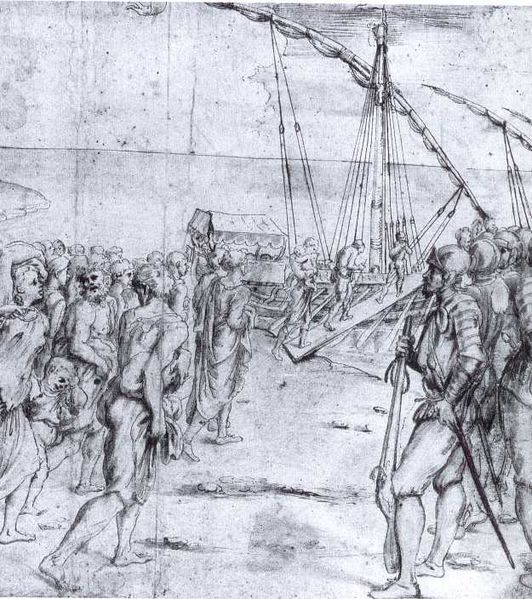
Having taken the trouble over the preceding century to eliminate (or force underground) its substantial Muslim population by forcibly converting it to Christianity, Spain in the early 1600s bethought itself to complete the operation upon its recently minted fellow-Christians by ejecting these Moriscos from Spain altogether.
When the edict for this radical act of expulsion first came down in the heavily Morisco area of Valencia, some of its victims reportedly embraced the prospect of deportation to a land where their dress, language, and religion were no longer forbidden.
the Muela de Cortes (Spanish link), an almost inexpugnable spot, being a deep valley surrounded by precipitous heights, of which the passes were easily defensible. The Moriscoes of that region … were in a state of excitement and were readily persuaded to rise by an outlaw named Pablillo Ubcar. They elected as king Vicente Turixi, who sent a proclamation through the sierra for all to join him under pain of treason. From their strongholds they made raids on the surrounding country, gathering cattle and provisions, burning villages, and desecrating churches.
[Ethnic cleansing coordinator Don Agustin] Mexia, absorbed in the work of embarkation and fearing to interrupt it, for awhile paid no attention to these movements … who could readily be reduced when the time came.
His provisions were justified … those of the Muela de Cortes … lost heart when they heard of the defeat of those of Aguar, and were disappointed as to the appearance of the Moor Alfatami on his green horse, whom tradition reported to be concealed under the mountain since the days of King Jayme … It was agreed that they [the rebels, surrendering] should be safe in person and property, provided they would go to embark within three days.
The rapacious soldiery, who had promised themselves abundant plunder, in their disappointment threw off all discipline; they sacked the village of Royaya, outraged the women and seized numbers of children as slaves. Only three thousand Moriscoes were brought to the port of embarkation, the rest having scattered and taken to the mountains to escape the fury of the soldiers.
These, estimated at two thousand in number, for several years gave infinite trouble, killing all the Christians they met and committing constant depredations. At one time the Governor of Jativa induced many of them to come down, but finding that they were to be enslaved they fled back to the mountains.
A reward was offered for King Turixi, dead or alive; he was tracked to a cave, captured, and brought to the city, when he was sentenced to have hands and ears cut off, to be drawn, torn with pincers, hanged and quartered; but at the execution, December 18th, the cutting of hands and ears was omitted. He had been confessed twice and reconciled twice, and died as a good Christian, making a most edifying end, for we are told that he had been a liberal almsgiver and devoted to the Virgin and the religious Orders.
The miserable remnants were hunted down gradually, the viceroy paying twenty ducats a head for them as galley-slaves.
The armed resistance in Valencia — where Moriscos were most numerous, and the expulsion was first decreed — was actually much less than had been feared, which gave the Spanish authorities all the encouragement they would need to enforce it elsewhere, too.
“Seeing that the whole body of our nation is tainted and corrupt, he applies to it the cautery that burns rather than the salve that soothes; and thus, by prudence, sagacity, care and the fear he inspires, he has borne on his mighty shoulders the weight of this great policy and carried it into effect, all our schemes and plots, importunities and wiles, being ineffectual to blind his Argus eyes, ever on the watch lest one of us should remain behind in concealment, and like a hidden root come in course of time to sprout and bear poisonous fruit in Spain, now cleansed, and relieved of the fear in which our vast numbers kept it.”
Jose Maria Torrijos y Uriarte (Spanish Wikipedia page) was one of the heroes of that downtrodden cause from way back, a noble-born officer who had been made a captain at the precocious age of 13 and been around for all of Spanish liberalism’s greatest early 19th century tragedies.
He was in Madrid for the ill-fated uprising against its French occupiers in 1808, and was captured en route to aid Pedro Velarde‘s last stand.
Lucky for Torrijos, and luckier still: as a prisoner, he might have been in line for the ensuing mass execution, but an aide-de-camp of General Murat let him go in gratitude for chivalrously preserving a French officer from the Spanish mob.
A few years after the Peninsular War, with independent Spain yoked to a reactionary Bourbon-backed monarchy, Torrijos’ dangerous opinions made him a prisoner once more.
This time, he was liberated by the brief ascendancy of fellow-traveler Rafael del Riego. This effusion, too, was destined for grief upon the scaffold; once more, Torrijos escaped, this time to exile.
The execution of Rafael del Riego
Pushing forty and a bit emptyhanded for all his strivings, Torrijos’ restless soul was not satisfied knocking about the shores of England. He soon assembled a company of like-minded folk (such as Robert Boyd) to make another bid at liberating Iberia. But he was induced to put ashore under the misapprehension of support, and promptly rounded up.
The Malaga governor’s message to Madrid requesting instruction returned the simple order: shoot them all.* (Spanish link)
El fusilamiento de Torrijos y sus compañeros en la playa de Málaga, by Antonio Gisbert
* Around 50 or so were shot. The exact figure is differently accounted by various sources; I have been unable to determine if any among them are authoritative.
On this date in 1780, Incan-Peruvian indigenous leader Tupac Amaru launched his insurrection against the Spanish with the public execution of a Spanish corregidor.
Antonio de Arriaga, as Spain’s man in Tungasuca, had as part of his job description forcing curacas to extract the crown’s tribute from the natives. This put some tension between him and the likes of the strong-willed Tupac Amaru, who advocated fiercely enough for his people’s rights that Arriaga threatened him with death.
It also made Arriaga’s death an invitingly emblematic scene to open the indigenous revolt.
On Nov. 4, 1780, Tupac Amaru kidnapped Arriaga returning from a dinner party, then forced him to sign letters summoning Spaniards and curacas alike to Tungasuca.
Account of the Most Horrible Crime Committed by Jose Gabriel Tupac Amaru, Cacique of Pampamarca
On the morning of Friday, November 10th, Tupac Amaru ordered that three columns … be organized from all the people from his Province that were already there. Two were composed of Spaniards and Mestizos armed with muskets, sabers, and sticks; and one of Indians with slings. In the middle of this, he brought out the Corregidor, dressed in his military uniform, and publicly started taking his uniform off, stripping him of his rank following the rituals he had understood and seen in other occasions, until he was left in his shirt. He then put a shroud on him … that had the title of La Caridad on it. He then gave the order to take him to the gallows, accompanied by the Priest and two other clergymen, where he went with a resignation and patience worthy of somebody who was already touching the portals of eternity.
Once on the gallows the Corregidor was forced by the tyrant to publicly declare that he deserved to die in that way. A black slave of the Corregidor [named Antonio Oblitas -ed.] served as his executioner, but the ropes snapped and both fell to the ground. But they suspended them again with a lariat around their necks, and thus they completed the execution in clear sight and tolerance of all his Province. [“they” is as rendered in the book; I have no indication that more than one person was executed. -ed.] Not one voice was raised that would disturb the operation. And most surprising of all was that those same Collectors and those close to the Corregidor were the ones who (oh, what an awful spectacle of perfidy!) sped his way to the ignominious place of execution, and who pulled on his feet so he could die even more violently.


 Handsome young
 These
These 


 It was a


