1635: Francisco de Nava, precipitating a church-state conflict

[S]trife* [between Manila archbishop Hernando Guerrero and the Spanish governor Don Sebastián Hurtado de Corcuera] being greatly inflamed … became entangled with one of the most memorable disputes that have occurred in the islands — a necessary occasion for the sharpest encounter between the two jurisdictions, and one from which Don Fray Hernando Guerrero could not excuse himself, as it concerned the most sacred part of the ecclesiastical immunity. That was a matter in which the archbishop could not neglect to sally out with all his might, in order to comply with the obligation of a true prelate. The case was as follows: There was an artilleryman in Manila, named Francisco de Nava, who had a female slave with whom he had illicit communication, as came to the ears of the archbishop. The archbishop ordered him to remove from himself this occasion [for sin] by selling the slave-girl to another person; and had the latter placed, for that purpose, in the house of a lady who was related to Doña María de Francia, who became fond of her and arranged to buy her from the artilleryman. The latter was so beside himself over the loss of the said slave that he refused to sell her at any price, saying that he wished, on the contrary, to marry her. But Doña María de Francia so arranged matters that the slave was sold, and came into her possession with very slight effort. The artilleryman, grieved and regretful for what had happened, almost became mad, and, it having been given out that he was mad, certain violence was shown him; and on one occasion he had received a sound beating at the house of Doña María de Francia, because he had gone there to request that they should give him the slave, as he had resolved to make her his wife.

Aggrieved and rendered desperate in this way, he saw the girl pass one day in a carriage with Doña María de Francia. Going to her he asked her whether she knew him, who was her master. The slave answered him with some independence, whereupon he, blind with anger, drew his dagger in the middle of the street and killed her by stabbing her, before anyone could prevent it. All the people, both those in the carriage and those in the street, ran tumultuously [after him]; but the artilleryman escaped them all, and took refuge in the church of our convent in Manila. The governor heard of what had happened, and ordered Don Pedro de Corcuera, his nephew (who was then sargento-mayor of the camp), to take the artilleryman from the church, saying that he could not avail himself of the sanctuary of the church, as he had committed a treacherous act — although it was only a homicide, and the settlement of this question did not concern the governor. However, his action arose mainly from the anger that he felt that what had happened was in the presence of his nephew, Don Pedro de Corcuera — who, also being angered at what concerned his wife, made use of his commission with less prudence than he ought to exercise in executing such orders from his superiors. He caused the church and convent to be surrounded; and, going inside, examined everything, not excepting even the sacristy; and it is even said that he declared that, if he found the artilleryman there, he would take him out a prisoner. But not having been able to find him then, Don Pedro left the church and convent surrounded by a double guard. The governor added to that that he would not allow the religious to enter or leave, until he had hold of the refugee. The latter was finally found, and taken from the sacristy, and surrendered to the commander of artillery, in order that he might proceed with the trial as his competent judge; and he, either carried away by flattery, or in obedience to the commands of the governor, proceeded so hastily that in a very short time he condemned the artilleryman to death.

The archbishop’s provisor, Don Pedro Monroy,** bore himself on this occasion with the prudence that was fitting, and proceeded against the commander of artillery, requesting him to deliver his prisoner and return him to the church. Having been informed that the commander of artillery was a mere instrument, and that all his actions were according to the impulses of the governor, he sent three lay priests to the palace to intimate to the latter that the judge should deliver the refugee to him. The priests entered, without anyone hindering them; and finding that the governor had already retired, as it was then an advanced hour of the night, they started to withdraw in order to return next morning; but the soldiers of the guard would not permit them to leave, saying that such was the order of the governor.

The sentence against the artilleryman having been given — which it is said that the governor sent ready made out to the judge, to sign — they proceeded to execute it,† notwithstanding that the provisor proceeded to threaten censures, and to impose an interdict and suspension from religious functions [cessatio de divinis]. The governor ordered a gallows to be erected in front of the very church of St. Augustine, and the criminal was hanged thereon — to the contempt of the ecclesiastical immunity, for the [proper] place assigned for such punishments was very distant from there. The governor, seeing that the sentence was already executed, and that he had now obtained the chief object of his desire, wrote to the archbishop, requesting him to have the censures removed and the interdict raised, and the churches opened on the day of the nativity of our Lady. The archbishop, recognizing the duplicity of the governor, refused to answer that letter without first consulting the orders; and, after consulting with some of them, decided that he would not raise the interdict, since there was less inconvenience in having it imposed [even] on so festive a day, than there would be in his yielding on an occasion so inimical to the ecclesiastical immunity. However, the requests of the Recollect fathers of our father St. Augustine, who had charge of the advocacy of the nativity, had so much influence that the archbishop ordered the interdict to be removed, and it was done.


Manila’s historic St. Augustine church. (cc) image from Jun Acullador

The commander of artillery was condemned to some pecuniary fines, from which he appealed to the judge of appeals, who was the bishop of Camarines. The ecclesiastical judge refusing to admit the appeal, he threatened the royal aid of fuerza; and this question having been examined in the royal Audiencia (which at that time consisted of but the governor and only one auditor, Don Marcos Zapata), it was declared in his favor, and the appeal went to the bishop of Camarines. The latter — namely, Don Francisco Zamudio, of the order of our father St. Augustine, and a son of the province of Méjico — declared the commander of artillery to be free from the sentence given by the ecclesiastical judge. The trial of the commander of artillery had its second hearing. On that account there did not fail to result certain charges against the governor, such as his having ordered the secular priests to be detained in the guard-house; his declaration that he could not be excommunicated by anyone except the pope; and that if an order were given to him to arrest the pontiff, he would arrest him, and even drag him along by one foot (which he was proved to have said by several persons). The governor freed himself from all these charges by excuses in a manifesto which he published; but as it is not a part of my duty to examine their adequacy, I shall not do so. I shall refer the reader to the reply made to him by a learned ecclesiastic of the university of Méjico; for there is no liberty in Filipinas to enable any one to complain, or to speak his mind against what the government manipulates

The Philippine Islands, 1493-1898 — Volume 25 of 55

* “The underlying reason for this public dissension was racial,” says this source.

The rivalry between Spaniards born in the peninsula and those born in the colonies, the creoles or americanos, affected not only the clergy but also the lay population. The Augustinians, and the Hospitaller Orders of San Juan de Ojos, San Hipolito and Guadalupe, whose members were creoles, were opposed by the Carmelites and the apostolic colleges in that country. “While legally they [both factions] were on complete equality,” writes Dr. Domingo Abella, Philippine ecclesiastical historian, “class distinctions were apparently encouraged as much as possible by the Spanish colonial policy, because the principle of divide et impera of every aristocratic system was the leading idea for the permanent subjection of the colonies.”

The rivalry reached such an extent that in 1627 the Dominican Order in Mexico refused to admit creoles into its ranks, an act which the Spanish king disapproved. In the Philippines the situation had not openly reached that extreme. The insular hierarchy managed to keep the number of creoles, mestizos and indios who were embracing the religious life down to a minimum. But the racial discrimination rankled among those born in the colonies. Archbishop Guerrero and Bishop Zamudio were both Augustinians, but the former was a peninsular, while the latter was a creole, and this was probably the reason for their taking opposite sides.

** Later exiled to Formosa.

† A letter quoted elsewhere in the same text confirms “the execution of the sentence on the night of Thursday, September six”

On this day..

1936: The Sacred Heart, by Spanish leftists

On this date in 1936, anticlerical leftists in the Spanish Civil War allegedly subjected a monumental statue of Christ to a ritual “execution”.


“This picture, taken by a Paramount News-reel representative and received by air from Madrid yesterday, illustrates an outrage which has no parallel in the photographs published by “The Daily Mail” of the Spanish Reds’ war on religion. It shows a Communist firing squad aiming at the colossal Monument of the Sacred Heart on the Cerro de los Angeles, a hill a few miles south of Madrid which is regarded as the exact centre of Spain.” (Source)

This outstandingly incendiary image made for great recruiting for the Francoist enemies of the “firing squad” and gave credence to a “crusade” lexicology that insured the devout would break overwhelmingly against the Republic. (Nearly 7,000 men and women in religious orders whose deaths during the war are charged to the Republican account also helped.)

Maybe that was inevitable, anyway.

George Orwell, the English leftist who volunteered for the Spanish Republicans, noted in his Homage to Catalonia that

the people in this part of Spain must be genuinely without religious feeling — religious feeling, I mean, in the orthodox sense. It is curious that all the time I was in Spain I never once saw a person cross himself; yet you would think such a movement would become instinctive, revolution or no revolution. Obviously the Spanish Church will come back (as the saying goes, night and the Jesuits always return), but there is no doubt that at the outbreak of the revolution it collapsed and was smashed up to an extent that would be unthinkable even for the moribund C. of E. in like circumstances. To the Spanish people, at any rate in Catalonia and Aragon, the Church was a racket pure and simple. And possibly Christian belief was replaced to some extent by Anarchism, whose influence is widely spread and which undoubtedly has a religious tinge.

Be that as it may, Republican types suspected photographic fakery.

Just like its inspiration is reported to have done, this statue survived its “execution” in fine shapewas resurrected by public subscription, and can still be seen at Cerro de los Angeles outside Madrid.


The “executed” statue today. (cc) image from bigchus.

On this day..

1582: Philippe Strozzi, corsair

On this date in 1582, Philippe Strozzi, the Florentine-born commander of a French naval expedition against the Spanish was summarily executed as a pirate.

The Strozzi were long one of Florence’s wealthy and powerful families, as evidenced by, say, the Strozzi Palace, or the Strozzi coat of arms on Michelangelo’s Doni Tondo.

That made the Strozzi sometime-allies, sometime-rivals* of Florence’s more famous powerbrokers, the Medici. It is in both capacities that we meet Philippe (English Wikipedia entry | Italian | French).

To cut a centuries-long story short, the Strozzi had basically come out on the wrong side of the power struggle in the 16th century.

Philippe’s father, Piero Strozzi, was the child of a Strozzi-Medici union, and Piero too married a Medici. He also fought the Medici for power and ended up in exile whereupon he gravitated to the French court of … Catherine de’ Medici. (Catherine had been educated at the home of Philippe’s grandfather, Filippo Strozzi.) Catherine then turned around and used Piero as a French Marshal, including sending him to back Tuscan city-state Siena in opposition to its (and France’s) rival, Florence.**

Your basic tangled geopolitical-genealogical web.

Bottom line, Piero’s son Philippe was born in Florence but grew up Gallic, and fought in the French army all over the continent from the time he was a teenager.

When France got involved in the War of Portuguese Succession, they put this warlike fellow aboard a boat and sent him to dispute Spanish King Philip II‘s attempt to claim the Portuguese throne and unify the Iberian peninsula.

Strozzi’s armada got its clock cleaned at the naval Battle of Ponta Delgada near the Azores, with devastating loss of life.


The Spanish galleon San Mateo, which did yeoman service at this battle.

Since Spain and France were putatively at peace, Spain treated its captives not as prisoners of war but as pirates, and proceeded to execute several hundred in Vila Franca do Campo. Strozzi didn’t even get that much ceremony, however; the day after the battle, he was mortally stabbed, then tossed into the waves.

Happily, the name and the fame of the Strozzi outlived Spanish justice. In the next century, a distant relative by the handle of Barbara Strozzi became one of the most renowned composers of Baroque vocal music. (As befits wealthy Italians of the Renaissance, the Strozzi were big on the arts; Philippe was supposed to be a fine musician himself.)

* The Strozzi-Medici conflict frames the action in the play Lorenzaccio, in which the titular Brutus-like character mulls assassinating the Medici dictator in order to restore the Republic, only to find no such restoration in the offing once he actually does the deed; the father and grandfather of our day’s protagonists are both principal characters.

** That didn’t work. Strozzi was trounced at the Battle of Marciano, which signaled the permanent demise of the ancient city-state‘s independence.

On this day..

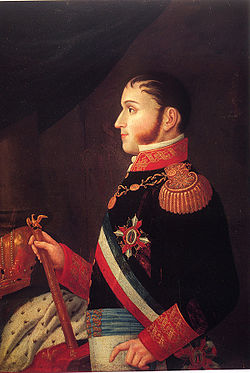
1824: Agustin de Iturbide, Emperor of Mexico

On this date in 1824, the Mexican officer who had made himself emperor was shot at the village of Padilla.

Iturbide‘s military acumen saw him through a meteoric rise in the service of what was then New Spain.

Iturbide rejected an early offer of generalship from the pro-independence leader Hidalgo in favor of spending the 1810s ably quashing the insurgency.

In a bizarre twist of fate, however, it would be Iturbide who would himself cement Mexican independence.

En route to try to finish off the last major rebel leader, Vicente Guerrero, Iturbide caught wind of the recent del Riego liberal revolt back in the mother country,* which had triggered civil war in Spain.

For the conservative royalist general, heir himself to a Basque noble lineage, the potential collapse of Bourbon authority in Spain raised the frightening specter of social upheaval.

All Iturbide’s work killing guerrillas for the sake of public order could come to naught if the Spanish monarchy collapsed or ceased projecting its power overseas … and then who knew what would emerge from the resulting power vacuum in Mexico?

So Iturbide cut a deal with Guerrero to consummate the Mexican War of Independence by separating from Madrid on an essentially conservative basis — a political breakaway without a social revolution. Independent Mexico would make nice with the Spaniards already living there, keep Catholicism as the official state religion, and get itself a constitutional monarchy of its own to insulate itself from the chance outcomes of continental politics across the ocean.

And when Iturbide marched into Mexico City and encountered a crowd conveniently imploring him to take the throne, well, who was he to deny them?

And so Iturbide transitioned smoothly from scourge of the revolution to its man on horseback,** immediately splintering the coalition that lifted him to power.


Contrary to this allegorical take on Iturbide’s coronation, he crowned himself — Bonaparte-like.

Only months after his July 1822 coronation, Iturbide shuttered Congress and began arresting the opposition. Meanwhile, Ferdinand VII had emerged from the Spanish fray as the (momentary) winner, leaving his upstart former subjects without international support.

A general that the freshly-minted emperor had himself had promoted, one Antonio Lopez de Santa Anna — yes, the Alamo guy — declared against Iturbide by the end of 1822, and come the following spring, Agustin I was a European exile, in the paradoxical position of drawing a pension from Mexico while also officially considered a traitor and outlaw.

In Tuscany and then England, Iturbide published an autobiographical justification — Statement of Some of the Principal Events in the Public Life of Agustín de Iturbide — then finally took up a much-asked-for invitation from Mexican conservatives to return and become the savior of his country against internal breakdown and a potential Spanish attack.

Founded on vainglory, this expedition was destined for fiasco; within five days of touching Mexican soil, Iturbide was serenading a firing squad with the last words, “Mexicans! I die with honor, not as a traitor; do not leave this stain on my children and my legacy. I am not a traitor, no.” Apparently they were serious about that injunction never to return.

When in Mexico City, relive happier times for our day’s subject at the Palace of Iturbide where he briefly maintained himself in the purple.


Iturbide’s palace. Creative Commons image from patricio00.

And do think twice about styling yourself Emperor of Mexico, since the only other person to claim that title also ended his reign in front of a firing squad.

* Ironically, it was a body of soldiers assembled for a reconquista of Spain’s independenceminded New World possessions that enabled del Riego to mutiny.

** Iturbide paused in the revolution’s good graces just long enough to design the Mexican flag.

On this day..

1572: The Martyrs of Gorkum

On this date in 1572, Dutch Calvinists fighting to break away from Spanish domination hanged 19 Catholics at Brielle.


The Martyrs of Gorkum, by Cesare Fracassini.

The heretofore abortive — and severely suppressedDutch Revolt blossomed in 1572 with the April 1 capture of Brielle by the Protestant raiders nicknamed Sea Beggars.

Dutch schoolchildren learn the occasion with the punny rhyme — bril, “glasses”, is a near-homophone for Brielle

“Op 1 april verloor Alva zijn bril”

On April 1st, the Duke of Alva lost his glasses

The mailed fist of imperial Spain in the Low Countries, the Duke of Alva (or Alba) would be forced by Calvinist gains this year onto the back foot; despite a vigorous counterattack that regained some lost territory in 1573, he was soon forced into retirement.

This was still just the opening saga of the Eighty Years’ War, but the Dutch Revolt would weave together theology and nationalism for Netherlands separatists. It already had.

So, small surprise that weeks after nicking the Duke of Alva’s glasses, Dutch rebels conquering other towns started making prisoners of Catholic clergy whose loyalties were suspiciously Habsburgish. Our day’s principals (here are their names; a batch of Franciscans taken are the largest contingent, to which various lay brothers, parish priests, and others were appended) were seized at and around Gorkum (Gorinchem).

The author of this intrepid iconoclastic incursion, William II de la Marck, was likewise the author of these Catholic martyrs’ doom once they had been removed back to Brielle. They were hanged without benefit of trial at an abandoned monastery.

Every sectarian propagandist of 16th century Europe made lurid heroes of his own side’s martyrs, and these were no exception to the pattern; we read in this Catholic source (perhaps while contemplating this devotional image) that

[i]t was on the 9th July 1572 when the execution of the pious sufferers began. On their side they had fully prepared themselves for it by confession and prayer. The executioner went so slowly to work that two hours had elapsed ere the last of the martyrs had taken his place on the gallows, and many of them still lived when morning broke. But the fury of the soldiers was not yet satisfied. They mutilated the dead bodies, cut off their noses and ears, and other limbs, and, alas, shame seems to touch the pen with which we write, bound them to their hats, and returned with these melancholy trophies in triumph into the city!

The location where this day’s unfortunates suffered became a pilgrimage destination, and they were formally enrolled in the minor leagues of Rome’s competitive hagiography circuit in the 19th century.

On this day..

1538: Diego de Almagro, explorer of Chile

On this date in 1538, Spanish conquistador Diego de Almagro was executed* at Cuzco by his vengeful rivals, the Pizarro brothers.

Conquistadoring with the rapacious Pizarros was a good way to get rich, get dead, or possibly both.

Almagro, a soldier, got to the New World in 1514 and soon fell in with alpha male Pizarro Francisco.** He’d become an adjunct to the latter’s conquest of the Incan Empire in the 1520s and 1530s; sent to capture the Incan city of Quito, Almagro found it razed by its defenders, and he sycophantically re-founded it as San Francisco de Quito.†

Things weren’t buddy-buddy for long.

The Iberian mothership divided Spain’s putative New World possessions north and south, putting Almagro in command of the southern cone. Great news … now all he had to do was actually take control of it.

Personally financing an expedition on the expectation of fabulous riches to be seized, Almagro instead foundered in Chile’s northern valleys in a frustrating environment of natives equally hostile and impecunious. After a couple years, he gave up and returned to Peru, angrier and poorer for his trouble — and there found that he could exploit the Spanish preoccupation with intransigent Incan chief Manco Inca to nick the capital city of Cuzco for himself.

Almagro actually had the lesser Pizarros — Gonzalo and Hernando — prisoner for a while, but he bartered them away to Francisco for a hill of beans (that is, a promise not to attack), and the Pizarros took their city back by routing Almagro at the Battle of Las Salinas.

The sentence of death against as august a personage as the appointed ruler of Nueva Toledo shocked many, and it was carried out against Almagro’s own entreaties for an appeal to the crown.


Detail view of a print of Almagro’s capture and execution. (Click for the full image.)

Francisco Pizarro would redeem his want of clemency towards his former partner in his own blood: in 1541, Almagro’s son, Diego de Almagro II or el Mozo, murdered Pizarro in an attempted coup d’etat. (Almagro the Younger, too, would be executed for his trouble.)

Although he was an important conquistador who spent most of his time at points further north, Almagro is best remembered today not in Peru but in Chile — for his abortive and disappointing expedition made him that land’s first European “discoverer”.

* Either beheaded or garroted.

** Almagro also rubbed shoulders with Vasco Nunez de Balboa.

† He pulled a similar trick with Trujillo, naming it after Francisco Pizarro’s birthplace.

On this day..

1816: Jorge Tadeo Lozano, Colombian Renaissance man

On this date in 1816, Jorge Tadeo Lozano was executed by firing squad in a Bogota temporarily reconquered for the Spanish crown.

Scientist, journalist, essayist and man-about-town Lozano (English Wikipedia entry | Spanish) sprang from the stock of New World Spanish nobility.

He studied literature, philosophy, medicine, chemistry, mathematics, mineralogy, botany; he served in the Spanish military and traveled in Europe; he returned to his native New Granada, where he became drawn into the liberal ferment with a celebration of the emerging bourgeoisie obviously contextualized by his scientific education.

Money, like the blood of a body, gives life and shares with each and every one proportionally the movement and robustness that it needs to freely comply with the action that it must complete as a member of society … This inistrumental motive of wealth can not be hushed, if it is to produce an effect … in the manner of electric flow [it] passes through bodies, leaving them with a glowing heat, also enlivens the arms and hands through which it passes… (Studies in the History of Latin American Economic Thought)

As a member of the constituent assembly, he helped draft an 1811 constitution that acknowledged the authority of the Spanish crown, but not of its viceroy, creating (so its signers thought) a new commonwealth state. Lozano thereupon became the first President of Cundinamarca, essentially the forerunner to the present-day Colombian presidency.

Since Lozano turned out to be a better botanist than executive, he resigned the office after a few months.

Only after Europe had sorted out the Napoleonic wars did the Spanish free up the resources for a brutal reconquista of their errant provinces. But when it came, under a general with the macho nickname El Pacificador, it had intellectuals just like Lozano right in its sights.

Even though he’d been back at lower-profile scribbling since his stint at the top, Jorge Tadeo was just the sort of guy Pablo Morillo targeted for demonstrative executions over the second half of 1816.

Thus perished the persons of the greatest wisdom, the most virtuous and wealthy, in New-Granada. The object which Morillo had in view, was to extinguish intelligence, remove men of influence, and destroy property, so that, in future, there should be none capable of originating or directing another revolution. (Source)

Thus perished Lozano this date, along with another intellectual, Miguel Pombo (Spanish link) among a whole train of patriotic martyrs over the months of Morillo’s rule.

The policy of killing these men to deprive New Granada of revolutionary potential was, however, an abject failure: just three years after these men were shot as traitors to that distant European line, Simon Bolivar detached Colombia from Spain at the Battle of Boyaca.

On this day..

1860: General Jaime Ortega y Olleta, for a Carlist uprising

This date marks 150 years since the admittedly little distinguished execution of turncoat General Jaime Ortega y Olleta for attempting to aid a Carlist uprising in Spain.

Hoping to exploit the Spanish military’s preoccupation with a conflict in Morocco, the Carlist pretender Infante Carlos and his brother Don Fernando attempted to topple their cousin Queen Isabella II.

They landed at San Carlos de la Rapita (Spanish link) bound for death or glory … or maybe just an “absurd fiasco”.

Ortega (Spanish Wikipedia link), dignified in the Encyclopedia Britannica‘s estimation as a “featherheaded officer”, turned coat to support this ill-fated adventure. Alas for him, none of the men under his command did likewise, nor did the populace.

The rising (more Spanish) collapsed immediately; Ortega was captured, court-martialed on April 17, and shot the following morning. (The New York Times recounts the story of his last hours from the Barcelona papers here.)

General Featherhead was the only casualty.

The would-be monarchs for whom he threw away his life were spared at the price of renouncing their claims, which renunciation they then attempted to renounce once back in exile. For some reason, nobody took them seriously; they died under suspicious circumstances the following year. Their nephew would later lead the last (likewise unsuccessful, but at least less embarrassing) Carlist war in Spain.

On this day..

1520: Gaspar Quesada, Magellan’s expedition mutineer

On this date* in 1520, on his famous voyage of circumnavigation, explorer Ferdinand Magellan ordered the immediate execution of a mutinous captain.

Not to be trifled with.

Having alit just days before at the natural harbor of Puerto San Julien on the Brazilian Argentine coast (Magellan named it) with plans to winter there, the overweening Portuguese explorer faced an uprising of grumpy Spanish officers.

Gaspar Quesada, captain of the Concepcion, along with Luis de Mendoza of the Victoria and recently displaced San Antonio skipper Juan de Cartagena, seized some of the expedition’s ships during the night of April 1-2.

Since you know Magellan’s name five centuries later, you already know he quashed it.

As the sovereign of this fragile floating world, Magellan had little choice but to treat a challenge to his authority mercilessly.**

Though accounts are inconsistent, it seems Mendoza was boldly slain by one of Magellan’s men meeting him under color of “negotiation”.


Mendoza’s assassination. From this site.

Mendoza was then posthumously beheaded and quartered along with Gaspar Quesada. Juan de Cartagena was either executed as well, or else caught a “break”: some sources relate that, instead of executing Cartagena, Magellan had him marooned.

the twentieth of June [1578], wee harboured ourselues againe in a very good harborough, called by Magellan Port S. Julian, where we found a gibbet standing upon the maine, which we supposed to be the place where Magellan did execution upon some of his disobedient and rebellious company.

From a member of the Francis Drake expedition. Just 12 days later and at the very same place, Drake visited a similar penalty for a similar offense upon one of his own crew.

* “‘The authorities’ are divertingly divergent on the precise date of these events,” says O.H.K. Spate in The Spanish Lake, referring specifically to the dates of the mutiny. “Denucé puts them on Easter Sunday and Monday, 1–2 April; Merriman on Easter Sunday and Monday, 8–9 April; Nowell on Palm Sunday and the next day, with the trial verdict on 7 April. By the Julian calendar, in use until 1582, the dates would be 1–2 April; by the Gregorian, ten days later. Pigafetta and Maximilian, who slur over the whole affair, give no dates at all. It is not of vast moment.” Clearly, O.H.K. Spate never had to write an almanac blog.

Anyway, there’s some primary sourcing on this affair here.

** Though Magellan made an example of the leaders, he pragmatically spared about 40 others after keeping them in chains and working the pumps for three months. After all, the man still needed to crew his ships.

On this day..

1526: Antonio Osorio de Acuña

On this date in 1526, Spanish bishop Antonio Osorio de Acuña was beheaded in Simancas for supporting the revolt of the comuneros.

Acuna was in his sixties when the popular revolt rose in Castile.

Given his age and station, he might have been expected to exercise the bishopric of Zamora in the interests of the powers that be. Instead, he threw in with the rebels, even fearlessly leading men into battle.

If that sounds (rightly or wrongly) principled to you, you might be surprised that Acuna has generally been tarred as an opportunist.

Was it “opportunistic” to seize the vacant bishopric of Toledo when that city was under attack by royalists? Or was it a courageous and needful stroke to take the ecclesiastical power in hand and direct the church’s material resources to the cause?

It’s really all in how you look at it. Surely throwing dissenting priests into the dungeon was a little harsh, but then, it was wartime.

Acuna was caught fleeing for France after the revolt broke down, but his execution took four-plus years to arrange through the sluggardly church courts.

Still, he was executed — a fact which underscores the stakes he was playing for, and insured that he would never get the benefit of historiographic doubt.

This Spanish-language page summarizes Acuna’s pre-comuneros career of graft and careerism. This Castilian nationalist page likes him quite a lot better.

On this day..