1430: Seven Parisian conspirators, during the Hundred Years War

In the early 15th century, France had stacked upon the woes of the Hundred Years War those of a civil war — between Armagnacs and Burgundians.

Burgundy, doughty duchy of Nibelungenlied renown, stretched to the Low Countries and was a gestating wealthy merchant state that perhaps had more in common with the English than with feudal, agrarian France. What Burgundy and England demonstrably had in common from 1419 was an alliance. Together, they bossed the northern half of what is now France during the endless Hundred Years War.

Thanks to this timely arrangement, the English came to occupy Paris — in Burgundian possession since 1418, when said party had bloodily ejected the French royalist Armagnacs.

Into this very low ebb of Valois fortunes entered Joan of Arc.

It is true that the king has made a truce with the duke of Burgundy for fifteen days and that the duke is to turn over the city of Paris at the end of fifteen days. Yet you should not marvel if I do not enter that city so quickly. I am not content with these truces and do not know if I will keep them.

-Joan of Arc, in a letter to Reims

Late in the 1420s, the illiterate farm girl somehow reversed the failing fortunes of the southerly French court. Joan, of course, will die at an English stake … but it is the Burgundians who will capture her.

At any rate, in 1429, Joan showed up and the French suddenly began going from victory to victory, knocking English and Burgundian heads in north-central France and culminating with having Charles VII crowned at Reims … which is actually north (well, northeast) of Paris.

Although Joan’s attack on Paris failed, advancing French arms put the fear of Holy Maid in the city and also cut off quite a lot of its rural food supply. “The capital itself was in a frightful state. As a result of interrupted communication and exposed supply routes, together with harassment by brigands and peasants, many Parisians were starving.”

Good times.

This naturally led some of the Armagnac-inclined citizens of Paris to think about ways to give the city back up to the French. We take up the narration of Anatole France, on a plot revolving around the “Seigneur de l’Ours,” or Jaquet Guillaume. (From here (HTML), or here (PDF).)

He was not of gentle birth and his arms were the sign of his hostelry. It was the custom in those days to give the title of Seigneur to the masters of the great Paris inns. Thus Colin, who kept the inn at the Temple Gate, was known as Seigneur du Boisseau. The hôtel de l’Ours stood in the Rue Saint-Antoine, near the Gate properly called La Porte Baudoyer, but commonly known as Porte Baudet, Baudet possessing the double advantage over Baudoyer of being shorter and more comprehensible. It was an ancient and famous inn, equal in renown to the most famous, to the inn of L’Arbre Sec, in the street of that name, to the Fleur de Lis near the Pont Neuf, to the Epée in the Rue Saint-Denis, and to the Chapeau Fétu of the Rue Croix-du-Tirouer. As early as King Charles V’s reign the inn was much frequented. Before huge fires the spits were turning all day long, and there were hot bread, fresh herrings, and wine of Auxerre in plenty. But since then the plunderings of men-at-arms had laid waste the countryside, and travellers no longer ventured forth for fear of being robbed and slain. Knights and pilgrims had ceased coming into the town. Only wolves came by night and devoured little children in the streets. There were no fagots in the grate, no dough in the kneading-trough. Armagnacs and Burgundians had drunk all the wine, laid waste all the vineyards, and nought was left in the cellar save a poor piquette of apples and of plums.

The Seigneur de l’Ours … was the proprietor of the house with the sign of the Bear (l’Ours). He held it by right of his wife Jeannette, and had come into possession of it in the following manner.

Fourteen years before, when King Henry with his knighthood had not yet landed in France, the host of the Bear Inn had been the King’s sergeant-at-arms, one Jean Roche, a man of wealth and fair fame. He was a devoted follower of the Duke of Burgundy, and that was what ruined him. Paris was then occupied by the Armagnacs. In the year 1416, in order to turn them out of the city, Jean Roche concerted with divers burgesses. The plot was to be carried out on Easter Day, which that year fell on the 29th of April. But the Armagnacs discovered it. They threw the conspirators into prison and brought them to trial. On the first Saturday in May the Seigneur de l’Ours was carried to the market place in a tumbrel with Durand de Brie, a dyer, master of the sixty cross-bowmen of Paris, and Jean Perquin, pin-maker and brasier. All three were beheaded, and the body of the Seigneur de l’Ours was hanged at Montfaucon where it remained until the entrance of the Burgundians. Six weeks after their coming, in July, 1418, his body was taken down from gibbet and buried in consecrated ground.

Now the widow of Jean Roche had a daughter by a first marriage. Her name was Jeannette; she took for her first husband a certain Bernard le Breton; for her second, Jaquet Guillaume, who was not rich. He owed money to Maître Jean Fleury, a clerk at law and the King’s secretary. His wife’s affairs were not more prosperous; her father’s goods had been confiscated and she had been obliged to redeem a part of her maternal inheritance. In 1424, the couple were short of money, and they sold a house, concealing the fact that it was mortgaged. Being charged by the purchaser, they were thrown into prison, where they aggravated their offence by suborning two witnesses, one a priest, the other a chambermaid. Fortunately for them, they procured a pardon.

The Jaquet Guillaume couple, therefore, were in a sorry plight. There remained to them, however, the inheritance of Jean Roche, the inn near the Place Baudet, at the sign of the Bear, the title of which Jaquet Guillaume bore. This second Seigneur de l’Ours was to be as strongly Armagnac as the other had been Burgundian, and was to pay the same price for his opinions.

Six years had passed since his release from prison, when, in the March of 1430, there was plotted by the Carmelites of Melun and certain burgesses of Paris that conspiracy which we mentioned on the occasion of Jeanne’s departure for l’Île de France. It was not the first plot into which the Carmelites had entered; they had plotted that rising which had been on the point of breaking out on the Day of the Nativity, when the Maid was leading the attack near La Porte Saint-Honoré; but never before had so many burgesses and so many notables entered into a conspiracy. A clerk of the Treasury, Maître Jean de la Chapelle, two magistrates of the Châtelet, Maître Renaud Savin and Maître Pierre Morant, a very wealthy man, named Jean de Calais, burgesses, merchants, artisans, more than one hundred and fifty persons, held the threads of this vast web, and among them, Jaquet Guillaume, Seigneur de l’Ours.

The Carmelites of Melun directed the whole. Clad as artisans, they went from King to burgesses, from burgesses to King; they kept up the communications between those within and those without, and regulated all the details of the enterprise. One of them asked the conspirators for a written undertaking to bring the King’s men into the city. Such a demand looks as if the majority of the conspirators were in the pay of the Royal Council.

In exchange for this undertaking these monks brought acts of oblivion signed by the King. For the people of Paris to be induced to receive the Prince, whom they still called Dauphin, they must needs be assured of a full and complete amnesty. For more than ten years, while the English and Burgundians had been holding the town, no one had felt altogether free from the reproach of their lawful sovereign and the men of his party. And all the more desirous were they for Charles of Valois to forget the past when they recalled the cruel vengeance taken by the Armagnacs after the suppression of the Butchers.

One of the conspirators, Jaquet Perdriel, advocated the sounding of a trumpet and the reading of the acts of oblivion on Sunday at the Porte Baudet.

“I have no doubt,” he said, “but that we shall be joined by the craftsmen, who, in great numbers will flock to hear the reading.”

He intended leading them to the Saint Antoine Gate and opening it to the King’s men who were lying in ambush close by.

Some eighty or a hundred Scotchmen, dressed as Englishmen, wearing the Saint Andrew’s cross, were then to enter the town, bringing in fish and cattle.

“They will enter boldly by the Saint-Denys Gate,” said Perdriel, “and take possession of it. Whereupon the King’s men will enter in force by the Porte Saint Antoine.”

The plan was deemed good, except that it was considered better for the King’s men to come in by the Saint-Denys Gate.

On Sunday, the 12th of March, the second Sunday in Lent, Maître Jean de la Chapelle invited the magistrate Renaud Savin to come to the tavern of La Pomme de Pin and meet divers other conspirators in order to arrive at an understanding touching what was best to be done. They decided that on a certain day, under pretext of going to see his vines at Chapelle-Saint-Denys, Jean de Calais should join the King’s men outside the walls, make himself known to them by unfurling a white standard and bring them into the town. It was further determined that Maître Morant and a goodly company of citizens with him, should hold themselves in readiness in the taverns of the Rue Saint-Denys to support the French when they came in. In one of the taverns of this street must have been the Seigneur de l’Ours, who, dwelling near by, had undertaken to bring together divers folk of the neighbourhood.

The conspirators were acting in perfect agreement. All they now awaited was to be informed of the day chosen by the Royal Council; and they believed the attempt was to be made on the following Sunday. But on the 21st of March Brother Pierre d’Allée, Prior of the Carmelites of Melun, was taken by the English. Put to the torture, he confessed the plot and named his accomplices. On the information he gave, more than one hundred and fifty persons were arrested and tried. On the 8th of April, the Eve of Palm Sunday, seven of the most important were taken to the market-place on a tumbrel. They were: Jean de la Chapelle, clerk of the Treasury; Renaud Savin and Pierre Morant, magistrates at the Châtelet; Guillaume Perdriau; Jean le François, called Baudrin; Jean le Rigueur, baker, and Jaquet Guillaume, Seigneur de l’Ours. All seven were beheaded by the executioner, who afterwards quartered the bodies of Jean de la Chapelle and of Baudrin.

Jaquet Perdriel was merely deprived of his possessions. Jean de Calais soon procured a pardon. Jeannette, the wife of Jaquet Guillaume, was banished from the kingdom and her goods confiscated.

Joan, for her part, had taken a noble prisoner named Franquet d’Arras. Anatole France says that after the plot was discovered, she attempted to exchange that hostage for Jaquet Guillaume. Having no affirmative reply, Joan proceeded to execute Arras shortly before her capture in May 1430 — a fact that was used against her at her trial.

Burgundy lost her political independence a few decades later.

On this day..

1897: The Bicol martyrs of Philippines independence

On this date in 1897, eleven pro-independence Filipinos were shot at Manila’s Bagumbayan execution grounds.

These eleven,* together with one who was tortured to death on a prison brig and three others who died exiled to prisons elsewhere in the Spanish empire, comprise the Fifteen Bicol (or Bikol) Martyrs.

Spanish suppression of the unfolding Philippine Revolution was in full martyr-making; just days before, the same site had seen the execution of Dr. Jose Rizal. (A few days after this, it made still another batch of martyrs.)

“They died bravely,” a Filipino newspaper reported. “They died like those who are sustained by a sacred ideal.”

They were.

This date’s victims had been rounded up on September 16 at Naga City in the Bicol Region. It was the aftermath of Spain’s discovery of the anti-colonial Katipunan secret society, and mass arrests followed by torture-aided interrogation were the order of the day.

These would not, in the end, avail.

As a result, the “Quince Martires” are still commemorated in independent Philippines every January 4, which is a public holiday in Naga City … and commemorated throughout the year at that city’s Plaza Quince Martires, and its monument.


(c) image courtesy of Wally Ocampo.

* Rev. Fr. Gabriel Prieto; Gabriel’s brother, Thomas Prieto; Rev. P. Severino Diaz; Rev. P. Inocencio Herrera; Manuel P. Abella; Manuel’s son, Domingo I. Abella; Camilo Jacob; Florencio Lerma; Macario Valentin; Cornelio Mercado; and Mariano Melgarejo.

On this day..

2010: Zeng Jinchun, corrupt anti-corruption official

On this date in 2010, a former Communist Party of China (CPC) anti-corruption official was shot … for corruption.

Zeng, former secretary of the Chenzhou Municipal Commission for Discipline Inspection of the CPC and vice secretary of the CPC Chenzhou Municipal Committee, gorged on 31 million yuan ($4.7 million) in bribes from 1997 to 2006, doling out lucrative mining contracts and sinecures in exchange.

Although known in the Hunan coal-mining city as “a modern-day Heshen” — Chenzhou residents whose businesses had been widely subject to Zeng’s crude protection-racket shakedowns set off fireworks to celebrate his arrest — Zeng was all but impossible to dislodge.

Zeng bribed up to higher officials for protection as effectively as he squeezed those below. It’s just another piece of the graft so endemic in China that it’s frankly represented in popular literature. (And has often appeared on the execution grounds, too.)

“Officials, especially high-ranking ones, are basically not held accountable for paying bribes,” a journalist who wrote a book about Zeng told NPR. “This is because China’s judiciary is not independent enough.” Zeng wasn’t even charged with this crime — just extortion.

Zeng’s well-placed protectors defeated at least three investigations. He was only overcome by an order from the very top: President and Party Chairman Hu Jintao, who scribbled onto a secret report of Zeng’s antics,

“To Comrade Wu Guanzheng: Put more effort into investigating corruption in Chenzhou. Signed, Hu Jintao, July 19, 2006.”

Three months later, Zeng was under arrest.

The effects of power, corruption, privilege, and cutthroat economies did not go with him. After all, on the same date Zeng was put to death, officials elsewhere in Hunan province also announced the execution of one Chen Haitao for torching an airport shuttle bus. The blaze killed two and seriously injured three others.

Chen committed the arson to revenge society as he had “blamed his business failure on social injustice,” the court said in a statement.

On this day..

2001: Kojiro Asakura, frustrated realtor

(Thanks to Meaghan Good of the Charley Project for the guest post. -ed.)

On this day in 2001, 66-year-old Kojiro Asakura was executed by hanging at the Tokyo Detention House for the murders of almost an entire family eighteen years before.

In June 1983, he had killed Akira Shirai, age 45, and Shirai’s wife, one-year-old son and two daughters aged six and nine by beating them to death with a hammer and an ax. He then dismembered three of the bodies.

The only survivor was the family’s oldest daughter, age ten, who was away at summer camp at the time of the murders.

The motive for Asakura’s crimes lay in frustrations related to his job. A property assessor, he had bid successfully on the Shirai family’s house and land in Tokyo when they came up for public auction. He planned to resell the property at a profit, but the deal stalled when the Shirais refused to move out. Four months after the auction, they were still residing in the house illegally.

Enraged, Asakura beat the wife and children to death, then waited for the husband to come home and killed him too.

At his trial, the defense argued insanity or at least diminished capacity, pointing out that normal, sane people do not go on gruesome murder sprees. The court didn’t buy it.

Asakura was hanged on the same day as another Japanese multiple murderer, Toshihiko Hasegawa, who breathed his last at the Nagoya Detention House. These were the first executions in Japan in eleven months, and thirteen months more would pass before anyone else stepped up to the scaffold.

On this day..

1678: William Staley, “the prologue to the bloody tragedy”

David’s mildness managed it so well,
The bad found no occasion to rebel.
But when to sin our biassed nature leans,
The careful devil is still at hand with means, [80]
And providently pimps for ill desires;
The good old cause, revived, a plot requires.
Plots, true or false, are necessary things,
To raise up commonwealths, and ruin kings.

-John Dryden’s Absalom and Achitophel, a Biblical allegory of the English political/religious scene in which the Popish Plot (“plots, true or false”) took place

On this date in 1678, a Catholic goldsmith was hanged and quartered for treason … a preposterous case that would preview the tragic main acts of the “Popish Plot”.

This 17th century anti-Catholic witch hunt traced to weird and unprincipled Anglican divine Titus Oates.

With his friend Israel Tonge, Oates in 1678 ginned up a fantastical Jesuit plot against the life of Charles II — which supposed conspiracy played insidiously to the realm’s age-old religious divisions, in a moment when a Catholic royal sibling stood next in line to the throne.

Indeed, Oates’s “revelations” would trigger the Exclusion Crisis, an unsuccessful parliamentary bid to balk the heir presumptive James (eventually James II) of his throne. Parliament, argued Henry Capell, “must quiet the minds of the people, as to their fears of Popery and the Succession.”

In Queen Elizabeth’s time there were conspiracies against her, when Mary Queen of Scots was taken off. In King James’s time, the Gunpowder-Treason. In the last King’s time, a horrid Rebellion, that ended in his murder; but here the Crown is under such a character as is more dangerous than all those; and from Popery came the notion of a standing Army and arbitrary power.

Oh, and London had just burned down within everyone’s living memory, an event popularly ascribed to a French Catholic conspiracy even into the 19th century.

There was an awful lot of latent (and not-so-latent) anti-Popery around for Oates to stir up, and he proved to have a gift for this demagoguery. (pdf) In late 1678, a magistrate investigating Oates’s claims, Edmund Berry Godfrey, was mysteriously murdered, and all hell broke loose: a political assassination could now be hung on the alleged Catholic conspiracy. In short order, alleged Catholic conspirators would themselves hang for it.

It was a full 9/12 mentality: people going about armed, loyalty oaths, rumors of French invasion or Guy Fawkes tunneling.

Oates, when feeling his, would have the juice to put peers of the realm on the scaffold … so what chance did poor William Staley have?

This patsy, no great ornament of the “plot”, was more an incidental (and expedient) casualty of the swelling paranoia. Overheard at a tavern chatting about the Protestant freak-out, in French (quelle horreur!), a couple of unscrupulous eavesdroppers shopped for treason when they couldn’t blackmail him.

The sovereign was supposed to have been characterized in this chat as “a great Persecutor or Tormentor of the people of God … And ([Staley] stretching forth his Arm, and then clapping his Hand on his Breast), speaking of His Sacred Majesty, said, I my self will kill him.” (Source) Whether a frustrated Catholic into his cups incautiously popping off, an innocent naif set up by reprobates, or a case of lost in translation, it seems safe to say that William Staley was no danger to the monarchy.

Staley, at any rate, denied having said anything of the sort all the few hours that remained to draw breath, which wasn’t many. It was a mere 12 days from the “treasonable” conversation on Nov. 14 to Staley’s execution.


Image from William Faithorne‘s 1681 (misdated) engraving depicting William Staley being drawn to execution.

With this hanging, and another (that of Edward Coleman) a week later, the Popish Plot persecutions were into full swing … three years of Stuart England McCarthyism that would claim at least 15 lives and end with Titus Oates imprisoned, whipped, and pilloried.

After the Orange Revolution chased the Catholic monarch out of England, Oates was released and pensioned: the incident long remained an ideological litmus test between proto-Whigs (pro-Oates, as he was a club wielded against the absolutist aspirations of Charles II and James II) and Tories (anti-Oates, for the same reason). Centuries later, one commenter could still remark, “There are three events in our history that may be regarded as the touchstone of party men: an English whig who asserts the reality of the Popish plot, an Irish Catholic who denies the massacre of 1641, a Scotch Jacobite who maintains the innocence of Queen Mary, must be considered as men beyond the reach of argument or reason.”

On this day..

1865: George William Gordon, Jamaican politician

“No incident of the dreadful story” of Morant Bay, wrote Edward Underhill, “produced a more painful impression than the arrest, trial, and execution of Mr. G.W. Gordon” this date in 1865.

The son of a white planter and a mulatto slave, George William Gordon was an able businessman and became a Jamaican assemblyman.
In that capacity, he was a vocal critic of British colonial maladministration, an advocate for blacks, and a political foe of Jamaica’s governor, Edward John Eyre. He’d already had government commissions canceled because of his politics.

Gordon had nothing to do with the Morant Bay outbreak. He was away from the disturbance altogether, in Kingston, when it broke out.

But he was regarded by many white elites as a class enemy, and Eyre did not intend to miss this opportunity to eliminate him. A few years later, a French tribunal would express the rationale as it cracked down on the Paris Commune: guilty or no, “a prudent and wise Government must rid itself [of troublemakers] when it finds a legitimate occasion to do so.”

Accordingly, Gordon was arrested by civil authorities in Kingston — he actually turned himself in when he heard there was a warrant out on him — and then transferred into the hands of the drumhead military tribunals that were operating in the conflict zone, obviously with the intent of terminating a gadfly.

This extra-legal act is discussed in greater detail here, but the long and short of it was tartly summarized by no less than the sitting Lord Chief Justice:

[Kingston authorities] were not the ministers or apparitors of the martial authority, and did not possess the power to take up Mr. Gordon for the purpose of handing him over to the martial law. Nevertheless, they did it. They did it by the exercise of the strong hand of power, because it was thought that a conviction could not be got at Kingston. It was altogether unlawful and unjustifiable. To Mr. Gordon it made the difference of life or death.

Gordon, in his last letter to his wife, took it all in an understandably contemptuous stride:

General Nelson has just been kind enough to inform me that the court-martial on Saturday last has ordered me to be hung, and that the sentence is to be expected in a hour hence, so that I shall be gone from this world of sin and sorrow.

I regret that my worldly affairs are so derranged: but it cannot be helped … I never advised or took part in any insurrection. All I ever did was to recommend the people who complained to seek redress in a legitimate way … It is however the will of my heavenly Father that I should thus suffer in obeying His command, to relieve the poor and needy, and to protect, as far as I was able, the oppressed …

do not be ashamed of the death your poor husband will have suffered. The judges seemed against me; and from the rigid manner of the Court, I could not get in all the explanations I intended. … It seemed that I was to be sacrificed.

Much of what Governor Eyre did in those desperate days skirted, at best, the edges of what might be legally colorable. But at least those instances, in the main, were directed at people alleged to have been actual rebels or rioters. Eyre could safely expect wide latitude where the security of the realm was at stake.

In Gordon, however, there was a man whose crime was nothing other than to have sympathized with the real and crushing plight of the lower orders and advanced their cause politically. Eyre’s magistrates made that fact alone into sedition, and twisted the rules of their own courts-martial to pin it on Gordon.

Given the exceptionally lawless nature of this scenario — and Gordon’s own visibility as a colonial elite — his became the lightning-rod case for English liberals incensed at Eyre’s behavior. John Stuart Mill, Charles Darwin, Herbert Spencer, and others demanded Eyre’s prosecution for the affair, Thomas Huxley writing for the faction,

the killing of Mr. Gordon can only be defended on the ground that he was a bad and troublesome man; in short, that although he might not be guilty, it served him right.

I entertain so deeply-rooted an objection to this method of killing people — the act itself appears to me to be so frightful a precedent, that I desire to see it stigmatised by the highest authority as a crime.

It can hardly surprise the reader, versed as we are by this late date in official impunity, that not Eyre nor any lieutenant was ever thus stigmatised.

While Eyre evaded due punishment, Gordon could not escape the plaudits of posterity. He’s been honored as a Jamaican National Hero, and the very building where the present-day parliament sits is called the Gordon House in his honor.

On this day..

1767: Elizabeth Brownrigg

On this date in 1767, a jeering mob damning her to hell* saw Elizabeth Brownrigg hang at Tyburn.

“The long and excruciating torture in which this inhuman woman kept the innocent object of her remorseless cruelty, before she finished the long-premeditated murder,” says the Newgate Calendar, “more engaged the attention and roused the indignation of all ranks, than any criminal in the whole course of our melancholy narratives.” Hers is a very rich text.

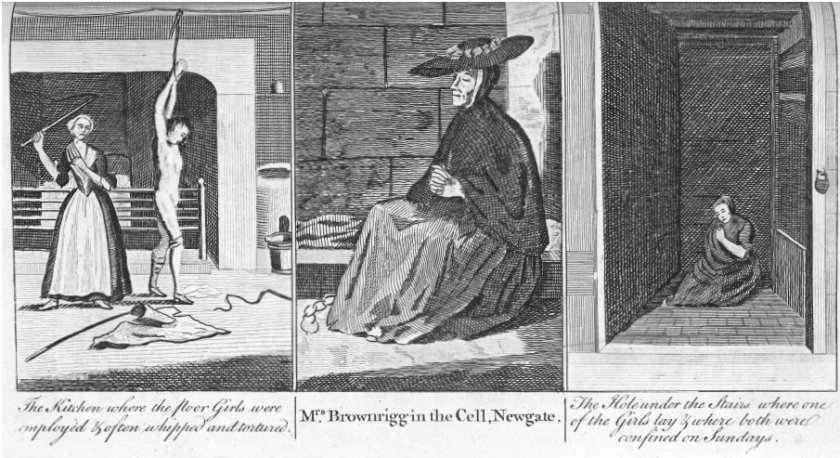
As a middle-class midwife, Brownrigg mined the Foundling Hospital for young girls whom she would take on as apprentice domestic servants.

Brownrigg was far from the only one exploiting this ready pool of virtual slave labor, but it was her home’s marked sexualized sadism that really moved copy (pdf pamphlet). And Chateau Roissy it was not.

Elizabeth liked to keep the servants locked up, starving, usually naked, and would pinion their hands and inflict merciless corporal punishment for the least transgression against rules like “having any more bread”. The Old Bailey Online preserves one servant’s trial testimony:

Q. In what manner did she use to beat her?

M. Mitchel. She used to tie her up in the kitchen; when first she began to be at her, she used to tie her up to the water-pipe, with her two hands drawed up above her head.

Q. Describe that water-pipe.

M. Mitchel. That goes across the kitchen; the hooks that hold it are fastened into a beam.

Q. Had she used to have her clothes on when your mistress tied her up in this manner to beat her?

M. Mitchel. No, no clothes at all.

Q. How came that?

M. Mitchel. It was my mistress’s pleasure that she should take her clothes off.

Q. What had she used to beat her with?

M. Mitchel. She beat her most commonly with a horse-whip.

Q. How long did she use to beat her in this manner?

M. Mitchel. I cannot justly say, but she seldom left off till she had fetched blood.

This witness Mary Mitchel(l) was the lucky one of the Brownriggs’ last two Foundling Hospital charges: both girls had been stripped and horsewhipped so regularly that ulcerating, infectious sores — never able to heal before the next thrashing — pocked their bodies.

But Mary Mitchell at least survived. Her fellow-sufferer Mary Clifford was flat beaten to death, the body stuffed in the family coal-hole like so much rubbish. (In life, Mary Clifford was sometimes made to sleep there, too.)**


Detail view (click for a larger, three-panel image) of Elizabeth Brownrigg and her crimes illustrated in the Newgate Calendar.

For working-class Londoners struggling to navigate the dislocations of the Industrial Revolution, here was a villainess indeed. London was swelling, urbanizing, bustling with vulnerable orphans and abandoned children like our foundling Marys; all its working classes, for that matter, had reason to feel endangered in the face of fights for their lives against emerging commercial powers working hand in glove with the state — not excluding the ubiquitous threat of the gallows for pitiable property crimes.

And as Peter Linebaugh observes, “apprenticeship” by the 18th century “was less likely to involve the development of highly qualified, skilled labour power than to be the means of organizing the exploitation of young labour power.”† Like it’s not enough working your crappy dead-end unpaid internship; now, it comes with flogging?

Somehow, Brownrigg’s husband and son were convicted only of a misdemeanor and got off with a few months in prison, but Elizabeth bore all the hatred of Londoners more used to seeing apprentices swing than even the vilest master. The Murder Act which had appropriated even the corpses of London’s marginal people was applied to anatomize our former midwife; her skeletal remains were long displayed in a niche at the Royal College of Surgeons.

Oh, and the Foundling Hospital — which had cautioned the Brownriggs before about their excessive abuse of servants but not actually stopped sending them young girls to abuse — started finally instituting some oversight.


There’s a vicious and unsigned satire, “Elizabeth Brownrigge”, published in the September 1832 Fraser’s magazine. Over the years, it has occasioned a great deal of dispute among Thackeray scholars as to whether it might not have been an early creation of that master satirist’s pen. (Thackeray would have just turned 21 when it published.)

We’re not qualified to render judgment on the literary forensics, but the skewering of a murderess through the author’s mock-sympathy has a deliciously Thackerian flavor about it: the world was “incapable of understanding the height of her virtue.” It also underscores the continuing resonance of Elizabeth Brownrigg to Londoners 65 years after her execution.

The magnanimity of her soul, like Mr. Smeaton‘s pharos on the Eddystone, was firmly fixed upon the rock of the soundest principles, and diffused a light around it, for the guidance of those who were beating the waves upon the dark and troubled ocean of adversity, but was itself unshaken by the storm … [in prison] the fair and excellent Elizabeth adopted, as nearly as circumstances would allow, the same admirable disposition of her time to which she had been accustomed when inhabiting her own romantic bower in the village of Islington. She completed a large stock of baby-linen for the poor; she perused new publications of the day; and she composed an elaborate parallel between the characters of Socrates and Lady Jane Grey, after the manner of Plutarch. These are the two distinguished personages, in the whole range of authentic history, who in their strength of mind, purity of life, and extensive accomplishments, bore the strongest resemblance to herself; and to them, perchance, the attention of our heroine was more particularly directed in the quiet and retirement of her cell by the many points of similarity which subsisted between their destiny and her own.

Later, the fictional Elizabeth mounts a defense of such oblivious loathsomeness that it naturally impresses the judge:

“… punishment is a moral medicine. I may, perchance, actuated by too eager a desire for the rapid cure of my little and much-cherished patient, have dispensed my alternatives too liberally, and produced and untoward, an unexpected, and a most deeply-lamented consequence; but am I, therefore, to be condemned as guilty? In the analogous case of the physician, whose too-abundant anodynes may have lulled the sufferer to endless slumbers, or whose too copious phlebotomy may have let out the fever and the life at one and the same moment from the veins, would this most harsh and unmerciful measure be applied? … I demand from the justice of your lordship and a jury of my countrymen — as a matter not of mercy, but of right — the same impunity in my case which would be accorded, freely an unasked, under parallel circumstances, to the medical practitioner.”

Thackeray or whomever lay behind this pasquinade had a wider literary target in mind than simply Elizabeth Brownrigg(e)’s class. The short story is prefaced with a dedication to “the author of Eugene Aram“, meaning the popular novel published earlier in 1832 by Edward Bulwer-Lytton — a lifelong Thackeray bete noir. That novel concerned another renowned 18th century murderer, and it’s safe to say from the dedication that our satirist considered Bulwer-Lytton’s empathetic portrayal of the titular homicide a little, er, soft on crime.

I have been taught by Eugene Aram to mix vice and virtue up together in such an inextricable confusion as to render it impossible that any preference should be given to either, or that the one, indeed, should be at all distinguishable from the other … I had, indeed, in my dramatic piece, been guilty of an egregious and unpardonable error: I had attempted to excite the sympathies of the audience in favour of the murdered apprentices, but your novel has disabused me of so vulgar a prejudice, and, in my present version of her case, all the interest of the reader and all the pathetic powers of the author will be engaged on the side of the murderess.

* The Newgate Calendar: “On her way to the place of execution the people expressed their abhorrence of her crime in terms which, though not proper for the occasion, testified their astonishment that such a wretch could have existed: they even prayed for her damnation instead of her salvation: they doubted not but that ‘the devil would fetch her,’ and hoped that ‘she would go to hell.’ Such were the sentiments of the mob.”

** Elizabeth Brownrigg admitted to the Ordinary of Newgate the truth of Mary Mitchell’s horror testimony.

† Conversely, rogues who took to the highway and became working-class heroes were very often men who had absconded from their apprenticeship — for instance, Jack Sheppard and Dick Turpin.

On this day..

1707: Pierre Fatio, Genevan Gracchus

On the evening of this date* in 1707, Pierre Fatio was secretly shot by arquebusers in a Geneva prison.

This Swiss Gracchus — classically-minded contemporaries could hardly fail to draw the parallel — was a magistrate and a rising member of the patrician oligarchy that ran nominally democratic Geneva.

But despising the side his class bread was buttered, Fatio (English Wikipedia page | French) took up the standard of the masses … or at least the masses of the bourgeoisie, whose universal-propertied-male suffrage was belied by the power exercised by Geneva’s magnates club, the “Petit Conseil” of 25 who actually ran the city-state.

Pierre Fatio really looks less like a revolutionary and more like a would-be liberal reformer. What started all the trouble was Fatio’s January 1707 sponsorship of a measure for a secret ballot and a little less nepotism: a modest downward redistribution of power.

Then as now, the powerful resisted.

From the pulpit the ministers cried at the top of their lungs against the people … accusing the people of rebellion against the magistrates, of insubordination to the laws, of enjoying only disorder and fomenting divisions, violating the oath which promises to be good and loyal to the city. (Source)

Oligarch apologists went on and on about these secret-balloteers having “broken all the bonds of society” (Benedict Calandrini) as the popular clamor for a bit of state accountability grew. In political-philosophy terms, this manifested itself as a debate between whether the sovereignty of the people (again, meaning the propertied male people) actually implied that these sovereigns were entitled to govern.

And the Little Council won the debate the old-fashioned way: by crushing its opponents as seditious, with the military aid of their brother-oligarchs at neighboring Swiss cantons. Several popular-sovereignty types were killed or exiled (French link) in mid-1707.

Its government is a mixture of Aristocracy and Democracy; but as the principal and most ancient families use their utmost endeavours to derogate from, and by slow degrees destroy the privileges of the citizens, in order to draw the power over to themselves, and perpetuate themselves in their posts, this practice is attended with frequent murmurings, and in these last times an insurrection had began, which would have broken out into a great fire, if Zurich and Bern had not sent wise and able deputies to extinguish it, and afterwards a good number of troops to garrison the city, which at present seems to keep quiet, though with evident prejudice to the liberty of its citizens. (Vendramino Bianchi in Relazi one del paese de Svizzeri (1708), quoted in this book

Fatio was the last and most noteworthy to go, and the council was so nervous about the “murmurings” if it should behead him in public, it determined its death sentence in secret: apt climax for a struggle over state accountability.

Rather than risk further disturbances, it simply dispatched its agents directly to Fatio’s cell where they informed him that he was condemned, and had him shot inside the prison without further ado.

“I would look with great honor on being the martyr of liberty,” a cool Fatio is said (by his party, naturally) to have remarked upon hearing his condemnation.

Martyr he may have been, but unlike the Roman Gracchi, Pierre did not have a brother to catch up his falling torch: Pierre’s, who was already among the Little Council, went ahead and voted for his sibling’s execution.

The martyr had more impressive family in cousin Nicolas Fatio de Duillier, a mathematician and Isaac Newton collaborator. Still more noteworthy heirs were kin of spirit, not of blood: one David Rousseau lost his state job for supporting Fatio’s movement … and Rousseau’s famous Genevan grandson would become the favored philosopher of the coming revolutionary age.

There’s a hard-to-find French biography of our man, Pierre Fatio et la crise de 1707, by his descendants Nicole and Oliver Fatio. (Here’s a French interview with Oliver.)

* I really hate to contradict the 7 September date that’s carved into marble, but as best I can interpret the documentation, Fatio’s sentence was finalized on the day of 6 September and executed within just a few hours that very evening. See e.g. the 6 September document excerpted in fn 1 here.

On this day..

1347: Not the Six Burghers of Calais

On this date in 1347, the city of Calais yielded to an English siege.


The siege of Calais, from Jean de Wavrin‘s Chroniques d’Angleterre. (More images)

Edward III had proceeded to invest Calais directly after the previous year’s staggering win at Crecy. The crippled French leadership could not relieve the city, and after fruitlessly probing for an opening, the relief army marched away at the start of August 1347.

By this time reduced to eating vermin and ordure, the starved city had little choice but to capitulate. According to Froissart’s account, the king declared that “the Calesians have done him so much mischief, and have, by their obstinate defence, cost him so many lives and so much money, that he is mightily enraged.” He wasn’t only sore about the city’s holding out over the preceding year: Calais was notorious as a refuge for English Channel pirates who had long bedeviled the commerce of Edward’s realm.

As a condition for sparing the rest of the town, Edward demanded that six of its leading citizens present themselves to him, “with bare heads and feet, with ropes round their necks, and the keys of the town and castle in their hands.” Edward seems truly to have meant (much against the conscience of his own nobles) to put these men to death “for that the Calesians had done him so much damage, it was proper they should suffer for it.”

This information caused the greatest lamentations and despair [in Calais]; so that the hardest heart would have had compassion on them; even the lord de Vienne wept bitterly.

After a short time, the most wealthy citizen of the town, by name Eustace de St. Pierre, rose up and said: “Gentlemen, both high and low, it would be a very great pity to suffer so many people to die through famine, if any means could be found to prevent it; and it would be highly meritorious in the eyes of our Saviour, if such misery could be averted. I have such faith and trust in finding grace before God, if I die to save my townsmen, that I name myself as first of the six.” When Eustace had done speaking, they all rose up and almost worshipped him: many cast themselves at his feet with tears and groans Another citizen, very rich and respected, rose up and said, he would be the second to his companion, Eustace; his name was John Daire. After him, James Wisant, who was very rich in merchandise and lands, offered himself, as companion to his two cousins; as did Peter Wisant, his brother. Two others then named themselves, which completed the number demanded by the king of England.

Wealthy elites sacrificing themselves for the greater good? The past really is a different country.

These six duly presented themselves, nearly naked and haltered and braced to bear the brunt of Edward’s vengeance. The English king had the executioner summoned … and then, Edward’s (very pregnant) queen Philippa dramatically fell to her knees

and with tears said, “Ah, gentle sir, since I have crossed the sea with great danger to see you, I have never asked you one favour: now, I most humbly ask as a gift, for the sake of the Son of the blessed Mary, and for your love to me, that you will be merciful to these six men.”

The king looked at her for some time in silence, and then said; “Ah, lady, I wish you had been anywhere else than here: you have entreated in such a manner that I cannot refuse you; I therefore give them to you, to do as you please with them.” The queen conducted the six citizens to her apartments, and had the halters taken from round their necks, after which she new clothed them, and served them with a plentiful dinner: she then presented each with six nobles, and had them escorted out of the camp in safety.

Edward still had the last laugh when it came to Calesian carnage.

This nigh-unconquerable foothold on the French coast would persist in English hands for two centuries: the first century spanned the Hundred Years’ War, which England was licensed to protract by dint of (and France would not settle because of) the menacing northern base England won this day. “Each will have to take up his shield,” ran a French verse cited in Barbara Tuchman’s A Distant Mirror: The Calamitous 14th Century, “For we’ll have no peace till they give back Calais.”


The Six Burghers persisted even longer than that.

George Bernard Shaw wrote a one-act play standing the story on its head, in which a henpecked Edward exasperatedly yields to his nagging wife’s merciful caprice, to the open derision of the burghers themselves.

A bit more exalted of spirited is Rodin‘s sculpture group Les Bourgeois de Calais — rendering six emaciated, suffering, and courageous figures.

I have, as it were, threaded them one behind the other, because in the indecision of the last inner combat which ensues, between their devotion to their cause and their fear of dying, each of them is isolated in front of his conscience. They are still questioning themselves to know if they have the strength to accomplish the supreme sacrifice–their soul pushes them onward, but their feet refuse to walk.

They drag themselves along painfully, as much because of the feebleness to which famine has reduced them as because of the terrifying nature of the sacrifice … And certainly, if I have succeeded in showing how much the body, weakened by the most cruel sufferings, still holds on to life, how much power it still has over the spirit that is consumed with bravery, I can congratulate myself on not having remained beneath the noble theme I dealt with.

Rodin

The discriminating connoisseur of Middle English may also enjoy Laurence Minot‘s poetic celebration of the siege of Calais. (Helpful explanatory annotations.)

Part of the Themed Set: Scary Escapes.

On this day..

1967: Luis Monge, America’s last pre-Furman execution

Forty-five years ago today, Luis Monge was gassed in Colorado for murder — the last execution in the United States before a decade-long lull in capital punishment in the U.S.

Monge, an insurance salesman with no prior history of violence, had a hearty brood of 10 children, but when his wife found out he was having an incestuous relationship with one of them, Monge bludgeoned the wife to death, and killed three of the young children just for good measure.

Monge pleaded insanity, and then when doctors found him sane enough to stand trial, just pleaded guilty — eventually dropping all appeals and asking to be hanged in public at the Denver City and County Building.

Despite the culprit’s preferences, his execution was stayed for all of 1966 while Colorado voters weighed a referendum on continuing the death penalty. They ultimately voted 3-1 in favor. (See this detailed history of the death penalty in the Columbine State.)

Even though Monge himself embraced execution willingly, his seven remaining children (also the children of, and siblings of, his victims: surely a difficult position) still fought for clemency, and shared Monge’s last meal with him.

Had Monge maintained his appeals, he — like four other Colorado inmates whose death dates were also on hold in 1966 — would likely have made it into the nationwide unofficial moratorium on executions that settled in while courts sorted out death penalty standards in the late 1960s and early-to-mid 1970s.* That period led into 1972’s landmark Supreme Court decision Furman v. Georgia, invalidating all existing death sentences in the country and sparing men much more nefarious than Luis Monge.

Instead, this date’s principal went to his death clutching a black rosary (and allegedly, and one must suspect apocryphally, asking if the gas would trouble his asthma)** and became a nigh-forgotten denouement from a closed chapter of death penalty jurisprudence, and the last man put to death in America until Gary Gilmore almost ten years later.

Apart from his milestone status vis-a-vis capital punishment nationwide, Monge is also the last person to die in the Colorado gas chamber.


The gas chamber that killed Luis Monge, now retired to Colorado’s Museum of Prisons. (cc) image from Cowtools, who also has a photo of Monge’s bullet-riddled grave marker.

In fact, Monge is currently still the second-last put to death in Colorado, period. It would be fully 30 years before Colorado executed again — in 1997, by lethal injection. As of this writing, it hasn’t done so again since.

* If Monge had avoided execution, the “last pre-Furman execution” milestone would be held instead by California’s Aaron Mitchell, the only man executed on the authority of California governor (and future U.S. president) Ronald Reagan.

** The man who pulled the lever for Monge’s execution, Canon City penitentiary warden Wayne Patterson, was not enthusiastic about the job. He describes his experience here, saying that “Monge was a guilt-ridden man who was nearly suicidal before he was executed. Those were the [kind of] guys who were executed — not the people I thought belonged in the chamber.”

On this day..