1979: Rahim Ali Khorram and Habib Elghanian, millionaire businessmen

Iranian Revolution firing squads claimed seven lives on this date in 1979, including two multimillionaire businessmen.

One of the businessmen was Rahim Ali Khorram, “an immensely rich contractor who built roads and airports for the government, and sometimes used his 2,000-man work force as a political shock force in support of the Shah.” That quote is from a New York Times profile of Khorram’s son, Hossain, who says that he himself was led out for a mock-execution not long after. (Hossain also says that his father was dead or dying of a heart attack as he was dragged out for execution.)

The charges against Khorram pere consisted of “operating gambling dens, cabarets and a prostitution ring* and feeding a man to a lion in his amusement park.” No lie. He was supposed to have an entire secret necropolis in that park stuffed with the bodies of his enemies. (New York Times, May 10, 1979.)
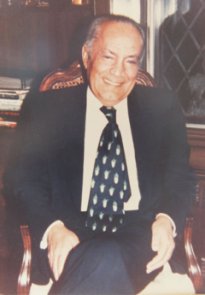
Habib Elghanian

The other businessman was the Jewish-Iranian plastics mogul Habib Elghanian.

Elghanian was the first Jewish person executed during the Iranian Revolution. His death on charges of spying for Israel, fundraising for Israel, and “friendship with the enemies of God” for having met with Israeli politicians, greatly alarmed Iran’s Jewish community: many fled the country, something Elghanian had pointedly refused to contemplate.

Though Elghanian allegedly claimed not to be a Zionist, he had investments and contacts in Israel — and a radio denunciation made clear to what extent such an association would be anathematized going forward.

He was a disgrace to the Jews in this country. He was an individual who wished to equate Jewry with Zionism … the mass of information he kept sending to Israel, his actions to achieve Israel’s designs, the colossal sum of foreign exchange and funds he kept transferring to Israel; these are only samples of his antinational actions; these were the acts used to crush our Palestinian brethren. (Source)

Weirdly, this execution has made news more recently: the Stuxnet computer worm, which is widely thought to have been engineered in Israel to attack Iran, contains the string 19790509. It’s been hypothesized that this apparent reference to May 9, 1979 might allude to Elghanian’s execution.

* Alleged clientele: the already-executed Gen. Nematollah Nassiri.

On this day..

1897: John Gibson, under Jim Crow

On this date in 1897, John Gibson was hanged for murder.

In its particulars, the case itself was as minute and forgettable as a homicide ever could be: Gibson got into a spat with a plantation overseer over the theft of 20 or 25 cents from his wages. Later that night, still steaming and now drunk, he called the boss out through the window. The overseer went out to the confrontation armed (Gibson wasn’t), and wound up shot dead by his own gun in the struggle.

This literal two-bit crime became national news, however, and went twice to the Mississippi Supreme Court and twice to the U.S. Supreme Court as a vehicle to challenge Mississippi’s new Jim Crow constitution.

After Reconstruction but especially in the 1890s, the dreadful regime of American apartheid reversed black civil rights gains.

Mississippi’s all-white* constitutional convention of 1890 was a signal event for this nadir of race relations — the first of a wave of new southern constitutions aimed at setting up a color bar. In addition to mandating segregated schools, that constitution imposed a few, ahem, reasonable requirements for voting, which lacked any overt racial language but just so happened to disenfranchise the black electorate almost to a man. (Don’t even get started about women.**)

  • every voter must pay “a uniform poll tax of two dollars”;
  • “every elector shall … be able to read any section of the constitution of this State.” Now, lest one miss the intent here, Mississippi added a clause permitting anyone descended from a legal voter pre-1867 to cast a ballot without passing the exam: if your grandfather could vote, you could vote too … too bad if your grandfather couldn’t vote on account of being property. This one-two punch throughout the South kept poor whites on the right team, and bequeathed to English the phrase “grandfather clause”.

Both these gratuitous hurdles to voting are now confined to the history books, but two other important techniques of disenfranchisement remain very much in use today.

  • a needlessly onerous voter registration process;
  • and, the franchise is reserved for upstanding voters who have “never been convicted of bribery, burglary, theft, arson, obtaining money or goods under false pretenses, perjury, forgery, embezzlement or bigamy.” In a context where wholesale incarceration of African Americans was a matter of policy.

Plus of course, brute force up to and including lynch law for political terrorism. “In those days,” one black Mississippian said, “it was ‘Kill a mule, buy another. Kill a nigger, hire another.’ They had to have a license to kill anything but a nigger. We was always in season.”

From 1901 to 1973, the South never once seated a black lawmaker in the U.S. Congress.

So it’s a grim scene for racial justice in the twilight of the 19th century. But we dwell on the voting-rights aspect because jurors were drawn from the voting rosters: all the filters that excluded African Americans from the ballot box likewise excluded them from the jury box. And here’s where we get back to John Gibson.

Gibson’s case was taken up by African-American attorneys† Cornelius Jones and Emanuel Hewlett, who argued it all the way to a Supreme Court. R. Volney Riser argues in Defying Disfranchisement: Black Voting Rights Activism in the Jim Crow South, 1890-1908 that they weren’t just trying to save their client — they were mounting a cagey attack on the Mississippi constitution and the pillars of Jim Crow law. If Jones and Hewlett

could show a racial motive in refusing potential black voters (and likewise potential black jurors), they would have a reasonably strong case.

The elements of a strong, jury-based anti-disfranchisement case were in place for Jones and Hewlett and all that they really wanted was to have his case remanded to a U.S. district court. That might seem anticlimactic, but it would have meant that southern judges, sheriffs, and voting registrars would find themselves standing before federal district judges to justify their administration of jury selection and voter registration. In the immediate short term, there would almost surely be some benefit for disfranchised African Americans.

They argued the cases on December 13, 1895, and the Supreme Court announced decisions in Gibson and [a companion case] Smith on April 13, 1896, little more than one month before [Jim Crow landmark] Plessy v. Ferguson. Justice John Marshall Harlan wrote both opinions and dismissed each case on jurisdictional grounds. The problem lay in the evidence, which was conspicuous by its paucity … Mississippi did not exclude blacks in terms … [and] in Gibson, Jones had not shown that Mississippi’s courts committed “any error of law of which this court may take cognizance” or that his client’s murder conviction “was due to prejudice of race.”

Washington Post, Oct. 27, 1895

In the real world, where rights need enforcement if they are to thrive, this ruling had the effect of giving a free hand to white power so long as it had the sense God gave a vegetable and didn’t directly declare that any of its universally all-white juries (or electorates) were constituted as a matter of explicit race prejudice. Just a marvelous coincidence! Nothing to see here, you federal judges.

As the Southwestern Christian Advocate editorialized after the ruling (Apr. 23, 1896)

Proof need hardly be asked that there was a deliberate purpose on the part of the persons charged with that responsibility [i.e., seating juries] to absolutely ignore the colored man as a juror. This is the cold truth, that the sheriffs and other court officers who have charge of the impanneling of juries will not select colored men. The persistency with which they deny such intent is one of the most gigantic mysteries of the age.

Of course, there is no constitutional enactment on the statute books of the State of Mississippi denying the right of jury service to Negroes, yet they do not serve, and for the simple reason that they are not chosen. It is the easiest matter in the world to keep Negroes out of the jury box in Mississippi. It is one of their sovereign rights.

There is no enactment against it, nothing for it, so there it is. And what is the Supreme Court or the Federal government going to do about it? Why, simply render its decisions upon what it does not permit. The fact is that the amendments to the Constitution, so far as the black man is concerned, are not worth the paper they are written upon without the moral sentiments of high minded and noble people behind it. And this will apply to State, Federal and Supreme Courts as well.

Meanwhile, the black man is expected to be an intelligent and a loyal citizen, notwithstanding the rights which he fought and bled for are now almost exclusively in the hands of those who at one time sought to pull the fair fabric of our Constitutional liberties to the ground.

It’s still to this day the case that defendants have very little scope to scrutinize potentially prejudicial jury composition. It’s still to this day the case that the Supreme Court has nothing but a toothless remedy. And it’s still to this day the case that some state’s attorneys can and do craft racially discriminatory juries more prone to convict by excluding blacks … so long as it’s “not in terms” and instead for literally any other pretext.

* Except for one black man.

** Representative sentiment of a Mississippian: “We are not afraid to maul a black man over the head if he dares to vote, but we can’t treat women, even black women, that way. No, we’ll allow no woman suffrage.” Mississippi only ratified female suffrage in 1984.

† There are some claims out there that the first black attorney to argue a case before the U.S. Supreme Court did so only in 1910; I may be overlooking a nuance in the manner these issues were presented to the high court, but so far as I can discern, Gibson was argued by black attorneys. This source suggests that it was hardly the first.

On this day..

1940: Wilhelm Kusserow, Jehovah’s Witness

(Thanks to Meaghan Good of the Charley Project for the guest post. -ed.)

On this date in 1940, 25-year-old Wilhelm Kusserow was executed by firing squad at Münster Prison in Germany.

A Jehovah’s Witness, he interpreted God’s command “thou shalt not kill” literally and refused to serve in the German army — a big no-no in Hitler’s Third Reich.

Kusserow had actually been born Lutheran, but his parents became Jehovah’s Witnesses after World War I and raised their eleven children in the faith. Jehovah’s Witnesses, in addition to not serving in the army, also refused to Heil Hitler, since the tenets of their religion required them to make obeisance only to Jehovah.

They were persecuted by the Nazis from the beginning of Hitler’s regime, and by 1935 the religion was banned altogether. The Kusserows, and many others, continued to practice their faith in secret.

During the Nazi era, some 10,000 Jehovah’s Witnesses did time in prisons and concentration camps (where they were required to wear a purple triangle), Wilhelm’s parents and siblings among them. 2,500 to 5,000 died.

The children in Jehovah’s Witness families were taken from their parents and sent to orphanages, foster families or reform schools.

(French Witness Simone Arnold Liebster would write a memoir about the years she spent in institutions as a child because she and her parents refused to renounce their beliefs.)

At Wilhelm Kusserow’s trial, the judge and the prosecutor were apparently reluctant to condemn this young man. They pleaded with him to back down, promising to spare his life if he did so, but Wilhelm refused. Some things were more important to him than life itself.

In his final letter to his family he wrote,

Dear parents, brothers, and sisters:

All of you know how much you mean to me, and I am repeatedly reminded of this every time I look at our family photo. How harmonious things always were at home. Nevertheless, above all we must love God, as our Leader Jesus Christ commanded. If we stand up for him, he will reward us.

Hitler later decided the firing squad was too honorable a death for Jehovah’s Witnesses and ordered that they be decapitated instead. Wilhelm’s younger brother Wolfgang, who had also refused to serve in the army, was executed in this manner in 1942.

On this day..

1900: Bill Brown, Sonnie Crain and John Watson

(Thanks to Meaghan Good of the Charley Project for the guest post. -ed.)

On this date in 1900, Sonnie (or Sonny) Crain and William “Bill” Brown, both 40, and John Watson, 59, were hanged side by side a quarter-mile from the Warren County Jail in McMinnville, Tennessee.

This was an integrated execution: Brown and Watson were white, and Crain was black.


From the April 27, 1900 American Citizen (Kansas City, Mo.)

The gallows was contained in a 30-by-30-foot enclosure and had been built especially for this day’s event. There were twenty official witnesses. A crowd of about two thousand waited outside the fence, hoping to catch a glimpse of the execution, but their view was obscured by a canvas curtain drawn hanging from the top of the gallows.

John Watson

Watson, a Civil War veteran who’d fought at Shiloh, had committed his crime on December 21, 1898. He shot a neighbor, 40-year-old James Hillis, white, after an argument about some corn and some fence rails.

Hillis walked away from the fight. Watson fetched his shotgun, waited for his chance then shot Hillis on the road that evening, in front of the victim’s daughter. Hillis lived for a few hours after the shooting and named Watson as his attacker.

The killer had a reputation for violence; he’d allegedly shot and seriously wounded a black man in a drunken rage in 1893, but was acquitted at trial. He had also served a term in federal prison for making and selling moonshine, and he was stone drunk on his own apple brandy at the time of Hillis’s murder.

His defense, one of temporary insanity caused by alcohol, didn’t fly with the jury.

Bill Brown was an illiterate tenant farmer; his victim was his wife of ten years, Mary Fults Brown. Bill was tired of his wife and attempted to leave her, but everywhere he went she just followed him. He and his brother, John “Bud” Brown, decided she had to die.

On May 5, 1898, In accordance with the plan, Bill invited a friend, Bill Rogers, to spend the night. Bill made sure to leave the door unlocked, and while Mary and the guest were sleeping, Bud Brown sneaked into the house, shot his sister-in-law and fled. Bill then woke up Rogers, crying, “Lordy, lordy, someone’s shot Mary!”

Bill told Rogers the shooter had fired through the open window, but this didn’t make sense because Mary had been asleep beside her husband and Bill was lying between her and the window. He claimed he didn’t own a gun, but a search of the house turned up a recently fired pistol hidden in a trunk.

It didn’t take long for Bill to crack. He confessed to his role in Mary’s death and implicated his brother Bud (who, incidentally, had a prior record for beastiality with a mare).

The brothers were to be tried separately and Bill went first. He was convicted and sentenced to death, but his conviction was appealed on the grounds that one of the jurors had mistakenly believed he was sitting at the trial of Bud Brown, not Bill Brown. (Like Sauron and Saruman, they’re easily confused.)

Seriously?

The appeals court judge couldn’t believe it when Bill’s attorney made this ludicrous assertion, and threatened to hold him in contempt for making a mockery of the proceedings and wasting the court’s time. Then Bill’s attorney brought in the juror in question, who admitted his error. (The confusion arose in part because Bill and Bud, neither of whom testified at the trial, were sitting next to each other at the defendant’s table.)

While Bud Brown was awaiting his first trial, Bill was waiting his second trial, and John Watson was awaiting the outcome of his appeal, they were all housed in a jail cell with Sonnie Crain.

Crain had been convicted of second-degree murder for shooting Will Snellings in a dispute over a craps game, and was sentenced to ten years in prison. He was housed in the jail while his case was under appeal.

On May 22, 1899, as the Brown brothers slept, Crain bludgeoned them both in the head with a piece of his bed, killing Bud and critically injuring Bill. He later said the brothers had threatened him and he’d acted in self-defense, but the authorities had another theory as to motive.

The jailer was away at the time of the murder and had placed his wife in charge, and there was some evidence that Watson and Crain had conspired together to murder their cellmates in order to create a diversion so they could escape when the jailer’s wife came to get Crain.

Crain (who denied any plan to escape from jail and insisted to his dying breath that he’d acted in self-defense) was convicted of Bud Brown’s murder and sentenced to death. Although Bill Brown’s wounds were very serious and he was not expected to live, he recovered from his injuries in time to be hanged alongside the man who’d tried to kill him and the other man who’d possibly conspired in his attempted murder.

So now that no one is confused … the three ultimately set to die in this labyrinthine affair were hanged at 11:50 a.m. on April 25, attended by two black ministers and two white ones. Crain and Brown were stoic, but Watson’s nerves failed him on the scaffold and he cried and shook as the noose was placed around his neck.

It was the last public(ish) hanging ever in McMinnville.

On this day..

1886: Joseph Jackson and James Wasson, at Fort Smith


St. Louis Globe-Democrat, January 31, 1886

America’s most notorious “hanging judge” Isaac Parker issued the sentences resulting in this date’s double hanging at Fort Smith, Ark.

A much more prodigious body count had been ordered initially by the court, but clemencies straight from the hand of U.S. President (and former hangman) Grover Cleveland averted five of seven death sentences on their eve of execution. All the killers under sentence, spared or no, committed their murders in Indian Country.

In February, 1886, seven men were sentenced to be hung on April 23, 1886, but before that day arrived the sentences of all but two had been commuted. The two unfortunates were Joseph Jackson, a negro, convicted of killing his wife at Oak Lodge, Choctaw Nation, on March 9, 1885, and James Wasson, a white man, who participated in the murder of Henry Martin in 1872, but was not apprehended until he took a hand in the killing of a man named Watkins in 1884.* (Source)

Jackson slashed his own throat with the shard of a vase in an unsuccessful bid to cheat the hangman, and sported a terrible gash on his neck when he hanged.

* According to the Atchison (Ks.) Daily Globe of April 30, 1885, Watkins was a cattle baron, whose widow wife then put a $1,000 price on Wasson’s head. The killer’s arrest ensued promptly. Although Wasson hanged for the earlier murder and not for that of Watkins, the aggrieved Texan woman “was here [at Fort Smith] every term of court after Wasson was brought in, and employed counsel to assist the District Attorney in prosecuting him, having, it is said, spent over $7,000 in bringing him to justice.” (St. Louis Globe-Democrat, April 24, 1886.)

On this day..

1705: The Camisards Catinat and Ravanel

On this date in 1705, two men were burned at the stake and two others broken on the wheel — Camisards all, put to death in Nimes, France.

The Camisards* were French Protestants of the mountainous southern Cevennes region who make their entry into these pages because the crown in 1685 revoked the Edict of Nantes, France’s guarantee of multiconfessional toleration.

Protestants were going to be bullied into conversion — or, in many cases, flight. (London’s Spitalfields textile industry, for instance, got a welcome shot in the arm from refugee Huguenot weavers.)

In 1702, the Cevennes Protestants pushed back.

“A persecution unsurpassed in violence had lasted near a score of years,” Robert Louis Stevenson wrote in his 19th century travelogue of the region. “This was the result upon the persecuted; hanging, burning, breaking on the wheel, had been in vain; the dragoons had left their hoof-marks over all the countryside; there were men rowing in the galleys, and women pining in the prisons of the Church; and not a thought was changed in the heart of any upright Protestant.”

On July 24, 1702, the Catholic torturer-priest running this show was assassinated, and the Camisard revolt was on.

Two years of dirty neighbor-on-neighbor violence mostly petered out in 1704 with the loss of the Camisards’ two main leaders — Jean Cavalier, the brilliant peasant-turned-commander who was bought off by an army commission and a royal pension, and Roland Laporte, who was betrayed as by Judas for 200 pieces of gold.

Catinat and Ravanel were Cavalier’s lieutenants; according to Alexandre Dumas, Catinat was a peasant named Abdias Maurel who picked up his nickname after serving under Marshal Catinat in the War of Spanish Succession.

The prospect of a renewed rising drew them back — a bold and terrible stroke to mount a surprise massacre and kidnap the exiled English Duke of Berwick. Catinat returned from his hidey-hole in Geneva; Ravanel came the bush where he was the last notable Camisard commander in the field.

An informer spilled the secret and the conspirators were busted in Nimes before they could spring their trap.

They faced immediate trial and condemnation — Catinat and Ravanel, along with two younger fighters named Jonquet and Villas.

After a long bout of pre-execution torture on April 21 to reveal their conspirators,**

The next day, the 22nd April, 1705, they were taken from the prison and drawn to the place of execution in two carts, being unable to walk, on account of the severe torture to which they had been subjected, and which had crushed the bones of their legs. A single pile of wood had been prepared for Catinat and Ravanel, who were to be burnt together; they were in one cart, and Villas and Jonquet, for whom two wheels had been prepared, were in the other.

The first operation was to bind Catinat and Ravanel back to back to the same stake, care being taken to place Catinat with his face to windward, so that his agony might last longer, and then the pile was lit under Ravanel.

As had been foreseen, this precaution gave great pleasure to those people who took delight in witnessing executions. The wind being rather high, blew the flames away from Catinat, so that at first the fire burnt his legs only — a circumstance which, the author of the History of the Camisards tells us, aroused Catinat’s impatience. Ravanel, however, bore everything to the end with the greatest heroism, only pausing in his singing to address words of encouragement to his companion in suffering, whom he could not see, but whose groans and curses he could hear; he would then return to his psalms, which he continued to sing until his voice was stifled in the flames. Just as he expired, Jonquet was removed from the wheel, and carried, his broken limbs dangling, to the burning pile, on which he was thrown. From the midst of the flames his voice was heard saying, “Courage, Catinat; we shall soon meet in heaven.” A few moments later, the stake, being burnt through at the base, broke, and Catinat falling into the flames, was quickly suffocated. That this accident had not been forseen and prevented by proper precautions caused great displeasure to spectators who found that the three-quarter of an hour which the spectacle had lasted was much too brief a time.

Villas lived three hours longer on his wheel, and expired without having uttered a single complaint.

A hecatomb of Camisard executions followed, fed by the denunciations of frightened or avaricious people; still others were “merely” condemned to the galleys … bringing at last a sullen peace of arms to the turbulent province.

* Here’s a 19th century public domain novel about the whole Camisard business.

** While three bore the torture quietly, Villas coughed up the name Boeton de Saint-Laurent-d’Aigozre. This man, too, was arrested and executed.

On this day..

1945: The children of Bullenhuser Damm

On this date in 1945, as Adolf Hitler celebrated his 56th birthday within a Red Army cordon, one of the Second World War’s more tear-jerking little crimes against humanity happened in Hamburg.

Bullenhuser Dammstill to be found today — was a former Hamburg school which fell out of use as World War II progressed, owing to the devastation Allied bombings wrought on the surrounding area.

The school itself sustained little damage, however, which eventually facilitated its appropriation as a satellite building for the nearby Neuengamme concentration camp.

Over at Neuengamme, the SS doctor Kurt Heissmeyer had been conducting a litany of horror medical experiments on 20 Jewish children — mostly from Poland — culled from the concentration camps, seeking medical evidence for Nazi racial theories further to a cushy professorship. But as April 1945 was obviously endgame for the Third Reich, thoughts naturally turned to disposing of evidence of indictable offenses.


Photos of the eventual Bullenhuser Damm victims showing their surgical scars after Heissmeyer injected them with tuberculosis.

Bullenhuser Damm was just the place for disposal.

On April 20, the 20 kids were loaded up on trucks with their four adult caretakers — two French, two Dutch — plus six Soviet prisoners of war.

At Bullenhuser Damm, the kids were parked in a room and hung out, blissfully ignorant of their danger. “They had all their things with them — some food, some toys they had made themselves, etc,” physician Alfred Trzebinski later recalled at his own trial. “They sat on the benches and were happy that they had gotten out. They didn’t suspect a thing.”

In the next room, the 10 adults were being hanged.

According to Admitting the Holocaust, Trzebinski was impressed with his own compassionate use of this bit of down time: he generously gave the children morphine shots to sedate them before their own executions. Or rather, their murders … since the doctor could not but agree that “you cannot execute children, you can only murder them.”

I must say that in general the children’s condition was very good, except for one twelve-year-old boy who was in bad shape; he therefore fell asleep very quickly. Six or eight of the children were still awake — the others were already sleeping … Frahm [an orderly] lifted the twelve-year-old boy and said to the others that he was taking him to bed. He took him to a room that was maybe six or eight yards away, and there I saw a rope already attached to a hook. Frahm put the sleeping boy into the noose and with all his weight pulled down on the body of the boy so that the noose would tighten. (Trzebinski, again)

The other 19 children were disposed of in like manner, and then all 30 corpses cremated overnight … just in time for what must have been a much-needed 5 a.m. coffee.

After the war, the facility went back to use as an actual (creepy!) school, but it was eventually renamed Janusz Korczak School, for a Polish-Jewish educator gassed with his young charges at Treblinka. There’s a permanent exhibition (German) at the site, as well as a memorial rose garden with a variety of plaques commemorating the victims of Bullenhuser Damm.

Trzebinski’s take on his conduct this horrible night might have been good enough for his conscience, but it didn’t pass muster with his judges: he was hanged on a war crimes rap prominently including Bullenhuser Damm on October 8, 1946. Kurt Heissmeyer, however, avoided detection until 1959 and only received a long prison sentence in 1966, shortly before his death.

On this day..

1928: Charles Birger, bootlegger

On this date in 1928, colorful gangster Charles Birger was hanged in Benton, Illinois.

A sort of social bandit for the Prohibition era, Birger was born Shachna Itzik Birger to a Russian Jewish family that immigrated to the U.S.

Birger was a young saloon-keeper on the make when the U.S. decided to make a go of its first foolish drug war, Prohibition. And in the immortal tradition of drug wars, it made the enterprising purveyor a whole lot richer, and a whole lot violent-er.

While Al Capone‘s Tommy Guns were tearing up Chicago, Birger set up shop in southern Illinois. A literal shop: from his famous speakeasy Shady Rest, he did three-way battle with the (pro-Prohibition) Ku Klux Klan and the rival Shelton Brothers Gang.

This cinematic affair of armored car shootouts, aerial bombings, and gangland assassinations comes off with verve in A Knight of Another Sort: Prohibition Days and Charlie Birger. The bon vivant Birger, bursting with charisma, entertains at his gin joint, aids the misfortunate, corrupts the police, and merrily mobs up Williamson County.

That story reached its conclusion when Birger was arrested for ordering the murder of Joe Adams, mayor of a nearby town who had taken the Shelton Gang’s armored “tank” car in for repairs.

Birger said he hadn’t actually done that, but he went to the gallows grinning, and humorously chatted up reporters before the big show — cementing his myth with that legend-quality indifference to death.

“I’ve played the game and lost, but I’ll lose like a man,” Birger philosophized. “I’m convicted of a crime I didn’t commit, but I’ve committed a lot of crimes. So I guess things are even. We got too strong against the law, and the law broke it all up.” (From the Chicago Tribune, April 20, 1928.)


Birger shakes hands with so-called “humanitarian hangman”
Phil Hanna.


Birger insisted on hanging in a black, not a white, hood — owing to his hatred of the Ku Klux Klan.

Birger is still a legend in southern Illinois, and a live one at that: he’s been in the news lately due to a weird custody fight over the rope used to hang him.

This macabre historical memento also happens to be the last rope ever used for any public execution in Illinois.

On this day..

1921: Mailo Segura, a Montenegrin in Alaska

(Thanks to Meaghan Good of the Charley Project for the guest post. -ed.)

At noon on this day in 1921, Mailo Segura was hanged in Fairbanks, Alaska.

In 1918 he had murdered a miner, J.E. “George” Riley, near the gold rush town of Flat, in a dispute over money. His was the second execution in Fairbanks history.

George Riley was in charge of the mining operations along Orter Creek near Flat. Segura was a lumberjack and, together with some other men, had sold $300 worth of cordwood to Riley on credit.

In early 1918, Segura confronted Riley with the bill and demanded to be paid. By then, the bill had been outstanding for two years. Riley, however, refused to pay. He said he wasn’t going to hand over any money until Segura either brought his wood-chopping partners along with him to collect the sum in person, or brought a statement from his partners authorizing Segura to take the full amount.

As witnesses at his trial later testified, Segura was furious with Riley and said he would kill him if Riley didn’t give him the $300. On March 2, he withdrew his life savings of $1,800 from his bank account and later that day went looking for the deadbeat.

Segura found his quarry at the mining claim and waited patiently, assisting with the mining work so he wouldn’t look suspicious.

When all the other miners had gone inside the boiler house, Segura shot Riley in the back without warning. The miners heard the shots — there were three, any one of which would have been fatal — and ran outside to find their employer lying stone dead on the ground and Segura running away.

It didn’t take much effort to catch him. Once he was surrounded, Segura raised his hands in surrender and shouted, “Me no kill no more.”

Seeing as how Mailo Segura had repeatedly threatened Riley’s life and then shot the unarmed man from behind, his claim of self-defense didn’t go very far at his trial. He was convicted of first-degree murder on July 18 and was supposed to be hanged on October 8, but Segura put his $1,800 life savings to use filing appeals, and thereby prolonged his life by three years.

When his time came, he was terrified and unable to walk to his death. The authorities had to strap him to a board to keep him upright while they fastened the noose around his neck.

A matter of minor interest: Mailo Segura hailed from halfway around the world in the tiny Balkan kingdom of Montenegro; he might be the only Montenegrin ever executed in North America. (Montenegrins were then and still are today a sizable minority in Alaska.) In spite of his European descent, in trial documents he was referred to as “black,” and possible racial prejudice on the part of the jury was an issue in his appeals.

On this day..

1950: Eugene LaMoore, the last hanged in Alaska

Thanks to Melissa S. Green for giving Executed Today permission to reprint this summary of Alaska’s last execution. It appeared as a section of Green’s longer history of the death penalty in the state, first published here.

For the first (proper, juridical) execution in Alaska, see here. -ed.


Austin Nelson and Eugene LaMoore, both black, were separately convicted and executed for the same crime, the December 1946 murder of a 52-year-old (white) Juneau storekeeper named Jim Ellen. Ellen’s store had also been robbed. Ellen had immigrated to the U.S. from Greece as a boy in 1909. He was a World War I veteran who held memberships in the American Legion and the Juneau Elks Lodge.

Austin Nelson, a 24-year-old who did odd jobs around Juneau, was arrested for the murder after a check written by him to Jim Ellen was found on the store counter following the robbery/murder. He was represented at trial by Henry Roden and Joseph A. McLean. Nelson was convicted on circumstantial evidence, including that of a witness who reported seeing him in the victim’s store on the night of the murder. No one witnessed the actual murder, nor was a murder weapon found, not even the straight-edged razor witnesses testified that Nelson had once owned. Nelson lacked money to pay for an appeal and there was no provision for a public attorney in post-conviction proceedings, His execution was set for July 1, 1947.

Eugene LaMoore, a 42-year-old fisherman with a Tlingit wife and two children, was originally an alibi witness at Nelson’s trial. He testified that he had spent much of the evening with Nelson on the night of the murder, including along the avenue where the victim’s store was located. LaMoore’s credibility with the jury was apparently eroded when he initially denied a felony robbery conviction of twenty years before. Although LaMoore returned to the stand the following day to correct his testimony, he was arrested by U.S. Marshal William Mahoney on a charge of perjury and held on a bond of $10,000 — a high bond in 1947 — which LaMoore could not pay. He was held in a cell in the federal jail, shackled in leg irons and, later, in a ball and chain. He was repeatedly questioned by the local FBI agent and other local law enforcement authorities about the murder of Jim Ellen. Shortly before Nelson’s scheduled execution, Nelson was brought to visit LaMoore in his cell. According to later testimony by LaMoore, Nelson pled with LaMoore to help save his life.

On July 1, 1947, the date of Nelson’s scheduled execution, LaMoore signed a typed confession stating that he had participated in a robbery of Jim Ellen’s store with Austin Nelson and that Nelson had killed Ellen during the robbery.

LaMoore was charged with first degree murder. Nelson’s execution was delayed because he was now considered a material witness against LaMoore.

LaMoore was represented at trial by Henry Roden and Joseph A. McLean, the same court-appointed attorneys who had represented Nelson. The only significant evidence offered at trial to suggest LaMoore’s involvement in the murder was the typed confession he had signed while in jail. At trial, LaMoore retracted the confession, stating it had been made on the advice of a prominent Juneau attorney, Herbert W. Faulkner, who had been persuaded by Deputy Marshal Walter Hellan to come and talk with him (LaMoore had had no lawyer at the time).

LaMoore testified that Faulkner agreed to advise him, though Faulkner denied having done anything except typing up what LaMoore wanted to say in the confession. LaMoore also stated that the confession had been prompted by a desire — especially after Nelson’s visit to his cell — to delay Nelson’s execution. Despite his retraction and the lack of other significant evidence, LaMoore was convicted by the jury and sentenced to death.

Nelson, who had been kept alive during LaMoore’s trial but was never called to testify, was executed on March 1, 1948, a month after LaMoore’s trial ended. LaMoore was executed on April 14, 1950 after an unsuccessful appeal. He reportedly took 13 minutes to die.

His was the last execution to be held in Alaska.

Sources:

Lerman, Averil. (1994). “Death’s double standard: Territorial Alaska’s experience with capital punishment showed race and money mattered.” We Alaskans [Sunday magazine of the Anchorage Daily News], May 1, 1994.

Lerman, Averill. (1998). “Capital Punishment in Territorial Alaska: The Last Three Executions.” Frame of Reference [Alaska Humanities Forum] 9(1): 6-9, 16-19, April 1998.

On this day..