Feast Day of St. Euphemia

This is the feast date of early Christian martyr St. Euphemia.

Euphemia the “All-Praised” (that’s an Eastern construction; both east and west honor her martyrdom on September 16) died in the Asia Minor city of Chalcedon around 307. That would place her at the tail end of the Diocletianic persecutions, the part that actually came after said Diocletian retired to his cabbages and left the care and feeding of the eastern empire to Galerius.

Euphemia is said to have been the daughter of a senator, but went off and took vows of chastity and avoided sacrificing to Ares. Like many early martyrs, she is supposed to have survived various creative Roman execution attempts thanks to angelic protection, before the pagans just gave up and pitched her into the arena for the classic Christians-vs.-Lions showdown.

Euphemia would be credited with a supernatural intervention of her own a century and a half after her death.

The 451 Council of Chalcedon, meeting at a cathedral consecrated to St. Euphemia in her native city, featured orthodox Christianity attempting to bring to heel the “heresies” disputing the eminently disputable nature of Christ.

God + man? How does that work?

Monophysites, a substantial minority in the east at that time, took the position that Christ had only one single nature, rather than the view still mainstream to Christianity that Christ had both divine and human natures simultaneously. Among well-educated people sensitive to historicity, it’s the sign of a gross prejudice towards the secular and the modern to consider it absurd that humans spent decades at one another’s throats over this sort of hairsplitting, but seriously … humans spent decades at one another’s throats over this sort of hairsplitting.

But memo to Monophysites: do not get Saint Euphemia involved unless you’re ready for a faceful of hypostasis all up in your christology.

The story goes that at Chalcedon, two quarrelsome prelates representing the orthodox and Monophysite positions submitted the matter to the holy martyr’s adjudication by each leaving an apologia in her tomb. Three days of fasting and praying later, they opened the tomb and found the orthodox manifesto in Euphemia’s right hand, and the heretical manifesto at her feet. As the synod gloated to the (very orthodox) Pope Leo I,

it was God who worked, and the triumphant Euphemia who crowned the meeting as for a bridal, and who, taking our definition of the Faith as her own confession, presented it to her Bridegroom by our most religious Emperor and Christ-loving Empress, appeasing all the tumult of opponents and establishing our confession of the Truth as acceptable to Him, and with hand and tongue setting her seal to the votes of us all in proclamation thereof.

Euphemia’s relics today rest in Rovinj, Croatia, and are not available for settling metaphysical debates.

On this day..

1944: Noor Inayat Khan, SOE operative

(Thanks to Meaghan Good of the Charley Project for the guest post. -ed.)

On either September 12 or (as we’re going with here) the early hours of September 13* in 1944, 30-year-old French spy Noor Inayat Khan (also known as Nora Baker, or by her code name Madeleine) was executed at Dachau for her activities on the behalf of the Resistance in Nazi-occupied France.

Noor, the first woman radio operator to be sent into France, came from a rather unusual background: her father was a Sufi religious leader descended from Indian royalty, and her mother an American from New Mexico.

Born in Russia, raised in England and France, Noor studied psychology and wrote poetry and a book of Buddhist-inspired short stories before the war intervened and her she and her family fled to England.

Although Noor had strong pacifist leanings, she decided to join in against Nazi Germany. Because she was fluent in French and English and was a good radio operator, they decided to send her to France. She went in June 1943.

Many of those who had trained her had grave doubts about her suitability as a spy. As part of her Sufi upbringing she had been taught that lying was the worst of all sins. Leo Marks, who taught her cryptography, later wrote his initial impressions of her in his book Between Silk and Cyanide:

She was cycling towards her ‘safe-house’ to practice transmitting when a policeman stopped her and asked what she was doing.

“I’m training to be an agent,” she said, “here’s my radio — want me to show it to you?” She then removed it from its hiding place and invited him to try it. […]

She’d been so startled by an unexpected pistol-shot that she’d gone into a Sufi-like trance for several hours, and finally emerged from it to consult a Bible.

Once in France, however, she displayed lion-like courage.

Even when the Nazis were making mass arrests of the French agents she associated with and the British forces offered to let her come home, she refused to desert her post.

After three and a half months she was betrayed, and pacifism notwithstanding she fought so furiously on arrest that her Nazi guards were afraid of her. In spite of considerable pressure (and we know what that means) she refused to provide them with any information about herself or her Resistance colleagues. On top of all that, she also made two escape attempts.

They decided to send her to Germany to better keep an eye on her.

Noor spent the rest of 1943 and most of 1944 in prison in KahrsruleKarlsruhe, subject to repeated interrogations by the Gestapo. She never gave anything away. In September 1944 she was sent to Dachau and shot to death with three other female agentsYolande Beekman, Madeleine Damerment, and Eliane Plewman — their bodies cremated.

Her last word? “Liberté.”

After her death she was awarded with the French Croix De Guerre and the British George Cross, and made a Member of the Order of the British Empire. Shrabani Basu published her biography, Spy Princess, in 2007 … and there’s a memorial in the works for her for London’s Gordon Square.

* Not everyone buys these dates or the story of these SOE agents’ execution.

On this day..

1942: Ten for Meir Berliner’s murder of a Treblinka officer

(Thanks to Meaghan Good of the Charley Project for the guest post. -ed.)

On September 11, 1942, Meir Berliner, an inmate of the Treblinka Extermination Camp, stabbed Unterscharführer Max Bialas to death with a penknife during evening roll-call. The Nizkor Project summarizes:

Max Bialas

At the evening roll-call of the prisoners, Max Bialas instructed those who had arrived that same day to line up on the side. It was not clear who was to be liquidated — the new arrivals or those who had arrived earlier. At that moment Berliner jumped out from the ranks of the prisoners, lurched toward Bialas and stabbed him with a knife. A great commotion followed. The Ukranian guards opened fire. Berliner was killed on the spot. and in the course of the shooting more than ten other prisoners were killed and others were wounded. When the tumult subsided the prisoners were lined up again for roll-call. Christian Wirth, who was in Treblinka at the time, arrived on the scene accompanied by Kurt Franz, the second in command of the camp. Ten men were removed from the ranks and shot on the spot in full view of all the others. On the following day, during the morning roll-call, another 150 men were taken out, brought to the Lazarett [the so-called “hospital” which was in fact an execution site] and shot there.

Little is known about Berliner.

According to the testimony of fellow-inmate Abraham Krzepicki, he was a middle-aged Jewish citizen of Argentina who had lived in that country for many years.

He and his wife and young daughter traveled to Poland on vacation in the summer of 1939. They could have picked a better time: when Germany invaded on September 1, 1939, the Berliners were unable to return home. Their Argentine passports should have protected them, but they ended up in the Warsaw Ghetto and were transported to Treblinka. Berliner’s wife and child were gassed immediately, but he was spared to work.

This reprieve would be expected to last days, or a few weeks at the most before he too would go to the gas chamber. Berliner became consumed with rage and the thirst for revenge, supposedly saying, “When the oppressors give me two choices, I always take the third.”

And so he took the first opportunity he could to kill one of his tormentors. As Yitzhak Arad said in his book Belzec, Sobibor, Treblinka: The Operation Reinhard Death Camps*: “His was an individual act of heroism and despair.”

As he must have known he would, Berliner died a horrible death — according to Krzepicki, he was beaten to death with a shovel.

Ironically, following Bialas’s murder, conditions for prisoners at Treblinka actually improved.

This was strictly for pragmatic reasons, as Arad noted: “The Jews selected for temporary work were a danger to the Germans, and the Berliner incident had proved it … When people knew they had nothing to lose, an act of despair like that of Meir Berliner could happen again and again.”

Rather than constantly killing and replacing their workers, the Nazis in charge of the camp decided to create a permanent staff of prisoner-workers and treat them with relative humanity. In this way, they hoped to prevent further acts of suicidal violence on the part of the Jews.

The existence of a permanent cadre of workers made it possible to plan and organize a revolt and mass escape from the camp. In August 1943, after months of conspiring and gathering the necessary weapons, the inmates killed most of the guards and made a run for it. About 300 or so actually made it outside of camp; of those, approximately 60 would survive the war.

* Operation Reinhard is presumably named for Reinhard Heydrich.

On this day..

1943: Phillip Coleman, the last man hung in Montana

(Thanks to Meaghan Good of the Charley Project for the guest post. -ed.)

On September 10, 1943, multiple murderer Phillip “Slim” Coleman Jr. was hanged in Missoula, Montana.

The African-American Coleman would be the last man judicially noosed in that state, and Montana didn’t execute anyone else at all for more than fifty years. (Duncan P. McKenzie died by lethal injection in 1995 to end the drought.)

Coleman started his crime spree when he battered to death eighty-year-old Andrew J. Walton on July 3. The octogenarian was still alive when his sister found him the next morning, but he died in the hospital the next day without ever regaining consciousness.

With no witnesses or leads, the case quickly went cold.

On July 24, Coleman another man, Lewis Brown, were hired to work on the Northern Pacific Railroad thirty miles from Missoula. They had arrived at the train stop separately and it’s unclear whether they knew each other before, but on the same day they were chummy enough to start plotting to rob and kill their boss, Carl W. Pearson.

Late that night, Coleman went to Pearson’s home, woke him up and said Brown was ill and he had to come. Pearson grabbed a bottle of aspirin and headed out. There in the yard, Brown struck him on the head behind and left his body in the yard. Coleman went back inside, found Pearson’s wife Roslyn, and stabbed her to death in her bed.

The men spared the couple’s child, seven-year-old Richard; it was he who found the bodies the next day.

The murderers collected their loot, divided it between them and went their separate ways. Brown and Coleman were almost immediately identified as the prime suspects in the murder and picked up: Brown the day after the killings, and Coleman the day after Brown. Coleman was charged with Roslyn’s murder and Brown was charged in Carl’s death. Both were convicted, but Brown got only a life sentence and Coleman got the death penalty.

The condemned Coleman converted to Catholicism after his conviction, then, attempting to cleanse his soul, he summoned the sheriff and confessed to Andrew Walton’s murder. He had been a suspect since his arrest in the Pearson case, since the crimes were so similar, but had previously denied any knowledge of Walton’s death. Coleman got all of twelve cents, he said, from robbing Walton.

Amateur historian R. Michael Wilson, writing of the case, said, “He asked the sheriff to keep his confession secret in case the governor had a last minute change of heart and decided to grant a reprieve or communtation.”

Coleman’s hanging went off without a hitch.

On this day..

1929: Constantine Beaver, Alaskan native

On this date in 1929, Alaskan native Constantine Beaver hanged in Fairbanks, Alaska.

Described as a “woodsman”, Beaver shot his friend Egnatty Necketta during a drunken altercation the previous December.

Neither Beaver himself nor the several witnesses spoke or understood English, so much of the trial was conducted via interpreters. The jury, in finding him guilty, availed an option to remain silent as to the penalty, punting the decision to the judge — who went with hanging. Several jurors then protested, too late, that they hadn’t understood that was a possible outcome of their silent penalty decision.

In pre-statehood Alaska under federal governance, it was U.S. President Herbert Hoover 4,000 miles away in Washington who would have the final say in this affair — riding high, as it happened, at the very moment of the stock market peak right before the economic meltdown that would define his presidency.

Hoover said no.

Hopeful throughout the greater part of the night that a stay of execution would arrive Beaver bore himself with fortitude when informed that he must die. His only wish was that the intervening time might speed by so that his mental agony might be ended.

When Beaver reached the death chamber he broke into a tribal chant which continued until the floor opened beneath him.

It was “the saddest affair I’ve had to witness,” said a U.S. deputy who was present at the execution. And it was the last hanging ever conducted in Fairbanks.

Of possible interest: “American Indian Executions in Historical Context” by David V. Baker, a lengthy pdf.

On this day..

1987: Moses Jantjies and Wellington Mielies, after the Langa massacre

On this date in 1987, Moses Jantjies and Wellington Mielies — “political prisoners” in the estimation of their supporters — hanged along with five common criminals at Pretoria for the murder of Ben Kinikini and five others.*

The killing of Kinikini occurred in an environment of bitterly escalating hostilities in the eastern cape city of Uitenhage and especially the KwaNobuhle township. Anti-apartheid school boycotts dating back to September 1984 (part of a spreading revolt in the townships at that time) had metastasized into violent confrontations when protesters were denied meeting space by the black KwaNobuhle councillors.

Kinikini was such a councillor, and he and the others had been under popular pressure to resign, and even had their homes stoned, since the last weeks of 1984.

Protesters stoned vehicles. Riot squads roamed the streets. Police shootings became everyday events, and more enraged crowds gathered at the resulting funerals of their victims.**

On March 21, 1985,† police opened fire on one such funeral procession, slaying some 20 people in a single go — the Langa Massacre.


Coffins of the Langa Massacre’s victims. (cc) image from United Nations Photo Library. Also see this, this, this and this.

And then it really hit the fan.

Riots erupted following the Langa massacre, and it was on March 23 that Kinikini was dragged from his house and murdered: black township councillors were liable to be seen as apartheid collaborators. Defense witnesses for Jantjies and Mielies were quite a bit more specific, slating Kinikini with direct links to murderous vigilantes who liked to beat up and rape protesters in the creepy privacy of Kinikini’s apt personal business, a mortuary.

And as one memoir of the period puts it, “the government knew black councillors would not participate in a democratic charade unless their lives and property were protected and avenged. Some two and a half thousand black councillors, policemen and informers, real and rumoured, had been killed in the unrest that had begun in 1984.”

For South African president and white-rule stalwart P.W. Botha, those were far more pressing constituencies than mercy appeals from usual suspects like black activists and the West German government. These were also the first two township-rising convicts to come up for execution, out of some 33 then on death row, so their treatment figured to set the precedent for even higher-profile cases on the horizon like the Sharpeville Six. (In the event, apartheid collapsed before the Six could actually be hanged.)

The message was hardly lost on its internal audience.

“We have come to terms with the fact that the enemy has declared war,” Winnie Mandela told a Johanessburg memorial service for Jantjies and Mielies hanged. “We accept the challenge. The blood of the comrades has not flowed in vain.”

* Ben Kinikini, his four sons and nephews, and one other person were stabbed and burned to death. Some reports term at least Ben Kinikini’s killing a “necklacing” — the brutal method of popular execution that arose in the 1980s in which the “jewelry” was a rubber tire filled with flaming petrol. It sounds from the widow’s secondhand description as if this could indeed characterize it, though the fact that the Truth and Reconcilation Commission called a July 1985 killing the country’s first necklacing might indicate otherwise. News stories suggest that photographs and video exist of, if not the murder, at least the aftermath: perhaps these are dispositive on the point.

** See Thole Majodina, “A Short Background to the Shooting Incident in Langa Township, Uitenhage,” Human Rights Quarterly, August 1986.

† March 21 also happened to be the very anniversary date of one of apartheid South Africa’s most infamous police atrocities, the 1960 Sharpeville Massacre. Thanks to Sharpeville, this first day of spring is the International Day for the Elimination of Racial Discrimination, as well as the date on which South Africa marks Human Rights Day.

On this day..

1890: Otto Leuth

(Thanks to Meaghan Good of the Charley Project for the guest post. -ed.)

On this date in 1890 at the Columbus Penitentiary in Ohio, a sullen German-American teenager named Otto Leuth (sometimes spelled “Lueth”) paid with his life for the brutal murder of his seven-year-old neighbor, Maggie Thompson.

John Stark Bellamy II, writing of the murder in his book The Corpse in the Cellar: And Further Tales of Cleveland Woe, noted how familiar the case sounds to modern ears:

[T]he sickening murder of an innocent child; yet another child accused for the dreadful deed; a sensational trial, replete with dubiously “expert” testimony, suspicious “confessions,” allegations of police “third-degree” methods, and charges of biased press; not to mention “latchkey” children, systematic child abuse, saccharine sympathy for the guilty, and charges of ethnic favoritism.

Yet it happened over a century ago.

Otto, sixteen at the time he killed little Maggie Thompson, had had a hard life, as Bellamy explains in his book. His mother, Lena, testified at his trial that she

went into veritably demonic fits of rage, during which she was in the habit of physically abusing her children, especially Otto. From an early age, she blandly admitted, she had pulled his hair, kicked him, beaten him, walked on him, and often hit him with any object that came to hand. Once, when Otto was eight, she had beaten him with a chair leg and, when [Otto’s father] Henry tried to intervene, stabbed Henry twice with a convenient butcher knife. Just a few months before Maggie Thompson’s murder, Lena had repeatedly slammed Otto’s head into a wooden door.

It speaks volumes of the difference between that century and this one that nobody who heard Lena’s testimony seemed to think this was in any way excessive, never mind cruel; on the contrary, one person praised her methods as being “good German discipline.”

On May 9, 1889, sixteen-year-old Otto was alone at his family’s home at 47 Merchant Avenue in Tremont, a suburb of Cleveland. He was used to being alone: his mother had been committed to a mental hospital some months before, his father was wrapped up in his cabinet-making business, and his older brother had moved out of the house.
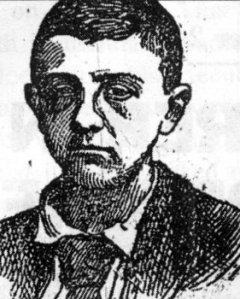

Otto (top) and his victim.

That morning, down the street at 24 Merchant Avenue, Maggie Thompson set off for school. Her mother, Clara, dropped her off at the front gate; it was the last time she would see her daughter alive.

Maggie attended the morning classes and, when school was dismissed for lunch at 11:15 a.m., started on the four-block walk home. En route, she vanished without a trace, as if “the sidewalk might have opened and swallowed the girl.”

Naturally there was a frantic search, lead by her devastated parents and the Cleveland Police Department, who tore the city apart looking for her.

But, although there were numerous false sightings and a few wild stories about Maggie’s disappearance, in spite of everyone’s efforts they couldn’t find her.

Otto participated in the search, along with most of the neighborhood. Nearly every day he would approach Clara Thompson and solicitously ask if she’d heard any news of her child.

In early June, Clarissa Shevel, the woman who lived with her husband in the back of the Lueths’ two-family house, asked Otto to do something about the terrible stench that pervaded the entire building. Otto suggested the odor was caused by a dead animal. He bought some chloride of lime and put it in the ventilation hole, then burned some sulfur, but it didn’t help.

Around that time he was witnessed carrying some badly stained bedding to the smokehouse at the back of the property.

On June 9, Otto’s mother Lena, who had by now been discharged from the mental hospital, became fed up with the smell and sent her husband Henry down to the cellar to investigate. He came back up a few minutes later, deeply shaken, and ran out to find a policeman.

In the Lueths’ cellar was the nude corpse of Maggie Thompson.

She was wrapped in one of Lena’s dresses and her own clothes lay underneath her. She had been beaten to death and her body was so badly decomposed that her parents had to identify her by scars on her hips.

The police promptly arrested everyone who lived at the house: Henry and Lena Lueth, Clarissa Shevel and her husband, and Otto, who was picked up on his way home from the ice cream parlor. All five suspects were separated and subjected to a serious “sweating,” but Otto was the prime suspect. He had a reputation as a bully, and he’d been at home alone for much of the previous month.

Bellamy records:

The climax came at 3:30 a.m., when an agonized female shriek resounded from the floor below the sweating room. “Who is that?” cried Otto to Detective Francis Douglass. “Your mother, I believe,” replied Douglass. “She had nothing to do with it!” blurted out Otto. “Who did?” queried Douglass. Otto: “I did it! I did it!” Douglass: “Did what, Otto?” “I killed her! I killed her! Please give me your revolver so I can kill myself!”

Resisting the temptation, the police instead took his verbal confession, wrote it down, had him sign it and escorted him to a cell.

Otto said he had been standing outside his parents’ home at about 11:30 a.m. on May 9 when he encountered Maggie. She asked him if he could donate any buttons to the “button-string” she was making, and he said he had four and would give them to her if she came inside.

Maggie obediently followed him in, and he led her upstairs to his bedroom, where he attempted to rape her. When she screamed, he hit her with a nearby hammer.

Otto said he thought he’d probably killed her with the first blow, but he kept striking her until her head was a pulp and the bed was covered in blood. After an unsuccessful attempt to have sex with her body, he fled the scene. He did go back to the house that night, but spent the next several days at his brother’s home.

Six days later, just before his mother was supposed to come home, Otto returned home to clean up. He carried Maggie’s corpse to the family cellar and left it lying there; he didn’t even bother to bury it or cover it up.

Given Otto’s confession, the circumstantial evidence and the revulsion his crime invoked in the city of Cleveland, his lawyer didn’t have much to work with. Not even trying for an acquittal, his defense instead claimed Otto was mentally impaired and/or insane.

Otto had a strange depression in his skull and his attorney suggested he was brain-damaged — which might very well have been true, given the abuse he had suffered at Lena’s hands. Several members of his family, including his mother and brother, had epilepsy, and his attorney suggested he might have had a seizure and committed his crime without even knowing what he was doing.

Such a scenario was possible. The problem was, though, that none of the medical experts who testified for the defense could diagnose Otto with epilepsy.

The claims of subnormal intelligence were contradicted by the testimony of Otto’s former teachers. Although his pathetic attempts to conceal Maggie’s body might indicate otherwise, his intellect seems to have been about average. Before he quit school at age 13, he had been an unexceptional student with some talent as a violinist.

Otto’s lawyer also said his client had not, in fact, attempted to sexually assault Maggie Thompson either before or after death, and Otto had invented that part of his confession because the police were pressing him to cough up an explanation for his motiveless crime. But given the fact that Maggie’s body was found naked, this claim didn’t carry much weight either.

It was no surprise that, when the trial concluded on December 27, 1889, the jury came back with a verdict of guilty without a recommendation of mercy. Perhaps the only surprising thing was that they actually bothered to deliberate for a whole four and a half hours.

Otto rapidly exhausted his appeals and was hanged eight months after his trial, alongside another killer, one John “Brocky” Smith of Cincinnati. Two other men had also been scheduled to die that night, but one got reprieved and the other’s execution was postponed.

Otto left behind a statement where he admitted he’d killed Maggie Thompson, but denied his previous claims that he’d tried to rape her. He died calmly and without a fuss, standing on the trap and saying simply “All right, let her go.”

On this day..

1987: Dale Selby Pierre, Hi-Fi Murderer

On this date in 1987, Utah executed Dale Selby Pierre for one of the most notorious crimes in that state’s history — the Hi-Fi Murders.

Pierre, along with two fellow airmen from the Hill Air Force Base, William Andrews and Keith Roberts, began an armed robbery of a hi-fi shop in nearby Ogden near closing time on the evening of April 22, 1974.

The night that unfolded would be a visit to an antechamber of hell not only for the two young clerks on duty at the time, but three other people who wandered into the store while the crooks were still in it — each of whom was added to the growing pen of hostages Pierre et al kept in the basement.

After plundering the shop of $25,000 worth of electronics, Pierre and Andrews went to get rid of their prisoners by making them drink liquid Drano.

This method of homicide, theoretically an elegantly quiet one which would facilitate a clean getaway, had been cribbed from a murder scene in the 1973 Dirty Harry movie Magnum Force.

The struggles of Cortney Naisbitt, one of the surviving victims, forms the subject of Victim: The Other Side of Murder — a classic of the true-crime genre and of the victim’s rights movement.

But human flesh is hardier than celluloid.

Unlike the poor prostitute in Magnum Force, Pierre and Andrews’s victims groaned and gurgled, their blistering mouths suppurating so much fluid that duct tape to quiet them down wouldn’t stick. And the Drano didn’t kill them, or at least it was sure taking its time.

“I remember the noise they were making, the sounds of pain they were making,” Pierre told his clemency hearing. “It was something greater than sad.”

Since they hadn’t got rid of their victims quite so cleanly, Pierre simply set about shooting them — and in the case of Michelle Ansley, a 19-year-old in her first (and last) week on the job at the Hi-Fi shop, raping her first. These execution-style murders had only mixed results, and one of the hostages — 43-year-old Orren Walker — being noticeably not dead, had a ball-point pen kicked into his ear in an attempt to finish him off.

Somehow, Walker still survived, as did 16-year-old Cortney Naisbitt, who suffered severe brain damage. (Both have since died.) Stanley Walker, Carol Naisbitt, and Ansley were not so “lucky.” But neither were the perps: since Andrews had openly talked at the Air Force base about boosting that very hi-fi shop and even killing anyone who “gets in the way,” suspicious fellow airmen soon turned them in.

The 21st century’s more polished and calculating strategic communications consultant probably would have advised keeping well clear of such an incendiary crime, but death penalty opponents actually pushed clemency hard in the Hi-Fi case.* For the NAACP, the sentences underscored racial disparity in the death penalty.

Rubbish, one might say, given the killers’ epically villainous conduct. But one member of the all-white jury was apparently passed a note by parties unknown reading “Hang the niggers.” And the NAACP noted that Utah gave death sentences to these guys, but not to a white supremacist who murdered two black men for jogging with white women.

None of this cut any ice with Utah. Years later, the killers themselves had a hard time fitting that monstrous night into any kind of comprehensible rationale. Pierre:

The crime took a course of its own. It wasn’t planned that way. People kept coming in and I just panicked. The only way to prevent what happened was to have been moved away from the Air Force entirely … Of course the alcohol and the pills I was consuming didn’t help — valiums, reds, black beauties and yellow jackets … I tell myself, “You have to accept responsibility for it — you did it, you were there. You can’t rationalize it.”


Dale Pierre pleads his case to the Utah clemency board.

Dale Pierre was the very first person put to death in Utah after its famously groundbreaking execution of Gary Gilmore in 1977. But in fact, the Hi-Fi killers had preceded the eager volunteer Gilmore on Utah’s death row, and Gilmore as he walked his last mile reportedly wisecracked to Pierre and Andrews, “I’ll be seeing you directly.”

Pierre’s accomplice William Andrews was also finally executed in 1992, after a then-unimaginable (and anything but “direct”) 18 years on death row — nearly half his life. Their fellow accomplice Keith Roberts didn’t personally take part in the cellar hecatomb and therefore avoided the death sentence: he was paroled in 1987.

* The clemency push was much stronger for William Andrews than for Dale Pierre, since Andrews was also making the argument that he hadn’t directly killed anyone and hadn’t intended to. As a matter of fact, the manipulative Andrews was and is widely doubted on that point — but any such claim was wholly unavailable to the acknowledged triggerman Pierre.

On this day..

1887: Israel Lipski

(Thanks to Meaghan Good of the Charley Project for the guest post. -ed.)

On this day in 1887, 22-year-old Israel Lipski was hanged at Newgate Prison for the murder of Miriam Angel.

His trial and execution were well-publicized in their day, and were the subject of a 1984 book, The Trials of Israel Lipski: A True Story of a Victorian Murder in the East End of London by Martin L. Friedland.

But Lipski has been largely forgotten now … except as a footnote in a much more famous unsolved murder.

Lipski was of Polish-Jewish origin. His real name was Israel Lobulsk; he changed it when he moved to the UK.

He lived in a boardinghouse and worked as an umbrella and walking-stick salesman. Miriam, who was also Jewish, lodged at the same address, 16 Batty Street.

Miriam was found dead in her bed June 28 of that year. She’d been killed in an unusual way: she was forced to consume nitric acid, also known as aquafortis, a strong corrosive chemical now used in rocket fuel. She was six months pregnant at the time of her death.

Lipski was found hiding under her bed. He too had consumed nitric acid and the inside of his mouth was burned. Investigators later determined he’d purchased an ounce of the chemical that very morning. They theorized he had killed Miriam during a rape attempt.

Lipski, for this part, insisted he was innocent of any crime and told an extraordinary story: he stumbled across two co-workers in Miriam’s room rifling through her things. Miriam was already dead at this point. The two men attacked and robbed him, poured the nitric acid down his throat and threw him under the bed, where he fainted.

The judge’s summing-up to the jury, described by one news account as “lucid and temperate,” went with the rape theory:

… that the murderer of Miriam Angel entered her room under the influence of unlawful passion; that, balked in this design, his passion turned to homicidal fury; and that in a reaction of shame and terror he had taken a dose of the same poison that he had given to his victim. If that theory was probable, continued the judge, the murder was much more likely to have been the work of one man than two.

The climate of pervasive anti-Semitism in East London during this time sealed Lipski’s fate. London’s Jewish population, largely impoverished Polish and Russian refugees, was ever liable to blame for a wide variety of social problems. On top of everything else, Lipski’s legal defense was abysmal and the judge clearly biased. He might have been guilty, but the fairness of his trial is questionable.

Following Lipski’s conviction and death sentence there was worried speculation that he might, after all, be innocent. Several prominent people, including members of Parliament and investigative journalist William Stead, petitioned the Home Secretary for a reprieve or commutation. (Stead referred to Lipski as “the young martyr” and the “much injured young exile.”) The wind went out of their sails, however, after Lipski’s confession was published:

I, Israel Lipski, before I appear before God in judgment, desire to speak the whole truth concerning the crime of which I am accused. I will not die with a lie on my lips. I will not let others suffer even in suspicion for my sin. I alone was guilty of the murder of Miriam Angel.

I thought the woman had money in her room, so I entered, the door being unlocked and the woman asleep. I had no thought of violating her, and I swear I never approached her with that object, nor did I wrong her in this way. Miriam Angel awoke before I could search about for money, and cried out, but very softly. Thereupon I struck her on the head and seized her by the neck, and closed her mouth with my hand, so that she should not arouse the attention of those who were about the house.

I had long been tired of my life, and had bought a pennyworth of aquafortis that morning for the purpose of putting an end to myself. Suddenly I thought of the bottle I had in my pocket, and drew it out and poured some of the contents down her throat. She fainted and, recognizing my desperate condition, I took the rest. The bottle was an old one which I had formerly used … The quantity of aquafortis I took had no effect on me.

Hearing the voices of people coming upstairs, I crawled under the bed. The woman seemed already dead. There was only a very short time from the moment of my entering the room until I was taken away.

Even before his execution, “Lipski” became a part of Londoners’ vocabulary. It was used as both a slur against Jews and as a verb, the way a certain kind of suffocation murder still known as “burking” was named after William Burke of “Burke and Hare” fame.

A year after Israel Lipski’s execution, the name “Lipski” once again came under scrutiny after a murder suspect yelled it out in front of a witness, leaving scholars and true-crime buffs to speculate about its meaning for the next 120 years and counting.

The victim in that case was a prostitute named Elizabeth Stride. The suspect is known only by his trade name, Jack the Ripper.

But that’s another story.

On this day..

1942: Irene Nemirovsky, Catholic Jewish writer

(Thanks to Meaghan Good of the Charley Project for the guest post. -ed.)

On this date in 1942, 39-year-old French/Ukrainian novelist Irene Nemirovsky was gassed at the Auschwitz Concentration Camp in Poland.

She was a victim of the Nazis’ racial laws: anyone with even one Jewish grandparent, even if they themselves did not practice the Jewish religion, could be considered a Jew. Nemirovsky, born to a wealthy Russian-Jewish family in what is now the Ukraine, had converted to Catholicism in 1939 — sincerely, insofar as anyone can discern.

Irene Nemirovsky fled Russian territory after the Bolshevik Revolution and spent a short time in exile in Finland and Sweden before eventually settling in France. There she married a banker, had two daughters, and published her first novel in 1930.

The book, called David Golder, was about a ruthless businessman (described by modern readers as “a Bernie Madoff of her time”) who in old age and poor health begins to regret the way he lived his life. It was a success and was made into a 1930 film.

Her second novel, Le Bal, also hit the silver screen. She penned several other books as well: Dimanche and Other Stories, Jezebel, The Dogs and the Wolves, The Courilof Affair, and more.

Although she was widely acclaimed as a writer in France, even by anti-Semites, she was denied citizenship in 1938. By then she had lived in the country for twenty years.

Following the German invasion of France in 1940, Nemirovsky’s books were pulled off the presses and she was required to wear the yellow star. If she and her family had succeeded in obtaining French citizenship, this would have provided some protection; the French were reluctant to deport their own Jews, filling the cattle cars with foreigners instead. Irene was instead classified as a “stateless person of Jewish descent” and the high-ranking Nazi official Ernst Kaltenbrunner called her a “degenerate artist of deluded Jewish hegemony.”

The “stateless” Irene was arrested on July 13, 1942. She had time to write a letter to her family, asking them not to worry about her, before she was deported to Auschwitz four days later.

Although she survived the initial selection and was tattooed with a prisoner number, it was reported a month later that she had died of typhus, a common and deadly disease in the concentration camps. However, later investigation showed she had in fact been sent to the gas chamber. Her husband was also gassed in Auschwitz in November of that year, but their two children survived the war.

One of Nemirovsky’s books, All Our Worldly Goods, was posthumously published in France in 1947. However, for sixty years following the war this once-famous author was largely forgotten.

In 2004, however, she became a literary sensation when a previously undiscovered manuscript, Suite Francaise, hit the press. The “suite” consisted of two books out of a projected five, titled “Storm in June” and “Dolce”. Irene had written them while in hiding in 1940. When she was arrested she gave the manuscripts in a suitcase to her daughter Denise, who safeguarded them all those years.

The book was received to great acclaim and became a bestseller, and publishers blew the dust off her novels from the 1930s and brought them back into print. In 2007, another of Nemirovsky’s works, Fire in the Blood, was published. The book was a companion to Suite Francaise — and like Suite, Nemirovsky had worked on it while in hiding during the Nazi occupation.

Nemirovsky never escaped controversy, in her life or after her death. Several critics and scholars have accused her of being an anti-Semite, a “self-hating Jew,” as detailed in this article from the Australian publication The Age.

Novelist Paul LaFarge charged her as “a Jew who disliked other Jews.” Primo Levi‘s biographer wrote of her, “She has taken on board the idea that Jews belong to a different, less worthy ‘race’, and that their exterior signs are easily recognizable: frizzy hair, hooked noses, moist palms, swarthy complexions, thick black ringlets, crooked teeth…”

There is evidence to support this assertion.

Some of her books were serialized in anti-Semitic magazines, and during the occupation Irene also wrote a letter to Marshal Petain, head of France’s collaborationist Vichy government, to say she disliked Jews and shouldn’t be classified as a Jew, racial laws notwithstanding. Her husband wrote a similar letter to the German ambassador after her arrest, saying his wife “did not speak of the Jews with any affection whatsoever.” The ambassador never bothered to reply.

Irene, however, also has her defenders in this matter: “She didn’t dislike Jews,” said one. “She disliked some Jews. Big difference.” Patrick Marnham, who wrote the introduction to the reprinted David Golder, argued that, “Her choice of an unsympathetic Jewish character [in the book] does not make Nemirovsky anti-Semitic; any more than Robert Louis Stevenson was anti-Scottish because he created the diabolical figure of Ebenezer in Kidnapped.”

You could argue that if she appeared to be anti-Semitic it was because she was trying to conceal her own Jewish origins and thereby protect her family from the deadly consequences. Her daughters believed this was the reason for her assertions that she hated Jews.

In any case, whatever Irene may have said or thought about her religious origin did not save her life. She was just one of many thousands of Christian converts who fell victim to Nazi Germany’s madness.

Irene’s younger daughter, Elisabeth Gille, who died in 1996, wrote a novel titled Shadows of a Childhood which was based on her parents’ disappearance. She had only been five years old when Irene was arrested. In 2010, Olivier Philipponnat and Patrick Lienhardt published the first major biography of Irene, The Life of Irene Nemirovsky, 1903-1942.

On this day..