1942: Jakub Lemberg and family

(Thanks to Meaghan Good of the Charley Project for the guest post. -ed.)

On this date in 1942, on the first day of Purim, Jakub Lemberg was executed together with his family in the Nazi ghetto in Zdunska Wola, Poland.

Lemburg, a 43-year-old internist and pediatrician, was head of the Judenrat in Zdunska Wola and thus it was his task to do the Nazis’ dirty work, such as putting together lists of his fellow-Jews for deportation.

He revealed himself to be a man of exceptional character and courage, and the circumstances of his death, as recorded in Louis Falstein’s The Martyrdom of Jewish Physicians in Poland, should not be forgotten:

The Gestapo chief ordered Dr. Lemberg to deliver ten Jews to be hanged for the ten hanged sons of Haman. Dr. Lemberg replied that he could deliver only four Jews: himself, his wife and their two children. Hans Biebow, “the Butcher of Lodz,” seized Dr. Lemberg and turned him over to the executioners, who killed him in the cemetery.

The Zdunska Wola ghetto was liquidated five months later. And in 1947, Biebow got his.

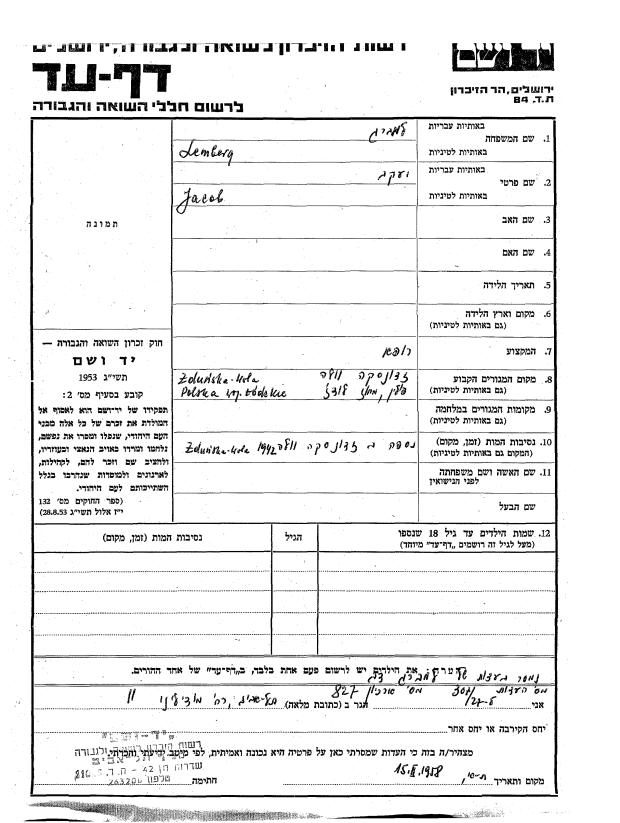
Here’s an image of Lemberg testimony (in Hebrew) from the Yad Vashem database.

On this day..

1864: Martin Robinson, treacherous guide

On this date in 1864, a Union officer frustrated of a design to raid Richmond during the U.S. Civil War hanged a local African-American guide whom he thought had intentionally misled him like Susanin.

The account of an army chaplain attached to the 5th New York Cavalry explains:

The guide, a negro, had misled us during the night, and, to obviate the delay of retracing our steps. Col. Dahlgren, on the representations of the negro that an excellent ford was to be found at Dover Mills, concluded to cross at that point. After two hours’ halt we again moved on, and soon reached Dover Mills, but only to meet disappointment.


Dover Milles, Civil War era illustration

The negro had deceived us, no ford existed at this point nor any means of crossing the river. He then stated that the ford was three miles below: this was obviously false, as the river was evidently navigable to and above this place, as we saw a sloop going down the river.

… he came into our lines from Richmond … [and] was born and had always belonged in the immediate vicinity of Dover Mills, was very shrewd and intelligent, and it would seem impossible that he should not know that no ford existed in the neighborhood, where he had seen vessels daily passing. Col. Dahlgren had warned him that if detected acting in bad faith, or lying, we would surely hang him, and after we left Dover Mills, and had gone down the river so far as to render further prevarication unavailing, the colonel charged him with betraying us, destroying the whole design of the expedition, and hazarding the lives of every one engaged in it, — and told him that he should be hung in conformity with the terms of his service. The negro became greatly alarmed, stated confusedly that he was mistaken, thought we intended to cross the river in boats, and finally said that he had done wrong, was sorry, etc. The colonel ordered him to be hung, — a halter strap was used for the purpose, and we left the miserable wretch dangling by the roadside.

Our correspondent terms this the case of the “Faithless Negro”, but posterity has the luxury of a less paranoiac reading than indulged by a troupe of hotheaded commandos deep in enemy territory all a-panic as their expedition implodes. The James River was just plain swollen with winter rains. Bad luck all around.

A Goochland County marker marks the spot of the botched crossing and subsequent execution.

But we’re really just getting started. Stay tuned for some serious blowback from this bootless military debacle.

The full story of the raid is a tangled and contested affair, but it’s well worth perusing in detail. To sum up:

This expedition’s leader, Col. Ulric Dahlgren, abandoned the effort and in the attempt to fall back, rode into a Confederate ambush the next day. He died in the fusillade, while his men were captured.

The body of this late Col. Dahlgren, on whose authority our misfortunate guide was put to death, was found by the Confederates to bear some startling papers* … indicating that the intent of his ill-starred expedition was not merely to liberate starving northern prisoners, but that “once in the City it must be destroyed & Jeff. Davis and Cabinet killed.”

Within days, the story was abroad and Richmond newspapers floridly outraged at this proposed breach of chivalrous warfare.

Though Confederate General Robert E. Lee was able to quash public demands for the Dahlgren party’s summary execution, the documents may indeed have marked a turning point in the war’s conduct, a public announcement of total warfare sufficient for the South to “inaugurate a system of bloody retaliations.”** If so, it was a well-timed license: the Confederacy was in the process of being steamrolled and would soon require recourse to more desperate strategems.

After Dahlgren, argues Come Retribution: The Confederate Secret Service and the Assassination of Lincoln, “there was an increase in Confederate clandestine activity designed to encourage the antiwar faction in the North to organize and revolt” — even including a mirror-image Confederate cavalry raid on Washington D.C. with an eye towards capturing Lincoln.

There are, in fact, some historians who postulate that it was “bloody retaliation” for Dahlgren’s attempt on the Confederate president that ultimately led southern agents to initiate the late-war plots against Abraham Lincoln’s person — resulting ultimately in Lincoln’s assassination:

Ulric Dahlgren, and [his] probable patron [U.S. Secretary of War] Edwin Stanton set out to engineer the death of the Confederacy’s president; the legacy spawned out of the utter failure of their effort may have included the death of their own president.

That is some blowback.

Books exploring the alleged link between the Dahlgren Papers and the Lincoln assassination

* It must be said that the Dahlgren papers have been continually contested as frauds from the moment they were known, though many historians do indeed consider them legitimate. We are in no position to contribute to that debate, and for the purposes of this post’s narration the question is immaterial: the papers, forged or not, certainly existed, were widely publicized, and genuinely angered many southerners.

** These words are the demand of the March 8, 1864 Richmond Dispatch.

On this day..

1856: Auguste Chapdelaine, saintly casus belli

On February 29, 1856, local Chinese officials in Guangxi beheaded French missionary priest Auguste Chapdelaine — and handed his countrymen a pretext for war.

Chapdelaine (English Wikipedia page | French) had gone illegally to the Chinese interior to proselytize Christianity.

The local mandarin Zhang Mingfeng was no doubt disposed to take such an harsh line against this provocation by virtue of the ongoing, Christian-inspired Taiping Rebellion, which had originated right there in Guangxi and was in the process of engulfing all of southern China in one of history’s bloodiest conflicts.

So Chapdelaine and his associates were snapped up, put to a few days’ dreadful torture, and on this date a Chinese convert and Chapdelaine were both summarily beheaded. (A female convert, Agnes Tsaou-Kong, expired under torture around the same time.)

Pietistic accounts of believers’ last extremes are here and here.


(Images from this French page.)

It took months for word of this martyrdom to reach French consular officials, and many months more for the gears of international diplomacy to turn — but when they did so, France pressed a demand for reparations.

Since pere Chapdelaine had been acting illegally in the first place, the Qing’s obdurate Viceroy Ye(h) adamantly refused to offer Paris satisfaction.

By 1858, this intransigence sufficed to license French entry (alongside Britain) into the Second Opium War, from which the Europeans won by force of arms a noxious treaty guaranteeing their right to push Christianity in China, extracting a couple million silver taels in damages, and (of course) assuring their right to traffic opium into China.

It would be rather ungenerous to hold all the ugly imperial consequences personally against our day’s martyr. August Chapdelaine was canonized by the Catholic Church in 2000 as one of 120 Martyrs of China.

China was not impressed by this celebration of a onetime colonial catspaw, and met the Vatican’s “anti-China” celestial promotion announcement with one of its own — charging that Chapdelaine “collaborated with corrupt local officials, raped women and was notorious in those areas [where he preached].”

On this day..

1870: Wyatt Outlaw lynched by the Ku Klux Klan

On this date in 1870, the lynching of a mulatto freedman in Alamance County, North Carolina sounded the tocsin for ex-Confederates’ rollback of Reconstruction.

Perhaps America’s most tragic period, the aftermath of the Civil War saw a too-brief attempt to enforce ex-slaves’ civil rights, before it succumbed to violent counterattack. The prevailing historiography in the century-long era of Southern apartheid that followed remembered it as a time of impertinent Negroes ravishing Dixie’s virtue by being seated in the legislature and giving orders to their natural betters.

Winners write history, after all.

Those of the pro-Republican coalition at the time, before Northerners folded their hand, had a mind to write a different history.

Alamance County was one epicenter of this aborted alternative. The enclave was cool to secession from the beginning, and in the early years of Reconstruction had a live black-white coalition. Wyatt Outlaw, a mixed-race Alamance native who had fought for the Union, was a local leader in it. A member of the antislavery Union League, which registered freedmen as voters throughout the South, he was appointed a town commissioner for Graham, N.C. under the state’s new constitution.

This made him a prime target of Ku Kluxers. On the night of February 26, 1870, an armed party of white supremacists about 100 strong raided his home and strung him up on an elm tree facing the county courthouse. Pinned to his corpse for the edification of the morning’s churchgoers was a note:

“Beware you guilty — both white and black.”

North Carolina Governor William Holden complained to the U.S. Senate of federal unwillingness to act against such outrages.

What is being done to protect good citizens in Alamance County? We have Federal troops, but we want power to act. Is it possible the government will abandon its loyal people to be whipped and hanged? The habeas corpus should be at once suspended.

After another pro-Reconstruction politician was murdered later that year, Holden boldly took the initiative himself and called out the troops to arrest suspected Klansmen. But the right-wing Democratic party won midterm elections in 1870, and promptly impeached Holden for this atrocious tyranny; he was the first U.S. governor ever removed from office by impeachment.*


A “carpetbagger” ally of Wyatt Outlaw named Albion Tourgee — a judge who stood as one of North Carolina’s most prominent and hated advocates for African American equality — later wrote a novel about his experiences, A Fool’s Errand, by One of the Fools. Now in the public domain and available free online, this book’s portrayal of the Reconstruction South is receiving renewed scholarly appreciation** — including Tourgee’s catalogue of terrorism against emancipated blacks and the Republican government. The novel was a sensation (pdf) in its time.

One of the characters in Fool’s Errand is a nearly exact representation of Wyatt Outlaw: “Uncle Jerry Hunt”, who resists the Klan. It is “chiefly through Uncle Jerry’s persuasions, and because of his prominence and acknowledged leadership, this spirit had gone out among the colored men of the county.” He meets a graphic end that almost journalistically reports Outlaw’s real fate.

It was a chill, dreary night. A dry, harsh wind blew from the north. The moon was at the full, and shone clear and cold in the blue vault.

There was one shrill whistle, some noise of quietly moving horses; and those who looked from their windows saw a black-gowned and grimly-masked horseman sitting upon a draped horse at every corner of the streets, and before each house, –grim, silent, threatening. Those who saw dared not move, or give any alarm. Instinctively they knew that the enemy they had feared had come, had them in his clutches, and would work his will of them, whether they resisted or not. So, with the instinct of self-preservation, all were silent–all simulated sleep.

Five, ten, fifteen minutes the silent watch continued. A half-hour passed, and there had been no sound. Each masked sentry sat his horse as if horse and rider were only some magic statuary with which the bleak night cheated the affrighted eye. Then a whistle sounded on the road toward Verdenton. The masked horsemen turned their horses’ heads in that direction, and slowly and silently moved away. Gathering in twos, they fell into ranks with the regularity and ease of a practiced soldiery, and, as they filed on towards Verdenton, showed a cavalcade of several hundred strong; and upon one of the foremost horses rode one with a strange figure lashed securely to him.

When the few who were awake in the little village found courage to inquire as to what the silent enemy had done, they rushed from house to house with chattering teeth and trembling limbs, only to find that all were safe within, until they came to the house where old Uncle Jerry Hunt had been dwelling alone since the death of his wife six months before. The door was open.

The house was empty. The straw mattress had been thrown from the bed, and the hempen cord on which it rested had been removed.

The sabbath morrow was well advanced when the Fool [i.e., Tourgee himself] was first apprised of the raid. He at once rode into the town, arriving there just as the morning services closed, and met the people coming along the streets to their homes. Upon the limb of a low-branching oak not more than forty steps from the Temple of Justice, hung the lifeless body of old Jerry. The wind turned it slowly to and fro. The snowy hair and beard contrasted strangely with the dusky pallor of the peaceful face, which seemed even in death to proffer a benison to the people of God who passed to and fro from the house of prayer, unmindful both of the peace which lighted the dead face, and of the rifled temple of the Holy Ghost which appealed to them for sepulture. Over all pulsed the sacred echo of the sabbath bells. The sun shone brightly. The wind rustled the autumn leaves. A few idlers sat upon the steps of the court-house, and gazed carelessly at the ghastly burden on the oak. The brightly-dressed church-goers enlivened the streets. Not a colored man was to be seen. All except the brown cadaver on the tree spoke of peace and prayer–a holy day among a godly people, with whom rested the benison of peace.

The Fool asked of some trusty friends the story of the night before. With trembling lips one told it to him,

“I heard the noise of horses–quiet and orderly, but many. Looking from the window in the clear moonlight, I saw horsemen passing down the street, taking their stations here and there, like guards who have been told off for duty, at specific points. Two stopped before my house, two opposite Mr. Haskin’s, and two or three upon the corner below. They seemed to have been sent on before as a sort of picket-guard for the main body, which soon came in. I should say there were from a hundred to a hundred and fifty still in line. They were all masked, and wore black robes. The horses were disguised, too, by drapings. There were only a few mules in the whole company. They were good horses, though: one could tell that by their movements. Oh, it was a respectable crowd! No doubt about that, sir. Beggars don’t ride in this country. I don’t know when I have seen so many good horses together since the Yankee cavalry left here after the surrender. They were well drilled too. Plenty of old soldiers in that crowd. Why, every thing went just like clock-work. Not a word was said–just a few whistles given. They came like a dream, and went away like a mist. I thought we should have to fight for our lives; but they did not disturb any one here. They gathered down by the court-house. I could not see precisely what they were at, but, from my back upper window, saw them down about the tree. After a while a signal was given, and just at that time a match was struck, and I saw a dark body swing down under the limb. I knew then they had hung somebody, but had no idea who it was. To tell the truth, I had a notion it was you, Colonel. I saw several citizens go out and speak to these men on the horses. There were lights in some of the offices about the court-house, and in several of the houses about town. Every thing was as still as the grave,–no shouting or loud talking, and no excitement or stir about town. It was evident that a great many of the citizens expected the movement, and were prepared to co-operate with it by manifesting no curiosity, or otherwise endangering its success. I am inclined to think a good many from this town were in it. I never felt so powerless in my life. Here the town was in the hands of two or three hundred armed and disciplined men, hidden from the eye of the law, and having friends and co-workers in almost every house. I knew that resistance was useless.”

“But why,” asked the Fool, “has not the body been removed?”

“We have been thinking about it,” was the reply; “but the truth is, it don’t seem like a very safe business. And, after what we saw last night, no one feels like being the first to do what may be held an affront by those men. I tell you, Colonel, I went through the war, and saw as much danger as most men in it; but I would rather charge up the Heights of Gettysburg again than be the object of a raid by that crowd.”

After some parley, however, some colored men were found, and a little party made up, who went out and saw the body of Uncle Jerry cut down, and laid upon a box to await the coming of the coroner, who had already been notified. The inquest developed only these facts, and the sworn jurors solemnly and honestly found the cause of death unknown. One of the colored men who had watched the proceedings gave utterance to the prevailing opinion, when he said,–

“It don’t do fer niggers to know too much! Dat’s what ail Uncle Jerry!”

And indeed it did seem as if his case was one in which ignorance might have been bliss.

The multitalented, ahead-of-his-time Tourgee might well have uttered the same sentiment in 1896, when he was the lead attorney on the losing side of Plessy v. Ferguson — the Supreme Court’s landmark sanction of the color line that Uncle Jerry’s hangmen had drawn.

There are a couple of interesting journal articles touching on Alamance County during Reconstruction which are freely available as pdfs from the Journal of Backcountry Studies: “Other Souths”: The Civil War and Reconstruction in Alamance County, North Carolina and Scalawags Among Us: Alamance County Among the “Other Souths”.

* Narrowly beating Nebraska’s David Butler, who got the boot a few months later. Holden remains the only governor to suffer this indignity in North Carolina history; there has been a recent push in the Raleigh legislature to posthumously pardon him. Holden’s own memoirs are also available free online.

** Along with the book’s contention that northern Republicans were to blame for vacillating on Reconstruction. “This cowardly shirking of responsibility, this pandering to sentimental whimsicalities, this snuffling whine about peace and conciliation, is sheer weakness … [the North is] a country debauched by weak humanitarianisms, more anxious to avoid the appearance of offending its enemies than desirous of securing its own power or its own ends.”

On this day..

1942: Five Jews in Sokal

(Thanks to Meaghan Good of the Charley Project for the guest post. -ed.)

The synagogue at Sokal.

On this day in 1942, the Nazis shot five Jewish men from Sokal, which was then part of Poland and now belongs to the Ukraine.

During the first years of the war, the Germans had designated Sokal as a Judenstadt (literally “Jew-town”), a central destination point for all Jews expelled from nearby towns and villages. Or, as diarist Moshe Maltz put it, “A solitary island in a sea of blood.”

It was Maltz, an Orthodox Jew and native of Sokal, who recorded the executions described in this entry. He kept regular notes throughout the war about the plight of Sokal’s Jews — not a diary exactly, but a chronicle, meant for the benefit of history.

On February 24, five Jews from Sokal were taken to a place somewhere on the outskirts of town and shot. One of them was Yeshaye, son of Yankel the coachman. In 1940, during the period of Soviet occupation, Yeshaye had been a coachman working for the NKVD. Now the Gestapo called him and ordered him to turn over to them the reins of his horses. They said to him, “We’ll give you three days to deliver those reins to us. If we don’t get them by that time, we’ll have you shot.” Yeshaye thought that the Gestapo must be joking. How could he go on working as a coachman without his reins? Unfortunately for Yeshaye, the Gestapo men were in dead earnest.

Also among the five shot was Dr. Knopf, a lawyer who had converted to Christianity. The Germans had ordered him to dismiss his Gentile maid so that she could be sent to work in Germany. Knopf petitioned the Gestapo to let him have his maid back. That’s why the Germans shot him. Despite his baptism, he was simply not an Aryan. The third victim was blind Yankel, who was found guilty of buying and slaughtering a calf. Under German occupation regulations, cattle can be slaughtered only by officially approved butchers.

In October 1942, the Jews of Sokal were confined to a ghetto. The following month Maltz wrote, with the same dispassionate tone, of the murder of his fourteen-month-old daughter at the hands of the Nazis.

Later in November he escaped from the ghetto with his wife and surviving son. They had made an arrangement with a Polish woman who lived nearby, and moved into her hayloft, above the pigsty.

Eventually fourteen people from three families in all would come to live in the hayloft. All of them survived except Maltz’s sister, who died of fever while in hiding. The others staggered out into daylight, barely able to walk, when the Russians liberated the area in July 1944.

Maltz and his entire family eventually emigrated to the USA.

After his death in 1993, his diary was translated and published under the title Years of Horror, Glimpse of Hope: The Diary of a Family in Hiding. In 2009, a Pennsylvania State University professor made a prize-winning documentary based on the book, called No. 4 Street of Our Lady. You can watch it on Netflix or read an article about it here.

On this day..

1912: Thomas Jennings, fingerprinted

One hundred years ago today, Thomas Jennings was ushered the scaffold … while Thomas Jennings’s fingerprints ushered in a new age of policework (pdf).

Hegemonic authority had been on a long march towards a forensic regime that could affix an oft-ephemeral identity to the profoundly corporeal body.

In the late 19th and early 20th century, investigative techniques and jurisprudence marched double time to keep pace with new techniques — from photography to the unwieldy system of Bertillonage.

A variety of American institutions — the U.S. Army, a number of prison systems — had begun systematically cataloging their respective inmates’ fingerprints in the preceding years, but it was in the Jennings case that the system really earned its whorls. It was the first U.S. murder case pinned on fingerprint evidence.

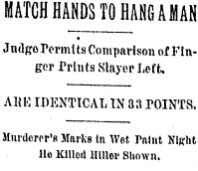
In September 1910, a Chicago homeowner in the present-day Beverly neighborhood surprised an intruder, and was shot dead. (pdf) In the course of the fight or the flight, the prowler splooshed his left hand into some wet paint on a railing.

Thomas Jennings, a paroled burglar, was arrested near the scene, and his fingerprints shown to match those left in the grieving Hiller household. A prosecution expert even gave a courtroom demonstration of dusting for prints.

This was as novel to judges as to jurymen, and given the dearth of other positive evidence against Jennings, the Illinois Supreme Court was called upon to deliberate upon the humble dactylogram. In the summer of 20111911, it stopped Jennings’ hanging just hours before it was to take place.

But its final word in December 20111911 only fitted the homebreaker’s noose.

We are disposed to hold from the evidence of the four witnesses who testified, and from the writings we have referred to on this subject, that there is a scientific basis for the system of fingerprint identification, and that the courts cannot refuse to take judicial cognizance of it …

Such evidence may or may not be of independent strength, but it is admissible, with other proof, as tending to make out a case. If inferences as to the identity of persons based on voice, the appearance or age are admissible, Why does not this record justify the admission of this fingerprint testimony under common law rules of evidence.

Courtrooms all around the world soon agreed, and within a generation the awesome investigative power of the fingerprint had fugitives going so far as to slice or burn off those incriminating little pads of flesh — the crime scene gold standard until the advent of DNA testing.

Jennings was hanged this date in a state-record five-man batch (the others, Ewald and Frank Shiblawski, Philip Sommerling, and Thomas Schultz, had all committed an unrelated murder together).

On this day..

1845: John Gordon, the last hanged in Rhode Island

Last year, the Rhode Island General Assembly approved a measure posthumously pardoning John Gordon — who on February 14, 1845 was the last man executed in that state.

Gordon’s hanging, for the murder of a prominent industrialist who had bad blood with Gordon’s brother, was long notorious in Rhode Island as one secured on highly uncertain evidence in an atmosphere of anti-Irish prejudice.

Executed Today is pleased to welcome on this occasion University of Rhode Island labor historian Scott Molloy, author of Irish Titan, Irish Toilers and a major advocate of the Gordon pardon.

ET: Can you set the scene — what’s going on in Rhode Island at this time, and what are the tensions surrounding Irish immigrants?

SM: Rhode Island was the site of the first factory in America in the 1790s, called Slater Mill. It really changed the face of Rhode Island and eventually the rest of the US.

In Rhode Island, curiously, as more and more people left the farms to work on the mills, they had an unusual requirement that really didn’t make any difference years earlier: in order to vote, you had to have so much land. (Specifically, $134 worth of land.)

By 1840, not only were the usual suspects not able to vote — women, people of color, Native Americans — 60% of native-born white male Rhode Islanders were also unable to vote. It meant that just a handful of people ruled the state, compared to the time of the American Revolution when just about every white male could vote. And immigrants in particular — and in those days, that was the Irish — were basically precluded from voting. You had a residency requirement, a property qualification. It made Rhode Island almost unique in New England, almost like a southern state.

A group of reformers came to the forefront, a guy named Thomas Wilson Dorr, a blueblood aristocrat, Harvard-educated, one of the best legal minds of the country. He threw his lot in with the reformers to try to get people the right to vote. It really polarized the state in 1842.

The Irish were sympathetic, but Irish priests tried to keep them out of it because they wanted to acclimate. But because a lot of the animosity toward people having the right to vote was directed at Irish immigrants. People blamed the Irish even though the Irish didn’t get particularly involved in the Dorr War.

Often times they got blamed for everything whether they did it or not. And of course we face the same situation with immigrants today.

What was the crime and how did the Gordons come to be the focus of the prosecution?

In 1843, a Yankee industrialist out in Cranston by the name of Amasa Sprague was found on New Year’s Eve 1843 bludgeoned to death in what today we might call a hate crime. He had a gold watch still on him, he had money in his poket, and he had been beaten to death.

Amasa Sprague was a very influential guy. His older brother who helped run the mill with him and was the US Senator from Rhode Island had the local city council lift the liquor license from the Gordon family’s business, which for all intents and purposes ended their livelihood. This was Nicholas Gordon’s shop: John Gordon had only just crossed over from Ireland.

When Sprague was found dead about six months after the license was lost, they focused on the Gordon family. The authorities formed a posse and they went after this Irish family.

Book CoverHow did anti-Irish sentiment manifest itself at trial?

The juries in all three trials had no Catholics and no Irish that I’m aware of. There was a lot of religious and socioeconomic animosity.

At the time, the Supreme Court of the state would sit in on the whole trial just because it was a capital trial, and the trial judge would say in the transcript — which is still available (pdf) — he basically says to the jury, if you find testimony that contradicts itself between a Yankee and an Irish witness, you should give the Yankee testimony more credence.

Doesn’t the fact that John Gordon’s brothers were not convicted militate against the notion of overwhelming anti-Irish prejudice?

You can’t go overboard on these things. The juries — all three of them — they found one Gordon innocent and in the other case they had a hung jury. I don’t want to say they were completely prejudiced, because they weren’t, but almost everything else in Rhode Island at that time was stacked up against them.

The earlier Irish who came in the 1820s and 1830s were a little bit better off, a little bit better-educated [compared to later Irish immigrants after the potato famine]. The animus against the Irish was still intense; the Irish were seen as criminal, unskilled, uneducated, ignorant. The Protestant majority at the time, mostly of English heritage, kind of brought that over with them even though they had been there for a long time.

So how did the legal proceedings play out?

They put two of the recently immigrated brothers up for conspiracy for murder, but not the oldest brother. So John Gordon and his brother William go on trial first.

The jury came back with a guilty verdict for John Gordon, who didn’t have much of an alibi, but a not guilty verdict for William, who did have an alibi. So you’ve got a conspiracy conviction with only one conviction.

Then they put Nicholas Gordon on trial, and the jury comes back deadlocked. His second trial is not going to be until the spring of 1845. In the interim, his brother John was to be hanged, Valentine‘s Day 1845 — rather than wait to see what happened at Nicholas Gordon’s trial and whether there even is a conspiracy.

The defense petitions the governor and the general assembly to hold off the execution until after the trial of the oldest brother. The governor washes his hands of it, and the general assembly votes very narrowly to go ahead with the execution.

So they hang him, and what’s interesting in that part of it is an itinerant, traveling Catholic priest — a guy named Father John Brady — hears John Gordon’s last confession.

Well, they invite the elite of providence inside the prison to watch the hanging. (There’s about 1,000 Irish outside the prison in support of John Gordon.) When they put the noose around his neck, the priest is with him, and the priest berates the elites and authorities, and he says, John, you are going before a just God who has seen way too many of your countrymen.

I always argue in my writings that this guy, he’s an immigrant, he’s uneducated, he’s just been in America for a few months. I just can’t believe that this guy would ever lie to the priest hearing his last confession, and the priest would never berate the elites unless he’d heard a confession of innocence.

After John Gordon’s hanging, his brother Nicholas goes on trial as planned, and they come back with another hung jury — this time, with a majority voting him as innocent. They were going to try him again except about 18 months later, Nicholas dies of natural causes.

I’ve seen a lot of people describe growing up hearing unambiguously that this was a wrongful execution. Is that how it was perceived right from the start? How universal was/is that perception?

There was such a collective feeling of guilt about this that in 1854, Rhode Island abolished the death penalty and John Gordon was the last person ever executed there.

There’s one flaw in the law. This was added late in the 20th century, that anyone convicted of killing a prison guard during an escape could still be killed. And there was an incident, I remember it as a kid maybe 30 years ago, but they still didn’t condemn even that person to death. But Rhode Island has never changed that.

None of us who ever testified ever said categorically that John Gordon was innocent, because we just can’t prove that. But we did say that he never got a fair trial, just like Sacco and Vanzetti in the 1920s.

We did in our research was come up with two or three suspects who had much better reason to assassinate Sprague. But there were no witnesses to the case. It was all circumstantial evidence. I have to say, every time I look at the case — there are some pieces of evidence that would make the Gordons look very guilty. There are other aspects of it that make them look very innocent. If it was in today’s world, the police would interrogate them as people of interest.

It’s not as cut-and-dried as some people make it. All I know is that they got an unfair trial.

Gordon was posthumously pardoned last year. How did that campaign get going, and how receptive were folks in the capitol?

The problem was a lot of people had forgotten the case. I had been writing for a number of years op-ed pieces in the Providence Journal, and mentioned John Gordon from time to time.

But it was an 80-year-old guy named Ken Dooley, and he grew up a couple miles from the murder site near Cranston, and he was a playwright. He came back home and remembered his grandmother singing some little ditty of a song 70 years ago saying something like “Poor Johnny Gordon”, and so he researched it, and he wrote a play.

And they put it on in Cranston, and over the couse of the month several thousand people saw it. A state representative, an Irish guy, saw the play four or five times and then introduced that into the general assembly trying to obtain a posthumous pardon — just to say that the evidence didn’t support the execution.

And Gov. Chaffee, who comes from an ancient Yankee family in Rhode Island, signed the damn thing. It was that play that this guy wrote and we were all amazed that this kind of came out of the blue. We held a lot of events around it — had church services, put up ceremonial headstones. I always tell people that I want this on my headstone: that I had a hand in getting John Gordon pardoned.


There are some excellent resources already available online concerning the Gordon case, including:

On this day..

1942: Icchok Malmed

(Thanks to Meaghan Good of the Charley Project for the guest post. -ed.)

On this day in 1942, Icchok Malmed* was hanged on Kupiecka Street in the Bialystok Ghetto for throwing acid in a Nazi’s face and blinding him.

Zchor tells the story:

When the Nazis attacked the house at 29 Kupiecka Street, rounding up all of its residents into the street, a bold young man, Izchok Malmed, whipped out a jar of acid from his pocket, hurling it in the face of a Nazi soldier, who was blinded at once. Seeking revenge, the sightless Nazi fired his revolver several times, hitting another Nazi soldier and instantly killing him. In the melee, Malmed vanished.

Commandant Friedl, after learning what had happened, ordered that one hundred men, women and children living in the area where the incident occurred be rounded up and force-marched to a nearby garden, where they were lined up against the wall of an adjacent bet hamidrash and shot with machine guns.

Afterward Nazi soldiers captured another group of Jews, forcing them to dig a large pit for the bodies of the one hundred martyrs. A thin layer of earth covered them. Some were still alive, their hands groping upward through the earth.

The Nazi soldier accidentally shot by his colleague whom Malmed had blinded was carried to the Judenrat building, and his body was placed on [Judenrat Chairman Efraim] Barasz’s desk. Friedl then proclaimed to Barasz, “See what your Jewish criminals have done. Now we shall take revenge. You shall see what we can do.” Friedl issued an ultimatum for the perpetrator of the crime to surrender within twenty-four hours. Failing that, the entire ghetto would be destroyed with everyone in it.

Barasz knew the Nazis meant what they said. He sent word to Malmed to give himself up and thereby save thousands of Jewish lives. As soon as Malmed heard, he surrendered himself to the Nazis.

Tamarof’s diary described in detail Malmed’s courage. Asked why he killed the Nazi soldier, he replied: “I hate you. I regret I only killed one. Before my eyes my parents were murdered. Ten thousand Jews in Slonim were liquidated before me. I have no regrets.” Tamarof tried to slip poison to Malmed but failed. Even the police could not get near the prisoner.

The next morning, Izchok Malmed, a hero of the ghetto, was hanged in the square where he had performed his act of courage. Despite the horrible torture to which he had been subjected, Malmed cursed the Nazi murderers. After several minutes of hanging on the gallows, the rope broke and the body fell to the earth. Instantaneously, the Nazis riddled Malmed’s corpse with bullets and re-hanged the body for another forty-eight hours.

Kupiecka Street was renamed Malmed Street after the war. Near the site of Malmed’s execution is a plaque reading, in Polish and in Hebrew, “Icchok Malmed, the hero and fighter of the Bialystok Ghetto, was killed here by the Nazi murderers on 8 February 1943. In his honor.”

* The Zchor account spells his name “Izchok” but on the memorial plaque it says “Icchok”. It’s a form of the name Isaac.

On this day..

1579: Thomas Sherwood, Catholic martyr

On this date in 1579, young Catholic layman Thomas Sherwood was hanged at Tyburn, cut down while still alive, disemboweled, and quartered.

This casualty of the Elizabethan era’s dangerous struggle for the soul of Britain had popped across to the continent to begin his studies under the church’s auspices.

He had not yet completed them when, on a return trip, a Protestant recognized him and got him locked up in the Tower, where Sherwood was tortured for information about the whereabouts of the underground Catholic Mass — but “he was brave beyond his years, no racking, no cross-examination could make him name any one.”

Sherwood had the distinction during his confinement of being one of the last earthly creatures to receive the (attempted) aid of octogenarian fellow-Catholic William Roper, Sir Thomas More‘s son-in-law and first biographer. (Roper’s attempts to send money to the imprisoned Sherwood were intercepted, however.)

Sherwood’s brother recalled of the martyr,

He was of small learning, scarcely understanding the Latin tongue, but had much read books of controversies and devotion, and had used much to converse among Catholic priests, and by reason thereof, having a good wit and judgment, and withal being very devout and religious, he was able to give good counsel, as he did to many of the more ignorant sort, being much esteemed for his virtuous life and humble and modest behaviour: besides God did give a special grace in his [conversation] , whereby together with his good example of life, he much moved and edified others. He was a man of little stature of body, yet of a healthful and good constitution, and very temperate in his diet.

After his first racking in the Tower (which was said to be rigorous), being visited by a Catholic gentlewoman, he showed himself of that joyful and comfortable spirit as she was astonished thereat. As also his keeper with compassion giving him warning that he was to be racked again, he was so little moved therewith, as merrily and with a cheerful countenance he said these words: ‘ I am very little, and you are very tall; you may hide me in your great hose and so they shall not find me; ‘ which the keeper did afterwards report to divers, much marvelling at his great fortitude and courage. He was about the age of twenty-seven years when he was martyred.

On this day..

1940: Nikolai Yezhov, terror namesake

In the terrible years of the Yezhovshchina, I spent seventeen months in lines outside the prison in Leningrad [queuing to deliver food to or get news of imprisoned loved ones: in her case, her son Lev]. One day somebody in the crowd identified me. Standing behind me was a woman, with lips blue from cold, who had, of course, never heard me called by name before. Now she started out of the torpor common to us all and asked me in a whisper (everyone whispered there):
‘And can you describe this?’
And I said: ‘I can.’
Then something like a smile passed fleetingly over what had once been her face.

-Poet Anna Akhmatova

On this date in 1940, the first name in Stalin’s terror got his just deserts.

Well. The first name after Stalin’s own, a point energetically made by Nikolai Yezhov’s daughter* in her fruitless post-Soviet attempts to rehabilitate the man.

But clearing a fellow’s name is a tough task when that name is the mother tongue’s very metonym for political persecution: the Soviet Union’s mind-bending late-1930s witch hunt for internal enemies, known as the Yezhovshchina.

From late 1936, when he eliminated his predecessor Genrikh Yagoda (later executed, of course), until his own fall from power in at the end of 1938, Yezhov presided over the apex of Stalinist terror, averaging hundreds of political killings daily — perhaps north of 600,000 for the two-year period, plus a like number disappeared into the Gulag’s freezers. (Just browse this here site’s ‘1937’ tag for a taste.)

Departments and regions received quotas for executions as if they were tractor factories. Security officials well understood that their own heads would be next on the block for any perceived shortcoming; Yezhov had thousands of them arrested, too. (pdf)**

We are launching a major attack on the Enemy; let there be no resentment if we bump someone with an elbow. Better that ten innocent people should suffer than one spy get away. When you chop wood, chips fly.

-Yezhov

The “Bloody Dwarf” — surely there is some of Yezhov in the Master and Margarita character Azazello, the Satan/Stalin figure’s murderous and diminutive attendant — rode this tiger unto his own destruction.


Stalin and other Soviet VIPs with (front right) Nikolai Yezhov.

The same photo ‘updated’ after Yezhov’s fall. (For a similarly chilling photographic disappearance, see Vladimir Clementis.)

As Yezhov had once displaced and killed his mentor Yagoda, so Yezhov’s own nominal underling Beria would displace Yezhov.

Power in the NKVD shifted towards Beria over the course of 1938 until Yezhov’s own resignation that November. The former boss was quietly arrested the next April and barely troubled his skilled torturers before copping to the usual litany of official self-denunciations: corruption, economic sabotage and “wrecking”, treasonable collaboration with the Germans, plus a bisexual personal life. (That last one was true.)

Bound for historical infamy, Yezhov salvaged a shred of dignity in the last, when he was “tried” a few hours before death and renounced those confessions — albeit from the twisted standpoint of a man still unquestioningly committed to the man and the system that had destroyed him.

It is better to die, but to leave this earth as an honorable man and to tell nothing but the truth at the trial. At the preliminary investigation I said that I was not a spy, that I was not a terrorist, but they didn’t believe me and applied to me the strongest beating. During the 25 years of my party work I have fought honorably against enemies and have exterminated them. I have committed crimes for which I might well be executed … But those crimes which are imputed to me by the indictment in my case I did not commit …

My fate is obvious. My life, naturally, will not be spared since I myself have contributed to this at my preliminary investigation. I ask only one thing: shoot me quietly, without tortures …Tell Stalin that I shall die with his name on my lips.

And indeed, Yezhov knew from plenty of personal experience how this script ended. It was called the Yezhovshchina for a reason.

The judges pretended to deliberate for half an hour. Ezhov fainted at the verdict, then scrawled a petition for mecy; it was read out over the telephone to the Kremlin and rejected. Ezhov was taken in the dead of night to a slaughterhouse he himself had built near the Lubianka. Dragged screaming to a special room with a sloping cement floor and a log-lined wall, he was shot by the NKVD’s chief executioner, Vasili Blokhin. Beria gave Stalin a list of 346 of Ezhov’s associates to be shot. Sixty of them were NKVD officers, another fifty were relatives and sexual partners. (From Stalin and His Hangmen: The Tyrant and Those Who Killed for Him

* Natalia Khayutina is actually Yezhov’s adoptive daughter. Her birth parents were killed … in the Yezhovschina.

** “I purged 14,000 chekists,” Yezhov later said. “But my guilt lies in the fact that I did not purge enough of them.”

On this day..