1897: Harvey DeBerry, raving like a madman

(Thanks to Meaghan Good of the Charley Project for the guest post. -ed.)

On this date in 1897, a 23-year-old black man named Harvey DeBerry was hanged for sexually assaulting his employer’s daughter.

His offense, this sexual assault, was a new one under the Tennessee statutes, different from the crimes of rape and attempted rape, and DeBerry was the first person in Shelby County to be convicted of it.

DeBerry was a live-in laborer on the Eigiman farm in Frayser Station, Tennessee, and his wife was the farm’s cook. Mr. and Mrs. Eigiman had three children aged seven, five and two. It was the oldest child, Elenora, that DeBerry assaulted on October 8, 1896.

At the time of the crime, Mr. Eigiman was in the hospital in Memphis recuperating from a fractured skull and a broken leg. Mrs. Eigiman went to see him that day, leaving her children in the care of the DeBerrys. She left Elenora in bed in her nightgown, because the little girl said she wasn’t feeling well.

When Mrs. Eigiman returned at the end of the day, Elenora was still in bed, crying and acting as if she was in pain. She refused to tell her mother what was wrong, and cried and moaned all night.

The next morning, her mother stripped the bed and found blood on the sheets. Mrs. Eigiman confronted her daughter, and Elenora said Harvey DeBerry had come into her room, lain on top of her and hurt her. That same day, a doctor was called to examine the victim. His findings, according to court documents, were as follows:

He found the child highly excited, nervous, and trembling; that the person of the child was swollen, and very tender to the touch; that the parts showed acute inflammation and swelling; that he found a purulent discharge, and a slight rupture of the hymen; that penetration had been partial, but not complete; that the acute inflammation, purulent discharge, and swelling indicated that the injury was recent. During the course of the examination the physician asked the child who hurt her, and she replied that ‘Harvey hurt her.’ The mother was not present when the child made this statement.

Harvey DeBerry fled when Mrs. Eigiman and Elenora confronted him with their accusations.

He turned up soon enough, though, living in Arkansas under the alias Frank Berry, and was extradited to Tennessee for trial. He was represented by a father-and-son team of black lawyers and offered two witnesses in his defense: a washerwoman who said there was no blood on Elenora’s clothing, and someone who said he and DeBerry were harvesting corn together at the time of the crime.

However, the prosecution was able to prove that DeBerry’s alibi witness was mistaken about the date, and the washerwoman had laundered Elenora’ clothing a full month before she was attacked.

Elenora testified about her experience at the trial, saying the reason she hadn’t immediately told her mother about the attack was that Harvey had threatened to kill her if she breathed a word about what he had done. The defense tried to convince the court that another man had abused the little girl, but Elenora denied this on the stand.

A jury acquitted DeBerry of two counts of rape, but convicted him of “assault and battery upon a female under ten years of age, with intent to unlawfully and carnally know her.” What exactly constituted “rape” when there was scant to no penetration was a grey area in Anglo jurisprudence, but with the sexual assault law it was six of one and a half-dozen of the other: both rape and sexual assault were capital offenses.

On the scaffold DeBerry was sobbing and appeared terrified.

A newspaper said later that his last words were “the ravings of a madman. There was no connection of coherency in what he said.”

When he stood on the trap and the sheriff pulled the lever, nothing happened. After an agonizing moment, a deputy stepped forward and pulled it a second time. This time the trap worked and DeBerry fell, cleanly breaking his neck. He was pronounced dead within twelve minutes.

As to whether he confessed before he died, the sheriff and the minister refused to say.


For a bit of period context, the same date that DeBerry hung lawfully saw the summary lynching of an unknown tramp in Manheim, Illinois, outside Chicago. That man attempted to outrage a farmer’s wife but was fought off by the “muscular German woman,” then led a desperate chase through woods and cornfields for half an hour until one of the pursuing posse finally plunked him with a gunshot.

The wounded assailant was searched for identity papers (none turned up), then instantly strung up on the nearest sturdy tree. (Source: The News and Observer (Raleigh, NC), Aug. 20, 1897)

On this day..

1786: Tom, “faithful, industrious, healthy slave”

(Thanks to Meaghan Good of the Charley Project for the guest post. -ed.)

On August 9, 1786, in the state of Franklin (in what is now eastern Tennessee), a black slave named Tom was hanged for murder.

Tom had poisoned John Fuller Lain, a white man. The circumstances of the murder and Tom’s motive for it have been lost to history; all we know is that Lain was not his owner. Tom’s owner, William Evans, actually hired counsel to defend him, but the court refused to hear it.

Tom was imprisoned in July of that year, tried and convicted on August 8 and put to death the next day.

Aptly for a man of Franklin, Evans was concerned about the Benjamins. He filed a lawsuit against the sheriff for wrongful destruction of his personal property, but this was dismissed. Doggedly, on May 2, 1799 — nearly thirteen years after Tom’s death — Evans petitioned the General Assembly asking to be reimbursed for the value of the dead man, whom he described as “faithful, industrious, healthy slave … in the prime of life.”

Edwards reckoned Tom was worth £100. A hundred people signed the petition, but the General Assembly — by now the Tennessee General Assembly, since “Franklin” had failed as an independent entity — refused to cough up the funds.

On this day..

1899: Three in the Klondike Gold Rush

On this date in 1899, the gallows of gold rush boom down Dawson City, Yukon strained for three murderers.

The 1896 gold strike in the Klondike triggered a huge rush of prospectors warming sub-Arctic climes with visions of sudden wealth. “When the world rang with the tale of Arctic gold, and the lure of the North gripped the heartstrings of men,” as put by that lure’s great muse Jack London, who himself had already come and gone from the Dawson City by this time, and struck his own variety of fortune in the process.

Miners pouring into the Yukon did not, of course, enter virgin territory. Native peoples had occupied it for thousands of years.

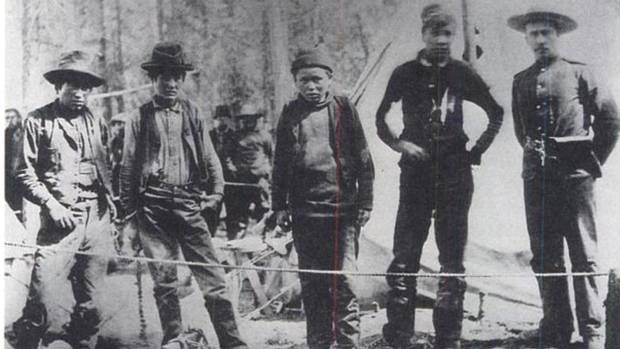
In May 1898, two prospectors, Christian Fox and William Meehan, camped near the mouth of McClintock Creek were only mildly uneasy about the arrival of the Nantucks, Tagish brothers who set up an adjacent camp. Relations were amicable for a while, but when returning one afternoon from the day’s work the prospectors were suddenly fired upon from ambush by their neighbors.

Meehan was slain in the fusillade. The injured Christian Fox managed to float away, get to land, and reach a miners’ settlement. He described the attack thus:

I was lying on the sacks against the side of the boat … and I saw Joe standing with his gun like this … and all the boys went into the brush, and I says to myself “Now they have shot us for our outfit, and are hurrying down to the next bend in the river to catch the boat … My only show is to get to the opposite side of the river and try to make for a white habitation” … I took the paddle in my hand and tried to paddle the boat but I was too weak, so I … used it as a pry … The boat ran up to a nice little level place where it was grassy and as I stepped out I stepped over the leg of my partner as he was stretched out over the boat with his head back and his mouth open and I saw that he was dead, and I said “Good by Billy old boy, I can do nothing for you here.”

By Fox’s report, the four Nantucks were soon taken into custody.


The four Nantuck brothers, shackled after arrest.

The trial unfolded in a court at the territorial capital of Dawson City. A compelling chapter in Strange Things Done: Murder in Yukon History does wonderful work with the cultural disconnections, including a two-page exchange between judge and interpreter (and, off-camera, Frank Nantuck) in which the court struggles to get the accused sworn “so help me God” since Frank’s cosmology has no idea of an afterlife. “He says, when he is dead he is dead — that is all I can get out of him,” the helpless middleman reports.

Q Has he any knowledge of God at all or any idea about a future state of rewards and punishments?

A No sir.

Q Or any clear belief in religion of any kind?

A No sir.

Q Will you say to him that we want him to tell us the truth and not to tell us anything that is not the truth; that he may be punished if he tells us anything that is not the truth; that we are going to ask him some questions and that he must tell us just the truth; ask him if he will agree to do that.

The outcome of the trial will not surprise and there was no question but that the Nantucks had done the shooting. What the Dawson court only barely noted was that brothers had been detailed to avenge two Tagish deaths. An old woman had previously been given or found some “baking powder” and proceeded to make bread with it: in fact, it was arsenic, which was used in mining. Here again is the cultural dislocation; the Nantucks living next to Fox and Meehan were trying to feel out whether those two prospectors were of the tribe that had provided this poison, and of equivalent social rank to the two men who died eating the arsenic-bread. Basically, neither side in this subarctic tragedy had any concept of what the other was on about.

There’s a play about this case, Justice. Peruse the play’s pdf companion study guide on the real historical case here.

In the end, all four Nantucks were condemned to die; Frank was probably still a minor, and he had cooperated with the investigation, so his sentence was commuted to life imprisonment … which did not turn out to be very long at all, since Frank and his condemned brother Joe both died in jail of tuberculosis during the 1898-99 winter.

Dawson Nantuck and Jim Nantuck remained to hang.

Momentarily sensational, the case was long forgotten among whites; it has, however, remained in the oral tradition of Yukon First Peoples. Both communities, however, saw the case brought to the fore when excavations accidentally turned up their remains — along with those of two other hanged men.

One of the other two was the third man to hang this date, a fellow by the name of Ed Henderson. Henderson was an American prospector whose fate might be a bit less instructive for posterity. He suffered from a horrible bladder infection that caused him to pass bloody water every 15 or 20 minutes. “The tortures of the damned,” he described it to court. Wincing yet?

The fact that Henderson suffered from it meant his two prospector-mates suffered from it as well — call it purgatory-level suffering; a member of their party had to relieve himself constantly and thrashed about in his sleeping bag all night for the agony it caused him.

Their empathy for his situation was overturned along with Ed Henderson’s inside-the-tent piss-bowl one night. The drenched and vengeful Tomberg Peterson started an immediate brawl, but Henderson’s leaky plumbing didn’t impair his ability to shoot Peterson dead. Henderson himself reported the incident when the prospectors reached their destination, possibly thinking that no jury would convict him.

The trio comprises the first men hanged by the Yukon Territory, which was only separated from the Northwest Territory in 1898. In fact, there was a bizarre procedural deficiency for the Nantucks (but not for Henderson): they were condemned by the court of the wrong, former territory since word of the territories’ separation had not reached Dawson City at the time of the trial. Nobody saw fit to remedy this blunder, however.

On this day..

1903: Dora Wright, in Indian Territory

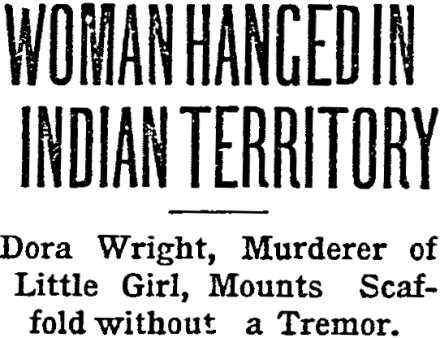
On this date in 1903, Dora Wright was hanged at McAlester in Indian Territory — the present-day U.S. state of Oklahoma.

Wright beat and tortured to death a 7-year-old orphan in her charge named Annie Williams. Wright tormented the little girl over several months until she finally succumbed to a thrashing in February 1903. It was, the local paper said, “the most horrible and outrageous” crime in memory in the area; Wright’s jury only needed 20 minutes’ deliberation to condemn her.

As Oklahoma was yet four years shy of statehood, “Indian Territory” jurisdiction — and with it any decision on executive clemency — fell to U.S. President Theodore Roosevelt. The inclination of the Rough Rider is aptly conveyed by the words of Attorney General Philander Knox‘s brief on the case to the President, which were released for press consumption:

The real facts in this case are that this woman tortured to death a little child seven years old, her niece, whom she was pretending to care for and support. She whipped the child most unmercifully with large switches, struck it about the hand and face so as to cause wounds sufficient to produce death, burned holes in its legs and thighs with a heated poker, and committed other nameless atrocities upon the person of the child. The testimony shows that the woman pursued a course of cruelty which was fiendish and barbarous … The only ground upon which her pardon is sought is that she is a woman, and that the infliction of the death penalty upon a woman would be a shock to the moral sense of the people in the community.

T.R. was incredulous at the feminine special pleading.

“If that woman was mean enough to do a thing like that,” Roosevelt said, “she ought to have the nerve to meet her punishment.”

Wright did have that nerve in the end, and was noted for the calm with which she comported herself on the scaffold. (She was hanged alongside another fellow, Charles Barrett, who shot a man dead in a robbery.)


From the Duluth (Minn.) News-Tribune, July 18, 1903.

On this day..

1917: “John Nelson”, mystery man


(Salt Lake (Utah) Telegram, Dec. 31, 1916)

On this date in 1917, someone was electrocuted in Rockview, Pennsylvania.

“John Nelson”, the cipher alias by which authorities were eventually content to call him, was 5′ 8″ tall and 165 pounds, and looked like an African-American. (“Nelson” himself said that neither white men nor black were of his race.) Papers put this about quizzically because he was also utterly steadfast in refusing to identify himself or his background.

He eventually allowed that he came from Canton, Ohio (but who knows if that’s true). “He reads Shakespeare and seeks high grade newspapers and magazines,” ran news-of-the-weird wire copy all around the country. He boasts “long hair which bears the appearance of having been done up in kids to give a ‘Sis Hopkins’* effect” as well as “long gray whiskers, sideburns and a heavy mustache.” He looked maybe 60 years old.

Anyone?

Aw, heck.


The Scranton Times sent 5,000 of these postcards around the country hoping to scare up information about their mysterious murderer.

Tips poured in from all over — but nothing definitive. An upstate New York sheriff reported discharging a guy named John Nelson from jail a couple of years before. A woman in Butte, Montana recognized the picture and thought it might be her vanished father. The prisoner also resembled a missionary from Ohio and a bank president from Richmond, Va., also both missing; a Scranton woman thought he maybe used to be her gardener. (All but the last of these indefinite tips via Cheryl Kashuba’s two-part series on this case in the March 17 and March 24, 2013, issues of the Scranton Times-Tribune.)

Although nobody could figure out who he was, everyone was pretty sure what he’d done.

On the evening of Oct. 30, 1915, he’d trudged into Mill City, a Wyoming County township outside of Scranton, and made an unexplained sudden attack on three men lolling about a barbershop porch.

According to those three men’s story — and they’re all we have to work with since Nelson kept mum on this, too — a little white boy running down the darkened street bumped into the mystery pedestrian. At that, “Nelson” suddenly produced a knife and charged at the trio of nearby men, bellowing “White people in a tank town like this can’t run over me!”

J.M. Sickler, a prosperous local farmer, bravely intercepted the attacker before he reached Judge Robert Westlake, and suffered mortal stab wounds for his trouble. The attacker fled, but other locals roused by the commotion overpowered him as he escaped; Sickler lived long enough to give a deathbed positive identification.

Of course, it wasn’t really “positive” — that’s the whole point. And “John Nelson”, whoever he might have been, kept his nose in his Shakespeare and his lips enigmatically sealed on the crime and its causes; on his background and biography; on everything whatsoever. “I just wouldn’t care to talk about that,” he would reply when questioned, or similar versions of that polite deflection.

He kept his queer peace all the way to the electric chair.

* Maybe Mr. “Nelson” was just taking Sis Hopkins’ good advice: “There ain’t no sense in doin’ nothin’ for nobody what won’t do nothin’ for you.” As Nelson blithely put it (and who could contradict him?) any name at all would do for his circumstances.

On this day..

1945: Louis Till, father of Emmett

The Aug. 28, 1955 lynching of Emmett Till and the subsequent acquittal of his murderers by an all-white Mississippi jury were among the American civil rights movement’s pivotal events.

For a certain indecent number of people, however, the passion of the 14-year-old youth — alleged to have flirted with a white woman — was to be mourned only insofar as it confirmed the menace that insatiable Negro libidos posed to southern way of life.

Further to that end, the months following Emmett Till’s death brought to the headlines the formerly obscure* July 2, 1945 hanging of an American G.I. in Italy: Emmett’s father, Louis Till.

The violent Louis Till ruined his marriage to Emmett’s mother Mamie shortly after his son’s birth. Repeatedly violating her restraining order eventually landed Till pere before a judge, who gave him a choice between hard time and enlistment. Till joined the U.S. Army.

In 1945, he was court-martialed for murdering an Italian woman and raping two others. His execution near Pisa — he’s buried in Europe in the Oise-Aisne American Cemetery, the same final resting place as Eddie Slovik — was the no-account end of a no-account man for many years thereafter. Mamie Till said that she wasn’t even told what happened to her ex-husband, and was stonewalled when she sought information.

By the end of 1955, everyone knew.

In Jim Crow’s backlash against nationwide condemnation of the Till lynching, Louis Till came back to life in newsprint all that autumn to visit the sins of the father upon his late son: here was the mirror of the young predator all grown up, violating Italian women. Mississippi’s white supremacist senators used their rank to obtain his army file, and leaked it to reporters.

According to Davis Houck and Matthew Grindy’s study of the Mississippi media’s conflicting reactions to the events of 1955, “Louis Till became a most important rhetorical pawn in the high-stakes game of north versus south, black versus white, NAACP versus White Citizens’ Councils.”

The pawn’s sacrifice did not figure in the endgame.

Crude attempts to impose blood guilt for Louis Till’s crimes aside, Clenora Hudson-Weems argues in her Emmett Till: The Sacrificial Lamb of the Civil Rights Movement that it was Emmett Till’s shocking death that catalyzed the civil rights movement — that the horrifyingly mutilated face at his open-casket funeral and the insouciant confession of his killers once they had been acquitted shook southern blacks and northern whites alike so profoundly as to dispel any confidence that legal briefs or political incrementalism could grapple with America’s race problem. Civil rights lion Joyce Ladner was an 11-year-old Mississippi girl when Emmett Till was lynched; she would tell Hudson-Weems of the shock it delivered in her world coming on the heels of the Brown v. Board of Education ruling desegregating schools.

A very important thing is that it followed the Supreme Court decision in 1954. It’s like the Whites said that they don’t care what rights we were given … So when the spark came in Mississippi to sit in the public library, for example, people who participated had been incensed by the Till incident and were just waiting for the spark to come. The Till incident was the catalyst.

On December 1, 1955, Rosa Parks refused to give up her seat to a white man on a Montgomery, Alabama bus, launching the famous bus boycott. “I thought of Emmett Till and I just couldn’t go back,” Parks said later.

Emmett Till’s body was exhumed for autopsy and DNA testing in 2005, in part to dispel the old story first promulgated by the attorneys who defended Till’s murderers — that the body wasn’t Emmett Till’s at all. On the corpse’s finger was a ring inscribed with the initials of his father: L.T.

* Louis Till did have one small claim to fame prior to his son’s murder: the fascist poet Ezra Pound chanced to be imprisoned with Till; he mentions the later-famous execution in his Pisan Cantos:

Till was hung yesterday
for murder and rape with trimmings

On this day..

1890: A quadruple hanging in Jim Crow America

(Thanks to Meaghan Good of the Charley Project for the guest post. -ed.)

Close to midnight on this date in 1890, four convicted murderers — three of them black and one white — were hanged on the gallows inside the Shelby County Jail in Tennessee. They were Edward Carr, 28, Parker Harris, 30, Hardy Ballard, 45, and Frank Brenish, 36.

Carr, who was half-black, had murdered his estranged wife Sallie in broad daylight on the street in Memphis on November 9, 1889. Edward Carr wanted to move to Mississippi and Sallie did not, and she had left him and moved in with a woman friend. When Edward saw his wife and her friend walking down the street, he said, “Sallie, I am going to kill you,” and then shot her.

She ran away, but he chased after her and shot her three more times. Sallie Carr died in her friend’s arms.

Edward surrendered to the police three days later, and his lawyer had to persuade him not to plead guilty to murder.

At his trial he said, “I do not know why I killed her. It was not because she offended me. We had lived happily together … I loved her so well, and she would not go with me.” Offering no defense, he was accordingly convicted on December 17, six weeks after his crime.

Harris had also killed his wife, Letha “Lettie” Harris, on the street in front of witnesses. Lettie was an “octoroon”, a now-outdated term for someone who is of mixed race and one-eighth black, seven-eighths white.

Like the Carrs, the Harrises were estranged and Lettie was living apart from her husband. On August 18, 1889, said husband encountered her riding in a buggy with several women and asked her to come home; Lettie replied that she never wanted to speak to him again.

In response, Parker Harris slashed her throat, then his own. He was able to run from the scene but collapsed several blocks away, weak from blood loss. He recovered sufficiently from his wounds to face trial; he too was easily convicted.

Hardy Ballard had killed a streetcar driver, G. Emmett Pinkston, on Christmas Day 1889 after an argument over the nickel fare. Ballard insisted he had paid; Pinkston said he hadn’t, and kicked him off the car. Both parties were armed in the ensuing fight, Ballard with a knife and Pinkston with an iron hook, and Ballard got the better of the streetcar driver and stabbed him to death.

His plea of self-defense at trial was not believed by the jury.

The sole white man, Frank Brenish, was a wife killer just like two of his co-condemned. Mary, his wife of two years, had left him because of his drinking and his failure to support her and his two stepchildren. Frank threatened to kill his wife if she didn’t come back to him, and Mary took these threats seriously enough to report them to the police. The cops had a talk with Frank and he promised to leave his wife alone.

Mary remained fearful, however, and when she went out she took her fourteen-year-old daughter, her sister and another man to protect her in case she encountered her husband. They were with her the night the murder was committed: they saw the whole thing.

Frank Brenish’s crime was so similar to Parker Harris’s that there was some speculation the two might have a joint trial: on July 5, 1889 he jumped out of a dark alley and slashed Mary’s throat, nearly decapitating her. Then he cut his own throat. Against the odds, a doctor was able to save Frank’s life, but Mary was beyond help: she had died almost instantly.

All four of the condemned were given copious amounts of alcohol while awaiting their execution, and Brenish got morphine as well. The wound on his throat hadn’t healed and it leaked from time to time. The night before his executed, he made a halfhearted attempt at suicide by slashing his wrist with a makeshift knife.

This was the era of racial apartheid in America, however, and even when men died together, they perhaps might not die together.

The gallows in this instance was built for two, so the natural idea was to hang the four men as two pairs.

Brenish, however, refused to suffer the indignity of being hanged alongside a Negro.

His jailers — and one hardly needs to mention their racial identity — honored his request for a segregated execution and modified the gallows so three people could be hanged at once.

The three black prisoners went first. Brenish died alone, fifteen minutes later. Harris, Ballard and Carr had “clean” hangings and died quickly, after making the usual final statements about their sins and their hope for redemption in Heaven.

When the time came for his racially unsullied death, Brenish was either so drunk or so scared he could barely stand, and he took several more swallows of whiskey while standing on the scaffold. He had severed his trachea when he slashed his throat and could only barely speak above a whisper. When he was asked for a final statement, the best he could come up with was, “They oughtn’t to hang a man when he ain’t in his right mind.”

It often happens that, when a person’s throat was previously cut, the wound will re-open during hanging. This didn’t happen to Harris, but it sure did during Brenish’s execution. Lewis Laska in Legal Executions in Tennessee: A Comprehensive Registry, 1782-2009 has a graphic description of what happened:

The officers had difficulty in placing the handcuffs because of his bandaged wrist. Blood trickled down his white gloves. With the noose and cap placed, he swayed to and fro and had to be held. When the lever was pulled and he dropped there was a pop (his neck was broken) and a hissing sound. The drop had opened the hole in his throat from the attempted suicide on the night of the killing. The hole was large enough to hold a cigar. As he hung, his wrist wound bled profusely.

Gruesome as his death may have appeared, though, Brenish didn’t suffer long. His heart stopped in less than a minute.

On this day..

1920: Triple lynching in Duluth, Minnesota

On this date in 1920, a white mob perhaps 10,000 strong swarmed into the Duluth, Minn. jail and extracted three young African-American circus workers accused of gang-raping a white woman. Elias Clayton, Elmer Jackson and Isaac McGhie stood an immediate drumhead trial, then were lynched in the heart of Duluth as they vainly protested their innocence.

The self-congratulatory posed photograph of mob members with the bodies was made into a horrifying postcard, a frequent practice in lynch law America.


“What this looks like is the kind of photo you would see at a hunting lodge, where the guys had been out shooting bear, and they came back and they said, ‘We got three.’ You can see people on tip-toe. They’ve crowded into this shot. These are not people who are ashamed to be seen here. This is, ‘I want to be in this picture.'”

Michael Fedo, author of The Lynchings in Duluth

Nineteen-year-old Irene Tusker and her boyfriend James Sullivan had attended the one-day circus the evening before. What transpired that night remains unknown to this day: Irene eventually took the streetcar home without incident. Hours later, James Sullivan’s father claimed that the couple had been held at gunpoint by black carnies as Irene was gang-raped.

By the evening of the 15th, a vengeful mob had surrounded the police station/local lockup. Officers were ordered not to use deadly force against the townsfolk, so the battle to push into the premises was waged with brickbats against firehoses, and eventually with ineffectual pleas to let the law take its course.*

The incident drew nationwide reaction — usually condemnation (with a couple of exceptions). Occurring as it did in one of the continental states’ northernmost towns, it also underscored lynching as a nationwide problem rather than “merely” a southern one.

“Duluth has disgraced herself and has, by reason of her geographical position, disgraced the north,” the Cleveland Plain Dealer editorialized (June 17, 1920) — just one of innumerable newspaper editorials in the days following the Duluth outrage. “A city that has no more backbone than to submit to the rule of riot cannot be held blameless. But it will be surprising if Duluth and the state of Minnesota do not take steps to punish the murderers. The method of procedure was so deliberate and so brazenly open that identification and conviction of the ringleaders should be an easy matter.”

Brace for a surprise: according to the Minnesota Historical Society’s excellent site on the Duluth lynchings, only three whites served prison time (a shade over one year apiece) for rioting. Nobody was ever convicted for murdering Clayton, Jackson, or McGhie.

One black man, Max Mason, caught a long prison sentence for the supposed rape. He was paroled after five years on condition that he leave Minnesota for good.

“I was just short of nineteen the night that the bodies of McGhie, Jackson, and Clayton swung from a light pole in Duluth. I read the stories in the newspapers and put them down feeling sick, scared, and angry all at the same time. This was Minnesota, not Mississippi, but every Negro in the John Robinson Show had been suspect in the eyes of the police and guilty in the eyes of the mob … I found myself thinking of black people as a very vulnerable us — and white people as an unpredictable, violent them.”

-Minnesota-raised Roy Wilkins, the eventual director of the NAACP, in his autobiography (via)

The great-grandson of one of the lynch mob’s members wrote this book about the hangings’ legacy

The lynching was practically written out of the official state history most white children consumed at school in the middle part of the 20th century,** though the nine-year-old Lithuanian Jewish boy Abram Zimmerman who lived nearby the execution site later told his son all about it. Young Robert Allen Zimmerman tapped his father’s lynching stories under his subsequent nom de troubadour of Bob Dylan, and the Duluth atrocity is alluded to in Dylan’s “Desolation Row”.†

Latter-day Duluth has, to its credit, tried to manage something a little bit more overt.

In 2003, a monument commemorating Duluth’s moment of infamy was dedicated opposite the place where the young men were strung up and photographed. Minnesota Public Radio produced a series on the lynching during the construction of this monument which is still available online.


All images (cc) ArtStuffMatters. The photographer has a thoughtful recent blog post on the [dearth of] public lynch memorials in the United States.

* The law in Minnesota had no death penalty on the books, and still has none today.

** To be fair to the state, its immediate response did include passing anti-lynching legislation in 1921.

† “They’re selling postcards of the hanging/They’re painting the passports brown/The beauty parlor is filled with sailors/The circus is in town.”

On this day..

1721: Joseph Hanno, “miserable African”

(Thanks to Meaghan Good of the Charley Project for the guest post. -ed.)

On this date in 1721, Joseph Hanno was hanged in Boston, Massachusetts for the murder of his wife, Nanny.

He’d killed her “in a very barbarous manner” on November 10 the previous year: while she was getting ready for bed, he struck her twice in the head with the blunt end of an ax and then slit her throat. He made a feeble attempt to pass the murder off as a suicide, but the coroner’s jury was not fooled.

“Could Hanno expect a fair trial in a Massachusetts court?” asks Mark S. Weiner in his book Black Trials: Citizenship from the Beginnings of Slavery to the End of Caste.

Perhaps surprisingly, Weiner believes the answer is yes:

In general, free black men received rather even treatment in the New England judicial system, at least at this period … They were entitled to the full range of legal rights, with the important exception of the ability to serve on juries. There also was no marked inequality between the punishments they received and those of white convicts. And though Hanno, in particular, certainly faced hostility and anger in the courtroom, in [Judge Samuel] Sewall, he was facing no irredeemably biased magistrate; in fact, years earlier, Sewall had written the first antislavery pamphlet published in the American Northeast.

Weiner notes that Hanno “had no defense counsel, for at the time the institution was almost unknown.” He may have hoped to beat the rap because there were no witnesses to the murder. But the jury convicted him and the judge pronounced the sentence of death.

Ultimately, Hanno himself admitted his guilt.

Other than her name, nothing is known about the victim in this case. But we know something about the perpetrator because of a sermon preached at the time of his execution and distributed in pamphlet form under the bombastic title of “TREMENDA: The DREADFUL SOUND with which the WICKED are to be THUNDERSTRUCK, Delivered upon the Execution of a MISERABLE AFRICAN for a most inhumane and uncommon MURDER.”

The sermon was promulgated by none other than Cotton Mather, the Puritan minister noted for his role in the Salem witchcraft trials. (Old Cotton really got around the gallows back in his day.)

Hanno had been brought over from Africa on a slave ship as a child and grew up in slavery. He was freed in 1707, when he was about forty years old, and then settled down in Boston with his wife.

He was literate and his masters brought him up as a Christian, and he enjoyed “vain gloriously Quoting of Sentences” from the Bible. Indeed, when Cotton Mather offered spiritual counsel to the condemned, Hanno boasted, “I have a great deal of knowledge. Nobody of my color, in old England or new, has so much.”

Replied the minister (without apparent irony), “I wish you were less puffed up with it.”

Hanno himself seems to have subscribed to the “slippery slope” theory of criminality. A newspaper account of his execution says he

hoped that all Mankind would take warning by him to keep themselves from committing such Sin & Wickedness as he was guilty of, particularly, Sabbath-breaking and willful Murder, the one being the Ringleader to the other, for which last he was justly Condemned, which had he not been guilty of the first he might probably have never committed the second.

An aside: although he may have been the only person executed that day, Joseph Hanno didn’t stand alone on the gallows.

At the same time a white woman did public penance on the same gallows. Her crime: giving birth to a child of mixed race. This being considered the lowest depth of self-degradation (especially if the father was a Negro), the woman was made to sit on the gallows with a noose around her neck — a sign of extreme disgrace. Then she was whipped through the streets until her back was raw. (Source)

On this day..

1891: Benjamin Harrison spares the Navassa rioters

On this date in 1891, U.S. President Benjamin Harrison settled a death penalty case from the remote Navassa Island by granting a commutation.

Back in the 19th century, islands stacked high with guano were worth their weight in bird crap. The phosphate-rich dung piled meters-deep in some places, and could be mined for agricultural fertilizer and for use in gunpowder and explosives.

In 1856, Congress even passed a Guano Islands Act empowering skippers to plant the stars and stripes on any of these lucrative little turd reefs they happened to run across. That’s how the U.S. came to possess, for instance, Midway Island … and more than 100 other islands as well. For audio product handling the guano binge, try this 99 Percent Invisible podcast.

Most of these claims have long since been ceded, but a few remain today. One of them is (still!) Navassa, a three-square-mile speck off the coast of Haiti, 100 miles south of Guantanamo Bay.

Today, Navassa is uninhabited and administered by the Department of the Interior on somewhat disputable footing. (Haiti, just two miles away, also claims Navassa.)

But in the late 19th century, its sweet, sweet guano was being extracted by a Baltimore-based firm known as the Navassa Phosphate Company. This operation employed 137 African-American laborers, moving groaning shitloads of product by raw muscle power under a blistering tropical sun … and under 11 white overseers.

The nature of the assignment — an island very far from the nearest American settlement, with no other industry, community or outpost to repair to — made taking a job on Navassa almost like hitching on somewhere as a sailor: you were off to a little floating dictatorship, with no way out until the end of the contract.

Navassa’s overseers turned out to have a taste for the cat o’nine tails, and worse.

“The conditions surrounding the prisoners and their fellows were of a most peculiar character,” Harrison noted in his eventual commutation order.

They were American citizens, under contracts to perform labor upon specified terms, within American territory, removed from any opportunity to appeal to any court or public officer for redress of any injury or the enforcement of any civil right. Their employers were, in fact, their masters. The bosses placed over them imposed fines and penalties without any semblance of trial. These penalties extended to imprisonment, and even to the cruel practice of tricing men up for a refusal to work. Escape was impossible, and the state of things generally such as might make men reckless and dangerous.

Or, as a naval inspection judged it, Navassa resembled “a convict establishment without its comforts and cleanliness”: people being worked brutally to the bone during their contract, eating rancid rations and living in filth.

Not surprisingly, Navassa’s “convict” laboring population rebelled in 1889, and in a vicious hour-long riot slew five overseers while maiming several others.

Warships calling on the island shipped 18 back to face murder charges; ultimately, three black guano-miners were sentenced to death for the affair.*

However, a huge clemency push spearheaded by the Baltimore-based black fraternal organization the Grand United Order of Galilean Fishermen raised the cry to spare the condemned men.

Guano harvesting resumed after the riot, but was aborted in 1898 by the Spanish-American War; the Navassa Phosphate Company fell into bankruptcy, and although the U.S. later threw up a lighthouse on Navassa to aid Panama Canal-bound vessels, it’s been effectively uninhabited ever since.

* The appeals arising from the Navassa conviction generated the 1890 Supreme Court case Jones v. United States, affirming Navassa’s American territoriality, and establishing Congressional jurisdiction over violations of U.S. law that didn’t take place in any particular state. This bit of jurisprudence has turned up all over the place in the century-plus since it was issued.

On this day..