Says that the Clootchman Anna and Okh-kho-not are equally guilty — body delivered to the medical college for dissection.
Kat-koo-at, the Chilicat Indian who was tried, convicted and sentenced to death in the United States Circuit Court for the murder of Thomas J. Brown, in Alaska Territory last January, was hanged yesterday afternoon. [This article is not explicitly datelined, but the day referred to is May 5, 1899 -ed.] United States Marshall Waters performed the unwelcome official duty of carrying into execution the sentence imposed by the court, and vindicated the outraged law. The execution took place in the jailyard, the same gallows on which James Johnson and Archie Brown suffered the extreme penalty of the law being used. Notwithstanding the public was well aware that Kat-koo-at was to be hanged there was very little excitement felt over the event and no guards or military companies were ordered out as in the case of Brown and Johnson. The stockade which had been erected to shut out public view from the appalling spectacle, did not prevent many from witnessing it who were not holders of tickets. Spectators were admitted until all the available space inside the enclosure was occupied, and many curiously disposed persons clambered up to the top of the fence and looked over, or peeped through the cracks between the planks and watched with evident interest the preparations which preceded the execution.
Kat-koo-at’s conduct.
Yesterday morning the doomed man ate a hearty breakfast at 6:30. After dispatching his meal Kat-koo-at sat down very composedly and smoked his pipe for some time. About 10 o’clock in the forenoon, Rev. W.C. Chattin called at his cell. Mr. Chattin, who converses quite fluently in the Chinook tongue, asked Kat-koo-at after the usual saluation if he was aware of the fact that he was going to die soon. The Indian replied:
“Yes, I know that; what time is it now?”
Mr. Chattin said “ten o’clock;” to which Kat-koo-at responded:
“Three hours yet before I die.”
He asked Mr. Chattin if he was afraid to die, to which he answered negatively.
This Indian it is said had been a regular attendant of the Mission School of the Greek church at Sitka, and has been taught about as much about God and Christ, and heaven and hell, as his untutored mind can comprehend. During his confinement, he frequently sung Sabbath school songs which he learned at Sitka.
Kat-koo-at was reminded by Mr. Chattin how upon the cross Christ forgave his enemies and asked whether he did likewise. Kat-koo-at answered: “Annie and Och-kho-not helped to kill Brown, and were as guilty as he himself; but I forgive them; I have put away all angry feeling; I feel as though you are the only friend I have, and I want you to be present with me to the last and pray for me.”
In the Prison.
U.S. Marshal Waters had made every preparation for the execution. The rope had been attached to the beam above the scaffold, the fatal drop drawn up to its proper position and all that was needed was the victim. To prevent a crowd, the court house doors were closed at 12 o’clock and about 75 persons who held tickets of admission were allowed to enter. In company with the officers, Rev. Mr. Chattin entered the cell of the doomed Indian at 12:45 and said (speaking the Chinook tongue), “Kat-koo-at, you are near your death.” He answered, “Yes.” Mr. Chattin continued, “You know it is a bad thing to die. Now tell me, were Annie and Och-kho-not equally guilty?” To which he responded “yes.” The question was asked Kat-koo-at whether his people would be angry with the whites for his execution, and whether they would take revenge for it. Kat-koo-at answered “no.”
The Fatal Drop.
Precisely 53 minutes past 12 o’clock Kat-koo-at, followed by U.S. Marshal A.W. Waters, Deputy Marshal W.P. Burns, Sheriff B.L. Norden, Constable M.B. Wallace, and Rev. W.C. Chattin, left the cell, ascended the steps leading to the scaffold, and took places thereon. As Kat-koo-at took his place in the center of the trap he surveyed the bystanders and made a profound bow. Marshal A.W. Waters then read the death sentence in paragraphs, which was interpreted to the Indian by Constable M.B. Wallace. At the conclusion of each paragraph, Kat-koo-at nodded assent. Mr. Wallace asked him whether he had anything to say, which was answered in the negative. Mr. Waters then drew the black cap quickly over the murderer’s face and adjusted the noose, while Mr. Burns placed handcuffs on the wrists and buckled a strap around the ankles. From the time Kat-koo-at came upon the scaffold until the drop fell, he maintained a stolid indifference, and not a quiver of a muscle was visible. However, he was under excitement, as his pulse beat 120 when he left his cell.
At 12:58, after the noose had been adjusted, Mr. Chattin advanced, and offered the following prayer in the Chinook tongue:
Oh, God! Thou art the Father of us all. Look in pity on this poor Indian, who is about to die. Although he has been a wicked man, he has renounced his sins and prays forgiveness.
The “Amen,” the click of the trigger, and a thud were then heard almost simultaneously. Kat-koo-at had stood too close to the edge of the trap, and as he dropped, his body struck the side of the trap-way and bounded to the other side. The breast heaved for two minutes and then the body was still. At 1:02 the shoulders were drawn up. This was the last perceptible movement of the body.
At 1:02½ Dr. Littlefield, the attending physician, felt the pulse and pronounced it very feeble.
At 1:03½ the pulse was barely perceptible.
At 1:04½ the pulse had ceased to beat, but by auscultation the feeble heart beats were counted 80 to the minute.
At 1:06, 58 to the minute.
At 1:09 there was only a slight murmur. At 12 he was pronounced dead, but the body was allowed to hang until 1:18, having hung a little longer than 19 minutes.
The fall was about 5½ feet — quite sufficient to have dislocated the Indian’s neck had he not struck against the edge of the scaffold. An examination was made after Kat-koo-at whas [sic] dead which disclosed the fact that death had been produced by strangulation instead of dislocation. After life was
Pronounced Extinct
The body was cut down and placed in a rude coffin. Subsequently it was conveyed to the medical college in conformity with the order of the court, and delivered to the professors and students of that institution.
On this date in 1986, Vietnam War veteran David Livingston Funchess was electrocuted in Florida for a double stabbing committed in the course of robbing a liquor store.
“But for Vietnam, all indications were that he was well on his way to entering Florida’s middle class,” in the words of the late anti-death penalty attorney Michael Mello.*
In addition to the horrors of jungle combat, Funchess was exposed to the herbicide Agent Orange, which has since been linked to a wide range of serious health problems in Vietnam veterans. Among the common symptoms among many Vietnam veterans has been neuropsychological damage.
After his return from Vietnam, Funchess was a deeply disturbed and confused young man. Compounding these problems, the medication he was receiving for his painful leg wounds eventually led him onto a debilitating heroin habit.
Understanding of PTSD — within the clinical, juridical, and public realms — advanced significantly during the course of 11-plus years from Funchess’s crime in December 1974 until his execution. In one of those perverse technicalities of the U.S. death penalty system, this issue was so little understood that it was not litigated at all at the time of his initial conviction … and by the time his appeals had run his course, it could only be litigated in the court of public opinion because its irrelevance to the 1970s trial court had procedurally disbarred it.
By the end, the toll of PTSD upon Funchess was being taken up by Vietnam veteran advocacy organizations, but it cut no ice with Governor Bob Graham, whose unilateral power of executive clemency was the man’s best hope of avoiding the electric chair.
The influx into Great Britain from the start of the 16th century of itinerant Romani — also known as Romanichal, English Travellers,* or (for their supposed Egyptian ancestry**) Gypsies — began the outbreaks of racism and moral panic that continue to this day.
April 18, 1577 marks the condemnation of six Gypsies: the date that sentence was executed — there’s little reason to suppose it would have been stayed — is not specifically recorded.. They’d forged official documents, which made them liable to a treason charge; but, merely being a Gypsy in England had been criminalized by a 1530 Act and the penalty of this crime upgraded to death in 1554.
“[A]n outlandish people, calling themselves Egyptians, using no craft nor feat of merchandise, who have come into this realm, and gone from shire to shire, and place to place, in great company; and used great subtlety and crafty means to deceive the people — bearing them in hand that they, by palmistry, could tell men’s and women’s fortunes; and so, many times, by craft and subtlety, have deceived the people for their money; and also have committed many heinous felonies and robberies, to the great hurt and deceit of the people that they have come among,” runs the description of the 1530 Act. Similar legislation was being promulgated all around continental Europe in this same period.
In practice neither law triggered wholesale genocide or expulsion, but lurking at the fringes of settled English habitation and bearing the stigma of crime and deviance, Romani stood in perpetual precarity. Little wonder that many became buyers in a black market of forged documents confirming their legitimate occupation. In this case, six Gypsies were apprehended in Berkshires in March 1577 making use of the counterfeit products of a Cheshire schoolmaster named Richard Massey.
Massey was lucky himself not to swing for this offense. The Gypsies, less so; according to David Cressy
Their leaders were tried to Aylesbury for high treason, for falsifying warrants under the Great Seal, though one, Philip Bastien, was set aside ‘because he may give evidence against others’. Roland Gabriel, Thomas Gabriel, William Gabriel, Lawrence Bannister, Christopher Jackson, George Jackson, Richard Jackson, and the widow Katherine Deago were all found guilty of ‘counterfeiting, transferring, and altering themselves in dress, language, and behaviour to such vagabonds called Egyptians, contrary to statute’. All were sentenced to be hanged, though whether all went to the gallows is uncertain. Katherine Deago was most likely reprieved, for a Gypsy with that name appeared in Essex a year later.
* Not to be conflated with Irish Travellers, who are of different heritage. The distinction is fraught political terrain in the U.K.
** Actually, this ethnic group hails from India, migrating thence around the 11th century.
On this date in 1756,* robber John Symmonds (Symonds, Simmons) aka “Spanish Jack” hanged at Maidstone.
One “Gonzalez” by birth in Alicante, Spain, our man obtained his Anglo-Saxon name by dint of service aboard English privateers during the multifaceted 1740s world war.
Maritime service and a piratical nickname might suggest that he earned his hemp as a buccaneer. Not so: Spanish Jack segued into the lucrative and dangerous smuggling trade, and thence to ordinary landlubber thefts in his adoptive realm.
So well had he adapted to this underworld that in 1751 he turned Crown’s evidence and hung three fellow footpads to save his own life, pocketing a £10 reward into the bargain. His Old Bailey evidence in this case gives some idea of his practices:
we consented to stop the first man we met that had any thing about him; there was one Jonathan Stevens with us, he is not apprehended yet. We had been in Stepney-fields; about nine we stopped the prosecutor at the end of Church-lane; I asked him what it was o’clock; he said he could not tell. I stopped him and said, you must give me what you have about you. He made a little sort of a resistance; I took him and shov’d him against a wall; the other four came up. I held him whilst they took what he had about him; I never saw the stock buckle; Holmes said nothing to us of that. Mandeville took from him a guinea and 4 s. 6 d. and some halfpence; we made the best of our way when we had done to the Blue Anchor in the Back lane; there we had some slip and changed a guinea, and divided every man a share.
But sauce for the goose would be sauce for the gander within a very few years, as the Newgate Calendar notes.
The many robberies he had committed in London and its adjacencies having rendered him so notorious that he thought himself in great danger of being apprehended, he determined to go into the country. Having travelled to Rochester, he formed an acquaintance with a fellow named Smith, who was publicly known to live by felonious practices.
Symmonds and Smith went to a public-house in Rochester, and while they were drinking some punch found an opportunity of concealing a silver tankard, which they carried off unperceived. On the following day they were apprehended, and committed to Maidstone Jail — Symmonds to be tried for stealing the tankard, and Smith to appear as evidence for the Crown.
Six Somali migrant workers were publicly beheaded in Jeddah on this date in 2005 for robbing taxi drivers. The muggings, though violent, were not fatal to the drivers, so the punishment was quite harsh even by the harsh standards of KSA.
According to an Amnesty International researcher, the doomed men had not been “informed in advance that their five-year prison sentences, which they had served — and also been lashed — by May 2004, had apparently been changed later to death sentences by a secret procedure.” They were unaware until the morning of their execution that they had even been condemned to death.
Their names were Ali Sheikh Yusuf, Abdel-Fatar Ali Hassan, Abdullah Adam Abdullah, Hussein Haroon Mohamed, Abdul-Nur Mohamed Wali and Abdullah Hassan Abdu.
On this date in 1985, 96 Iraqis were executed for an assassination attempt on Saddam Hussein. Though not the only or the largest atrocity of that dictator, it was the crime that would do to hang him under the U.S. occupation.
Two years deep into the horrific Iran-Iraq War, Hussein paid a ceremonial visit to theShi’ite town of Dujail north of Baghdad and was greeted by an armed ambuscade — up to a dozen gunmen springing from the cover of date palms to fire at the president’s motorcade. They missed.*
The ensuing vengeance was visited so widely as to earn the sobriquet Dujail Massacre: something like 1% of the 75,000-strong town wound up in the hands of the torturers, with 148 death sentences handed down and approved by the president — and they were none too exacting about direct complicity in the assassination, freely sweeping up regime opponents and sympathizers with the outlawed Dawa Party.
A document of March 23, 1985, certifies their mass execution although the Iraqi Special Tribunal‘s investigation found this to be a a bit of an overstatement; some had already been executed previously or died of maltreatment in custody, while a few of those still alive were not present in Abu Ghraib on that day. All told, it appears that 96 of the 148 people condemned to death for the attempt on Saddam Hussein’s life were put to death on March 23, 1985. To multiply the injury, the families of the alleged perpetrators also suffered confiscation of their homes and destruction of their orchards.
(Thanks to the nails-tough journalist Ida Wells for the guest post on the March 9, 1892 triple lynching in Memphis, Tennessee, of African American grocers Thomas Moss, Calvin McDowell and Will Stewart. Born a slave in Mississippi, Wells was in Memphis at this point running the black newspaper Free Press, which figures in the story; the victims, too, were personal friends of hers, particularly Tommie Moss to whose daughter Ida Wells stood godmother. The event is known as the Peoples’s Grocery Lynchings or the Lynchings at the Curve, and as will be seen from Wells’s piece it’s a rich cross-section of American pathologies. It’s also one that reshaped Wells’s entire life: she became the nation’s most ferocious anti-lynching crusader. This text is excerpted from a long address Wells delivered in Boston on February 13, 1893 titled “Lynch Law in All its Phases” — which was also the title of an anti-lynching pamphlet she was circulating. (Find the address and much more in this Ida Wells document archive.) She never returned to Memphis. -ed.)
We had nice homes, representatives in almost every branch of business and profession, and refined society. We had learned that helping each other helped all, and every well-conducted business by Afro-Americans prospered. With all our proscription in theatres, hotels and on railroads, we had never had a lynching* and did not believe we could have one. There had been lynchings and brutal outrages of all sorts in our own state and those adjoining us, but we had confidence and pride in our city and the majesty of its laws. So far in advance of other Southern cities was ours, we were content to endure the evils we had, to labor and wait.
But there was a rude awakening. On the morning of March 9, the bodies of three of our best young men were found in an old field horribly shot to pieces. These young men had owned and operated the People’s Grocery, situated at what was known as the Curve — a suburb made up almost entirely of colored people — about a mile from city limits. Thomas Moss, one of the oldest letter-carriers in the city, was president of the company, Calvin McDowell was manager and Will Stewart was a clerk. There were about ten other stockholders, all colored men. The young men were well known and popular and their business flourished, and that of Barrett, a white grocer who kept store there before the “People’s Grocery” was established, went down. One day an officer came to the “People’s Grocery” and inquired for a colored man who lived in the neighborhood, and for whom the officer had a warrant. Barrett was with him and when McDowell said he knew nothing as to the whereabouts of the man for whom they were searching, Barrett, not the officer, then accused McDowell of harboring the man, and McDowell gave the lie. Barrett drew his pistol and struck McDowell with it; thereupon McDowell, who was a tall, fine-looking six-footer, took Barrett’s pistol from him, knocked him down and gave him a good thrashing, while Will Stewart, the clerk, kept the special officer at bay. Barrett went to town, swore out a warrant for their arrest on a charge of assault and battery. McDowell went before the Criminal Court, immediately gave bond and returned to his store. Barrett then threatened (to use his own words) that he was going to clean out the whole store. Knowing how anxious he was to destroy their business, these young men consulted a lawyer who told them they were justified in defending themselves if attacked, as they were a mile beyond city limits and police protection. They accordingly armed several of their friends — not to assail, but to resist the threatened Saturday night attack.
When they saw Barrett enter the front door and a half dozen men at the rear door at 11 o’clock that night, they supposed the attack was on and immediately fired into the crowd wounding three men. These men, dressed in citizens’ clothes, turned out to be deputies who claimed to be hunting another man for whom they had a warrant, and whom any one of them could have arrested without trouble. When these men found they had fired upon officers of the law, they threw away their firearms and submitted to arrest, confident they should establish their innocence of intent to fire upon officers of the law. The daily papers in flaming headlines roused the evil passions of the whites, denounced these poor boys in unmeasured terms, nor permitted them a word in their own defense.
Headline and excerpt from the Appeal-Avalanche of March 9, 1892.
The neighborhood of the Curve was searched next day, and about thirty persons were thrown into jail, charged with conspiracy. No communication was to be had with friends any of the three days these men were in jail; bail was refused and Thomas Moss was not allowed to eat the food his wife prepared for him. The judge is reported to have said, “Any one can see them after three days.” They were seen after three days, but they were no longer able to respond to the greeting of friends. On Tuesday following the shooting at the grocery, the papers which had made much of the sufferings of the wounded deputies, and promised it would go hard with those who did the shooting, if they died, announced that the officers were all out of danger, and would recover. The friends of the prisoners breathed more easily and relaxed their vigilance. They felt that as the officers would not die, there was no danger that in the heat of passion the prisoners would meet violent death at the hands of the mob. Besides, we had such confidence in the law. But the law did not provide capital punishment for shooting which did not kill. So the mob did what the law could not be made to do, as a lesson to the Afro-American that he must not shoot a white man, — no matter what the provocation. The same night after the announcement was made in the papers that the officers would get well, the mob, in obedience to a plan known to every prominent white man in the city, went to the jail between two and three o’clock in the morning, dragged out these young men, hatless and shoeless, put them on the yard engine of the railroad which was in waiting just behind the jail, carried them a mile north of city limits and horribly shot them to death while the locomotive at a given signal let off steam and blew the whistle to deaden the sound of the firing.
“It was done by unknown men,” said the jury, yet the Appeal-Avalanche, which goes to press at 3 a.m., had a two-column account of the lynching. The papers also told how McDowell got hold of the guns of the mob, and as his grasp could not be loosened, his hand was shattered with a pistol ball and all the lower part of his face was torn away. There were four pools of blood found and only three bodies. It was whispered that he, McDowell, killed one of the lynchers with his gun, and it is well known that a policeman who was seen on the street a few days previous to the lynching, died very suddenly the next day after.
“It was done by unknown parties,” said the jury, yet the papers told how Tom Moss begged for his life, for the sake of his wife, his little daughter and his unborn infant. They also told us that his last words were, “If you will kill us, turn our faces to the West.”
All this we learned too late to save these men, even if the law had not been in the hands of their murderers. When the colored people realized that the flower of our young manhood had been stolen away at night and murdered, there was a rush for firearms to avenge the wrong, but no house would sell a colored man a gun; the armory of the Tennessee Rifles, our only colored military company, and of which McDowell was a member, was broken into by order of the Criminal Court judge, and its guns taken. One hundred men and irresponsible boys from fifteen years and up were armed by order of the authorities and rushed out to the Curve, where it was reported that the colored people were massing, and the point of the bayonet dispersed these men who could do nothing but talk. The cigars, wines, etc., of the grocery stock were freely used by the mob, who possessed the place on pretence of dispersing the conspiracy. The money drawer was broken into and contents taken. The trunk of Calvin McDowell, who had a room in the store, was broken open, and his clothing, which was not good enough to take away, was thrown out and trampled on the floor.
These men were murdered, their stock was attached by creditors and sold for less than one-eighth of its cost to that same man Barrett, who is to-day running his grocery in the same place. He had indeed kept his word, and by aid of the authorities destroyed the People’s Grocery Company root and branch. The relatives of Will Stewart and Calvin McDowell are bereft of their protectors. The baby daughter of Tom Moss, too young to express how she misses her father, toddles to the wardrobe, seizes the legs of the trousers of his letter-carrier uniform, hugs and kisses them with evident delight and stretches up her little hands to be taken up into the arms which will nevermore clasp his daughter’s form. His wife holds Thomas Moss, Jr., in her arms, upon whose unconscious baby face the tears fall thick and fast when she is thinking of the sad fate of the father he will never see, and of the two helpless children who cling to her for the support she cannot give. Although these men were peaceable, law-abiding citizens of this country, we are told there can be no punishment for their murderers nor indemnity for their relatives.
I have no power to describe the feeling of horror that possessed every member of the race in Memphis when the truth dawned upon us that the protection of the law which we had so long enjoyed was no longer ours; all this had been destroyed in a night, and the barriers of the law had been thrown down, and the guardians of the public peace and confidence scoffed away into the shadows, and all authority given into the hands of the mob, and innocent men cut down as if they were brutes — the first feeling was one of utter dismay, then intense indignation. Vengeance was whispered from ear to ear, but sober reflection brought the conviction that it would be extreme folly to seek vengeance when such action meant certain death for the men, and horrible slaughter for the women and children, as one of the evening papers took care to remind us. The power of the State, country and city, the civil authorities and the strong arm of the military power were all on the side of the mob and of lawlessness. Few of our men possessed firearms, our only company’s guns were confiscated, and the only white man who would sell a colored man a gun, was himself jailed, and his store closed. We were helpless in our great strength. It was our first object lesson in the doctrine of white supremacy; an illustration of the South’s cardinal principle that no matter what the attainments, character or standing of an Afro-American, the laws of the South will not protect him against a white man.
There was only one thing we could do, and a great determination seized upon the people to follow the advice of the martyred Moss, and “turn our faces to the West,”** whose laws protect all alike. The Free Speech supported by our ministers and leading business men advised the people to leave a community whose laws did not protect them. Hundreds left on foot to walk four hundred miles between Memphis and Oklahoma. A Baptist minister went to the territory, built a church, and took his entire congregation out in less than a month. Another minister sold his church and took his flock to California, and still another has settled in Kansas. In two months, six thousand persons had left the city and every branch of [white] business began to feel this silent resentment of the outrage, and failure of the authorities to punish the lynchers. There were a number of business failures and blocks of houses were for rent. The superintendent and treasurer of the street railway company called at the office of the Free Speech, to have us urge the colored people to ride again on the street cars. A real estate dealer said to a colored man who returned some property he had been buying on the installment plan: “I don’t see what you ‘niggers’ are cutting up about. You got off light. We first intended to kill every one of those thirty-one ‘niggers’ in jail, but concluded to let all go but the ‘leaders.'” They did let all go to the penitentiary. These so-called rioters have since been tried in the Criminal Court for the conspiracy of defending their property, and are now serving terms of three, eight, and fifteen years each in the Tennessee State prison.
To restore the equilibrium and put a stop to the great financial loss, the next move was to get rid of the Free Speech, — the disturbing element which kept the waters troubled; which would not let the people forget, and in obedience to whose advice nearly six thousand persons had left the city. In casting about for an excuse, the mob found it in the following editorial which appeared in the Memphis Free Speech, — May 21, 1892:
Eight negroes lynched in one week. Since last issue of the Free Speech one was lynched at Little Rock, Ark., where the citizens broke into the penitentiary and got their man; three near Anniston, Ala., and one in New Orleans, all on the same charge, the new alarm of assaulting white women — and three near Clarksville, Ga., for killing a white man. The same program of hanging — then shooting bullets into the lifeless bodies was carried out to the letter. Nobody in this section of the country believes the old threadbare lie that negro men rape white women. If Southern white men are not careful they will overreach themselves, and public sentiment will have a reaction. A conclusion will then be reached which will be very damaging to the moral reputation of their women.
Commenting on this, The Daily Commercial of Wednesday following said:
Those negroes who are attempting to make lynching of individuals of their race a means for arousing the worst passions of their kind, are playing with a dangerous sentiment. The negroes may as well understand that there is no mercy for the negro rapist, and little patience with his defenders. A negro organ printed in this city in a recent issue publishes the following atrocious paragraph: ‘Nobody in this section believes the old threadbare lie that negro men rape white women. If Southern white men are not careful they will overreach themselves and public sentiment will have a reaction. A conclusion will be reached which will be very damaging to the moral reputation of their women.’ The fact that a black scoundrel is allowed to live and utter such loathsome and repulsive calumnies is a volume of evidence as to the wonderful patience of Southern whites. There are some things the Southern white man will not tolerate, and the obscene intimation of the foregoing has brought the writer to the very uttermost limit of public patience. We hope we have said enough.
The Evening Scimitar of the same day copied this leading editorial and added this comment:
Patience under such circumstances is not a virtue. If the negroes themselves do not apply the remedy without delay, it will be the duty of those he has attacked, to tie the wretch who utters these calumnies to a stake at the intersection of Main and Madison streets, brand him in the forehead with a hot iron and —
Such open suggestions by the leading daily papers of the progressive city of Memphis were acted upon by the leading citizens and a meeting was held at the Cotton Exchange that evening. The Commercial two days later had the following account of it:
ATROCIOUS BLACKGUARDISM.
There will be no Lynching and no Repetition of the Offense.
In its issue of Wednesday The Commercial reproduced and commented upon an editorial which appeared a day or two before in a negro organ known as the Free Speech. The article was so insufferable and indecently slanderous that the whole city awoke to a feeling of intense resentment which came within an ace of culminating in one of those occurrences whose details are so eagerly seized and so prominently published by Northern newspapers. Conservative counsels, however, prevailed, and no extreme measures were resorted to. On Wednesday afternoon a meeting of citizens was held. It was not an assemblage of hoodlums or irresponsible fire-eaters, but solid, substantial business men who knew exactly what they were doing and who were far more indignant at the villainous insult to the women of the South than they would have been at any injury done themselves. This meeting appointed a committee to seek the author of the infamous editorial and warn him quietly that upon repetition of the offense he would find some other part of the country a good deal safer and pleasanter place of residence than this. The committee called on a negro preacher named Nightingale, but he disclaimed responsibility and convinced the gentlemen that he had really sold out his paper to a woman named Wells. This woman is not in Memphis at present. It was finally learned that one Fleming, a negro who was driven out of Crittenden Co. [the Arkansas county facing Memphis across the Mississippi River -ed.] during the trouble there a few years ago, wrote the paragraph. He had, however, heard of the meeting, and fled from a fate which he feared was in store for him, and which he knew he deserved. His whereabouts could not be ascertained, and the committee so reported. Later on, a communication from Fleming to a prominent Republican politician, and that politician’s reply were shown to one or two gentlemen. The former was an inquiry as to whether the writer might safely return to Memphis, the latter was an emphatic answer in the negative, and Fleming is still in hiding. Nothing further will be done in the matter. There will be no lynching, and it is very certain there will be no repetition of the outrage. If there should be —
Friday, May 25.
The only reason there was no lynching of Mr. Fleming who was business manager and half owner of the Free Speech, and who did not write the editorial, was because this same white Republican told him the committee was coming, and warned him not to trust them, but get out of the way. The committee scoured the city hunting him, and had to be content with Mr. Nightingale who was dragged to the meeting, shamefully abused (although it was known he had sold out his interest in the paper six months before). He was struck in the face and forced at the pistol’s point to sign a letter which was written by them, in which he denied all knowledge of the editorial, denounced and condemned it as slander on white women. I do not censure Mr. Nightingale for his action because, having never been at the pistol’s point myself, I do not feel that I am competent to sit in judgment on him, or say what I would do under such circumstances.
I had written that editorial with other matter for the week’s paper before leaving home the Friday previous for the General Conference of the A.M.E. Church in Philadelphia. Conference adjourned Tuesday, and Thursday, May 25, at 3 p.m., I landed in New York City for a few days’ stay before returning home, and there learned from the papers that my business manager had been driven away and the paper suspended. Telegraphing for news, I received telegrams and letters in return informing me that the trains were being watched, that I was to be dumped into the river and beaten, if not killed; it had been learned that I wrote the editorial and I was to be hanged in front of the court-house and my face bled if I returned, and I was implored by my friends to remain away. The creditors attacked the office in the meantime and the outfit was sold without more ado, thus destroying effectually that which it had taken years to build. One prominent insurance agent publicly declares he will make it his business to shoot me down on sight if I return to Memphis in twenty years, while a leading white lady had remarked she was opposed to the lynching of those three men in March, but she wished there was some way by which I could be gotten back and lynched. I have been censured for writing that editorial, but when I think of five men who were lynched that week for assault on white women and that not a week passes but some poor soul is violently ushered into eternity on this trumped up charge, knowing the many things I do, and part of which tried to tell in the New York Age of June 25, (and in the pamphlets I have with me) seeing that the whole race in the South was injured in the estimation of the world because of these false reports, I could no longer hold my peace, and I feel, yes, I am sure, that if it had to be done over again (provided no one else was the loser save myself) I would do and say the very same again. The lawlessness here described is not confined to one locality. In the past ten years over a thousand colored men, women and children have been butchered, murdered and burnt in all parts of the South. The details of these terrible outrages seldom reach beyond the narrow world where they occur. Those who commit the murders write the reports, and hence these blots upon the honor of a nation cause but a faint ripple on the outside world. They arouse no great indignation and call forth no adequate demand for justice. The victims were black, and the reports are so written as to make it appear that the helpless creatures deserved the fate which overtook them.
A few books about and by Ida Wells
* Just six months prior to the events described in this post, a labor conflict in Lee County, Arkansas — just down the Mississippi and involving some Memphis workers — had been, in the words of an Arkansas Gazette headline, “Settled with Rope”.
** Many migrated to Oklahoma, which opened formerly reservation land to non-Indian settlement on April 19, 1892.
Nathaniel Woods was controversially executed by lethal injection at William C. Holman Correctional Facility in Atmore, Alabama, tonight at 9:01 p.m. U.S. Central Time.
Woods and Kerry Spencer — a co-defendant who is awaits execution for the same affair — were in a Birmingham trap house when officers Charles Bennett, Harley Chisholm III, Carlos Owen and Michael Collins arrived to serve a warrant. Of the four, only Collins would outlive the deadliest day in Birmingham police history.
While the facts of the case are contested, one that is universally agreed is that Kerry Spencer, not Nathaniel Woods, killed all three officers. Woods met them but as the police were in the process of taking him into custody, Spencer — just waking up from the commotion, he claimed — burst onto the scene firing an SKS.
“When I looked to the side, there was two police officers trying to train their guns on me so I opened fire with the fucking rifle. I wasn’t trying to get shot, period. I got a rifle in my hand. They’re going to shoot me,” Spencer told CNN. “You point a gun at me, bitch, I’m fixing to shoot.”
Woods said he simply fled from an unexpected crossfire, and Spencer agrees. “Nate is absolutely innocent,” he said. “That man didn’t know I was going to shoot anybody just like I didn’t know I was going to shoot anybody that day, period.” Alabama prosecutors characterized Woods as conspiring with Spencer to lure the cops into an ambush.
Woods and Spencer not only deny this, but developed an explosive appellate argument — never probed by any court — that the slain policemen were hassling the place as part of a routine police shakedown racket, to which the apartment’s owner had fallen behind on payments, and intimidated that owner out of providing exculpatory evidence.
But at a minimum, Woods’s execution presented the disturbing spectacle of a non-triggerman being punished for actions to which he might have been little other than a bystander. The #SaveNate campaign garnered a wide and fruitless call for clemency compassing civil rights leaders …
Governor Ivey cannot allow the execution of Nate Woods. Please call 334-242-7100 and ask to grant him a reprieve, and tag @GovernorKayIvey. We must stop this injustice before it is too late. Please Retweet. #SaveNatehttps://t.co/pyCTYyhEhr
— Martin Luther King III (@OfficialMLK3) March 3, 2020
… celebrities …
#NathanielWoods is scheduled to be executed in Alabama TONIGHT for murders he did NOT commit. Join the broad coalition- including members of the jury and relatives of the victims – in urging @GovernorKayIvey and @AGSteveMarshall to stay Nate’s execution.
— Kim Kardashian West (@KimKardashian) March 5, 2020
… and at least one relative of a victim.
Just got off phone with Kimberly Chisholm Simmons, sister of Harley Chisholm III, one of 3 Birmingham police officers killed in 2004. She does not support the execution of #NateWoods. "He did not kill my brother. This is so unjust. I don't understand," she told me in tears. 1/5 pic.twitter.com/bwt7jKRLPp
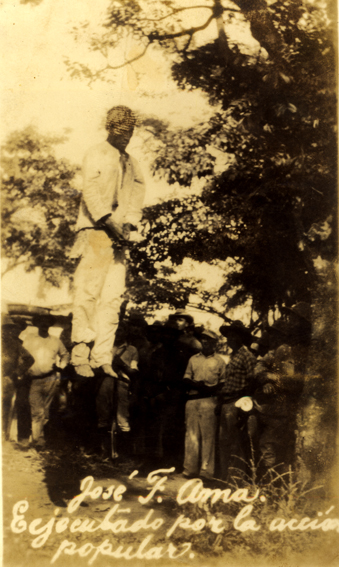
El Salvador campesino Jose Feliciano Ama was hanged in the town square of Izalco on this date in 1932 during a ferocious repression of the peasantry.
In an environment of desperate economic immiseration for nearly all Salvadorans below the landed oligarchy, the heavily indigenous western peasantry rebelled on January 22, 1932 — aided or led by the Communist Party.*
This fate of this rebellion might be inferred by its historiographical sobriquet, the Salvadoran peasant massacre — or simply la Matanza, the slaughter.
In numerical terms, it ran to well into the tens of thousands, maybe up to 40,000 — indiscriminately visited on peasants of originario complexion in the zone of rebellion, batches of them summarily shot into mass graves they’d been forced to dig for themselves.
In the Pipil town of Izalco, where coffee latifundias dominated the best agricultural land,* up to a quarter of the population was butchered. None of those put to la Matanza were more recognizable nor more vividly recalled than the local rebel leader Feliciano Ama English Wikipedia entry | Spanish), extrajudicially noosed in front of the Izalco church. Today a small plaque in this square honors him as a popular martyr.
Treasure-hunters mark this date in 1891, the hanging of an elderly Katzie indigenous man named* Slumach. Did he take with him to the gallows the secret of a lost gold hoard?
The previous September, Slumach shot dead a man named Louis Bee at a fishing spot along Lillooet Slough near the Pitt River in Canada’s western province of British Columbia. Evidently, Mr. Bee was the slough’s resident asshole, “in the habit of blustering at, and threatening almost everyone with whom he came in contact,” and had a running grudge with Slumach that the old man decided to resolve.
Although there were several bystander who witnessed the murder, none could — or dared try — apprehend the gunman, who escaped into the rugged wilderness and evaded pursuers for a number of weeks, until winter deprived him of his forage and forced his surrender.
Legendary for his ferocity in a scrap, this Slumach was much reduced, having scarcely eaten for days and showing every bit of his 60 years. “There was much sympathy for Slumach among those who witnessed his execution,” one news report ran — for, “[i]t was thought that the Government might, with just clemency, have extended a reprieve to him, for he certainly would not have lived very long in confinement, and the fact that he never ran across law and order in any shape until the latter years of his long life made many hope that he would be allowed to finish his career in the confinement of the penitentiary.”
This is an interesting enough incident on its own but what’s not in any of the original reporting is talk about gold. Many years later, however, newspapers began to speculate on his possible associations with Pitt Lake’s lost gold mine, a mythical(?) B.C. El Dorado that has been a desideratum of prospectors since the mid-19th century.
Both the existence of this mine and its relationship to Slumach are highly dubious propositions — greatly embroidered from the 1920s onward in wistful romances of the vanished frontier. (For example, Slumach is supposed to have cursed the stash, dooming a number of explorers and treasure-hunters lost in the vicinity.) Nevertheless, the link is so tightly held at this point that the mine is also sometimes known simply as “Slumach’s Mine” and latter-day adventurers have still been known to take up the trail in the hopes of conquering a lucrative historical mystery.
There’s a fun audio summary of this continuing enigma from the Dark Poutine Podcast — a Canadian true crime/dark history jam, as one might guess — here. And if you’re ready to break out the pick and shovel, the site slumach.ca has you covered for deep background reading.
* He was baptized under the scaffold and given the Christian name Peter. Fortunately for his searchability, nobody refers to him that way.


 A late casualty, with his victims, of America’s imperial exertions in Indochina,

 Woods and Kerry Spencer — a co-defendant who is awaits execution for the same affair — were in a Birmingham trap house when officers Charles Bennett, Harley Chisholm III, Carlos Owen and Michael Collins arrived to serve a warrant. Of the four, only Collins would outlive the
  In an environment of desperate economic immiseration for nearly all Salvadorans below the landed oligarchy, the heavily indigenous western peasantry rebelled on January 22, 1932 —