1726: The Gypsy outlaws of Hesse-Darmstadt

On November 14 and 15, 1726, more than 20 Gypsy outlaws of Hesse-Darmstadt were executed en masse.

Detail view (click for full image) of the execution of the Gypsies at Giessen.

Gypsies in Europe still suffer ample discrimination today, so it’s little surprise to find early modern Europe thick with anti-Gypsy legislation.

No surprise, Angus Fraser writes in The Gypsies, this sort of thing

did in the end produce enormous changes in the life of the Gypsies in Europe. To survive, they had to adapt; they also had to make the most of the loopholes in a system which expressly sought, by denying them food and shelter, to make honest living impossible. Some found a degree of security in inaccessible waste-lands and forests. Some exploited differences in jurisdiction and the spasmodic nature of the authorities’ activity, by making a home in frontier regions … Many broke up into small groups when it was necessary to avoid attention; conversely, others gathered into larger bands to facilitate self-protection … sometimes resorting to violence. Certain Gypsy brigands gained notoriety in eighteenth-century Germany, large tracts of which were overrun with robber companies of mixed and varying origins. Some of these had a strong Gypsy element: numbering perhaps 50 or 100, armed and defiant, they stole for their sustenance and skirmished with the soldier-police sent to confine them.

“The poor Gypsies,” one poor Gypsy lamented to a contemporary German author,* “also want to have the right to live.”

Like the Gypsies’ other necessities, that right went as far as they themselves could secure it … and when secured by brigandage, it eventually brought down an overwhelming response.

The German author in question, J.B. Weissenbruch, relates the tale of a particularly notorious pack of Gypsy outlaws under the leadership of rough characters names of Antoine la Grave, aka “der Grosse Galantho” or “the Great Gallant”, and Johannes la Fortun, aka “Hemperla”.

These were no romantic Johnny Depp-esque Gypsies, at least according to Weissenbruch. Besides “their disposition to wandering, to idleness, to theft, to polygamy, or rather promiscuous license” — well, okay, sort of romantic — these went toe to toe with soldiery dispatched to corral them and had the chops to “take military possession” of a village for the purpose of exacting some corporal revenge.

We know where this ends up.

Though the Great Gallant escaped punishment,† Hemperla and 20-plus of his band (different sources quote slightly different figures) enjoyed the pleasures of the thumbscrew and the Spanish boot to secure confessions necessary to license their sentences. Some were hanged, others (including women) beheaded, and Hemperla and a few comrades were broken on the wheel.

* Cited here; regrettably, I have not been able to locate a browsable original of the Weissenbruch text.

** Same story in yet another Google books freebie.

This German book says his rank got him off the hook, but he lost his head just the same in 1733.

On this day..

1909: Will James, “the Froggie”, lynched in Cairo

One hundred years ago today, Will James was lynched as a murderer in Cairo, Illinois.

“The Frog” or “The Froggie” was a black man implicated in the murder of a white girl, captured in nearby Belknap and

taken to the most prominent square in the city and strung up. The rope broke and the man was riddled with bullets. The body was then dragged by the rope for a mile to the scene of the crime and burned in the presence of at least 10,000 rejoicing persons. Many women were in the crowd, and some helped to hang the negro and to drag the body.

Part of the mob then sought other negroes. Another part, at 11:15 o’clock, after battering down a steel cell in the county jail, took out Henry Salzner, a white man charged with the murder of his wife last August, and lynched him.* (New York Times, Nov. 12, 1912)


Other pictures related to the Will James lynching are at the Without Sanctuary site here (images 41 through 47).

The grey lady’s dim view of this jubilant scene prompted a letter to the editor in defense — the author’s disclaimer notwithstanding — of the lynching, which paints a grim and striking portrait of the town where it occurred.

CAIRO’S NEGROES.

Former Resident Says They Are Spoiled by Coddling and Are a Menace.

As a former resident of Cairo, Ill., where I was the editor of a daily newspaper for three years, I crave a word, not in defense of the double lynching which occurred there a few days ago, but in explanation of it. Cairo, at the extreme southern point of Illinois, at the junction of the Ohio and Mississippi Rivers, is peculiarly located. Across one river is Missouri; across the other is Kentucky, and Tennessee is only fifty miles away. Cairo thus becomes a buffer between the North and the South. It is probably the only town in the North which has a true race problem to deal with. … Out of a population of 13,000 in 1900, 5,000 of the inhabitants of Cairo were negroes. Of the 100,000 negroes in the State of Illinois 5 per cent are massed in this one little town. Aside from this, the floating colored population is unusually large, and Cairo, at some time or other, harbors most of the “bad niggers” from St. Louis, Cincinnati, Louisville, Memphis, Vicksburg, and New Orleans. It is these whom citizens fear the most, and for whom the police are constantly alert. Murders by negroes either of white men or negroes are alarmingly frequent, but the murderer usually escapes either to Kentucky or Missouri, and is never heard of again. Thus crime after crime is recorded against the name of Cairo, with no recompense in the name of the law. On the other hand, there is hardly a time when there are not forty or fifty Cairo negroes in the Southern Illinois Penitentiary, all convicted of theft or burglary.

The white people of Cairo have always dealt indulgently with the negro. For years it has been the policy to keep two negroes on the small police force, and there have been negro Justices of the Peace. A negro physician once came near being elected a member of the Board of Education. While they pay but little taxes, the negroes are provided with three public schools. The Sumner was the first colored High School ever established in the United States. Yet this negro population, coddled as it is, is a constant menace to the town. No white woman dare venture outside of the house at night alone for fear of assault. Many outrages of which the world has never heard have been attempted. This is why, as Mayor Parsons says, the effect of the recent lynching will be “salutary.”

Altogether it is not surprising that a lynching took place in Cairo. The only wonder is that one did not take place long ago.

W.L. CLANAHAN
New York, Nov. 14, 1909

That electric arch and celebratory mob are now long gone from Cairo: in the century since Will James was butchered, Cairo, Ill., has withered — striken in part by its own poisonous legacy of racism. (Also by flooding from the adjacent rivers, the routing of transportation corridors elsewhere, and the general deindustrialization of the heartland.)

During the civil rights struggle as played out in Cairo in the 1960’s and 1970’s (more in this pdf), the town’s white business owners made a name for themselves by refusing to integrate their workforces in response to black boycotts … preferring to go out of business and/or leave town.

Cairo today is a near ghost town at one-quarter of its previous population, and generally appalling quality-of-life indicators.

* Salzner’s lynching occurred after midnight, according to the same article; hence, his absence from this article’s marquee.

On this day..

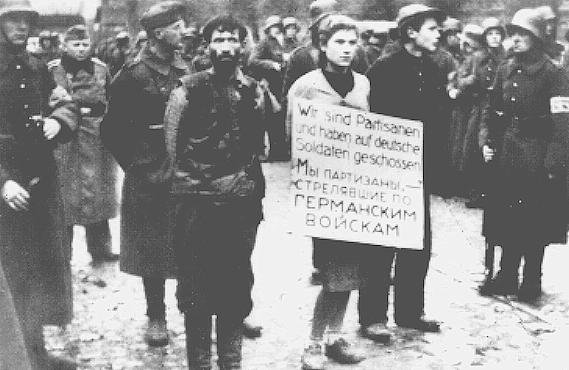
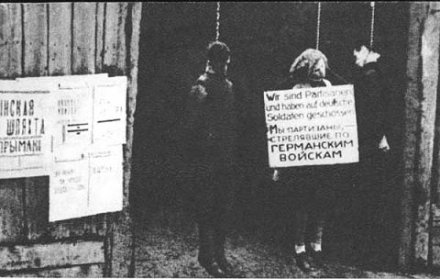
1941: Masha Bruskina, Kiril Trus, and Volodia Shcherbatsevich, partisans

On this date in 1941, the German occupiers of Minsk conducted an infamous public hanging of partisans — perhaps the first such salutary public execution of resistance members of the war.

Jewish* 17-year-old Maria (Masha) Bruskina was the central figure of the grim tableau, and wore the placard announcing “We are partisans and have shot at German soldiers.” Evidently, she also attracted the most attention** from the onlookers to whom the scene was addressed.

Before noon, I saw the armed German and Lithuanian soldiers appear on the street. From over the bridge they escorted three people with their arms tied behind their backs. In the middle there was a girl with a sign-board on her chest. They were led up to the yeast factory gate. I noticed how calmly these people walked. The girl did not look around … The first one led to the gallows was the girl.

She was hanged with bewhiskered World War I vet Kiril Trus and the 16-year-old Volodia Shcherbatsevich. The men were members of a partisan cell organizing anti-fascist resistance; Masha Bruskina was a nurse who had been caught aiding the partisans by providing civilian clothes and papers for wounded Red Army soldiers under her care to smuggle them back to the resistance.

The scene of their deaths was captured in a series of powerful photographs taken by one of the Lithuanian Wehrmacht collaborators.

(More images here and here.)

* Phototextualities: Intersections of Photography and Narrative claims that Bruskina lightened her hair and changed her name to prevent her Jewishness affecting her resistance work; even though she was a Minsk native, her initial identification didn’t happen until 1968. The men who suffered with her were named almost immediately after the war.

** Despite the eye-catching place of the girl, she was officially unidentified for decades even after the name Masha Bruskina surfaced. In “A Historical Injustice: The Case of Masha Bruskina,” (Holocaust Genocide Studies 1997, 11:3) Nechama Tec and Daniel Weiss argued that Soviet authorities, and later Belarusian ones, found her Jewishness problematic and resisted identifying her because of it — while an ethnically Russian female partisan like Zoya Kosmodemyanskaya could be more conveniently accepted as a heroine. Maybe, but bureaucratic inertia and simple precedence (since Zoya Kosmodemyanskaya was known immediately while Masha Bruskina was not) are also plausible contributing factors.

A plaque unveiled at the Minsk yeast factory in 2009 finally called her Maria Bruskina.

On this day..

1503: Anacaona and the caciques of Xaragua

Sometime around this date in 1503, the Spanish destroyed the independent territory of Xaragua on Hispaniola in a bloodbath of native caciques — capped with the ignominious public hanging of the Taino queen Anacaona.

The widow of the chief Caonabo (Spanish link), who had been captured and shipped to Spain by Christopher Columbus himself, Anacaona inherited leadership of one of the principle Taino realms of Hispaniola, present-day Haiti and Dominican Republic.

Spain had the werewithal to be extremely crappy to the Hispaniola “Indians”, but it would take a few years to have sufficient presence to conquer them all.

By 1503, after a decade’s slaughter and disease had decimated the native populace, villainous Spanish Governor Nicolas de Ovando was ready to dominate the whole island.

Calling a meeting with the Xaragua caciques, Ovando’s troops enjoyed the Taino hospitality. Bartolome de las Casas describes the festivities:

Xaraqua is the Fourth Kingdom, and as it were the Centre and Middle of the whole Island, and is not to be equalled for fluency of Speech and politeness of Idiom or Dialect by any Inhabitants of the other Kingdoms, and in Policy and Morality transcends them all. Herein the Lords and Peers abounded, and the very Populace excelled in in stature and habit of Body: Their King was Behechio by name and who had a Sister called Anacaona, and both the Brother as well as Sister had loaded the Spaniards with Benefits (pdf) and singular acts of Civility, and by delivering them from the evident and apparent danger of Death, did signal services to the Castilian Kings. Behechio dying the supreme power of the Kingdom fell to Anacaona: But it happened one day, that the Governour of an Island, attended by 60 Horse, and 30 Foot (now the Cavalry was sufficiently able to unpeople not only the Isle, but also the whole Continent) he summoned about 300 … noblemen to appear before him, and commanded the most powerful of them, being first crouded into a Thatcht Barn or Hovel, to be exposed to the fury of the merciless Fire, and the rest to be pierced with Lances, and run through with the point of the Sword, by a multitude of Men: And Anacaona herself who (as we said before) sway’d the Imperial Scepter, to her greater honor was hanged on a Gibbet. And if it fell out that any person instigated by Compassion or Covetousness, did entertain any Indian Boys and mount them on Horses, to prevent their Murder, another was appointed to follow them, who ran them through the back or in the hinder parts, and if they chanced to escape Death, and fall to the ground, they immediately cut off his Legs; and when any of those Indians, that survived these Barbarous Massacres, betook themselves to an Isle eight miles distant, to escape their Butcheries, they were then committed to servitude during Life.

Horror followed horror. Washington Irving‘s History of the Life and Voyages of Christopher Columbus:

Contemporary writers … have concurred in representing Anacaona, as remarkable for her native propriety and dignity. She was adored by her subjects, so as to hold a kind of dominion over them, even during the lifetime of her brother; she is said to have been skilled in composing the areytos or legendary ballads of her nation, and may have conduced much towards producing that superior degree or refinement remarked among her people … After the massacre ot Xaragua, the destruction of its inhabitants still continued. The favourite nephew of Anacaona, the cacique Guaora who had fled to the mountains, was hunted like a wild beast, until he was taken, and likewise hanged. For six months the Spaniards continued ravaging the country with horse and foot, under the pretext of quelling insurrections; for, wherever the affrighted natives took refuge in their despair, herding in dismal caverns and the fastnesses of the mountains, they were represented as assembling in arms to make a head of rebellion. Having at length hunted them out of their retreats, destroyed many, and reduced the survivors to the most deplorable misery and abject submission, the whole of that part of the island was considered as restored to good order; and in commemoration of this great triumph, Ovando founded a town near to the lake, which he called Santa Maria de la verdadera Paz. (St. Mary of the true Peace.)

Such is the tragical story of the delightful region of Xaragua, and of its amiable and hospitable people. A place which the Europeans, by their own account, found a perfect paradise, but which, by their vile passions, they filled with horror and desolation.

The martyred artist-queen continues to inspire art of her own.

(More — in Spanish — about this Cheo Feliciano song.)

On this day..

2007: Michael Richard, whose time ran out

Two years ago today, the U.S. Supreme Court unexpectedly accepted a case, Baze v. Rees, challenging the constitutionality of lethal injection — the supposedly humane execution method that seemed less and less so.

Texas inmate Michael Richard, condemned for raping and murdering Marguerite Dixon in 1986, was slated to die that very evening, also by lethal injection.

As Richard’s Texas Defender Service lawyers scrambled to prepare a last-minute legal challenge based on the pending Supreme Court case — for how could Texas carry out a procedure whose constitutionality was in question? — they tripped over an unexpected stretch of red tape that ultimately claimed their client’s life:

The Texas Court of Criminal Appeals closed at 5 p.m. on the day of the scheduled 6 p.m. execution, and refused to accept an appeal filed a few minutes after 5.

Or more specifically, Judge Sharon Keller refused to accept the appeal, for which she came under immediate fire — and launched campaigns like the website SharonKiller.com.

This bizarre situation, complicated by the fact that the Lone Star State did not have written rules for handling last-minute appeals (it does now), has a thicket of procedural detail best appreciated by lawyers.

But it caught worldwide attention as an illustration of Texas’s cavalier approach to its numerous death penalty cases.

Keller, who has what you might say is an inordinate regard for “finality” (and for prosecutors), has herself been forced to defend her conduct in hearings of the State Commission on Judicial Conduct. Those hearings could result in her removal from the bench over this incident; a decision is expected soon. (Update: She skated.)

Though it was not completely clear for a few more weeks, it was in fact true that the pending Baze decision suspended the death penalty in the United States. As a result, Michael Richard — whose execution would have been stayed had the appeal entered the judicial system — was the last American put to death until May of 2008.

On this day..

1847: The San Patricios

At 9:30 a.m. this day, as the American army raised the Stars & Stripes over Chapultepec Castle during the Mexican-American War, it simultaneously carried out a mass hanging of 30 Irish deserters who had gone over to Santa Anna — the Saint Patrick’s Battalion, or the San Patricios.

Irish had been migrating to the United States en masse even well before the Great Famine got rolling in 1845.

And for those of that great migration wave who wound up in the service fighting the Mexican-American War, there was a hint of deja vu — an Anglo and Protestant imperial power seizing land from a “black”* and Catholic neighbor?

Some of the Irish decided they were fighting for the bad guys, and switched sides.**

These were the plurality (though not necessarily the majority) of the couple hundred soldiers who comprised the Saint Patrick’s Battalion. German immigrants and other nationalities, along with American-born deserters (desertion during the Mexican-American War seems to have been rife), made up the balance.

Knowing full well the fate that would await them upon capture, the San Patricios were renowned for their ferocity in battle; at the hopeless Battle of Churubusco, they reputedly forced down a white flag that Mexican comrades were trying to hoist on three separate occasions.

Eventually, the ammunition ran out, and with it, the San Patricios’ luck.

Within days, courts-martial began handing out death sentences to almost the whole of the surviving unit. U.S. General Winfield Scott subsequently reduced a number of sentences, and those who had deserted before the war couldn’t legally be executed … but even the “lucky” ones suffered faint-inducing scourgings and branding on the cheeks with the letter “D”.

And 50 men more were still bound for the gallows.

Twenty hung in the days prior to this at two separate sites, but the Yanks’ piece de resistance was an orchestrated scene on the second day of the Battle of Chapultepec.

On September 13, 1847, at dawn, Harney ordered the thirty remaining prisoners to be brought forward. They stood on wagons with nooses placed around their necks. This included one man who had lost both legs and was unable to walk to his own execution. The site of these executions was within viewing distance of the site where the final battle — the outcome of which could not have been in doubt — was to be fought. There the sentenced soldiers watched until finally, at 9:30, the US victors raised the American flag atop Chapultepec Castle.† At that point the order was given, the wagons were pulled away and the men were all hanged.

It must be remembered that the San Patricios had been standing, bound hand and foot, each with his head in a noose, for nearly four hours in the burning Mexican sun. When Harney finally gave the order for the hangings to proceed, such was the relief that their sufferings were finally at an end that “some of the men actually cheered as the nooses tightened and the wagons pulled away.”

The cruelty of the punishments led a Mexican paper to spit,

these are the men that call us barbarians and tell us that they have come to civilize us … May they be damned by all Christians, as they are by God.

The San Patricios are still honored as heroes in Mexico.

They brand with hot irons the faces of the Irish deserters and then hang them from the gallows. The Saint Patrick Irish Battalion arrived with the invaders, but fought alongside the invaded.

From the north to Molino del Rey, the Irish made theirs the fate, ill fate, of the Mexicans. Many died defending the Churubusco monastery without ammunition. The prisoners, their faces burned, rock to and fro on the gallows. -Eduardo Galeano, Masks and Faces

* The “blackness” of the Irish and the process of their “becoming white” later in the 19th and 20th centuries is one of the more illustrative and well-documented case studies of race and racism as social rather than biological constructs.

** They weren’t alone in this opinion. Many hundreds of miles from the fighting, Henry David Thoreau famously landed in jail for tax resistance in 1846 largely because of his disgust with the war. From Civil Disobedience:

The government itself, which is only the mode which the people have chosen to execute their will, is equally liable to be abused and perverted before the people can act through it. Witness the present Mexican war, the work of comparatively a few individuals using the standing government as their tool; for in the outset, the people would not have consented to this measure.

Abraham Lincoln, then a young Whig delegate to the U.S. House of Representatives, excoriated President James K. Polk for lying the nation into war.

† The capture of Chapultepec Castle, forgotten north of the Rio Grande, is still commemorated in Mexico for the heroism of six teenage cadets who died in its defense. The last of their number, Juan Escutia, leapt from the castle walls wrapped in the Mexican standard to prevent its capture.

On this day..

1852: John and Jane Williams, slaves

On this date in 1852, John and Jane Williams hung in Richmond for the hatchet-murder of the wife and infant child of their master.

This one was a sensation for the antebellum crime beat, the “deep brain-cuts” to the heads of Joseph Winston (who survived) and Virginia Winston and nine-month-old child (who, obviously, did not) administered in the small hours July 19th was just the sort of thing to tap white slaveholders’ fears. (Reportedly, they were cruel masters and had recently threatened to sell Jane without also selling her child.)

That the crime was authored by urban slaves assimilated to the money economy connected it directly with broader anxieties about social transformations, as explored by Midori Takagi in Rearing Wolves to Our Own Destruction:

[U]rban slaves who enjoyed a variety of privileges including hiring out, living apart, socializing without supervision, and cash bonuses. White Richmonders believed these privileges encouraged the slaves to be rebellious …

Although John belonged to the Winston household, he worked at the docks for John Enders during the day. Like most hired slave workers, John could move about the city before and after working hours with no supervision. He also probably received cash from his earnings and could earn extra by performing overtime work. John was not required to live in the Winstons’ house but chose to in order to be with his wife. Janes, on the other hand, was directly owned by the Winstons and most likely did not enjoy the same privileges as her husband. But she was able to move about in the city making trips to the market, did socialize with other slaves and possibly free blacks, and was well aware of the privileges and expectations of hired slaves including her husband.

White residents came to believe that these factors encouraged slaves to act violently by planting within them “the germ of rebellion.” One influential Richmonder, Joseph Mayo (who later became mayor), attributed the “glaring evils” of the slave population to “the system of board money … [and] the assumptions of equality exhibited by the blacks in riding in carriages contrary to law, and in dress and deportment.” Increasingly, white city dwellers began to wonder if they had been — in the words of one resident — “rearing wolves to our own destruction.”

These anxieties, piqued by crimes such as the Williamses’, would lead to a welter of new restrictions on the movement, behavior, and even attire of urban slaves in Richmond in the ensuing years.

But that was for the future. While Richmond had real-life master-murdering miscreants in its clutches, it gave vent to all its opprobrium.

Papers described the crimes as “hardly paralleled in history,” anticipated for Jane (who eventually copped to the crime and unsuccessfully tried to exculpate John) “the fires of her eternal doom,” and her execution “without the smallest particle of sympathy from any human being possessed of the ordinary feelings of justice.” The exhortations of her pastor, the Richmond Daily Dispatch opined, fell upon “unwilling ears. The thick-crowding thoughts of the diabolical murder of two innocent, guileless beings, committed by Janes with the coolness and deliberation of a fiend, rendered unimpressive, cold, and tedious, those ceremonies.”

It is to be hoped [the Dispatch concluded] that her merited and summary execution will operate as a warning to the fractious portion of our negro population.*

In a show of scrupulous regard for the inalienable rights endowed by the Creator, the state of Virginia compensated the convalescing Joseph Winston to the tune of $500 for expropriating and executing his property.

* (Second-hand) sources for the newspaper excerpts: The Penalty is Death: U.S. Newspaper Coverage of Women’s Executions by Marlin Shipman; and, “Black Female Executions in Historical Context” by David V. Baker, Criminal Justice Review, vol. 33, no. 1 (March 2008).

On this day..

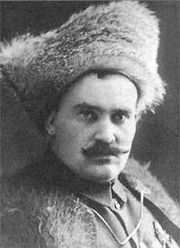
1946: Grigory Semenov, anti-Bolshevik

At 11 p.m. this date in 1946, White general turned Japanese collaborator Grigory Semenov (or Semyonov) was hanged for a generation’s worth of anti-Soviet depredations in the Far East.

The tsarist officer Semenov joined the Russian Civil War as a notoriously vicious White commander with the grandiosely retro title of Ataman of the Baikal Cossacks.

According to G. Patrick March, Semenov’s “penchant for killing, torturing, and looting” extended to executing a captured socialist by tossing the man into his locomotive’s fuel chamber.

Although also a rival in the suicidally fractious White political jostle, Semenov was the designated successor of Aleksandr Kolchak when the latter was shot in 1920, but by that time there wasn’t much left to succeed.

Knocking around the interwar era in gloryless exile, Semenov was an easy recruit for the Japanese war machine, which was in the market by the late 1930’s for locals with command experience and a grudge against Moscow and put him on retainer in Manchuria. Like the Soviet-Japanese front in general after Khalkin Gol, nothing much came of that enterprise; the Ataman’s last great hurrah was but a footnote for Japan, and his death would be a footnote in the annals of postwar victors’ justice.

Having picked a loser two wars in a row, Semenov was captured during the short-lived Soviet invasion of Manchuria at the tail end of the war and packed off for the inevitable. Five co-defendants, including Semenov’s son Mikhail, suffered death as well — although they were simply shot, while Semenov was ignominiously hanged. (According to White Terror: Cossack Warlords of the Trans-Siberian, the hanging was either botched or engineered to be an ugly strangulation job.)

On this day..

1944: Bronislav Kaminski, Waffen SS collaborator

On this date in 1944, the Gestapo eliminated more-trouble-than-he-was-worth Russian SS man Bronislav Kaminski.

The St. Petersburg-born Kaminski was Soviet by citizenship, but not Russian by nationality. Half-German and half-Polish, he’d done time twice for his questionable loyalties during the paranoid 1920’s and 30’s.

Turns out the commissars were on to something … or maybe, to paraphrase the old saying, that a Nazi is a Communist who’s been to the gulag.

Either way, when the front swept past Belarus where Kaminski was serving his post-release internal exile, the engineer jumped on an opportunity to join a classmate with the Russian National Liberation Army (RONA, or ROA). Kaminski soon rose to command the anti-partisan “army,” and earned an Iron Cross and the rank of Major General when it was incorporated into the Waffen-SS.

Unfortunately for Kaminski — and more so for anyone who happened to be in his unit’s vicinity — the 29th Waffen Grenadier Division was much better at roughing up partisans and their presumed civilian sympathizers than conducting disciplined military operations.

Little more than a roving band of armed thugs,* it was completely ineffective in the Siege of Warsaw earlier in August 1944, spending its time raping and looting instead.

That, evidently, was enough for Himmler, who had Kaminski eliminated** in punishment for his own looting (the booty was supposed to belong to the Reich), and the alleged rape-murder of German women along with all the expendables in Warsaw.

The exact trigger for this execution (for the juridical machinery always veils acts of discretion and intentionality; certainly, this is evident in a state like Nazi Germany) has never been completely clear; it may have been that between Kaminski and turncoat Red Army general Andrei Vlasov, the shrinking Reich had room enough for only one Russian commander.

Devil knows what he was commanding, anyway.

When, post-Kaminski, Vlasov assigned the remains of the RONA to Ukrainian collaborator Sergei Bunyachenko, the latter fumed, “So that’s what you’re giving me, bandits, robbers and thieves! You’ll let me have what you can no longer use!” … and soon bailed on his “patrons” by switching sides in the war yet again.

* It had some operations with the notorious Dirlewanger Battallion.

** The official announcement was that Kaminski had been killed in a partisan ambush; crazy conspiracy theorists refused to buy it.

On this day..

1915: Eleven Arab nationalists

On August 21, 1915, the Turkish governor of Syria had 11 Arab nationalists publicly hanged in Beirut for seditious contacts with the French.

A larger and more famous batch would follow these the next year, like today’s victims the fruit of the French consul‘s leaving an incriminating list of potential allies in its embassy when it bugged out.

According to Charles Winslow,

[i]n all, fifty-eight individuals were tried and sentenced to death; forty-five of these were either out of the country or avoided arrest; two were given reprieves; and the other eleven, ten Muslims and one Christian, were disgracefully hanged. This public display of terror was only a prelude to additional steps taken as part of the wartime policy of repression…

Lightly defended, Jemal argued that he had no means other than those of terror to hold the area. He claimed that the executions had, in fact, forestalled a rising in Syria. Others, however … see Jemal’s actions in Syria as turning the tide against Istanbul, “causing the Arab Muslims in the area to make up their minds once and for all to break away from the Turkish Empire.” Jemal had perpetrated a “Remember-the-Alamo” for the Lebanese. Throughout the country, the story of his perfidy was passed from person to person and from village to village … One can hardly measure the significance of these hangings in stimulating people to abandon their Ottoman attachment.

By the next year, Arabs had risen in revolt, in alliance — as Pasha had feared — with the Triple Entente.

On this day..