Jesus of Nazareth, King of the Jews

Images of the Crucifixion



(Thanks to Jeffrey Fisher [jeffreyfisher at me.com] for the guest post.)

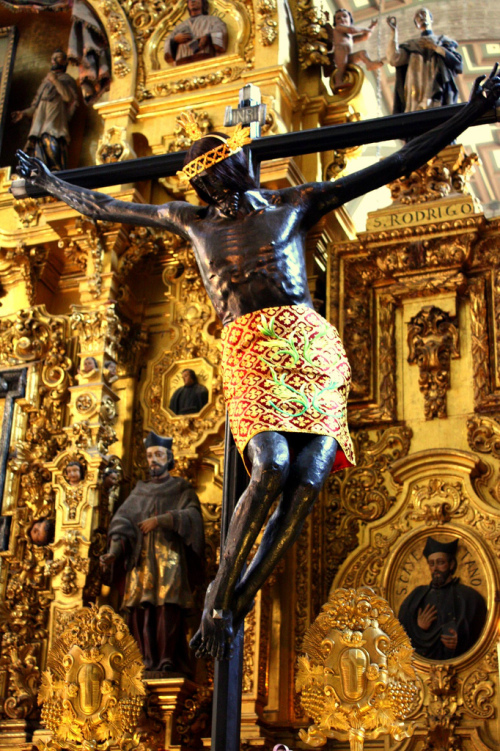
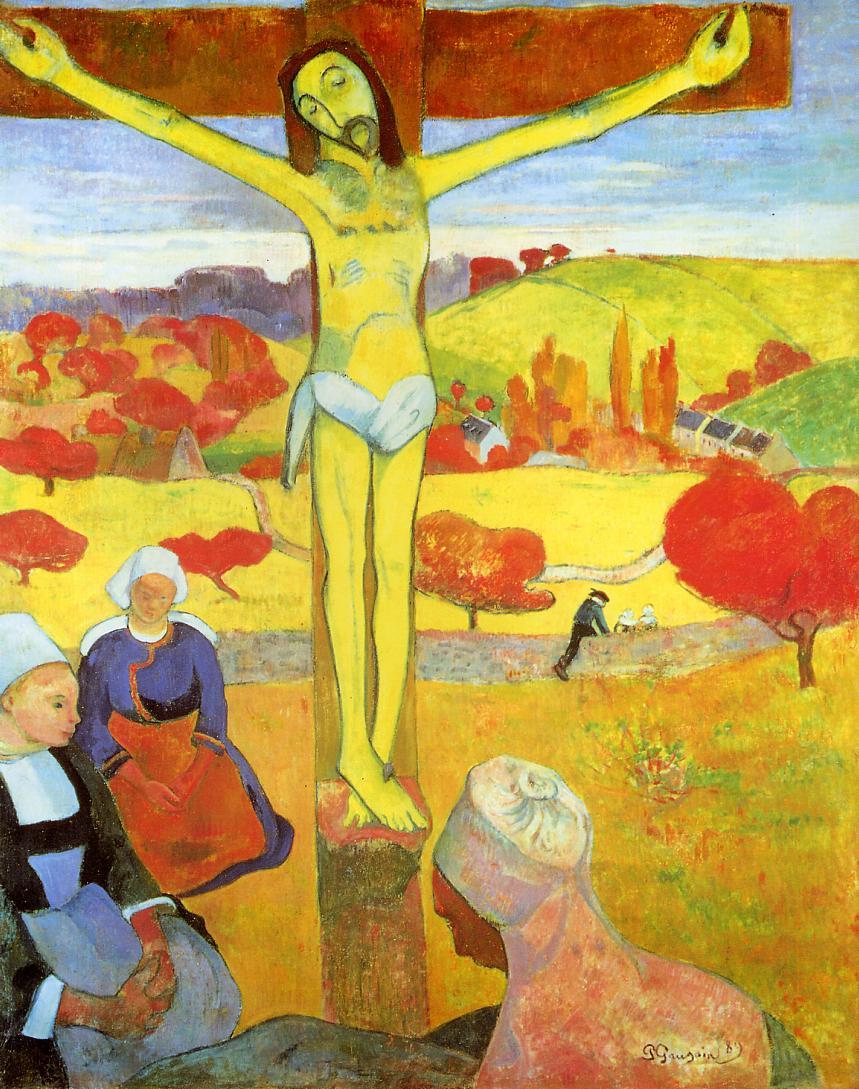
On Good Friday every year,* Christians around the world commemorate the death by crucifixion of Jesus of Nazareth, rabbi, prophet, Son of God, Son of Man, messiah, and all-around trouble-maker.

The truth is that very little is known of Jesus’ life and teachings from verifiable accounts, but this has not stopped generation after generation of Christians from telling his story, beginning with Jesus’ semi-official biographers, the evangelists of the New Testament. Almost everything we know about the life and teachings of the physical human being Jesus are in those writings, which do not portray him always in compatible ways, and which are almost entirely unconfirmed by any external source. The Roman historian Tacitus mentions (with disdain if not disgust) Jesus’ cult following, as does the Jewish historian and philosopher Josephus, but neither gives us anything to work with as historians (or, for that matter, as theologians). For the record, Suetonius and Pliny also talk about Christians, but these piecemeal sources tell us much more about Roman perceptions of Christians than about Christ and his teachings, or even necessarily Christian beliefs and practices.

What, then, can we reasonably say about Jesus?

It is almost impossible to find universal agreement around anything more than a few basics, including most importantly Jesus’ crucifixion. The Gospels narrate it; Paul the Apostle (who never met Jesus in the flesh, as it were) hangs his theology on it, together with the equally important resurrection; and no contemporary sources (Christian or otherwise) dispute it.

But it’s when we ask why Jesus was crucified that things start to get interesting.

What did he do? The two men he is traditionally said to have been crucified with are commonly understood to be “robbers,” but that they were common criminals is highly unlikely. Crucifixion is a horrible death designed to make a very public statement about the crucified, the sort of thing you use on gladiator-slave rebels like Spartacus, not on pickpockets and roustabouts. The Greek term used for these two men (lestai) is consistent with the description of the released Barabbas as one who had participated in rebellious activities, whose “criminality” was related to his revolutionary business. Moreover, the name “Barabbas” means literally “son of the father,” a purely symbolic and surely entirely fictional name, and that the people choose to have him released indicates their affinity for him as a thorn in the side of the Romans. He is thus contrasted with Jesus, the other son of the father, the peaceful (apocalyptic) revolutionary.

So Jesus would have been crucified as a political criminal, a rebel. This would make sense of accounts of his having been identified by the Romans as “Iesus Nazarenus Rex Iudaeorum”: “Jesus of Nazareth, King of the Jews.” Anyone claiming to be king (and “son of God” was a Jewish way of talking about the king of Israel recorded clearly in Psalm 2), would, if taken seriously, be understood as challenging Roman authority.

Insofar as Jesus seems to have been deliberately poking the Romans’ local running dogs, the Sadducees and the Temple priests, his seizure and termination were surely inevitable. If his teaching is as opposed to violence and unconcerned with “politics” as it seems to have been, it’s hard to believe the Romans would have noticed him without some prodding, this coming not from the “crowd,” but from the leadership (who in Mark and Matthew incite the crowd). Indeed, the priests and scribes look for ways to arrest him when the crowds are not around, because they fear a riot.

If we take the Gospel of Mark at all seriously, Jesus was preaching a new kingdom of God, an apocalyptic redemption of the people of the earth by God’s direct intervention (and with Jesus as the sacrificial pesach lamb). If we take the Gospel of Luke seriously, Jesus spoke in a classic prophetic mode, calling people — Jew and Gentile both — to care for the oppressed of the earth, the poor and the hungry and the helpless. Both Jesuses called for people to be better to each other, to love each other, and indeed to love each other when love was, according to common sense, the foolish thing.

Why would this get you executed?

Well, in itself, it wouldn’t. But the Gospel of Mark tells us of Jesus speaking with a man who realizes that all the animal sacrifices in the world don’t amount to a hill of beans (in that crazy world). When love counts more than sacrifice, we are undermining the Temple. When we go into the Temple, start knocking things over, and say it’s become about robbing the poor and not about loving God and one’s neighbor, we are undermining the Temple. And to undermine the Temple’s authority is also to undermine Rome’s authority, and Rome’s cash flow.

Jesus, like the Essenes he may or may not have associated with, was a purist.

The Temple was full of collaborators and exploiters, the kind seen before in the history of Israel (and berated by prophets like Isaiah and Amos), the kind hated also by the Dead Sea community of apocalyptic purists awaiting a final showdown between God and evil (i.e., the Roman Empire and their local potentates, the Temple authorities).

Jesus, like other Jewish prophets before him, thought that Judaism was about something. That it was somehow about justice and not just about following rules or waiting around for things to get better: that it was about our making the world a better place, and not just making our own lives better.

Start talking that way and get people on your side, and you’re fairly likely to get killed, even twenty centuries later.

* Though the actual date (even the year) of the execution marked by the movable feast of Good Friday is fundamentally unknowable, there are some present-day astronomer types who’d like to sell you April 3, 33 A.D.

On this day..

1939: Mikayil Mushfig, Azerbaijani poet

On this date in 1939, Azerbaijani poet Mikayil Mushfig was shot during Stalin’s purges.

The 30-year-old former schoolteacher was a socialist enthusiast as a youth in the 1920s; his work celebrated officially sanctioned subjects like virtuous peasants and workers, and modernization of the alphabet.

How far to go to put aside the backward old ways? Poets debated in verse whether the traditional instrument tar ought to be banned.

[O]ne poet, Suleyman Rustam, wrote, “Stop tar, stop tar, You’re not loved by proletar!” Another poet, Mikayil Mushfig, countered, “Sing tar, sing tar! Who can forget you!”

The tar wasn’t banned, but Mushfig’s enthusiasm for the Soviet project was deemed (however genuine) insufficient, “petit-bourgeois”.

The nightingale is sorrowing near the rose,
Though autumn comes-it lingers to depart,
Life, life! This cry of longing ever grows:
With love, with burning passion how to part?

With feelings new, you string your singing lute
My youthful pen, now just about to start!
O friends, give answer to my pain acute:
With this great seething fire flame, how to part?

Here‘s a pdf of some Mushfig poetry in Azerbaijani.

On this day..

1842: Maketu Wharetotara, New Zealand’s first execution

On this date in 1842, New Zealand carried out its first official execution: the hanging of Maori teen Maketu Wharetotara for murdering five people.

The son of a Nga Puhi chief named Ruhe, Maketu took employment as a farmhand for a white household.

An ill-tempered white servant evidently offended him sufficiently to split the bugger’s skull with an axe … and since Maketu wasn’t the type to leave a job half-done, he went ahead and murdered the rest of the household, too.

European settlers, still a minority, initially worried that this outburst might herald the onset of a general native rising. The police magistrate even refused to apprehend the criminal, who had fled back to his people, for fear of triggering conflict.

But internal Maori politics would not let the boy off so lightly.

One of the household members he had murdered was a mixed-race granddaughter of another important Nga Puhi chief, which raised the specter of intertribal strife.

To pre-empt a possible bloodbath, Ruhe turned his own son over to the Europeans.

By British law, it was a pretty cut-and-dried case with a pretty predictable outcome which became, for the crown, a precedent establishing its authority over incidents of interracial violence.

(Maketu Wharetotara — baptized “Wiremu Kingi” by an Anglican minister on the morning of his execution — obtained his milestone status because another Maori minor who had previously been condemned to death died of dysentery before they could noose him.)

On this day..

1910: George Reynolds and John Williams

At 6:30 this morning a century ago, two black men were hanged in Kansas City, Mo., for raping a white violinist less than seven weeks before.

There was really only one way this case was going to end.

The assault was of such a nature that intense feeling was aroused. Threats of lynching frequently were heard …

Prisoners in the County Jail raised bedlam when the verdict became known. They had previously threatened to lynch the negroes in the exercise room of the jail.

That’s from the Los Angeles Times blog’s roundup of its A.P. coverage from the Show-Me state a century ago — which further reveals George Reynolds and John Williams enjoyed a five-minute jury deliberation, and this vituperative sentence from the judge:

“They don’t even deserve to be classed with the murderer who must pay the penalty for his crime with his life,” continued Judge Latshaw.* “It would be an insult to these men, who had at least a spark of manhood in their hardened souls, to have such brutes as these put in their class. I don’t care to desecrate the day by ordering these two brutes hanged on the legal hanging day.”

(The regular hanging day — Friday — was safely un-desecrated; Reynolds and Williams hanged on a Tuesday.)

Reynolds fainted at the gallows. “Cowardly Brute,” the LA Times headlined it, also mentioning that he’d been starving himself for a week in a desperate bid to cheat the hangman. He maintained his innocence at the last.

* Judge Latshaw presided over a number of high-profile Missouri trials … often acquittals.

On this day..

1924: Alikomiak and Tatimagana, Inuit

On this date in 1924, the Canadian government made an example of two Inuit murderers on the Arctic Sea’s Herschel Island.

Alikomiak.

Alikomiak and Tatimagana (there are many alternate transliterations of each name) had been arrested in 1921 for killing four in a wife-stealing affair, then killed two more while in custody.

Canada, in the midst of a decades-long process of projecting its sovereignty in the Arctic, had let lenient treatment of some Inuit “criminals” in a few notable cases during the preceding years, and there was sentiment that an example of the majesty of the law was in order. “Make these tribes understand that the stern but at the same time just hand of British justice extends also to these northern shores,” the prosecutor implored the jury. (pdf, a great resource on this case)

To say nothing of whites’ sense that Inuits were savages.

Mr. Rasmussen states that 75% of the male population are murderers in fact it is the exception, where a man is a weakling or has something wrong with him, that a man has not at least one killing to his credit. These people are always on the offensive. This is particularly the case among the Netsilik band. While at Pelly Bay he offered a reward to his native Greenland Boy if he could find one man who was not a murderer. These people hold life very cheaply and as Mr. Rasmussen says it is a very easy matter to get killed. An attempt was made on his life at the H.B.C. post at Kent Peninsula. Now that these people know that the Police from Chesterfield Inlet and Kent Peninsula Detachments have arrested and taken out natives for committing murder, they immediately prepare for a fight on observing the approach of a strange sled or outfit. They are prepared to die fighting and have absolutely no fear of death yet they have the greatest fear of being taken away from their own country. Here I would like to say that this latter is the reason Alicomiak gave for killing Cpl. Doak and O. Binder at Tree River and lends truth to Mr. Rasmussen’s statement also judging from the absolute fearlessness with which Alicomiak and Tatamigans met their death here on the scaffold in February last would further corroborate it. In his travels from Pelly Bay through to Ellice River, Rasmussen says that on approaching a native camp of a number of natives, they, on noticing his strange outfit, at once made preparations for a fight thinking he was a policeman and on such occasions the first thing he had to do was to inform them that he was not a policeman, where upon they were most friendly and hospitable and would talk openly of murders they had committed when questioned about it.

That Dr. Knud Rasmussen cited at second-handed in the RCMP brief above was a great chronicler of the Inuit, and would record of this day’s hanging how “heavy and cumbersome machinery was required to get the two murderers sentenced. Judges, jury and witnesses had to be summoned from long distances.” The legal personnel were sent especially for this trial, along with the timber to build a gallows. You could say the verdict was foreordained.

Rasmussen’s work on the Inuit was recently put to celluloid by the director of Atanarjuat: The Fast Runner … another dimension, like the hanging this date, in the complex collision of cultures.

There was only one more hanging in the Yukon before Canada abolished the death penalty, though Canada was hardly finished using Inuit as instruments of its northern policy.

On this day..

1609: Vicente Turixi, King of the Moriscos

La Expulsión de los Moriscos, by Vincenzo Carducci (Vicente Carducho).

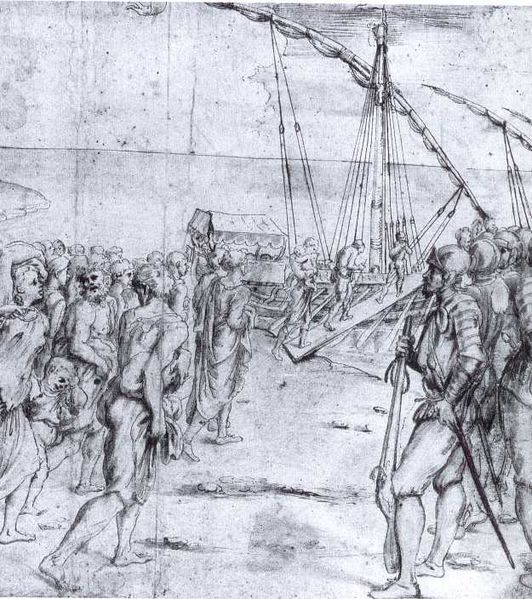
Having taken the trouble over the preceding century to eliminate (or force underground) its substantial Muslim population by forcibly converting it to Christianity, Spain in the early 1600s bethought itself to complete the operation upon its recently minted fellow-Christians by ejecting these Moriscos from Spain altogether.

When the edict for this radical act of expulsion first came down in the heavily Morisco area of Valencia, some of its victims reportedly embraced the prospect of deportation to a land where their dress, language, and religion were no longer forbidden.

Others were less sanguine.

Armed resistance broke out in two wilderness fastnesses, the mountainous Vall de Laguar (Spanish link) and — as narrated by Henry Charles Lea in his freely available The Moriscos of Spain; their conversion and expulsion

the Muela de Cortes (Spanish link), an almost inexpugnable spot, being a deep valley surrounded by precipitous heights, of which the passes were easily defensible. The Moriscoes of that region … were in a state of excitement and were readily persuaded to rise by an outlaw named Pablillo Ubcar. They elected as king Vicente Turixi, who sent a proclamation through the sierra for all to join him under pain of treason. From their strongholds they made raids on the surrounding country, gathering cattle and provisions, burning villages, and desecrating churches.

[Ethnic cleansing coordinator Don Agustin] Mexia, absorbed in the work of embarkation and fearing to interrupt it, for awhile paid no attention to these movements … who could readily be reduced when the time came.

His provisions were justified … those of the Muela de Cortes … lost heart when they heard of the defeat of those of Aguar, and were disappointed as to the appearance of the Moor Alfatami on his green horse, whom tradition reported to be concealed under the mountain since the days of King Jayme … It was agreed that they [the rebels, surrendering] should be safe in person and property, provided they would go to embark within three days.

The rapacious soldiery, who had promised themselves abundant plunder, in their disappointment threw off all discipline; they sacked the village of Royaya, outraged the women and seized numbers of children as slaves. Only three thousand Moriscoes were brought to the port of embarkation, the rest having scattered and taken to the mountains to escape the fury of the soldiers.

These, estimated at two thousand in number, for several years gave infinite trouble, killing all the Christians they met and committing constant depredations. At one time the Governor of Jativa induced many of them to come down, but finding that they were to be enslaved they fled back to the mountains.

A reward was offered for King Turixi, dead or alive; he was tracked to a cave, captured, and brought to the city, when he was sentenced to have hands and ears cut off, to be drawn, torn with pincers, hanged and quartered; but at the execution, December 18th, the cutting of hands and ears was omitted. He had been confessed twice and reconciled twice, and died as a good Christian, making a most edifying end, for we are told that he had been a liberal almsgiver and devoted to the Virgin and the religious Orders.

The miserable remnants were hunted down gradually, the viceroy paying twenty ducats a head for them as galley-slaves.

The armed resistance in Valencia — where Moriscos were most numerous, and the expulsion was first decreed — was actually much less than had been feared, which gave the Spanish authorities all the encouragement they would need to enforce it elsewhere, too.

“Seeing that the whole body of our nation is tainted and corrupt, he applies to it the cautery that burns rather than the salve that soothes; and thus, by prudence, sagacity, care and the fear he inspires, he has borne on his mighty shoulders the weight of this great policy and carried it into effect, all our schemes and plots, importunities and wiles, being ineffectual to blind his Argus eyes, ever on the watch lest one of us should remain behind in concealment, and like a hidden root come in course of time to sprout and bear poisonous fruit in Spain, now cleansed, and relieved of the fear in which our vast numbers kept it.”

-Cervantes, Don Quixote

On this day..

2007: Seven Tuareg and Arab civilians

On this date two years ago, seven civilians were apparently summarily executed by Niger security forces in that country’s long-running internal conflict with its Tuareg population.

Extrajudicial executions have been a recurring event (among the other usual charms of warfare) in Niger’s fight against the Mouvement des Nigériens pour la Justice (MNJ).

Amnesty International charged that these were among 13 civilians executed in a four-week span, possibly in retaliation for MNJ armed attacks.

A close relative of one of the dead told Amnesty International: “We were waiting for our relatives in Agadez when we saw their vehicles arrive driven by soldiers. We asked them where our relatives were. They refused to answer and then, as we insisted, they agreed to drive us to the place where the seven were buried.”

The people who identified the bodies said that they saw numerous signs on the victims of cigarette burns and whipping as well as many bullet wounds to the face and chest.

The nomadic Tuareg people of Niger’s (and neighboring Mali’s) northern Sahara territories have a long-running history of rebellion against the southerly federal government stretching back into the colonial period. (There’s a very detailed pdf paper on the subject here.)

These executions, which also swept up Arab businessmen, were part of the most recent (as of this writing) incarnation, a 2007-2009 campaign that seems ostensibly to have simmered down for now.

But the lucrative, contentious, and damaging (to the Tuareg) uranium mining industry that fuels the conflict (and that put Niger in the American news for the Bush administration’s duplicitous attempt to impute nuclear ambitions to Iraq in order to justify invading) still remains … and that fact seems to promise more bloodshed yet to come.

On this day..

1781: The slaves of the Zong, for the insurance

Beginning this day in 1781, the captain of the slave ship Zong began throwing his cargo overboard in a still-notorious case combining the horrors of the Middle Passage with the cruel rapacity of capital.

The Liverpool-based ship was en route from Africa to Jamaica, there to exchange its human chattel for New World produce bound for the European market.

Characteristically for slave ships, it was inhumanly packed: more economical for a slaver to overcrowd its captives and write off the ones who died than to maximize slaves’ chances of survival. And on this particular ship, malnutrition and disease claimed more than 60 slaves (as well as seven crew members).


Underwater sculpture off Grenada commemorating slaves thrown overboard during the Middle Passage.

With many more in danger of expiring, Captain Luke Collingwood reasoned that the cargo would be a loss if it succumbed, but that shippers’ insurance would reimburse the firm “when slaves are killed, or thrown into thrown into the sea in order to quell an insurrection.” Over a three-day span beginning Nov. 29, 1781, Collingwood had 133 still-living but sick slaves cast overboard;* “the last ten victims sprang disdainfully from the grasp of their executioners, and leaped into the sea triumphantly embracing death.” (Source)

This gave the ship’s owners — the good captain himself was not among them — the chance to attempt an insurance scam.

This historical-philosophical book (review, a pdf) analyzes the Zong affair as the emblematic “inauguration of a long twentieth century underwritten by the development of an Atlantic cycle of capital accumulation.”

When the Zong landed having lost in total more than half of its original 440 slaves (and Collingwood himself, that fastidious servant of his shareholders), its owners did indeed attempt to recoup the many who had been intentionally killed. Smelling fraud, the insurer refused to pay.

There followed the signal case of Gregson v. Gilbert, a dry insurance trial that also became a beacon of the slave system’s blood-chilling jurisprudential logic.

After a jury sided with the claimant shippers against the insurers, the matter hit a wide public on appeal before Lord Chief Justice Mansfield when abolitionist activists Granville Sharp and Olaudah Equiano seized upon its conscience-shocking quality.

While Sharp and Equiano agitated unavailingly for a homicide investigation, the insurer — which was itself in the very same business of human bondage as the shipper — self-righteously posed “as counsel for millions of mankind, and the cause of humanity in general.” (Source) Its interests, after all, would be served by the least possible indemnity for slaves murdered in passage.

Solicitor-General John Lee — “the learned advocate for Liverpool iniquity,” in Sharp’s estimation — successfully insisted upon limiting the case to its commercial considerations.

What is this claim that human people have been thrown overboard? This is a case of chattels or goods. Blacks are goods and property; it is madness to accuse these well serving honourable men of murder. They acted out of necessity and in the most appropriate manner for the cause. The late Captain Collingwood acted in the interest of his ship to protect the safety of his crew. To question the judgment of an experienced, well-travelled captain held in the highest regard is one of folly, especially when talking of slaves. The case is the same as if horses had been thrown overboard. (Quoted here; Wikipedia has it “as if wood had been thrown overboard.”)

Lord Mansfield agreed, “(though it shocks one very much) that the case of slaves was the same as … horses,” and simply found with the insurers that no liability attached them since the killings were voluntary rather than necessary.

Nobody was ever prosecuted.


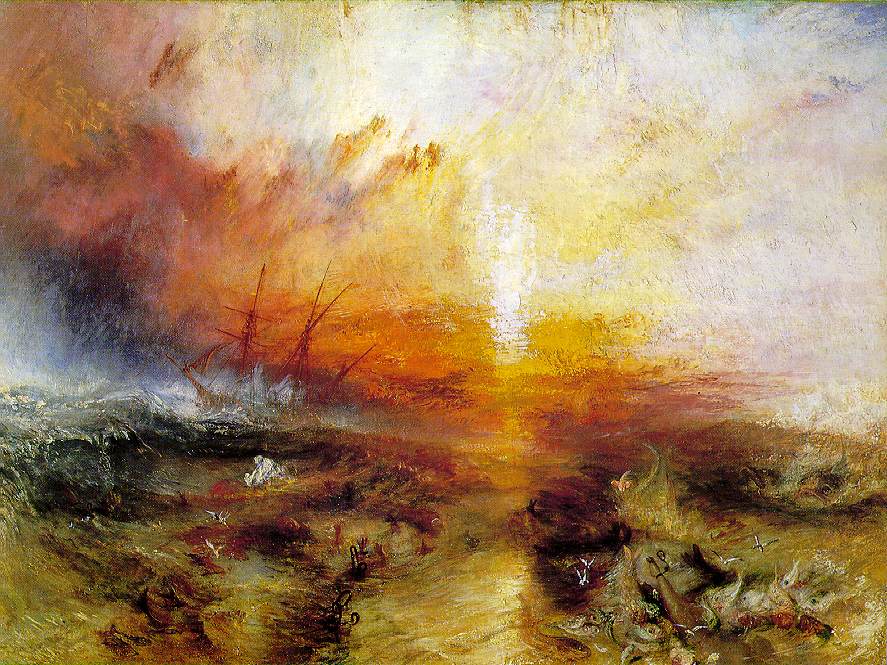
The disturbing 1840 Turner seascape “Slavers throwing overboard the Dead and Dying – Typon [sic] coming on”, also known simply as “The Slave Ship”, is widely thought to have been inspired by the Zong episode. The allusion would have been well-known to his contemporaries.

* One of the 133 survived by climbing back aboard the ship.

On this day..

1895: Florence English and Amanda Cody

On this date in 1895, Amanda (Mandy) Cody became the first woman hanged in Georgia’s Warren County when she died with her (male) lover Florence English for murdering Cody’s husband, Cicero and dumping his body in a swamp.

According to The Penalty is Death: U.S. Newspaper Coverage of Women’s Executions (citing the Atlanta Constitution), they were all set to get away with it until English told his mother and “to the surprise of all, [she] told it to the white people living near.”

To credit the New York Times (Nov. 23), they went to the gallows in a rhapsodic religious transport.

SANG HYMNS WHILE BEING EXECUTED

A Negro Man and Woman Continued Their Melody Until the Drop fell.

WARRENTON, Ga., Nov. 22. — Florence English, twenty years old, and Mandy Cody, both colored, were executed here to-day for the murder of the latter’s husband. They died in the ecstacy of religious enthusiasm.

A trio of colored ministers held a prayer meeting in the corridor of the jail during the early morning. The prisoners at times mingled their supplications with those of the preachers, producing intense excitement. The culprits stood in the midst of the visitors, swaying their bodies to and fro, singing plaintive melodies characteristic of the black race.

Shortly before noon the prisoners marched from their cells to the scaffold. As they stepped on the platform both commenced singing an old negro camp meeting melody, “We’ll Soon Be on the Way to Heaven.” While their hands and feet were being pinioned, the murderers still continued the hymn.

They refused to make a statement. The black caps were then drawn over their faces, the hymn still being sung with renewed vigor. When the trap was sprung they were still singing.

On this day..

1885: Louis Riel, Metis leader

On this date in 1885, Louis Riel, “the puzzling Messianic figure of Canadian history,” was hanged in Regina for treason.

We have already met in these pages the magnetic, controversial figure of Louis Riel when his Red River Rebellion caused the 1870 execution of Thomas Scott, one of the soldiers sent to suppress it.

Now, after a decade and a half in the political and sometimes literal wilderness, the champion of the Métis had been recalled from the United States to press the rights of his mixed-race French-indigenous people against the Anglo Canadians’ westward march.

It was North America’s familiar clash of civilizations between expanding industrial economies and the traditional ways of life they displaced. (Here’s a good background documentary video, with a Part 2 that gets into the weeds on battlefield events.) Because the Metis were “half-breeds” whose European stock was French, the story’s familiar cocktail of racism had a twist of Canada’s Anglo-French rivalry, too.

Riel declared an independent Provisional Government of Saskatchewan, and the North-West Rebellion was on.

The rebels had some initial successes. But hampered by an inability to make a firm alliance with the more politically realistic Cree, by the non-support of the Catholic Church in view of Riel’s increasingly out-there millenarianism, and by the extension of technological superiority another 15 years’ railroad-building had given the Ottawa government, Riel’s forces soon gave way.

The lightning-rod leader was arrested and repaired to the provincial capital for trial, where he spurned his lawyers’ desperation attempt to plead insanity and cogently vindicated his position.

“Life, without the dignity of an intelligent being, is not worth having.”
Riel

For a man twice a rebel, the hanging sentence was no surprise. Later, juror Edwin Brooks would tell a newspaper “We [the jury] tried Louis Riel for treason but he was hanged for the murder of Thomas Scott.” (Source, via this pdf handbook all about the Metis.)

His hanging was met with outrage in Francophone Quebec, and Louis Riel remains a polarizing figure down to the present day — an emblem of multiple overlapping cultural conflicts never fully resolved. The upcoming year’s 125th anniversary of events profiled here promise a renewed examination of Louis Riel (or at least of his tourism potential).

Below are a few more-or-less obtainable recent books about Riel and the North-West Rebellion, culled from this pdf reading list. Also note the public-domain volume The history of the North-west rebellion of 1885.

Recent considerations of Louis Riel and the North-West Rebellion

On this day..