1909: Madanlal Dhingra, Indian revolutionary

A century ago today, the first Indian revolutionary martyr to be hanged in England was put to death at Pentonville Prison.

Madanlal Dhingra (or Madan Lal Dhingra) was a bright young scion of a loyalist Indian family that disowned him when he took to radical politics.

As an engineering student in London, Dhingra quaffed the martyr’s cup by assassinating Sir William Curzon Wyllie, a career imperial official spending his golden years keeping tabs on nationalist types among England’s Indian students. (Evidently, he could have been doing his job better.)

Dhingra rejected the legitimacy of the British court, disdained a defense, and was sentenced to death on the first day of trial. His martyrdom being the shared object of both the prosecutors and the offender, he was not long for the world — supposedly checking out with the well-turned last words,

My only prayer to God is that I may be re-born of the same mother and I may re-die in the same sacred cause till the cause is successful.

Dhingra is a noteworthy martyr to the cause of Indian independence now, but like anything else things weren’t so black and white at the time. Gandhi was not down with Dhingra — Gandhi’s own differences with Hindu extremists would eventually cost him his life — and plenty of Indian liberal types shared his abhorrence.

On the other hand, a subversive Brit like poet Wilfrid Scawen Blunt filled his blog-like diary with admiration for the assassin during the weeks of his celebrity — writing of this date, for instance:

They have done me the honour of choosing [my birthday] for Dingra’s execution, thus making of it an anniversary which will be regarded as one of martyrdom in India for generations.

And reflecting later, after the hanging:

People talk about political assassination as defeating its own end, but that is nonsense; it is just the shock needed to convince selfish rulers that selfishness has its limits of imprudence.

Other subjects of the Empire were inclined to agree.


From the Aug. 19, 1909 London Times.

On this day..

1865: Chief Ahan of the Tsilhqot’in

“The Indian Ahan,” read the dispatch in the British Columbian this date in 1865, “will have expiated his crime upon the gallows ere these lines meet the public eye. The execution will take place in the rear of the jail early this morning.”

Ahan and another Tsilhqot’in (or Chilcotin) were of the party of Klatsassin, whom we have already met in these pages. Months after the Chilcotin War‘s mass execution, the luckless pair were arrested trying to pay what would have been a routine-for-them bit of blood money.

Both were condemned; Lutas received clemency, and his freedom. (“I eagerly availed myself of some favorable circumstances in the case of Sutas and sent him back pardoned to his tribe. A sufficient number of Indians has now perished on the scaffold to atone for the atrocities committed last year.”)

Documents related to this proceeding are archived at a canadianmysteries.ca page on Klatsassin.

Ahan’s execution in New Westminster, now part of the Vancouver, B.C. metropolis, isn’t dead, though — and isn’t even past.

Over the course of the past year, a public school project in the city that had been built over an old pauper’s grave that might have become the hanged man’s resting place was gravely (ahem) complicated by the continuing Tsilhqot’in search for Ahan’s remains. While Ahan’s own situation remains unresolved, the suit on his behalf eerily outlined the macabre past lurking everywhere beneath our workaday feet.

On this day..

1942: The village of Lidice, for the assassination of Reinhard Heydrich

On this date in 1942, the Germans visited upon the Czechoslovakian village of Lidice one of the most notorious butcheries of World War II: the physical destruction of the town, and the execution of most of the adult population, in revenge for the assassination of Reichsprotektor Reinhard Heydrich.

Heydrich had power of life and death in Nazi-occupied Bohemia and Moravia, and did not scruple to use it.

“The Hangman of Prague” was no mere functionary, but a Nazi grand wizard from way back, who’d had a hand in the Third Reich’s most terrifying greatest hits — the Night of the Long Knives, Kristallnacht. Just four months before this date, Heydrich had chaired the Wannsee Conference.* (Watch Kenneth Branagh as Heydrich ride herd over a gaggle of bureaucrats to get the Final Solution up and running in Conspiracy.) Hitler called him his “man with the iron heart.”

So he was a natural target for the Czechoslovakian army-in-exile and their British handlers, made more so by his lordly disdain for common-sense security safeguards.

Zipping along a predictable route in an open car, he was a sitting duck for a hit squad, who gave the Nazi bastard a mortal shrapnel wound from a grenade that had him lingering painfully at death’s door for several days before he finally died of blood poisoning.

The 1964 Czechoslovakian film Atentat (“Assassination”) chronicles the plot to kill Heydrich and its aftermath.

For this effrontery, Czechoslovakians would pay a dreadful price.

Naturally, the Nazis mercilessly hunted down and slaughtered those with any connection to the plot.

But the Reich also exacted collective reprisals to make plain that the entire “protectorate” could be considered hostage against such plots in the future.

Special transports of Jews marked “Attentat auf Heydrich” were shipped to the camps, and 152 were executed on the day Heydrich succumbed. But then, the Nazis were brutalizing Jews anyway. Something more headline-grabbing would be needed.

Enter Lidice.

After gaudy funerals for the slain Reichsprotektor, the Reich settled upon the small town of Lidice north of Prague — trumping up a few connections to resistance to “justify” collective punishment.

On this date, German troops stormed it, summarily executed all the men and boys** old enough to bear arms and a fair number of women, deported the others, and then physically destroyed and buried the town.

Lidice was intended as a demonstration — boldly published to the world as proof against a repeat,† it became the byword of Nazi cruelty towards subject nations. Though not by quantitative standards the greatest crime of the occupation, not even the greatest crime in reprisal for Heydrich, its three syllables distill all the evil of Hitler’s conquest for Czechoslovakia.

Lidice did live, and does yet, as an emblem par excellence those terrible years.

Less alive: Heydrich’s right-hand man Karl Hermann Frank, who was hanged in Prague after the war for engineering this monstrous crime. Those survivors of Lidice able to make the trip enjoyed priority seating.

* Heydrich’s aide at the Wannsee Conference, and taker of cleaned-up minutes, was Mr. Banality of Evil himself, Adolf Eichmann.

** Only three men of Lidice survived the destruction: two who were in England at that time, and one who was imprisoned in Prague for killing his son. The sentence for this crime, it turned out, was life.

† An effective proof — the calculated wholesale slaughter apparently did cool both the conquered populace and the enemies of Germany on enthusiasm for further assassinations.

On this day..

1989: Sandra Smith and Yassiem Harris

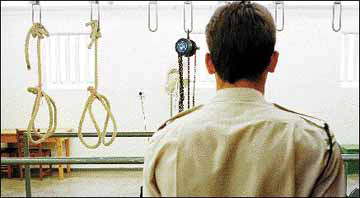
(Thanks to Richard Clark of Capital Punishment U.K. for the guest post, a reprint of an article originally published on that site. The images accompanying this post are also provided by Mr. Clark. -ed.)

Sandra Smith was the last woman to be hanged in South Africa (with her boyfriend Yassiem Harris).

Background.

Sandra Smith was a 22-year-old coloured woman (official South African designation during the apartheid era) who was married to a trawlerman called Philip and had two small children. Philip spent long periods at sea and sent money back for Sandra and the children. She began having an affair with Yassiem Harris, who was 3 years her junior, in the autumn of 1983 and soon they were deeply in love. Harris had been involved in crime since the age of 13 and had convictions for theft and fraud and was also a drug user. Philip found out about the affair from his neighbours and in March of 1986, he finally threw Sandra out. She and Harris now began living together in a rented apartment but soon the money that Philip used to give her ran out and their finances became tight.

The crime.

To make ends meet, they tried renting video recorders from shops and then selling them but this didn’t net them any real money. Harris, who was unemployed, also spent time hanging about outside a girl’s school and got to know some of the girls, including Jermaine Abrahams. He soon found out where she lived and from his conversations with Jermaine, he concluded that her family were quite wealthy.

They hatched a plan to break into the Abrahams’ family home and steal her mother’s jewelry and anything else of value. Harris had also found out that her parents left for work at 7.00 a.m. in the morning and she left for school about 7.40 a.m.

The victim, Jermaine Abrahams.

Smith and Harris arrived at the house about 7.30 a.m. on September the 1st, 1986, and Harris was let in by Jermaine on the pretext of him wanting to use the telephone. They tied Jermaine up but were disturbed by someone knocking at the door. She started to shout for help and struggle so they then tried to strangle her with a dish cloth. Harris now fetched a knife from the kitchen and repeatedly stabbed Jermaine in the neck. Amazingly, she didn’t die from her injuries and managed to get to her feet and stagger a few paces before collapsing. Harris carried Jermaine to her parents bedroom and made her show him where the jewelry and valuables were kept. He wrapped the poor girl in a duvet and then cut her throat, leaving her to bleed to death. He and Smith collected up what they wanted and then left the house.

Two weeks later, while Smith was being questioned by the police regarding the video scam, she surprised the interviewing officer by confessing to the killing of Jermaine. “I wouldn’t have been able to live with it,” she said. In her statement she told the police, “He pulled the scarf tight across her mouth and then cut her throat.”

On the 15th of September 1986, Sandra Smith was formally charged with the murder and 5 days later Harris was arrested and also charged with it.

Trial.

At their committal hearing at the Mitchell’s Plain Magistrates’ Court on the 23rd of September, they pleaded guilty to murder, alternatively to culpable homicide, and to stealing R2,000 worth of jewelry.

They were tried together at the Cape Town Supreme Court on December the 1st, 1986, before Mr. Justice Munnik, the Judge-President of the Cape Court, and two assessors. South Africa did not use the jury system, although its court proceedings were based upon British law, but instead a system of a judge and assessors. Both were represented by counsel and both attempted to shift the blame on to the other. Smith maintained that Harris had done the actual killing and Harris claimed to have been dominated by Smith, although they both admitted being present during the murder.

Sandra Smith was embarrassed by the revelations of her sex life with Harris in court and seemed at times more concerned with these than the fact that she was on trial for her life.

Having heard all the evidence, Mr. Justice Munnik gave a full reasoned judgement in which he described Harris as “an appalling witness.” He said it was clear that it was Harris who had stabbed the girl and slit her throat to prevent her identifying them. He also rejected Harris’ defence claim that he been dominated by Smith which had been refuted by the psychiatrist giving evidence for the prosecution. He accepted that Smith was demanding but not dominant, and there was no evidence to indicate that she forced Harris to kill Jermaine, nor that she had done anything to prevent the murder. He thus concluded that they were both equally responsible for the crime under the doctrine of “common purpose.” Thus on the 11th of December 1986, they were both formally convicted of the murder of Jermaine Abrahams and with robbery with aggravating circumstances and remanded for sentence.

Eleven days later they were brought back to the court and received the mandatory sentence for murder — that they be hanged by the neck until they were dead. Additionally, Harris received a 10-year prison sentence for robbery and Smith was given seven years for it. Sandra Smith became hysterical when she was sentenced to death and had to be taken struggling and screaming to the cells.

They were transferred to the country’s only death row, at Pretoria Central Prison, a modern facility on the outskirts of the capital where all South African executions were carried out. Their appeals were turned down and the review of the trial transcripts to determine whether to recommend that the state president grant clemency carried out by the Ministry of Justice failed to find any mitigating circumstances. As clemency was not forthcoming, their execution date was set for the 2nd of June 1989. Apparently, only around one in 50 people convicted of homicide were actually hanged at this time, the majority serving a prison sentence.

Execution.

At 6.50 a.m. on that morning, Smith was taken to meet Harris for the first time in over two and a half years. Together with two other men who had been convicted of murder, they were led the 52 steps to the pre-execution room next to the gallows. The death warrants were read to them and they were given the opportunity to say their last words. Their hands were handcuffed behind them and white hoods placed over their heads, these having a flap at the front which was left up until the last moment.

They were now led forward by warders into the large and brightly lit execution room. It was some 40 feet long with white painted walls. They would have seen the gallows beam running the length of the room and the 7 large metal eyes from which the four nooses dangled. (Seven prisoners could and often were hanged at once on this gallows.) The picture shows very much what Smith and Harris would have seen as they were led to the gallows. The chain hoist on the middle metal eye is used for raising the trapdoors after an execution.

They were positioned side by side, on painted footprints over the divide of the trap and held by warders while the hangman placed the nooses around their necks. He then turned down the hood flaps and when all was ready, pulled the lever plummeting them through the huge trapdoors.

They were left to hang for 15 minutes before being stripped and examined by a doctor in the room below. Once death had been certified, the bodies were washed off with a hose and the water allowed to drain into a large gully in the floor. A warder put a rope around each of their bodies and with a pulley lifted them to allow the rope to be taken off. They were then lowered onto a stretcher and placed directly into their coffins before taken to a public cemetery for burial.

Although executions in South Africa were held in private, the procedure was described in detail by the then hangman, Chris Barnard, in an interview before he died. He officiated at over 1,500 hangings there.

South Africa hanged 1,123 people at Pretoria Central prison between 1980 and 1989, Solomon Ngobeni being the last on November 14th, 1989. Surprisingly perhaps, almost all of these were for “ordinary” murders rather than politically motivated crimes and most attracted very little publicity.

According to the South African Department of Correctional Services, two other coloured women were hanged for murder in the years 1969 to 1989, Gertie Fourie, on the 20th of May 1969 and Roos de Vos, on the 12th of December 1986. A total of 14 women were executed between 1959 & 1989, out of a total of 2,949 hangings.

President De Klerk ordered a moratorium on executions in 1990 and capital punishment was abolished altogether by the incoming black government of Nelson Mandela on the 7th of June 1995.

Comment.

We cannot know why Smith and Harris went to the Abrahams’ home while they knew Jermaine would still be there or whether they had actually formed any intention to kill her. Neither of them had any record of violence prior to the murder. My guess is that they panicked when she started to call for help from the person who knocked on the door and they tried to silence her. However, it seems hard to believe that Harris really thought she wouldn’t identify him to the police as soon as they had left and he may well have decided to kill her for this reason. It is claimed that Smith wanted Jermaine dead as she was jealous of her having some sort of relationship with Harris. In any event, Jermaine suffered a horrible and agonising death at their hands.

We cannot know, either, which one of them did the actual killing or whether they both took equal part in it. But there was clear “common purpose” established under law, and there were no obvious mitigating circumstances to allow the state to reduce the sentence on either of them. South Africa had the highest rate of judicial execution in the world during the 80’s so they would surely have known the penalty for murder but like so many people, gave no thought to it until it was too late.

Sadly, it is so typical of the kind of brutal and senseless murder that happens all too frequently and one that led to cruel deaths for three young people.

On this day..

1946: Karl Hermann Frank

On this date in 1946, the Sudeten German whose fifth column had paved the way for the Nazi conquest of Czechoslovakia expiated his war crimes at Prague’s Pankrac Prison.

Karl Hermann Frank (English Wikipedia page | German) had been a prewar mover and shaker in the Sudeten German Party, increasingly the Reich’s stalking-horse as it bluffed European rivals into acceding to Czechoslovakia’s dismemberment.

The onetime Czechoslovakian MP did well by the Anschluss, gaining the rank of Obergruppenführer and becoming one of Bohemia and Moravia’s top evildoers.

Notably, he helped orchestrate (though the orders for it came from above) the notorious massacre of Lidice in revenge for the assassination of Reich Protector Reinhard Heydrich.

The Lidice operation formed a war crimes charge against Herr Frank after the war, and Frank’s own lasting badge of infamy: the systematic destruction of the entire male population of an arbitrarily chosen village remains the emblematic crime of the Nazi occupation to this day.

(Source of the video)

Thousands of spectators came to see the former “Protector of Bohemia and Moravia” executed in Prague’s Pankrac Prison by the Austro-Hungarian “pole hanging” method, as depicted in the film above.

Those of Lidice’s widows who were able to come — and widows of some of the 30,000 other Czechs for whose executions Frank had been adjudged indirectly responsible — occupied the second row of seats. …

Not the slightest gleam of compassion could be seen in that long row of unforgiving eyes as Frank, garbed in a ragged Nazi Elite Guard uniform, walked quietly between two guards. …

As the noose was adjusted about his neck, Frank muttered: “Deutschland wird leben auch wenn wir nicht leben” (“Germany will live even if we do not live.”)

The spectators, admitted by special cards, watched quietly in the bright sunshine. (New York Times)

On this day..

1781: Tupac Amaru II, Incan insurgent

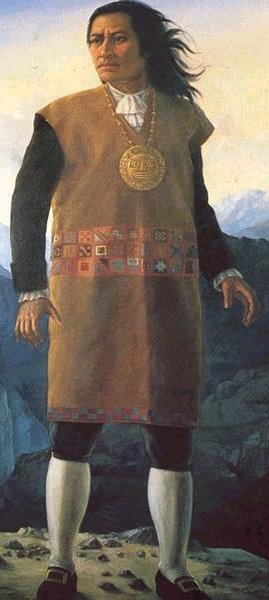
On this date in 1781, the last name in Incan rebellion met a horrible end in the ancient Incan capital of Cusco.

José Gabriel Condorcanqui — rechristened Tupac Amaru II, as he was a distant descendant of the last Incan king — was a member of the privileged indigenous population depended upon by the Spanish to administer the forced and extorted labor that made its New World empire worth having.

Condorcanqui evidently had an epiphany.

In November 1780, he launched a well-planned rebellion by engineering the public execution of a hated corregidor Antonio de Arriaga at the hands of his own servant.

“From this day, no longer shall the Spanish feast on your poverty!”

This attention-grabbing entry onto the political chessboard was followed with an exemplary victory over Spanish forces. His revolt rapidly metastasized into an ethno-religious crusade, with all the accumulated bitterness of the Indians’ two-plus centuries maltreatment ferociously visited upon the Spanish.

It was a heady moment — but only a moment; within a few months, the Spanish had rallied and Tupac Amaru was betrayed into their hands.

The rebel had seized Incan symbology for his own purposes — speaking at ancient shrines, for instance — and the Spanish sentence against him included not only the inevitably horrific execution (of both Tupac Amaru and his wife and family) but a comprehensive and explicit programme of cultural annihilation to consign the Incan identity to the past. This lengthy sentence is well worth the read. (Sourced here, a pdf file; the bolded sections are my highlights.)

I must and do condemn José G. Túpac Amaru to be taken out to the main public square of [Cuzco], dragged out to the place of execution, where he shall witness the execution of the sentences imposed on his wife, Micaela Bastidas [Spanish link]; his two sons, Hipólito and Fernando Túpac Amaru; his uncle, Francisco Túpac Amaru; and his brother-in-law, Antonio Bastidas, as well as some of the principal captains and aides in his iniquitous and perverse intent or project, all of whom must die on the same day.

And once these sentences have been carried out, the executioner will cut out his tongue, and he will then be tied or bound by strong cords on each one of his arms and feet in such a way that each rope can be easily tied or fastened to others hanging from t he saddle straps of four horses, so that, in this position, each one of these horses, facing opposite corners of the square, will pull toward his own direction; and let the horses be urged or jolted into motion at the same time so that his body be divided into as many parts and then, once it is done, the parts should be carried to the hill or high ground known as “Picchu,” which is where he came to intimidate, lay siege to, and demand the surrender of this city; and let there be lit a fire which shall be prepared in advance and then let ashes be thrown into the air and a stone tablet placed there detailing his main crimes and manner of his death as the only record and statement of his loathsome action.

His head will be sent to the town of Tinta where, after being three days on the gallows, it shall be placed on a stake at the most public entrance to the town, one of his arms will go to the town of Tungasuca, where he was chief, where it will be treated in like manner, and the other in the capital of the province of Carabaya; one of the legs shall likewise be sent for the same kind of demonstration to the town of Libitaca in the province of Chumbilcas, while the remaining one shall go to Santa Rosa in the province of Lampa along with the affidavit and order to the respective chief magistrates, or territorial judges that this sentence be proclaimed publicly with the greatest solemnity as soon as it arrives in their hands, and on the same day every year thereafter; and they will give notice in writing of this to their superiors in government who are familiar with the said territories.

Since this traitor managed to arm himself and form an army and forces against the royal arms by making use of or seducing and leading with his falsehood the chiefs who are the second in command in the villages, since these villages, being of Indians, are not governed by such chiefs but rather by mayors who are elected annually by the vote or nomination of the chiefs: let these same electoral communities and the chief magistrates that care to give preference to candidates who know Spanish, and who are of the best behavior, reputation, and customs so that they will treat their subjects well and lovingly, honoring only those who have demonstrated honestly their inclination and faithfulness, eagerness, respect, obedience, submission, and gratitude to the greater glory of our great Monarch through the sacrificed of their lives, properties, or ranches in deference of their country or religion, receiving with brave disdain the threats and offers of the aforesaid reel leader and his military chiefs, yet taking care that these elected leaders are the only ones with the right to the title of chief or governor of their ayllus [communities] or towns, and that they cannot transmit their position to their children or other family members.

To this same end, it is prohibited that the Indians wear heathen clothes, especially those who belong to the nobility, since it only serves to symbolize those worn by their Inca ancestors, reminding them of memories which serve no other end than to increase their hatred toward the dominant nation; not to mention that their appear is ridiculous and very little in accordance with the purity of our relics, since they place in different parts images of the sun, which was their primary deity; and this prohibition is to be extended to all the provinces of this southern America, in order to completely eliminate such clothing, especially those items which represent the bestialities of their heathen kings through emblems such and the unco, which is a kind of vest; yacollas, which are very rich blankets or shawls of black velvet or taffeta; the macapaycha, which is a circle in the shape of a crown from which they hand a certain emblem of ancient nobility signified by a tuft or tassel of red-colored alpaca wool, as well as many other things of this kind and symbolism. All of this shall be proclaimed in writing in each province, that they dispose of or surrender to the magistrates whatever clothing of this kind exists in the province, as well as all the paintings or likenesses of their Incas which are extremely abundant in the houses of the Indians who consider themselves to be nobles and who use them to prove their claim or boast of their lineage.

These latter shall be erased without fail since they do not merit the dignity of being painted in such places, and with the same end in mind there shall also be erased, so that no sign remains, any portraits that might be found on walls or other solid objects; in churches, monasteries, hospitals, holy places or private homes, such duties fall under the jurisdiction of the reverend archbishops or bishops of both viceroyalties in those areas pertaining to the churches; and in their place it would be best to replace such adornments with images of the King and our other Catholic sovereigns should that be necessary. Also, the ministers and chief magistrates should ensure that in no town of their respective provinces be performed plays or other public functions of the kind that the Indians are accustomed to put on to commemorate their former Incas; and having carried out the order, these ministers shall give a certified account to the secretaries of the respective governments. In like manner shall be prohibited and confiscated the trumpets or bugles that the Indians use for their ceremonies and which they call pututos, being seashells with a strange and mournful sound that celebrate the mourning and pitiful memorial they make for their antiquity; and there shall also be prohibited the custom of using or wearing black clothing as a sign of mourning, a custom that drags on in some provinces in memory of their deceased monarchs and also of the day or time of the conquest which they consider disastrous and we consider fortunate since it brought them into the company of the Catholic Church and the very loving and gentle domination of our Kings.

With the same goal it is absolutely forbidden that the Indians sign themselves as “Incas,” since it is a title that anyone can assume but which makes a lasting impression on those of their class; and it is ordered, as is required of all those who have genealogical trees or documents that prove in some way their descent, that they produce them or send them certified and without cost by mail to the respective secretaries of both viceroyalties so that the formalities may be observed by those persons responsible to their excellencies the viceroys, consulting His Majesty where necessary according to each case; and the chief magistrates are charged to oversee the fulfillment of such requirements, to seek out and discover anyone who does not observe them correctly, in order to have it done to collect the documents with the aim of sending them to the proper authorities after giving their owners a receipt.

And so that these Indians renounce the hatred that they have conceived against the Spaniards, and that they adhere to the dress which the laws indicate, adopting our Spanish customs and speaking Castilian [Spanish], we shall introduce more vigorously than we have done up to now the use of schools, imposing the most rigorous and fair penalties on those who do not attend once enough time has passed for them to have learned the language; the duties and responsibilities involved in this plan going to the very reverend ecclesiastical prelates so that, in the opposition between parishes and doctrinas, they take care that those candidates bring affidavits from the provincial judges as to the numbers of people who speak the Said Castilian in those provinces … it being left up to the sovereign discretion of His Majesty to reward and honor those towns whose inhabitants have rendered, under the present circumstances, their due loyalty and faithfulness.

Finally, the manufacture of cannons of all kinds shall be prohibited under the penalty that any noble found manufacturing such items will be sentenced to ten years of prison in one of the presidios in Africa and any commoner will receive two hundred lashes as well as the same penalty for the same time period; reserving for a future time a similar resolution with regards to the manufacture of powder. And since there cannons of almost every caliber in the many ore-crushing mills and timber yards in these provinces, they will be gathered up by the magistrates once of the pacification of this uprising has been completely terminated in order to give account of them to the respective captaincy general so that he may determine whatever use he deems proper for them. Thus have I visualized, ordered, and signed: this is my final judgment.

José Antonio de Areche.

Tupac Lives.

The Spanish campaign to eradicate his name and identity didn’t exactly have legs.

The savagery of the crackdown helped generate Incan support for the rebellions that would shake off Spanish authority in the generations to come. He entered the official iconography of the post-colonial state, and can be found on Peruvian currency.

The very name Tupac Amaru became pregnant with the spirit of resistance — both in Peru, where it was adopted by a 1990’s revolutionary movement, and abroad, where a New York City Black Panther activist (pdf) gave the name to a son: Tupac Amaru Shakur.

On this day..

1993: Leonel Herrera, perilously close to simple murder?

On this date in 1993, Leonel Herrera was executed by lethal injection in Huntsville, Texas, for shooting two policemen. Herrera’s last statement averred,

Herrera’s sister Norma self-published this book about the case — keeping a promise to her executed brother.

I am innocent, innocent, innocent. Make no mistake about this; I owe society nothing. Continue the struggle for human rights, helping those who are innocent, especially Mr. Graham. I am an innocent man, and something very wrong is taking place tonight. May God bless you all. I am ready.

Well, Herrera wasn’t the first to go to his death maintaining his innocence. The circumstances (and circumstantial evidence) of the crime rate on the forgettable side.

But Leonel Torres Herrera was a bit different from his cousins in hopeless protestation: while he died this evening, his name lived on … in a landmark Supreme Court decision

Herrera v. Collins

Years after Herrera was convicted and death-sentenced, multiple affidavits were produced to the effect that his late brother, Raul, was the real killer.

This evidence was naturally pursued with gusto by the condemned man.

Unfortunately, a claim like Herrera’s of “actual innocence” faces a very high bar when raised in appellate courts, once a prisoner has already been convicted and their presumption of innocence become a presumption of guilt.

That this arbitrary rule of the game has a defensible rationale — could any criminal justice system operate if prisoners could continually relitigate their cases while memories fade and evidence ages into obsolescence? — does not make it the less Kafkaesque for individual prisoners, some of whom are in fact innocent.

Herrera presented this problem in unusually stark terms. Lacking any procedural violation upon which to hang his hat as an appeals issue, his claim pitted substance against form in the Supreme Court. (Oral arguments at Oyez.org)

You already know how it ended.

Chief Justice William Rehnquist’s opinion patiently explained a jurisprudential truism loftily uncolored by any experience in life liable to introduce a sense of kinship with a Hispanic man charged with a Texas cop-killing who uncovers too late the evidence that could save him.

“[A]ctual innocence” is not itself a constitutional claim.*

Instead, the Court recommended — tongue no doubt planted firmly in cheek — that Herrera apply for executive clemency, a dead letter procedure in Texas used exclusively in a good cop/bad cop routine opposite the black robes.

“Judicial restraint forbids relieving you,” says the court. “Go ask the governor.”

“The courts have thoroughly reviewed the case,” intones the governor. “May God have mercy on your soul.”

Herrera himself may or may not have been innocent. At the end of the day, he went down because the game was rigged against him: his exculpatory evidence was not available at trial, when it might have introduced “reasonable doubt” — as Rehnquist’s opinion put it, “in state criminal proceedings the trial is the paramount event for determining the guilt or innocence of the defendant.” Once that evidence became available deep in the appeals process, it was procedurally barred, and far from such a slam-dunk exoneration that any institutional actor would stick his, her or its neck out to lift Leonel Torres Herrera from the gurney.

Justice Harry Blackmun’s dissent retorted,

Just as an execution without adequate safeguards is unacceptable, so too is an execution when the condemned prisoner can prove that he is innocent. The execution of a person who can show that he is innocent comes perilously close to simple murder.

Whether “simple murder” happened in Huntsville this night in 1993, perhaps no one can really say with certainty.

But as DNA evidence and other forensic advances in the intervening years have increasingly eroded confidence in the reliability of the justice system that metes out death, Herrera v. Collins stands as a key precedent in a case now before the Supreme Court — in which states (joined by the Obama administration) are asking the justices to agree that convicted prisoners have no right to cheap, simple, and frequently dispositive DNA testing that may not have been available when they were tried.

Given the composition of the court (including three holdovers from the Herrera majority), that decision figures to have Leonel Herrera rolling over in his grave.

* Rehnquist conceded a theoretical possibility that extraordinarily persuasive evidence could generate relief on due process grounds. Antonin Scalia and Clarence Thomas went much further, claiming that prisoners had no right to anything but their trial and their (procedural) appeals.

On this day..

1947: Willie Francis, this time successfully

(Thanks to Gilbert King, author of The Execution of Willie Francis (book site), for the guest post, the second of two. Read the first here.)

On May 9, 1947, Willie Francis was executed in the same electric chair that he had walked away from a year and a week earlier, when a drunken prison guard and trustee bungled the wiring. Willie’s story had made front-page headlines around the country as the United States Supreme Court grappled with questions about what the State of Louisiana was permitted to do with regard to double jeopardy and cruel and unusual punishments.

One of the things that drew me to this story as I was working on my book, The Execution of Willie Francis, was the shroud of secrecy that surrounded the Willie Francis case.

Willie was accused and convicted of killing 53-year-old Andrew Thomas, a Cajun pharmacist who was something of a mystery to the people in the small town of St. Martinville, Louisiana. Thomas’ brother Claude was the town’s chief of police, and Willie was convicted by twelve Cajun jurors and sentenced to death by a Cajun judge. His court-appointed attorneys neither called nor cross examined any witnesses, and did not even make a case in defense of their 16-year-old client.

The prosecution based its entire case on a confession obtained while Willie was in police custody without the aid of a lawyer. In this confession, Willie wrote, “it was a secret about me and him,” which was never explained. It was obvious to me that there was more to Willie’s story than the version presented in trial and to the public.

In my research, I came across a photograph taken on the evening Willie had survived his own execution. He’d been brought back to his cell, and the sheriff allowed reporters and a photographer to visit with Willie, where he told them that death tasted “like peanut butter” and looked a lot “like shines in a rooster’s tail.” The photographer asked for a few pictures, and Willie, holding his dog-eared Bible, stood in front of a dull pink wall. The flash fired.

This picture was never used by any of the newspapers. There was a lot of glare on the wall, and the photographer had gotten a much better one of Willie smiling — the picture that ended up on the front page of many newspapers the next day. But there was some writing on the wall image that was barely legible. I scanned it onto my computer and ran it through Photoshop, adding contrast and burning and dodging until the words could be read. The handwriting matched Willie’s.


Detail of the enhanced photograph. Click for the full image.

Not surprisingly, the sheriff had testified under oath that Willie had confessed to killing Andrew Thomas in writing on the wall of his cell a month before he was scheduled to die in the chair. But the Sheriff had also taken Willie’s words out of context, reading only select portions of the writing, and mischaracterizing others. In fact, Willie Francis, just as he had when he wrote in his confession that “it was a secret about me and him,” alluded to something different than the robbery-turned killing prosecutors accused him of. Willie wrote, “Practically I killed Andrew by accident. It will happen once in a life time”

Only two people know the truth about that fateful confrontation at the house of the Cajun bachelor and the black teenager who once worked for him. Both are dead, and the official story does not ring true. Willie Francis never denied killing Andrew Thomas. But he disputed the prosecution’s accusation that he was trying to rob the pharmacist. “I wasn’t after money,” Willie insisted to a reporter before he went to the chair a second time. Yet he would never elaborate, and took whatever “secret” there was between him and Thomas to his grave.

On this day..

1946: Not Willie Francis, who survived the electric chair

(Thanks to Gilbert King, author of The Execution of Willie Francis (book site), for the guest post, the first of two. Read the second here.)

Death, Delivered

The truck was a 1941 International Harvester K–3 two-ton cornbinder, from the manufacturer known at the time for its production of heavy-duty farm equipment. Painted red, it was mounted with a large, gray sheet-metal trailer, unmarked and nondescript. In fact, the only thing odd about this truck was the additional muffler and exhaust pipe that extended from the roof of the van. It would not have turned heads, at least not until it pulled up to park behind a Louisiana parish jail. Then, as photographs show, people would stop dead in their tracks and stare, as if some ancient beast of classical mythology was lurking behind the thick, metal doors. And when Captain Ephie Foster, the Angola prison guard who, on May 3, 1946 had arrived to execute Willie Francis emerged from the truck, they stared at him, too — their somber eyes carefully registering the face of a killer.

May 3rd was supposed to be Willie’s last day on earth. His head had been shaved and his pant leg had been torn so that current could cleanly surge through the body of the 17-year-old Louisiana youth as he sat strapped into the electric chair known as “Gruesome Gertie.” But things did not proceed as planned in the small town of St. Martinville. Foster and his assistant had been drinking and did not wire the chair properly on that hot morning, and when the switch was thrown, Willie convulsed and screamed for more than a minute, until it became obvious to everyone in the death room that something was wrong. “I am not dying,” Willie shouted, until finally, the sheriff ordered the electricity shut off.

Deputies put Willie back in his cell and Louisiana Governor Jimmie Davis was called as town officials were unsure what to do with the boy who walked away from the electric chair. About an hour later, Davis had made up his mind. Foster was to load the chair back into the truck and drive it home to Angola where it would be fixed. Then they’d send it back to St. Martinville a week later where Willie Francis was to be re-executed.

Gruesome Gertie had haunted the dreams of many a condemned man in Louisiana. Willie was the twenty-third person to take the deadly current, but the first to survive an electrocution. By the 1940s, executions were private affairs. They took place behind the walls of prison complexes, and the most anyone might see of them would be a hearse driving out with a coffin loaded in the back.

But Louisiana had a traveling electric chair that turned an execution into a bizarre, macabre road show.

A crowd would often gather to watch prison officials unload Gruesome Gertie and bring her into a parish jail. The chair would then be attached to two long, black, snake-like cables that would lead back to the truck, plugged into a powerful gasoline engine in the back that gave Gertie her juice. The engine was loud, and people were drawn to the noise from blocks away. On May 3rd, one of the people in the crowd in St. Martinville, Louisiana was Frederick Francis, Willie’s father. He’d arrived with a coffin and was seen pacing back and forth beneath a live oak tree, waiting to claim the body of his youngest son.

I’d been working on my book, The Execution of Willie Francis for nearly two years, but had never seen a picture of the truck that had delivered death to so many condemned men (and one woman, Tony Jo Henry) in Louisiana. I’d read about it in countless newspaper stories, as well as in Ernest Gaines’ book, A Lesson Before Dying, which was loosely based on Willie’s story. But it wasn’t until I had the opportunity to go through the legal files of Bertrand DeBlanc, the lawyer who took Willie’s case after the botched execution, that I ever got a glimpse of the truck. DeBlanc lived across the street from the St. Martinville jail, and when the truck parked in front of his house, he was just another curious onlooker who went outside with his Brownie camera to take pictures.

The photographs DeBlanc took on that fateful day not only provide a record of one of the most famous execution attempts in this country’s history, but they also serve to illustrate the inequity of the death penalty in the south at the time. Lynchings were becoming less common, but the implied bargain of swift justice pacified the vigilante cry for death. This innocuous looking truck rolled through small Louisiana towns to execute mostly black men at the hands of white law enforcement officials. But when townspeople gathered around, and the doors swung open and Gertie was taken up the back steps and fired up, the spectacle of this traveling show of death sent as strong a message to blacks as any public mob lynching.

On this day..

1861: Paula Angel … but why?

Thanks to Laura James for the guest post, which originally appeared on her outstanding blog CLEWS Nov. 9, 2005. Laura’s first book, The Love Pirate and the Bandit’s Son, hits the shelves on May 5.

It’s not clear today how old she was — nineteen, maybe, or twenty-six, or twenty-seven — the reports all differ. It’s not even clear what her true name was: Paula Angel by most accounts, but she was also called Pablita Martin. But the most pressing questions, still unanswered nearly 150 years after her execution, are why she was hanged in the first place and how the sheriff managed to bungle the job so badly.

Paula Angel was the first and last woman ever executed in New Mexico (while it was yet a territory). Her crime: she stabbed her married lover, Juan Miguel Martin, to death when he tried to end their affair. Her execution was on April 26, 1861, in San Miguel, now Las Vegas.

Anyone familiar with historical crimes and trials, particularly those involving women, will marvel at such an outcome. A capital conviction for stabbing a lover, a crime passionel? That’s certainly not the outcome one would expect for that era (or this era, for that matter; today we’d label it second-degree murder at worst).

One explanation for Miss Angel’s hanging is that the newspapermen never got the story. Decades later, the wire services circulated very brief accounts of her trial and execution under headlines such as “The Story The Newspapers Missed.” So she may well have lacked the greatest champion anyone facing a murder charge can have: public opinion — the verdict of the greater jury. Throughout the nineteenth century, there was a universal revulsion for the execution of women, no matter what their crime, and judges and juries were anxious to find a reason to acquit a woman.

But the authorities in New Mexico Territory were eager to see her hanged. The accounts that survive today report that the jailer taunted her every day leading up to her execution — “I’m going to hang you until you’re dead, dead, dead,”* is the quote attributed to the sheriff.

What was her social status? Was she a prostitute? Was she a violent menace to the community? Had she committed other terrible acts? Was she unrepentant? Did she sullenly testify at her trial and put in a poor appearance on her own behalf? Most importantly, was she ugly? The accounts available today don’t say.

When it came time to launch Angel into eternity, the sheriff did not build a gallows. He selected a sturdy cottonwood tree outside of town. Paula Angel was driven there on a wagon, forced to ride on her own coffin to the site of her execution, which was witnessed by ranchers and townsmen. The sheriff fixed the rope to the tree, garlanded her with hemp, and then resumed his seat on the wagon and hawed the horses. But he’d made an error. He forgot to tie her hands behind her.

Paula Angel managed to get her fingers underneath the rope in a last pitiful effort to save her own neck, and she struggled on the end of the rope. It must have been an awful sight to see. The crowds surely voiced loud complaints. The sheriff was forced to put the wagon beneath her a second time, to cut her down, retie the rope amid the jeers and catcalls, properly secure her hands and feet, and to repeat the process. She did not survive her second hanging.

And there hasn’t been one woman executed in New Mexico since. Rarely has any woman from that state even faced the possibility, though a few years ago Linda Henning nearly became the second woman executed there — and she certainly deserved it. Fans of Court TV will recognize the name, since Court TV has rebroadcasted Henning’s bizarre trial more than once. She was tried for the cooly planned and bloody murder of Girly Chew Hossencofft, the estranged wife of her boyfriend, in one of the weirdest trials of the century. But the jury rejected the death penalty. The reason Henning agreed to involve herself in the murder of a woman she had not even met: Henning was convinced that Girly Chew was a reptilian alien queen from another galaxy.

You read that right: an alien queen from another galaxy. You can’t make this stuff up.

***

Recommended reading: Death on the Gallows : The Story of Legal Hangings in New Mexico, 1847-1923 by West Gilbreath (High Lonesome Books, 2002).

For the stories of the men executed in New Mexico see the excellent compilation by Mark Allan of the Angelo State University Library. [Note: link updated from Laura’s original post. -ed.]

For more on the Hossencofft case see the website of author Mark Horner.

* [Shades of Billy the Kid. Maybe it was something lawmen said to lend it that Wild West atmosphere. -ed.]

[Former New Mexico state historian Robert Torrez unpacks the Paula Angel story and reprints a corrido (folk ballad), “La Homicida Pablita” written by her cousin in Myth of the Hanging Tree. -ed.]

On this day..