1861: The Bascom Affair hangings, Apache War triggers

The retaliatory executions a U.S. Army lieutenant carried out on this date in 1861 helped set in motion a decade-long war with the Apaches.

Three years out of West Point and brand new to Arizona’s Fort Buchanan, George Bascom in retrospect was probably not the ideal ambassador to send out with orders to retrieve a young half-Apache boy kidnapped from a ranch by an Indian raid. (Along with all the cattle.)

Since nobody was present at the time, the identity of the raiders just wasn’t known — but someone’s suspicions affixed on the wily and dangerous* Chiricahua warrior Cochise. The Chiriachuas were just one group among the Apache peoples; they ranged from Mexico to southeastern New Mexico and southwestern Arizona, and were divided into many small local groups each with their own leader — like Cochise.

Lt. Bascom would be killed in a Civil War engagement a year after the events in this post without leaving posterity his memoirs, so his understanding of Apache society can only be guessed at. But his on-the-make bullheadedness is universal to every time and place where young men can be found. “Bascom was a fine-looking fellow, a Kentuckian, a West Pointer, and of course a gentleman,” Arizona frontiersman Charles Poston later remembered. “But he was unfortunately a fool.”
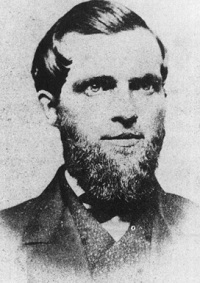

Lt. Bascom and Cochise.

The greenhorn lieutenant rode out with 54 cavalrymen to Apache Pass and lured Cochise to a confabulation. Cochise showed up with his brother, wife, and children — clearly expecting some sort of social call.

Cochise was entirely unaware of the kidnapping, and unaware that Bascom considered him the kidnapper. He offered to find out about it and retrieve the boy from whomever had him.

Bascom, whose troops had surrounded the tent during the parley, accused Cochise of lying to him. Cochise had twice the impertinent lieutnant’s years and at least that multiple of Bascom’s sense, and must have been affronted by his opposite number’s behavior — but when Bascom announced that he would be taking Cochise and his companions as prisoners pending the return of the raiders’ spoils, the Apache commander whipped a knife out of its sheath and instantly slashed his escape route through the wall of the tent. Bursting past the shocked troops (they were as inexperienced as their officer), Cochise escaped into the twilight. This “Bascom Affair” (to Anglos) is remembered more evocatively by Apaches as “Cut Through The Tent”.

But the tent-knifing was only the start of it.

Cochise’s party did not manage to follow his escape, so Bascom now held Cochise’s brother, wife, son, and two other warriors. The Apache tried to put himself in a negotiating position by seizing hostages of his own — first a Butterfield stagecoach stationmaster named Wallace, and later three white men seized from a passing wagon train.

Nor were the hostages’ the only lives at stake. Cochise’s band, including the soon-to-be-legendary Geronimo, had assembled and their campfires burned menacingly in the hills around the little stage station where Bascom’s force fortified themselves. Bascom could have defused it all with a hostage swap, but the kid had his orders and stubbornly refused to make the trade unless it included the one hostage Cochise didn’t have: that little boy from the ranch.

At length, reinforcements for the beleaguered cavalry began arriving, one such party bringing three other Apaches captured en route and entirely unrelated to Cochise. “Troops were sent out to search for us,” a much older Geronimo recalled in his memoirs. “But as we had disbanded, it was, of course, impossible for them to locate any hostile camp … while they searched we watched them from our hiding places and laughed at their failures.”

Despairing now of seeing his family again, Cochise had his hostages killed and dispersed, leaving the mutilated remains to be discovered by his antagonists with the help of circling buzzards. When they did so, they retaliated in fury — releasing only Cochise’s wife and child, but hanging the six other hostages, including Cochise’s brother. In the narration of Sgt. Daniel Robinson,

After witnessing the fiendish acts committed by the Apaches, the minds of our officers and men were filled with horror, and in retaliation, it was decided in Council, that the captive Indians should die. On the 19th we broke camp to return to our respective posts leaving a Sergeant and eight men to take charge of the station until relieved. We halted about half a mile from the station where there was a little grove of Cedar trees. The Indians were brought to the front with their hands tied behind their backs, and led up to the trees. Noosed picket ropes were placed around their necks, the ends thrown over the limbs of the trees and manned by an equal number of willing hands. A signal was given and away flew the spirits of the unfortunate Indians — not to the happy hunting grounds of Indian tradition. According to their ideas or belief in a hereafter, those who die by hanging can never reach that region of bliss. I was in an ambulance with the other Sergeant, and must confess it was a sad spectacle to look upon. An illustration of the Indians sense of Justice: “That the innocent must suffer for the guilty.” And the white man’s notion — “That the only good Indians are dead ones.” Whatever it may be, I do not think it was much worse than the present policy of penning them up on Reservations and starving them to death. (See Cochise: Firsthand Accounts of the Chiricahua Apache Chief.)

A devastating decade-long war against Cochise and his equally able father-in-law Mangas Coloradas ensued, and right when the army most needed its military resources for the Civil War. The conflict claimed hundreds or thousands of lives, crippled mining and ranching, and depopulated fearful white settlements around Apache country in favor of “gravestones … by the road-side like sentinels, bearing the invariable description ‘Killed by the Apaches'”.

A fort near the Texas border was later named for Bascom. The kidnapped boy was never recovered and grew up in a different Apache tribe.

The events of, and following, the Bascom Affair were depicted on the silver screen in the 1950 Jimmy Stewart western Broken Arrow and its 1952 prequel Battle at Apache Pass — among many other cinematic adaptations.


Tom Jeffords (Jimmy Stewart): “Cochise didn’t start this war! A snooty little lieutenant fresh out of the east started it. He flew a flag of truce which Cochise honored, and then he hanged Cochise’s brother and five others under the flag.”

* Cochise was officially at peace with the Americans at this point and hostile to Mexicans. In “Cochise: Apache War Leader, 1858-1861,” in the Journal of Arizona History (Spring 1965), Barbara Ann Tyler argues that the reality of the situation was that his warband flexibly shifted between temporary peace and opportunistic small raids, moving north and south of the Mexican border as convenient.

On this day..

2013: A day in the death penalty around the world

United States

The first U.S. execution of 2013 was that of Robert Gleason, Jr. in Virginia last January 16.

Gleason was serving a life sentence for another murder when he conned a fellow-prisoner into letting him tie his hands as part of a supposed escape attempt. Instead, Gleason choked the poor bastard to death with a urine-soaked sponge.

The killer said he did this precisely in order to be executed.

“I murdered that man cold-bloodedly,” he told a reporter in 2010. “I planned it and I’m gonna do it again. Someone needs to stop it. The only way to stop me is to put me on death row.”

He was as good as his word. That summer, he got a necklace around the throat of a prisoner in a neighboring solitary pen and horribly throttled him to death. Virginia obliged Gleason’s heart’s desire with a death sentence that the killer did not contest.

Unusually, Gleason chose to die in the state’s 104-year-old oak electric chair, rather than by lethal injection. Virginia at the time was one of 10 states still allowing an inmate to choose electrocution, but Gleason was the first person to do so since 2010.

His last words: “Well, I hope Percy ain’t going to wet the sponge. Put me on the highway to Jackson and call my Irish buddies. Pog mo thoin. God bless.” As was widely reported after the fact, Pog mo thoin is Gaelic for “kiss my ass.”

His last words — and everything else about him — are remembered here by a reporter who got to know Gleason during his three-year journey to the death chamber.


Somalia

Dennis Allex, an agent of French intelligence held captive for over three years by al-Shabaab militants, was allegedly summarily executed on January 16 following an unsuccessful French raid to free him.

Allex, whose name is thought to be a pseudonym, had been seized in Mogadishu in 2009 and forced during his captivity to broadcast his captors’ demands.

Following the French intervention in Mali last January — an event potentially raising the danger for French hostages throughout the Islamic world — a commando unit attempted to free Allex on January 12.

The French suspect that Allex might have been killed during that operation. His captors, however, claimed that Allex survived it, and that they thereafter “reached a unanimous decision to execute the French intelligence officer, Dennis Allex.

“With the rescue attempt, France has voluntarily signed Allex’s death warrant”


Iran

On this date in 2013, Iran hanged a man in public in the city of Sabzevar.

Also in Sabzevar on the same day, another man suffered a spectacular public lashing.

Still another prisoner was reportedly hanged privately in Mashhad on January 16 in Iran.

On this day..

1939: Fifty-six Poles shot in retaliation at Bochnia

We owe this discomfiting executioner’s-eye view from the ranks of German soldiers as they gun down Poles in the town of Bochnia on December 18, 1939 to a partisan attack two days prior by a Polish underground organization called White Eagle. Fifty-six civilians were executed in retaliation.

On this day..

1864: Four Confederate soldiers, under Burbridge’s Order 59

The Martyrs Monument of Midway, Ky., honors four Confederates publicly executed by the Union one hundred fifty years ago today.

A brutally contested frontier zone between North and South, Kentucky at this point was under martial law, governed by General Stephen Burbridge — but nearly anarchic on the ground in some areas.

In an effort to quell the activities of Confederate guerrillas-slash-outlaws, Burbridge issued a still-notorious directive called Order 59: Citing the “rapid increase in this district of lawless bands of armed men,” the order threatened to expel Southern sympathizers and seize their property. Moreover, it warned: “Whenever an unarmed Union citizen is murdered, four guerrillas will be selected from the prison and publicly shot to death at the most convenient place near the scene of the outrages.”

The outrages in question for this occasion were raids on Midway horse farms* (allegedly led by “Sue Mundy”) that, on November 1, resulted in a shootout fatal to one Adam Harper Jr.

Agreeably to Order 59, Burbridge had four of his prisoners — men with no specific connection to Harper’s death — shot on the town’s commons, forcing the local populace to attend the scene.

Rest
Soldiers
Rest
Thy
Warfare
Oe’r [sic?]

M. Jackson
J. Jackson
C. Rigsner
N. Adams

Shot by order of
Genl. Burbridge
Nov. 5 1864
In retaliation

Our Confederate Dead

Burbridge would be dismissed, and his Order 59 revoked, early the next year. “Thank God and President Lincoln,” was the reaction of the Louisville Journal.

Three other similar monuments in Kentucky (in Eminence, Jeffersontown, and St. Joseph) honor other soldiers executed under Burbridge’s retaliation policy.

* Midway knows from horses.

On this day..

1961: About fifteen anti-Lumumbists, in Stanleyville

Although it occurred some weeks before, the execution/murder of Congolese Prime Minister Patrice Lumumba only became public on February 13, 1961.

A week later, on February 20, pro-Lumumba forces in Stanleyville (today, Kisangani) shot approximately 15 prisoners in retaliation. Stanleyville was the headquarters of Lumumba ally Antoine Gizenga, whose enclave the late Lumumba had been trying to reach when he was captured. In the confused post-Lumumba days, Gizenga elevated himself to head of state for the rebellious Lumumbist state; 21 Communist-backed states would recognize this as Congo’s legitimate government, in opposition to the official one of Joseph Kasavubu.

Those suffering the Lumumba-backers’ wrath this date included ten politicians — notably Alfonse Songolo, a former Lumumbist minister who had prominently broken with that faction after Lumumba was deposed the previous autumn — plus five soldiers in the anti-Lumumba force of the bright young officer and future definitive author of Congolese horrors, Joseph-Desire Mobutu.

The London Times had reported (Feb. 23-24) that “usually well-informed sources” alleged the execution, but that the U.N. was unable itself to confirm the fact independently.

On this day..

1290: Zavis of Falkenstein

On this date in 1290, the vaunting nobleman Zavis of Falkenstein was beheaded below the walls of Hluboka Castle.

For from this eminence ye shall discern
Better the acts and visages of all,
Than in the nether vale among them mix’d.
He, who sits high above the rest, and seems
To have neglected that he should have done,
And to the others’ song moves not his lip,
The Emperor Rodolph call, who might have heal’d
The wounds whereof fair Italy hath died,
So that by others she revives but slowly,
He, who with kindly visage comforts him,
Sway’d in that country, where the water springs,
That Moldaw’s river to the Elbe, and Elbe
Rolls to the ocean: Ottocar his name:
Who in his swaddling clothes was of more worth
Than Winceslaus his son, a bearded man,
Pamper’d with rank luxuriousness and ease.

-Dante’s ungenerous assessment of Wenceslaus in the Purgatorio

The Bohemian Premyslid dynasty was at the height of its power in the 13th century. King Ottokar II, ruling a vast swath of central Europe, twice mounted unsuccessful bids for election to the imperial throne.

The second man to defeat him, Rudolph,* Ottokar refused to recognize, and open warfare ensued between the men — a war that Rudolph won when Ottokar was killed in battle in 1278.

The late sovereign left to his six-year-old son Wenceslaus II a reduced patronage, a betrothal to Rudolph’s daughter, and a strong domestic noble faction like to oppose the crown internally.

Zavis of Falkenstein was among the foremost of the many complications afflicting the young Wenceslaus. His Vitkovci family had been among the late Ottokar’s most potent domestic opponents,** and Claudius-like slithered right into the royal bed with Ottokar gone. Zavis paid court to the widow of his great foe, the Queen Regent Kunhunta, and married her in 1285. He was the first man in the kingdom for several years.

Wenceslaus, still a teenager, was becoming frantic at the prospect of Zavis usurping him altogether. When Kunhunta died and Zavis left town to marry again, the monarch turned the tables on his “protector”. When Zavis returned to Prague, he found himself clapped in prison. Wenceslaus then packed Zavis up for a Bohemian tour, where the hostage was brandished at belligerent Vitkovci fortresses to force their submission. Hluboka Castle, commanded by Zavis’s brother, refused to knuckle under, so the threat — and Zavis — were executed.

When your South Bohemia holiday stops over for a visit to this still-extant castle consider a stay at Hluboka nad Vltavou‘s four-star Hotel Zavis z Falkenstejna. Zavis himself is interred much further south at the borderlands’ Vyssi Brod monastery, which also boasts a jeweled crucifix donated for the salvation of the ambitious magnate’s soul.

* Rudolph I (Formerly Count Rudolph IV) was the first Habsburg king.

** Ottokar founded the city of Ceske Budejovice to project his power into the Vitkovci’s South Bohemia stomping-grounds. The city is still going strong; from its name derives the disputed Budweiser beer brand.

On this day..

1944: A day in mass executions in Axis Europe

June 29, 1944, saw several noteworthy mass executions around Axis western Europe.

France: Seven Jewish hostages for the assassination of Philippe Henriot

Poet and journalist Philippe Henriot (English Wikipedia entry | French), the “French Goebbels”, was the Vichy government’s able chief propagandist.

On June 28, 1944, Henriot was assassinated by Maquis operatives disguised as milice paramlitaries.

Incensed, the real milice this morning gathered seven Jews already held in prison as hostages at Rillieux, drove them to the cemetery, and shot them one by one.

(Paul Touvier, who orchestrated this retaliatory execution, managed to stay underground until 1989. At his 1994 war crimes trial, he claimed that the Germans wanted 30 hostages killed, and therefore what he actually did was “save 23 human lives.” Touvier was convicted on the charge of crimes against humanity.)


Italy: Massacres in San Pancrazio, Cornia, and Civitella

As dawn broke this date, German soldiers retreating from liberated Rome fell upon several Tuscan villages.

German columns had been beset by partisans on the way, and standard operating procedure was to retaliate against partisans indirectly, by killing civilians — as in the notorious massacre in the Ardeatine caves. This vengeance was visited on the three towns: over 200 civilians were summarily executed on June 29, 1944.

“My mother later said she went to speak to my father,” remembered one San Pancrazio man. “A soldier turned her back and told her they were taking him to be tortured. She and my father both cried.” The father and those taken with him were shot in the basement of a farmhouse.

Caution: Graphic video.

The towns themselves have kept this date in remembrance, but the massacres were swept under the rug in the postwar settlement as Italy, Germany, and their former western enemies realigned for the Cold War. Only in the 21st century have they come to wider attention, when the discovery of secret archives documenting the atrocities enabled an Italian court to convict an aged German soldier in absentia.

There’s a CNN documentary on these events focusing particularly on San Pancrazio. Called “Terror in Tuscany”, it may be viewable here or here, depending on your location.


Denmark: The Hvidsten Group

The Danish resistance group named for a Jutland tavern was betrayed by a captured Brit under torture.

S. P. KRISTENSEN * 20. 8. 1887
ALBERT IVERSEN * 28. 9. 1896
NIELS N. KJÆR * 2. 4. 1903
JOH KJÆR HANSEN * 2. 4. 1907
HENNING ANDERSEN * 16. 7. 1917
MARIUS FIIL * 21. 6. 1893
PETER SØRENSEN * 8. 6. 1919
NIELS FIIL * 12. 6. 1920

1944 on the 29 June
They fell before German bullets
Precious is their memory to Denmark

Hvidsten Group stone photo is a (cc) image from Hansjorn.

On this day..

1922: Four anti-Treaty Irish Republicans

On this date in 1922, Irish Republicans Rory O’Connor, Liam Mellows, Richard Barrett and Joe McKelvey were shot.


Stagey-looking fake propaganda photo of Rory O’Connor’s (very real) Dec. 8, 1922 execution.

These four were militant foes of the 1921 Anglo-Irish Treaty, which was to the Troubles as the Apple of Discord was to the Trojan War.

Furious at the betrayed dream (and, briefly, reality) of a united Irish republic, they were among those who occupied central Dublin’s Four Courts in April 1922, hoping to draw Britain into a counterproductive intervention.

It was a move straight from the playbook of tragic guerrilla-cum-statesman Michael Collins … except that Collins was on the other side in 1922. Collins, then Chairman of the Provisional Government for the new Irish state (and negotiator of the hated treaty) spent that spring trying to convince the Four Corners occupiers to back off, but also not intervening to force their garrison out.

Noninterference came to an end after some other Irish militants assassinated British Field-Marshal Sir Henry Wilson in June 1922. London put the political screws to Michael Collins, leading to the anomalous sight of the onetime anti-British revolutionary turning British-lent artillery against Dublin republicans.


Times change.

The Four Courts guys, imprisoned from July, would provide an even more poignant illustration of Ireland’s heartbreaking house-divided history.

For it was the Provisional Government’s Minister of Justice Kevin O’Higgins who ordered the executions — a man who had once been so tight with the executed Rory O’Connor that O’Connor was in his wedding party. (Where they toasted the Easter Rising martyrs.)

What could turn men so tight against one another? On December 7, anti-Treaty gunmen killed Sean Hales, an IRA man whom Collins had brought over to the pro-Treaty side. In a ruthless reprisal, Higgins approved the summary execution of his former comrades.

According to the official announcement* — which was bitterly denounced as lawless by the Free State’s Labour parliamentarians —

The execution took place this morning at Mountjoy Gaol of the following persons taken in arms against the Irish Government: — Rory O’Connor, Liam Mellowes, Joseph McKelvey, and Richard Barrett, as a reprisal for the assassination on his way to Dail Eireann on December 7 of Brigadier Sean Hales, T.D., and as a solemn warning to those associated with them who are engaged in a conspiracy of assassination against the representatives of the Irish people.

Bloody ironies would stack one upon the other. The rest of Sean Hales’s family had remained staunchly anti-Treaty, and publicly denounced the executions.

Sean’s own brother Tom Hales had famously withstood British torture in 1921. But Tom is even more famous for a different deed: in August 1922, Tom Hales led the republican column that ambushed and killed Michael Collins.

Many more bodies lay ahead.

* Quoted in the December 9,1922 London Times, along with some of the opposition firestorm that ensued in the Dail. “Mr. Cathal O’Shannon, shouting indignantly at the Government, said they were not fit to govern, and described the executions as the greatest crime, without exception, committed in Ireland in the last ten years. ‘You have no authority,’ he said, ‘to execute these men. You murdered them.'”

On this day..

1347: Not the Six Burghers of Calais

On this date in 1347, the city of Calais yielded to an English siege.


The siege of Calais, from Jean de Wavrin‘s Chroniques d’Angleterre. (More images)

Edward III had proceeded to invest Calais directly after the previous year’s staggering win at Crecy. The crippled French leadership could not relieve the city, and after fruitlessly probing for an opening, the relief army marched away at the start of August 1347.

By this time reduced to eating vermin and ordure, the starved city had little choice but to capitulate. According to Froissart’s account, the king declared that “the Calesians have done him so much mischief, and have, by their obstinate defence, cost him so many lives and so much money, that he is mightily enraged.” He wasn’t only sore about the city’s holding out over the preceding year: Calais was notorious as a refuge for English Channel pirates who had long bedeviled the commerce of Edward’s realm.

As a condition for sparing the rest of the town, Edward demanded that six of its leading citizens present themselves to him, “with bare heads and feet, with ropes round their necks, and the keys of the town and castle in their hands.” Edward seems truly to have meant (much against the conscience of his own nobles) to put these men to death “for that the Calesians had done him so much damage, it was proper they should suffer for it.”

This information caused the greatest lamentations and despair [in Calais]; so that the hardest heart would have had compassion on them; even the lord de Vienne wept bitterly.

After a short time, the most wealthy citizen of the town, by name Eustace de St. Pierre, rose up and said: “Gentlemen, both high and low, it would be a very great pity to suffer so many people to die through famine, if any means could be found to prevent it; and it would be highly meritorious in the eyes of our Saviour, if such misery could be averted. I have such faith and trust in finding grace before God, if I die to save my townsmen, that I name myself as first of the six.” When Eustace had done speaking, they all rose up and almost worshipped him: many cast themselves at his feet with tears and groans Another citizen, very rich and respected, rose up and said, he would be the second to his companion, Eustace; his name was John Daire. After him, James Wisant, who was very rich in merchandise and lands, offered himself, as companion to his two cousins; as did Peter Wisant, his brother. Two others then named themselves, which completed the number demanded by the king of England.

Wealthy elites sacrificing themselves for the greater good? The past really is a different country.

These six duly presented themselves, nearly naked and haltered and braced to bear the brunt of Edward’s vengeance. The English king had the executioner summoned … and then, Edward’s (very pregnant) queen Philippa dramatically fell to her knees

and with tears said, “Ah, gentle sir, since I have crossed the sea with great danger to see you, I have never asked you one favour: now, I most humbly ask as a gift, for the sake of the Son of the blessed Mary, and for your love to me, that you will be merciful to these six men.”

The king looked at her for some time in silence, and then said; “Ah, lady, I wish you had been anywhere else than here: you have entreated in such a manner that I cannot refuse you; I therefore give them to you, to do as you please with them.” The queen conducted the six citizens to her apartments, and had the halters taken from round their necks, after which she new clothed them, and served them with a plentiful dinner: she then presented each with six nobles, and had them escorted out of the camp in safety.

Edward still had the last laugh when it came to Calesian carnage.

This nigh-unconquerable foothold on the French coast would persist in English hands for two centuries: the first century spanned the Hundred Years’ War, which England was licensed to protract by dint of (and France would not settle because of) the menacing northern base England won this day. “Each will have to take up his shield,” ran a French verse cited in Barbara Tuchman’s A Distant Mirror: The Calamitous 14th Century, “For we’ll have no peace till they give back Calais.”


The Six Burghers persisted even longer than that.

George Bernard Shaw wrote a one-act play standing the story on its head, in which a henpecked Edward exasperatedly yields to his nagging wife’s merciful caprice, to the open derision of the burghers themselves.

A bit more exalted of spirited is Rodin‘s sculpture group Les Bourgeois de Calais — rendering six emaciated, suffering, and courageous figures.

I have, as it were, threaded them one behind the other, because in the indecision of the last inner combat which ensues, between their devotion to their cause and their fear of dying, each of them is isolated in front of his conscience. They are still questioning themselves to know if they have the strength to accomplish the supreme sacrifice–their soul pushes them onward, but their feet refuse to walk.

They drag themselves along painfully, as much because of the feebleness to which famine has reduced them as because of the terrifying nature of the sacrifice … And certainly, if I have succeeded in showing how much the body, weakened by the most cruel sufferings, still holds on to life, how much power it still has over the spirit that is consumed with bravery, I can congratulate myself on not having remained beneath the noble theme I dealt with.

Rodin

The discriminating connoisseur of Middle English may also enjoy Laurence Minot‘s poetic celebration of the siege of Calais. (Helpful explanatory annotations.)

Part of the Themed Set: Scary Escapes.

On this day..

1945: 8 American flyers at Fukuoka

On this date in 1945 — morning after a devastating U.S. air raid that destroyed much of Fukuoka — eight previously-captured American airmen* were summarily executed there in retaliation.

In a precedent that dated back to the Doolittle raids, Japan officially considered as a prospective war criminal any enemy airman who could be connected to indiscriminate bombing. Tokyo didn’t follow this logic to the point of executing all downed Americans — indeed, late in the war, beleaguered Japanese civilians became increasingly hostile towards the government for allowing excess legalism to stand in the way of exacting some satisfying revenge for the cities burning under American bombs — but it did execute some, and it had sanctioned legal theorems that could have accommodated quite a bit more bloodletting.

Finding Tokyo short of prison space, the government ordered on May 1, 1945, that the various armies should no longer send to the capital any downed airmen they captured. In the chaos of the war’s last months, this would create the context for local commanders at the Western Military District in Fukuoka to put those legal theorems to seriously nasty use.

Four captured airmen held in Fukuoka were stuck in an indeterminate judicial process which the army realized was going nowhere slowly. The others were just plain underfoot. Over the period of May-June, between a couple of ambiguously-worded orders and the officers’ annoyance at having to divert scarce resources to these captives, an understanding formed if “the air raids increased and conditions became more chaotic, the prisoners would be executed without a trial.”

Well, as U.S. papers exultantly reported on June 20,

About 3,000 tons of … incendiary bombs … were released by the B-24s from low level starting about three a.m. … The three cities [Fukuoka, Toyotashi and Shizuoka] were tasting for the first time the bitter flames of war, roaring over factories, shops and thousands of congested homes.

Timothy Lang Francis, whose “‘To Dispose of the Prisoners’: The Japanese Executions of American Aircrew at Fukuoka, Japan, during 1945” from the November 1997 Pacific Historical Review traces the confluence of factors that made possible this day’s executions, describes the fate that was unfolding for Fukuoka’s eight captive airmen at about the same time those words were going to press.

All were blindfolded and had their hands tied in front. Several swords were obtained from the Legal Section. [Yusei] Wako** then told the twenty or so assembled Japanese that, “in compliance with the Commanding General†’s orders, we were going to execute the plane crash survivors.” One officer, Lt. Michio Ikeda of the Medical Section, volunteered himself, and Wako ordered Probationary Officer Tamotsu Onishi, since he was skilled in kendo, to assist him as a third executioner. Sato watched the proceedings from one side.

The first flyer was brought to the edge of the pit and made to sit on his haunches. Wako then ritually washed one of the swords and stood behind the prisoner, slightly to the left. Raising the sword above his right shoulder with both hands, Wako brought it down on the flyer’s neck. “Both the body and head fell into the pit,” remembered Wako; “I washed my sword and ordered the guard to bring another flyer to the pit. I killed this flyer exactly the same way I had killed the first one.” Onishi then executed a third prisoner in the same manner.

In the pause that followed, Lt. Kentaro Toji, an officer attached to Western Army Headquarters, approached Sato. According to his pretrial affidavit, Toji said to Sato, “My mother was killed in the air raid on Fukuoka this morning, and I think it would be fitting that I be the one who execute these American flyers.” Sato told him to wait while Wako ordered Ikeda to execute the fourth flyer. Toji, after borrowing a sword from Onishi, beheaded the last four prisoners. The pit was then filled with dirt.

This is all well and good, but Tokyo’s orders to its armies had been to do the juridical legwork on these cases themselves — and not just to summarily kill prisoners. So, in a bit of ex post facto bureaucratic butt-covering, the Western District Army’s legal section proceeded to close the matter by shipping the central government a report saying that all these prisoners had been killed during the previous night’s air raid. Problem solved!

No known direct connection to this particular atrocity, but there’s a recent documentary about an elderly Japanese man who used to serve at Fukuoka that looks worth the watching.

* Six of the eight were Robert J. Aspinall, Merlin R. Calvin, Jack V. Dengler, Otto W. Baumgarten, Edgar L. McElfresh, and Ralph S. Romines. The other two remain unidentified. These eight were, maybe, the lucky ones: Fukuoka had had 16 prisoners from downed bombers, but the other eight weren’t around to be beheaded because they’d previously been given over to the local hospital to suffer ghastly deaths in vivisection experiments.

** A Judge Advocate who had also been involved in the Doolittle trials.

† Gen. Isamu Yokoyama. When he’d been briefed prior to the June 19 raid that the army was fixing to just dispose of its prisoners if it came to that, Yokoyama had done the Pontius Pilate act and informed Wako, “I have decided to concern myself only with the decisive battle and hereafter do not bother me with the problem of the flyers.”

On this day..