1842: Charles Stoddart and Arthur Conolly, Great Game diplomats

On this date in 1842,* British diplomats Charles Stoddart and Arthur Conolly were summarily beheaded by a Central Asian potentate as London’s ill-chosen intervention in Afganistan came to a disastrous conclusion.

The backdrop is “the Great Game”,** the long-running chess match for supremacy in Central Asia between an expanding Russian Empire and Great Britain, with its imperial position in India.

Seeking to pre-empt a Russian move into Afghanistan, Britain invaded in 1839. This was the First Anglo-Afghan War: it would have, for the Brits, an inglorious end.

Our day’s featured principals were among the postscript casualties of that catastrophe, never-avenged losses for an empire that had overreached itself.

Stoddart, an intelligence officer, had been dispatched northward to the ancient silk road city of Bokhara intending enlist the allegiance, or at least the benign neutrality, of its emir, Nasrullah Khan. Today Uzbekistan’s fifth-largest city, Bokhara was then an independent state .

[I]n the nineteenth century, the executions carried out there with genuine cruelty, as well as the tales told by travelers gave the city a reputation of being a forbidden, closed, and hostile place. It was “despotic” Bukhara, and the Europeans projected onto it their own oriental fantasies: with citadel, dungeons, palaces, and city walls bolted shut at night, all helping to set the scene.

(Vibe on some the oriental fantasy in the 1911 volume The Emir of Bokhara and His Country, or this volume on Russian Central Asia, which by then included Bokhara.)


Scenic! Bukhara’s historic citadel, the Ark, where Stoddart (and later Conolly) were imprisoned (and later executed). (cc) image from elif ayse.

Into this scene, our Brit entered clumsily, immediately irritating the ruler he intended to supplicate. Reportedly (though the fact has been disputed), he was on the brink of execution when he acceded to save his life to Nasrullah’s formulaic offer of clemency in exchange for conversion to Islam.

In any event, Stoddart languished for years, alternately imprisoned and in the custody of the (better-received) Russian mission. Though the latter had also been charged by its sovereign to retrieve the ill-favored English emissary as a gesture of Great Powers goodwill (and to deprive England of any rationale for intervention that his captivity might offer), Stoddart seems to have been too stubbornly prideful to get out via St. Petersburg while the getting was good.

Instead, he waited on the arrival of countryman Arthur Conolly, who showed up in late 1841 on a mission to secure Stoddart’s release. But Stoddart’s situation little improved, considering Nasrullah Khan’s wary reaction to this second British interloper.

Word has it that the Bukharan prince was piqued that correspondence to him did not arrive over the signature of the British monarch herself, but merely some subcontinental subaltern — as well as, we might think understandably, suspicious at his guests’ motivations and mission.

The captor’s uncertain attitude towards his prisoners was resolved by Britain’s catastrophic loss of Kabul and the subsequent massacre of an entire 16,000-strong army as it attempted to retreat.

Seriously, the whole army. To a man. Except for one guy.


Remnants of an Army, by Elizabeth Butler, depicts the only British subject on retreat from Kabul to reach Jalalabad, William Brydon.

Battles don’t get much more decisive than that.†

Reasoning‡ that the routed British were now of no conceivable threat, nor his prisoners of any conceivable benefit, Nasrullah Khan now accused them of espionage and abused them with impunity.

The two were cast into an Indiana Jones-esque “bug pit,” an oubliette infested with … well, you know.§

Later, finding illicit writing materials secreted on his captives’ persons, the mercurial Nasrullah disposed of them outright.

their quarters were entered by several men, who stripped them, and carried them off to prison … In stripping Colonel Stoddart a lead pencil was found in the lining of his coat, and some papers in his waist. These were taken to the Ameer, who gave orders that Colonel Stoddart should be beaten with heavy sticks until he disclosed who brought the papers, and to whom he wrote. He was most violently beaten, but he revealed nothing; he was beaten repeatedly for two or three days. On Friday, the 8th or 9th (the 7th) of Jemmadee-ool-Eovel (17th of June), the Ameer gave orders that Colonel Stoddart should be killed in the presence of Captain Conolly, who was to be offered life if he would become a Mahomedan. In the afternoon they were taken outside the prison into the street, which is a kind of small square. Their hands were tied across in front. Many people assembled to behold the spectacle. Their graves were dug before their eyes. Colonel Stoddart exclaimed aloud at the cruelty and tyranny of the Ameer. His head was then cut off with a knife.

The chief executioner then turned to Captain Conolly, and said — “The Ameer spares your life if you will become a Mussulman.” Captain Conolly answered, “Colonel Stoddart has been a Mussulman for three years, and you have killed him, you killed Yoosoof too; I will not be a Mussulman, and I am ready to die.” Saying which he stretched forth his neck. His head was then cut off.

London Times, Aug. 22, 1843, reporting the testimony of a dubious local semi-ally

The veracity of this faint bulletin from a distant and inaccessible realm nevertheless remained in some doubt. Friends of the lost men, despairing of obtaining definitive word of their fate, commissioned a strange but courageous missionary named Joseph Wolff to brave his own sojourn to Bokhara to investigate.

Wolff barely escaped with his own life, but seemingly confirmed the sad story and published a Narrative of his travels in 1845 (Part 1, Part 2).

* The initially reported June 17 execution date was subsequently contested by Joseph Pierre Ferrier, who argued that the chronology instead pointed to the next Friday, June 24. The matter appears to me permanently unresolvable.

** Ironically, the sportive phrase “the Great Game” was itself attributed to Arthur Conolly for whom, in the end, events turned out to be quite other than playful.

† Britain recaptured Kabul in reprisal later in 1842, upon which pretext it was able to declare its honor vindicated and depart Kabul (sans massacre), ending the war. Certain latter-day occupations of that “graveyard of empires” might envy their forebear’s talent for declaring victory and leaving.

‡ Correctly. Nasrullah Khan faced no British reprisal for his treatment of Stoddart and Conolly, notwithstanding the attempt by some friends to use their sad fate as some sort of casus belli. This public domain book from 1845 bears a dedication to Queen Victoria in “hope of directing your Majesty’s attention to the cruel sufferings and alleged murder of two British officers … abandoned in an unaccountable manner, by your Majesty’s Government … [in circumstances] degrading to the British nation;” the same man had previously published an “Appeal to the British Nation” in an “endeavour to excite the public sympathy.” Sympathy or no, the two British officers stayed abandoned.

§ Bug tortureenhanced interrogation was actually authorized during the Bush administration for the insect-averse Abu Zubaydah. The gentleman approving that technique, Jay Bybee, is now a federal circuit judge.

On this day..

1098: Rainald Porchet, martyr Crusader

On this date in 1098, Antioch’s besieged Muslim defenders martyred a Crusader knight who refused to secure a ransom for himself.

The armies of the First Crusade had pressed their way through Anatolia and had laid to siege these past five months the ancient Syrian city of Antioch. (It’s in modern Turkey now, where it’s known as Antakya.)

On April 3, 1098, by the account of the priest Peter Tudebode, an eyewitness to the event,

the Turks led to the top of an Antiochian wall a noble knight, Rainald Porchet [alternatively, Rainaud or Reynaud Porquet], whom they had imprisoned in a foul dungeon. They then told him that he should inquire from the Christian pilgrims how much they would pay for his ransom before he lost his head.

According to Encounter Between Enemies: Captivity and Ransom in the Latin Kingdom of Jerusalem — a source which ought to know, if any would — marching a guy out to appeal to his comrades was little to the Antiochians but the time-honored practice of ransoming captured VIPs, “the usual diplomatic method of starting a peaceful encounter with the enemy, in the between-fighting interlude.” It’s not like this sort of hostage-hocking was unknown to Europeans; even hundreds of years later, France cratered its economy by ransoming its captured king from the English.

To the shock of the garrison, Porchet went all clash-of-civilizations on this routine diplomacy.

From the heights of the wall Rainald addressed the leaders: “My lords, it matters not if I die, and I pray you, my brothers, that you pay no ransom for me. But be certain in the faith of Christ and the Holy Sepulchre that God is with you and shall be forever. You have slain all the leaders and the bravest men of Antioch; namely, twelve emirs and fifteen thousand noblemen, and no one remains to give battle with you or to defend the city.”

The Turks asked what Rainald had said. The interpreter replied: “Nothing good concerning you was said.”

The emir, Yaghi Siyan, immediately ordered him to descend from the wall and spoke to him through an interpreter: “Rainald, do you wish to enjoy life honorably with us?”

Rainald replied: “How can I live honorably with you without sinning?”

The emir answered: “Deny your God, whom you worship and believe, and accept Mohammed and our other gods. If you do so we shall give to you all that you desire such as gold, horses, mules, and many other worldly goods which you wish, as well as wives and inheritances; and we shall enrich you with great lands.”

Yaghi Siyan was obliged to make this proposition of apostasy to his prisoner as a prelude to executing him.

Rainald replied to the emir: “Give me time for consideration;” and the emir gladly agreed. Rainald with clasped hands knelt in prayer to the east; humbly he asked God that He come to his aid and transport with dignity his soul to the bosom of Abraham.

When the emir saw Rainald in prayer, he called his interpreter and said to him: “What was Rainald’s answer?”

The interpreter then said: “He completely denies your god. He also refuses your worldly goods and your gods.”

After hearing this report, the emir was extremely irritated and ordered the immediate beheading of Rainald, and so the Turks with great pleasure chopped off his head: Swiftly the angels, joyfully singing the Psalms of David, bore his soul and lifted it before the sight of God for Whose love he had undergone martyrdom.

Rainald got himself a starring role in the Chanson d’Antioche, an epic poem celebrating the Crusade, for this pious self-sacrifice. We can only presume that his name- and numberless compatriots in the dungeons, who also paid the price for Rainald’s obstinacy, were satisfied with suffering the same fate but only getting a role in the chorus.

Then the emir, in a towering rage because he could not make Rainald turn apostate, at once ordered all the pilgrims in Antioch to be brought before him with their hands bound bend their backs. When they had come before him; he ordered them stripped stark naked, and as they stood in the nude he commanded that they be bound with ropes in a circle. He then had chaff, firewood, and hay piled around them, and finally as enemies of God he ordered them put to the torch.

The Christians, those knights of Christ, shrieked and screamed so that their voices resounded in heaven to God for whose love their flesh and bones were cremated; and so they all entered martyrdom on this day wearing in heaven their white stoles before the Lord, for Whom they had so loyally suffered in the reign of our Lord Jesus Christ, to Whom is the honor and glory now and throughout eternity. Amen.

In these heady early months of the Crusades, when the enterprise stumbled from near-disaster to miraculous success, the renown of Porchet et al was clinched by the siege’s success in early June — just days ahead of the arrival of a Turkish relief force which thereafter had to content itself with besieging the now-Crusader-held city.

When this second siege was repelled with the help of the Christians’ convenient — staged, one might think — “discovery” of the Holy Lance of Antioch, everyone had to know that the Big Guy was truly on their side.

On this day..

2002: Daniel Pearl

“I decapitated with my blessed right hand the head of the American Jew, Daniel Pearl, in the city of Karachi, Pakistan. For those who would like to confirm, there are pictures of me on the Internet holding his head.”

-9/11 mastermind Khalid Sheikh Muhammad, in a claim made after torture in Guantanamo but nonetheless considered accurate according to a detailed 2011 report on Pearl’s death*

Warning: Although the filming was botched, this execution video still has plenty of gore and a severed head.

On this date in 2002, American hostage Daniel Pearl was executed by his captors in Karachi, Pakistan.

The 38-year-old Wall Street Journal reporter had been abducted January 23 by Islamic radicals while pursuing an interview with a (mistakenly) suspected handler of shoe bomber Richard Reid. Instead of being taken to the interview, Pearl was disappeared and held hostage for a variety of implausible demands targeting the United States’ relationship with Pakistan’s military government.

The reporter’s death this day was not confirmed until late February, when his killers released a video on the Internet interspersing images of American and Israeli violence with footage of Pearl speaking — and then, horrifically, of Pearl being beheaded with a knife.** It was the first of several hostagebeheading videos various militants would release in the next few years.

Pearl’s captors drew a direct line from his Jewishness to his murder in the statements they forced him to make:

My name is Daniel Pearl. I am a Jewish American from Encino, California USA … I come from, uh, on my father’s side the family is Zionist … My father’s Jewish, my mother’s Jewish, I’m Jewish … My family follows Judaism. We’ve made numerous family visits to Israel … Back in the town of B’nei Braq there is a street named after my great grandfather Chayim Pearl who is one of the founders of the town.

It was the more startling because Pearl himself was a very secular Jew. Pearl did not set out to be a martyr for his cultural or religious heritage: that identity as the identity was thrust upon him.

And it’s been suggested that it was thrust upon Pearl’s captors as well, whose object in kidnapping an American reporter might have been a much more parochial kidnapping commonplace — publicity, cash — but who became politically boxed in when their hostage was publicized by the media as a “Jewish-American reporter”. One of the emails the captors had pre-drafted actually announced Pearl’s release. It was edited after the kidnapping … to announce Pearl’s execution within 24 hours, as a Mossad agent. Al-Qaeda’s Khalid Sheikh Mohammed seems to have been summoned from outside the abductors’ circle as a ringer with the captors unsure of how to dispose of their prey.

As an investigative reporter, Pearl’s own work had in some notable instances countered the preferred narratives of American hegemony. For instance, his reporting rubbished American charges that the Khartoum pharmaceutical factory Bill Clinton ordered bombed in 1998 was actually a chemical weapons plant. His work in Kosovo led him to contradict the most bellicose “genocide” allegations from that region’s dirty ethnic war.

He was a star reporter in the prime of his life, a man who poured out words that defined a career and a public persona. From February 1, 2002, suddenly and without justice, that text was torn from his hands. In its place, during the charged months after September 11 and the American invasion of Afghanistan, came a silent Rorschach blot.

Pearl, the Jewish martyr. Pearl, the victim of blowback. Pearl, the journalistic icon. Pearl, the naive liberal in the heart of darkness. Pearl, the mandate for waterboarding and Iraq.

Pearl, the object lesson.

Pearl, the axe for others’ grinding.

Omar Sheikh, a Pakistani militant reportedly linked to Britain’s MI6 and the author of the kidnapping, was arrested within days of Pearl’s murder. He remains imprisoned under sentence of death in Pakistan for the crime.

* Mohammed also claimed that he wanted to kill Pearl personally to “make sure I got the death penalty” if he were eventually arrested.

** Among the many bone-chilling details to emerge from the subsequent investigation, it became clear that the actual murder was not shown — only some quick flashes of re-enacted throat-cutting — because the cameraman missed the shot of the kill.

On this day..

1802: Jacques Maurepas and his entire family

On this date in 1802, a Haitian general, his family, and his men, were butchered by French forces fighting to retain control of Saint-Domingue.

Haing recently mastered the French Revolution, Napoleon Bonaparte — ever one for keeping it in the family — late in 1801 dispatched his brother-in-law* and brother-in-arms Leclerc to suppress the Haitian Revolution.

Over the course of 1802, Leclerc made headway towards accomplishing just that, as much with carrots as with sticks.

Maurepas was one of the Haitian commanders tasked by Toussaint L’Ouverture with defending Saint-Domingue, in his case, Port-de-Paix. Faced with a French landing, Maurepas burned the town to the ground and withdrew for an effective guerrilla resistance in the mountains.

But he eventually came to terms with the French, as did other Haitian officers, L’Ouverture included — reintegrating forces back with the French on the understanding that all that liberte, egalite, fraternite stuff would at least extend as far as not reintroducing slavery.

The French had other plans for their lucrative once-and-future colony, and when the Haitians caught wind of them, trouble resumed — now under the leadership (since the French had sagely deported L’Ouverture) of Jean-Jacques Dessalines.**

Leclerc had the, er, “fortune” of succumbing to yellow fever shortly after Dessalines’ promising revolt got underway; he was succeeded by the brutal Rochambeau, who threw away the carrots and relied on naked violence to control the island. (Again, not uncharacteristic of Napoleonic conquests.)

Maurepas had not actually gone over to Dessalines, but the fact that he was a black Haitian general was reason enough for his white French superior officer to arrest him preventively. Immediately upon assuming command, Rochambeau made an example of Maurepas.

The sea off the Cape was chosen to be the theatre of an execution, unparalleled in what is called civilized life. For fear that Maurepas, who had gained distinction under Toussaint L’Ouverture, after having embraced the side of France, should join the insurgents, Leclerc had written to him to come by sea, with his family and his troop, to take the command of the Cape, which he destined for him as a reward for his services. No sooner had he arrived than he and his soldiers were seized and disarmed. Rochambeau ordered preparations to be made for a barbarous punishment in order to put the negro general to death, with his troop, consisting of 400 blacks. It was also put in deliberation whether death should be inflicted on his children, in order to prevent them from rising up to avenge their father.

After having been bound to the mast of a vessel, Maurepas was frightfully insulted. His wife, his children, and his soldiers were brought to be drowned under his eyes. The executioners were astounded when they beheld a father fix his dying eyes by turns on his children, his wife, and his companions in arms, undergoing a violent death; while they, on their part, turned their eyes away from a father, a husband, a general, whose countenance was disfigured by the tortures he was enduring. After being made to contemplate each other’s sufferings, they were all tossed into the ocean. They died without complaining in a manner worthy the champions of liberty. With a reversal of the order of nature, the father died last; he also suffered most.

Thus died Maurepas, whose character was a compound of frankness and severity. Thrice had he repulsed the French at the gorge of Trois-Rivières; he had at once the glory and the misfortune to go over to the French with victorious arms. The elevation of his soul equalled his valor. He preserved a tender feeling for the master whose slave he had been; he caused funeral honors to be paid to that master, and when his grave had been negligently prepared, he threw off his upper garment in order to perform the pious office properly. Among men of his own blood he was a powerful chief. A spirit of order and justice prevailed in his life. His riches, which were considerable, were given up to pillage. It would almost seem as if so much excellence were subjected to so much ignominy, expressly to show that while black men are capable of any virtue, white men are capable of any crime. Certainly, my narrative is replete with instances which, beyond a question, prove that moral as well as mental excellence is independent of the varieties of color.

This brutal punishment, preceded by vile perfidy, filled the camps of the insurgents with horror. That horror was augmented when Rochambeau, at the Cape, put to death five hundred prisoners. On the place of execution, and under the eyes of the victims, they dug a large hole for their grave, so that the poor wretches may be said to have been present at their own funeral.

Far from cowing the rebels into submission, this savagery fired more ferocious resistance from men, women, and children who now perceived that their race subjected them to wholesale and arbitrary cruelty that no display of loyalty could overcome.

A terrible retribution was determined upon. Dessalines erected 500 gibbets, and hanged half a regiment of French that he had captured by a bold countermarch. A war of extermination followed, and in December, 1803, aided by an English squadron, the French were compelled to evacuate the island.

January 1, 1804 is Haiti’s Independence Day.

* By way of marriage to Napoleon’s sister Pauline. Pauline enjoyed the Saint-Domingue adventure more than did her spouse; she sported with lovers and balked at returning to France. “Here,” she noted, “I reign like Josephine; I hold first place.”

This character is the subject of a recent biography.

** After expelling the French and becoming the first ruler of independent Haiti, Dessalines took a page from Napoleon’s own playbook and crowned himself Emperor.

On this day..

1941: Forty-eight French hostages

On “a beautiful autumn day” this date in 1941, four dozen French leftists were executed by that country’s occupiers as punishment for the murder of a German officer.

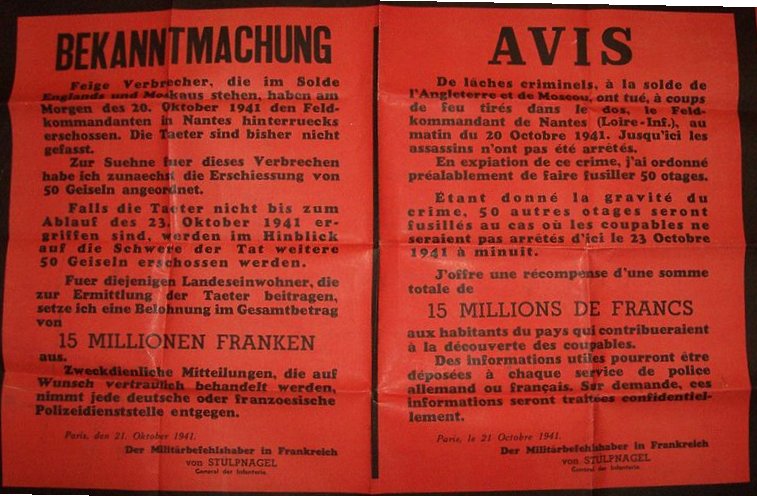
On October 20, 1941 — sixteen months into the German occupation — a pair of Communist commandos assassinated the Feldkommandant of Nantes, Lt. Col. Karl Hotz (French link).

News of this crime went straight to Adolf Hitler himself, who personally ordered a fearful reprisal.

The list of the executed hostages as published Oct. 23 in L’oeuvre

Accordingly, the collaborationist Petain government was induced to select 50 persons from among the ranks of detained German political prisoners. Pierre Pucheu, who would later be executed himself,* intentionally selected Communist types in an effort to confine the retaliation to fellow-travelers.

On this date, those 50 — well, 48, but who’s counting?; the numbering can get dodgy in these mass-execution scenarios — were put to death at three different locations: five at Fort Mont-Valerien; sixteen at Nantes; and most notoriously, 27 internees of Choisel (French link) at Chateaubriant.**

In three different batches of nine, the 27 reds and trade unionists were fusilladed into the ranks of Gallic martyrdom. They remain among the most emblematic French martyrs of the occupation; there’s a cours des 50-Otages named for them in Nantes, and various streets that bear individual victims’ names — such as Rue Jean-Pierre Timbaud in Paris. (Timbaud was a Communist steelworker.)


Monument to the martyrs of Chateaubriant. Image (c) Renaud Camus and used with permission.

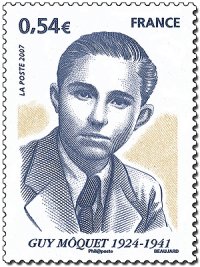
The youngest, 17-year-old Guy Moquet (you can find his name on the Paris Metro) was the son of an exiled Communist parliamentarian (French link).

He made headlines in 2009 when current French President Nicolas Sarkozy had added to the educational curriculum the reading of Moquet’s brave-but-sad last letter to his family: the decision drew some rather mean-tempered fire because of Moquet’s political persuasion. In the end, the text bore a fairly universal reading that could play inoffensively to posterity — like its postscript injunction,

“You who remain, be worthy of the 27 of us who are going to die!”

There’s a thorough roundup of the Oct. 22 executions (including poetic tribute) here.

* Vindicating Winston Churchill’s prophecy to the Times upon receiving news that “These cold-blooded executions of inocent people will only recoil upon the savages who order and execute them.” (Oct. 25, 1941, as cited in the The Churchill War Papers, vol. 3)

** Fifty more were supposed to be executed if the assassins weren’t promptly turned in, but that second batch never took place. (There was, however, a different batch of 50 executed on October 24 in retaliation for a different political assassination. Maybe they just all ran together.)

Part of the Themed Set: Illegitimate Power.

On this day..

1868: The native prisoners of Emperor Tewodros II

On this date in 1868, on the eve of his rout at the hands of a British expeditionary force, the frustrated Emperor Tewodros II had hundreds of prisoners executed en masse.

Our setting is the 1868 British Expedition to Abyssinia, “one of the most expensive affairs of honour in history.” And it all got started from a bad experience with technical support.

Tewodros — generally known to the Europeans as Theodore — had risen from a humble station to the throne of Abyssinia, but by the 1860s held it but tenuously against various rival warlords. Tewodros lodged appeals for aid with a number of European powers, including the British, who evidently took the emperor’s letter for Queen Victoria and stuck it indefinitely in a file called “Pending”.

After two years without an answer, Tewodros took hostage the British consul Charles Duncan Cameron, a missionary named Henry Stern (whose unflattering report of Tewodros’s mean origins particularly enraged the monarch), and other Europeans.


Illustration of the hostages from Henry Stern’s The Captive Missionary.

And then he took hostage the Ethiopian sent to negotiate their release.

He wasn’t “Pending” any longer.

Gaze not into Abyssinia

Tewodros, perhaps, had depended on the notoriously treacherous Ethiopian highlands to protect him from any effective reprisal. But when the Brits decided in 1867 to let men with guns resolve the dispute, they spared no expense at all.

Months of planning and millions of pounds were poured into the operation, which landed 13,000 soldiers and 40,000 animals organized by the Bombay Army.

“For a total cost of about £9,000,000,” writes Harold Marcus in a biography of another former Tewodros hostage, the future Emperor Menelik II, “Napier set out to defeat a man who could muster only a few thousand troops and had long ago ceased to be Ethiopia’s leader in anything but title.”

The forces converged on Tewodros’s last stronghold, Magdala, with the mercurial king refusing repeated demands of the invader to release his European captives.

Angrily refusing, at least according to the accounts of the hostages who were the subject of all this … and whose accounts have just enough consciousness of the privilege their own skin has given them as they witness these bloodlettings.

On April 8, the king put to death seven of the native prisoners in his train. These prisoners comprised generally people on the political outs with Tewodros, adherents of once-rebellious chiefs and the families of those adherents. It was no mean thing to slaughter a few of them arbitrarily.

But much worse was to come the following day, when the hunted emperor espied the British advance guard reconnoitering his position.

According to a report by European hostage W.F. Prideaux in the May 21, 1868 London Times, the Emperor

had seen the British troops descending the Bashilo, and had remarked among them four elephants and some white animals, which we surmised to be Berbera sheep. A short time afterwards a friend of ours (for we had a few friends at Magdala) … implored us to keep within our tents, for the King was in a fearful passion, and was then issuing an order to kill all his native prisoners, who were confined in a few houses a couple of hundred yards off. The repeated discharge of firearms, which we heard soon afterwards, confirmed the sad story, and it was with many misgivings that we asked ourselves, “What next?” At dusk, however, the King returned, and we returned to our tents comparatively at our ease. From what I have heard it appears that the King rushed down mad with rage and arackee, and calling out one of the prisoners hacked him to pieces with his own sword. Another speedily met the same fate. The third was a boy about ten years of age. His youth and innocence (for it was his father who had been the offender) were no protection. He was mangled in the same way as the two others. The cutting and slashing went on in this manner for some time, when the King, finding this mode of execution too slow for his impatient spirit, ordered out the musketeers. The remainder were then quickly shot down, and thrown over the low cliff, the force of the shock in several cases opening the chains of the wretched victims. Those whose quivering limbs showed any signs of life were fired on from above till the murderous work was completed.

The account of the Rev. Stern:

[W]e were suddenly startled by the sound of an intermittent musketry. … The rattle of musketry blended with the yells of despair, and the shouts of rage fell, however, with an ominous and appalling horror on our ears. “What is the matter?” I inquired of my neighbour. “Hist,” was the response, “the king is killing all the prisoners.” These terrible words diffused an aguish chill through my very heart. … The sun had already disappeared from the horizon, and twilight spread a dismal, dusky hue over the scene around, and still the firing continued unabated. With night it gradually diminished, and then only isolated shots reverberated across the panic-stricken camp.

The slaughter lasted about three hours, and during that interval three hundred and seven human beings* were, unwarned, and perhaps unprepared, hurled into eternity. Some of the prisoners did not unresistingly yield to their woeful doom. One, Immer Ali, a native of Ferga, near the Tzana Lake, formerly a chief of consideration in his province, in spite of hand and foot chains, with a convulsive grasp dragged his executioner towards the precipice over which he was to be hurled. The hangman, who dreaded the doom which he intended to inflict on his fellow man, shouted for help. On hearing the cry the tyrant, tiger-like, sprang forward and with his gory sword literally hacked the man to pieces.

And to hear Stern tell it, it was by dint of nothing but great fortune — or in his view, divine providence — that saved the British hostages from joining them.

One victim after another lay writhing and quivering in the last pangs at the foot of the dizzy precipice, and still the tyrant’s rage was un-appeased. “Bring the white men, and let their blood flow, mingled with that of my own subjects,” was the order that fell from his lips. Already, we were informed, whole bands of ruffians stood prepared to seize the intended prey, when several chiefs, no friends of the foreign captives, stepped forward, and requested that our execution might be deferred till next day. “Your Majesty,” they respectfully remarked, “the white men do not deserve the easy death of the sword and bullet; no, keep them till to-morrow, and then let the slow torture of a flaming hut put an end to their existence.” “You are right,” was the response.

Since the next day was Good Friday, the Christian Tewodros, “though a perfect fiend and coarse blasphemer, repaired, from a superstitious impulse, at a very early hour to church,” Stern says. The decisive British attack began later that day, and would end with the un-executed hostages liberated, and Tewodros taking his own life rather than fall captive.

Among the spoils of war was the crown of the dead emperor, which in 1925 King George V would personally present to Haile Selassie.

* The provenance of the very precise figure of 307 is not apparent in Stern’s account; presumably, he knew through his friendly contacts (of from relieving the boredom of captivity in recreational head-counting) the overall number of prisoners beforehand.

On this day..

1872: Jose Balta, former President of Peru

On this date in 1872, four days after he was deposed as President of Peru, Jose Balta was summarily shot by the would-be dictatorship of Tomas Gutierrez.

Balta (English Wikipedia entry | Spanish) made his name as a soldier, an ironic background for a martyr to constitutional government.

As a colonel, Balta in 1867 led a revolt against President Mariano Ignacio Prado in Chiclayo (mirrored by a similar revolt by Gen. Pedro Diez Canseco Corbacho in Arequipa). The resistance forced Prado’s resignation, and Balta won the ensuing 1868 election.

(Notably, it was under Balta’s administration that unprincipled American railroad speculator Henry Meiggs got his prolific track-building operations going in Peru. Basically, the government took all the capital it raised on its guano-export contract — appropriate source — and plowed it into Meiggs’ well-hyped railroads, whose returns rarely justified the outlay to construct them. Wealthy and influential at his zenith, this adventurer was widely considered culpable for the disastrous state of the Peruvian economy by the time of his 1877 death, since in the interim the guano market had crashed and Peru found itself buried in debt it would ultimately default on. Oh, and: reason Meiggs was in Peru? He had to flee California after perpetrating a real estate scheme.)

Back to Balta. The soldier-President was adamant about an orderly departure from office (with a handover to an opposition party*) when his term came up in 1872, but others around him were less keen on constitutional precedents when there was power to be kept or lost.

On July 22, 1872, War Minister Tomas Gutierrez and his brother, Col. Silvestre Gutierrez, arrested the president. Tomas Gutierrez proclaimed himself dictator.

He was surely expecting a more appropriately cowed reaction from the country than he got: the President-elect got away on a warship, whose crew declared for him; the Peruvian Congress passed a resolution outlawing the Gutierrez coup; and the public reaction against him was chilly enough that someone gunned down Silvestre Gutierrez in a railway station on July 26.

News of this turn for the worse reached brother Marcelino, who had (ex-)President Balta in his charge at Callao … and Marcelino had Jose Balta immediately shot. This event meets the definition of an execution better by its circumstances than by its ceremony, since there was none of the latter; Balta was simply blasted while lying sick in bed, perhaps even still asleep, and not with the least sense of occasion.

And by no standard did it meet the usurpers’ definition of utility.

Neither of the remaining two Gutierrezes would outlive Jose Balta by so much as a day, and news of Balta’s murder only helped fan the incipient uprising: both were killed by mobs as the would-be dictatorial party collapsed in the hours ahead. All three of Tomas, Silvestre and Marcelino wound up on lampposts in Lima (and then burned to ashes in a public square) as recompense for their four days’ sovereignty.

As one report given out in North America recounted it:

The events of the past week will forever be remembered in Peruvian history. The spectacle of a Constitutional President deposed and imprisoned by a military usurper; of a Congress dispersed at the point of the bayonet, after the members, irrespective of partisan feeling, had united in signing a solemn protest, declaring the new officers of the so-called Government criminals and outlaws; of an entire country gathering together its strength to repel the attack made upon its liberties and legal rights; of the rising of the people when their indignation could no longer be restrained on the news of the cowardly assassination of Balta by the Dictator; of the triumph of moral force and justice over bayonets and a bastard cause; of the terrible vengeance of the populace on their tyrants; of the final re-establishment of peace, order and good government. This wonderful series of events has been witnessed by Lima in the space of five days. The Peruvian people have nobly vindicated their name and their national honor; the country is now on a firmer basis, and presents greater hopes for prolonged tranquility, prosperity and progress than it has for many years past.

(Not exactly. The economy, as mentioned, crashed in the 1870s, and there was a successful coup in 1879.)

* The guy set to succeed Balta was Manuel Pardo — not to be confused with Mariano Prado, whom Balta had supplanted.

On this day..

1871: Hostages of the Paris Commune

The fall of the Paris Commune on May 28, 1871 launched many a leftist insurrectionary into the martyrs’ firmament.

But the last semaine sanglante that engulfed the Commune there was blood enough for many martyrdoms.

On this date in 1871, just days before the Commune gave way, it executed a clutch of hostages (French link) in desperate reprisal for the Versailles army’s cruelties. For the Commune, it was too little ruthlessness and much too late. For the 52 who stood up against the wall this date, they were just as dead.

These unfortunates were marched from La Roquette prison — whose inmates by dint of timely resistance only narrowly avoided a more extensive massacre — to Rue Haxo and slaughtered.

A number of them were men of the cloth. In 1938, the Catholic church of Notre Dame des Otages was erected on the site and dedicated to the victims’ memory.


A crucifix at Notre Dame des Otages. Copyrighted image used with permission.

(The markers on the spot have settled on 52 as the number of the victims, which might be the historically authoritative count; different sources, however, provide slightly different numbers.)

On this day..

2003: Guillermo Gaviria Correa and nine other FARC hostages

On this date in 2003, the Colombian military mounted a raid in an attempt to free 13 hostages of the narco-trafficking guerrilla organization FARC — causing the rebels to summarily execute their hostages. (Three survived.)

Most notable among the victims of what Colombian President Alvaro Uribe called “another massacre” in that country’s long-running civil war were two men:

Scion of a political family, Gaviria had become a notable exponent of nonviolence; he and Echeverri had been captured leading an unarmed, 1,000-person solidarity march in April of 2002.

It was part of the governor’s visionary (or quixotic) bid to transform his society.

As time passes, my confidence about the benefits of spreading and promoting nonviolence in Antioquia grows stronger. It is not about using nonviolence as a tool to try to transform FARC-EP attitudes. Before we can aim that high, it is absolutely necessary for the people of Antioquia to familiarize themselves with the concept of nonviolence and to adopt it, to the best of their abilities, as their own. We need nonviolence as a society to overcome our mistakes and transform the cruel reality suffered by so many in Antioquia. Here I have pondered about what kind of message I could offer as a leader. I came to the conclusion that the only message I want and can give is about the transforming power of nonviolence, its tremendous capacity to bring out the best in human beings, even in the worst of circumstances.

Peace activist Glenn D. Paige paid Gaviria the tribute of comparing him to Mahatma Gandhi and Martin Luther King, and nominated the governor for a posthumous Nobel Peace Prize.

The diary Gaviria kept during his year’s captivity, reflecting on his “journey toward nonviolent transformation,” has been published.

On this day..

2007: Ajmal Naqshbandi, Fixer

On this date in 2007, the Taliban beheaded hostage Ajmal Naqshbandi, an Afghan “fixer” who arranged local contacts for foreign journalists.

Naqshbandi had been pinched on March 6 with La Repubblica writer Daniele Mastrogiacomo while both were out on a story together, even though Naqshbandi himself had set up Taliban interviews before.*

Quiet negotiations over several weeks produced a swap that would free the scribes, but a last-minute breach by the authorities — who decided not to return one of the agreed-upon prisoners — caused the Taliban to hang onto the Fixer. (Mastrogiacomo was set free. The man who was driving these two had been beheaded at the outset to prove the captors meant business.)

The story wasn’t quiet any longer, and as it mushroomed into a worldwide cause celebre with a scramble to save Ajmal, the Taliban evidently perceived a political advantage in butchering its hostage.

Success! Afghan President Hamid Karzai looked like a total stooge, willing to ransom a foreigner but not an Afghan.

So, for that matter, did the Italian government, which got it from both sides for being abject enough to deal with terrorists in the first place, and then ignoble enough once it did so to bail out its own national while letting his local partner die.

Naqshbandi is the subject of the (aptly titled) documentary Fixer: The Taking of Ajmal Naqshbandi (review).

Fellow-hostage Daniele Mastrogiacomo wrote this book about the ordeal.

The film follows Ajmal’s work with journalist Christian Parenti.

Doug Henwood of Left Business Observer interviewed Christian Parenti in the second half of this August 2009 episode from his (highly recommended, though rarely death penalty-related) WBAI radio program/podcast Behind the News, with intriguing coverage of the political context and the role of Pakistani intelligence:

[audio:http://shout.lbo-talk.org/lbo/RadioArchive/2009/09_08_15.mp3]

(Another leftist outlet, Democracy Now!, interviewed Parenti here.)

Pretty brutal.

But then, war is hell for journalists.

* “This work is very dangerous,” Naqshbandi said a few months before his death. “I bring one enemy to meet another.”

On this day..