1896: Chiefs Kahimemua and Nicodemus, Mbanderu rebels

Children, how should it be otherwise? They were ranchmen and proprietors, and we were there to make them landless workingmen; and they rose up in revolt. They acted in just the same way that North Germany did in 1813.

-Gustav Frenssen, Peter Moor’s journey to Southwest Africa; a narrative of the German campaign (review)

On or about this date in 1896, Herero chiefs Kahimemua Nguvauva and Nicodemus Kavikunua were executed by the Germans.

Germany was little more than a decade into its colonization of South-West Africa (present-day Namibia) when the events of this post took place, and the growing German presence was a growing thorn in the side of native chiefs.

Colonial administrator Theodor Leutwein had the delicate task of trying to negotiate a convenient-to-Germany colonial order among rivalrous tribes of Herero hersdmen … even as Germany’s expanding presence guaranteed their continually growing irritation.

Leutwein approached this Gordian knot in a manner convenient for a European functionary but less so for his unwilling subjects: he recognized the friendly leader Samuel Maharero as the “paramount” chief with whom he could arrange policy — a stature that rival Hereroland chiefs did not so readily admit. Maharero and Leutwein scratched one another’s backs: Maharero made treaties touching lands and people that were never truly in his jurisdiction, and superior German arms then cowed lesser chiefs into compliance with those treaties — and the attendant cattle confiscations, boundary adjustments, land clearances, and population expulsions, all of it tending to the steady increase of Maharero and his German backers.

Finally in 1896, chiefs Nicodemus and Kahimemua rose in revolt in the colony’s eastern reaches, a short-lived bush scrap known as the Ovambanderu Khauas-Khoi War.*

The Germans prevailed easily, forced the discontented chiefs’ surrender, and then eliminated them.

The two were tried and convicted by court-martial on June 11 and shot either that same day, or this, the next day.**

Maharero and the German colonists both profited by their relationship with each other, and eliminated some rivals in the process. But their marriage was only an expedient one.

Years later, as the German posture towards natives moved from rough colonial domination to outright genocide, Maharero himself would rebel, eventually having to flee to Botswana for his trouble. The sentiments he voiced at that time — sentiments that have helped land him an honored place in the national-resistance mythology of the post-colonial state Namibia — would have been awfully surprising to Nicodemus and Kahimemua, had they been around to hear him utter them.

All our obedience and patience with the Germans is of little avail, for each day they shoot someone dead for no reason at all. Hence I appeal to you, my Brother, not to hold aloof from the uprising, but to make your voice heard so that all Africa may take up arms against the Germans. Let us die fighting rather than die as a result of maltreatment, imprisonment or some
other form of calamity. (pdf source)

Both Kahimemua and his enemy Maharero share honorary space at Namibia’s “Heroes’ Acre” memorial to patriotic heroes.

* Refers to two different groups of peoples who participated in the rebellion: the (Ova)Mbanderu — whose zone one can see on this map of Namibia c. 1896: look for where the colony’s eastern border with British territory does a right-angle dogleg, then carry your eyes straight to the left along the 22nd parallel; and, some allied Khauas-Khoi.

** Sources I’ve found are cleanly split on which was the execution date. It is not clear to me that there exists any dispositive primary source.

On this day..

1753: Dr. Archibald Cameron, the last Jacobite executed for treason

Dr. Archibald Cameron of Lochiel on June 7, 1753 became the last Jacobite executed for high treason.

The son of the Cameron clan chief who had had to take refuge in France for his role in the Jacobite rebellion of 1715, Archibald was in 1745 sent as an emissary by his older brother Donald to talk the Stuart claimant out of trying a do-over.

But it was Bonnie Prince Charlie who won the charisma check in this encounter, and ere ’45 was out Archibald was fighting under the Pretender’s colors. (Donald, too.)

Sadly for Donald and Archibald, they were as prescient as they were unpersuasive, for by the next spring the Jacobites had been decisively put down in a battle that cost the Clan Cameron alone hundreds of casualties. Both sons followed their father’s path to exile.

Archibald Cameron did, however, venture a couple of furtive visits back to his native soil, and on one of these missions he was betrayed and captured by the British. There were indeed a variety of refugee Jacobite intriguers in this period who were bold enough to canvass the heather for yet another possible rising, a circumstance which Lord Amulree credits for the severity of the Crown against our principal when it caught him.

Dispatched to London to be made an example of, Cameron was condemned to be drawn on a hurdle and cut down still alive for a traitor’s dismembering. He was, in fact, permitted to hang long enough to die, and his corpse was not quartered. After all, there’s making an example, and then there’s making a martyr.

“I the more cheerfully resign my life as it is taken away for doing my duty to God, my king, and my country,” Cameron wrote on the eve of his execution. “Nor is there anything in this world I could so much wish to have it prolonged for, as to have another opportunity to employ the remainder of it in the same glorious cause.”

On this day..

1688: Constantine Gerachi, the Siamese Falcon

On this date in 1688, the astonishing Constantine Gerachi — the Greek cabin-boy turned virtual prince of Siam — plummeted to earth.

The son of a Cephalonian innkeeper, Gerachi ran away to sea in 1660 and soon caught on with the English East India Company ships who plied the Mediterranean and all the Seven Seas. Though little-educated, Gerachi proved himself frightfully clever and picked up his crewmates’ English. In time he also mastered French, Portuguese, Malay, and of course Siamese.

The word gerachi is Greek for falcon, and no name was ever more aptly conferred. From the humblest beginnings, Constantine Phaulkon soared higher than all.

By the late 1670s, Constantine had segued from hauling East Indies cargo to trading it, and this brought him to the attention of the Siamese king Narai. For Siam, the growing influence of European traders, diplomats, and arms was the prevailing issue of the late 17th century; Narai engaged fully with those interlopers and most especially with the French, who provided architects, mathematicians,* missionaries, and military engineers to the Siamese kingdom and received lucrative commercial concessions in return.

The king appreciated our polyglot adventurer’s many talents and attracted him to the Siamese court, where the pro-French Constantine quickly rose to become Narai’s indispensable chief counselor — basically the equivalent of the Siamese Prime Minister, the power in the kingdom.

But Gerachi’s close association with Narai, and with a French relationship that Siamese grandees increasingly feared might convert insensibly into domination, finally felled the Falcon.

In 1688, the ailing king tried to arrange for the succession of his daughter. Instead, he triggered a revolt by his foster brother Phetracha, backed by a “broad coalition of anti-foreigners, including Buddhist monks, the nobility and low-ranking officers.”**

This Chief of the Royal Elephant Corps seized power, murdering a number of royal relatives (and possibly hastening along the dying Narai himself). Monsieur Constantine of such discreditable familiarity to the French naturally went in his own turn, unsuccessfully trying to rally the realm’s French garrisons to defense of the mutual benefits of the ancien regime.

Nor was this merely a palace coup: Petracha’s takeover became the Siamese Revolution of 1688, “one of the most famous events of our times, whether it is considered from the point of view of politics or religion” in the judgment of a European contemporary. Thais who had resented the growing prominence of the farang now expelled most Europeans, or worse: though not a Japan-like closure (Siam maintained active intercourse with its neighbors), the country would remain essentially dark to Europeans until the 19th century.

Historical Fiction Series by Axel Aylwen

* The relationship gave to European mathematics the “Siamese method”.

** Thanet Aphornsuvan, “The West and Siam’s quest for modernity: Siamese responses to nineteenth century American missionaries”, East Asia Research, vol. 17, no. 3. (Nov. 2009)

On this day..

1581: James Douglas, Earl of Morton

On this date in 1581, James Douglas, the Earl of Morton was beheaded on the Maiden.

The fourth and last of little King James‘s regents, Morton was arguably the most able of the bunch and distinguished his span of authority by winning the raging civil war against James’s mother Mary.

Regent Morton had a reputation for avarice during his run in the 1570s. However, deriving as it does from his executive impingement on the treasures of courtiers and clans no less grasping than himself, that reputation probably ought to be taken with a grain of salt.


Rimshot

If nothing else, Regent Morton had the excuse of king and country. Sir Walter Scott, for one, favored this Red Douglas with a much more charitably statesmanlike gloss in The Monastery and The Abbott.

As one example, Morton irked divines by enforcing with a minimum of pious exceptions a pre-existing statute requiring a one-third cut of ecclesiastical revenues.

Likewise, he made an enemy of Lady Agnes Keith — the widow of the assassinated first regent — and her (subsequent) husband, the Earl of Argyll by forcing them to turn over crown jewels that were being held in their quote-unquote safekeeping.

In 1578, this Argyll kidnapped King James VI and induced the 12-year-old to declare his majority and dismiss the Earl of Morton. Argyll landed a Chancellorship out of the deal: Morton — well, you know. He would eventually be accused, 14 years’ belatedly but not inaccurately, of complicity in the 1567 murder of Lord Darnley.

Argyll in the end lost his head to that distinctive Scottish proto-guillotine known as the Maiden. Though the apparatus actually dates back to 1564,* a legend as moralistic as it is specious holds that the Regent Morton was himself the man who ordered construction of the device that would eventually end his own life. Sir Walter could hardly be asked to resist that kind of material:

“Look you, Adam, I were loth to terrify you, and you just come from a journey; but I promise you, Earl Morton hath brought you down a Maiden from Halifax, you never saw the like of her — and she’ll clasp you round the neck, and your head will remain in her arms.”

“Pshaw!” answered Adam, “I am too old to have my head turned by any maiden of them all. I know my Lord of Morton will go as far for a buxom lass as anyone; but what the devil took him to Halifax all the way? and if he has got a gamester there, what hath she to do with my head?”

“Much, much!” answered Michael. “Herod’s daughter, who did such execution with her foot and ankle, danced not men’s heads off more cleanly than this maiden of Morton. ‘Tis an axe, man, — an axe which falls of itself like a sash window, and never gives the headsmen the trouble to wield it.”

“By my faith, a shrewd device,” said Woodcock; “heaven keep us free on’t!”

-Sir Walter Scott, The Abbott

When next in Edinburgh, quaff Scots engineering acumen with the friendly backpackers crashing at the High Street Hostel — the glorious stone town house that was once Regent Morton’s very own crib.


By Kim Traynor (Own work) [CC BY-SA 3.0], via Wikimedia Commons.

On this day..

1946: Ion Antonescu

Romania’s wartime fascist dictator Ion Antonescu was shot on this date in 1946.

Antonescu (hand raised) and Adolf at Nazi headquarters in June 1941. Behind them are Ribbentrop and Keitel.

An army officer who worked his way up to the brass via his exploits in the Second Balkan War and then in World War I, Antonescu emerged as a major nationalist politician in the interwar period. He was the elite political figure who allied with Corneliu Codreanu‘s Iron Guard movement.

Antonescu became the Defence Minister in a a far-right government, was temporarily shouldered out of the state by King Carol II‘s coup, and then re-emerged as the leading alternative when Carol’s government was undone by the tectonic political crises in the run-up to World War II. After territorial concessions wrung by Romania’s neighbors triggered protests against the king in Bucharest, Antonescu on September 5, 1940, forced Carol to transfer dictatorial power to him — and shortly thereafter, he forced Carol to abdicate altogether.*

That left Carol’s son Michael the figurehead of state, and Ion Antonescu the actual strongman — at least, once he tamed the Iron Guard.

Antonescu oriented Romania towards Hitler’s Germany, including a fairly enthusiastic involvement in the Holocaust.**

For Germany, it was an important alliance: Romania’s oil fields were essential to powering the Reich’s mechanized army. And Romania ultimately fielded the largest Axis army other than Germany and Italy themselves with well over one million men under arms by the summer of 1944. For Romania, well, opportunism is as opportunism does: as Antonescu put it, echoing an ancient argument, “in today’s circumstances a small country which is under threat, such as ours, does not do what it wishes, but what it can.”

The Romanian “General Antonescu Army Group” joined the fateful invasion of the Soviet Union. Romanian divisions were prominent at Stalingrad where some 150,000 were lost as casualties or prisoners.

The turn of the war’s tide put Romania in a grievous dilemma whose parameters ran something like this:

  • Maintain Antonescu’s personal grip on power
  • Maintain the territorial expansion Romania had achieved early in the war
  • Exit the war without going down in Germany’s Gotterdammerung

… pick one of three. Provided it’s the last one.

As the Red Army approached from the northeast and American bombers struck from Italy and North Africa, Antonescu scrambled to sound out what kind of a deal he could cut with the Allies.

Antonescu might perhaps have negotiated without the desperation due his position,† and dilated with his decreasingly patient enemies while the Germans flattered him with the dream that he could still retain conquered Bessarabia (present-day Moldova). Only with the Soviet army on his doorstep was Antonescu finally disabused of the statesman’s dream and office both — when King Michael ousted Antonescu and immediately switched Romania to the Allied side.‡ This move accepted the Soviet occupation that was about to become a fait accompli, and put Romanian soldiers into the field for the last months of the war fighting against their former German allies.

It also put Antonescu into Soviet custody. He rode out the war under guard in Moscow, then was shipped back to postwar Romania where he would serve as the feature attraction of the People’s Tribunals.

One hundred eighty-seven people answered war crimes charges to these bodies; there were 13 death sentences, but only four were actually executed.§ All four — Transnistria governor Gheorghe Alexianu, Interior Minister Constantin Vasiliu, and Foreign Minister Mihai Antonescu (no relation — were shot on this date at Jilava. The executions were filmed.

* Carol went into exile, never to see his native soil again. He died in Portugal in 1953.

** “Of all the allies of Nazi Germany, Romania bears responsibility for the deaths of more Jews than any country other than Germany itself,” according to a 2003-2004 commission. “Efforts to rehabilitate the perpetrators of these crimes are particularly abhorrent and worrisome. Nowhere else in Europe has a mass murderer like Ion Antonescu, Hitler’s faithful ally until the very end, been publicly honored as a national hero.” (The full report is available here; the quoted lines come from its executive summary.)

† Berlin was keeping an eye on Romania’s separate-peace feelers, too, and had prepared a plan to occupy Romania should it attempt to desert the Axis. This is precisely the fate that befell Nazi-allied Hungary … but in Romania’s case, Germany never had the moment to implement the plan.

‡ Michael was, like his father, forced into exile in 1947; he did not return to Romania until after the collapse of Communism. Now in his nineties, King Michael is still alive as of this posting and remains the claimant should Romania ever re-establish its monarchy.

§ Six of the 13 death sentences were delivered in absentia. Notable among those fled souls was the Hungarian writer Albert Wass: Wass had escaped to the United States, which refused repeated appeals by Communist Romania to deport him. There is a running struggle in both Hungary and Romania over whether to rehabilitate Wass or posthumously rescind his death sentences. (Postwar Hungary condemned him, too.)

On this day..

1865: Not Lambdin P. Milligan, ex parte man

This date in 1865 was the originally scheduled hanging of Indiana pro-slavery gadfly Lambdin P. Milligan — a sentence respited two days prior by President Andrew Johnson, and then subsequently commuted, for which reason Milligan survived to attach his surname to a landmark Supreme Court decision the following year.

During the Civil War, the state of Kentucky was a borderlands claimed by, and viciously fought over, by both North and South. “I hope to have God on my side, but I must have Kentucky,” Abraham Lincoln wrote in 1861.

Kentucky’s northern neighbor, the Union breadbasket Indiana, had little fighting and no hint of Confederate power — but it was a hotbed of so-called “Copperheads”, northern Democrats who opposed Lincoln’s willingness to prosecute the civil war. So fraught was the Hoosier political situation that in 1862, Indiana’s Republican governor refused to call the Democrat-dominated legislature for fear that it might vote a secession bill or attempt to withdraw Indiana from the war.

The inevitable existence of northern domestic opposition to the war came joined at the hip to impossible statecraft conundrums. Just how much wartime dissent and/or resistance could be countenanced — as a legal matter, and a practical one? President Lincoln would not have received an A+ from the American Civil Liberties Union; he suspended the writ of habeas corpus in the Union and resorted to military tribunals and martial law in some places.

Our man Milligan was one of these Copperhead Indiana Democrats born to test Washington’s elasticity. He was an exponent of the Knights of the Golden Circle,* a pro-slavery secret society whose name denoted their aspiration to the antebellum filibusters‘ dream of a human-bondage empire to ring the Caribbean basin.
An attorney,** Milligan briefly became the toast of Democrats nationwide (whatever was left of the nation) for his robust defense of Clement Vallandigham when the former Congressman was prosecuted under the anti-Copperhead General Order 38.

At this point, Milligan was very well-known in what was then called the Northwest, and he was a major political player in Indiana — a pivotal state in the 1864 election.

But according to federal spies who tailed him in 1863-64, his interests in governance ran to more illicit grants of state power. Milligan was arrested in October 1864 as a principal in what was dubbed the “Northwestern Conspiracy”: a plot to mobilize the antiwar factions in that part of the country. This was no mere matter of pamphleteering; the “visionary and desperate” scheme aimed to prolong the hopes of the now-fading South by instigating an armed uprising in the Northwest that would relieve Union pressure on Dixie and perhaps turn the tide of the war.

Milligan was among several of the conspirators swept up in arrests in the following weeks, then tried by military tribunal for treason and sedition. It’s hard to argue that the plot was anything but.

But why a military court? This is the question in Milligan’s great legacy to posterity, the Supreme Court ruling Ex Parte Milligan.†

Milligan himself was not a soldier, and had not been in a war zone. He was a civilian, and Indiana’s regular civilian courts had never ceased to function. The question at stake in Milligan’s appeal to the Supreme Court was whether there was any legitimate recourse to a military tribunal under such conditions — well behind the lines, as it were.

On the morning of March 5, 1866, 34-year-old Republican U.S. Representative James Garfield — the future president whose assassin would command contentious caselaw all his own — strode into the U.S. Supreme Court to eloquently argue Milligan’s side.

“Such a doctrine,” Garfield intoned of the civilian courts’ being intentionally bypassed on national security grounds, “is too monstrous to be tolerated for a moment; and I trust and believe that … it will receive its just and final condemnation. Your decision will mark an era in American history. the just and final settlement of this great question will take a high place among the great achievements which have immortalized this decade. It will establish forever this truth, of inestimable value to us and to mankind, that a republic can wield the vast enginery of war without breaking down the safeguards of liberty; can suppress insurrection, and put down rebellion, however formidable, without destroying the bulwarks of law; can, by the might of its armed millions, preserve and defend both nationality and liberty … if the protection of the law shall, by your decision, be extended over every acre of our peaceful territory, you will have rendered the great decision of the century.

The high court found for Milligan unanimously, establishing as a constitutional bedrock Garfield’s proffered principle that civilian courts must try civilians wherever those courts are open, and ordered Milligan’s release. Although re-indicted by a civilian grand jury, Milligan was not re-prosecuted; he resumed his law practice and died near Fort Wayne, Indiana on December 21, 1899.

* Also known as the Sons of Liberty, a callback to revolutionary patriots.

** Milligan studied law in Ohio, his native soil; his class of nine also included Edwin M. Stanton — Lincoln’s War Secretary during the events of this post. Milligan himself reflected that “I should have probably been hung” but for his fortuitous ancient friendship with Stanton.

† Court precedents with names like Furman v. Georgia are most familiar to us, signifying two disputing parties; by contrast, the phrase ex parte (by/for the party) theoretically indicates a decision issued on behalf of the named party, without need of any opposing party’s intervention. (Ex parte Quirin is another notable death penalty case using this terminology.)

While the ex parte locution was once a common one for habeas corpus appeals, such cases were in practice almost invariably contested by some organ of the state — as Milligan’s was.

On this day..

1536: Anne Boleyn’s supposed lovers

Beware, trust not in the vanity of the world, and especially in the flattering of the court … if I had followed God’s word in deed as I did read it and set it forth to my power, I had not come to this.

-From the last statement of George Boleyn

This was the execution date in 1536 of Anne Boleyn‘s co-accused, the undercard to the deposed queen’s beheading.

It was the accusation of adultery that furnished Anne’s downfall; some adulterers were perforce required. These were William Brereton, Henry Norris, Sir Francis Weston, Mark Smeaton … and the ex-queen’s own brother, George Boleyn.

They had just days prior been subjected to a trial whose outcome was a foregone conclusion. All pleaded their innocence save Smeaton, a commoner court musician who could not withstand torture and “admitted” fooling around with Queen Anne.*

Along with Smeaton, three gentlemen-doomed plucked from the Tudor court’s shadowy recesses — joined to the legendary queen at the chopping-block, if not very probably in her bed.

  • Norris, the Groom of the Stool
  • Weston, a Gentleman of the Privy Chamber
  • Brereton, a Groom of the Privy Chamber

“Everyone was moved at their misfortune, especially at the case of Weston, who was young and of old lineage and high accomplishments,” one contemporary recorded of the fearful pall cast upon King Henry’s court by the purge. “But no one dared plead for him, except his mother, who, oppressed with grief, petitioned the King, and his wife, who offered rents and goods for his deliverance.”

The most egregious charge, naturally, did not concern these men. To put the fallen queen beyond the reach of sympathy it was alleged that she

following daily her frail and carnal lust … procured and incited her own natural brother, Geo. Boleyn, lord Rocheford, gentleman of the privy chamber, to violate her, alluring him with her tongue in the said George’s mouth, and the said George’s tongue in hers, and also with kisses, presents, and jewels; whereby he, despising the commands of God, and all human laws, violated and carnally knew the said Queen, his own sister, at Westminster; which he also did on divers other days before and after at the same place, sometimes by his own procurement and sometimes by the Queen’s.

This outrageous smear on the extremely specious grounds that big brother “had been once found a long time with her, and with certain other little follies,” invited as much skepticism among the Boleyns’ contemporaries as it does for posterity. Even after Anne had been condemned for adultery and incest in her stage-managed trial, George — the last of the bunch to face the tribunal — fought his corner so vigorously “that several of those present wagered 10 to 1 that he would be acquitted, especially as no witnesses were produced against either him or her, as it is usual to do, particularly when the accused denies the charge.”

A foolish bet, but perhaps one placed from a position of willful hope. If a peer of the realm could be condemned a traitor for hanging out with his sister, then no Henrician nobleman could hope to sleep securely.

Little could their dread fathom the bloody years to come. Many who saw the Boleyns’ heads drop would in time have cause to make of their gambling winnings a purse to tip their own executioners.

Thomas Cromwell, who engineered the Boleyn faction’s fall, outlived it by barely four years. The Earl of Surrey, who sat in judgment on this occasion, lost his head in 1547; his father the Duke of Norfolk,** who was the presiding judge, only avoided execution because Henry VIII died hours before Norfolk was to go to the block. George Boleyn’s wife, Lady Rochford, is supposed to have provided evidence against him; she was later swept up in the fall of Catherine Howard and beheaded for her trouble on that occasion.

But those were tragedies for later days.

In the spring of 1536, from his window in the Tower, the poet Thomas Wyatt witnessed this date’s executions: the young Anne’s last lover before the king descended on her, Wyatt too had been initially implicated in debauching the queen and he was fortunate not to be among their number. (Wyatt’s son would not be as lucky.) The shaken Wyatt wrote his fellow courtiers’ heartbreaking eulogy, and perhaps that of his era too, in his verse reflection on that terrible fall from fortune. (Via)

V. Innocentia
Veritas Viat Fides
Circumdederunt
me inimici mei

by Sir Thomas Wyatt, the Elder

Who list his wealth and ease retain,
Himself let him unknown contain.
Press not too fast in at that gate
Where the return stands by disdain,
For sure, circa Regna tonat.†

The high mountains are blasted oft
When the low valley is mild and soft.
Fortune with Health stands at debate.
The fall is grievous from aloft.
And sure, circa Regna tonat.

These bloody days have broken my heart.
My lust, my youth did them depart,
And blind desire of estate.
Who hastes to climb seeks to revert.
Of truth, circa Regna tonat.

The bell tower showed me such sight
That in my head sticks day and night.
There did I learn out of a grate,
For all favour, glory, or might,
That yet circa Regna tonat.

By proof, I say, there did I learn:
Wit helpeth not defence too yerne,
Of innocency to plead or prate.
Bear low, therefore, give God the stern,
For sure, circa Regna tonat.

* In the Tower awaiting execution, Anne would voice worry for Smeaton’s soul when she learned that he had failed to retract this confession at the block. But Smeaton and all the men were beheaded in preference to a sentence of drawing and quartering, and had reason to be cautious about their comportment on the scaffold lest crueler torments be reinstated for them.

** Norfolk was Anne Boleyn’s uncle.

Circa Regna tonat: “Around the throne it thunders”, from Seneca’s Phaedra.

On this day..

1715: Thomas Nairne, Charles Town Indian agent

The generations-long conquest of indigenous peoples in North America might look from posterity like a historical ienvitability, but the 1715-1718 Yamasee War was perhaps “as close to wiping out the European colonists as ever [they] came during the colonial period.” (Gary Nash, quoted by William Ramsey in “‘Something Cloudy in Their Looks’: The Origins of the Yamasee War Reconsidered”, Journal of American History, June 2003. This post draws heavily from Ramsey’s article, which is the source of any quote not otherwise attributed.) In it, not only the Yamasee but a vast coalition of peoples throughout what is today the United States Southeast nearly swept the British out of South Carolina.

And it started three hundred years ago today with some executions.

British South Carolina had extensive trading contacts with the native peoples in their environs — acquiring deerskins and Indian slaves for the plantation colony — and said trading had too often been a flashpoint between alien cultures. South Carolina’s annals record a number of instances of natives crudely abused by Anglo merchants, including women whose bodies were next to sacrosanct for the matrilineal Yamasee, and traders aggressively taking slaves even from friendly tribes. Many years later a Lower Creek man would recall that “we lived as brothers for some time till the traders began to use us very ill and wanted to enslave us which occasioned a war.”

It has never been entirely clear just why and how such individual abuses, even as a pattern, triggered in 1715 something as drastic as military action; our source William Ramsey suspects that they only hint at much wider-ranging economic pressures of the Atlantic economy, which entangled native peoples in debt and warped traditional lifeways towards producing ever more deerskins for export, obtained at ever poorer prices from ever more belligerent merchants.

Just as trade relations were at their most antagonistic, the colonial capital Charles Town fell down on the diplomatic side of the job. (This is, again, per Ramsey.)

The colony had created in 1707 an office of Indian Agent.

Intended to manage the complications of its sometimes-delicate cross-cultural trade and police the traders, the post instead became a locus of bitter competition between two men: Thomas Nairne and John Wright. (There’s a 1710 account of South Carolina in Nairne’s hand available here.) These two men, South Carolina’s most expert Indian diplomats and the only two men ever to hold the Indian agent office, had by the 1713-1715 period become consumed with their internal rivalry. Wright, a trader who thought Nairne too accommodating of the natives generally and unduly meddlesome with Wright’s own commerce specifically, bombarded the latter with lawsuits; Nairne eventually had to stay in Charles Town almost permanently to protect his own affairs. The colony’s diplomatic voice fell silent — which meant that rapacious traders squeezing mounting debts on their spring rounds in 1715 were that voice.

In annoyance, one tribe returned an ultimatum to Charles Town: “upon the first Afront from any of the Traders they would down with them and soe goe on with itt.” (See The Southern Frontier, 1670-1732)

That warning got the colony’s attention.

The Indian Agent rivals Wright and Nairne were dispatched together to meet with the Yamasees at Pocotaligo and smooth things over. But just as these men stood at loggerheads professionally, they were noted for quite distinct policies towards the Indians: Nairne was the friendly hand, the man who sympathized with natives. Wright was the asshole. If their joint presence was intended to be a good cop-bad cop act, they carried it off as clumsily as their mutual antipathy might suggest.

In a famous meeting on the night of April 14, Nairne, Wright, and a number of traders seemingly reassured the Yamasees over a feast that their grievances would be redressed, and went to sleep satisfied that matters were well in hand.

It was not so for the Yamasees, who held council that night after the Europeans were tucked away. An unknown Indian leader who signed himself “the Huspaw King” would later dictate a letter to a hostage charging that at the April 14 meeting

Mr. Wright said that the white men would come and fetch [illegible] the Yamasees in one night and that they would hang four of the head men and take all the rest of them for slaves, and that he would send them all off the country, for he said that the men of the Yamasees were like women, and shew’d his hands one to the other, and what he said vex’d the great warrier’s, and this made them begin the war.

We don’t know if this was on-message for the delegation — a glimpse of the iron fist that Nairne’s politesse was to glove — or delivered privately in Wright’s going campaign to undermine his opposite number. What we do know is that the Yamasees had seen both these men in authority over colonial-Indian trade over the past several years: on the night of April 14-15, they had to decide between mixed messages. Could they count on Nairne’s reassurances of comity? Or should they believe, as Wright intimated, the increasingly obnoxious inroads of traders presaged the outright destruction of their people?

April 15th was Good Friday. And the Europeans awoke to their Calvary.

The Yamasees’ decision about the intentions of their European counterparts was far from internally unanimous — but it was instantly effected.

“The next morning at dawn their terrible war-whoop was heard and a great multitude was seen whose faces and several other parts of their bodies were painted with red and black streaks, resembling devils come out of Hell,” a plantation owner later wrote to London. Most of the Europeans were killed on the spot, Wright apparently among them. A couple of them escaped.

And for Thomas Nairne, a stake in the center of the little village awaited, with an agonizing torture-execution said to have required three days before Nairne mercifully expired on April 17th.

The red indicates War, and the black represents the death without mercy which their enemies must expect.

They threw themselves first upon the Agents and on Mr. Wright, seized their houses and effects, fired on everybody without distinction, and put to death, with torture, in the most cruel manner in the world, those who escaped the fire of their weapons. Amongst those who were there, Captain Burage (who is now in this town, and from whom I derive what I have just said) escaped by swimming across a river; but he was wounded at the same time by two bullets, one of which pierced his neck and came out of his mouth, and the other pierced his back and is lodged in his chest, without touching a vital spot. …

Another Indian Trader (the only one who escaped out of a large number) saved his life by crawling into a marsh, where he kept himself hid near the town. He heard, during the whole day, an almost continual fire, and cries and grievous groans. He often raised his head in his hiding-place, and heard and saw unheard-of things done; for the Indians burned the men, and made them die in torture. They treated the women in the most shameful manner in the world. And when these poor wretches cried O Lord! O my God! they danced and repeated the same words mocking them. Modesty forbids me to tell you in what manner they treated the women: modesty demands that I should draw a veil over this subject.

This man who had witnessed so many cruelties, stripped himself naked so as completely to resemble the Indians; and in this state, made his escape by night, crossing the town without being perceived, he heard many people talking there, and saw several candles in each house; and having avoided the sentries, God granted that he should arrive here safe and sound.

Mr. Jean Wright, with whom I had struck up a close friendship, and Mr. Nairne have been overwhelmed in this disaster. I do not know if Mr. Wright was burnt piece-meal, or not: but it is said that the criminals loaded Mr. Nairne with a great number of pieces of wood, to which they set fire, and burnt him in this manner so that he suffered horrible torture, during several days, before he was allowed to die.

On this day..

1969: Alexandre Banza, Central African Republic politician

On this date in 1969, the Central African Republic’s dictator Jean-Bedel Bokassa had his number two condemned for plotting against him, and summarily shot.

Back on New Year’s Eve of 1965, Alexandre Banza had been on the same team as Bokassa in the conspiring business — achieving a rapid promotion from Captain when he leveraged his command of the Camp Kassai military base in support of Bokassa’s successful coup against his (Bokassa’s) cousin, David Dacko.

This was a great career move for Captain Banza, who speedily became Colonel Banza and the Minister of State and Minister of Finance to boot. But it wasn’t long before this made man looked to Bokassa like his main threat.

Notorious for his vanity — a few years after the events of this post, Bokassa, an unabashed admirer of Napoleon, would proclaim himself Emperor of the “Central African Empire” — the chief looked askance at his finance minister’s willingness to challenge Bokassa’s profligacy. Over the year or two prior to Banza’s execution, Bokassa maneuvered to push him away from power … and Banza maneuvered to create a power base for himself from which to launch his own putsch.

In the end it was Camp Kassai that played the decisive role once again. The guy with Banza’s old job as camp commandant, one Lt. Jean-Claude Mandaba, was supposed to be in on the plan, but on the eve of the intended April 9, 1969 coup, he tipped off Bokassa.

“The following afternoon Banza arrived at Camp Kassai with plans for the coup in his pocket,” writes Brian Titley in his Dark Age: The Political Odyssey of Emperor Bokassa:

As he stepped from his car, Mandaba and a couple of soldiers grabbed him. So fiercely did he struggle to escape that the soldiers had to break one of his arms before overpowering him. The ambushers then tied him up, stuffed him the trunk of a Mercedes, and took him to meet the man he had sought to depose. … [Bokassa] was jubilant at the sight of his former companion-in-arms being brought to him in chains. Banza was in poor shape after the journey to Berengo, but his torments were only beginning. Bokassa launched the interrogation by beating the prisoner almost senseless with his ever-present walking stick.

Bokassa was only narrowly dissuaded from thrashing this turncoat to death on the spot, and instead consented to a pro forma military tribunal — although rumors of the pre-death punishment visited on Banza once he was captured have muddied the waters quite a bit. Banza was reportedly hailed before the Cabinet and personally brutalized by Bokassa; Le Monde even reported that he’d been outright killed in this meeting and dragged through the streets by soldiers.

Bokassa was deposed by the French in 1979,* and condemned to death in absentia the following year. The former strongman voluntarily returned from exile in 1986 to face trial for a variety of abuses during his reign; his treatment of Alexandre Banza — and that of Banza’s family, a number of whom were arrested and some “disappeared” — formed part of the very extensive charge sheet. Though sentenced to death himself in that trial, Bokassa’s sentence was eventually commuted. The ex-emperor lived out his last years in a private home of his former capital.

* France’s “last colonial expedition,” in the words of one of her diplomats.

On this day..

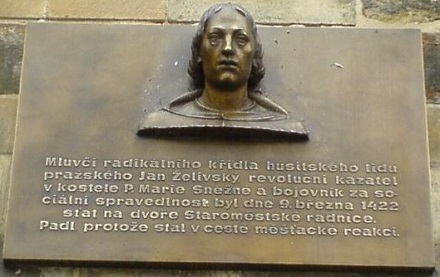
1422: Jan Zelivsky, Hussite defenestrator

Radical Hussite Jan Želivský was beheaded on this date in 1422.


1952 memorial plaque of Zelivsky in Prague

Zelivsky (English Wikipedia entry | Czech), a priest, emerges in the 1410s as a fiery populist orator at Prague’s Church of Our Lady of the Snows.

After the treacherous capture and execution of Jan Hus, the Hussite movement split between radical and moderate factions. The firebrand Zelivsky became the chief voice of the lower-class, radical Hussites and led the dramatic Defenestration of Prague wherein a Hussite mob pitched several Catholic city ministers out the window of the Prague town hall — triggering a revolution and 15 years of war.

Over the ensuing year, Zelivsky came to dominate politics in Prague. But he had to struggle for his power against both the external threat of Hapsburg armies, and the internal rivalry of moderate Hussites — and these factions did not scruple to deploy the executioner for mastery of Prague.

Zelivsky in the summer of 1421 mounted a coup against moderate Hussites who were negotiating with the Catholic nobility, and even executed some of those movement apostates. But power was wrested away from him in the ensuing months and he was arrested by surprise at a town meeting and secretly put to death.

On this day..