1938: Branislaw Tarashkyevich, Belarusian linguist

On this date in 1938, linguist and politician Branislaw Tarashkyevich was shot at the Kommunarka execution range outside Moscow: another victim of Stalin’s purges.

Tarashkyevch (English Wikipedia page | Russian | Belarusian) is best remembered today for “Taraskevica”.


Tarashkyevich, and his grammar.

That’s the familiar name for Tarashkyevich’s 1918 grammar (Belarusian link) that standardized the tongue, or rather the collection of related “Belarusian” dialects.

Its creator also happened to be a political leftist; he served briefly in the parliament of Poland (which then controlled West Belarus), then became a leader of the Belarus Peasant and Worker Masses, a communist movement. Tarashkyevich was arrested in 1928 and subsequently exchanged for a Belarusian journalist whom the Soviets had imprisoned.

His career as a Soviet appartchik in Moscow was short-lived, however, before those guys clapped him in prison, too, with the outcome typical to that frightening time and place.

A like deletion was supposed to befall taraskevica when the Stalin-era Belarus SSR ordered a standardization with grammar and orthography that more closely resembled Russian; this version (“narkomawka”) still remains the official “Belarusian” to this day.

However, the taraskevica variant has established a stubborn foothold among users who consider it more authentic than its Russified rival.*

* See Curt Woolhiser, “Communities of Practice and Linguistic Divergence: Belarusophone Students as Agents ofLinguistic Change,” Harvard Ukrainian Studies, Vol. 29, No. 1/4 (2007).

On this day..

1977: Benigno Aquino condemned

On this date in 1977, former Philippines Senator Benigno Simeon “Ninoy” Aquino, Jr. was sentenced to death by firing squad under the dictatorship of Ferdinand Marcos.

Aquino, a lifetime politician from one of the archipelago’s powerbroking families, was one of the principal opposition figures against the increasingly autocratic Marcos. His 1968 denunciation of the “garrison state” — Marcos would quadruple the size of the military and infiltrate it widely into civil society — was one of the definitive and lasting brands upon that regime.

So nobody, and certainly not Aquino himself,* was surprised when the outspoken senator was arrested hours after Marcos imposed martial law in September 1972.

Unlike most such political prisoners, Aquino stubbornly refused to cut any deal for amnesty that would confer any hint of submission to Marcos. Their conflict reads, on both sides, as an intensely personal one.

Placed on trial for allegedly arming a guerrilla organization, murdering a political follower, and trying to place the Philippines under (unspecified) foreign domination, Aquino staged a headline-grabbing 40-day hunger strike in 1975 and received extreme unction. The Archbishop of Manila finally talked the wasting Aquino out of letting himself starve to death, but perhaps not out of a certain thirst for martyrdom. (New York Times, Feb. 22, 1977)

“If Marcos believes I’m guilty, I want to be shot tomorrow,” he’s supposed to have exclaimed as he was led away from the tribunal that pronounced his death. (New York Times, Nov. 26, 1977)

That didn’t happen.

While Aquino’s death sentence on this date was expected, it was also generally thought that Marcos — who had allowed only one (non-political) execution during five years of martial law to that point — would spare his foe, as indeed he did. Marcos even released Aquino to travel to the U.S. for treatment after suffering two heart attacks in 1980.

Aquino had those few years to raise his profile and that of the Philippines opposition around the states. Returning to his native country on August 21, 1983, a moment when a then-ailing Marcos seemed weakened enough for a political opening, Aquino was infamously assassinated right on the tarmac as he stepped off the plane.

This event, and the two million-strong funeral march of Aquino’s bullet-riddled body to Manila’s Rizal Park, helped galvanize the country’s opposition. By 1986, popular demonstrations sent Marcos fleeing to exile … and elevated to the presidency Ninoy Aquino’s widow, Corazon.

Today, the couple adorns the Philippines’ 500-peso banknote, and their only son, Benigno Aquino III, is the country’s president. To pay him a call, just catch the next flight to Manila’s Ninoy Aquino International Airport.


Marchers with a banner alluding to Ninoy Aquino’s assassination date pass the monument to the slain ex-senator in Makati. (cc) image from littleislanddimp

* According to In Our Image: America’s Empire in the Philippines, Aquino was disappointed at the muted public reaction to his arrest. “I judged Marcos correctly,” he told a friend, “but I misjudged the people.”

On this day..

1724: Willem Mons, head grafter

On this date in 1724, Willem Mons was beheaded in St. Petersburg for peculation.

Mons was the brother of the German commoner Anna Mons, a beautiful young woman who segued from being the May-December lover of Peter the Great‘s trusted admiral Franz Lefort to the mistress of the teenage emperor himself. Peter and Anna had a famous (famously scandalous) romance through her twenties, but as she entered her thirties and heard the clock ticking, her bid to make Peter put a ring on it by flirting with a Prussian diplomat came to grief and got her briefly tossed in prison.

Willem Mons was still a minor when his big sister fell from Peter’s graces. He would prove to have an equally adroit instinct for imperial bedchamber politics.

“One of the best-made and most handsome men that I have ever seen,” in the French ambassador’s estimation, Mons hustled his way into the train of the woman Peter had married instead of Anna — Catherine.

There Willem Mons and his other sister Matryona Balk monopolized the access routes to the empress and lucratively tolled all petitioners who traveled them. Wealth and status accumulated; the immigrant bourgeois’s son even stopped going by William in favor of the more impressive “Moens de la Croix”.

Not surprisingly, the emperor himself was the last to discover the open secret of his wife’s household’s river of graft.* Peter, who could be quite the moralist, was incensed; he interrogated the chamberlain so terribly that the young man fainted dead away.

“Moens de la Croix” was no longer. In both senses.

Having issued the confessions to condemn himself under the very credible threat of torture, Mons was socked away in Peter and Paul Fortress. Catherine made bold to defy Peter’s edict that nobody petition him for Mons’s life; in response, the enraged tsar smashed a Venetian mirror with his bare hand and roared, “thus I can annihilate the most beautiful adornment of my palace!” Court observers reported that marital relations between the two were visibly strained well after the scandal.

These weren’t happy days for the oft-sickly Peter; indeed, they were the last months of his life. Early the next year, he would succumb to a gangrenous bladder and leave the throne to this very Catherine. Perhaps his decrepit state accounts for the likely scurrilous rumor that the handsome chamberlain’s real offense wasn’t so much corruption as cuckoldry. It’s fair to say that such an affair would have been an extraordinarily reckless thing for Catherine.

On November 16, 1724, William Mons and Matrena Balk were taken in sledges to the execution site. Mons behaved courageously, nodding and bowing to friends he saw in the crowd. Mounting the scaffold, he calmly took off his heavy fur coat, listened to the reading of the sentence of death and laid his head on the block. After his death, his sister received eleven blows of the knout, very lightly administered so that not much harm was done, and was exiled for life to Tobolsk in Siberia. Her husband, General Balk, was given permission to marry again if he wished. (Source)

The late courtier’s severed head was preserved in alcohol (legend says that the fuming Peter made Catherine contemplate it). It was eventually deposited in the Kunstkamera museum, famous for housing Peter’s gross horde of collected pickled fetuses, dwarves, and other medical curios. Mons’s head still resides there today.

On this day..

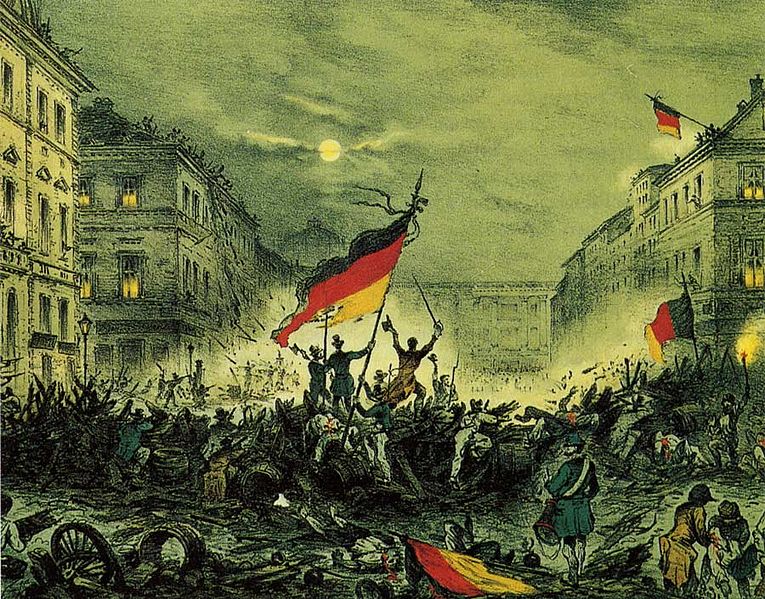
1848: Robert Blum, German democrat

On this date in 1848, a day short of his forty-second birthday, the German revolutionist Robert Blum was summarily shot in Vienna — a tragic victim of Germany’s Revolutions of 1848.

Marker at Robert Blum’s birthplace in Cologne reads “I die for the German liberty that I fought for. May the fatherland remember me.” (cc) image from Elke Wetzig.

Blum grew up in a penniless proletarian family but drifted into the literary set. He spent the 1830s penning liberal-minded plays, poetry, newspaper correspondence. He uncovered a magnetic personality and a gift for organization.

By the 1840s he was a — maybe the — preeminent left-liberal in the Kingdom of Saxony: pro-parliamentary democracy, anti-violence, for a wide grant of civil liberties and mass education.

The pressures, both liberal and radical, pushed to the brink the small realms in the German Confederation, as well as the neighboring Austrian Empire. Both struggled to handle even the liberals’ demands like expanding the franchise and freedom of the press, with old hereditary polities that might not be up to changing times. Germany, Marx and Engels wrote in the Communist Manifesto (1847), “is on the eve of a bourgeois revolution.”

Right on cue…

That pregnant year of 1848 found Blum in the Frankfurt parliament, and his neither-fish-nor-fowl leftism — a little too out there for mainstream liberals; a little too bourgeois for real radicals — made Blum the perfect pick for a solidarity mission.

When in September 1848 the Austrian army was defeated trying to crush a Hungarian rebellion, the Habsburg capital of Vienna took the example and mounted a revolution of its own, putting the government to flight.

Blum was sent as sympathetic delegate to this abortive Viennese commune, but found himself trapped in the city when the Austrian army encircled it in late October.

The Austrians, when they caught him, sent their own message back by denying him any form of deference for his parliamentary rank. Blum’s direct condemnation was a stark warning by the Habsburg state to agitators, but also to their putative brethren dreaming of a Greater Germany. Austria wasn’t buying what the Großdeutsche people were selling.


Detail view (click for the full image) of Carl Steffeck’s painting of Robert Blum’s execution. Here’s a YouTube recreation (in German).

Blum went on to a posthumous career as a star liberal martyr among the German circles who had use for such a character.

Blum’s seven-year-old son Hans grew up to follow his father’s literary footsteps … but from quite the other side of the aisle. He was a pro-Bismarck nationalist.

On this day..

1865: George William Gordon, Jamaican politician

“No incident of the dreadful story” of Morant Bay, wrote Edward Underhill, “produced a more painful impression than the arrest, trial, and execution of Mr. G.W. Gordon” this date in 1865.

The son of a white planter and a mulatto slave, George William Gordon was an able businessman and became a Jamaican assemblyman.

In that capacity, he was a vocal critic of British colonial maladministration, an advocate for blacks, and a political foe of Jamaica’s governor, Edward John Eyre. He’d already had government commissions canceled because of his politics.

Gordon had nothing to do with the Morant Bay outbreak. He was away from the disturbance altogether, in Kingston, when it broke out.

But he was regarded by many white elites as a class enemy, and Eyre did not intend to miss this opportunity to eliminate him. A few years later, a French tribunal would express the rationale as it cracked down on the Paris Commune: guilty or no, “a prudent and wise Government must rid itself [of troublemakers] when it finds a legitimate occasion to do so.”

Accordingly, Gordon was arrested by civil authorities in Kingston — he actually turned himself in when he heard there was a warrant out on him — and then transferred into the hands of the drumhead military tribunals that were operating in the conflict zone, obviously with the intent of terminating a gadfly.

This extra-legal act is discussed in greater detail here, but the long and short of it was tartly summarized by no less than the sitting Lord Chief Justice:

[Kingston authorities] were not the ministers or apparitors of the martial authority, and did not possess the power to take up Mr. Gordon for the purpose of handing him over to the martial law. Nevertheless, they did it. They did it by the exercise of the strong hand of power, because it was thought that a conviction could not be got at Kingston. It was altogether unlawful and unjustifiable. To Mr. Gordon it made the difference of life or death.

Gordon, in his last letter to his wife, took it all in an understandably contemptuous stride:

General Nelson has just been kind enough to inform me that the court-martial on Saturday last has ordered me to be hung, and that the sentence is to be expected in a hour hence, so that I shall be gone from this world of sin and sorrow.

I regret that my worldly affairs are so derranged: but it cannot be helped … I never advised or took part in any insurrection. All I ever did was to recommend the people who complained to seek redress in a legitimate way … It is however the will of my heavenly Father that I should thus suffer in obeying His command, to relieve the poor and needy, and to protect, as far as I was able, the oppressed …

do not be ashamed of the death your poor husband will have suffered. The judges seemed against me; and from the rigid manner of the Court, I could not get in all the explanations I intended. … It seemed that I was to be sacrificed.

Much of what Governor Eyre did in those desperate days skirted, at best, the edges of what might be legally colorable. But at least those instances, in the main, were directed at people alleged to have been actual rebels or rioters. Eyre could safely expect wide latitude where the security of the realm was at stake.

In Gordon, however, there was a man whose crime was nothing other than to have sympathized with the real and crushing plight of the lower orders and advanced their cause politically. Eyre’s magistrates made that fact alone into sedition, and twisted the rules of their own courts-martial to pin it on Gordon.

Given the exceptionally lawless nature of this scenario — and Gordon’s own visibility as a colonial elite — his became the lightning-rod case for English liberals incensed at Eyre’s behavior. John Stuart Mill, Charles Darwin, Herbert Spencer, and others demanded Eyre’s prosecution for the affair, Thomas Huxley writing for the faction,

the killing of Mr. Gordon can only be defended on the ground that he was a bad and troublesome man; in short, that although he might not be guilty, it served him right.

I entertain so deeply-rooted an objection to this method of killing people — the act itself appears to me to be so frightful a precedent, that I desire to see it stigmatised by the highest authority as a crime.

It can hardly surprise the reader, versed as we are by this late date in official impunity, that not Eyre nor any lieutenant was ever thus stigmatised.

While Eyre evaded due punishment, Gordon could not escape the plaudits of posterity. He’s been honored as a Jamaican National Hero, and the very building where the present-day parliament sits is called the Gordon House in his honor.

On this day..

1982: Khosrow Khan Qashqai

On this date in 1982, Khosrow Khan Qashqai was publicly hanged in Shiraz.

A member of the pastoral Turkic Qashqai people of southern Iran, Khosrow returned from exile* with the Iranian revolution. These were the revolution’s hopeful first days, when SAVAK was gone and a new world was possible.

Before it went all pear-shaped.

Not long after Khosrow’s constituents sent him to the new Iran’s new Parliament, relations with the emerging theocratic dictatorship soured, sending the Qashqai leader fleeing to the hills one step ahead of the new secret police in 1980.

Khosrow et al held out for two years before succumbing to Iran’s Revolutionary Guards — a grim period throughout Iran, marked by growing suppression of political dissidence and the ruinous war with neighboring Iraq.

Thirty years on, Qashqai still labor under discriminatory cultural restrictions and even property expropriation that the U.N. has charged constitutes a campaign of “ethnic restructuring”.

* The Shah kicked him out for having backed Mossadegh.

On this day..

1944: Pietro Caruso, fascist chief of police

On this date in 1944, Pietro Caruso was shot to death by a firing squad for his reign as the head of police in fascist Rome.

Renowned for his sadism towards the enemies of Mussolini, Caruso was most infamous for his role rounding up Italians* for a Nazi mass-execution just months before — the Ardeatine Massacre.

Subject of the first war crimes trial in Allied-occupied Italy, Caruso almost wasn’t around long enough to make this blog: an angry mob invaded the courtroom where he was tried just days earlier, attempting to lynch him.

Authorities managed to safeguard the war criminal, but the mob sated its bloodlust by grabbing another fascist who had turned state’s evidence and was all set to testify against Caruso until he was hauled out and drowned in the Tiber.

Apparently they didn’t need his evidence anyway.

The war, of course, was not yet over … and in northern Italy’s ongoing fascist enterprise, the blackshirts conducted retaliatory executions to retaliate for executing Caruso for retaliatory executions.

* Caruso’s defense: the Nazis had demanded 80 prisoners of him for this reprisal execution. Caruso moderated it to 50. David Broder would have approved.

On this day..

1707: Pierre Fatio, Genevan Gracchus

On the evening of this date* in 1707, Pierre Fatio was secretly shot by arquebusers in a Geneva prison.

This Swiss Gracchus — classically-minded contemporaries could hardly fail to draw the parallel — was a magistrate and a rising member of the patrician oligarchy that ran nominally democratic Geneva.

But despising the side his class bread was buttered, Fatio (English Wikipedia page | French) took up the standard of the masses … or at least the masses of the bourgeoisie, whose universal-propertied-male suffrage was belied by the power exercised by Geneva’s magnates club, the “Petit Conseil” of 25 who actually ran the city-state.

Pierre Fatio really looks less like a revolutionary and more like a would-be liberal reformer. What started all the trouble was Fatio’s January 1707 sponsorship of a measure for a secret ballot and a little less nepotism: a modest downward redistribution of power.

Then as now, the powerful resisted.

From the pulpit the ministers cried at the top of their lungs against the people … accusing the people of rebellion against the magistrates, of insubordination to the laws, of enjoying only disorder and fomenting divisions, violating the oath which promises to be good and loyal to the city. (Source)

Oligarch apologists went on and on about these secret-balloteers having “broken all the bonds of society” (Benedict Calandrini) as the popular clamor for a bit of state accountability grew. In political-philosophy terms, this manifested itself as a debate between whether the sovereignty of the people (again, meaning the propertied male people) actually implied that these sovereigns were entitled to govern.

And the Little Council won the debate the old-fashioned way: by crushing its opponents as seditious, with the military aid of their brother-oligarchs at neighboring Swiss cantons. Several popular-sovereignty types were killed or exiled (French link) in mid-1707.

Its government is a mixture of Aristocracy and Democracy; but as the principal and most ancient families use their utmost endeavours to derogate from, and by slow degrees destroy the privileges of the citizens, in order to draw the power over to themselves, and perpetuate themselves in their posts, this practice is attended with frequent murmurings, and in these last times an insurrection had began, which would have broken out into a great fire, if Zurich and Bern had not sent wise and able deputies to extinguish it, and afterwards a good number of troops to garrison the city, which at present seems to keep quiet, though with evident prejudice to the liberty of its citizens. (Vendramino Bianchi in Relazi one del paese de Svizzeri (1708), quoted in this book

Fatio was the last and most noteworthy to go, and the council was so nervous about the “murmurings” if it should behead him in public, it determined its death sentence in secret: apt climax for a struggle over state accountability.

Rather than risk further disturbances, it simply dispatched its agents directly to Fatio’s cell where they informed him that he was condemned, and had him shot inside the prison without further ado.

“I would look with great honor on being the martyr of liberty,” a cool Fatio is said (by his party, naturally) to have remarked upon hearing his condemnation.

Martyr he may have been, but unlike the Roman Gracchi, Pierre did not have a brother to catch up his falling torch: Pierre’s, who was already among the Little Council, went ahead and voted for his sibling’s execution.

The martyr had more impressive family in cousin Nicolas Fatio de Duillier, a mathematician and Isaac Newton collaborator. Still more noteworthy heirs were kin of spirit, not of blood: one David Rousseau lost his state job for supporting Fatio’s movement … and Rousseau’s famous Genevan grandson would become the favored philosopher of the coming revolutionary age.

There’s a hard-to-find French biography of our man, Pierre Fatio et la crise de 1707, by his descendants Nicole and Oliver Fatio. (Here’s a French interview with Oliver.)

* I really hate to contradict the 7 September date that’s carved into marble, but as best I can interpret the documentation, Fatio’s sentence was finalized on the day of 6 September and executed within just a few hours that very evening. See e.g. the 6 September document excerpted in fn 1 here.

On this day..

897: Pope Stephen VII, Cadaver Synod convener

“The papacy is no other than the ghost of the deceased Roman Empire, sitting crowned upon the grave thereof.”

-Thomas Hobbes, Leviathan

In August 897 or so, the deposed Pope Stephen VII (or VI*) was executed (or just murdered) in prison by strangulation.

Details, you see, are thin on the ground here in the so-called Dark Ages. Rome has come down a bit in the world.

“The ruins of Rome,” quoth Gibbon,

presented the sad image of depopulation and decay: her slavery was a habit, her liberty an accident; the effect of superstition, and the object of her own amazement and terror. The last vestige of the substance, or even the forms, of the constitution, was obliterated from the practice and memory of the Romans; and they were devoid of knowledge, or virtue, again to build the fabric of a commonwealth. Their scanty remnant, the offspring of slaves and strangers, was despicable in the eyes of the victorious Barbarians. As often as the Franks or Lombards expressed their most bitter contempt of a foe, they called him a Roman;

“and in this name,” says the bishop Liutprand, “we include whatever is base, whatever is cowardly, whatever is perfidious, the extremes of avarice and luxury, and every vice that can prostitute the dignity of human nature.”

While the popes of the 10th century would really set that prostituted standard with the period known as the “pornocracy”, Stephen VI(I) makes everybody’s bad popes lists with one of the papacy’s all-time embarrassing events: the Cadaver Synod.

The pontiff at this point is no global media celebrity but an ensemble character captive to the the disreputable politics of a shrunken, malarial borough. Stephen’s predecessor Formosus had been one of the city’s “Carolingian” faction backing the withering remains of Charlemagne’s once-great line.

At loggerheads with the Italian Spoleto family claiming the Holy Roman Emperor title for the anti-Carolingians, Formosus had invited an illegitimate Frankish scion to roll down the Italian peninsula and take it from them — which is exactly what happened.

Two months after Formosus crowned this Carolingian, Arnulf by name, as “Augustus” in Rome, Formosus died while Arnulf was on his way back to Bavaria … putting the Spoletos back in charge. After a brief interregnum papacy, the Spoleto-backed anti-Carolingian prelate Stephen ascended St. Peter‘s throne.

The factional conflict was approaching civil war. Stephen’s Cadaver Synod (or in the equally evocative Latin, Synod horrenda) was a singular show of power against the Carolingians.

About January of 897, the pope had Formosus’s corpse exhumed and creepily propped up in its vestments on a throne at the Basilica of St. John Lateran. There, before a reluctant clerical conclave, the rotting remains of Formosus** were subjected to a kangaroo prosecution personally conducted by Pope Stephen. As Robert Browning described it in a digressive passage of The Ring and the Book,

And at the word the great door of the church
Flew wide, and in they brought Formosus’ self,
The body of him, dead, even as embalmed
And buried duly in the Vatican
Eight months before, exhumed thus for the nonce.
They set it, that dead body of a Pope,
Clothed in pontific vesture now again,
Upright on Peter’s chair as if alive.

For frightful was the corpse-face to behold,—
How nowise lacked there precedent for this.


Pope Formosus and Stephen VII (aka Stephen VI), by Jean-Paul Laurens, 1870

After the possibly-nuts Stephen had his fill of ranting at the mortal remains, he declared his foe “convicted” and condemned the body to the dissevering of its three right-hand blessing-fingers — symbolic of the damnatio memoriae the synod would pass upon the ex-pope, revoking the decrees and undoing the ordinations that hand had wrought in life. Formosus in his various parts was tossed into the Tiber.

While this macabre spectacle lives forever in the papal annals, Stephen didn’t live out the year: his enemies overthrew him that summer and had him summarily put to death, declaring the Synod horrenda‘s judgment reversed in the process.

In the event, the matter would be settled the old-fashioned Roman way: in the streets.

Despite the loss of their leader, [Stephen’s] party remained active and elected a certain Cardinal Sergius as pope, simultaneously with the election of a candidate by the opposite faction.

But, in a sudden burst of violence, Sergius and most of his followers were chased out of the city … Over the next twelve months, four more popes scrambled onto the bloodstained throne, maintained themselves precariously for a few weeks — or even days — before being hurled themselves into their graves.

* Between VI and VII, it depends on whether you count a short-lived 8th century Stephen in the list of Stephens; the popes at this time weren’t using regnal numbering themselves. Since the Catholic Encyclopedia’s roster of popes goes with VII, we will as well.

** Ironically, “Formosus” is Latin for “handsome”. It’s too bad he wasn’t “Pope Mephitis“.

On this day..

1946: Chu Minyi, collaborationist Foreign Minister

On this date in 1946, China executed Chu Minyi for serving as the Foreign Minister of the wartime Japanese puppet government.

Chu was a nationalist dating back to the Qing dynasty, though he spent most of the first decade after the revolution at European universities.

He returned to China as a Koumintang supporter in the 1920s.

The guy had the bad luck to be the brother-in-law of notorious quisling figure Wang Jingwei, who enjoyed the title of President of China under the Japanese aegis.

For what’s generally interpreted as reasons of personal more than political loyalty, Chu accordingly agreed to serve in Wang’s cabinet as Foreign Minister. “Chen Gongbo‘s mouth, Zhou Fuohai‘s pen and Chu Minyi’s legs” was the government’s tagline. (Chu was also a noted martial artist.)

But it was Hirohito’s guns they relied upon, and none of them would much outlive Japan’s surrender. Chu was tried as a traitor in April 1946.

On this day..