The previous village chief, Cao Xinbao, had profiteered gleefully from his run at the top with sweetheart deals on rapidly appreciating real estate for himself and his connections.
Cao Haixin, a reformist farmer, beat Cao Xinbao at the polls in 1995 and set about making unwelcome inquiries into the whereabouts of millions of yuan … at which point a goon squad of the ancien regime led by Cao Xinbao’s own brother actually invaded Cao Haixin’s home looking to intimidate or murder him. No subtlety needed.
Instead, the mayor grabbed a hunting rifle and killed his predecessor’s brother in the affray.
Astonishingly, Cao Haixin was the man arrested for this incident, and sentenced to death in a provincial court seemingly stacked with Cao Xinbao allies. A Zhengzhou municipal judge reportedly told one of the condemned man’s many supporters that local village officials had on a full-court press for execution as the case worked its way through the system.
Eventually — after a few cycles of appeals to the Supreme Court, which in turn fruitlessly referred inquiries back to those very village officials who wanted him dead — Cao Haixin was executed in secret. The next day’s news announcement reported nine executions, but listed only eight names.
The problem, analysts say, is that the national and provincial governments are dependent on local strongmen such as Cao Xinbao to implement the state’s basic rural policies concerning land, grain and taxes. Local cadres’ control of these policies affords them ample opportunities to line their own pockets.
These strongmen often wear the multiple hats of local clan leader, village chief and party boss. They often have a corrosive influence on China’s fledgling village election system, leaving peasants with little recourse to justice.
…
Today, the faith of many of the villagers–faith in the law, in China’s future and in themselves–lies shattered.
Cao Haixin’s widow and 14-year-old daughter struggle to survive. Many of the villagers, lawyers and journalists who fought for more than two years to stop Cao’s execution remain depressed and cowed.
“I feel powerless and frustrated,” said one of Cao’s lawyers. “I ask myself, did I help to deceive the masses by even participating in this sham trial?”
His anti-fascist activities did him no favors as Bulgaria’s aligned with the Axis, and he spent the war touring his country’s internment camps.
The anti-fascist Fatherland Front that Petkov co-founded — allying with the Communist party in what would prove to be a Faustian bargain — had become the government by the end of the war, with Petkov in a ministerial role.
Unfortunately for Petkov, greater ministers of greater states were even then carving up spheres of influence in the postwar world. In the process, the Bulgarian statesman would get carved right out.
Here’s the blog of this critically acclaimed novel’s author.
With Bulgaria slated for the Soviet bloc and all its scary political purges, the Fatherland Front was soon controlled by the Communists. Petkov mounted brave but futile opposition as a Member of Parliament — until he was arrested in the parliament building itself, an apt image for Bulgaria’s entrance onto the Cold War chessboard as a red pawn.
The show trial and resultant death sentence “for having tried to overthrow the legal authority and restore Fascism in the country by conspiring with military organisations” briefly exercised western diplomats filing appeals and high-minded talk about justice during the summer of 1947.
Which stuff earned the derision of Bulgarian Premier Georgi Dimitrov, so Soviet-aligned that he was a Soviet citizen.
In this menacing speech to the Social Democrats the next January, his Don’t-Mess-With-TexasBulgaria umbrage at outside actors for having the temerity to object stands in ironic contrast to Dimitrov’s own history as a prewar international cause celebre … back whenhe was unjustly accused in Nazi Germany for the Reichstag Fire.
So sauce for the goose-stepper is sauce for the dialectical materialist?
Negatory.
As you remember from this rostrum I many times warned your political allies from Nikola Petkov’s group. They did not listen to me. They took no notice of all my warnings. They broke their heads, and their leader is now under the ground. You should now think it over, lest you share their fate … When the trial against Nikola Petkov began you said “The court will not dare to sentence him to death. It would be too horrible. Both Washington and London will rise against it in order to stop it.” I said then: “Nobody can stop it. Those who may try to intervene from abroad will only worsen the position of the accused and his friends.’ What happened? What I said would happen. The court fulfilled its role, fulfilled the will of the people and sentenced the traitor to death.
Then you said: “If they execute the death sentence, the glass of patience will overflow. The whole world will rise against it, and all its wrath will fall on the back of the Bulgarian people.”
Of course, if there had been no interference from abroad, if they had not tried to dictate to the sovereign court, the head of Petkov could have been saved Yes, it could have been saved. His death sentence could have been commuted to another sentence. But when they tried to blackmail the Bulgarian people and question the authority of a sovereign court, it became necessary for the death sentence to be executed. And it was executed.
What happened then? Who rose against it in the country? Where were the demonstrations, the mutinies with which we were threatened? Nothing like that happened.
And what happened abroad? Not even decent diplomatic notes were delivered, which could have been expected. No one raised a hand in defense of Petkov. Some people in the West shouted for a while, but soon quietened (sic) down … The whole incident was soon forgotten.
Hard to say Dimitrov was wrong about that: just one week after Petkov’s execution, the United States officially recognized a Bulgarian state dedicated (so the U.S. State Department had only just declared) “to remov[ing] all save a purely nominal opposition and to consolidat[ing], despite its professions to the contrary, a totalitarian form of government.”
“To a dog, a dog’s death,” sneered the official trade union council about Petkov — a taunt liberally repeated by Radio Sofia.
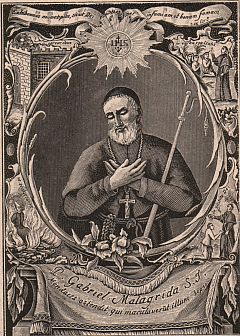
On this date in 1761,* the Jesuit Gabriel Malagrida became a late casualty of the Tavora Affair and the Lisbon earthquake when he was garroted for heresy.
Malagrida (English Wikipedia entry | Portuguese) was a 72-year-old Italian with decades of missionary service to the Portuguese New World colonies under his belt.
He had, in his time, been a prominent exponent of the Jesuits missions’ policy in the Amazon, which amounted to asserting their own jurisdiction against the secular government’s attempt to order its overseas territories. (There’s more on that conflict here.)
And this only exacerbated his principal sin of being a Jesuit — an order whose diminution was eagerly sought by the rising statesman of Enlightenment Portugal, the Marquis of Pombal.
The shock of the 1755 Lisbon earthquake would deal Pombal the trump hand he needed to start reshaping both city and society to his liking.
Malagrida, meanwhile, carped that the earthquake’s causes
“are not comets, are not stars, are not vapors or exhalations,** are not phenomena, they are not natural contingencies or causes; but they are solely our intolerable sins … I do not know how a Catholic subject dares to attribute the present calamity of this tragic earthquake to causes and natural contingencies. Do not these Catholics understand this world is not a house without an owner?”
This published pamphlet merely echoed what many of the order were saying in the pulpits, and Pombal was not about to let the backwards, superstitious crowd** own the catastrophe.
Malagrida was banished from Lisbon: and, when the Tavora family was implicated in an attempt to assassinate the Portuguese king, Malagrida, their confessor, found himself clapped in prison.
Though the now-septuagenarian priest did not share the Tavoras’ grisly public butchery, he was left to molder. A couple years in a dungeon saw him go a bit strange, and supposedly he published treatises with such eccentric features as God’s personal instructions to Malagrida, and Malagrida’s fascination with St. Anne’s uterus. Catholic sources, which consider Malagrida a martyr, doubt that he ever published any such thing; if he did, it seems apparent that it was dementia rather than heresy that afflicted the old man.
But Pombal had installed his own brother as judge of the tribunal, so the matter was prearranged. The execution itself was
staged in a dramatic way, even to the point of Malagrida’s appearing on the scaffold in Jesuit habit, to impress upon the Portuguese and the world at large that an old order had come to an end and a new one was to be established … one might say that … symbolism at the cost of one human life was a relatively humane procedure in comparison with the symbolic elimination of whole classes of society in the twentieth century.
Detail view (click for the full image) of Malagrida executed at a Lisbon auto de fe. CC image from Ricardo Mealha, original provenance unknown.
Pitying the superstitious Jesuit at the stake, Enlightenment secularist Voltaire inveighed against Enlightenment secularist Pombal for conducting the execution … just part of Voltaire’s queer ideas about not killing people over their religious beliefs.
“It is all pity and horror,” Voltaire wrote in a private correspondence. “The Inquisition has found the secret to inspire compassion for the Jesuits.”
Voltaire’s appraisal in Candide (already published by this time) of a country in the grip of religious superstition unjustly stands as one of the lasting literary monuments to an event that actually rolled back clerical influence: “the sages of [Portugal] could think of no means more effectual to prevent utter ruin than to give the people a beautiful auto-da-fé; for … the burning of a few people alive by a slow fire, and with great ceremony, is an infallible secret to hinder the earth from quaking.” That the philosophe who penned those words waxed so immoderately outraged at the demonstrative chastisement of a man who preached precisely all that hocus-pocus — that Voltaire ascribed his execution to “the Inquisition” — plants the cherry on the irony sundae.‡
But Pombal’s expedient use of the Inquisition’s medieval machinery to make an example of Father Malagrida would not be the start of a pattern; the Pombaline reforms of the years to come brought the Inquisition sharply to heel, and it was Malagrida himself who was its last victim (pdf) in Portugal in its classical ecclesiastic form.
** The “God is pissed” hypothesis was posited against theories of earth’s vapors promulgated by the Pombal-sponsored scientist Ribeiro Sanches.
† Anti-Jesuit sentiment was widely abroad in Europe at this time; increasingly resented as political manipulators, the Society would be suppressed by papal order in 1773, only to revive during the post-Napoleonic reaction.
‡ Malagrida was well-known to contemporaries in Europe, but that does not mean sympathy for him was universal. The British pol Lord Shelburne was satirized as “Malagrida” for his putative duplicity.
Ten years ago today, former Chinese politburo member Cheng Kejie was executed for gobbling up an impressive $5 million in bribes.
The onetime chairman of the Guangxi Zhuang Autonomous Region was (and, as best I can determine, remains) the highest-ranking official judicially executed since the Communists took power in China in 1949. He’d spent the best part of the 1990s soaking up kickbacks from his powerful post, much of it secreted in out-of-country accounts.
The execution was part of a massive campaign against official corruption which has long bedeviled China’s economic surge. Cheng’s own former boss around this time warned that “graft could destroy China”.
Cheng’s execution was announced after the fact, at the same time that China belatedly publicized the arrest of former Vice-Minister of Public Security Li Jizhou in a billion-dollar smuggling scandal. Li somehow managed to duck execution for similarly show-stopping corruption allegations (including scandalous details supplied by his mistress*), a fact which raised eyebrows in the People’s Republic about improper influence.** He “deserves to die ten thousand times over,” opined the Beijing Youth Daily.
Here in 2010, China (whose wholesale execution pace is quietly on the decline) has moved — not without opposition — to drop the death penalty for a number of non-violent economic crimes. That rollback apparently would not apply to bribery, however.
Dissatisfaction worked on multiple planes: nobles were angry at Gustav’s circumventing aristocratic prerogatives (both to launch this war, and elsewhere); those with Finnish estates were especially piqued at the prospect of bearing the burdens of a war and a possible Russian occupation.
The Anjala conspirators pitched Russian Empress Catherine the Great on the prospect of making peace on their authority and withdrawing Finland from Gustav’s control. Catherine demurred, and enough of the army stayed loyal to the crown that the conspiracy collapsed.
Product of an old Swedish-Finnish noble lineage, he might well have expected leniency: for all his executive overreach, Gustav III wasn’t the wholesale-execution type. And indeed, Hastesko was the only conspirator to visit the scaffold.
Cold comfort both to the condemned and to his widow Beata, the latter of whom wore mourning clothes for the remaining 51 years of her life. But she would see in her time the wheel of fortune turn for her late husband’s defeated project quite dramatically.
This particular Russo-Swedish War ultimately amounted to a tempest in a teapot, but not long after it blew over, another tetchy noble assassinated Gustav III.
On the 20th of August, 1672, the city of the Hague, always so lively, so neat, and so trim that one might believe every day to be Sunday, with its shady park, with its tall trees, spreading over its Gothic houses, with its canals like large mirrors, in which its steeples and its almost Eastern cupolas are reflected,–the city of the Hague, the capital of the Seven United Provinces, was swelling in all its arteries with a black and red stream of hurried, panting, and restless citizens, who, with their knives in their girdles, muskets on their shoulders, or sticks in their hands, were pushing on to the Buytenhof, a terrible prison, the grated windows of which are still shown, where, on the charge of attempted murder preferred against him by the surgeon Tyckelaer, Cornelius de Witt, the brother of the Grand Pensionary of Holland was confined.
…
the whole town was crowding towards the Buytenhof, to witness the departure of Cornelius de Witt from prison, as he was going to exile; and to see what traces the torture of the rack had left on the noble frame of the man who knew his Horace so well.
Yet all this multitude was not crowding to the Buytenhof with the innocent view of merely feasting their eyes with the spectacle; there were many who went there to play an active part in it, and to take upon themselves an office which they conceived had been badly filled,–that of the executioner.
There were, indeed, others with less hostile intentions. All that they cared for was the spectacle, always so attractive to the mob, whose instinctive pride is flattered by it,–the sight of greatness hurled down into the dust.
That ominous mob got its spectacle this date in 1672, lynching the Dutch Republic’s longtime de facto head of state, Johan de Witt along with his brother Cornelis/Cornelius.
A statue of Johan (standing) and Cornelis de Witt in their native Dordrecht.
The mercantile powerhouse that was the 17th century Dutch Republic was the stage for a long-running conflict between the Orange monarchists (hence the soccer uniforms) and the Republican merchant class.
With the sudden death of the young William II, Prince of Orange in 1650, leaving the (non-hereditary) executive office of stadtholder vacant, the Republicans became ascendant.
And the outstanding figure of the First Stadtholderless Period was Johan de Witt, scion of a Dordrecht merchant family powerful enough that William II had imprisoned de Witt’s own father during a power struggle.
While all these guys were landing themselves in their respective canons, Johan de Witt was trying to keep the age Golden.
Having only relatively recently broken free of Spain, the small country was an up-and-comer on the horns of a serious security dilemma: its leading commercial position put it into maritime competition with England, while its continental location made it vulnerable to the enormous army of the neighboring continental hegemon, France. Ultimately, even with its trade wealth, it did not have the resources to keep up with both of western Europe’s leading powers.
For a generation, de Witt’s statecraft kept the men of the Low Countries out of that predicament, while his brother Cornelis chipped in with a couple of timely naval victories. (Actually authored by Michiel de Ruyter, but Cornelis rode shotgun.)
In 1654, Johan brought the First Anglo-Dutch War to a close, making with Oliver Cromwell a secret pact he was only too happy to enforce never to allow William II’s son, the eventual William III, to be named stadtholder. Reason being: William III was the grandson of the Stuart king Cromwell beheaded, Charles I, and thus a potential claimant to the English throne. Both Protestant Republics had a distinct interest in keeping this monarchist well away from power. (Both would be sorely disappointed.)
A decade and a Stuart Restoration later, de Witt maintained (mostly) Dutch dominance of the seas in the Second Anglo-Dutch War, then held off France (with the help of a timely alliance with the recent adversary, England) in the War of Devolution.
In each case, he kept at least one of England or France on the sideline, or in his own camp.
But the Third Anglo-Dutch War was the charm — as it was also the Franco-Dutch War, and therefore 1672 was Rampjaar: disaster year. While the Dutch were aces on the waves, a massive French invasion easily overwhelmed them on terra firma.
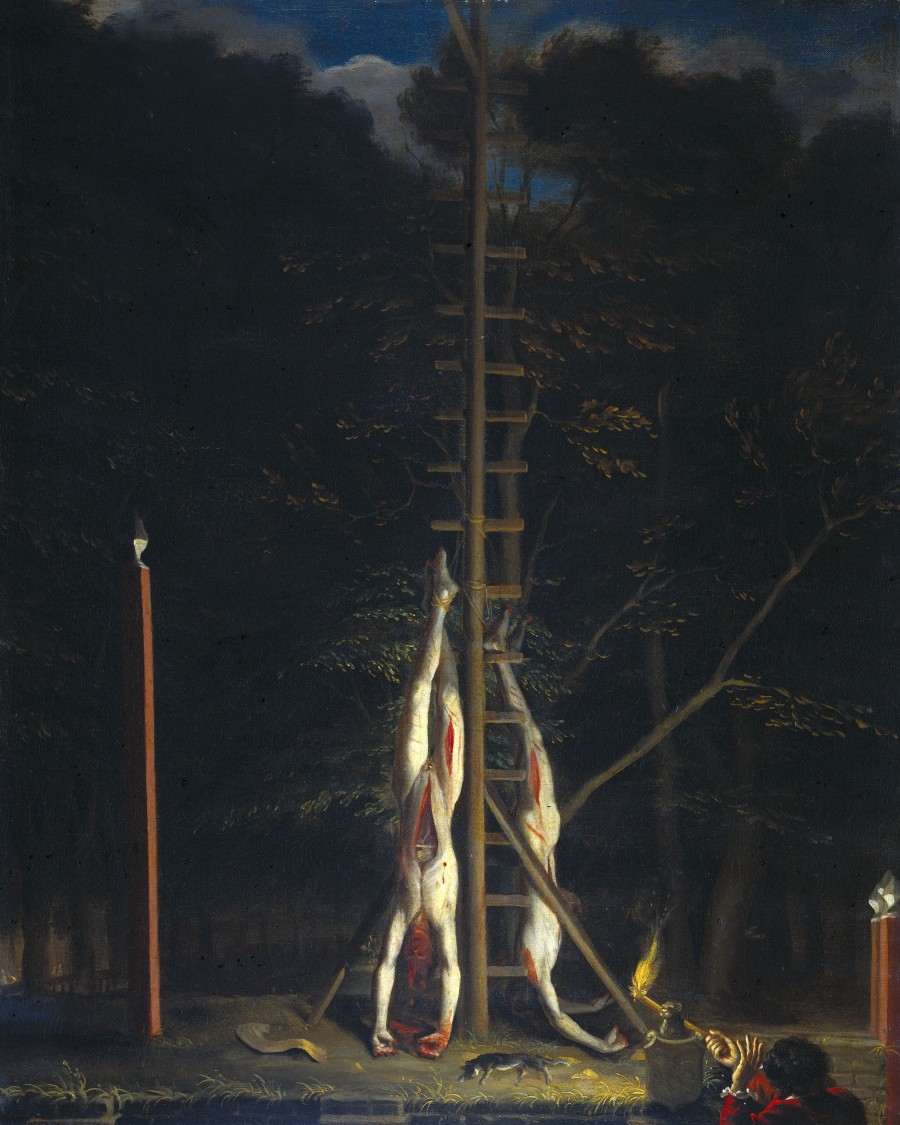
Detail view (click for the full image) of a grisly painting of the mutilated de Witt brothers strung up at The Hague. It’s attributed to Jan de Baen, who in better times took Johan de Witt’s portrait.
De Witt’s never-beloved mercantile oligarchy speedily collapsed with the military reverses, and the now all-grown-up William III was there to pick up the pieces to popular acclaim. Arrested for treason, Cornelis sustained torture without confessing, but when Johan visited him in prison — and William III incriminatingly withdrew the cavalry protecting the brothers — the mob quenched its fury with the de Witts’ blood.
every one of the miscreants, emboldened by his [Johan’s] fall, wanted to fire his gun at him, or strike him with blows of the sledge-hammer, or stab him with a knife or swords, every one wanted to draw a drop of blood from the fallen hero, and tear off a shred from his garments.
And after having mangled, and torn, and completely stripped the two brothers, the mob dragged their naked and bloody bodies to an extemporised gibbet, where amateur executioners hung them up by the feet.
Then came the most dastardly scoundrels of all, who not having dared to strike the living flesh, cut the dead in pieces, and then went about the town selling small slices of the bodies of John and Cornelius at ten sous a piece.
-Dumas
The word “ungrateful” comes to mind.
De Witt stood altogether on a lower plane than Cromwell. We regard him rather as a man of rare and singular talent, than as one of the chosen great ones of the earth, which Cromwell was. He stands far above the common run of men; and he was head and shoulders above nearly all the notable men of his time. He would have been greater if the movement of his limbs had been less burdened with the Dutch governing apparatus … He is not one whom the world can ever greatly admire or love.
(Here’s another, and here’s a 17th century volume de Witt himself coauthored.)
The rise of William III came with the decline of that Dutch Golden Age: the country fended off the immediate military threat, but it increasingly slipped behind its larger neighbors. Costly as was the Franco-Dutch War, it is a step on the path towards the present-day Europe, and this gives us enough excuse to notice that the Eurovision lead-in tune is actually from a Te Deum composed to mark its end.
But William’s own ascent to this wealthy sovereignty was just the beginning for him. Sixteen years later, the House of Orange’s champion vindicated Cromwell’s trepidation about him and gained a far more satisfactory position from which to do battle with his Gallic rival Louis XIV by stunningly overthrowing the Stuart dynasty and becoming King of England in the Glorious Revolution.**
* The Dutch remained the sole western contact of closed Japan until 1854, which is why Japan’s eventual period of scientific advancement became known as ‘Dutch Learning’.
** Albion did not forget the de Witts, either: according to this 1785 cant dictionary, the term “dewitted” had a 17th-18th century run in English to denote — well, exactly what happened to Cornelis and Johan.
On this date* in 1527, Jacques de Beaune was hanged on the gallows of Montfaucon for peculation.
Beaune (French Wikipedia entry) was an aged man well into his 70s or 80s, and had served four kings’ treasuries, rising to become Superintendent of Finance for Francis I.
His slow-motion ruin began with France’s military involvement in Italy earlier that decade, in which capacity the French commander near Milan suffered a grievious reverse and had to abandon Lombardy.
Furious buck-passing ensued:
The commander blamed the defeat on a lack of pay for his Swiss mercenaries;
The paymaster — Beaune — blamed the lack of funds for the mercs on the Queen Mother, Louise of Savoy‘s calling in a debt
The ensuing investigation revealed this story to be true, but Beaune was obliged to retire from the court because of the Queen Mother’s fury at him.
And that might have been that, but for the further French misadventures in Italy.
In 1525, Francis himself contrived to be captured at the Battle of Pavia, elevating Louise of Savoy to regent in his absence. By the time the spendthrift king had been ransomed back, his treasury was nigh empty and Louise knew just the person to blame.
An audit of Semblancay’s accounts intended to turn up some loose ducats embarrassingly showed that the noble was actually a creditor of the king, but
on 13 January 1527, after Semblancay had returned to Paris on business, he was arrested and thrown in the Bastille … the king and his council … had been looking for ways of raising within five days 370,000 livres needed for the payment of troops. Semblancay was known to be a very rich man and the prospect of confiscating his property must have been tempting. (Source)
Semblancay was tried by a handpicked favorite of the court, with the predictable result on a somewhat nebulous embezzlement/corruption thing; a jailhouse snitch once in the great lord’s employ gave evidence against him. The doomed man, perhaps untroubled to be relieved of the infirmities of his advanced age, was supposed to have been downright chill walking through Paris to his death, and he was met with respect by a citizenry that could hardly help sympathizing with this wizened but serene victim of the royal wrath.
Lorsque Maillart, juge d’Enfer, menoit
À Monfaulcon Samblançay l’ame rendre,
À votre advis, lequel des deux tenoit
Meilleur maintien ? Pour le vous faire entendre,
Maillard sembloit homme qui mort va prendre
Et Samblançay fut si ferme vieillart
Que l’on cuydoit, pour vray, qu’il menast pendre
À Montfaulcon le lieutenant Maillart.
When Maillart, judge of Hell,
To Montfaucon led Samblançay to give up his soul,
Which of the two, in your mind,
Had the better demeanour? To enlighten you,
Maillart seemed the man whome death would take
And so sturdy an old man was Samblançay,
That one truly believed that it was he who led
Lieutenant Maillart to be hanged at Montaucon.
This case is less well-remembered today than it ought to be; to contemporaries, the hanging of France’s treasurer for corruption was an awfully noteworthy event.† (Opinions at the time seemed to be split on the justice of the matter, even though Semblancay was posthumously rehabilitated; later generations have more strongly gravitated to the understanding that he was railroaded.)
And it launched an ensuing, decade-long project of Francis’s, to squeeze wealthy financiers through the commission de la Tour Carree and thereby get in the good graces of the early modern bond markets unsettled by France’s 1520s fiscal faceplant.
We noticed in a great Press from twenty to twenty-five huge Gallows-birds round a great Table [bourreau, punning bureau] covered with green Cloth, staring at each other, with their Hands as long as Crane’s Legs and their Nails two Feet long at least, — for they are forbidden ever to pare them, so that they become as crooked as Bills or Boat-hooks — and just at that time was brought in a great Bunch of Grapes which they gather in that Country, from the Vine called Extraordinaire, the Grapes from which often hang on Poles. As soon as the Bunch was laid there, they put it under the Press, and there was not a Berry from which they did not squeeze Oil of Gold, insomuch that the poor Bunch was carried off so drained and stripped, that there was not a Drop of Juice or Liquor left.
Most of those Tour Carree prosecutions didn’t result in executions — “merely” confiscations of lands and titles which could be re-sold, and sentences which could be commuted for a fine. R.J. Knecht, in The Rise and Fall of Renaissance France, 1483-1610, puts the king’s profit on such confiscations into the millions of livres.
But to make those shakedowns seem a small price to pay, the threat of Semblancay’s example must have lurked in the background for targeted nobles.
(Semblancay himself had been reckless enough not to accept an initial mostly-exoneration in the inquiry that preceded his arrest and trial, since part of it required him to “repay” supposed debts to Louise of Savoy. His appeal against that part of the judgment might have set him up to be the cautionary example for everyone else.)
The Beaune name would scintillate to posterity through such illustrious descendants as Renaud de Beaune (French link), a notable archbishop; and, more salaciously, Escadron Volant all-star Charlotte de Beaune Semblançay, who seduced powerful nobles at Catherine de’ Medici’s behest.
A lengthy French history of our day’s early modern moneybags can be perused here; when visiting Tours, you can revisit the days when he was in the chips by crashing at one of the many buildings he put, the Hotel de Beaune-Semblancay.
** There’s another (translated to English) meditation Marot wrote on Semblancay here, in the first-person voice of the hanged man. Marot was a friend of the eventually-executed French linguist and translator Etienne Dolet, and his own unorthodox opinions would eventually require him to flee the realm for his life.
We do note that in this era of combative pamphleteering, the geezer who made himself a tycoon by administering the taxes wasn’t universally supported by the literary set. Roger de Collerye (cited here) hooted Jacques de Beaune into the hereafter with the verses,
Tremblez, tremblez, larrons gros & petiz!
Retirez vous, gens trop fins et subtilz!
Absentez vous bientost & prenez terre,
Gens de finances et tresoriers gentilz
Qui d’attrapper estes tant ententifz.
Sur vous surviegne tempeste & tonerre!
Craignez la court qui vous donna la guerre
Bien asprement, quant je l’ay pance,
Souvieigne vous de la mort Sant Blancey!
† It happened yet again in September 1535, to Jean Poncher. Historically, proximity to the French crown’s revenues was also proximity to the gallows.
European-educated and on retainer by the colonial German government, Bell was hardly the subversive type: rather, as the head of the largest clan of the important Duala tribe, he was the guy that Berlin looked to to uphold its authority.
This mutually satisfactory relationship began unraveling in 1910, with the Reich’s plan to abnegate the 1884 treaty under whose auspices it intruded into Kamerun (Cameroon) in the first place.
Seeking to confine the Duala to a few coastal villages — and subsequently, to push those Duala to less desirable inland territory — Berlin managed the rare feat of uniting the tribe’s various families, and pushing Rudolf Manga Bell himself into (surprising, to Germany) resistance.
When petitions to the Reichstag were ignored, the Duala began (Bell’s own degree of involvement in this seems to be a disputed point) making noises about holding Berlin in breach of the colonial treaty and finding itself a new European patron, like France or England.
And one notes the year in this post’s title, which would become momentous to Germany for other reasons. “The coming war,” notes Victor T. LeVine, “made it appear that Manga Bell had been plotting with Germany’s enemies.”
Bell was arrested for treason in the first half of 1914, as the Germans seized prime Bell land along the Wouri River.
In the conflict that became remembered as World War I, the first declarations of war were made in the very first days of August; Axis and Ententethe Central Powers and Triple Entente lined up against one another in the colonial territories, too, and German administrators in Kamerun realized that they were about to face an invasion from neighboring British and French colonies.
So it was in an atmosphere of panic and a view towards desperate internal repression that Bell was tried for treason on August 7, 1914, along with his friend and fellow-traveler Martin Paul Samba — and put to death the very next day.
Postscript
The Allied invasion had taken Duala and the other principal cities of Kamerun from the Germans by the end of September; over an 18-month campaign, the Germans were totally defeated in the territory, which France and England claimed as victors’ spoils after the war. (Also inheriting the tense relationship with the Duala; France was still trying to sort out the 1914 German expropriations that started the whole mess decades later.)
As a result, Rudolf Duala Manga Bell’s son, Alexander Ndoumbe Duala Manga Bell, not only inherited his father’s royal position among the Duala — he became Cameroon’s first elected representative to the French National Assembly.* There’s more about that guy here.
It is here that the Germans part ways with Cameroon’s national story, but there was almost a “peace in our time” diplomatic reconquista.
Although Hitler originally held the colonial movement in great disdain, in the late 1930s his regime ‘adopted’ and coordinated this movement. After 1936 the renewed campaign for the recuperation of German colonies had its desired results among the Allied powers. In discussions between the French Foreign Minister, Yvon Delbos, and the American Ambassador, William Bullitt, proposals were considered for the appeasement of Germany including tariff reductions, the involvement of the Third Reich in the development of Africa, and finally the granting of a colony to Germany, probably the Cameroons. In November 1937, during talks between Premier Chautemps, Prime Minister Chamberlain, Eden and Delbos, the suggestion was allegedly made by Chamberlain that France should ‘hand the Cameroons to Germany at once without any quid pro quo’.**
* Ralph A. Austen, “The Metamorphoses of Middlemen: The Duala, Europeans, and the Cameroon Hinterland, ca. 1800 – ca. 1960”, The International Journal of African Historical Studies, Vol. 16, No. 1 (1983).
** Richard A. Joseph, “The German Question in French Cameroun,” Comparative Studies in Society and History, Vol. 17, No. 1 (1975)
On this date in 1781, South Carolina patriot Isaac Hayne was hanged for breaking his conditional British parole and re-enlisting in the American Revolution.
Though Hayne is not, to us, the most famous revolutionary executed by the British, he might have been considered by his contemporaries as the most prominent individual to go to the scaffold for the cause.
These prisoners were required to swear an oath of allegiance to the crown in exchange for their parole, which Hayne reluctantly agreed to do because his family had been hit with smallpox.
He declared to a friend that,
as they [the British] allow no other alternative than submission, or confinement in the capital, at a distance from my wife and family, at a time when they are in the most pressing need of my presence and support, I must, for the present, yield to the demands of the conquerors. I request you to bear in mind, that previous to my taking this step, I declare that it is contrary to my inclination, and forced on me by hard necessity. I will never bear arms against my country … I do not mean to desert the cause of America.
But as the British southern campaign foundered over the year ahead, the mother country eventually attempted to call him up to do just that: bear arms against his country.
Hayne thought his parole terms protected him from ever having to serve against the colonies, so he simply got back into the fight on the revolutionary side instead. He was captured in that capacity.
The British commander Francis Rawdon handled his relapsed prisoner with uncommon severity, putting him to a drumhead military tribunal with a preordained outcome and refusing the many public pleas for leniency.
The irregular and vengeful nature of these proceedings, and Hayne’s seemingly honorable conduct, raised hackles on both sides of the Atlantic; shortly after hanging Hayne, Rawdon returned to the British Isles to find a good deal of pointed criticism of his behavior. (Parliament quashed any damaging official inquiry, and Lord Rawdon actually extracted an apology from the peer who had the temerity to motion the investigation — an intolerable impeachment on Rawdon’s honor.)
The Hayne incident was widely understood to have been conditioned by British frustration at its failing fortunes in the war. By the time of the execution, the redcoats held nothing of South Carolina save Charleston itself. General Cornwallis had recently marched north from the Palmetto State; in a few weeks’ time, he would surrender his sword and the British cause alike after the decisive British defeat at Yorktown, Virginia.
And though the commandants at Charleston scarcely anticipated that stunning reversal, they had only a few months before suffered the upsetting (but more legally tenable) hanging of the honorable British Major John Andre as a result of the Benedict Arnold affair. British forces were reputedly on the lookout for any opportunity to trade tit for tat.
Continental Gen. Nathaniel Greene alleged that the British officer who received the petition for Hayne’s life simply wrote on it John Andre — and sent it back.
It was during this exchange of Senatorial disquisitions that Webster delivered one of the noted orations of the antebellum era, the aptly-named Second Reply to Hayne:
I have not allowed myself, Sir, to look beyond the Union, to see what might lie hidden in the dark recess behind. I have not coolly weighed the chances of preserving liberty when the bonds that unite us together shall be broken asunder. I have not accustomed myself to hang over the precipice of disunion, to see whether, with my short sight, I can fathom the depth of the abyss below; nor could I regard him as a safe counselor in the affairs of this government, whose thoughts should be mainly bent on considering, not how the Union may be best preserved, but how tolerable might be the condition of the people when it should be broken up and destroyed. While the Union lasts, we have high, exciting, gratifying prospects spread out before us and our children. Beyond that I seek not to penetrate the veil. God grant that in my day, at least, that curtain may not rise! God grant that on my vision never may be opened what lies behind! When my eyes shall be turned to behold for the last time the sun in heaven, may I not see him shine on the broken and dishonored fragments of a once glorious Union; on States dissevered, discordant, belligerent; on a land rent with civil feuds, or drenched, it may be, in fraternal blood! Let their last feeble and lingering glance rather behold the gorgeous ensign of the republic, now known and honored throughout the earth, still full high advanced, its arms and trophies streaming in their original lustre, not a stripe erased or polluted, not a single star obscured, bearing for its motto, no such miserable interrogatory as “What is all this worth?” nor those other words of delusion and folly, “Liberty first and Union afterwards”; but everywhere, spread all over in characters of living light, blazing on all it sample folds, as they float over the sea and over the land, and in every wind under the whole heavens, that other sentiment, dear to every true American heart, – Liberty and Union, now and for ever, one and inseperable!
When not being rhetorically posterized by New England gasbags, Robert Hayne made time to pen a justification for his famous forebear’s conduct for the Southern Review in 1828 — comparing the British behavior of executing rather than detaining a prisoner who broke parole to the massacre at Jaffa Napoleon notoriously ordered in 1799.
(Actually, Isaac Hayne’s old nemesis Francis Rawdon had only died in 1826; Robert Hayne wrote his piece to confute a vindication of himself that Lord Rawdon — also recognized by his subsequent titles, Earl of Moira and Marquess of Hastings — had authored, decades after the fact, of his conduct in the Hayne matter.)
Though this 37-page slog of Robert Hayne’s is obviously in the public domain by now, it appears it is not yet freely available online. However, it’s the source of the otherwise unattributed quotes in this article.
On this day in 1419, an angry mob of Hussite peasant rebels stormed the town hall on Charles Square in Prague and threw the judge, the mayor and several city council members (either seven or thirteen; accounts differ) out the window. They all either died in the fall or were killed by the crowd outside.
Hussites followed a Christian reformer, Jan Hus, who was one of the forerunners of the Protestant Reformation. Hus was eventually excommunicated and burned as a heretic. The cause of the July 30 riot was the city council’s refusal to release from custody several Hussite prisoners.
The mob, led by the Hussite priest Jan Želivský and future general Jan Žižka, marched to the town hall, but they only became violent after someone inside the building threw a stone at them. After that there was no stopping them.
The riot had far-reaching consequences, inasmuch as it is seen as the start of the Hussite Wars, which lasted until 1434 or so and involved government-sponsored military action against the Hussites as well as Hussites fighting amongst themselves.
This event has come to be known as the First Defenestration of Prague. That is, I’m sure we all can agree, an AWESOME name, and probably the principal reason the riot is still remembered today. The word “defenestration” comes from Latin: de-, meaning “out of,” and fenestra, “window.”
The Czechs have a habit of throwing people out of windows at critical junctures in history; since 1419 there has been at least one more (nonfatal, but more famous) Defenestration of Prague, in 1618. A couple of similar events since then have sometimes been called the Third Defenestration of Prague, though this is not universally agreed upon.


 Malagrida (

 The onetime chairman of the
  Named for the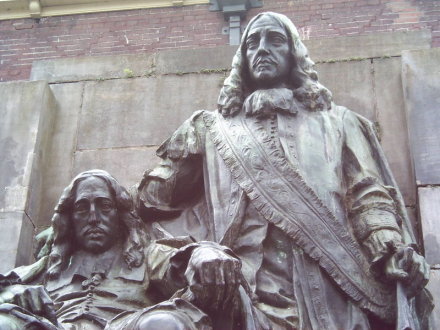


 European-educated and on retainer by the colonial German government, Bell was hardly the subversive type: rather, as the head of the largest clan of the important Duala tribe, he was the guy that Berlin looked to to uphold its authority.
 Though Hayne is not, to us,
