1807: Ephraim Blackburn, low roller

On this date in 1807, a throw of the dice noosed Ephraim Blackburn.

The son of a Pennsylvanian who served in George Washington’s army, Blackburn sought his own martial adventure by joining the expedition of Louisiana-Mexico border trader Philip Nolan in 1801.

Nolan had spent the 1790s living and trading along the frontier of Mexico and (Spanish, until 1800) Louisiana. Nolan worked in a legal twilight, earning the connivance of some Mexican officials and the hostility of others; perhaps no Anglo was better-acquainted with Texas.

By 1800 he was barred from the territory but assembled a coterie of 30-plus armed men and ventured into Texas once agan on an apparent filibustering operation seeking to carve out control of some piece of Texas. Our man Ephraim Blackburn was among these daring souls, whose wooden palisade somewhere near the Brazos River was quickly overwhelmed by a Mexican attack.

Nolan died in the battle, leading the remainder of his men to surrender. From there they would embark on a strange years-long legal road, their numbers continually winnowed by escapes. Ordinarily when one is prosecuted as a foreign invader, one is not permitted to have the liberty of the city or to go into business, but that is exactly what occurred with the Nolan men.

One of their number, Peter Ellis Bean, is known to have survived his incarceration; he escaped and fought for Father Miguel Hidalgo‘s Mexican revolutionaries against Spain, returned to the United States in 1818, then re-settled in post-independence Mexico. Bean conferred on posterity a memoir recalling that during their imprisonment,*

Some of my companions got leave of the general to go to other towns to live, but I thought I would find out some way of making something. I gave myself out as a hatter. There was a gentleman who trusted me for whatever was necessary to carry on that business. I employed two Spanish hatters to work with me, for, in fact, I was no hatter at all. In about six months I had so raised my name, that no one would purchase hats except of the American. By this means I got a number of journeymen to work with me. I was clear of debt, and making from fifty to sixty dollars per week.

All this entrepreneurialism was unfolding while capital case meandered with no great urgency among Spanish courts. One judge recommended the prisoners’ outright release in 1804; by the time the message had been shipped across the Atlantic and back, it was 1807, and the judge had died. The crown’s reversal horrifyingly required the death of one in every five of the invaders — although since deaths and escapes had now reduced their ranks to just nine, the local authorities mercifully rounded the figure down to one.

On the 9th of November, the nine remaining prisoners were gathered in a Chihuahua barracks and made aware of their situation. They agreed among themselves to cast dice in order of seniority — low roll hangs.**

Blackburn was the oldest, and the first to roll. He threw a 3 and 1. Bean narrates, beginning with the frighteningly mysterious arrival of confessional priests the night before the survival lottery:

all our conversation that night was in view of our being put to death. I told them that we should trust to fate, and not fret ourselves about what we could not remedy. One of them said the bravest would be cast down to see his open grave before him. “But,” said I, “if you find no way to escape that grave, is it not better to march up to it like a man, than to be dragged to it like one dead? It is enough for them to drag me to it when life is gone. The most cowardly, where under sentence of death, have marched up with great bravery. And, as for myself, if I must die, I mean not to disgrace my country.” The reason I talked so was that I did not believe they would put us to death.

Soon the next morning the priests returned, and David Fero asked them if we were to be put to death. They said they did not know — perhaps some might be. I then began to conclude it would be me, and all my companions thought the same thing. I, however, said nothing; for, as I had before talked of valor in such cases, it became necessary for me to support that character. The priests said we must confess all our sins to them, and we should be forgiven. As for myself, I had been taught that God knew all my crimes and it was not worth while to relate them to the parsons. But some of my companions began to confess, and had their sins forgiven. When they asked me, I told them I must have four or five days to recollect all my sins — that they were so many, it was doubtful whether I could ever remember them all. The parsons advised me to begin, and God would enlighten me, and help me to remember them. I told them I could not that day, but perhaps by the next day I could remember some things. They then left us. All that day the talk among us was as to who it would be. I told them, I supposed, as I was the worst, it would be me; and, as my friend Tony Waters had been put in with us to share our fate, I thought, as he had broken open my letter, that if the thing went according to justice, and they hung the worst man, it must be him, for he was, without doubt, the greatest villain and ought to have been dead some years ago. Waters sighed, but said nothing. The next day the parsons came again, and brought with them a colonel, who read to us the king’s order — which was, that every fifth man was to be hung, for firing on the king’s troops. But, as some were dead, there were but nine of us, and, out of the nine, but one had to die. This was to be decided by throwing dice on the head of a drum. Whoever threw lowest, was to be executed. It was then agreed that the oldest must throw first. I was the youngest, and had to throw last. The first was blindfolded, and two dice put in a glass tumbler. He was led to the drum which was put in the room, and there cast the dice on the head of the drum. And so we went up, one by one, to cast the awful throw of life or death. All of my companions, except one, threw high: he threw four. As I was the last, all his hopes were that I should throw lower than he. As for my part, I was indifferent about it, for I had resigned myself to fortune. I took the glass in my hand, and gained the prize of life, for I threw five.

After two days to prepare himself, Blackburn hanged on Chihuahua’s Plaza de los Urangas. The remaining prisoners were scattered to different prisons for many years to come; among the survivors, only Bean is known to have set eyes on his native soil again.

* On the expedition that would staple his name to mainland America’s highest peak, Zebulon Pike was briefly captured by the Mexicans and taken to Chihuahua, where he met some of the Nolan gang prisoners.

** Both the random selection and its circumstances — punishing Anglo adventurers — strongly foreshadow Mexico’s later Black Bean Lottery.

On this day..

1929: Habibullah Kalakani, Tajik bandit-king

Warlord Habibullah Kalakani, deposed after ten months styling himself King of Afghanistan, was publicly shot on this date in 1929.

An ethnic Tajik whose surname alludes to his native village north of Kabul, Kalakani served in the army of Emir Amanullah Khan.*

This Khan aspired to far-reaching reforms that would modernize his marchlands kingdom and not for the last time an Afghan ruler found this programme stoked a furious resistance among tribal grandees. Kalakani, though derisively nicknamed Bacha Seqao (son of a water-carrier) was just such a grandee, having pivoted profitably from regular military orders to highway robbery.

When Khan’s forces had vacated Kabul to manage a Pashtun rebellion in the south — only the latest of numerous tribal risings that plagued the Khan years — Kalakani in late 1928 sprang a surprise Tajik rebellion from the north and marched on the unprotected capital.

Amanullah evacuated Kabul with a quickness, personally behind the wheel as he blazed his Rolls Royce ahead of Kalakani’s cavalry all the way to India and eventual exile in Europe.


Kalakani

But the “bandit king” soon found his own government strained by the same tensions that had elevated him. Pashtun rebels who used to chafe under a western-oriented king now chafed under a Tajik one — in fact, the only Tajik to rule Afghanistan in its modern history — and their fresh rebellion soon toppled Kalakani in his own turn. He was shot with his brother and their aides, contentedly telling his firing squad, “I have nothing to ask God, he has given me everything I desired. God has made me King.”

Kalakani is still the third-last king of Afghanistan and is still bitterly — violently — controversial on his native soil, where whether you reckon him a hero or a thug depends upon your kinship. Just weeks ago as we write this, a reburial of Kalakani’s remains in Afghanistan provoked bloody ethnic melees on the streets.

* Although there is no specific connection here to Habibullah Kalakani, an execution blog would be remiss not to include a reference to this sadly undateable National Geographic photo tracing to Khan’s reign of one of those real-life dangling man-cages so beloved of the sword-and-sandals fantasy genre. Per NatGeo’s caption, an actual thief was “put in this iron cage, raised to the top of the pole, so that his friends could not pass food or poison to him, and here he was left to die.”

On this day..

1996: Arshad Jameel, military man

Pakistani army Capt. Arshad Jameel (or Jamil) was hanged at Hyderabad Prison 20 years ago today.

Capt. Jameel exploited a security sweep to orchestrate the summary execution of nine Indian-armed terrorists … who turned out not to be terrorists at all, but ordinary residents of Tando Bahawal village whom Jameel had a personal grudge with.

It was a resonant case in a country dominated by its military and only wide public outrage at the journalistic expose unveiling the crime put Jameel in the dock of a military court.

Even so, the wheels turned so painfully slow that Pakistanis could not but suspect an institution accustomed to a broad grant of impunity of dragging its feet. Four years deep into Jameel’s appeals, two sisters of victims protested the delay by publicly immolating themselves on September 11, 1996. They died painfully of their burns, but they got the result they wanted: appeal denied.

On this day..

1573: Hugh Cahun, unjustly

On this date in 1573, miscarried justice took the head of Scottish cavalryman Hugh Cahun in Stockholm.

Modernizing in the 16th century, Sweden flattered Scotland with deepening ties not excluding marriage feelers for Mary, Queen of Scots. When a rising Sweden’s ambitions brought her into conflict with Russia, Sweden summoned thousands of Scots soldiers to her banner.


1555 illustration of a Scottish sword dance in the chronicle of Swedish monk Olaus Magnus. (Source).

Hugh Cahun had been in Sweden since probably 1565, in the service of a unit commanded by his older brother William. It was one of three Scottish cavalry commands in Sweden at this time; French and German troops too joined the polyglot coalition.*

In the summer of 1573, Cahun caught wind of recruitment among these foreign auxiliaries for a plot to depose the Swedish King John III in favor of his imprisoned predecessor Erik XIV. Cahun reported the plot, but he didn’t know enough about it to make it stick to someone else — so perversely, he himself became the one suspected of seditious design.

King John appears by his vacillation not to have been all that convinced of the turn justice had taken in this case, twice reprieving Cahun and ultimately sparing him the horrors of the breaking-wheel for a simple beheading — sort of the early modern equivalent of the calculating modern governor who, faced with compelling evidence of innocence, consents to send a condemned man to a dungeon for the rest of his life instead of letting the law take its course. (There’s an account of the back-and-forth run-up to Cahun’s execution in this public domain book, provided you’re packing your Swedish proficiency.)

He would have cause to regret his severity soon enough: in the months to come, it would emerge that the plot was actually being spearheaded by a French loyalist of Erik named Charles de Mornay, who would himself be executed the following September.

* The Scottish were suffered their Calvinist religious devotions because of their foreign tongue — “otherwise their heresy could have infected others.”

On this day..

1968: Harun Thohir and Usman Janatin, for the MacDonald House bombing

On this date in 1968, Indonesian Lance Corporal Harun Thohir and Sgt. Usman Janatin were hanged in Singapore for bombing the Hong Kong and Shanghai Bank three years earlier.

Aptly, such confrontational behavior took place during the era of Konfrontasi, a running fight between Indonesia — feeling its oats as a regional power — and the British straits possessions that had just recently been amalgamated (to Indonesia’s irritation) into the new country Malaysia.

This wasn’t a “war” full of set-piece battles: think commando raids and jungle skirmishing instead. Initially confined to the island of Borneo of which Indonesia occupied three-quarters and coveted the remainder, the fight provocatively spilled to the “homeland” Malay Peninsula itself, including a number of saboteur bombings concentrated in Singapore — which was still a part of Malaysia in the early 1960s.

The most notorious and destructive of these was conducted on March 10, 1965, by our men Harun Thohir and Usman Janatir along with a third commando named Gani bin Arup. Tasked with bombing an electric station, they instead packed 12 kg of nitroglycerin into a bank — an iconic landmark that was at the time the tallest in its vicinity. The MacDonald House bombing killed three civilians and injured 133 more.

Gani bin Arup escaped successfully, but Janatin and Thohir suffered a motorboat breakdown and were apprehended. By the time their execution date arrived, a few things had changed: Singapore itself had been expelled from Malaysia to become an independent city-state; and, the Konfrontasi era had been dialed back with the deposition of Indonesian president Sukarno.

But the hanging still stayed on, and feelings ran understandably high for both the former antagonists.

The jurisdictional issue of most moment for the bombers was not the identity of the offended state, but their contention that they were regular armed forces members just following their orders and entitled to prisoner of war status. Jakarta was indignant at Singaporean courts’ dismissal of this angle; Singapore, well, it didn’t want to take a soft line on terrorists blowing up banks.


Headline in the Oct. 18, 1968 London Times, reporting “a crowd of 10,000 people who joined the procession to the war heroes’ cemetery here [Jakarta] carried banners proclaiming: ‘Declare total war on Singapore’, ‘Annihilate Singapore’, and ‘Hang Lee Kuan Yew‘.”

As is so often the case, one man’s terrorists are often another’s freedom fighters: the hanged marines remain today official national heroes in Indonesia, and in 2014 the navy created a diplomatic incident with Singapore by christening a Bung Tomo-class corvette the KRI Usman-Harun.

On this day..

1914: Lt. Jean-Julien Chapelant, mort pour la France

On this date in 1914, the French army shot Lt. Jean-Julien Chapelant as a coward.

Most resources about Lt. Chapelant are in French, as are almost all the links in this post — but within France this case has been contested since the interwar years when his father fought in vain ferocity to reinstate the honor of his son.

Four days before his execution, Chapelant, commanding a machine gun section near a village in the Somme, was captured with four other gunners when the Germans overran their position. Though he’d been shot in the leg, Chapelant managed to escape his captors and return to French lines. (Three of the other gunners escaped, too.)

While the categorical rehabilitation of Great War soldiers “shot at dawn” as cowards or deserters has been a going concern in recent years, Chapelant also has a compelling individual argument that he ought not have been construed such even by the standards of his time.

The luckless lieutenant was shot for “capitulating in open country”. This was at best an extremely prejudicial interpretation of the facts, seemingly one that commanding officers themselves still adjusting to the unexpected prowess of German arms had already settled upon before any proper investigation, out of their pique at losing the position. The verdict was so certain that Chapelant’s commanding officer gave him his revolver back urging him to “burn out his own brains” and save everyone the trouble.

Chapelant refused, insisting that he had done his proper duty, and military justice was edified by the spectacle of a crippled man who could not stand propped up in his stretcher against an apple tree for the tender ministry of his firing squad.

“I die innocent. You will all know it later,” he told his executioners — then added, futile wish, “do not tell my parents.”

Although we have been treated in these pages to the heartbreaking scene of an officer comforting a man about to be shot with the remark that “yours also is a way of dying for France,” the idea has until very recently been confined to the precincts of personal sentiment and certainly not to the institutions responsible for the dying.

On November 11, 2012 — the centennary of Lt. Chapelant’s execution* — he was ceremonially rehabilitated and his death officially ascribed to that same cause that laid so many of his comrades low: “mort pour la France.”

* Adding round numbers is hard, apparently.

On this day..

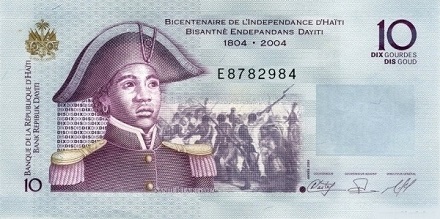
1802: Sanite Belair, tigress

On October 5, 1802, Haitian soldier Suzanne Bélair, called Sanité Bélair, was shot with her husband by the French.

This “tigress” is the most famous of the Haitian Revolution’s numerous female protagonists. A free black woman, she married Charles Belair, the nephew and aide of the man who in the 1790s established pre-eminence on Saint-Domingue — Toussaint L’Ouverture.

L’Ouverture tragically vacillated when the French made their move in 1802 to reverse the revolution’s gains and re-establish slavery, but the tigress rallied General Belair to take the field in resistance — and not only rallied him, but fought alongside him as a regular in his army, attaining the rank of Lieutenant.

It’s said that at her capture, when threatened with beheading, she successfuly asserted the right to an honorable soldier’s death by musketry, and standing before their muzzles cried “Viv libète! Anba esclavaj!” (“Long live freedom! Down with slavery!”)

On this day..

2012: Moussa Agh Mohammed, by Ansar Dine in Timbuktu

On this date in 2012, northern Mali’s Islamist Ansar Dine movement, then in control of the city of Timbuktu, publicly executed Moussa Agh Mohammed there for murder.

Mohammed was one of Ansar Dine’s own fighters, but stringent consistency would oblige his fellows to put him to death under the sharia law Ansar Dine itself was enforcing in Timbuktu. Some days before he got into a fight with fishermen who reproached him for trampling their nets; as the confrontation escalated towards physical violence, Mohammed unslung his Kalashnikov and gunned one of them down. The fisherman’s family was offered, but refused, compensation in exchange for sparing the killer.

According to a correspondent, Mohammed “was a Tuareg cattle farmer from a major tribe [who] joined the Ansar Dine movement one month ago [before his execution]” having previously been affiliated with the Tuareg rebel army the National Movement for the Independence of Azawad. It was the third known execution in northern Mali under sharia: the previous two were an adulterous couple stoned to death in the town of Aguelhok.

“I didn’t feel a great deal of emotion from the crowd,” our observer reported. “People just stood there and watched as if it were a show. In contrast, the members of Ansar Dine looked moved by the event. Mohammed had close relationships with a number of his peers. But they explained that no one is exempt from Sharia law, and because of that they had no choice but kill him. It was a question of God’s will.”

On this day..

1822: Augustin Joseph Caron, entrapped

On this date in 1822, French Lt. Col. Augustin Joseph Caron was shot at Strasbourg as a rebel.

Little is known of his background, but Caron (English Wikipedia entry | French) enlisted in his army during the revolutionary year of 1791 and advanced into command positions under Napoleon. From his later conduct it’s apparent that these years shaped a political passion that would be starkly at odds with the post-Napoleon Bourbon restoration.

As we have noted elsewhere on this site France’s Liberal (often Bonapartist) opposition during these years was urged by the persecution of the monarchist party into conspiracy as the common coin of its politics.

Out of this mire grew both charbonnerie (France’s analogue to the carbonari terrorists who proliferated in Italy) and an overvigilant secret police whose campaigns of entrapment and threat exaggeration did nothing so well as to further obscure the line between mundane opposition and treason.

The strange interplay between these midnight foes would shape the fate of Col. Caron.

Caron’s path to execution begins with the thwarted rising of the Belfort garrison for New Year’s 1822 — a real plot that the government spies were able to squelch. This resulted in a number of executions, by dint of which it has featured in these very pages.

Caron enters this story in its second chapter: a pensioned former officer of known Bonapartist sympathies, Caron was (with another man named Roger) baited by police spies into mounting an attempted raid on Colmar prison where the arrested Belfort conspirators were being held. Officers chosen to play the part were detailed to meet him as “conspirators” and march with him to Colmar, allowing Caron to make compromising “Vive l’Empereur” exhortations along the way, before finally arresting him.

Though Caron himself had been a willing participant who most certainly did intend to raise a mutiny, the ridiculous spectacle of His Majesty’s warriors congratulating themselves for crushing a plot that they themselves controlled from the get-go came to crystallize the Liberal fulminations against abusive use of agents provocateur. As Alan Barrie Spitzer puts it in Old Hatreds and Young Hopes: The French Carbonari against the Bourbon Restoration,

the means employed to net such a minor, and such a vulnerable, agitator gave the critics of the regime and the defenders of other conspirators the opportunity to assimilate all the operations of the political police to this contemptible one. The government was placed on the defensive from the first. It proved difficult to demonstrate the Caron and Roger had initiated the seditious proposals … Two entire squadrons of chasseurs had conducted their brilliant operation to net only the two original suspects. And then there was the abrasive question of who, under what circumstances, shouted out “Vive l’Empereur!” — that is, tempted innocent passersby-into political crime. The original story … described the squadrons as riding through the countryside crying “Vive l’Empereur,” and innocently wondered whether these purveyors of seditious slogans would be arrested along with Caron, their alleged “leader.”

One Liberal deputy sneeringly pictured future French veterans boasting of their service, “I was in those squadrons that rode through the countryside of the Haut-Rhin shouting ‘Vive l’Empereur!’ in order to test the disposition of the inhabitants.” Indeed, what if the dispositions had been otherwise? It had been only a few years since the emperor really had returned from exile and raised a brief civil war; the idea that the military had risked triggering “the insurrection of a town and the massacre of its inhabitants” for no better reason than to compromise an utter nobody blossomed into a gigantic scandal. Caron became France’s metonym for a patsy;* demands to grant Caron leniency and turn the investigation against his persecutors multiplied discomfitingly.

But this was only one of several high-profile trials against anti-Bourbon plotters unfolding in 1822, and the Liberal denunciations against them practically staked the government’s credibility upon their outcome. So the government saw to the outcome it required — by invoking Caron’s military rank to have him transferred out of the civilian justice system and tried by a military tribunal that would be sure to convict him. Just to complete the shambles, the execution was then hurriedly conducted before Caron’s appeal could be brought before the Court of Cassation.

The Journal of the Lower Rhine gives the following details concerning the execution of Colonel Caron: —

Colonel Caron, who was unanimously condemned to death for the crime of embauchage [“hiring” -ed], by the first permanent council of war of this division, the judgment of which was likewise unanimously confirmed by the council of revision, was executed at two o’clock in the afternoon, in the presence of a small detachment of the garrison, and a numerous concourse of people who were attracted by curiosity. The Abbe Schittig zealously administered to him the consolations of religion, which he received with humility, and he died with the courage of a Christian and an old soldier. Caron was alone in a carriage, amidst the retinue which conducted him to the place of execution. At the entrance of the horn-work, called Finkmatt, where the execution took place, he alighted from the carriage without the assistance of the driver. On arriving in front of the 12 men who were to be his executioners, he refused to have his eyes bandaged. With his hat on, he himself gave the signal. Immediately the muskets were fired, and Caron was no more.

–London Times, Oct. 10, 1822

He’s buried in Strasbourg, under a slab that reads MORT POUR LA LIBERTE.

* In The Red and The Black, the main character Julien Sorel at one point muses that, should a provocative letter be attributed to his hand, it could make him “the next Colonel Caron at Colmar.”

On this day..

1946: Takashi Sakai

On this date in 1946, Japan Gen. Takashi Sakai was shot by the World War II Allies at Nanking for war crimes.

Fifty-eight years old at his death, Sakai had built his career in the 1920s and 1930s manning various commands in the occupation of China.

Hours after Japan struck the U.S. at Pearl Harbor, Sakai commenced an attack on Hong Kong, then under British control but defended with only a token force that had no odds against the Japanese.

Sakai’s forces committed numerous summary executions and other cruelties on troops captured from the overwhelmed garrison before Hong Kong finally surrendered on Christmas Day.

The whole operation was much more protracted and difficult than Japan had anticipated and perhaps as a result Sakai was relieved of responsibility for the (similarly brutal) occupation of Hong Kong, and eased into retirement back on the mainland.

His next visit to China would occur under very different circumstances — where he would find himself obliged to dissociate himself from the atrocities that his men had authored in the capture of the city. His war crimes tribunal was not impressed.

The Tribunal dismissed the accused’s plea that he could not be held responsible for the above violations because they were perpetrated by his subordinates and he had no knowledge of them. The Tribunal’s findings were as follows:

That a field Commander must hold himself responsible for the discipline of his subordinates, is an accepted principle. It is inconceivable that he should not have been aware of the acts of atrocities committed by his subordinates … All the evidence goes to show that the defendant knew of the atrocities committed by his subordinates and deliberately let loose savagery upon civilians and prisoners of war.

The principle that a commander is responsible for the discipline of his subordinates, and that consequently he may be held responsible for their criminal acts if he neglects to undertake appropriate measures or knowingly tolerates the perpetration of offences on their part, is a rule generally accepted by nations and their courts of law in the sphere of the laws and customs of war.

(Conversely, Sakai’s attempt to cite superior orders as defense against charges for his part in initiating the war also got short shrift. So in terms of the chain of command, he got it coming and going.)

On this day..