On this date in 1800, Rodaí Mac Corlaí — with due apologies for the imperial encroachment, we’re going to roll with the Anglicized “Roddy McCorley” — was hanged “near the Bridge of Toome” in Ireland
The actual nature and extent of his involvement in that rebellion is totally undocumented, but that doesn’t mean it’s not celebrated in an oft-covered patriotic song.
Post-rebellion, the (probably) Presbyterian McCorley was part of the so-called “Archer Gang”, men whom that newspaper account of McCorley’s execution calls “nefarious wretches who have kept this neighbourhood in the greatest misery for some time past.” That’s a hostile witness, obviously; the band in question looks to be Irish rebels turned outlaws, for whom plunder on the roads and vengeance on the rebellion’s enemies neatly coincided.
That coterie was gradually rounded up; its leader Tam Archer would also hang. But the national cause ran in the McCorley blood: the hanged man’s great-grandson Roger McCorley was a Republican insurgent during the Irish War of Independence in the early 1920s.
Thanks to @elongreen for bringing Roddy McCorley to our attention.
* Although even the execution date has been blurred by a later, martyr-making tradition claiming that McCorley died on Good Friday. He did not.
Although it occurred some weeks before, the execution/murder of Congolese Prime Minister Patrice Lumumba only became public on February 13, 1961.
A week later, on February 20, pro-Lumumba forces in Stanleyville (today, Kisangani) shot approximately 15 prisoners in retaliation. Stanleyville was the headquarters of Lumumba ally Antoine Gizenga, whose enclave the late Lumumba had been trying to reach when he was captured. In the confused post-Lumumba days, Gizenga elevated himself to head of state for the rebellious Lumumbist state; 21 Communist-backed states would recognize this as Congo’s legitimate government, in opposition to the official one of Joseph Kasavubu.
Those suffering the Lumumba-backers’ wrath this date included ten politicians — notably Alfonse Songolo, a former Lumumbist minister who had prominently broken with that faction after Lumumba was deposed the previous autumn — plus five soldiers in the anti-Lumumba force of the bright young officer and future definitive author of Congolese horrors, Joseph-Desire Mobutu.
The London Times had reported (Feb. 23-24) that “usually well-informed sources” alleged the execution, but that the U.N. was unable itself to confirm the fact independently.
The desertion rate for American soldiers in the War of 1812 was 12.7%, according to available service records. Desertion was especially common in 1814, when enlistment bonuses were increased from $16 to $124, inducing many men to desert one unit and enlist in another to get two bonuses.
We’re not sure how well these eight got paid off in life … only that they collected their last check in lead.
Nathaniel Chester, age unknown, a member of the Corp of Artillery.
Benjamin Harris, 38, a private in the 44th Regiment. Born in Virginia and raised in New Orleans, Louisiana, he enlisted on March 26, 1814 and deserted on July 1.
John Jones, 33, a private in the 2nd Rifle Regiment. He’d enlisted for a five-year stint on July 25, 1814 in Farquier, Virginia. The date he deserted has not been recorded.
Jacob King, 20, a private in the 1st U.S. Artillery. He was born in Pennsylvania and enlisted on March 28, 1814 for five years. He deserted on July 12.
James McBride, 21, a native of Virginia. Records about his military service are unclear: some reports are that he enlisted on April 20, 1813, and other accounts give the date as July 22, 1814. It’s possible he deserted twice; this was a common practice, as noted above.
William Myers, 19, a private from Georgia. He enlisted on March 27, 1814; it’s unknown when he deserted.
Drury Puckett, 36, a member of the 2nd Infantry. (Almost certainly the son and namesake of this Drury Puckett.) Like Harris and McBride, he was from Virginia and he had enlisted there for five years on September 24, 1814. The record says he deserted on December 31, but this is surely in error, because by then he had already been sentenced to die.
John Young, age unknown, from Winchester, Virginia. He enlisted on October 3, 1814 and deserted after a mere five days.
General (and future President) Andrew Jackson affirmed their sentences on January 28, pardoning five others at the same time. This was twenty days after Jackson fought the Battle of New Orleans, the final major conflict in the war. This day’s event was the largest mass execution in Tennessee history.
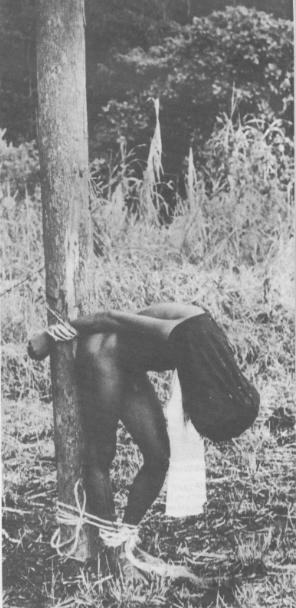
On this date in 1973, 12 actual or supposed Ugandan guerrillas opposing the Idi Amin dictatorship were shot in groups of one or two at various places around the country — having been condemned just days before in military trials for terrorism and assassination plots.
The Fronasa rebel movement was a new player on the Uganda political scene, and it drew a ferocious government response. Idi Amin’s regime was reluctant even to dignify its opposition by naming it, but it certainly made no secret about the punishments. “The public are to attend,” said the official announcement, ominously. (London Times, Feb. 8, 1973.)
“The execution by firing squad that has been carried out today is a real lesson to the people of Uganda to know that involvement in guerrilla activities means loss of life,” a military spokesman explained, unnecessarily. (Times, Feb. 12) Just to make sure the public turned up thoroughly for the lesson, the shootings were filmed and televised.
There’s an extensive photographic series of at least one set of executions — that of Tom Mabasa and Sebastino Namirundu in Mbale. It’s viewable here. Per the image captions,
Masaba and Namirundu were interrogated, stripped naked, fitted with short white aprons and tied to their execution posts. Masaba, who was accused of being a terrorist, was reported to have said, “Let those, like me, who are killing innocent people in the country, come out and report to the authorities.”
The book Battles of the Ugandan Resistance contains an account of Namirundu’s capture. According to the author, Namirundu was a mere bystander whe Ugandan troops arrived to his area trying to arrest rebel leader (and present-day Uganda president) Yoweri Museveni. Museveni gave them the slip, but as soldiers rudely searched houses, the teenaged Namirundu made a panicked run to get away from them, which act was taken as self-incrimination and led him to the stake.
On an uncertain date in the winter of 416-415 B.C.E., the island of Melos surrendered to an Athenian siege during the ruinous Peloponnesian War.
Athens put all of Melos’s adult men to death, selling its women and children into slavery.
This ghastly event is covered by Thucydides‘ History. Thucydides’ account of the diplomatic negotiation between the mighty Athenians and the hopelessly outmuscled Melians is the subject of the Melian dialogue — a timeless classic of philosophy and statecraft.
The Athenians’ coldly realistic position — and their ultimate disposition of their conquest — is summed up in the wonderful epigraph, “the strong do what they will, and the weak suffer what they must.” (And numerous variations of this translation.)
As the reigning naval power, Athens (at war with a league led by its rival, the land power Sparta) had decided that an independent and neutral Melos would no longer be in the offing. The Melian dialogue pits Athens’ ultimatum to Melos to submit and save itself, against the Melians’ vain attempt to assert the justice of their cause; likewise, it is the dialogue of an imperial order against a holdover independent city-state from a fading era.
Athenians: Well, then, we Athenians will use no flue words; we will not go out of our way to prove at length that we have a right to rule, because we overthrew the Persians; or that we attack you now because we are suffering any injury at your hands. We should not convince you if we did; nor must you expect to convince us by arguing that, although a colony of the Lacedaemonians, you have taken no part in their expeditions, or that you have never done us any wrong. But you and we should say what we really think, and aim only at what is possible, for we both alike know that into the discussion of human affairs the question of justice only enters where the pressure of necessity is equal, and that the powerful exact what they can, and the weak grant what they must.
Melians: Well, then, since you set aside justice and invite us to speak of expediency, in our judgment it is certainly expedient that you should respect a principle which is for the common good; and that to every man when in peril a reasonable claim should be accounted a claim of right, and any plea which he is disposed to urge, even if failing of the point a little, should help his cause. Your interest in this principle is quite as great as ours, inasmuch as you, if you fall, will incur the heaviest vengeance, and will be the most terrible example to mankind.
Athenians: The fall of our empire, if it should fall, is not an event to which we look forward with dismay; for ruling states such as Lacedaemon are not cruel to their vanquished enemies. And we are fighting not so much against the Lacedaemonians, as against our own subjects who may some day rise up and overcome their former masters. But this is a danger which you may leave to us. And we will now endeavour to show that we have come in the interests of our empire, and that in what we are about to say we are only seeking the preservation of your city. For we want to make you ours with the least trouble to ourselves, and it is for the interests of us both that you should not be destroyed.
Melians: It may be your interest to be our masters, but how can it be ours to be your slaves?
Athenians: To you the gain will be that by submission you will avert the worst; and we shall be all the richer for your preservation.
Melians: But must we be your enemies? Will you not receive us as friends if we are neutral and remain at peace with you?
Athenians: No, your enmity is not half so mischievous to us as your friendship; for the one is in the eyes of our subjects an argument of our power, the other of our weakness.
Over and over the Melian envoy is dismayed by his visitors’ indifference to the moral high ground. Frustrated of any concession, he resolves his embattled city to embark upon the remote hope of resistance in preference to voluntary servitude — leading the Athenians to part with this chilly sentiment:
You told us that the safety of your city would be your first care, but we remark that, in this long discussion, not a word has been uttered by you which would give a reasonable man expectation of deliverance. Your strongest grounds are hopes deferred, and what power you have is not to be compared with that which is already arrayed against you. Unless after we have withdrawn you mean to come, as even now you may, to a wiser conclusion, you are showing a great want of sense. For surely you cannot dream of flying to that false sense of honour which has been the ruin of so many when danger and dishonour were staring them in the face. Many men with their eyes still open to the consequences have found the word honour too much for them, and have suffered a mere name to lure them on, until it has drawn down upon them real and irretrievable calamities; through their own folly they have incurred a worse dishonour than fortune would have inflicted upon them. If you are wise you will not run this risk; you ought to see that there can be no disgrace in yielding to a great city which invites you to become her ally on reasonable terms, keeping your own land, and merely paying tribute; and that you will certainly gain no honour if, having to choose between two alternatives, safety and war, you obstinately prefer the worse. To maintain our rights against equals, to be politic with superiors, and to be moderate towards inferiors is the path of safety. Reflect once more when we have withdrawn, and say to yourselves over and over again that you are deliberating about your one and only country, which may be saved or may be destroyed by a single decision,
Athens wasn’t kidding.
Finding no traction with the Melian delegation, the greater power immediately besieged Melos. Thucydides recounts the Melians’ subsequent fate:
So the summer ended.
In the following winter the Lacedaemonians had intended to make an expedition into the Argive territory, but finding that the sacrifices which they offered at the frontier were unfavourable they returned home … About the same time the Melians took another part of the Athenian wall; for the fortifications were insufficiently guarded. Whereupon the Athenians sent fresh troops, under the command of Philocrates the son of Demeas. The place was now closely invested, and there was treachery among the citizens themselves. So the Melians were induced to surrender at discretion. The Athenians thereupon put to death all who were of military age, and made slaves of the women and children. They then colonised the island, sending thither 500 settlers of their own.
On top of everything else, the Athenian sack put an end to the production of Melian reliefs. (The island still had the glory of the Venus de Milo to look forward to, however.)
If there was a consolation for the scattered remains of the ruined Melian polis, it was that Athens’ cruel imperial hubris led it just months later to launch a catastrophic invasion of Sicily.
That defeat helped turn the Peloponnesian War decisively against Athens. Just eleven years after overrunning Melos, haughty Athens itself surrendered to a Spartan siege.
Thucydides, an exiled former Athenian general, deploys the classical dialogue form to great effect; his own perspective on the various arguments advanced in the Melian debate is difficult to discern with confidence. Clearly, however, it’s a topic of great interest to Thucydides, as his account dwells repeatedly on the conundrums touching justice and international relations: he’s one of the first intellectuals to explore what’s now thought of as the “realist” view of foreign policy. Compare the Melian Dialogue, for instance, to the Athenian demos‘s Mytilenian Debate; or, to the Plataean speech making a Melos-like appeal to the powerful Spartans.* And in one early passage, private Athenians appeal to Sparta and Corinth not to commence on war against the hegemony of Athens with words similar to those later used at Melos: “It has always been a rule that the weak should be subject to the strong; and besides, we consider that we are worthy of our power. Up till the present moment you, too, used to think that we were; but now, after calculating your own interest, you are beginning to talk in terms of right and wrong. Considerations of this kind have never yet turned people aside from the opportunities of aggrandizement offered by superior strength.”
At any rate, Thucydides’ proud city-empire would never recover from the inglorious fall inflicted by this war. The result was a fourth-century power vacuum which the Macedonia of Philip II and Alexander the Great eventually rose to fill.
* Thucydides also reports the Athenians hoisted by their own realpolitik when, in the Sicilian invasion, they attempt to appeal to Camarina for support. That city spurns the appeal, fearing subjugation should expansionist Athens prevail, and the revenge of their overwhelmingly powerful neighbor Syracuse otherwise.
On this date in 1653, the German bandit Jasper Hanebuth was broken on the wheel in Hanover.
An illiterate farmer’s son from Groß-Buchholz, Hanebuth came of age during the calamitous Thirty Years’ War and thereby made his bread for a time as one of the numberless strong arms enlisted to let out one another’s blood.
Hanebuth is the titular villain in the German historical fiction novel The Murderer’s Concubine.
In a time of crisscrossing armies with conflicting loyalties and uncertain pay, it was a fine line between soldiers and thieves — sometimes just the hour of the day. What matter to a rural family or a vulnerable traveler if the gang of armed men who dispossessed him did so under the banner of God or that of opportunism? And given means and opportunity, what matter to the armed gang itself? Victims in such a chaotic environment, either actual or potential, were liable in their own turn to resort to brigandage as the only viable option, paying the devastation forward.
True to the template, Hanebuth parlayed wartime soldiery into an alarmingly bold career of opportunistic robbery in the still-extant Eilenriede. A purported “Hanebuth’s Block” in the vicinity of the present-day zoo there long preserved the association; there’s still a street in the forest known as Hanebuthwinkel.
He was reputed an especially vicious outlaw, who would raid singly as well as jointly with other farmers and decommissioned warriors, and would as readily for sport or pleasure shoot a convenient target dead before bothering to approach and find out if the business end of the felony was even worth the murder. He ultimately confessed to 19 homicides.
But it was still the pecuniary motive that drove things. Hanebuth approached crime-lord status with secret smuggling tunnels allegedly set up to move his ill-gotten gains and regular traffic with Hanover merchants. Hanebuth also set up as a horse-trader, exploiting his predilection for violence to obtain stock by force. One trader who refused a shakedown simply had his horses outright stolen the next night, and this man at last reported Hanebuth, resulting in his arrest, torture, and execution on the wheel.
He remains one of Hanover’s most iconic historical criminals.
Jacques Collot’s 1633 cycle “The Miseries of War” might have foretold Hanebuth’s fate: here, a soldier of the Thirty Years’ War who has turned to robbery is punished, as Hanebuth would be, on the wheel. The caption explains:
The ever-watching eye of the divine Astrée [Justice]
Banishes entirely the mourning from the country
When holding the sword and scales in her hands
She judges and punishes the inhuman thief
Who awaits passersby, hurts them, and plays with them
[And] then becomes himself the plaything of a wheel.
Two hundred years ago today, the Mexican revolutionary Mariano Matamoros was shot by the Spanish at Valladolid.
A Catholic priest (defrocked for the occasion of his execution) who had previously gone to prison for his nationalist sympathies, Matamoros joined the revolutionary army of fellow-clergyman Jose Maria Morelos as the Mexican War of Independence blossomed.
Matamoros proved to have the knack for martial leadership and was a lieutenant general and Morelos’s second-in-command within months.
The Spanish captured him in early January 1814 after the revolutionaries’ failed attempt to take Valladolid. His foes could not be moved to exchange him on any terms.
Though Morelos too would suffer this fate in time, their cause eventually prevailed. Post-independence, the martyred Matamoros became a Mexican national hero. He’s interred today at Mexico City’s iconic El Angel monumental column.
That physique got him turned away when he tried to volunteer to fight the Soviets in the Winter War, but it didn’t put the Gestapo off him after Germany occupied Norway in 1940. He formed an informants’ network known as the Rinnanbanden which infiltrated the resistance movement and entrapped anti-occupation Norwegians — a “game in the negative sector,” as Rinnan described it.
The “game” got more than a thousand people arrested and something like 100 killed, including one of the more notorious episodes of the occupation, the Majavatn affair. (Norwegian link) It also eventually got Rinnan a German rank and the opportunity to kill some people personally.
Twelve people in all from the Rinnanbanden were sentenced to death after the war, counting Rinnan. Ten of those did indeed pay the penalty.
There’s a Norwegian page about the Rinnanbandenhere.
Ten men were executed at dawn on this date in 1963 in Tunis for an assassination plot against President Habib Bourguiba.
Lazhar Chraiti. His daughter has founded a center dedicated to rehabilitating his memory.
Bourguiba was first president of the independent Republic of Tunisia, having led that country out of French domination in the 1950s … and this plot was the first major threat to his rule. “It is a miracle that I am still alive,” he told a women’s conference at the western city of El Kef after it was discovered on December 19. Kebair Meherzi, an officer of President’s Guard (who was among those executed this date) had been privy to the plot, and intended to admit the assassins to Bourguiba’s own bedside. (London Times, Dec. 27, 1962)
Twenty-six people faced a military trial for this attempted coup in early January with thirteen death sentences handed down — most notably including legendary Arab independence guerrilla Lazhar Chraiti (by now a respected official in the ruling Neo Destour party).
One of those 13 was condemned in absentia, having already fled the country to Algeria — the plotters’ Algerian ties caused Tunisia to withdraw its embassy — while two other army officers were reprieved to life and hard labor.
On this date in 1942, Senitsa Vershovsky was shot in the city of Kremenchuk in the Soviet Union, in what is now the Ukraine.
Vershovsky was the mayor of Kremenchuk and was also a major in the Red Army. His executioners were members of Einsatzgruppe A, one of Nazi Germany’s mobile killing squads: they killed Vershovsky for “carry[ing] out his duties in gross defiance of German orders … [and] sabotaging the handling of the Jewish problem by having a great number of Jews baptized in order to remove them from German control.”
Approximately 30,000 Jews lived in Kremenchuk, constituting 40% of the city’s population and they had good cause to remove themselves as far as possible from German control. The Einsatzgruppen, as they did in countless other cities throughout the Soviet Union, rounded up the Jewish population, forced them to dig their own graves, and machine-gunned them by the thousands.
Vershovsky’s attempts to help the Jews under his charge, futile though his efforts may have been, nevertheless deserve a footnote in history. For, as historian Raul Hilberg noted, in all the situation reports filed by the Einsatzgruppen during their 22 months of operation,
This incident appears to be the only one of its kind. The counterpressure was evidently too great. Whoever attempted to aid the Jews acted alone and exposed himself as well as his family to the possibility of a death sentence from a German Kommando. There was no encouragement for a man with an awakened conscience.
In a time of great adversity, Senitsa Vershovsky showed himself to be a courageous and fundamentally decent human being, and he paid for it with his life. The least we can do is remember him.




 A Catholic priest (defrocked for the occasion of his execution) who had previously gone to prison for his nationalist sympathies, Matamoros joined the revolutionary army of fellow-clergyman
  Standing just 5′ 3″ on tippytoe, Rinnan (