1340: Nicholas Behuchet, Battle of Sluys naval commander

On this date in 1340, the English and French fought an early naval engagement of the Hundred Years’ War: the Battle of Sluys.

The English won the battle … and the French admiral wound up hanging from a mast.

At the outset of the Hundred Years’ War in 1337, the French bossed the Channel and inflicted devastating sea raids on the English coast. In the long war’s first major battle at sea, a French fleet in September 1338 overwhelmed an English flotilla carrying valuable English wool to the Low Countries.

Nicholas Behuchet, one of the French commanders at this earlier battle, did not hesitate to massacre his prisoners.

Thus conquering did these said mariners of the king of France in this winter take great pillage, and especially they conquered the handsome great nef called the Christophe, all charged with the goods and wool that the English were sending to Flanders, which nef had cost the English king much to build: but its crew were lost to these Normans, and were put to death.

England’s allies were in the Low Countries, so too many battles like this stood to strangle the English cause in the crib. For near two years, French privateers had leave to ravage the English coast, while French troops overran Flanders and made the English Queen Philippa* hostage.

Seeking a breakout, King Edward III requisitioned English merchant cogs — there was no standing navy at the time — into a fleet of perhaps 160 or 200 vessels, heavy with soldiers to invade Flanders.

On June 24, two days after setting out from the Orwell estuary at Ipswich, Edward’s armada boldly fell upon a larger French fleet anchored at the Flanders port of Sluys.

The medieval chronicler Froissart’s account makes for riveting reading.** This was no stately ballet of seamanship but a gory close-quarters melee: as was characteristic for the time, the “sea” battle was mostly just about coming together for the respective fleets’ marines to board one another’s ships and murder anyone on board who wasn’t worth a ransom. The French admiral Behuchet lashed his ships together across the mouth of the harbor, a sort of floating breastwork that would enable the French soldiery to shimmy up and down the entire line no matter where the English focused their attack.

To the sound of “scores of trumpets, horns and other instruments,”

Fierce fighting broke out on every side, archers and crossbowmen shooting arrows and bolts at each other pell-mell, and men-at-arms struggling and striking in hand-to-hand combat. In order to come to closer quarters, they had great iron grappling-hooks fixed to chains, and these they hurled into each others’ ships to draw them together and hold them fast while the men engaged. Many deadly blows were struck and gallant deeds performed, ships and men were battered, captured and recaptured. The great ship Christopher [a large English cog previously captured by the French and situated in the French front row -ed.] was recovered by the English at the beginning of the battle and all those on board were killed or taken prisoner …


An illustration of the Battle of Sluys from Froissart’s chronicle. Note the mast of the ship at far left: it displays the English arms quartered with the French, Edward III’s heraldic assertion of sovereignty over both realms.

It was indeed a bloody and murderous battle. Sea-fights are always fiercer than fights on land, because retreat and flight are impossible. Every man is obliged to hazard his life and hope for success, relying on his own personal bravery and skill … [it] rage[d] furiously from early morning until afternoon, during which time there were many notable feats of arms and the English were hard put to it to hold their own, since they were opposed by hardened soldiers and seamen, who outnumbered them by four to one.

Edward III took an arrow or crossbow bolt to the leg — great-man historical legend has it that it was fired by Nicholas Behuchet himself — but captained his flotilla to an overwhelming victory, capturing most of the French ships and destroying the French, their Genoese allies, “and all who were with them … [they were] killed or drowned, not a single one escaping in the general slaughter.” Poetic license aside, it was a spectacular triumph for the English — and a crushing defeat for the French.†

In the 1596 play Edward III, which might have been co-written by Shakespeare, imagined the scene in the report of an escaped mariner:

Purple the sea, whose channel filled as fast
With streaming gore that from the maimed fell
As did the gushing moisture break into
The crannied cleftures of the through-shot planks.
Here flew a head dissevered from the trunk,
There mangled arms and legs were tossed aloft
As when a whirlwind takes the summer dust
And scatters it in middle of the air.
Then might ye see the reeling vessels split
And tottering sink into the ruthless flood,
Until their lofty tops were seen no more.

Let it not be said that in this instance the commander escaped the consequences of his folly. Behuchet, who insisted against advice on lashing the boats together and thereby sacrificed all maneuverability, didn’t have much room for maneuver himself when the victorious English hanged him at battle’s end from the mast of his own ship.

* Seen elsewhere in these pages successfully begging her husband’s pardon of the famed Six Burghers of Calais later in the war. Philippa was a homegrown native of the Low Countries, and her marriage to Edward III reflects the alliance between their respective regions.

** For a snappy modern gloss on the battle, check this excerpt of Dan Jones’s The Plantagenets: The Warrior Kings and Queens Who Made England.

† It is said that no courtier dared give King Philip VI of France the horrifying news until a jester availing his station’s license for cheek informed him that “Our knights are much braver than the English.” Asked why, the fool replied, “The English do not dare jump into the sea in full armour.”

On this day..

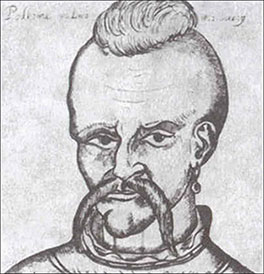
1578: Ivan Pidkova, Cossack hetman

On this date in 1578, Cossack hetman Ivan Pidkova lost his head in Lviv.

Pidkova* — the name means “horseshoe” and alludes to the horsemanship that would be de rigueur for a Cossack leader — had risen by his aptitude to leadership of the Zaporozhian Cossacks in present-day Ukraine.

His death was a bid to promote himself from the steppe to power over neighboring Moldavia, and in fairness to Ivan Moldavia was worth a go.

Its throne was held at that time by a new guy named Peter the Lame, and although the nickname just referred to Peter’s physical deformity, he was a creature of the Ottoman court who scarcely knew Moldavia before he became its vassal ruler in 1574. He was twice temporarily deposed before finally voluntarily resigning in 1591 so that he could retire to the comforts of Italy.

The first deposition came courtesy of our man Pidkova.

Claiming kinship with Peter’s late predecessor Ivan III,** Pidkova seized Iasi and proclaimed himself hospodar of Moldavia until the arrival of Ottoman reinforcements refuted the conceit.

This whole border region between the Polish-Lithuanian Empire to the north and the Ottomans to the south was a perennial trouble spot. Putatively subjects of the Polish crown, the refractory Cossacks were known to raid Ottoman territory illicitly and provoke diplomatic headaches on both sides of the border.

At this particular moment — 1578, that is — the Polish king Stephen Batory had only just concluded a truce with the Ottomans. As Batory had war with Russia to worry about, he was more than keen to keep his southern frontier calm; Polish troops captured the Cossack pretender and had him put to an exemplary death.


Monument to Ivan Pidkova in present-day Lviv. Image (c) stacy2005ua, a prolific photographer of Lviv’s environs whose work can be enjoyed at FaceAndHeart.com or on Flickr, and used with permission.

Ukraine’s national bard Taras Shevchenko celebrated Ivan Pidkova in an eponymous 1839 poem:

There was a time in our Ukraine
 When cannon roared with glee,
A time when Zaporozhian men
 Excelled in mastery!
They lived as masters — freedom’s joy
 And glory were their gain:
All that has passed, and what is left
 Is grave-mounds on the plain!
High are those ancient tumuli
 In which were laid to rest
The Cossacks’ fair white bodies
 In silken cerements dressed.
High are those mounds, serene and dark
 Like mountains they appear,
Their gentle whispers in the wind
 Of freedom’s fate we hear.
These witnesses of ancient fame
 Hold converse with the breeze;
The Cossacks’ grandson reaps the grass
 And sings old memories.
There was a time when in ukraine
 Even distress would dance,
And sorrow in a tavern drank
 In honeyed brandy’s trance.
There was a time when life was good
 In that Ukraine of ours …
Recall it then — perhaps the heart
 May briefly bathe in flowers.

II.

A murky cloud from Liman’s shore
 Covers the sun from sight;
The sea is like an angry beast
 That groans and howls with might.
It floods the mighty Danube’s mouth.
 “My fellows, come with me
Within our barks! The waves are wild.
 Let’s have a merry spree!”
The Zaporozhians rushed out;
 The stream with ships was roiled.
“Roar on, O sea!” they all sang out,
 As waves beneath them boiled.
Billows like mountains round them surged,
 They saw no land, no sky.
Yet not a Cossack heart grew faint,
 Their eagerness ran high.
A bold kingfisher flies o’erhead
 As on they sail and sing;
The brave otaman in the van
 Leads on their mustering.
He strides the deck, and in his mouth
 His pipe grows cold from thought;
He casts his glances here and there
 Where exploits may be wrought.
He curled his long black whiskers,
 He twirled his forelock free,
Then raised his cap — the vessels stopped:
&nbsp:”Death to the enemy!
Not to Sinope, comrades,
 Brave lads beyond all doubt!
We’ll drive on full to Istanbul
 To seek the Sultan out!”
“Well spoken, our fine chieftain!”
 They roared in chorus back.
“I thank you, lads!” He donned his cap.
 Again the seaward track
Beneath their keels began to boil;
 And once more thoughtfully
He paced the deck in mute content
 And gazed upon the sea.

That translation is via The Poetical Works of Taras Shevchenko; the original in Ukrainian can be enjoyed here. The exact text of that poem also comprises the lyrics of this jam:

* Or Ioan Potcoava, as Ivan came from Romanian stock.

** Moldavia’s own “Ivan the Terrible” — no relation to his Russian contemporary, of course.

On this day..

1850: Five Cayuse, for the Whitman Massacre

On this date in 1850, five Cayuse were publicly executed in Oregon City for the Whitman Massacre.

Beginning in earnest in the 1830s, Anglo settlement in the Oregon Country presented for the native inhabitants of the Pacific Northwest the same Hobson’s choice that had confronted tribes further east long before: resist or accommodate.

The New York-born couple Marcus and Narcissa Whitman* were two of the most notable figures among the hundreds, and then thousands, of settlers pouring into the territory every year. In 1836, they founded on the banks of the Walla Walla River a Christian mission to the nomadic Cayuse who roamed the territory. It’s in present-day Washington State, which was then part (with the current U.S. states of Oregon and Idaho) of a single frontier territory collectively known as Oregon.

The Whitmans’ early settlement, offering medicine, education, and (of course) proselytizing, proved a success at first; it would become for several years a waypoint on the developing Oregon Trail.

White diseases came with the settlers.

The Cayuse people had already dwindled (pdf) to just a thousand or two after the decimations of smallpox and other plagues swept the region in the decades preceding. Now, outbreaks of measles were ravaging those remaining.

Marcus Whitman, a doctor as well as a spiritualist, proved unable to check the new epidemic. Rumors went abroad that the missionaries were bewitching or poisoning the Cayuse, as the vanguard of a coming territorial conquest; the Whitmans themselves were very keen to the hostile feeling the situation had engendered and had even heard whispers that they were the targets of assassination plots. Bravely, they stayed.

“Perhaps God thought it for the best that your little child should be called away,” Narcissa Whitman said in strange consolation to the grieving mother of an Anglo child who also succumbed to measles in 1847. “It may calm the Indians to see a white child taken as well as so many natives, for otherwise we may all be compelled to leave within two weeks.” (pdf source, op. cit.; this document also reconstructs a detailed narrative of the unfolding tragedy)

But that remark was only days before the terrible November 29, 1847. On that cold autumn Monday, a small party of Cayuse led by a chief named Tiloukaikt fell on the mission and slaughtered both Whitmans plus another 11** inhabitants of the little compound.

Some 54 surviving women and children were taken hostage, and several of these died in custody as well. A Canadian official of the Hudson’s Bay Company hurried to ransom the captives at the price of 62 blankets, 63 cotton shirts, 12 muskets, 600 loads of ammunition, 37 pounds of tobacco, and a dozen flints.†

This quick response might have forestalled a worse tragedy for the missionaries — but as far as the Cayuse went, the die was already cast. A volunteer militia of Oregonians under Cornelius Gilliam soon mobilized to retaliate, driving many Cayuse into the Blue Mountains.

By mid-1848, spurred in part by the Whitman bloodbath, Congress officially incorporated the region as the Oregon Territory; arriving early in 1849, the new territorial governor Joseph Lane immediately opened negotiations with the Cayuse to hand over the perpetrators of the massacre. With federal troops arriving later in 1849, the Cayuse at last capitulated and gave up five warriors: Tiloukaikt, the leader; Tomahas; Kiamasumpkin; Iaiachalakis; and Klokomas. (There are numerous alternative transliterations of these names.)

They were tried in Oregon City, the territorial capital at the time — a town of 500 or so on the Willamette River Falls — in a landmark case: the first proper death penalty trial in the young territory.‡ This would fall a little short of modern standards, and not just because it was held in a tavern for want of a regular courthouse. The prosecution was not especially rigorous linking all the defendants to specific violent acts, but the defense’s recourse to Cayuse cultural practices that held shamans liable for the failure of their medicine conceded the point by implication. The judge‘s final instructions simply directed his jury to “infer” the defendants’ culpability by virtue of “the surrender of the Defendants by the Cayuse nation as the murderers, the nation knowing best who those murderers were.” So why even have the trial? Kiamasumpkin, against whom no evidence was ever individually presented, went to the gallows insisting that he didn’t even arrive to the Whitman Mission until the day after the massacre.

All five were condemned in the end, and executed by prominent early pioneer and lawman Joe Meek.§ “On the 3d of June an election and a hanging match took place at Oregon City,” ran the Aug. 22, 1850 story in the New York Tribune — for the Whitman massacre had been a matter of national interest. “The town was full of men and women, the former coming to see how the election resulted, and the latter to see how the Indians were hung.”

“Their tribe, the Cayuses, gave them up to keep peace with the whites. Much doubt was felt as to the policy of hanging them, but the popularity of doing so was undeniable.”

Fears that the quintuple hanging would stoke a running conflict with the Cayuse were not altogether misplaced, but over the subsequent years the dwindling tribe was simply dwarfed by over 30,000 newly arriving settlers lured by a congressional grant of free land. By 1855, the defeated Cayuse were forced onto the small Umatilla Reservation, ceding (along with the Umatillas and the Walla Wallas) 6.4 million acres to whites. The Cayuse tongue was extinct by the end of the century.


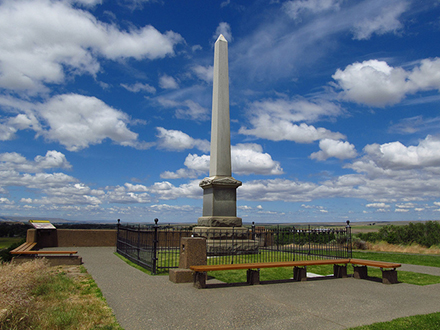
Present-day memorial obelisk at the site of the Whitman Massacre, now a national historic site. (cc) image from Jasperdo.

* Present-day Whitman College (Walla Walla, Wash.) is named for them.

** Figures of both 13 and 14 (inclusive of the Whitmans) are cited in various places for the Whitman Massacre’s body count; the discrepancy turns on whether one’s tally includes as a casualty Peter Hall, who escaped from the mission, fled to Fort Walla Walla, and then made a panicky attempt to reach The Dalles. Hall disappeared into the wilderness, and was never heard from again.

† Ransom covered gratis by the Hudson’s Bay Company.

‡ The Espy file‘s index of U.S. executions lists only a couple of undated executions many years before under informal frontier justice.

§ Cousin to the recent First Lady Sarah Childress Polk.

On this day..

1776: James Langar, Smuggerlius?

On this date in 1776, footpad James Langar was hanged at Tyburn for robbing a Hyde Park gentleman of his watch and coat.

Actually, and despite a reputation for honesty attested by his fellow militiamen, Langar was implicated in several highway robberies on shaky witness testimony, prompting him to remark in disgust, “I see they are determined to swear my life away, I leave myself to the mercy of the Court.”

He didn’t get it.

A vanishing obscurity even in his own time, Langar has been making 21st century headlines based on a pair of researchers’ identifying him with a ghoulish ecorche sculpture known as “Smugglerius”.

That astonishing object, and its controversial identification with James Langar, are discussed in this previous Executed Today post.

On this day..

1859: The martyrs of Tacubaya

On this date, the conservative Mexican Gen. Leonardo Marquez earned himself the nickname “Tiger of Tacubaya” for the mass execution of liberal prisoners after a battle in Mexico’s Reform War.

The “reform” warred-over is actually the label for a whole era of liberal modernization with all the usual stuff to enrage a conservative old guard: land reform, a liberal constitution, and a rollback in the prerogatives of the clergy and the military.

It was rather sucessful.

The liberals successfully deposed General Santa Anna* and set about implementing this stuff. You, clever reader, have already surmised from the existence of a “Reform War” that they did not do so without resistance.

In the late 1850s, Mexico actually sported two rival presidents — Benito Juarez, under the liberals’ 1857 constitution, and Gen. Miguel Miramon, under a rebellious military junta that rejected this constitution.

One of the conservatives’ top commanders was Leonardo Marquez, our Tiger of Tacubaya: so called because at that ancient village, today engulfed in the sprawl of Mexico City, Marquez defeated a liberal army in a bloody fight.

Beginning that very night, Marquez had all his prisoners executed,** not excepting the wounded, foreign nationals, medical personnel, and even civilians sympathetic to the losing side. U.S. President James Buchanan denounced this affair to Congress in 1859 as evidence of the “wretched state” of Mexico that, he said, demanded American intervention.†

To cap the climax, after the battle of Tacubaya, in April, 1859, General Marquez ordered three citizens of the United States, two of them physicians, to be seized in the hospital at that place, taken out and shot, without crime, and without trial. This was done, notwithstanding our unfortunate countrymen were at the moment engaged in the holy cause of affording relief to the soldiers of both parties who had been wounded in the battle, without making any distinction between them.

Congress demurred on warmongering, but this act of wanton cruelty towards the so-called Martires de Tacubaya helped to turn Mexicans against the conservatives. The liberals had won the Reform War by the first days of 1861 — just in time to brace for that year’s ill-fated French intervention.

* Of Alamo fame, for yanquis; Santa Anna’s loss of Texas to the United States did no favors for his political position back home.

** One notable victim: writer Juan Díaz Covarrubias.

Marquez said he was ordered to carry out the summary executions by Miramon, but Marquez also had a reputation for ruthlessness apart from the incident at hand. Miramon got his a few years later when he was shot by the victorious constitutionalists alongside Emperor Maximilian, a later French-backed interloper not yet on the scene in 1859.

† Buchanan also cited the hanging of Ormond Chase in this same speech.

On this day..

1812: Jose Antonio Aponte, Cuban revolutionary

On this date in 1812, the great Cuban revolutionary leader “Black” Jose Aponte was executed with eight comrades.

Like South Carolina’s Denmark Vesey, Aponte led a slave revolt but was not actually a slave himself. Instead, he was a free black woodworker, and a respected captain in Cuba’s black militia.

Aponte led a bold island-wide conspiracy of slaves and free blacks who aimed at liberating themselves by revolution.

A few hours’ sail off Cuba’s eastern coast lay Haiti, whose slaves had done just that only a few years before to the greater hope or terror — depending on which end of the lash one had — of slave societies all around the region.*

So it was with Aponte.

There is some debate over the degree to which Aponte personally can be said to have led or coordinated the various planned (and in some cases, actual) rebellions around Cuba. He was certainly a leader of such a plot in the capital city and viewed by Spanish authorities as a figure of significance across the island, and so the whole movement has become known as the Aponte Conspiracy or Aponte Rebellions.

By any name they were an impressive undertaking, and the widespread collaboration of free black militiamen must have chilled the blood of plantation owners who banked on these forces to maintain order in Cuba. Five of those hanged with Aponte were, like him, freemen.

Sadly lost to history is a book of of Aponte’s drawings which are known only by the descriptions of interrogators who were alarmed by its depictions of, among other things, black armies defeating white ones** … and maps of the military fortifications around Havana.

This book and the movement it supported were betrayed to the Spanish with the familiar consequences. Aponte and his comrades hanged outside Havana’s Catillo San Salvador de la Punta on the morning of April 9, 1812. Then their heads were posthumously hewed off for public display around the city.

* Hilario Herrera, a principal organizer of the conspiracy in Oriente, was himself a veteran of the revolution on Saint-Domingue.

** Some of the subversive drawings depicted Aponte’s grandfather, Captain Joaquin Aponte, fighting the 1762 English invasion of Havana.

On this day..

1949: Dr. Chisato Ueno, because life protracted is protracted woe

The Truk Atoll, in Micronesia, is more commonly known today as Chuuk. It’s a hot diving location notable for the many sunken World War II Japanese hulks to be explored there — the legacy of its once-pivotal position in the Pacific War.

Japan used Truk as forward naval base in the South Pacific, and armored up its little islands like an armadillo.

Rather than capture it outright, the U.S. Navy bombed Truk right out of the war in February 1944, leaving that enormous warship graveyard and a stranded stronghold of starving soldiers who were left to wither on the vine. At war’s end, it was just a matter of circling back to collect 50,000 surrenders.

Unfortunately, the castaway Truk garrison did not pass the last months of the war with sufficient care for its foreseeable postwar situation.

According to testimony given the postwar Guam war crimes tribunal, 10 American prisoners were murdered on Truk in 1944 “through injections, dynamiting, tourniquet applications, strangling and spearing.” (Source) Hiroshi Iwanami was executed for these gruesome experiments/murders in January of 1949.

Ueno, a lieutenant surgical commander, hanged for two other killings that read quite a bit murkier.

Five American POWs were being held in a temporary stockade that was hit by an American bombing raid in June 1944 — killing three of those prisoners.

The surviving two were severely injured, eventually leading Dr. Ueno on June 20, 1944, to perform what he characterized as a legitimate exploratory surgery on one of those men. His prosecutors framed it instead as a fiendishly gratuitous vivisection.

During that procedure, an order arrived for the execution of both the prisoners. The other guy, the one Dr. Ueno wasn’t operating upon, he never had in his care at all; that unfortunate fellow ended up being bayoneted to death. The man on the table (both men’s names were unknown to the prosecuting court) Dr. Ueno stitched back together well enough that subalterns could stretcher him out to a swamp and chop off his head.

Here’s the difficult part: Ueno actually gave the immediate order to execute his ex-patient.

As described in the National Archives’ Navy JAG Case Files of Pacific Area War Crimes Trials, 1944-1949, the physician’s barrister mounted a quixotic philosophical defense of this deeply indefensible order, noting the principled acceptability of euthanasia in Japanese hospitals (so he said), the inevitability of the prisoner’s approaching execution via superior orders, and the agony the man was already in from his wounds.

[Dr. Ueno] had expected that some other person would dispose of this prisoner. But he could not find anyone who looked like the person to carry this out … the thought dominated his mind that all hope is lost to save this prisoner. His fater has been determined. Yet the prisoner is in pain …

He was faced with the predicament of killing by his order the prisoner which he had treated as hiw [sic] own patient. What sarcastic fate was this that he had to face? As the Napoleon, described by George Bernard SHAW, and as McBeth [sic] described by William SHAKESPEARE, the accused, UENO was also “a man of destiny.”

…

A certain English poet wrote, “Life protracted is protracted woe.” If the life of the prisoner in the present case was protracted one second, he would have so much more suffering to endure. Should it be condemed [sic] so severely to shorten one’s life under such circumstances and shorten his last woe in this world?

There were in all either 10 or 13 official executions of Japanese war criminals on Guam from 1947 to 1949. It’s devilishly difficult to find those 13 enumerated by name and date, but it appears to me that Ueno and his boss Admiral Shimpei Asano were the very last to achieve that distinction.**

The readable little history on Truk island and the U.S. Navy operations against it, Ghost fleet of the Truk Lagoon, Japanese mandated islands”, captures the scene.

Shortly after eight o’clock on the humid, tropical evening of March 31, 1949, according to War Department Pamphlet #27-4 Procedure For Military Executions, the 5’6″ Japanese surgeon with extremely strong neck muscles was escorted up the nine steps to the gallows. The handcuffs were removed by a Marine guard and a strap placed to secure his arms to his side and another placed around his legs. A black hood was placed over his head and at 8:26 p.m. the floor panel on which he was standing fell from under his feet and Ueno dropped 94 inches to eternity. He was the last to die, as Rear Admiral Shimpei Asano* had preceded him only moments before. Under the dubious honor that rank has its privileges — the Admiral went first.

* Executed for these same two murders on Truk, as well as two other POWs killed at Kwajalein, in the nearby Marshall Islands.

** Angered by Naval administration of the island, Guam’s Congress had staged a walkout earlier in March 1949. This action did successfully force an end to Naval government.

On this day..

1875: John Morgan, slasher

On this date in 1875, a private named John Morgan was hanged for murdering his fellow.

The London Times reported the trial (March 12, 1875: Morgan did not outlive his victim by so much as a month) thus:

THE SHORNCLIFFE MURDER

Home Circuit.
Maidstone, March 11.
Crown Court.– (Before Mr. Justice Denman.)

The Court was occupied all day with a trial for murder — a case of a very remarkable character.

John Morgan, a private in the 82d Regiment, was indicted for the murder of Joseph Foulstone, another private in the same regiment, at Shorncliffe, on Saturday last.

Mr. Biron and Mr. Denny were for the prosecution; Mr. Norman, at the desire of the learned Judge, defended the prisoner, and was assisted by Mr. Grubb.

The prisoner Morgan and Foulstone, the deceased, were quartered at Shorncliffe. The prisoner and Foulstone occupied the same “hut,” No. 26. At 9 o’clock on the night of last Saturday they were in the same room together, with two boys and a man named Reader, who was fast asleep, sleeping off the effects of drunkenness. Just after 9 the prisoner asked one of the boys to go and get him some sweets, giving him a shilling for the purpose, and when he was gone told the other boy to go and get him some sauce. When they left the hug Foulstone was reading near a bed (not the one on which Reader was sleeping, but another one). Almost immediately afterwards a man named Brown, in the next hut, was horrified at seeing Foulstone, the deceased, coming staggering towards him, holding his throat with both hands and the blood gushing from it rapidly. He motioned for writing materials and wrote something not in evidence. [n.b. — he wrote “Morgan done it” -ed.] The attempts to stop the flow of blood from his throat were vain, and in a minute or two he dropped his head and died. The prisoner was found in his hut, standing over a can of water, evidently in the act of washing. There were marks of blood on his shirt, and one of his sleeves was wet as if recently washed. There were also drops of blood on his coat and trousers and boots. When brought into the presence of the dying man the latter motioned with his hands towards him. The prisoner said, “I did not do it; he did it himself,” and that was the defence set up. The evidence of the surgeon, however, went to show that the wound was such as the deceased could not have inflicted himself. There was a clean fresh cut on the prisoner’s thumb, and there were cuts both on the left and right hand of the deceased. A razor covered with blood was found in the hut, and was evidently the weapon with which the wound was inflicted.

The suicide story seemed so far-fetched that the jury had little difficulty reaching its verdict. In time, Morgan did confess to the crime; according to the London Times of March 31, 1875 he admitted the motive for it only to his chaplain and under a strict seal of confidentiality — an unusual stricture that can’t but put one in the mind of a scandalous subtext like the love that dare not speak its name.


Since consummate professional hangman William Marwood was busy long-dropping Morgan at Maidstone Gaol, a yokel named George Incher had to be recruited to carry out a simultaneous execution at Stafford Gaol. Twenty-three-year-old John Stanton had murdered his uncle in a quarrel earlier that month, and spent his last weeks pleading contrition for this family tragedy to anyone who would listen; this non-Marwood hanging used the old “short drop”, which meant that Morgan just strangled to death.

Part of the Daily Double: Victorian Soldiery.

On this day..

1875: Richard Coates, gunner and rapist

On this date in 1875, artilleryman Richard Coates (or “Coote”) was hanged for murder.

He’d been detailed as a schoolteacher for the Purfleet garrison. One day deep into his cups, he raped a 6-year-old* girl. And then killed her by bashing her head into a privy.

The “Purfleet Murder” got all kinds of copy on the Victorian crime wire, for the crime was very simple and simply horrendous. After he had done with his victim, Coates tucked her broken body under his greatcoat like a shoplifter and smuggled her down to the river to dispose of.

Adding humiliation to the greater sins of the day, he was unable there to get the body up over the palings, so he abandoned it inside the fence. Presumably no veteran hand at homicide, Coates appeared palpably agitated to basically everyone else who saw him that day, and his clothes turned up bloodstained. He was an easy suspect to collar.


To the tune of Civil War hymn “Just Before the Battle, Mother” by George F. Root.

Richard Coates, that cruel murderer,
Now is cold within his grave,
None could show him any pity,
None stretch for a hand to save;
His horrid crime was so unmanly,
I’m sure we no excuse could give,
He did disgrace our gallant soldiers,
And he was not fit to live.

—
CHORUS

Richard Coates, the Purfleet murderer,
On Easter Monday met his doom;
He killed the soldier’s little daughter,
Now he’s dead and in his tomb.
—

For the murder of poor Alice Bougham
He justly was condemned to die,
For a murder so outrageous,
The country for his death did cry;
You never heard or ever read of
Such treatment to a little child,
Altho’ so innocent and so loving,
Cruelly murdered and defiled.

A full confession of the murder
To the champlain he has made,
He has told the truth to those around him,
For which his poor old mother prayed;
He took his victim to the closet,
Frightful was his conduct there,
He took her life in a cruel manner,
Before his death he did declare.

He tried to throw his victim’s body
Over the pailings in the sea,
The fence was high, he could not do it,
It was ordained it should not be;
Could he have thrown her in the water,
And the tide have carried her away,
The murder of the soldier’s daughter
Would not have been found out to-day.

He might have done well in the army,
In the barracks he was born,
Alas! he has disgraced his father,
Who the uniform has worn;
Heaven help his poor old mother,
She has been a true good soldier’s wife,
She would sooner have seen him shot in action,
Than in such a way to lose his life.

Then let us all now take a warning
By his sad and fearful end,
Don’t give way to unholy passion,
Nor against the laws offend;
Try to be honest and be sober,
I’m sure you’ll find it is the best,
In the world let’s do our duty,
As we hope in heaven to rest.


[audio:Driven_From_Home.mp3]

This one is set to “Driven From Home” by William Shakespeare Hays.

Upon Easter Monday within Chelmsford gaol,
A murderer, when dying, his crime doth bewail,
Upon the dark scaffold he drew his last breath,
The penalty of murder he paid with his death;
Richard Coates was his name, by Sata beguiled,
He outraged so cruel a dear little child,
And all through the country it has been the cry,
His sentence was just, he deserved to die.

—
CHORUS

Gone from this life, gone from this world,
By the hands of the hangman to Eternity hurled,
May heaven forgive him, is all we can say,
As we hope for forgiveness on our dying day.
—

There never was known such a cowardly crime,
That we are relating at this present time;
It is dreadful to think there could be a man,
Who in his senses this murder could plan.
He pleaded “not guilty” almost to the last,
Till he saw all the chance of forgiveness was past;
His poor moter begg’d him the truth to unfold,
And confess to his crime for the sake of his soul.

He took the poor child to the coset, he said,
Innocent and smiling to her death she was led.
He murdered her there at the bottom of the field,
And beneath his great coat her dead body conceal’d,
He went to the edge of the wide rolling sea,
To throw the child in but it was not to be,
Tho’ time after time the villain did try,
He could not reach over the pailings so high.

When he found that his crime he could not conceal,
He left the child’s body ‘neath the grass in the field,
Where the dear little angel soon after was found,
By those who so long had been searching around.
They seized him and ask’d him the crime to explain,
He cried “I’m not guilty” again and again;
They could not believe him in spite of denial,
They sent him to saol to wait for his trial.

As he walked from the cell through the sweet morning air,
At the end of the prison the gallows was there;
‘Twas the last time he’d gaze on that beatiful sky,
As he walked to the spot where he knew he must die.
The hangman was ready, deep sounded the bell,
‘Twas scarcely a moment before the drop fell!
The murderer, Coates, from the world was torn,
His body was there, but his dear life was gone.

May his fate be a warning to both old and young,
May it be an example to everyone,
From the straight path of duty never to stray,
Or we shall regret it on our dying day.
The murderer now is gone from this world,
By his own folly to destruction is hurled,
Then pray let us all to this warning attend,
And may heaven preserve us from his fearful den.


According to Flat Earth: History of an Infamous Idea, Coates’s condemnation was immediately followed — in the same courtroom, before the same judge — by the tragicomc libel trial of nutbar flat-earther John Hampden for his ongoing campaign to savage the reputation of Alfred Russel Wallace.**

The bombastic Hampden — who denounced “that Satanic device of a round and revolving globe, which sets Scripture, reason, and facts at defiance” and actually wrote Wallace’s wife wishing that her hubbie would have “every bone in his head smashed to a pulp” — would have been right at home with the Coates ballad that vengefully prayed,

While the spotless soul of little Alice,
Is taken to a better land
May perdition light upon the monster,
Who has disgraced the name of man.

* Reports of age differ, but Alice Boughen was definitely a prepubescent youngster well under the age of 10.

** Wallace is the guy whose collegial letters to Darwin mooting Wallace’s own ideas about natural selection led the previously reticent Darwin to rush into publication with On the Origin of Species.

Part of the Daily Double: Victorian Soldiery.

On this day..

1713: Juraj Janosik, Slovakian social bandit

On this date (most likely) in 1713, Slovakian “Robin Hood” figure Juraj Janosik was hung on a hook in Liptov County for his outlawry.

Janosik was a flesh-and-blood man, but much of what is known or believed about him lies squarely in the realm of folklore.

He hailed from the village of Terchova. You’ll find Terchova today just on the Slovakian side of the Polish border; in Janosik’s time, this was the Habsburg Kingdom of Hungary.


In Janosik’s native Terchova, a walking path leads to a monumental statue of the famed outlaw. (cc) image from Andre Skibinski.

Janosik is said to have fought with the anti-Habsburg Kuruc guerrillas in his youth, then joined the imperial army when that rebellion fizzled, then found his short life’s calling when detailed to guard a brigand named Tomáš Uhorcík. The two went into (Uhorcík’s) business together in about 1711, and Janosik’s natural aptitude soon made him the leader of their robber band.

From pine-forest lairs the merry bandits preyed on aristocrats and rich merchants throughout their mountainous home territories and into Moravia, Silesia, and Slovakia and are supposed to have taken chivalrous care not to injure their prey other than financially. They’re inevitably also credited with sharing the fruits of their heists with the poor.

When Janosik became celebrated in later centuries his virtues both moral and martial would multiply by each astonishing retelling. In this Polish verse, for example, Janosik is less Robin Hood and more Terminator as he boldly presents himself at a royal tourney and avenges the honor of Slovakian maids raped by some of the contending knights.

“O king, an accusation I bring thee!” he proclaimed.
“Our women are dishonored, our village maidens shamed!
Twelve of our maidens ravished — on these twelve knights the guilt! —
Twelve of our village maidens! Let blood for blood be spilt!

“Twelve cottages dishonored — twelve homes lament today …
Sire, throned on gold, be gracious — give ear to me, I pray!
Blood must be shed, and bloody must be the foeman’s face;
I come, I come avenging our Slovak maids’ disgrace!”

Then all men stood astounded, and silent fell the ring.
“What word is this? How durst thou? Who art thou?” asked the king.
“A hill-born outlaw, hetman Janosik, that am I.”
Then marvelled all the courtiers, and king enthroned on high.

And the king’s visage slowly with rising wrath was lit,
And his moustache was bristling, his grizzled brows were knit.
Upon that band of Magyars, twelve gentlemen, he glowered.
Beneath the crested headgear twelve heads were earthward lowered.

“What, willest thou to fight them, all twelve, and brow to brow?”
— “With all, O king,” Janosik made answer; “all, and now!
O king, twelve fields of harvest a single gust will clear;
Thus let me, single-handed, meet these twelve warriors here.”

Then the king’s sceptre signalled; the trumpets gave one blast.
Janosik fixed his girdle, and off his mantle cast.
The king and all the courtiers, they marvelled to behold
The shirt that came from Juhasz, the trousers looped with gold.

There from his cap a bundle of discs, all golden, rayed,
And moved he ever so little, the cap a tinkling made.
A row upon his axe-haft of brazen rings he had;
At every step he swung it. His shoes in steel were clad.

His hand had gripped the hatchet, and there he took his stand.
Heralds struck up; then signalled the king, with sceptred hand;
Twelve lances, like a forest thick-timbered, took their aim,
And at Janosik’s bosom twelve lances flying came.

Hola! in golden Budzyn, hola! how went it, tell!
And in the king’s chief city what thing that day befell?
Upon that day what pastime might there the king await
In his dear daughter’s honor, by his town’s golden gate?

Now on the sand, all shattered, twelve lances fell and crashed,
And off the polished helmplates twelve glittering sabres flashed.
For see! up sprang Janosik, and raised his arm to strike,
Whistled the tune of Juhasz, and whirled around his pike.

How like a flame of lightning that hatchet circled round!
Erdoedy, count, with vizor hewn through, was on the ground;
Pallavicini, margrave, had rent his horse’s rein;
His riven skull was soiling the sand with bloody stain.

And now Prince Bathyani on his left side had dropt;
Right hand and sword were severed. Count Palffy’s brows were chopt.
And soon Prince Esterhazy upon the sand lay low,
Scrabbling the ground; and straightway his face was white as snow.

Not long did Count Festetics smile in the light of day,
But by the brothers Toskoel fell dead — and dead were they.
And then, before Janosik, the remnant lay in death.
When the twelfth corpse had fallen, he drew a mighty breath,

And leaned upon his weapon; like some rich beechtree then
He stood; there lay before him twelve haughty gentlemen;
Twelve golden suits of armor and twelve sharp sabres lay;
And dumbly gazed the people upon that mortal fray.

And no man spoke, and all men a tomblike silence kept.
To the king bowed Janosik, and low his cap he swept.
Then in their blood were carried twelve corpses from that place
And thus avenged Janosik those Slovak maids’ disgrace.

But the actual Janosik was quite vincible.

His career only really lasted a year or so; he was captured in 1712, escaped, and was soon re-taken. It seems that despite the marauders’ usual care for the safety of their victims, they managed to kill a Father Juraja Vertíka.

March 17, 1713 was the date of Juraj Janosik’s conviction and death sentence; though not explicitly recorded of Janosik, the usual practice would have been to carry out such a sentence without delay. Many of his comrades met similar fates: Uhorcík, for instance, was put to death a month after Janosik.


Janosik Hanged, by Miloš Jiránek (1906). (Via)

The bandit’s legend has survived and thrived after his death in literally hundreds (per Hobsbawm) of poems, legends, and folk ballads, like Jan Botto’s epic “The Death of Janosik”.

Oddly, Martin Votruba argues,** there is no indication that anyone in 1713 or the years following celebrated Janosik with anything like the fervor he eventually attained.

Janosik is all but invisible as a literary figure until the late 18th century, according to Votruba. Pesumably his name attached to miscellaneous anecdotes and exploits — enough to keep it in the conversation of bandits.

Around the turn to the 19th century Janosik’s person seems to have become gradually conjoined to stories and songs about other brigands, both real and fictional, just as these characters were booming in literary popularity. Juraj Janosik went from being just a guy who’d be mentioned in passing in a list of bandits, to the bandit. (Votruba guesses that the linguistic similarity our fellow’s surname had with with generic male name Jan, Janik, or Janko — variations on “John” that were commonly used for entirely legendary outlaws in folk songs — helped to form the connection)

Only in the 1830s and 1840s did the long-dead outlaw, who by then dominated lowbrow bandit-legend folklore, begin to take on the form familiar today — that of “a benevolent, rebellious, tragic, quasi-folkloric freedom-fighter” called “Janosik.” And “since this happened in a period of mounting ethnic activism in central Europe, Janosik could not become merely a romantic hero. The Slovak literary and social discourse highlighted his ethnicity, which then appeared in implicit contrast to the ethnicity of the now politically overpowering Hungarians.” The rich guys Janosik robbed — not ethnically specified in the earliest sources — now became oppressive foreign lords. Janosik’s growing corpus of attributed exploits now earned elite artistic attention.

He’s never looked back since.

In the 20th and 21st centuries, he’s been the subject of many film treatments, most recently in 2009.

* Translation by Oliver Elton from the Slavonic and East European Review. American Series, Vol. 2, No. 2 (November 1943)

** Martin Votruba, “Hang Him High: The Elevation of Janosik to an Ethnic Icon”, Slavic Review, Vol 65, No. 1 (Spring 2006).

On this day..