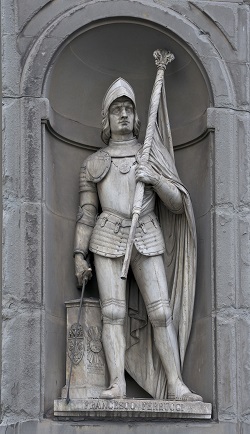
1530: Francesco Ferruccio, victim of Maramaldo

On this date in 1530, Francesco Ferruccio (or just Ferrucci) and his executioner Fabrizio Maramaldo clinched their immortality at the Battle of Gavinana.

The battle was the tragic final scene of the War of the League of Cognac, in which an alliance of Italian city-states tried to expel the Habsburg Holy Roman Emperor Charles V from the peninsula. Charles had already in effect decided matters by forcing the French out of the fight, which also brought about the capitulation of the Vatican.

Left alone in the fray, doughty Florence — ever so briefly at this moment restored as a Republic, having given the Medici the boot — continued to hold out against impossible odds. A vast imperial army swollen by landsknechts whose mercenary arms were now unnecessary elsewhere in Italy besieged Florence on October 24, 1529.

The Siege of Florence, by Tuscan Renaissance Man Giorgio Vasari.

The intrepid Florentine commander Francesco Ferruccio (English Wikipedia entry | Italian) strove to take his hopeless fight to the enemy. After a plan to coerce papal support by striking Rome was vetoed, Ferruccio mounted a march through the Apennines to threaten the Imperials’ rear.

He was intercepted at Gavinana, a battle decided by the arrival of landsknecht reinforcements under the command of the notoriously cruel condottiere Fabrizio Maramaldo.

Maramaldo would elevate himself for posterity out of the ranks of his merely brutal brethren by finding Ferruccio, badly wounded, his prisoner, and putting him to immediate death by his own hand — an execution that resulted in Florentine capitulation one week later, and the installation of Alessandro de’ Medici as Duke of the now ex-Republic.*

While admittedly borderline as an “execution” suitable for this here site, Ferruccio’s defiance in the face of his killer and his last denunciation of Maramaldo — “Coward, you kill a dead man!” — became the stuff of legend in a later Italy. (It also helped Ferruccio’s case for the nationalist pantheon that he died fighting against the Germans, not against the next city-state over.)

The romantic novelist Francesco Domenico Guerrazzi** made Ferruccio the subject of his magnum opus L’Assedio di Firenze, and before you knew it the name was on the lips of every risorgimento Tom, Dick and Francesco. Garibaldi invoked him in speech; Goffredo Mameli wrote him into the national anthem.


Every man has the heart
and hand of Ferruccio …

Under the Italian state those men helped to make, Ferruccio was appropriated as the name of a battleship; fascist Italy especially found Ferruccio congenial to the national-pride project and valorized the martyr relentlessly.


1930 Fascist Italy stamp depicting — for the 400th anniversary of the occasion — Fabrizio Maramaldo murdering his prisoner Francesco Ferruccio. Other Februccio stamps from the same period can be found on the man’s Italian Wikipedia page.

For Maramaldo, a less flattering but possibly more durable legacy: Italian gained the noun maramaldo, the adjective maramaldesco, and the verb maramaldeggiare to signify bullying or cruel domineering.

* Alessandro had a reputation for despotism, and was assassinated a few years later by his cousin Lorenzino de’ Medici in a tyrannicide that was Brutus-like in both its motivation and effect. That later affair is the subject of the 19th century play Lorenzaccio.

** Guerrazzi also did his bit for the legend of Beatrice Cenci.

On this day..

1868: Stefan Karadzha, Bulgarian national hero

On this date in 1868, the Ottoman Turks executed Bulgarian revolutionary Stefan Karadzha.

Karadzha was one of several nationalist cheta (guerrilla) leaders aspiring to father the future sovereign Bulgaria.

Operating from adjacent, and conveniently independent, Romania, around 1866-1867, Karadzha and others of his ilk — Hadzhi Dimitur Nikolov, Filip Totyu, and the dramatically mustachioed Panayot Hitov — slipped over the mountainous border to organize revolutionary cells and foment ill-feeling towards the Sublime Porte.

In Bulgaria’s late 19th century progress towards independence, these figures are transitional characters between the vanguard leadership of Georgi Rakovski, and the ensuing primacy of Vasil Levski.

Levski himself was a guerrilla in this period; after the cheta legions suffered some backbreaking defeats in the field — one of which saw our man Karadzha captured so badly wounded that he was “half-dead before the emergency Turkish court”* when condemned to hang — Levski set about honeycombing his country with the revolutionary network that would shape the future revolutionary struggle.

A national hero of lesser stature than Levski, which is sure no disgrace, Karadzha has a village named after him.

* The quote is from the unimpeachable source of Karadzha’s Wikipedia page.

On this day..

1746: Francis Towneley, of the Forty-Five

On this date in 1746,* the English Jacobite Francis Towneley was hanged, drawn and quartered at London’s Kennington Park.

This Lancashire Catholic had relocated residence and loyalty to France at age 19 in 1728, and fought in that country’s army. He was right at the sweet spot of veteran seasoning and youthful enterprise by the time “the Forty-Five” rolled around: the last great Jacobite rising to reverse the Glorious Revolution and re-enthrone the dispossessed heirs of King James.

With British armies deployed around Europe and the colonies in the 1740s during the War of Austrian Succession, the French decided to back a Jacobite bid to restore the exiled Stuart pretender, using the customary geopolitical strategem of teaming up with the Scottish. Being a Lancashire local, Towneley was commissioned a colonel and dispatched as an advance party to Manchester to scare up a regiment of Stuart loyalists there who would join up with Highlanders on the march from points north.

Towneley’s Manchester Regiment turned out to number just 300 hardscrabble souls. Discouraged by the thin show of public support — and by reports of a large loyalist army that turned out to be pure bluff — the Jacobites retreated, dropping off Col. Towneley’s regiment on the way to garrison Carlisle. Just days later, this small rearguard was overrun and forced into unconditional surrender by a guy named William the Butcher. This wasn’t destined to end well.

Towneley’s legal defense made the case that he was a commissioned officer of France, and not of the Stuarts themselves, which made him a prisoner of war rather than a traitor, an interesting debating point for barstool barristers but the sort of jurisprudence that will inevitably be determined in the breach by policy instead of principle. Policy in this instance was not to go easy on the Jacobites.

After he had hung for six minutes, he was cut down, and, having life in him, as he lay on the block to be quartered, the executioner gave him several blows on the breast, which not having the effect designed, he immediately cut his throat: after which he took his head off then ripped him open, and took out his bowels and threw them into the fire which consumed them, then he slashed his four quarters, put them with the head into a coffin, and they were deposited till Saturday, August 2nd, when his head was put on Temple Bar, and his body and limbs suffered to be buried.

Towneley’s family still had his severed, spike-holed head into the 20th century, when they finally interred the macabre mememto.

* We’re sticking with the local date in England here. England was still on the Julian calendar at this point (though for just a few years more). You’ll also see August 10 cites out there: that’s the equivalent date on the Gregorian calendar, which was current in France and throughout Europe’s Catholic realms.

On this day..

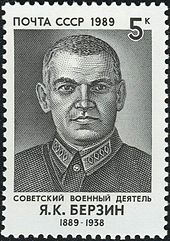
1938: Janis Berzins, Soviet military intelligence chief

On this date in 1938, the Soviet intelligence agent Janis Berzin(s) was shot in the basement of Moscow’s Lubyanka Prison.

A Latvian radical back to Riga’s chapter of the 1905 revolution,* Berzins became a trusted associate of Lenin in exile, and transitioned with the 1917 Revolution into a variety of political-security-military leadership positions in the new Soviet state.

For most of the 1924-1937 period, Berzins directed — indeed, practically created — Soviet military intelligence. He’s credited with personally recruiting the legendary World War II spy Richard Sorge; in 1936-1937 he was the chief Soviet military advisor in the Spanish Civil War under the nom de guerre “Grishin”. Russians fighting in Spain just referred to him as “the old man.” (Source)

Of course, no degree of seniority was sufficient safety during the frightful purging years of the Yezhovshchina. Once back in Moscow, Berzins fell instantly, almost randomly, over a spurious accusation of internal espionage.

His conviction was reversed after Stalin died.

* But not one of the Latvian revolutionaries who ended up in a shootout with London police.

On this day..

1455: Kunz von Kauffungen, Altenburg Prince-Robber

On this date in 1455, the German knight Kunz von Kauffungen was beheaded at the Freiberg marketplace for the trifling offense of kidnapping a couple of Saxon princes.

Kunz von Kauffungen (English Wikipedia link | German) fought on the side of Frederick II, Elector of Saxony in the colorfully christened Saxon Fratricidal War. That’s no ornamental prose: it was literally a war between siblings, namely the aforesaid Frederick and his little brother William III, Landgrave of Thuringia.*

While captaining a unit for Frederick, Kunz had his lands ravaged by William’s guys; eventually he even got outright captured and had to spring for a crippling 4,000-florin ransom.

The warring brothers settled things in 1451, but Kunz found to his fury that his postwar meaningful ahems around the Elector of Saxony did not meet with any compensation reciprocating the fortune ruined in the Elector’s service. (During the war Kunz had been given some captured property of one of William’s supporters, but the terms of the peace reverted everything to its original owner.)

Kunz skulked, and sued, and eventually Frederick flat-out banished him. But his grievance was never met, and in that day German nobles felt themselves entitled to force redress via feuds and private wars entirely alien to our post-Westphalian states.

Kunz’s personal contribution to the annals of noble vendetta was the Altenburg Prinzenraub — the Altenburg Prince-Robbery, which consisted of, well, robbing Frederick of his two sons Ernest** and Albert.

On the night of July 7-8, 1455, Kunz and his retainers snatched the two boys, aged 14 and 11 respectively, from Altenburg. The kidnapping went pear-shaped almost immediately: starting for Bohemia on the 8th, Kunz was captured by some concerned citizen or other, liberating Albert. Various legends make it monks, villagers, or a heroic collier.

His buddies took Ernest to an abandoned medieval mine shaft, today known as the “Prince Cave”. After holing up three days — and catching the news of Kunz’s ignominiously easy capture — this party arranged to turn Ernest back over in exchange for an amnesty, and scuttled away.

Kunz, of course, was not so lucky. A black paving-stone in Freiburg is said to mark the spot where his severed head came to rest on the 14th of July, 1455.

* Data point for the nature vs. nurture debate: the father of Frederick and William was known as Frederick the Belligerent or Frederick the Warlike.

** This is the “Ernest” referenced by the the Ernestine line — a lineage ancestor to present-day royal families of Belgium and Great Britain.

On this day..

1654: Gerard the conspirator, and the Portuguese envoy’s brother

On this date in 1654, the gore-soaked annals of Tower Hill added the names of two of Protectorate England’s highest criminals.

John Gerard was only an ensign from the army of the late King Charles I, but he gave his name to a one of the great royalist conspiracies of the 1650s.

Gerard — alternately rendered Gerrard or Gerhard by his contemporaries — led a plot to assassinate Lord Protector Oliver Cromwell. It would ultimately yield some 40 arrests, enough to arouse suspicion that the entire thing was a trap laid as part of the vigorous counterespionage game between the exiled royal heir and the Puritan government.

Initially condemned to hang — which was indeed the fate on this same date of one fellow conspirator, schoolteacher Peter Vowell — Gerard successfully petitioned for beheading instead, where he made a great show of courage and fidelity.

When he came to (or rather leap’d upon) the Scaffold (for he was so far from flagging when to tread that Tragical stage, that many observ’d hos sprightfully he seem’d to skip up the steps to it, as if he had gone to dance there rather than to die) his grim Executioner presented himself to him, to whom with a cheerful smile he said, “Welcom honest friend”; And desiring to see his Ax, he took it into his hands, and kissing it, with a pretty glance of his eye (which was a natural loveliness in him) towards the Minister, he said, “This will do the Deed I warrant it.”

The Sheriff stopped him delivering an address he had scribbled down, rightly expecting that it tended to the seditious. Nothing daunted, Gerard prayed with his minister, and

[t]hen turning himself to the people, and putting off his Hat, he told them, That he was not permitted to speak a few words according to his intention, yet he doubted not but what he would have said would come to their eyes, thought it must not come to their ears: “But this I desire all to take notice of,” and this he spoke (with a double vehemence) “that I die a faithful subject and servant to King Charles the second, whom I pray God to bless and restore to his Rights; and had I ten thousand thousand lives I would gladly lay them all down thus for his service.”

Execution ceremonies of the period tended to the elaborate, and the condemned could not easily be balked of their featured role. Although the Sheriff interrupted him here, and pressed him under a scorching sun to reveal more conspirators, Gerard put him off and “call’d for some small beer” to quench his thirst, which he did indeed receive. Oh for the days when a traitor could kick back with a frosty during his execution.

[Gerard] calls for the Block: and viewing it (as with delight) laid himself down upon it to see how it would fit, and was so far from sinking at the sight of it, that he almost play’d with it: and rising quickly pulls a little paper-book out of his pocket, which he gave to the Minister, willing him to find that particular Prayer which was proper for that occasion, but the crowd being great, he could not quickly find it, so that he kneeled down with the book open a while in his hand as if he had read; but quickly shut it, and prayed with great expressions of fervency by himself.

When he had done, the Lieutenant said something to him (as it seems) concerning his Brother Charles that had witnessed agianst him; (I know not what the Lieutenant said, for he spake low) but Mr. Gerrard spake aloud, and replyed passionately, “O Christ Sir! I love my poor Brother with all my heart, he is but a youth and was terrified, I know how he was dealt with; tell him I love him as well as ever I lov’d him in my life.”

…

forgiving the Executioner and saluting the Minister with his last embrace and kisses, he bow’d himself to the stroak of death, with as much Christian meekness and noble courage mix’d together, as I believe was ever seen in any that had bled upon that Altar.


Much less the pitied by the Tower Hill crowd was the executioner’s second act that date, don Pantaleon de Sa.

This Iberian noble, in town while his brother the Count of Penaguiao negotiated a treaty, got into a quarrel and escalated it egregiously, descending on the tony New Exchange shopping center on The Strand with a score of armed retainers looking to get his satisfaction.

This would be offense enough but don Pantaleon compounded matters by actually shooting dead some luckless sod who only happened to resemble his recent antagonist. Cromwell had his men invade the diplomatic residence where don Pantaleon tried to claim refuge, an act that perhaps would have been accomplished by an angry mob had he not done so.

International affairs proceeded apace, the commerce of nations proving very much thicker than blood for the Portuguese ambassador. On the very morning of his brother’s execution, the Count signed his treaty and set sail for home from Gravesend, leaving his belligerent brother to pay the forfeit of English justice.

The fruit of such costly statecraft was an English-Portuguese affinity to long outlast the pains of Tower Hill.

The trading relationship cemented in the 1654 treaty set the stage for a political arrangement as well when Gerard’s beloved Charles II was restored to the throne and made a Portuguese princess his queen.

So profitably were English merchants rewarded for moving Portuguese freight that by the next century, long after anyone could remember don Pantaleon or his marketplace quarrel, Portuguese wine displaced French as Britons’ libation of choice.

On this day..

1944: Ferruccio Nazionale, Ivrea partisan

On this date in 1944, the fascist frogman unit Decima Mas Flottiglia MAS (English Wikipedia link | Italian) executed and publicly gibbeted the partisan Ferruccio Nazionale in Ivrea.


The placard around his neck claims the hanged man “made an armed attack on the Decima.”

The square where he’s hanging in these images is today named in his honor — Piazza Ferruccio Nazionale.

On this day..

1814: Two War of 1812 deserters

On this date two centuries ago, there was — or at least, there was supposed to be — a military execution for desertion from U.S. forces during its War of 1812 against Britain/Canada.

I depend here on only a single source, this public-domain tome about the history of New York City.

There’s a noticeable discrepancy here in that the execution order (the first document) references, and names, two people sentenced to die — but the ensuing garrison orders consistently refer to “the prisoner” in the singular. I have not been able to clarify this discrepancy, and it’s worth noting that the Espy file of historic U.S. executions — which is incomplete, but nevertheless pretty complete — does not note an execution on or around this date. It’s possible that either or both of the men were pardoned; there had been an amnesty proclaimed in June for (successful) deserters who were still on the lam, and although that wouldn’t have directly covered these cases, it might have signaled a corresponding leniency liable to extend within the courts-martial system.

Headquarters 3d Military District,

N. Y., July 7th, 1814.

Capt. Moses Swett or officer commanding troops on Governor’s Island.

Sir :–The general court martial which convened on Governor’s Island on the 23d ult., of which Col. D. Brearly,* of the 15th Inft. is president, having sentenced John Reid and Roger Wilson, privates in the corps of artillery, to be shot to death — By power in me vested you are hereby directed to have the sentence carried into execution on the day and at the hour prescribed in the general order of the 3d inst., for which this shall be your warrant. I am, sir, your obedient servant,

Morgan Lewis, Major-General Commanding 3d M. D.

They didn’t stand on ceremony in the Third Military District, which comprised southern New York and northern New Jersey. (Hence the artillery batteries in Battery Park.)

Off the tip of Manhattan, at Governors Island, this warrant was put into execution the very next day.

Garrison Orders.

Fort Columbus, July 7th, 1814.

The troops on Governor’s Island will parade tomorrow morning at 11:30 o’clock on the Grand Parade, for the purpose of witnessing the execution of the prisoner [singular — sic?] sentenced by a general order of the 3d inst. to be shot to death.

The troops will form three sides of a square, the artillery will form the right and left flank, the Infantry the rear; the execution parties, consisting of a sergeant and twelve privates, will parade at 11:30 o’clock and placed under the command of Lieut. Forbes, Provost Marshal; the guards of the advanced posts will have their sentries at their respective posts, and will repair to the parade at 11:30, those under charge of the Provost Marshal will join the execution party, for the purpose of escorting the prisoner to the place of execution.

The execution parties, in divisions preceded by the music with the Provost Marshal at their head, will march in front of the prisoner, the music playing the dead march; the guards formed in divisions will march in rear of the prisoner.


According to our source, the dirge “Roslyn Castle” was the go-to tune for a military execution at the time. It was a popular Scottish air alluding to a gorgeously ruined Midlothian fortress.

The procession will enter the square from the rear, face ten paces from the coffin placed in the center, upon which the prisoner kneels by a signal from the Provost Marshal. The music ceases, the warrant and sentence of death is read, the signal to fire is then given to the execution parties. By order of

M. Swett, Commander.

* Nephew of one of the founding fathers.

On this day..

1817: Two-fifths of the condemned in Valenciennes

From the York Herald and General Advertiser (York, England) of Saturday, Aug. 16, 1817.

Five English soldiers being on guard, the 18th of June last, at one of the gates of Valenciennes, committed a robbery on the house of an individual, and were condemned to be hanged. They were conducted, by the orders of Lord Wellington, on the 3d of July, outside the walls of the town, to undergo their punishment.

The people followed the culprits, invoking, in accents of sorrow, the pity of their officers, and crying “Mercy! Mercy!”

Two of them were executed, and the other three received their pardon at the very moment they were about to part with life. At this news the joy of the numerous spectators was extreme, and the thanks they addressed to the English General were no doubt less eloquent than the joy from which they emanated.

On this day..

1622: Samuel Korecki, defeated magnate

On this date in 1622, the swashbuckling Ruthenian nobleman Samuel Korecki was strangled by the Ottomans.

Korecki English Wikipedia entry | Polish) was a szlachcic of the Polish-Lithuanian Commonwealth at that empire’s early 17th century peak.

Korecki’s clan hung its zupans at Korets, in present-day western Ukraine, and the young Samuel fought gleefully in the early 1600s in the train of the legendary commander Stanislaw Zolkiewski when the Polish army was ravaging Russia.

Samuel Korecki married the daughter of Jeremi(ah) Mohila or Movila, a boyar who contended for the Moldavian at the turn of the century; it was by this link that he too became drawn into the politics of that frontier realm, along with several other powerful families of the Polish-Lithuanian Commonwealth. This period is known as the Moldavian Magnate Wars.

Though a dependency of the Ottomans, Moldavia had proven appealing in the past for Polish adventurers. The late Mohila had bequeathed power in Moldavia to his son Constantine but after some years Constantine’s tributary payments to Istanbul started to lag. His resulting deposition by the sultan saw Constantine flee to Polish territory — and his brother-in-law Korecki come to his aid by mounting an armed expedition meant to depose the Ottoman replacement.*

Korecki was captured by the Turks in the process, dramatically escaped via Greece and Italy (and a celebrity-making papal audience into the bargain), then returned to the field only to be captured again at the Battle of Cecora in 1620.

This decisive Ottoman victory portended ill and not just for Korecki personally.


19th century woodcut illustrating the death of Samuel Korecki. (Source)

As our man was hauled back to Istanbul (he would not escape a second time), the rampant Turks drove for Ukraine with the intention of taking a bite out of it for the Sublime Porte.

The Poles were able to stanch the advance with a stand at Khotyn, but the Commonwealth would shift into an unmistakable decline thereafter; by mid-century, rebellious Cossacks had taken Ukraine over to Russian protection, while Swedish incursions from the north so greatly reduced Poland’s reach that the period is known as the Deluge. (For his part, the teenage Ottoman sultan Osman II went home from this campaign determined to reform the Janissary corps whom he blamed for the unsatisfying stalemate of Khotyn; these dangerous slave-soldiers vetoed the plan by murdering Osman instead.)

* Moldavia was a secondary foreign policy concern for the Ottomans, who were absorbed in this period by war with Persia.

On this day..